
An orange bar of Japanese soap is now searched more often in the US than almost anything else in personal care that nobody advertises on television. "Persimmon soap" ran at 33,100 monthly searches as of July 2026, up 124% in a year, and it peaked at 40,500 in January 2026. Two years ago it sat at 18,100. Five years ago it barely registered.
Every page ranking for the term tells you the same two things: there is a compound called 2-nonenal, and this soap contains tannins that bind to it. None of them tells you the part that actually matters. The demand did not follow the coverage. It ran roughly six weeks ahead of it, out of menopause forums and a dermatologist's video feed, toward a chemistry that was patented in the United States in 1985 and has been in the public domain since 2005. Here is what our data shows and what it means for anyone selling to people over 40.
Key takeaways:
- "Persimmon soap" peaked at 40,500 US monthly searches in January 2026 and has held 33,100 a month since April, up 124% year over year and classified as EXPONENTIAL in the Rising Trends database (data as of July 2026).
- The peak came before the press. The first mainstream explainer ran on February 26, 2026 and the dermatologist video that everyone credits went up on March 13. Both landed on the way down from January.
- The generic category it replaced is collapsing. "Body odor remedies" is down 89% in a year to 320 searches a month and "whole body deodorant" is down 70% to 8,100. People stopped searching for a remedy and started searching for a molecule.
- The active ingredient is not proprietary. US patent 4,681,757, filed in October 1985, already claimed persimmon juice as a deodorant. It expired in 2005, which is why four different brands each claim to be the only one.
- Mirai Clinical, the brand most associated with the trend, was rejected by all five investors on Shark Tank in May 2025 after disclosing $3.2 million in annual sales. Its own brand search is up 233% in two years.
- The scientific paper the whole category rests on is 25 years old, and the researcher who studies these molecules says plainly that washing is not a cure.
Let's get into it.
What we're seeing in the Rising Trends data
Here is the monthly curve for "persimmon soap" over the last two years, pulled straight from our database.
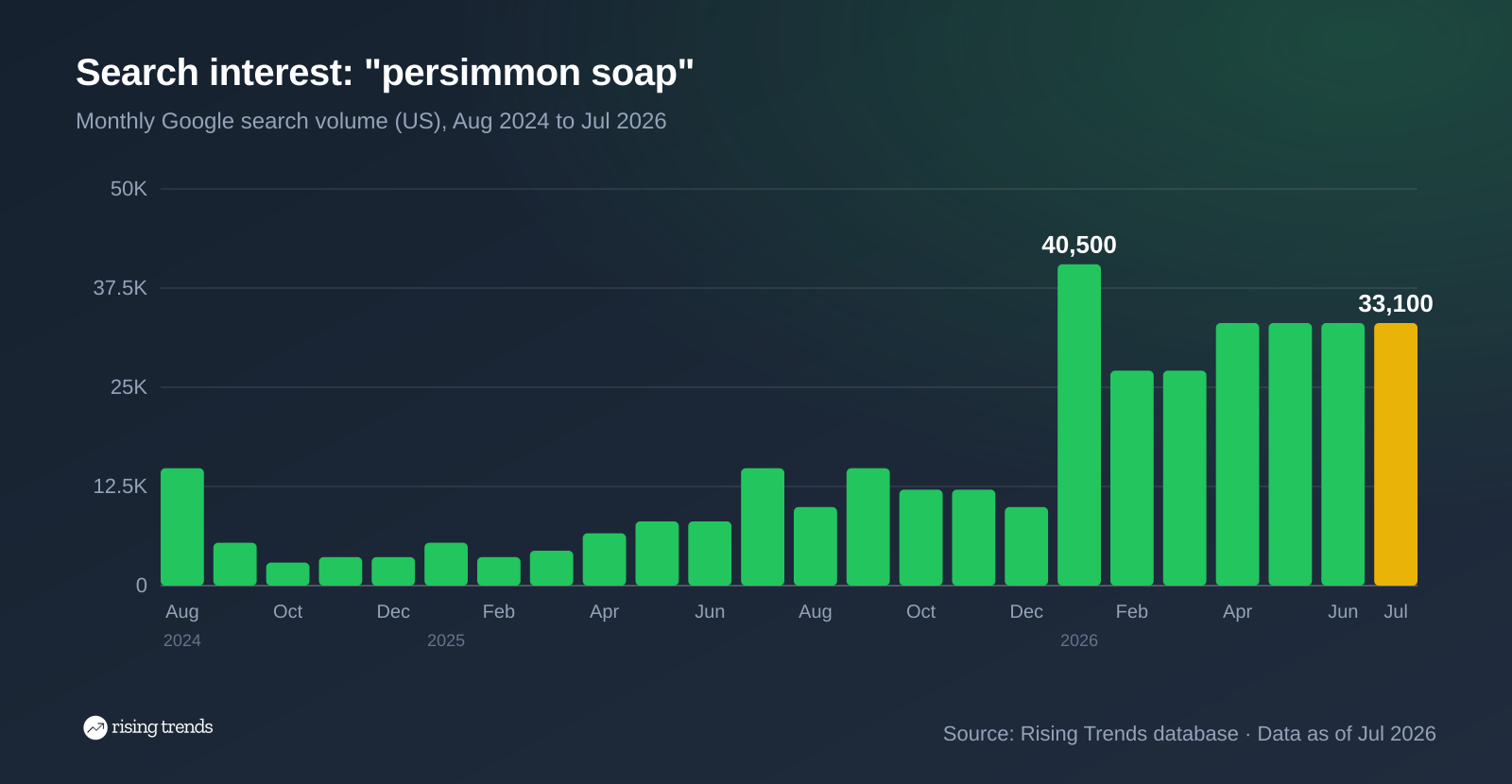
Look at the step, not the spike. The term bumped along under 15,000 through 2025, sank to 9,900 in December, then jumped to 40,500 in January 2026. What happened next is the interesting part. It did not fall back to where it started. It settled at 27,100 for two months and then locked at 33,100 for four straight months through July. A news spike decays. This one found a floor more than twice as high as its old ceiling.
The floor is what makes it a category rather than a moment. So we looked at what else people search around it.
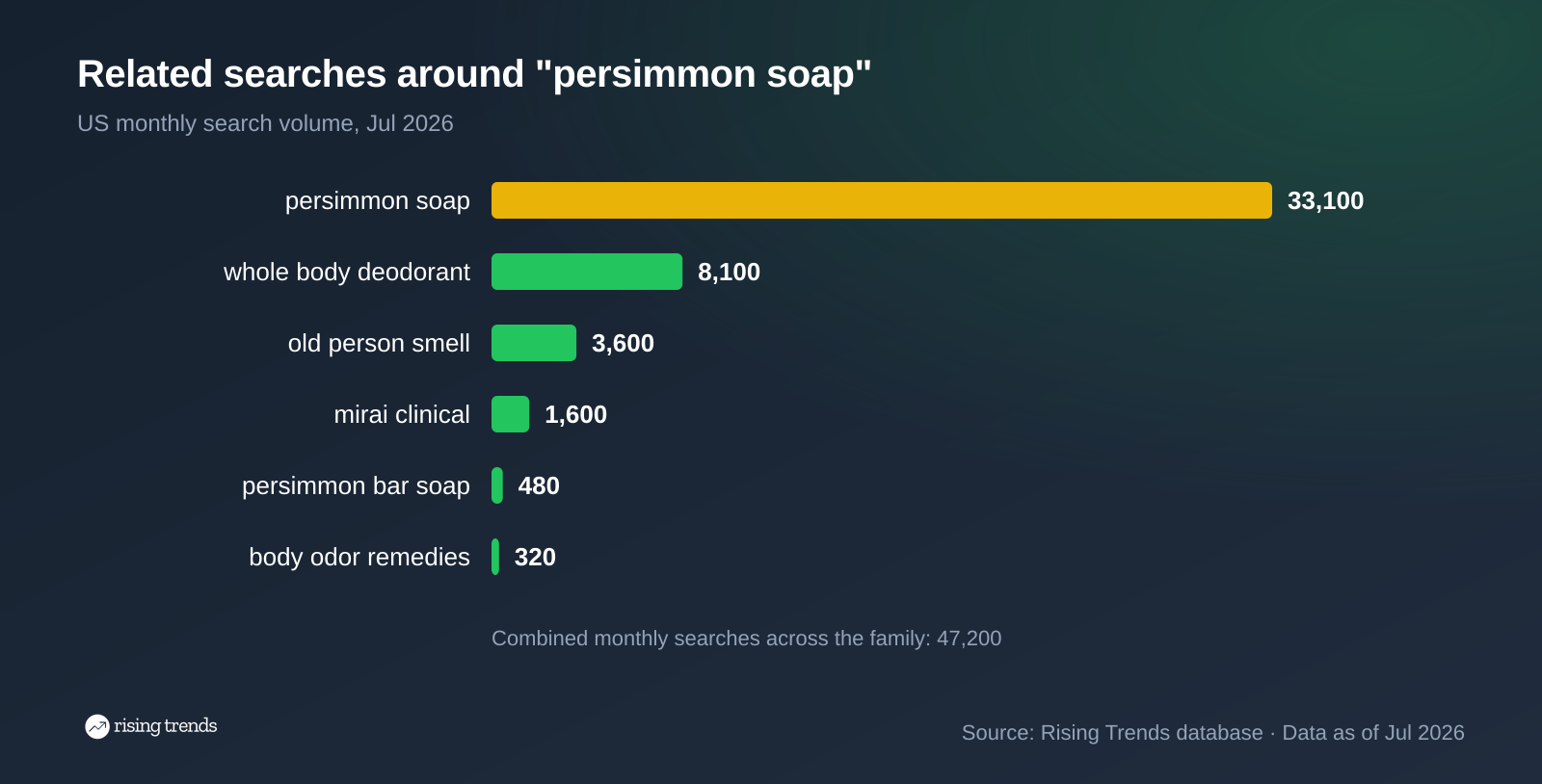
The specific term is now four times the size of the general one. Whole body deodorant, the category that every major antiperspirant brand launched into in 2024, gets 8,100 searches a month. The soap gets 33,100. And the growth directions are opposite.
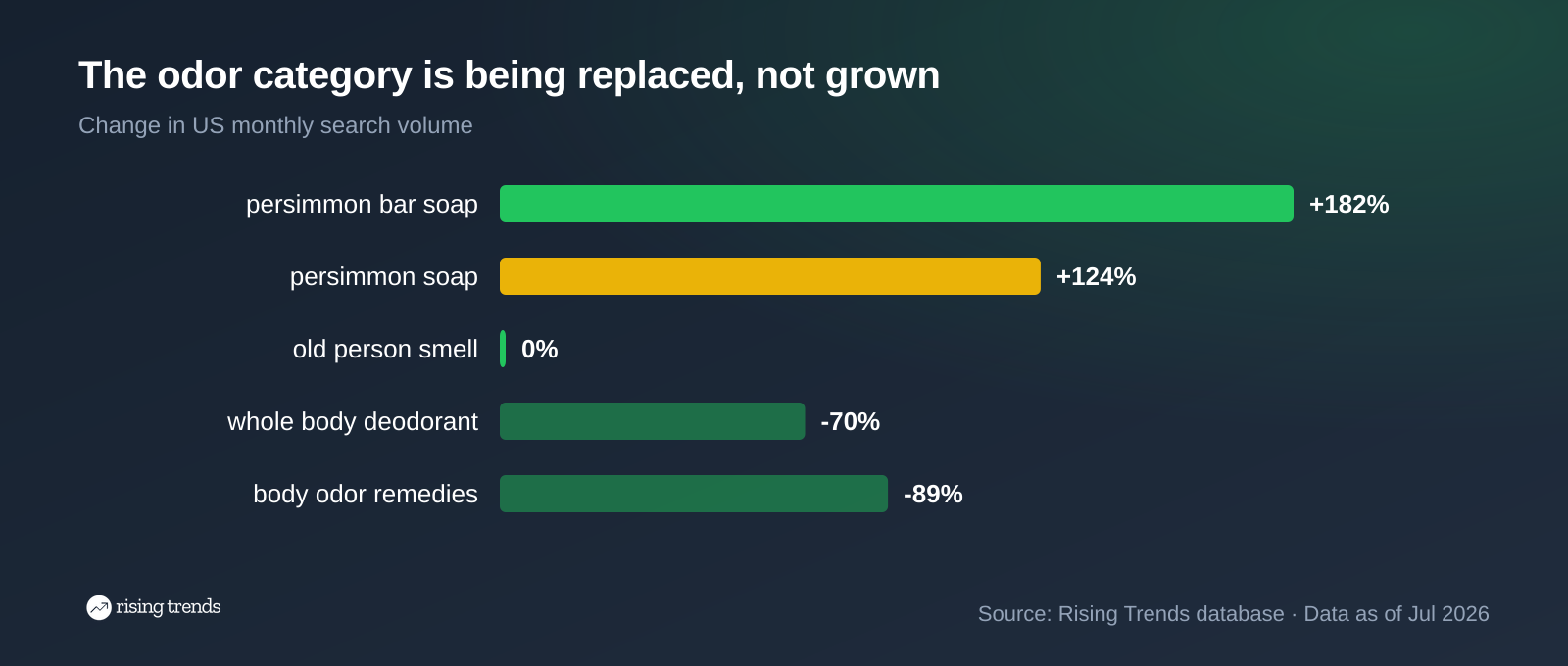
That is the whole thesis in one chart. Body odor remedies is down 89% in a year, to 320 searches a month. Whole body deodorant is down 70%. Meanwhile persimmon soap is up 124% and "persimmon bar soap" is up 182%. Demand did not leave the odor category. It moved from asking for a remedy to naming an ingredient, and the vaguer the term, the harder it fell.
What persimmon soap actually is
The claim is narrow and chemically specific. Around age 40, the skin's antioxidant defences weaken and omega-7 unsaturated fatty acids in sebum begin oxidising into 2-nonenal, an aldehyde that smells greasy and grassy. It is not sweat, it is not bacteria, and it is not a hygiene failure. That is why the usual products miss it.
We know this because of one paper. In April 2001, Shinichiro Haze and colleagues published 2-Nonenal Newly Found in Human Body Odor Tends to Increase with Aging in the Journal of Investigative Dermatology. They collected body odour from shirts worn for three days by subjects aged 26 to 75 and analysed the headspace by gas chromatography and mass spectrometry. 2-Nonenal showed up only in subjects aged 40 or older. Every persimmon soap page in Google's results is standing on that one study, usually without citing it.
Persimmon tannin is the counter-move. Condensed tannins bind aldehydes, so a bar with enough of them can pull 2-nonenal off skin rather than perfume over it. This is not a recent discovery either.
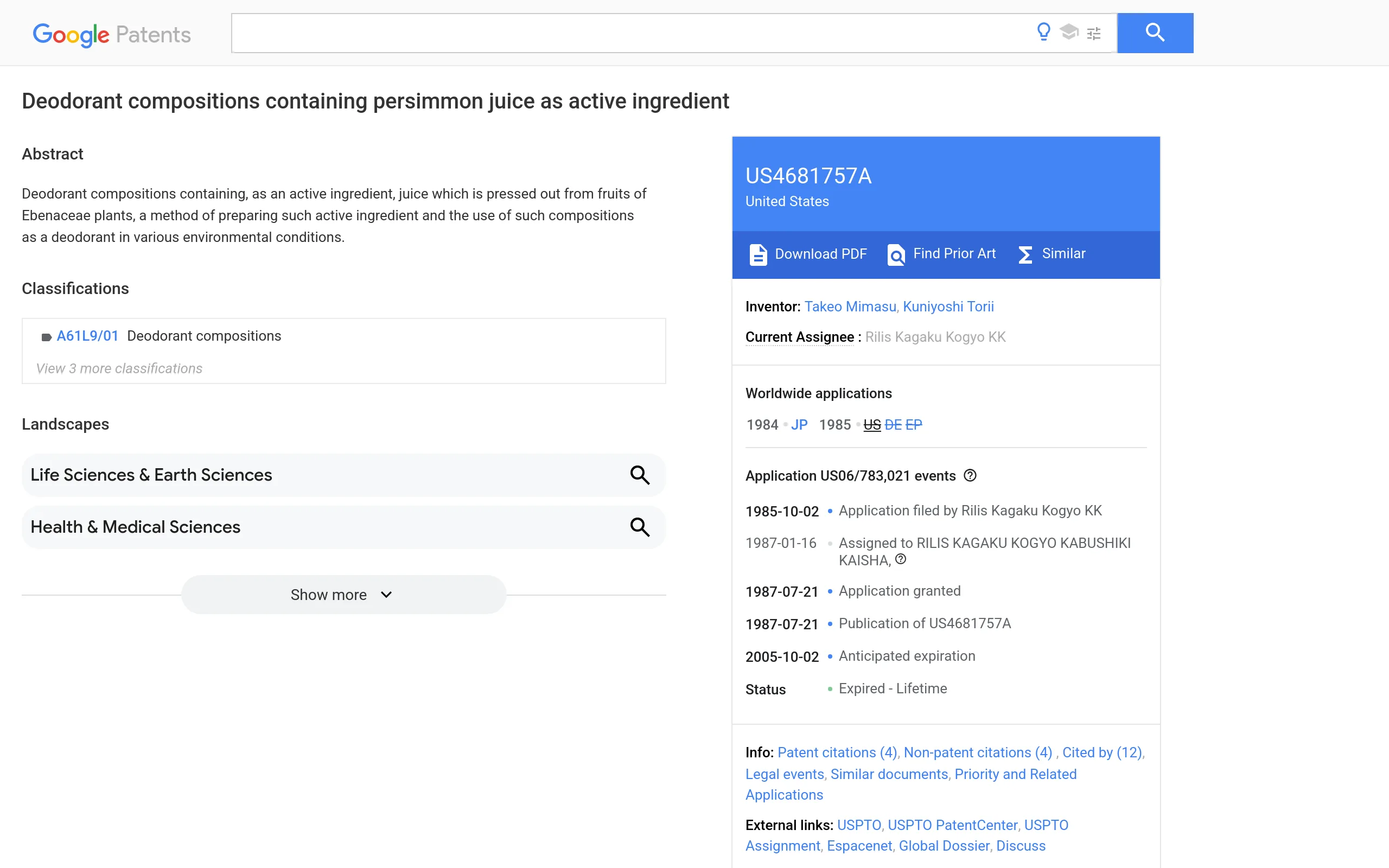
That is US patent 4,681,757, "Deodorant compositions containing persimmon juice as active ingredient," filed on October 2, 1985 and granted in July 1987. It expired in 2005. A follow-up, US 6,139,842, granted in 2000 and expired in 2018, spells out the mechanism in the plainest language anyone has managed since: the deodorising effect comes from "the ability of various polyphenols and condensed tannins found in the persimmon fruit juice to adsorb or mask various odorants." So the ingredient was US-patented 14 years before the smell it now sells against had a name, and nobody owns it today.
Why it's trending now
The honest answer is that we cannot point to a single launch or a single viral video, because the numbers moved first. January's 40,500 has no press event behind it. What sits before it is a menopause community that had been testing the stuff for over a year: r/Menopause ran a thread titled "Persimmon Soap Hype" in June 2025, and by December 2025 the same subreddit had moved past whether it works to arguing about where on the body you can safely use it.
The coverage arrived afterwards. HuffPost ran its explainer, Why Do Old People Smell Different, on February 26, 2026. Then, on March 13, the dermatologist who posts as Dr Dray put up this video.
Note the tags she used: #persimmonsoap, #bodyodor, #nonenalsmell and #creatorsearchinsights. That last one is TikTok's own programme telling creators what people are already searching for. The platform was reporting demand back to the supply side. That is what a trend looks like when the audience gets there first.
The new behaviour: people are shopping for a compound
The change is not that people started worrying about smelling old. It is what they type. A year ago the search was for a fix ("body odor remedies", "whole body deodorant"). Now it is for a mechanism.
Three shifts are visible in the search and in the reviews.
People are self-diagnosing a molecule. Old person smell holds 3,600 searches a month and is up 89% over two years, and the questions Google surfaces alongside it are diagnostic rather than shopping: can you smell nonenal on yourself, do dermatologists recommend persimmon soap. The honest answer to the first one is usually no. Because 2-nonenal builds gradually, olfactory adaptation hides it from the person producing it, which is exactly the anxiety that sells a bar of soap.
They are running their own tests. One Amazon reviewer quoted in HuffPost's shopping roundup described a control experiment: "I washed behind my ears on day one and then didn't do it again for 3 days. Constantly smelling that area each day. The smell stayed gone for 2 days and by about the 3rd day it was starting to become slightly noticeable. That made me a believer." Another was shorter: "Magical!! This stuff really works! No more perimenopause weird odor."
It is a perimenopause purchase before it is an old-age purchase. The reviews and the threads keep landing in the same demographic, and it fits the wider pattern we track in skincare trends for 2026: mid-life buyers who want a named active ingredient and a mechanism, not a fragrance. The same instinct drives the optimisation habits we wrote about in the maxxing trend and the ingredient-first buying behind PDRN skincare.
The experts are more careful than the marketing. Danielle Reed, chief science officer at the Monell Chemical Senses Center, told HuffPost that 2-nonenal "loves to stick to your skin and it loves to stick to fabrics. You'll remove some of it when you bathe, but your body is constantly making it, so washing isn't a cure." Dr Naana Boakye of Bergen Dermatology put the soap itself in the right box: it "has a plausible mechanism and a long history of use, though large randomized trials are lacking."
Who's building on it
Because the chemistry is unpatented, the market is a claims race rather than a technology race.
| Brand | Price per bar | Headline claim |
|---|---|---|
| Mirai Clinical | $19.97 unscented, $21.97 scented | Removes nonenal by 97% versus 35% for conventional soaps; "the only U.S. soap with persimmon" |
| Kiyo Clinical | Not listed publicly | 92% of 124 participants aged 42 to 68 noticed less odour within two weeks; "the only soap with persimmon extract" |
| Natrulo | $12.99 | Persimmon tannins to reduce odour |
| Moon Haven | Sells against it | Persimmon "may reduce odour temporarily, but it doesn't remove the build-up causing it" |
Mirai Clinical is the anchor. Founder Koko Hayashi took it on Shark Tank in May 2025, asked for $500,000 for 5% at a $10 million valuation, and was turned down by all five investors after telling them the business had done $3.2 million in sales the previous year with the persimmon soap at 53% of it, figures she repeated to Beauty Independent days after the episode aired. The brand's own account of the pitch is still up. National television did not move the search line. The forums did. Searches for mirai clinical are 1,600 a month, up 233% in two years, which is a brand riding a category rather than creating one.
Kiyo Clinical is the fast follower with the better-looking evidence page: a self-assessment study of 124 participants over four weeks. It is the brand's own study, not a randomised trial, and it also claims to be the only persimmon soap, which cannot be true given Mirai says the same thing on the same week. Natrulo undercuts both at $12.99.
Then there is the counter-position. Moon Haven, an Australian soap maker, published a post arguing persimmon soap treats the smell and not the build-up, and recommends exfoliating bars instead. It sells those bars, so read it accordingly. It is still the only page in the category making a falsifiable argument against the consensus.
What it means for business
The deodorant aisle lost a demographic it thought it had bought. Whole body deodorant was the big personal-care launch story of 2024, and it is down 70% in search in a year while a $20 bar of soap is up 124%. The over-40 buyer did not want more coverage. They wanted a different chemistry, and they were willing to pay roughly ten times the price of a standard bar to get it.
Unpatented actives make brands, not moats. Nobody can stop anyone selling persimmon tannin soap, so the only defensible assets are the claim, the study and the shelf. That is why Mirai spends its page on a 97% figure and Kiyo spends its page on a 124-person panel. Reale Actives rests its clinical claims on a 31-person study for the same reason. Expect the same pattern anywhere an old ingredient meets a newly named condition, which is the mechanism behind a lot of what is moving in beauty right now.
Regulatory pressure is the obvious risk. "Eliminates 97% of nonenal" is a strong claim for a cosmetic, and the supporting evidence is in-house on every page we read. Categories that sell to older buyers on clinical-sounding claims tend to attract scrutiny once they scale, a dynamic that runs through the wider senior care market and one we hit again in the ghost lashes trend, where the only lash dye the FDA approves is cleared for professional use only. The first brand to publish an independent trial will take the category, because right now the highest bar in the market is a customer survey.
Where this is heading
Three calls, each with a term in our database to watch.
The floor holds and the category fragments. Four straight months at 33,100 is not a spike, and the 40,500 January peak now reads as an entry point rather than a summit. Watch whether persimmon soap stays above 30,000 through the autumn. If it does, private label follows, and the $19.97 price collapses toward Natrulo's $12.99.
The molecule outgrows the bar. Mirai already sells a persimmon shampoo, a deodorant and a room spray. The signal to watch is whether "nonenal" itself starts appearing as a standalone search rather than only inside product queries. When a compound name gets searched without a product attached, the ingredient has become a category.
Someone runs the trial, or a regulator asks for it. Every claim in this market traces back to one 2001 paper and a set of company studies. The gap between "plausible mechanism" and "clinically proven" is where this either matures or gets trimmed. Watch the brand terms: a sharp move in mirai clinical or a new brand entering our database above 1,000 searches a month would say the money has arrived, and the money is what usually pays for the evidence.
The thing worth remembering is the sequence. A 1985 patent, a 2001 paper, a rejected Shark Tank pitch, then a menopause forum, and only then the press. If you are watching the coverage to spot trends, you are reading last month's news.
Want to catch shifts like this while they are still in the forums? Read our guide on how to identify market trends, or browse what is breaking out right now in our trending topics list.
Never miss a trend again
- One trend broken down with the numbers
- Who's making money, and what to build
- A website on the rise
- A breakout app
Join 5,000+ founders