Trends


A year ago, 110 people a month typed "aippy" into Google. As of August 2026 it is 5,400, and in June it touched 8,100. The thing they are looking for is a phone app where the feed is not videos. Every post is a small game somebody made by typing a sentence, and you play it instead of watching it.
What makes Aippy worth a close look is not the app. It is the decision behind it. In early 2025 the team was building a vibe coding tool, the hottest category of that spring. They quit it and built a social feed instead. Our database says that call has aged well: "vibe coding" is still the bigger search term at 74,000 a month as of August 2026, but it is down 33% in a year, while "aippy" is up 4,809%. Nobody ranking for the company's name has that comparison. We do.
Key takeaways:
Let's get into it.
Here is the monthly search volume for "aippy" from our database. The term did not exist two years ago, which is why the left half of this chart is flat.
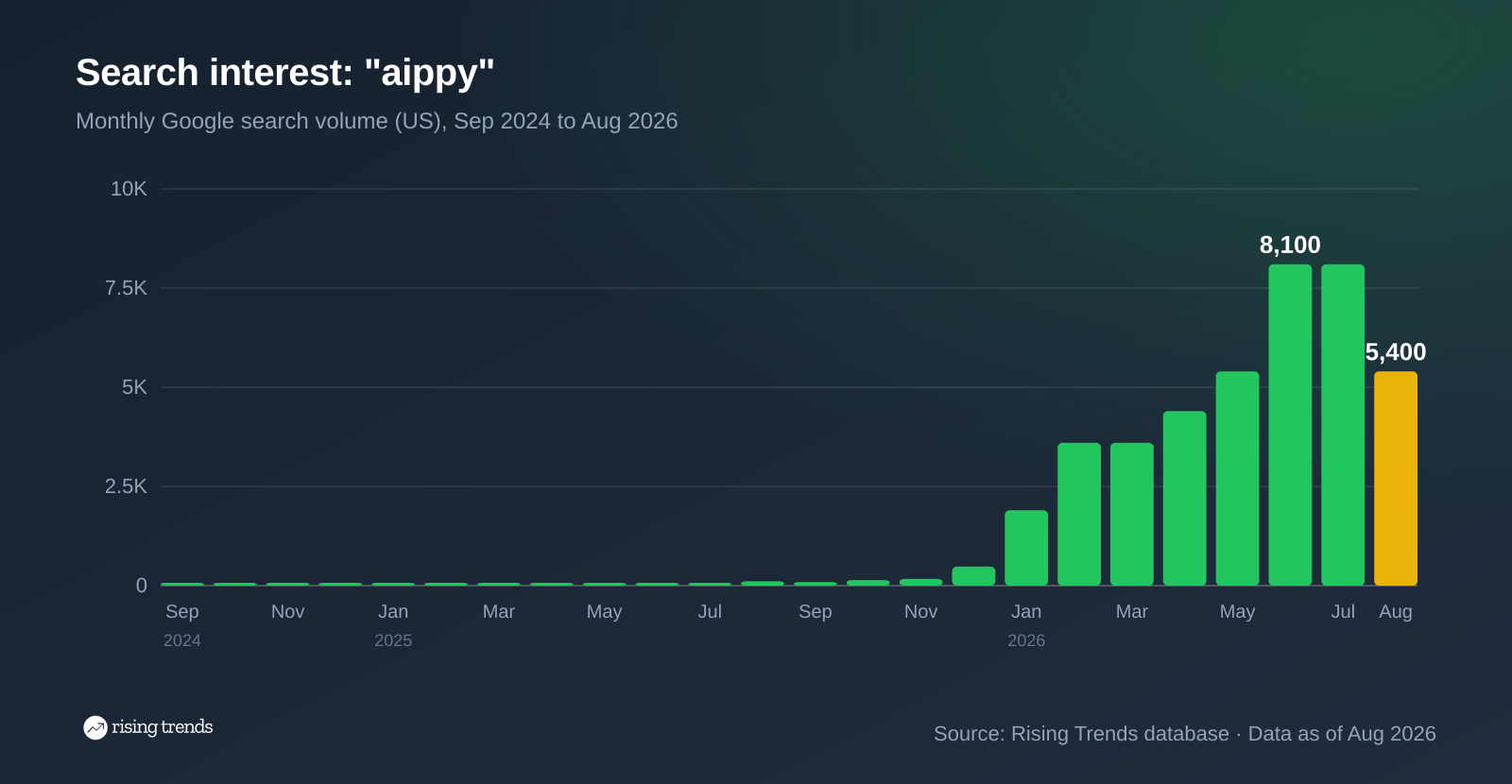
The shape matters more than the height. December 2025 is the last quiet month. January takes it to 1,900, February to 3,600, and February is the breakout month in our model, the first time the term crossed a quarter of its eventual peak. Then June hits 8,100 and July holds it. August steps back to 5,400, which is still 49 times where the term sat a year earlier.
Put Aippy next to the search terms it competes with and the picture gets more interesting.
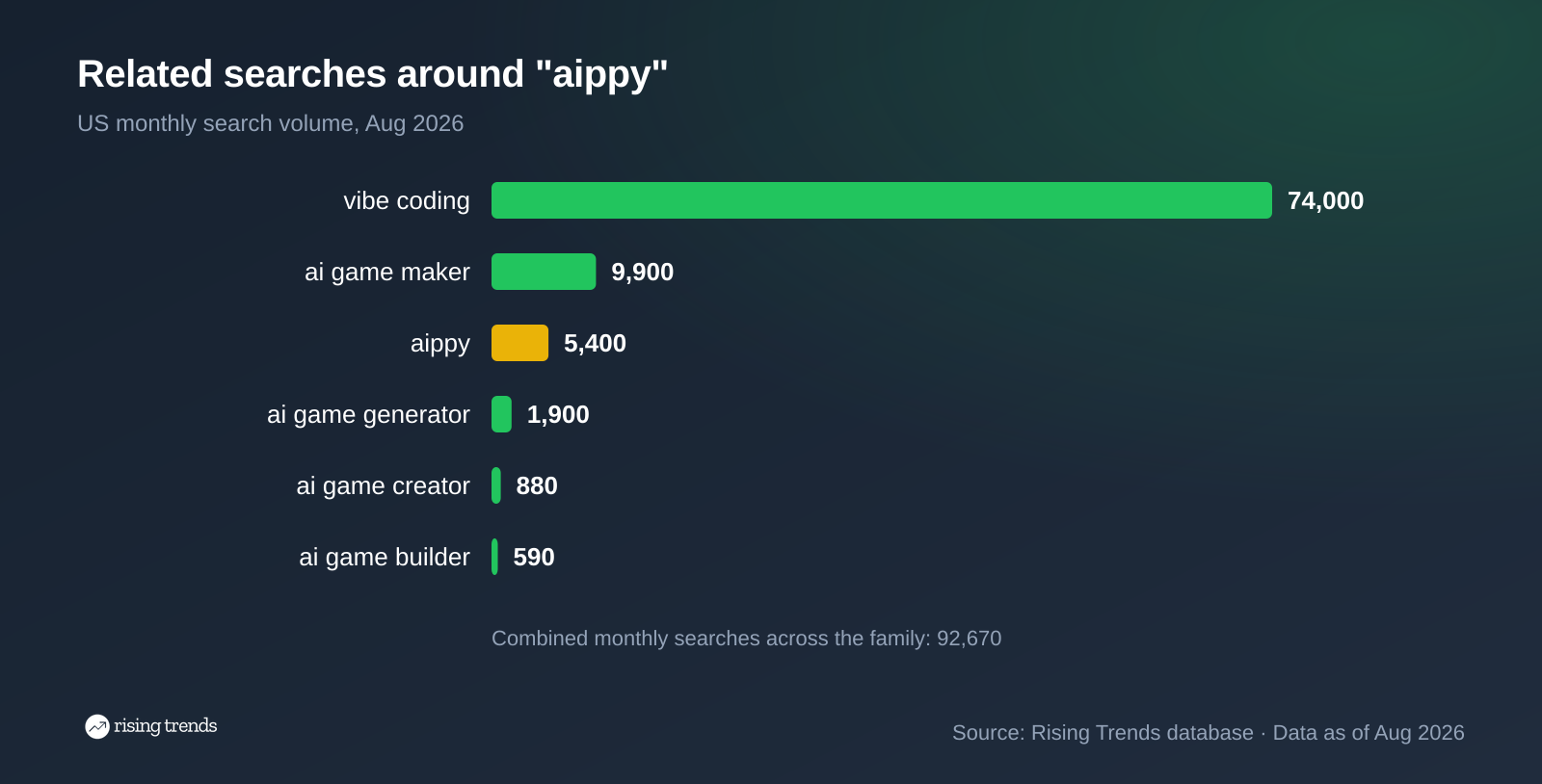
"ai game maker" is the generic category term at 9,900 a month, and Aippy at 5,400 is already more than half of it. Below that the category thins out fast: "ai game generator" is 1,900, "ai game creator" is 880, "ai game builder" is 590. A single brand is close to outweighing the words people use when they do not know a brand yet. That is the signature of a category where one product is becoming the default answer.
Open the site and you get a text box and a feed. The tagline is "Build What You Feel."
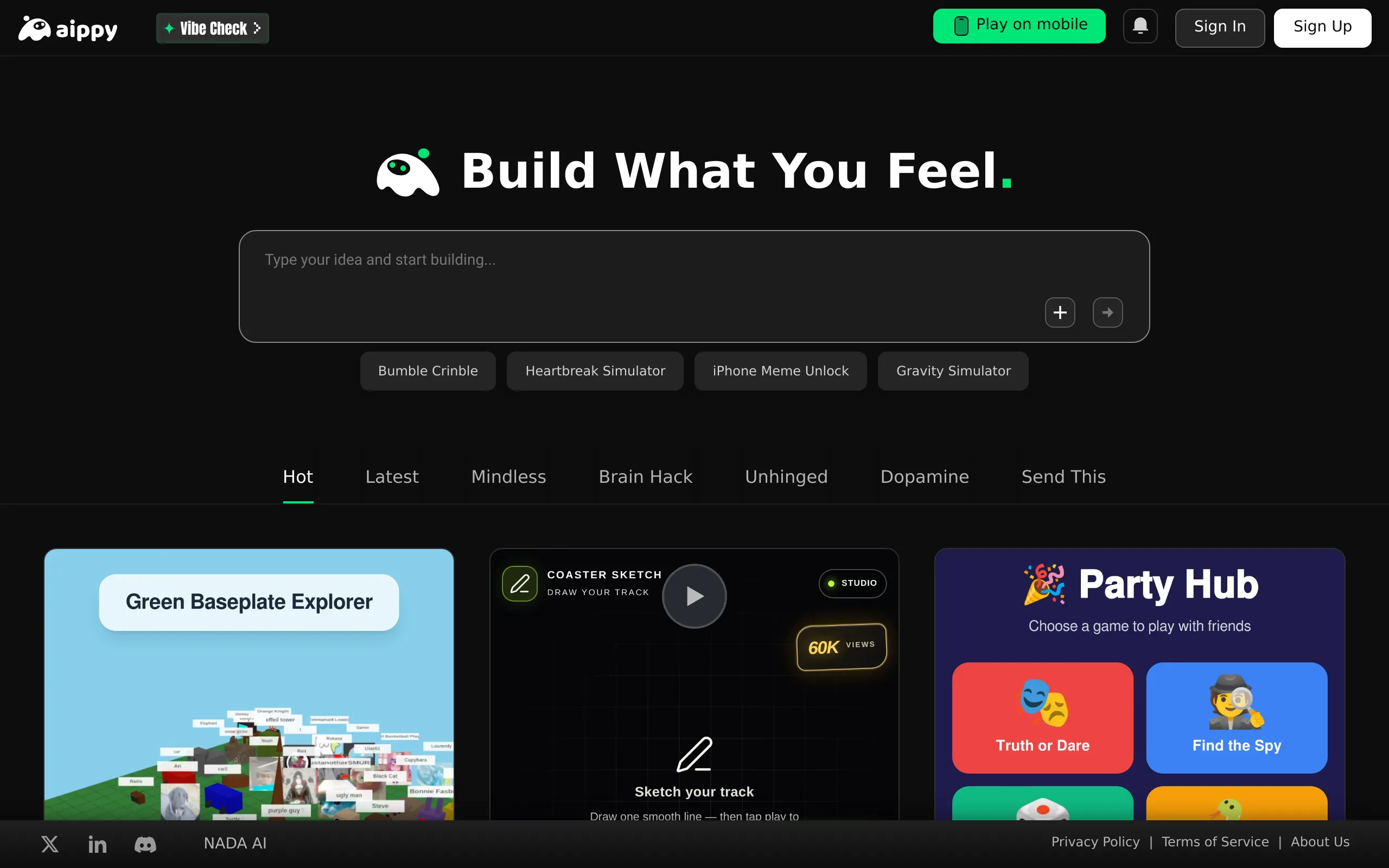
Read the tabs in that screenshot, because they are the product strategy in six words: Hot, Latest, Mindless, Brain Hack, Unhinged, Dopamine. This is an entertainment app that knows exactly what it is replacing.
The mechanics are simple. You describe a game in plain language, the AI builds a playable version in under a minute, and it goes into the same vertical feed everyone else swipes. If you like somebody's game you tap Remix, change the rules or the theme, and republish it as yours. The company says roughly 40% of its content now arrives through that Remix path, and that remixed games score higher on its internal quality checks than originals do.
There is a second Aippy that most coverage misses. The official documentation describes a full browser-based builder: prompt to app, live preview, one-click rollback, custom domains, payments, a Supabase-backed database. The backronym on that page is "Allowing Innovative People to Program Instantly with Your ideas." So the tool the team supposedly abandoned is still there. They just stopped leading with it, because a tool is something you leave when you are done and a feed is something you come back to.
Money comes in through Crystals. The App Store listing prices them from 100 for $0.99 up to 10,000 for $83.99. The Google Play listing meanwhile promises "No paywalls, no ads." Both can be true at once, and the gap between them is the whole commercial question: generation costs real compute, and nobody is paying for it yet at scale.
The trigger is dated and it is first-party. On June 2, 2026 the company announced that it had raised tens of millions of dollars in its first funding round, led by Glowill Capital, at a $250 million post-money valuation. June is also the month our search curve peaks at 8,100.
The announcement carries the operating numbers the company is willing to stand behind: 3 million downloads worldwide, approaching 2 million monthly active users, more than 2 million games created by users, about 15,000 people in the Discord, a daily engagement rate among active users near 50%, and more than 30% of new users arriving through channels it does not pay for. It also says the daily volume of published games has grown tenfold since the start of the year.
Founder Evan Yip described the plan in two lines: better recommendation and distribution, then "investing further in our creator ecosystem through better growth tools, incentives, and community support." Read that second half carefully. It is a company telling you that creators are not yet paid.
The organic 30% is the number worth watching. Most consumer AI apps of the last two years have bought their growth, and their search curves collapse the moment the ad budget stops. Aippy's curve stepped up and then held at 8,100 for two months before easing, which is what word of mouth looks like rather than a media buy.
The publisher is NADA AI PTE. LTD., a Singapore entity, and the founder is Evan Yip, who spent years as chief technology officer of a Hong Kong listed consumer social company before spinning this out. The team was around 30 people at the time of the round. Here is the stack, with the caveats attached:
| Date | Event | Figure | Source |
|---|---|---|---|
| Apr 2025 | Aippy launches | US, UK and Canada first | Company announcement |
| Jun 2, 2026 | First funding round, led by Glowill Capital | Tens of millions at a $250M post-money valuation | Company announcement |
| Jun 2, 2026 | Reported traction | 3M downloads, close to 2M monthly actives, 2M+ games | Company announcement |
| Oct 14, 2026 | Latest Android release | 1M+ downloads, 4.6 from 18.3K reviews | Google Play |
Three caveats. The round size is "tens of millions", which is a range the company chose not to narrow. Every usage figure above is self-reported and has not been audited by a platform. And the App Store's 4.9 from 25,000 ratings is softer than it looks: at least two of the visible reviews are furious one-star complaints that the writer deliberately rated five stars so they would surface first. "You will be met with the blackScreen of despair," one of them reads. Ratings on an app where the AI sometimes fails mid-build are a noisy signal.
What the reviews do agree on is the comparison. "I'll describe it as a TikTok for games," wrote one App Store reviewer in June 2026. Another, in January: "It's kinda like TikTok, where you scroll... I have been playing it for three weeks and my screen time has been an hour just on this app." An hour a day of screen time is the metric the company is really selling.
Two sets of rivals, and only one of them shows up in search.
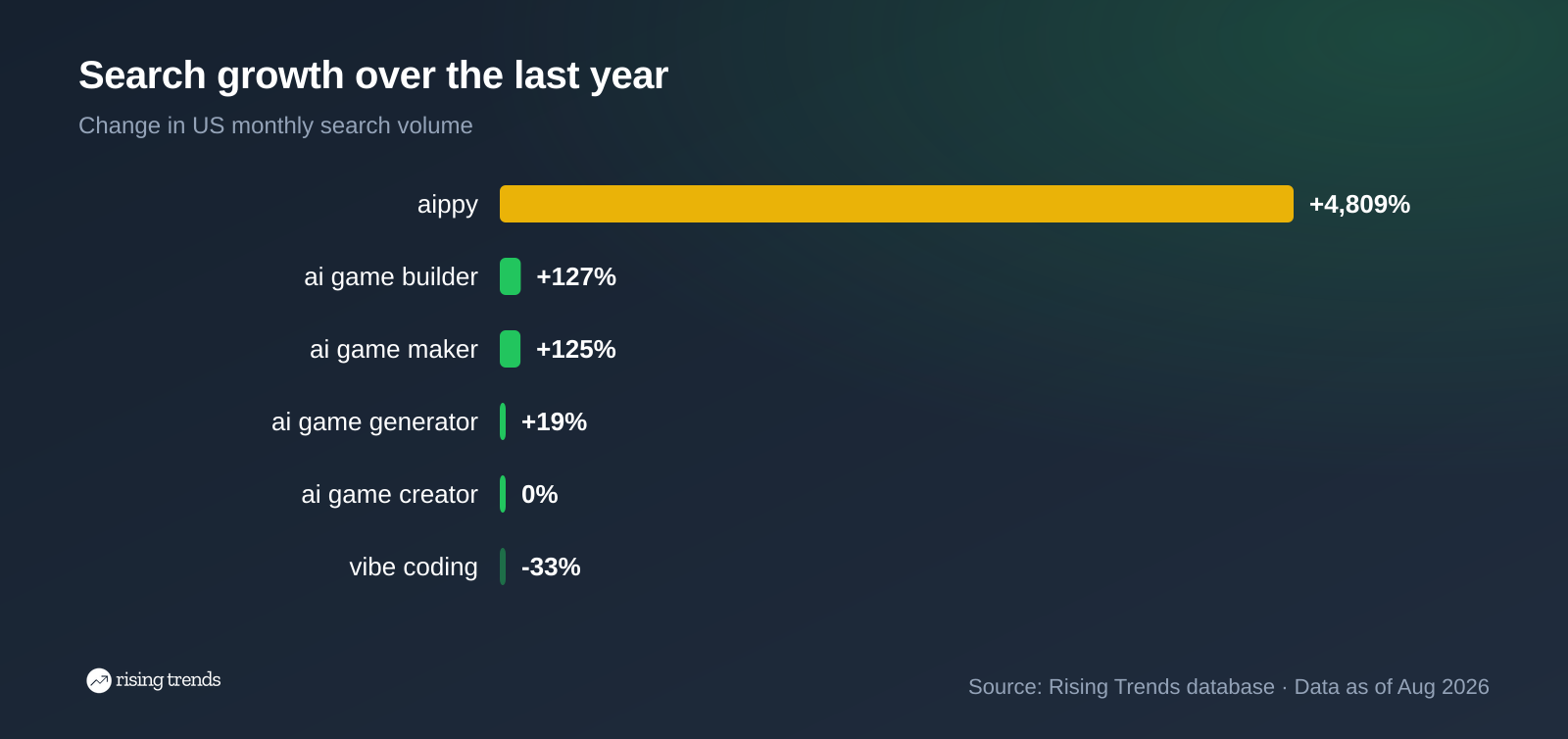
The first set is the tool category Aippy walked away from. Not one term in it grew more than 127% in the last year, and "vibe coding" itself is down 33% from a base of 74,000. The generic AI game tools are growing politely. The feed is growing 38 times faster than the fastest of them. If you want a single chart that explains why a team would abandon a tool product in 2025, that is it.
The second set is other AI-native feeds, and they are mostly too young to register. Sekai and Loopit are building the same swipeable playable feed; "sekai ai" sits at 1,000 searches a month as of August 2026, up 213%. The one that has genuinely broken out alongside Aippy is Isekai Zero at 6,600 searches, up 65,900% in a year. Expect more of these. The pattern we described in the AI mods trend, where tooling collapses the cost of making a game until amateurs out-ship studios, is the same pattern running one layer further down.
Then there is the incumbent nobody wants to name. Roblox is 11,100,000 searches a month in our database and down 33% over the year. Aippy is not taking Roblox's users yet. It is taking the half hour those users spend somewhere else.
Generation is cheap, distribution is the asset. Every company in that growth chart can turn a sentence into a game. Only one of them built somewhere to put it. The 36Kr profile of the company quotes an internal creed from its parent that reads "tools are doomed", meaning no matter how good a function is, users leave when they are finished with it. The search data agrees. That lesson applies well beyond games, and it is the same squeeze we mapped in the SaaS apocalypse: when the capability commoditises, the product that owns the audience keeps the margin.
The content treadmill gets a new gear. Short video solved the problem of making content cheap to produce. Playable content is heavier, and until now that was a hard floor. Aippy's answer is to make the games small, disposable and remixable, which is why 40% of them are edits of something else. The generative AI shift we track across categories is arriving in entertainment as volume, not quality.
Asset pipelines get pulled along. A feed that needs millions of new playable objects a month needs art, audio and 3D to match. That demand lands on companies like Meshy, the AI 3D firm whose own searches went from 2,900 to 49,500 in two years. Watch the whole gaming category rather than the app: the interesting money is in the supply chain under it.
Monetisation is the next headline. Crystals at $0.99 do not fund a 2 million user compute bill, and the founder has already flagged creator incentives as a priority. Whether that becomes a revenue share, a subscription or ads will decide whether the creators stay. Watch "aippy" against terms like "aippy free" and the Crystals queries; a sudden spike in pricing-related searches usually means a paywall landed.
Safety is the open risk, and it is already being litigated in public. The App Store rates the app 13+ with user-generated content and simulated gambling flags, Google Play rates it Teen, and the company's own release notes show it adding user blocking and direct-message privacy settings through the middle of 2026. This review, posted on August 29, 2026, is the sharper version of the concern.
The reviewer is a child-safety account, and their complaint is structural rather than about any one game: an endless feed of machine-made content, made largely by and for teenagers, with private messaging attached. Aippy is not unusual in this. It is just the first AI-native feed big enough to be audited by parents. How it handles that will matter more to the business than the next model upgrade, and it is the kind of story that shows up in the wider AI category long before it shows up in regulation.
The term to watch is the generic one. Right now "ai game maker" at 9,900 is still larger than "aippy" at 5,400, as of August 2026. The day the brand passes the category term is the day this stops being an app people are curious about and starts being the thing they mean. Given it closed a 9,790-search gap in twelve months, that day is not far off.
Want to catch the next app before its funding round makes it obvious? Read our guide on how to identify market trends, or see what is breaking out right now in our trending topics list.
Join 5,000+ founders · Free