For six years, "ghost lashes" was a Halloween search. It bumped every October, collapsed every November, and never once cleared 320 searches in a month. Then it broke. The term hit 18,100 US monthly searches in July 2025, fell all the way back to 480 by April 2026, and returned to 6,600 in July 2026, as of our latest data.
Every page ranking for the term tells you it means skipping mascara and that Zendaya did it. None of them tells you the term changed seasons, that it has now peaked in July two years running, or that the phrase is falling while the behaviour underneath it climbs. Here is what our monthly data actually shows, and what it means if you sell anything that goes near an eye.
Key takeaways:
- "Ghost lashes" peaked at 18,100 US monthly searches in July 2025 and sits at 6,600 as of July 2026, up 65,900% over two years from a base of 10 (Rising Trends data).
- The word is older than the look. It spiked every October from 2019 to 2024, topping out at 320 in October 2021, as a Halloween costume query. The October spike is now gone.
- Both beauty peaks landed in July, one year apart, with a trough of 480 searches in April 2026 between them. This is a seasonal look, not a fashion cycle.
- The label is cooling while the behaviour is not. Ghost lashes is down 64% in a year. Makeup minimalist is up 517% and clean makeup is up 402% over the same period.
- Circana's H1 2026 numbers show where the money went: prestige makeup grew 3% in dollars with unit demand softening, and the gains were in blush, bronzer and lip liner.
- The only lash dye the FDA has approved, silver nitrate, is cleared for professional use only and, in the agency's words, is "not for distribution or direct sale to consumers."
Let's get into it.
What we're seeing in the Rising Trends data
Here is the monthly curve for "ghost lashes" over the last two years, straight from our database.
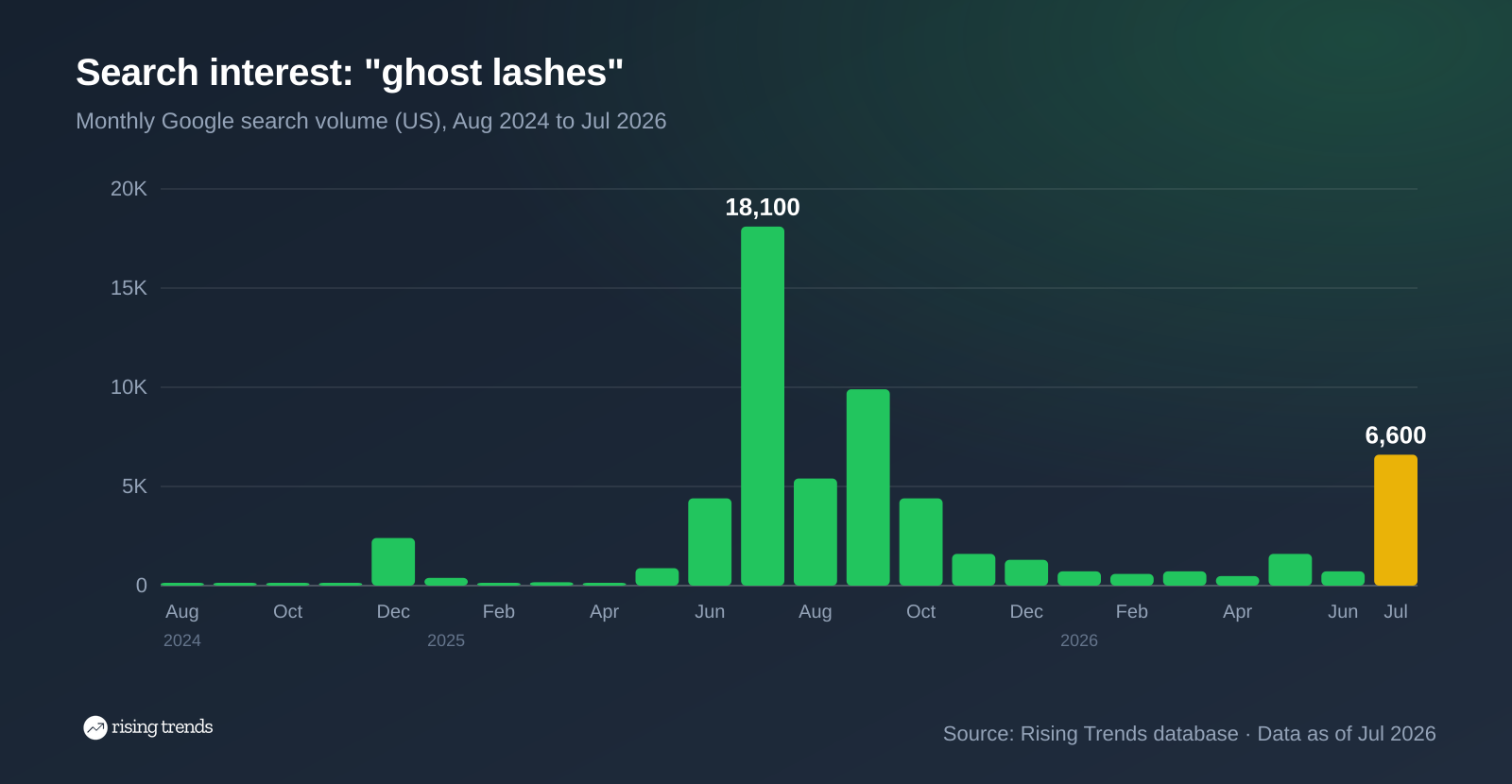
Two spikes, both in July. That is the shape that matters. The first one ran from 4,400 in June 2025 to 18,100 in July 2025, then bled out over nine months to 480 in April 2026. The second one went from 720 in June 2026 to 6,600 in July 2026, a 9.2x jump inside a single month.
Now go further back than the chart. From 2019 to 2024, this phrase only ever moved in October: 90, then 70, then 320, then 140, then 140, then 140. Every other month of every one of those years sat between 10 and 50 searches. People were looking for a ghost costume, not a makeup look. The first month that broke the pattern was December 2024, at 2,400, with no runway show or press hit attached to it.
So the term did not appear from nowhere in 2025. It got repossessed. A dormant Halloween query was taken over by beauty and its season moved from October to July, which is worth knowing if you plan content or inventory around it.
The next question is whether the trend is the word or the behaviour. Those turn out to be two different things.
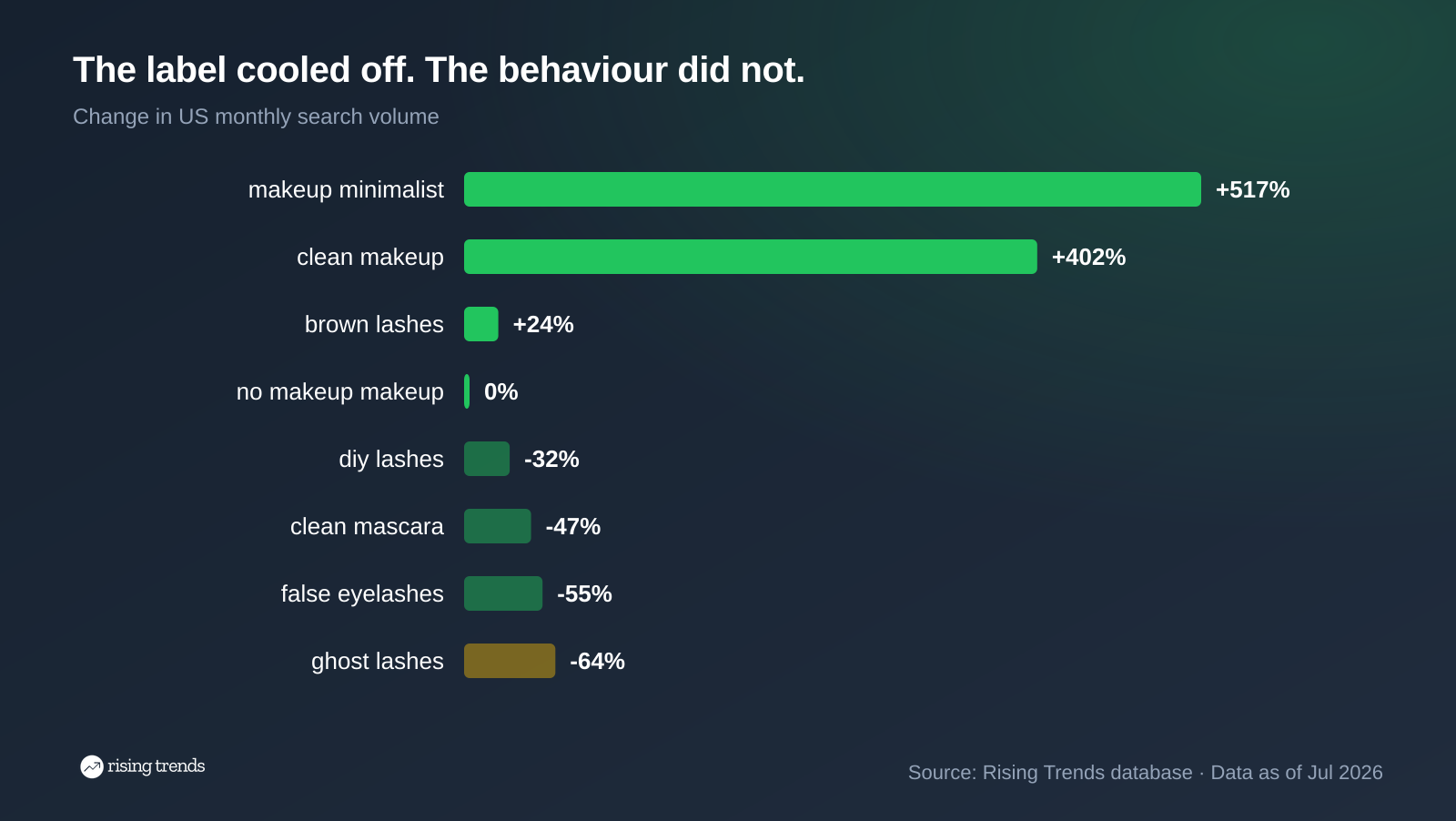
Ghost lashes is down 64% year over year, the worst performer on that list. But the terms describing what people are actually doing went the other way. Makeup minimalist is up 517% to 14,800 a month as of July 2026 and classified RAPID by our system. Clean makeup is up 402% to 33,100 and classified EXPONENTIAL. Meanwhile every maximalist lash term fell: false eyelashes down 55%, clean mascara down 47%, diy lashes down 32%.
That is the whole thesis. "Ghost lashes" is a magazine word with a July season. The reallocation underneath it is permanent, and it is bigger than the word.
One more check before we move on: size.
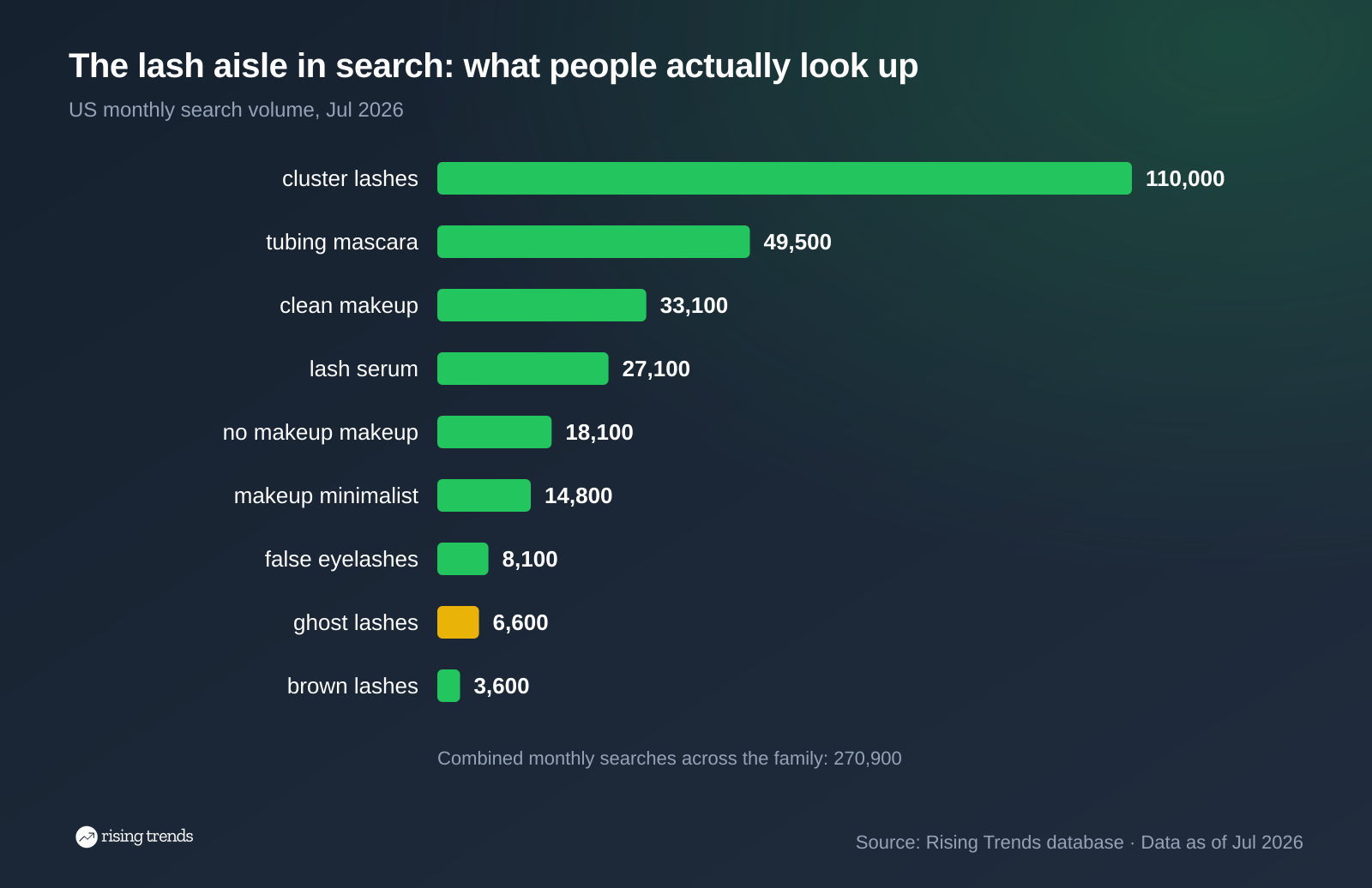
Keep this in view whenever someone declares the lash industry dead. Cluster lashes still pulls 110,000 searches a month as of July 2026, which is 16.7 times the term written up as its replacement. Tubing mascara pulls 49,500. The minimal look is real and it is growing fast, but it is growing from a much smaller base than the coverage suggests.
What ghost lashes actually is
The definition is narrower than the name. Ghost lashes means curled, groomed, barely pigmented lashes: no mascara, or a single microdosed coat of brown, or a clear gel, sometimes a tint or a lash lift underneath. The eye is deliberately the quietest part of the face.
Makeup artist Suzy Gerstein put the logic to W Magazine in July 2025: "When your eye doesn't register the lashes, it allows the softer and more nuanced elements of a makeup look to come into play without overpowering." Her read on why now is blunter. It is, she said, "a pendulum swing in the opposite direction of all the heavy lash extensions that have become omnipresent on social media and, consequently, in real life."
The look is not new, only the name is. Lisa Eldridge told British Vogue that ghost lashes "hark back to a particular look from the '90s. Mascaras that intended to give the eyelashes a subtle tint became available and were quite popular." Her diagnosis of the mood is the sentence worth keeping: "I think that people have become fatigued with the idea of using heavy make-up to construct your features and achieve conventional prettiness."
The runways got there before the search did. W Magazine traces the look to Valentino's spring/summer 2025 show in Paris in September 2024 and Gucci Cruise 2026 in Florence on 15 May 2025.
Why it's trending now, twice
Here is the sequence, and it is the same both times: the search moved first, the press followed.
In 2025, the term went from 880 in May to 4,400 in June to 18,100 in July. W Magazine's explainer ran on 28 July 2025. British Vogue's ran on 4 August. Both landed on the way down.
In 2026 it repeated. Zendaya wore the look to The Odyssey premiere in New York on 14 July. Cosmopolitan published on 15 July. The month closed at 6,600, up from 720 in June. Her makeup artist Ernesto Casillas named two Prada Beauty products for the look, a concealer and a blush, and zero eye products. That detail is the trend in miniature: the budget did not disappear, it moved four inches down the face.
The supply side noticed faster than the press did. This clip from lash artist @kaylahertz, posted in October 2025, is a professional teaching other professionals how to build a "ghost lash" extension set, which is to say how to sell the mascara-free look back to the customer as a service.
Her advice is to grab "only 2-3 fibers or what matches the diameter of the natural lashes." An industry built on volume learning to sell restraint is what a real behaviour change looks like from the inside.
Not everyone is buying the name. TikTok creator @iamkaylabeauty, quoted on a lash brand's own blog, put the objection best: "STOP TRYING TO MAKE FETCH HAPPEN!! Ghost lash?? Princess nails??? Y'all tryna come up with new words for conservatism." Our data agrees with her. No makeup makeup has held 18,100 searches a month with a 235% two-year gain, a steadier line than the label sitting on top of it.
The new behaviour: people are buying maintenance, not coverage
The change is not that people stopped decorating their eyes. It is what they buy to do it.
The swap is from daily product to periodic service. Emily Wood, whose clients include the singer Lola Young, told Vogue that "more clients are choosing lash lifts or just using a great curler." A lift or a tint is bought every six to eight weeks. A mascara is bought and used daily. Those are completely different revenue shapes for a beauty brand.
The eye budget moved to the cheek and the lip. Bobbi Brown's global artistic director Hannah Murray described the trade to Elle: "There's nothing more modern than a bold red lip with polished skin and a subtle hint of shine on the eye." She also framed the whole thing as downstream of skincare: "I think everyone now is so into skincare and embracing healthy, spa-like skin that this is an extension of that." That is the same ingredient-first, mechanism-over-makeup instinct we tracked in PDRN skincare and in the wider beauty category.
And it is being read as an economy signal, not just a taste. When the trend first moved on TikTok in June 2025, creators filed it under recession, and one of the posts W Magazine cited sits under the hashtags #lashes #recession #latisse #beautyindustry. The vendor pages say it out loud too. Godefroy's own explainer notes that "in uncertain economic times, minimalism often resurfaces." A lash appointment every three weeks is a subscription. Curling your own lashes is free.
Who's building on it, and the rule most of them are testing
The commercial opportunity in a mascara-free trend is not mascara. It is tint, lift and serum: the things that make bare lashes look deliberate.
| Player | What it sells into the look | Price, checked Sep 2026 |
|---|---|---|
| Godefroy Beauty | 28 Day Mascara, an at-home eyelash tint kit, plus a lash serum and a heated curler | $29.95 for 25 applications |
| 19/99 Beauty | Lash Tint Mascara, sold as "the look of freshly tinted lashes" | $20, up from $18 in July 2025 |
| Glossier | Boy Brow, recommended by makeup artists as a clear lash hold, plus a No-Makeup Makeup Kit | $22 |
| Lisa Eldridge | Kitten Lash Mascara, the brown "microdose" formula | GBP 29 at Space NK |
| Lash technicians | light extension sets rebranded as ghost lash sets | a service, sold every 6 to 8 weeks |
Notice that Glossier's page for Boy Brow does not mention lashes at all. It is a brow product being recommended off-label by professionals because the trend created a job that no product was built for. That gap is where the next launch comes from.
The tint half of the market has a problem worth naming, though. Tinting a lash means putting a dye in the area of the eye, and the FDA is unusually specific about that.
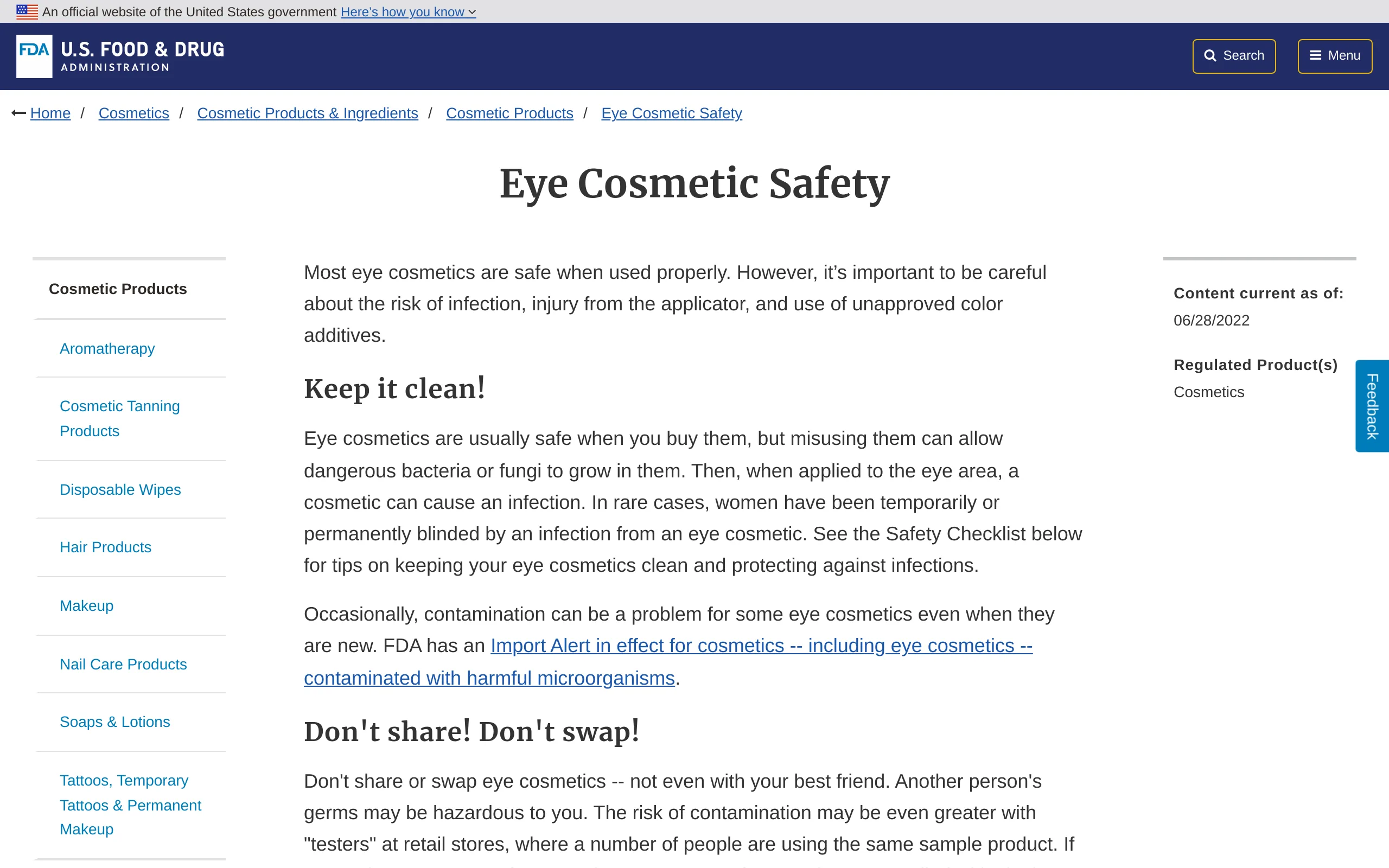
The agency's eye cosmetic safety guidance states that "permanent eyelash and eyebrow tints and dyes have been known to cause serious eye injuries, including blindness." Its color additive fact sheet is narrower still: silver nitrate is the only color additive approved for dyeing eyebrows or eyelashes, and only in professional-use products, capped at 4% by weight in a viscous gel, not for anyone under 16, and not applied for longer than a minute. The same page adds that these products "are not for distribution or direct sale to consumers."
Now look at what the top-ranking vendor page for this trend routes readers toward. Godefroy's ghost lashes explainer links its own 28 Day Mascara tint kit, sold direct at $29.95 for 25 applications, whose listed gel activator is water, silver nitrate, copolymer and ammonia. The box carries its own warning language and a "clinically proven safe to use on and around the eye area" claim. We are not aware of any enforcement action here, and consumer lash tint kits have been sold in the US for years. It is still the sharpest unaddressed question in the category, and no beauty write-up about ghost lashes has raised it.
What it means for business
The category did not shrink, it redistributed. Circana's US beauty read for the first half of 2026, published on 11 August, put prestige at $17.1 billion and mass at $39.2 billion, both up 7%. Inside that, prestige makeup grew only 3% in dollars with unit demand softening, and mass makeup grew 5% while units actually declined. The growth that did happen was "concentrated in trend-driven products" and, in Circana's words, "face makeup outperformed the broader category, with bronzer and blush posting double-digit gains, while lip liner continued its strong momentum as the fastest-growing segment in makeup." People are buying fewer makeup units at higher prices, and the units they buy are for the cheeks and the mouth.
Eye brands should sell condition, not coverage. Lash serum is still a 27,100-a-month term as of July 2026 even though it is down 18% and classified DECLINING, and it is the single largest lash-adjacent category left standing after false eyelashes fell 55%. The product that wins the ghost lash buyer is the one that makes bare lashes worth showing.
Watch the price ladder, not the volume. A $22 brow gel used on lashes and a $29.95 tint kit that lasts four weeks are both cheaper per month than an extension fill. That is a trade-down disguised as a taste change, and it is the same pattern behind a lot of what is moving in makeup and cosmetics right now. Brands reading it as pure aesthetics will price it wrong. The mouth is where that ladder is clearest: demand is splitting between a $24 treatment and a $5 gloss, which is the split we traced in Eadem's lip gloss breakout.
Do not build a campaign on the word. The backlash to "ghost lashes" is really a backlash to renaming the same face for the fifth time, and the word is down 64% in a year. The optimisation reflex behind the constant relabelling is the one we mapped in the maxxing trend, and the buying behaviour around it rhymes with dopamine shopping.
Where this is heading
Three calls, each with a term in our database to watch.
July 2027 decides whether this is a season or a fad. Two July peaks make a pattern. A third makes it a planning assumption for every beauty retailer's summer calendar. Watch whether ghost lashes clears 6,600 next July. If it does, the term is a fixture with a season, like tan lines or tubing mascara, not a trend with an expiry.
The behaviour outlives the label. Makeup minimalist at +517% and clean makeup at +402% are the lines to track, not the ghost lashes line. If those keep compounding while the fashion word decays again this autumn, the reallocation is structural and the eye category has a multi-year problem rather than a bad summer.
Someone will regulate the tint, or a brand will get ahead of it. The gap between a professional-use-only color additive and a $29.95 consumer kit closes in one of two ways. Watch brown lashes, up 24% and the only lash colour term still growing, as the tell for whether buyers stay with washable tinted mascara or keep pushing toward semi-permanent dye.
The thing worth remembering is where the word came from. A costume search that ran quietly every October for six years got picked up by beauty, moved to July, and now sells tint kits and lash appointments. If you only watch the coverage, you see a Zendaya premiere. If you watch the data, you see a term that changed seasons eighteen months before anyone wrote about it.
Want to catch shifts like this before the magazines name them? Read our guide on how to identify market trends, or browse what is breaking out right now in our trending topics list.
Never miss a trend again
- One trend broken down with the numbers
- Who's making money, and what to build
- A website on the rise
- A breakout app
Join 5,000+ founders