Trends


Two years ago, "titanium cookware" was a niche search. It ran at 3,600 a month, roughly the level of a mid-sized kitchen gadget. As of July 2026 it is 74,000 a month, up 814% in a year and 1,956% in two, and our database classifies its pace as EXPONENTIAL. Nothing about pans changed that fast. What changed is the word people type.
Here is the part nobody ranking for this term will tell you: every other way of asking the same question is shrinking. "Pfas free cookware" is down 70% over the same year. "Toxin free cookware" is down 46%. "Nonstick pan" is down 18%. The non-toxic kitchen search did not grow eightfold. It moved from naming a chemical to avoid to naming a material to buy, and most of that move happened inside nine months. This is what that looks like in the data, why it happened, and what it does to a cookware business.
Key takeaways:
Let's get into it.
Start with the curve. This is monthly US search volume for "titanium cookware" over 24 months, straight from our database.
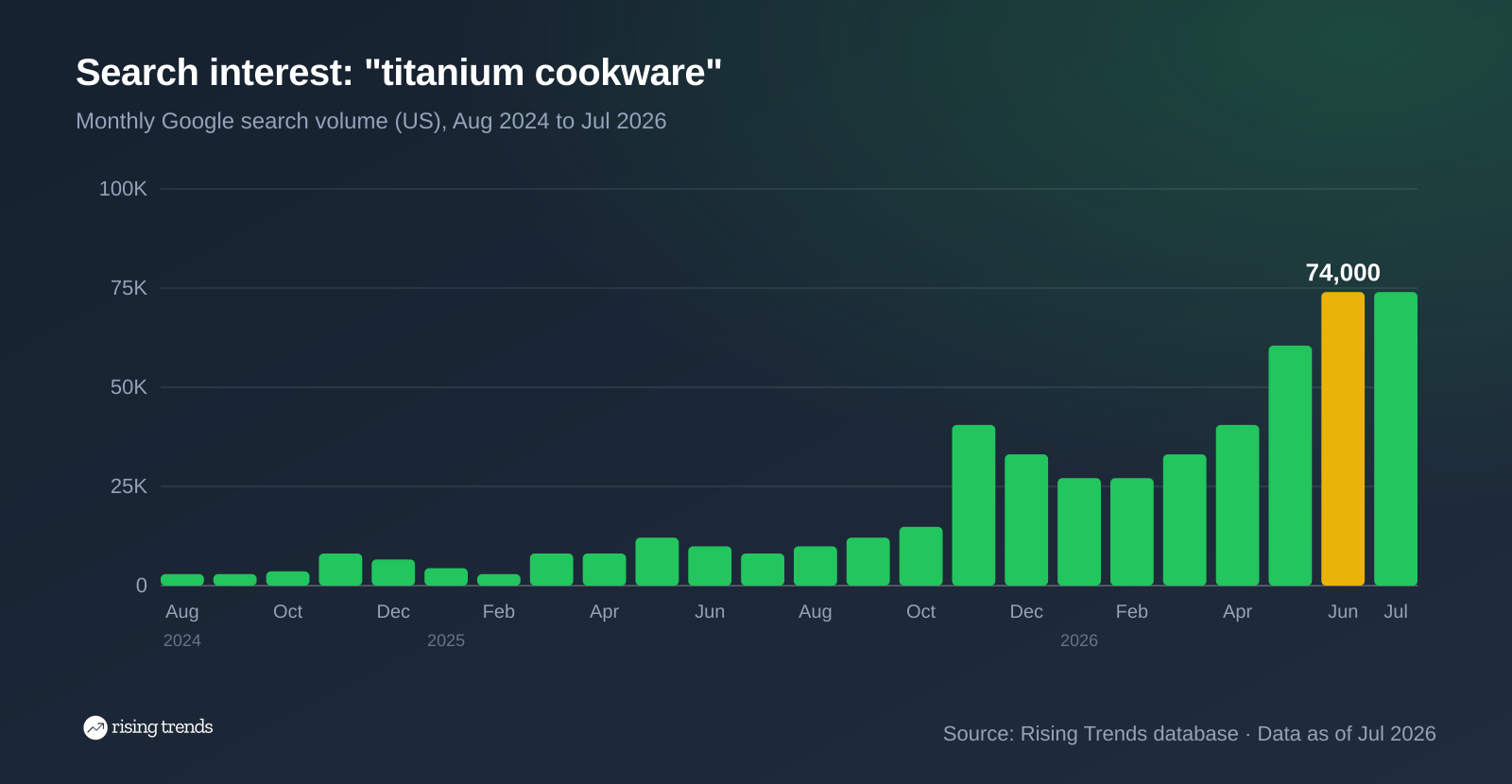
For the first 15 months the line sits under 15,000. Then November 2025 happens: 14,800 the month before, 40,500 that month. It cools through the winter, bottoms at 27,100 in February, and then climbs every single month to 74,000 in June. That second climb is the one that matters. A spike that decays is a news cycle. A spike that decays and then gets beaten is a category.
Now put it next to its neighbours.
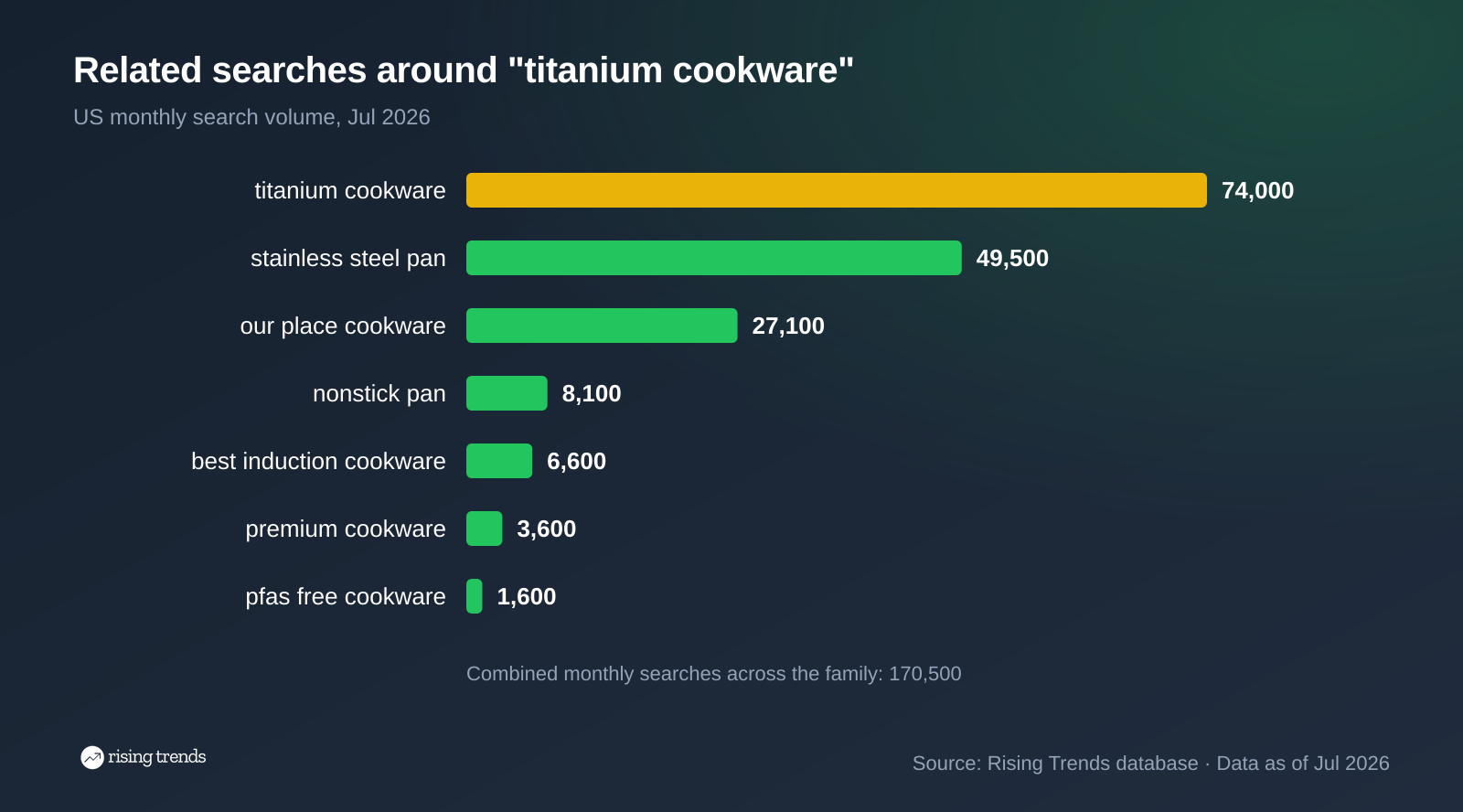
A material that barely existed as a consumer search two years ago now outranks every term around it. It is 1.5x stainless steel pan, the default answer for the last decade, and nearly 3x the brand that did the most to popularise it. Volume alone is only half the story though. The direction of travel is the other half.
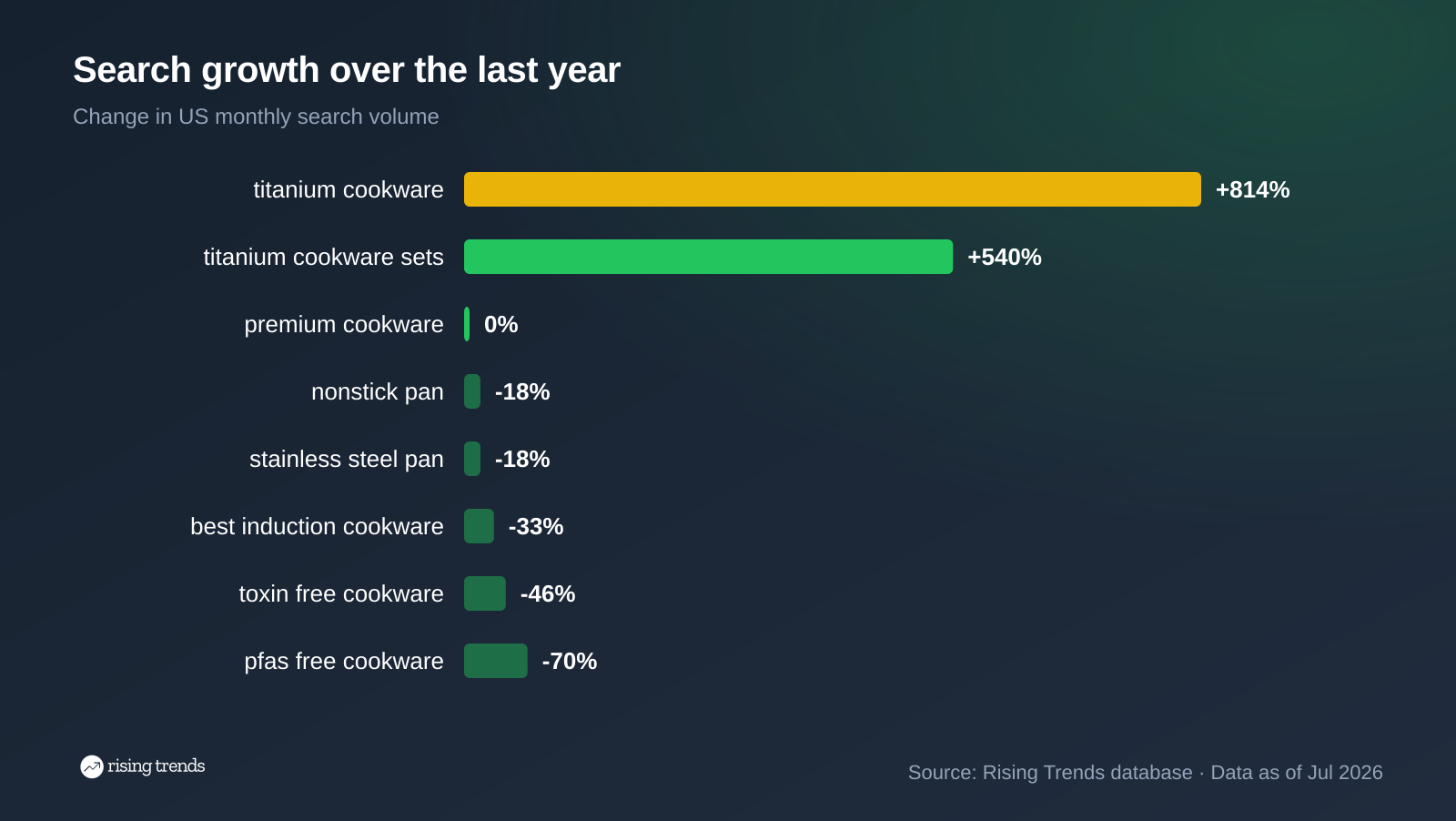
Two terms are up. Six are down. And the steepest fall is pfas free cookware, off 70% to 1,600 a month. That pairing is the finding. If people had simply lost interest in chemical safety, titanium would be flat too. Instead the interest moved intact into a different noun.
Think about what each search asks for.
"Pfas free cookware" is a negative. It asks a manufacturer to prove an absence, which means reading a label, trusting a certification and understanding an acronym. It is work, and it is the kind of work shoppers abandon.
"Titanium cookware" is a positive. It names a thing you can see, weigh and scratch. You do not need to know what PTFE stands for to understand "there is no coating on this, so there is nothing to flake off". The claim is checkable by holding the pan.
That swap is why the numbers look the way they do. The buyer did not get less worried. The buyer got a shortcut. And shortcuts are how mass categories form: the same move happened when "organic" absorbed a dozen separate pesticide questions into one word on a sticker.
The cost of the shortcut is precision, and we will come back to that, because "titanium" is doing a lot of work it has not earned.
Regulation made the old vocabulary official, then obsolete. On January 1, 2025, Minnesota's Amara's Law took effect. The Minnesota Pollution Control Agency's own summary of the 2025 PFAS prohibitions lists 11 consumer categories that can no longer be sold in the state with intentionally added PFAS, and cookware is on it. The agency reads the category broadly: it "considers cookware to include any product used to prepare, dispense, or store food, foodstuffs, or beverages." Once compliance is the law rather than a selling point, "PFAS free" stops being a differentiator and starts being table stakes. Brands need a new word. Regulation has done this to categories before, which is the same dynamic we traced in the packaging rules taking effect in 2026.
A durability argument replaced a toxicity argument. In October 2022, researchers at Flinders University and Newcastle University published Raman imaging work on nonstick surfaces. Their finding, summarised by Flinders, was that a single surface crack on a Teflon-coated pan can release about 9,100 plastic particles, and that broken coating released 2.3 million micro and nanoplastic particles. Professor Youhong Tang's comment was measured: "It gives us a strong warning that we must be careful about selecting and using cooking utensils to avoid food contamination." Three years later that study is the spine of nearly every titanium ad you will see. The pitch is no longer "this chemical is bad". It is "your coating will fail, and ours cannot, because we do not have one."
Then somebody bought the traffic. Our breakout month is November 2025 and there is no press cycle attached to it. What there is, is a Black Friday wave from the pure titanium direct-to-consumer brands. This is what one of those storefronts looked like when we captured it this week.
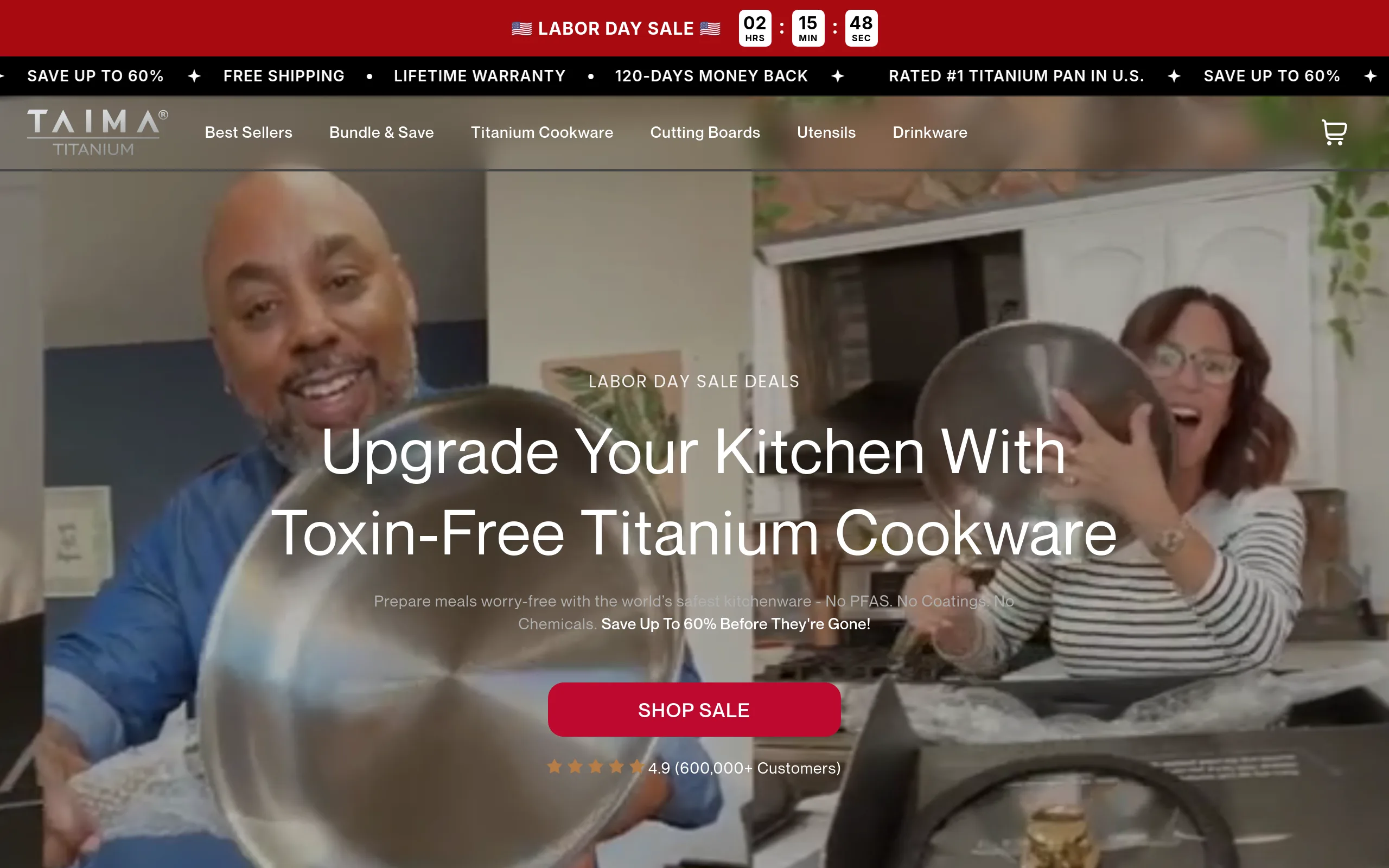
Countdown clock, 60% off, lifetime warranty, a self-reported "4.9 (600,000+ Customers)" and the three-word promise underneath: no PFAS, no coatings, no chemicals. Taima is not selling cookware to people who research cookware. It is selling to people scrolling, and the numbers are its own.
The creator layer works the same way. This reel from @keto.risa, posted on September 6, 2026, is typical of what the term looks like on Instagram right now.
"Titanium cookware has officially entered my kitchen," it opens, before listing the specification that every one of these posts lists: 100% pure titanium, no coatings, no PFAS, no PTFE. The caption also carries a 15% discount code. That is not a knock on the creator, it is the point: the demand curve above is being paid for, one code at a time.
Here is where the shortcut breaks. We pulled the pages of the brands ranking for this term and they are not selling the same object.
| Brand | What "titanium" means here | Price we saw |
|---|---|---|
| Our Place | Titanium interior pressed with a micro pattern, on an aluminium core and steel exterior | $165 to $199 for the 10.5" pan |
| Hestan | Molecular titanium bonded onto a steel body | $199.95 to $450 per skillet |
| Heritage Steel | Titanium inside the alloy itself (316Ti), five-ply, made in the USA | $159.95 for the 12" fry pan |
| Taima, Apex | Solid titanium cooking surface, tri-ply | Permanently discounted, up to 60% off |
| Budget retail | A nonstick coating with titanium particles in it | The cheap end of the Amazon listings |
Our Place is the one that built the market. Its NoCo explainer, published in April 2024, describes the mechanism honestly: "A micro, dot-like pattern that's invisible to the naked eye is applied to a durable titanium surface," creating a hydrophobic surface that behaves like nonstick without being a coating. The company's titanium collection page claims the interior is "Up to 300% as hard as tested stainless steel" and is oven safe to 1000F. Its Titanium Pro set runs $499.95 to $549.95.
Hestan's NanoBond sits above it, describing "a tri-ply pure aluminum core with a molecular pure titanium coating" and claiming titanium is "400% stronger than traditional stainless steel". Heritage Steel sits to the side of both, and is the reminder that none of this is new: its Titanium Series, built from 316Ti, was "first introduced in 2013".
Then there is the new wave. Apex sells "The Original Titanium Pan" in Grade 1 titanium with a 100-day guarantee. Its page also claims titanium surfaces give "the best protection for essential micronutrients", with no study cited anywhere on it. Treat that one as advertising.
The thing buyers are not being told is that a coating-free pan is a different skill.
Business Insider's Stella Totino tested the category in May 2026 and her verdict on the category leader is worth reading twice: "There's a learning curve to heating this pan. I found you really need to crank the heat before you add ingredients if you want to prevent sticking." On the $450 Hestan she was blunter: "It's not very nonstick." Her framing of the whole market is the honest one, and it is the sentence the search term hides: "most 'titanium' cookware isn't solid titanium."
So the behaviour shift is real but partial. People stopped buying a disposable surface and started buying a permanent one, which is a genuine change in what a pan is for. They also inherited a preheat routine that a Teflon pan never asked for. Our Place's own FAQ quietly confirms the trade: its titanium line is pitched at cooks who want "high-heat searing, metal-utensil durability", while the ceramic Always Pan stays the "easy-care everyday option, best on low to medium heat."
The second thing buyers inherit is the induction question. Titanium is only weakly magnetic, so a pure titanium pan cannot heat itself on an induction hob. Our Place spells this out: pure titanium "won't stick to a magnet", so its pans work on induction because of a ferromagnetic steel base, not because of the titanium. Not every seller explains that. Meanwhile best induction cookware is down 33% to 6,600 a month, one of the sharpest falls in the family and a reminder that appliance-led questions are losing to material-led ones across the home appliances category.
Material claims are cheaper to make than brand equity. Notice what is not rising. Our place cookware is down 18% year over year to 27,100 a month, while the material term it did the most to popularise went up 814%. The company created the category and the category is now shopping around. That is the recurring cost of educating a market on an ingredient rather than a name.
Discounting is already structural. When a homepage carries a permanent countdown and 60% off, the list price is fiction and the real price is the ad spend. The brands defending a genuine build (Heritage Steel at $159.95 for a fry pan, Hestan at $450 for a skillet) are competing against pans sold at half of an invented number. Expect margin pressure at the top before the bottom.
The word is a compliance risk waiting to happen. A category where five constructions share one label, and where the cheapest of them is a coating, is exactly the setup for the first "titanium" mislabelling complaint. Minnesota already defines cookware broadly, and the 2032 tranche of its prohibitions is still coming.
Retailers should merchandise by construction, not by metal. The buying question is not "titanium or not". It is "coating or no coating", and the shelf does not currently answer it. Anyone building the kitchen category has an obvious gap to fill, and it is the same gap the non-toxic materials push opened across home and design two years earlier.
Three calls, each with a term in our database to watch.
The peak is not the top, but the growth rate is done. Two months at 74,000 with an acceleration figure of 2.07 says the curve is still steep, but a term that is up 814% in a year cannot repeat that. Watch titanium cookware through the holiday quarter. If November 2026 clears 74,000 it is a seasonal category now, not a spike.
A backlash term will appear. The doubt is already in the results. The questions Google shows alongside this search are "What are the disadvantages of titanium cookware?" and "Is titanium cookware really worth it?", and the most-viewed video on the term is a test titled "Is Titanium Cookware a Scam?". The tell will be when a qualifier like "pure titanium" starts outgrowing the plain term in our data.
The falling terms will keep falling, and that is not a safety story. Pfas free cookware at 1,600 and dropping does not mean shoppers stopped caring about coatings. It means the question got absorbed. Any brand still leading with the acronym is speaking a language its buyer has already replaced, which is the same trap we watch for across cooking and recipe searches.
The honest summary is that a 20.6x rise in two years bought a real improvement and a real complication in the same pan. You get a surface that will not flake. You also get a word that five companies define differently and a preheat you have to learn. Both things are true, and only one of them is in the ads.
Want to catch a category renaming itself before the ads do? Read our guide on how to identify market trends, follow the live titanium cookware trend page, or see what is breaking out right now on the Rising Trends dashboard.
Thousands of Emerging Trends
Thousands of Breakout Apps
Mega Trends
Trend Analysis Tool