
Trends


A year ago, 480 people a month in the US searched for "ppwr". As of July 2026 it is 3,600, up 650%, and the climb has a date attached to it. On August 12, 2026, the EU's Packaging and Packaging Waste Regulation started to apply and the packaging directive that governed Europe since 1994 was repealed.
Here is the part that shows up in our data and nowhere else. While searches for the rule number went up 650%, searches for the voluntary green vocabulary collapsed. "Biodegradable packaging" is down 75% in a year. "Recycled packaging" is down 64%. The people who buy packaging stopped searching for adjectives and started searching for a regulation.
Key takeaways:
Let's get into it.
Here is "ppwr" over the last two years from our database. It is not a spike, it is a ramp with a deadline at the end of it.
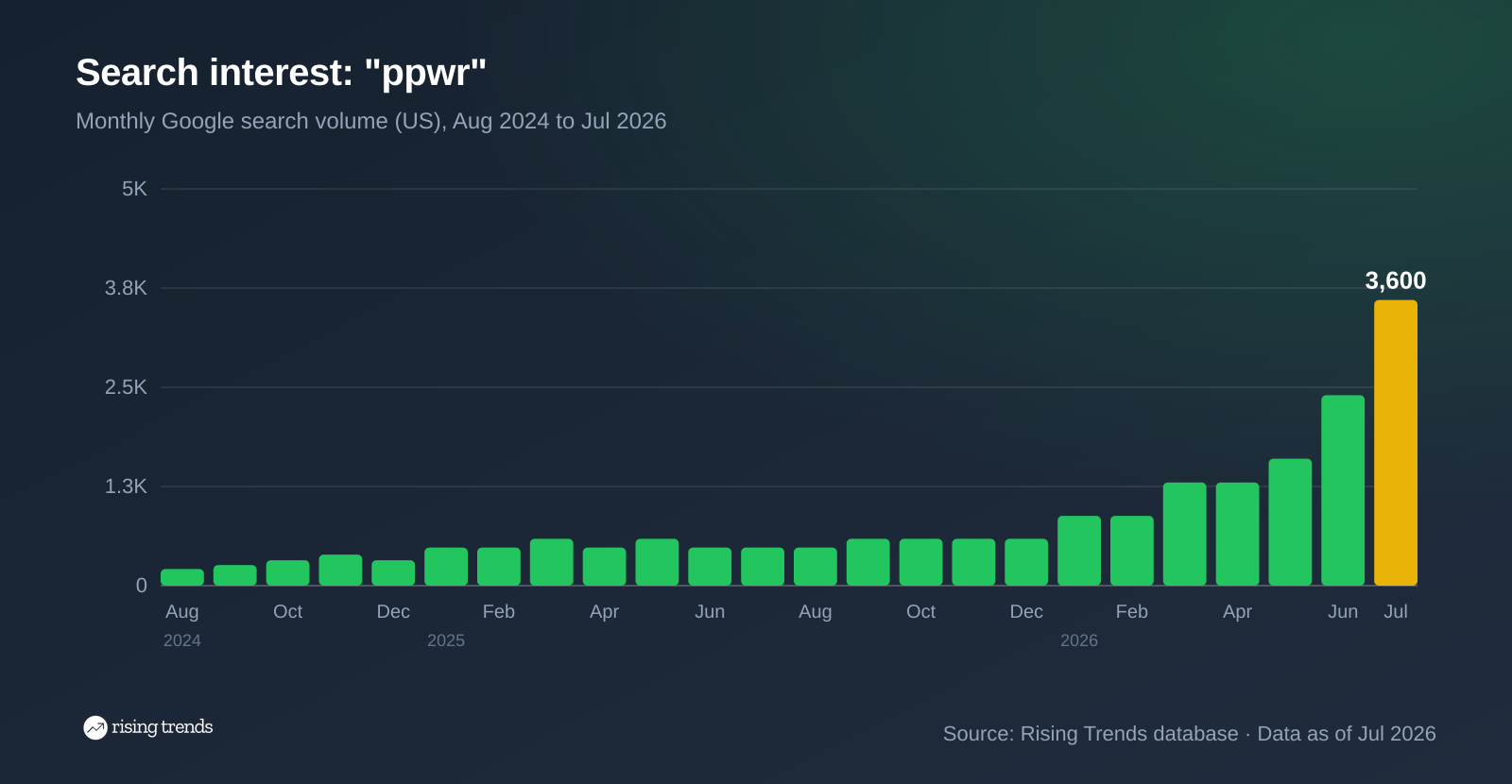
The term sits between 210 and 590 for eighteen months. Then it moves in steps that match what the Commission was doing: 880 in January 2026, 1,300 in March, the month the Commission published its implementation guidance, 1,600 in May, 2,400 in June, and 3,600 in July 2026, the month before the rules applied.
Three-month growth is 177%. This is the shape of compliance demand, which is different from consumer demand. It does not decay after the event, because the obligations are only starting.
One note on the data. Our series shows an old high for this acronym in 2019, years before the regulation existed. It is an artifact of a three-letter string and we have ignored it. Everything here uses the 24-month window.
Now the cluster around it.
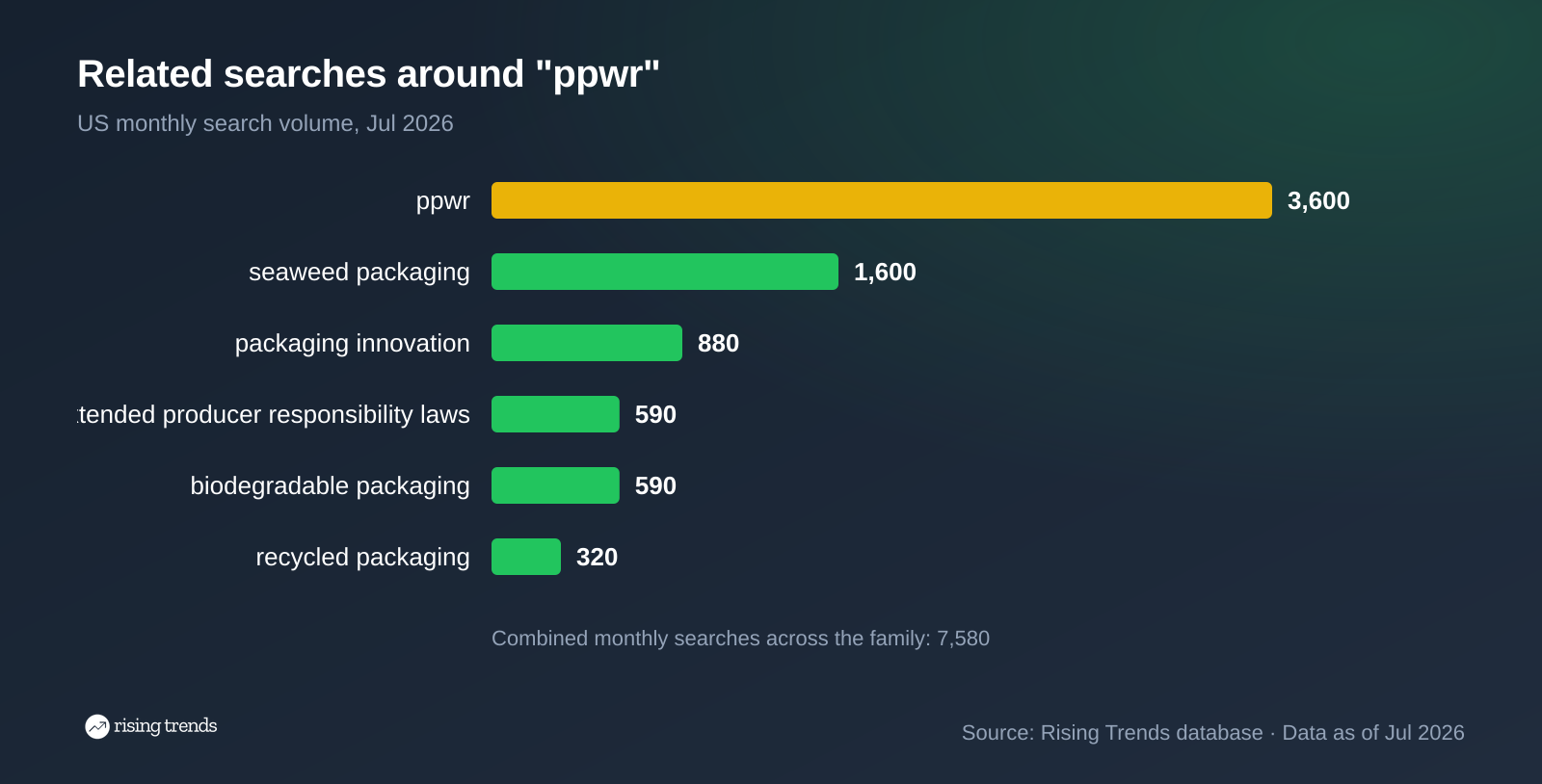
The regulation is now the largest term in its own category, bigger than every material and every voluntary label we track alongside it. Put growth next to it and the reversal is stark.
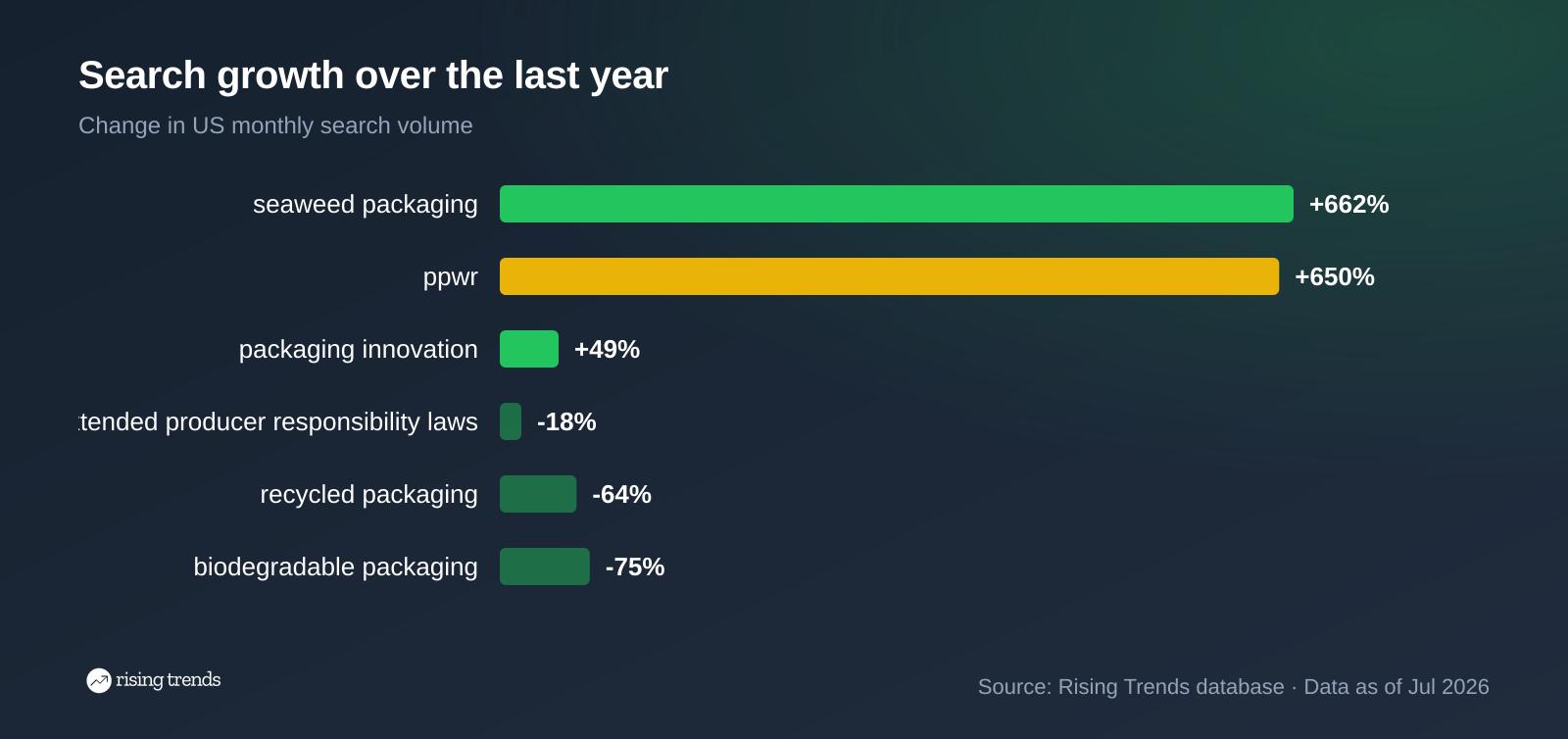
Two things are rising: the rule and a material that did not exist commercially five years ago. Everything that sounds like a marketing claim is falling. Biodegradable packaging has lost three quarters of its search demand in a year, and recycled packaging nearly two thirds.
Even extended producer responsibility laws, the general term for this kind of rule, is down 18%. People are not searching the concept. They are searching the specific regulation that binds them.
It is a regulation, not a directive, and that distinction is the whole point.
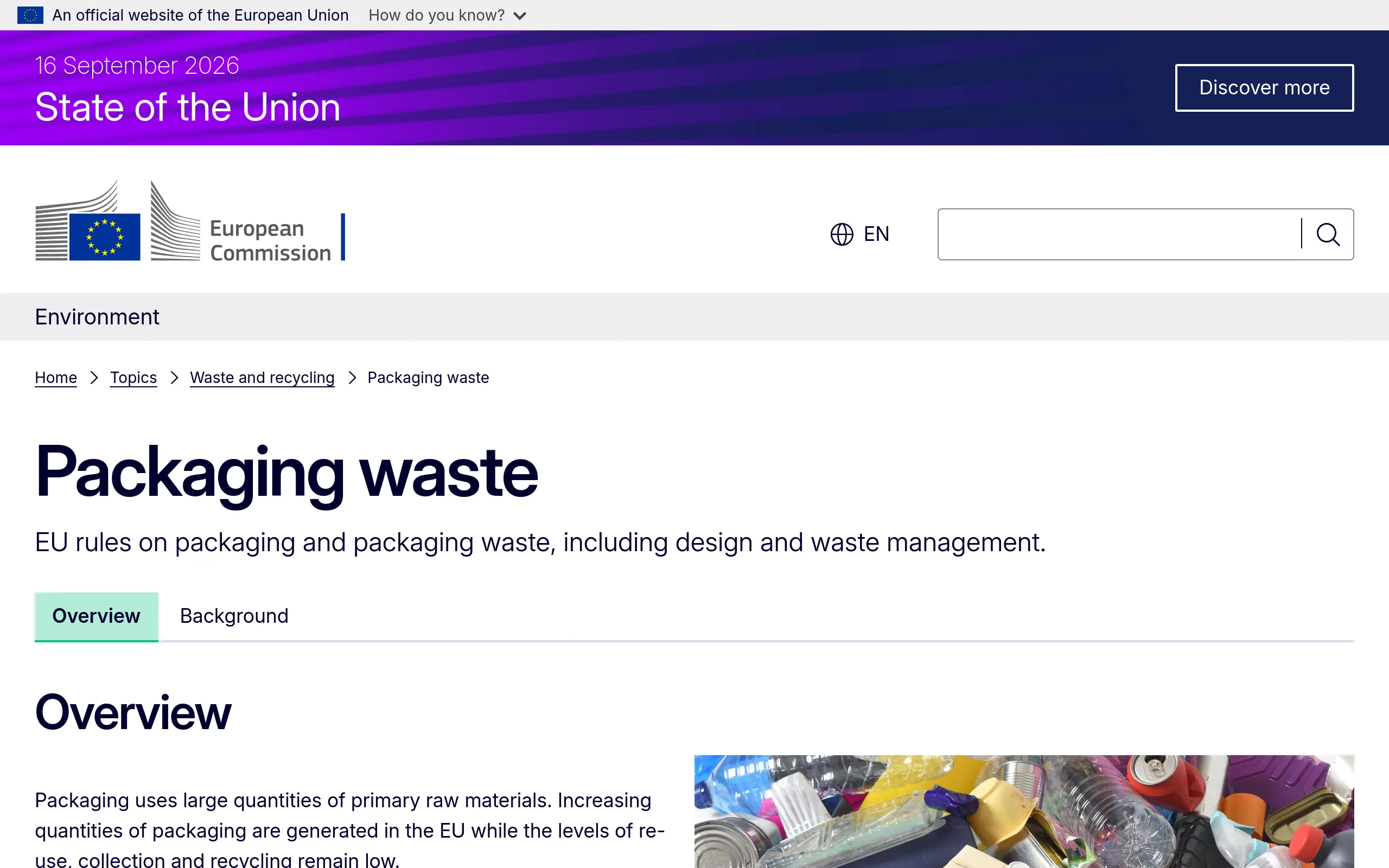
A directive tells 27 member states what outcome to reach and lets each write its own law. That is what the 1994 Packaging Directive did, and the result was 27 slightly different rulebooks. A regulation applies directly and identically everywhere. According to the Commission's packaging waste page, PPWR "establishes a harmonised, directly applicable regime governing all packaging placed on the EU market, regardless of material or origin".
The key dates from that page: in force since February 11, 2025, application date August 12, 2026. The old directive was generally repealed on the same day, though some provisions continue to apply after it.
The scale argument the Commission makes is straightforward. Packaging waste reached 186.5 kg per person in the EU in 2022. Packaging takes 40% of the plastics used in the EU. Roughly half of marine litter is packaging. And each European generates around 35 kg of plastic packaging waste a year, which the Commission notes is "made almost entirely from imported fossil fuels", putting an energy-security argument next to the environmental one.
Most of what a shopper will notice is dated 2030. Most of what a business has to do started last month.
| Change | Who it hits | When |
|---|---|---|
| Regulation applies, 1994 directive repealed | Anyone placing packaging on the EU market | August 12, 2026 |
| Limits on PFAS in food contact packaging above thresholds | Food and drink packaging | Applies with the regulation |
| Take-away customers can bring their own container at no extra cost | Restaurants, cafes, delivery | Applies with the regulation |
| Less empty space in delivery boxes | Online retail | Applies with the regulation |
| All packaging recyclable in an economically viable way | Everyone | 2030 |
| Bans on unnecessary single-use formats | Hotels, restaurants, retail | 2030 |
The Commission's own examples of what goes in 2030 are unusually concrete for an EU document: "small ketchup packets in restaurants or mini shampoo bottles in hotels". It is careful to say the goal "is not to ban single-use packaging outright", and that formats needed for food safety, public health or medical purposes stay.
On labels, the consumer facts page answers the question people actually have, which is whether they will need more bins at home. The answer is no: new harmonised sorting labels, same bins.
On price, the Commission's position is that harmonisation cuts cost: "Less packaging, and harmonised EU rules that create a single market, can lower costs for businesses ... These savings should trickle down to consumers." That is the argument, not a finding, and it is worth reading as such.
Here is what the compliance side of this looks like in practice, published three days ago.
Testing requirements are the unglamorous centre of this regulation, and an entire advisory industry has appeared around them in the last year. That is what 3,600 monthly searches on an acronym mostly are.
A regulation that applies is not a regulation that is finished.
In December 2025, in what it calls the Environmental Omnibus, the Commission proposed simplifying administrative burdens, including suspending the obligation for producers to appoint an authorised representative when they sell packaged products directly to consumers in a member state other than their own. As the Commission's page records, that proposal is still being examined by the Parliament and the Council.
For a small business selling cross-border into the EU, that single obligation is the difference between one compliance relationship and up to 26. It is unresolved, and it is the most consequential open question in the file.
There is also the guidance itself. The Commission published an implementation guidance document in March 2026 and a set of FAQs on August 3, 2026, nine days before the rules applied. Guidance arriving nine days before an application date tells you how much interpretation was still live this summer, and it explains the June and July search numbers better than anything else.
Compliance became a purchasing criterion. The falling terms in our chart are the ones a marketing team would search. The rising one is the one a procurement or regulatory team searches. When the rule number outgrows the green adjective by that margin, the buying decision has moved departments.
Materials get a second look, not a rebrand. Seaweed packaging at 1,600 searches and up 662% is the tell. Substitution is being driven by what will still be legal in 2030, which is the same pattern we see across sustainability trends once a rule sets a date.
Non-EU sellers are in scope. The regulation covers packaging placed on the EU market regardless of origin. A US brand shipping into Europe is inside this, which is why a US search curve exists for a European regulation at all.
The cost lands unevenly. Large manufacturers have regulatory teams. The businesses most exposed are mid-sized exporters, the same group that feels every change in logistics and supply chain rules first and has the least capacity to absorb it.
Whether the curve holds above 3,600. Compliance searches usually peak at the deadline and then settle into a lower plateau of ongoing questions. If August and September stay near the July level, the sector is still working out what it has to do. The live PPWR trend page is where that resolves.
The authorised representative decision. If the Parliament and Council adopt the Commission's suspension, small cross-border sellers get a reprieve. If not, expect a second search wave from exactly that group.
The 2030 clock. All packaging recyclable in an economically viable way, and the single-use bans, are four years out. Every material substitution decision being made now is aimed at that date, and the terms that rise next in our data will tell you which materials the industry actually picked. For a signal on how fast a regulatory deadline reshapes a market, the pattern is the same one we traced through legal trends coverage: the searching starts about eighteen months out and never fully stops.
The useful way to read this curve is as a calendar rather than a fashion. A term that grows 650% because of a date in a legal text behaves differently from one that grows because of a video, and the businesses in it do not get to lose interest.
Want to see regulatory shifts while they are still search curves? Read our guide on how to identify market trends, follow the live PPWR trend data, or browse what is breaking out right now on the Rising Trends dashboard.
Thousands of Emerging Trends
Thousands of Breakout Apps
Mega Trends
Trend Analysis Tool