
Two years ago, 1,300 people a month in the US searched for "e bike law". As of September 2026 it is 9,900, up 662%, and in June it touched 12,100. That is not a product going mainstream. That is a country full of riders trying to work out whether the bike in their garage is still legal where they live.
Here is the comparison nobody else has. Over the same two years, "ebikes" grew 123% to 135,000 monthly searches. The rule term grew more than five times faster than the thing it regulates. Every state guide ranking for this query was written by a bike brand or an injury law firm, one state at a time, and none of them shows that the legal question is now the fastest-moving part of the category.
Key takeaways:
- "e bike law" is 9,900 US monthly searches as of September 2026, up 175% in a year and 662% in two, classified EXPONENTIAL in the Rising Trends database.
- The rule is outrunning the ride. "ebikes" is 135,000 searches and up 123% in two years. "ebike helmet" is 22,200 and up 236%, which is the compliance tail showing up in the shopping basket.
- New Jersey went first and went furthest. Since January 2026 the state requires a licence and registration for e-bikes, with enforcement live since July 19, 2026.
- North Carolina's rewrite starts December 1, 2026 and Illinois follows on January 1, 2027. If you ride in either state, the rules you looked up in the spring are not the rules you will ride under.
- The federal number behind all of it: CPSC estimates 59,200 e-bike emergency department visits in 2024, against a 6,300 annual average for 2017 through 2021.
- Florida is the counter-example. Its 2026 micromobility bill passed and was then vetoed, so a lot of what currently ranks for "Florida e-bike law 2026" describes a law that does not exist.
This is not legal advice. Rules differ by state, and cities and counties can add their own on top. Check your own statute and your local ordinance before you ride.
Let's get into it.
The curve follows the legal calendar
Here is "e bike law" over the last 24 months from our database.
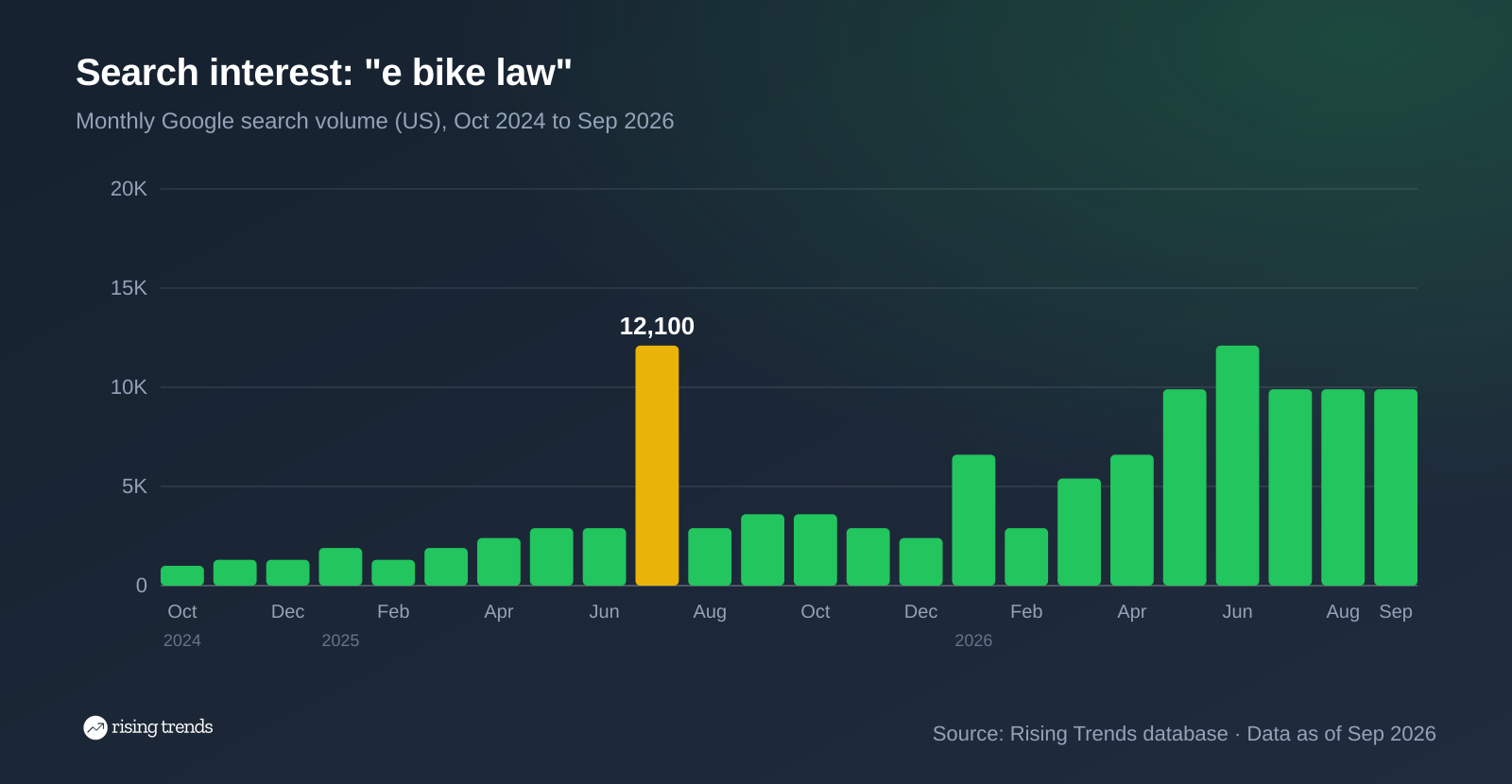
The shape is the tell. The term sits between 1,000 and 2,900 through late 2024 and early 2025, spikes to its peak of 12,100 in July 2025, settles back, and then ramps hard through 2026: 6,600 in January, 5,400 in March, 6,600 in April, 9,900 in May, 12,100 again in June, and then a flat 9,900 in July, August and September.
Those 2026 months line up with legislative sessions and signing dates, not with a viral moment. January is the New Jersey law. June and July are the Florida veto, the North Carolina signature and the Hawaii signature landing within three weeks of each other. The plateau since then is what compliance demand looks like once the questions stop being seasonal and start being permanent.
Now put the cluster side by side.
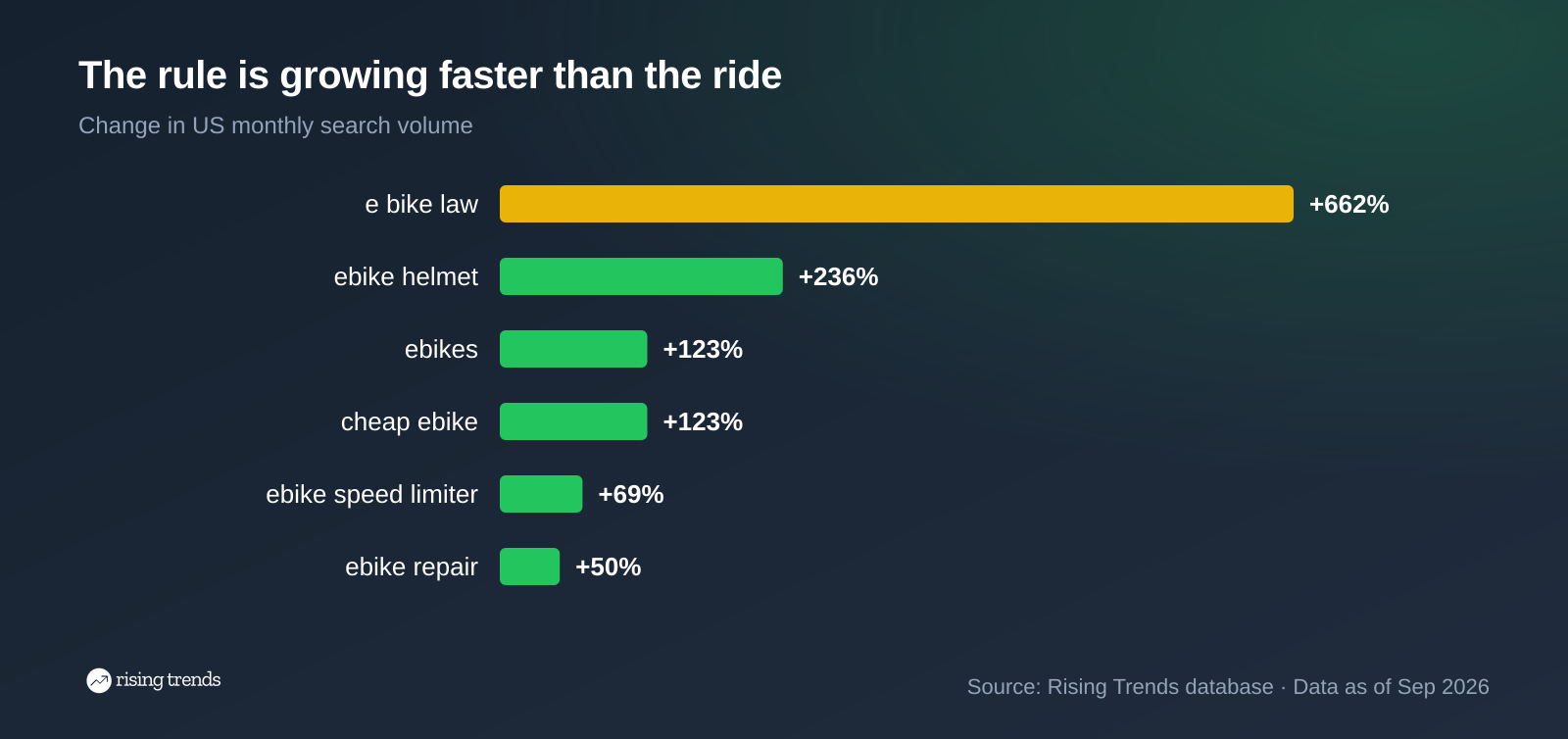
This is the whole story in one chart. The legal term grew 662% in two years. The vehicle term grew 123%. The gap between them is the gap between buying an e-bike and being allowed to ride it.
Look at second place too. "ebike helmet" is up 236% to 22,200 monthly searches as of September 2026. Helmet demand is not a taste. It is what happens when a dozen states write an age-based helmet rule in the same eighteen months. "ebike speed limiter" at 1,000 searches and up 69% is the same signal from the other end: riders trying to make a fast bike compliant rather than buying a slower one.
What actually changed in 2026
Three things happened at once. States rewrote their classification rules, a federal safety regulator published the injury numbers, and one state threw out the classification system entirely.
Start with the system most states use. Three classes, all capped at a 750 watt motor. Class 1 assists only while you pedal and stops at 20 mph. Class 2 can push the bike without pedalling and also stops at 20 mph. Class 3 is pedal-assist only and runs to 28 mph. North Carolina's new law puts it in almost exactly those words.
The clearest statutory text of the 2026 crop is North Carolina's Session Law 2026-46, signed July 7, 2026. Section 19 replaces the old treatment of Class 3 bikes as mopeds, which had carried registration and age baggage. It requires that "A person under the age of 18 operating or riding as a passenger on a Class 3 electric assisted bicycle shall wear a helmet", and it says plainly: "This section becomes effective December 1, 2026."
It also hands power downward. New sections let cities and counties regulate e-bikes on sidewalks and multiuse paths, restrict particular classes, set speed limits, and extend the helmet rule to Class 1 and Class 2 riders under 18. That last part is why a single statewide answer is never the whole answer.
Hawaii went in the same week. Act 259, signed July 15, 2026, took effect immediately. Its state DOT describes statewide rules for e-bikes and micro-mobility devices, a ban on devices over 750 watts or 28 mph on public roads and paths, mandatory labels showing class, top assisted speed and wattage, and a requirement that distributors hand buyers a pamphlet on state e-bike law. The helmet age for micro-mobility devices went from under 16 to under 18. Where a rider is under 18, enforcement can fall on a parent or guardian.
Oregon moved the other way. Its 2026 HB 4007, Chapter 101, lowers the minimum age for Class 1 e-bikes rather than raising it, makes helmet rules uniform for under-16 riders across bicycles, e-bikes and scooters, and creates two new offences aimed at sellers: improper sale or lease of a vehicle, and selling an "impostor vehicle", each carrying a maximum $250 fine.
That last offence is the quiet theme of 2026. Legislators stopped only regulating riders and started regulating what gets sold as an e-bike in the first place.
New Jersey is the one everyone is searching
If one state drove this curve, it is New Jersey, and it did it by deleting the three-class system instead of adopting it.
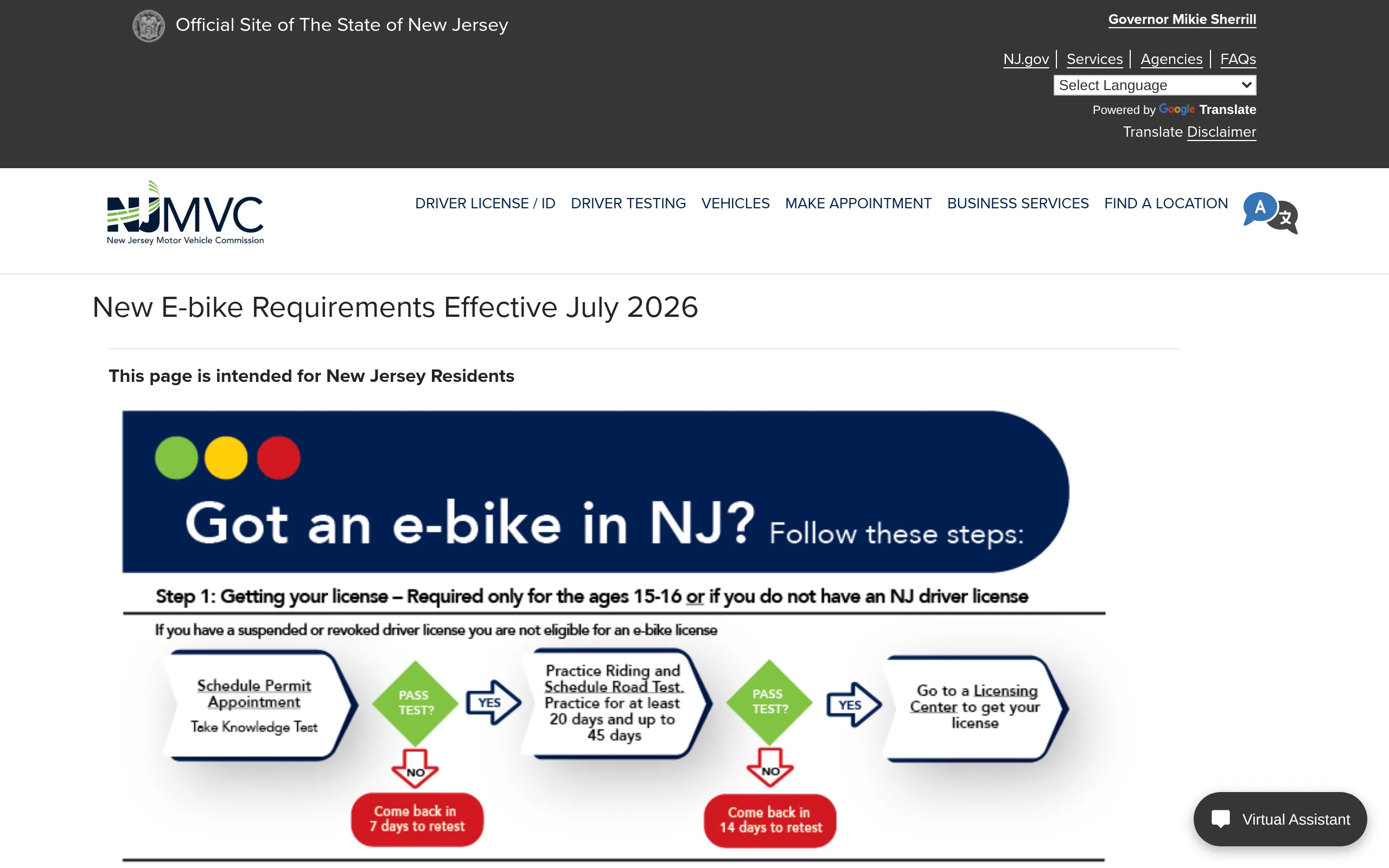
That is the state's official page, headed "New E-bike Requirements Effective July 2026", with a flowchart that walks a rider through a permit, a knowledge test, supervised practice and a road test. For a bicycle.
The NJMVC e-bike page sets out the requirements: "you must be at least 15 years old and have (1) an e-bike license or (2) a valid driver's license", and "E-bikes must be registered with the New Jersey Motor Vehicle Commission". Insurance is narrower than the headlines suggested: "Only motorized bicycles are required to have insurance coverage." The permit exam fee is $5, waived until January 2027. A road test has to be booked at least 20 days and up to 45 days after the permit is validated.
The MVC announced on June 23, 2026 that licensing and registration appointments would open three days later. Acting Chief Administrator Rosalie Johnson said in that release: "We strongly encourage e-bike riders to utilize the guidance on the NJMVC's website." Registration runs on form BA-49EB, and riders get two plate stickers to display on both sides of the front fork. The grace period ended July 19, 2026.
The pushback was immediate and is still running. The New Jersey Bike & Walk Coalition argues the law misses the target: "This law does nothing to address the real source of road danger in our state." The same page notes that over 500 people die on New Jersey roads each year, almost all in crashes involving motor vehicles rather than low-speed e-bikes. That is their position, not a finding, but it is the position the rollback campaign is built on.
And there is a rollback campaign. Senate bill S4830 would restore the low-speed exemption, dropping the licence, registration and insurance duties for e-bikes rated 750 watts or less with a 20 mph assisted top speed. It is not law. Riders are campaigning for it anyway.
This clip from @jesseserides1, posted on October 19, 2026, is that campaign in its native format.
A rider making an explainer about a bill number is the clearest possible illustration of why a legal phrase is now a 9,900-a-month search term.
The number that explains the whole wave
Legislators do not rewrite vehicle codes because of vibes. In April 2026 the Consumer Product Safety Commission published its micromobility injury and fatality report for 2017 through 2024, and the e-bike section is the reason half of these bills exist.
| CPSC finding, 2017 to 2024 | Figure |
|---|---|
| Estimated e-bike emergency department visits, 2024 | 59,200 |
| Annual average e-bike ED visits, 2017 to 2021 | 6,300 |
| Estimated e-bike ED visits, full period | 155,200 |
| Reported e-bike fatalities, full period | 310 |
| All micromobility fatalities, full period | 533 |
| Micromobility fatalities, 2017 then 2024 | 5, then 135 |
Read the first two rows together. The 2024 estimate of 59,200 e-bike ED visits is an increase of 52,900 over the 2017 to 2021 annual average, which CPSC calls statistically significant. That single row is the pitch deck every state sponsor used this year.
Two details matter for anyone selling into this. Rental e-bikes accounted for 11 percent of e-bike ED visits in the agency's 2024 follow-up study, so the bulk of the problem is privately owned bikes. And of the 310 e-bike fatalities, 19 were tied to 13 lithium-ion battery fire incidents. Batteries dominate the headlines; crashes dominate the data.
The federal response is still open. In June 2026 CPSC proposed a mandatory lithium-ion battery safety standard covering e-bikes, e-scooters, replacement packs, aftermarket chargers and conversion kits, with comments closing in August. Nothing is final, which is exactly why fifty state legislatures went ahead without it.
Who this actually hits
Riders in states that moved. North Carolina on December 1, 2026. Illinois on January 1, 2027, under Public Act 104-0854, which brings statewide rules including a 28 mph ceiling on roads and bike paths. Hawaii already. New Jersey hardest of all.
Parents. Almost every 2026 bill is an age bill underneath. Helmet ages moved to under 18 in several states, Hawaii can direct enforcement at a parent or guardian, and Oregon lowered a floor while tightening the helmet rule around it. Our data agrees: "ebike helmet" at 22,200 searches and up 236% in two years is not a cycling-enthusiast number.
Retailers and importers. Label requirements, pamphlet duties and impostor-vehicle offences all land on the seller. A bike that is legal to sell in one state can be an offence to sell in the next. This is the same compliance-becomes-a-purchasing-criterion pattern we traced through the PPWR packaging regulation, where the rule number out-grew every marketing adjective in its category.
Insurers. New Jersey created a liability-insurance requirement for motorized bicycles where none existed. If a second state copies that model, a product with no insurance market acquires one overnight, which is the kind of structural shift that shows up first in insurance trends.
The industry's lobbyists. PeopleForBikes says it tracked nearly 700 bike-related bills nationwide in 2026, and names the categories it fought: new e-bike definitions, licensing and registration mandates for low-speed e-bikes, road and trail bans, and battery and labelling compliance costs. Seven hundred bills in one year is the supply side of a 9,900-a-month search term.
What it means for business
The legal page is now the product page. Page one for this query is bike brands and law firms. Brands are writing state law guides because that is what buyers ask before they buy. If you sell e-bikes, your state-law content is a conversion asset, not a blog chore.
Fragmentation is the business model risk, not regulation itself. A single federal rule would be cheaper than fifty. Instead there are three classes in most states, no classes in New Jersey, a separate e-motorcycle category in Hawaii, and local overrides on top. Compliance cost scales with the number of rulebooks, which is why mid-sized sellers feel this before the big brands do.
Accessories inherit the demand. Helmets up 236%, speed limiters up 69%. Mandates create product categories. The same mechanism runs through auto and car trends, where safety rules reliably pull an aftermarket up behind them, and it is visible on the vehicle side too in the EREV trend.
Check what ranks before you trust it. Florida is the cautionary tale. CS/SB 382, "Micromobility Devices", was vetoed on June 25, 2026 and never became law. Plenty of pages ranking for Florida e-bike rules describe provisions from a vetoed bill. Rule pages age badly, and a wrong one costs a reader a citation.
What to watch next
Whether 9,900 holds. Three flat months at 9,900 after a 12,100 June suggests a plateau rather than a decay. North Carolina's December 1 date and Illinois's January 1 date both sit outside our current window, so if the curve steps up again in those months, the pattern is confirmed: this term tracks effective dates, not news cycles.
Whether New Jersey reverses. S4830 is the single highest-leverage bill in the category. If the strictest state walks it back, the registration-and-licence model stops spreading. If it does not, expect copycats, and expect "ebike helmet" and "ebike repair" to keep climbing as the compliance basket fills out.
Whether Washington finishes the job. The CPSC battery standard is proposed, not final. A federal rule would reset the labelling and import questions that states are currently answering twelve different ways, and it is the one development that could flatten this curve rather than feed it. Watch "ebike speed limiter" and "ebike repair" for the aftermarket's answer either way.
The useful way to read a 662% curve on a legal phrase is as a calendar. Terms that grow because of a date in a statute do not lose interest the way terms that grow because of a video do. Three more effective dates land between now and the new year, and everyone searching this right now will have to search it again. For the wider pattern of rules reshaping a consumer category, our legal trends coverage tracks the same shape across other markets.
Want to catch regulatory shifts while they are still search curves? Read our guide on how to identify market trends, or browse what is breaking out right now in our trending topics list.
Never miss a trend again
- One trend broken down with the numbers
- Who's making money, and what to build
- A website on the rise
- A breakout app
Join 5,000+ founders