Trends


Two years ago, 2,900 Americans a month typed "hiringcafe" into Google. As of August 2026 that number is 27,100, and the company has never spent a dollar on marketing. On September 28 it announced a $6.8 million pre-seed led by Spark Capital, took its AI Talent Agent out of beta, and confirmed what the search curve had been saying since January: a side project that started as a spreadsheet is now a job search engine two million people use every month.
Here is the part nobody ranking for the name has noticed. Over the same two years, searches for "indeed" fell 33% and the generic term "job search sites" fell 63%. The job-search market is not growing. It is changing hands. Our database has the curve for both sides of that trade, and the comparison is the whole story.
Key takeaways:
Let's get into it.
Here is the monthly search volume for "hiringcafe" over two years, straight from our database. It is a staircase with one obvious step.
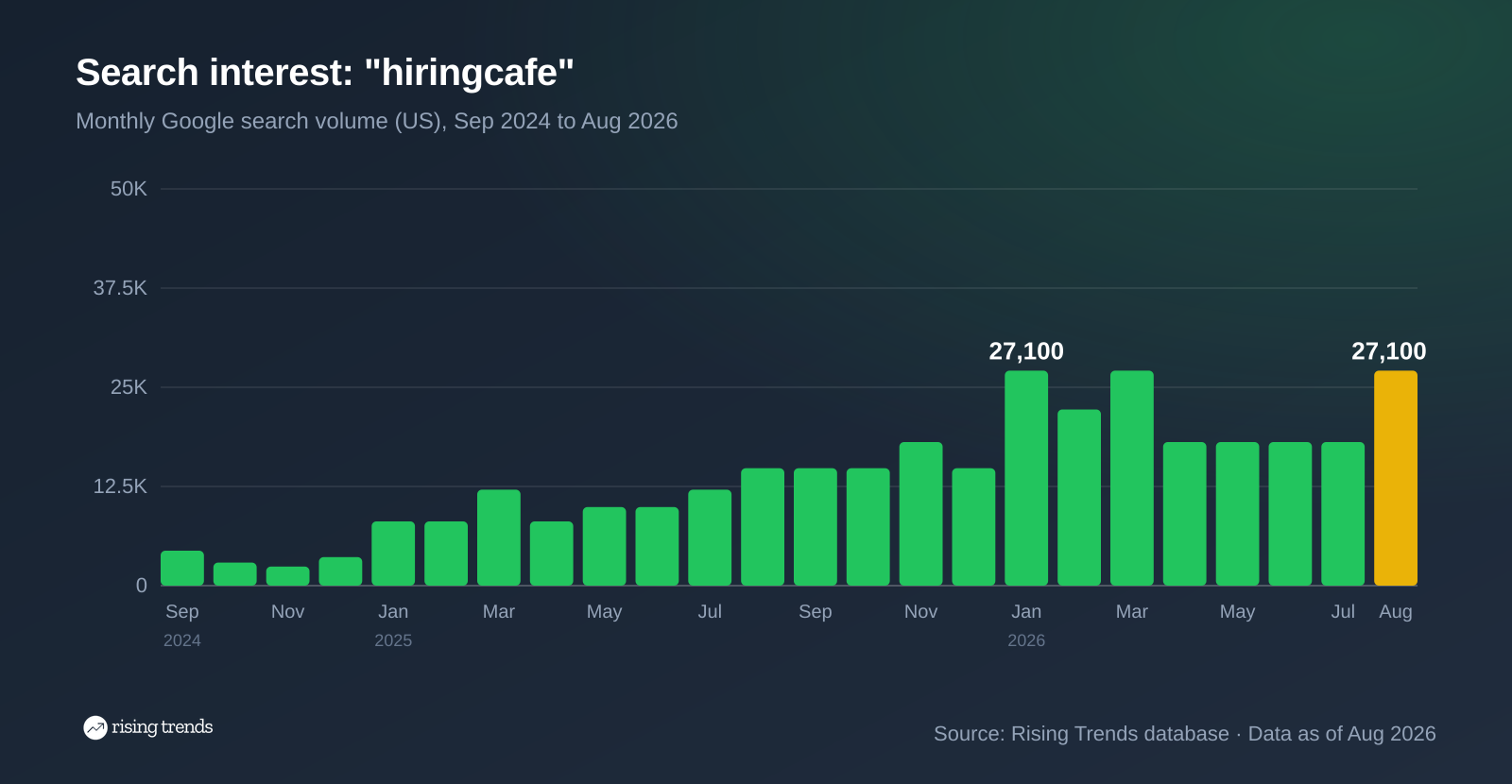
The breakout month in our data is January 2025, when volume first crossed a quarter of the eventual peak. The step everyone would notice is January 2026, when the curve jumped from 14,800 to 27,100 and then held. The last three months average 21,100 searches, which is 16.4 times the level of two years earlier. The database classifies the pace as RAPID and the trajectory as RISING.
What makes this interesting is not the growth on its own. Plenty of brands grow. It is what the rest of the category is doing at the same time.
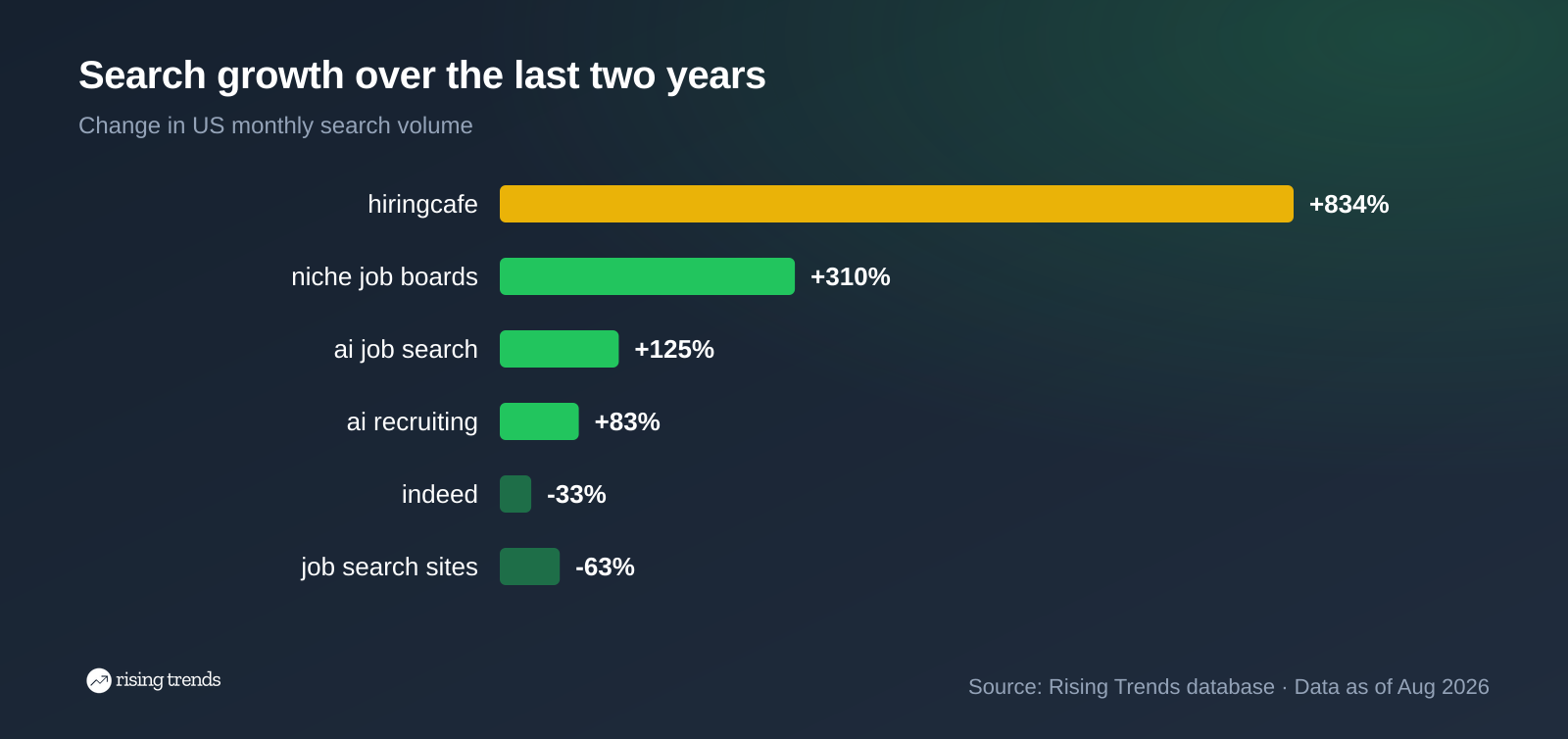
Two of those six bars point down, and they are the two that represent the old way of looking for work. Indeed is still enormous at 13,600,000 searches a month as of August 2026, roughly 500 times HiringCafe's volume, but it is down 33% over two years and flat year over year. "Job search sites", the term you type when you do not yet know where to go, has lost almost two thirds of its volume. Meanwhile ai job search is up 125%, ai recruiting is up 83%, and "niche job boards" is up 310%.
People are not searching less for work. They are searching for specific tools instead of generic categories.
The product is a search engine, not a job board, and the difference is the entire pitch. A job board waits for employers to send it a feed. HiringCafe crawls company career pages directly, the way Google crawls the web, and indexes what it finds whether or not anyone paid for the privilege.
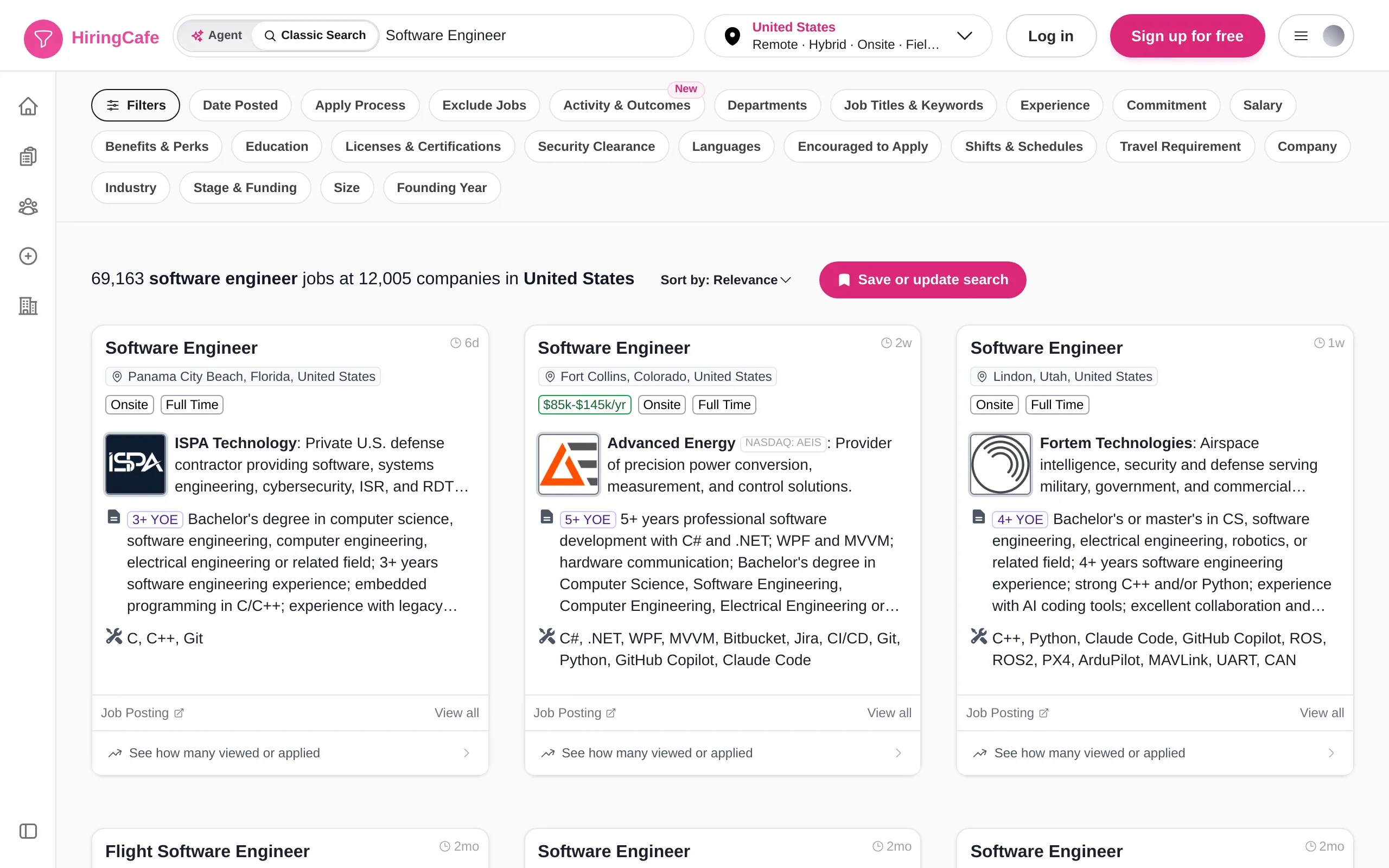
That screenshot is a live US software engineer search on the day this was published: 69,163 jobs at 12,005 companies. Look at the filter rail along the top. Security clearance, shifts and schedules, travel requirement, stage and funding, founding year. Those are not job-board filters. They are the filters you can only offer when you parsed the job description yourself rather than accepting whatever fields an applicant tracking system chose to send.
Note the toggle in the search bar too: Agent, or Classic Search. That toggle is a deliberate product decision, and we will come back to why.
The company's own explanation of the off-board job market sets out the thesis in five tiers of visibility. Tier one is a heavily sponsored listing that follows you around the internet. Tier four is a real, live, publicly posted job that sits on an employer's careers page and was never sent to any board, usually because distribution costs money or because nobody ever configured the feed. The company estimates 20 to 40% of live postings are off-board, and, to its credit, says plainly that this is an informed internal estimate rather than a published statistic.
The business model is the other half. Talent Agent, the AI job search product, is free, and the company says it always will be for job seekers. Employers can sponsor a job, but a sponsored listing is labelled, only appears when it fits your search, and never reorders anything else. Because "is HiringCafe legit" is one of the questions Google shows against the name, there is also a trust and safety page naming the operating entity, SPICYHR INC. of Cupertino, and linking its Better Business Bureau profile.
The trigger is dated and specific. On September 28, 2026, the company published a post announcing the funding and the Talent Agent launch on the same day, alongside a press release giving the full numbers.
Talent Agent is an agent that reads your resume, searches the whole index on your behalf 24 hours a day, and flags roles the moment they go live. It had been in beta for months. What changed on September 28 is that it opened to every US user at once, with a funding announcement attached.
The growth that made the round possible happened somewhere else entirely. The company's about page links its own launch threads, and they are Reddit posts: one on r/recruitinghell in 2024 titled "My 2-year plan to destroy Indeed", another on r/ChatGPT in 2025 titled "Update: I scraped 41 million jobs with ChatGPT". A 100,000-member subreddit grew out of those posts, and it is still where product feedback goes.
That is also where the sharing happens. Job seekers recommend HiringCafe to other job seekers, which is why it shows up inside almost every 2026 job-hunting video as a destination rather than a sponsor. This clip from @nextmovewithkamila, posted on August 25, 2026, is a typical example: a method for finding remote work in 2026 whose first named site is HiringCafe.
The press release carries a user testimonial that reads the way the Reddit threads read. "A few weeks ago I learned that my position is being eliminated and immediately went to HiringCafe," said Karen Joyce. "Today, I accepted an offer of employment with a new company." For a company with no marketing budget, that sentence is the marketing budget.
The founders are Ali Mir, previously an engineer at Meta, DoorDash and Rippling, and Hamed Nilforoshan, a Stanford computer science PhD who did data science at Airbnb and Snapchat. Mir quit his job in 2022 to build an HR startup, and when friends were laid off in the tech cuts he made them a spreadsheet of 10,000 hard-to-find startup jobs. The spreadsheet went viral. Nilforoshan, then still at Stanford, saw it and joined. Jure Leskovec, the Stanford professor and former Pinterest chief scientist, came in as an early investor and advisor.
| Date | Event | Figure | Source |
|---|---|---|---|
| 2022 | Founding spreadsheet of hard-to-find startup jobs | 10,000 roles, millions of views | HiringCafe press release |
| Aug 2024 | Public launch thread on r/recruitinghell | 2,900 monthly searches that month | Rising Trends database |
| Sep 28, 2026 | Pre-seed led by Spark Capital | $6.8M | HiringCafe, press release |
| Sep 28, 2026 | Scale at announcement | 2M monthly active users, 5M+ indexed jobs | HiringCafe press release |
The round included Nonfiction Capital, Silicon Gardens, Sarah Smith Fund, Night Capital, and angel investors from ZipRecruiter and Indeed. That last detail is worth sitting with: people who built the incumbents are funding the thing taking their search traffic.
"HiringCafe is building the absolute best product for people looking for a job, not for people advertising jobs," said Fraser Kelton, the Spark Capital general partner on the deal. "Their growth so far, without any marketing spend, is a testament to how much people want a product genuinely focused on helping them find one."
Two caveats. No valuation has been disclosed, and a $6.8 million pre-seed is a small round for a product serving two million people a month, which tells you the company has not yet committed to a revenue model. And the index numbers, the two million users and the claim of "up to 400% more" jobs than the big boards, all come from the company. Nobody audits job counts.
The team is still tiny. Its careers page lists eight founding roles, every one of them in-person in Cupertino.
The honest answer is that it is not up against Indeed yet. Indeed draws 13.6 million searches a month to HiringCafe's 27,100. That is a rounding error in the incumbent's traffic.
But direction matters more than level when you are reading a trend. Indeed's search demand has been falling for two years and is flat over the last twelve months. HiringCafe's doubled in a year. The incumbents are not losing because a challenger is big; they are losing because the generic habit, typing "job search sites" and clicking the first result, is dying. That term is down 63% over two years.
LinkedIn gave the clearest demonstration of why. In August 2026 it pushed every user into a mandatory AI job search, removing classic keyword-and-filter search entirely, and r/linkedin filled with threads about losing the ability to sort by salary. LinkedIn reverted the change within weeks. HiringCafe wrote up the episode in a post on LinkedIn's AI job search reversal, arguing that a feature trading transparency for speed should always be optional. That is the argument behind the Agent and Classic Search toggle in the screenshot above, and it is a sharper competitive position than any feature list.
The broader category is moving the same way. The AI recruiting tools we track across human resources are growing on the employer side while candidates adopt the mirror image, and our profile of micro1 shows what happens when the hiring funnel itself becomes an AI product.
Crowding is the incumbent's real problem. BambooHR's 2026 hiring analysis, drawn from five years of its own customer data, found applicants per posting nearly doubled from about 46 in 2021 to 95 in 2025, while the hiring rate fell from 4.5% to 2.8% and completed hires dropped more than 20%. Offer acceptance held steady in the mid-to-upper 70s, so candidates are not the ones saying no. The funnel is jammed at the top.
That is exactly the gap HiringCafe sells into. If a sponsored listing draws 400 applicants and an off-board listing draws a dozen, the second one gets read by a human. The company is explicit that this advantage is a distribution gap and that distribution gaps narrow as more people use it. That is a more honest framing than most startups offer about their own moat.
Ghost listings concentrate where the ad spend is. ResumeBuilder's survey of 1,641 hiring managers, published in 2024 and still the most-cited number on the subject, found 40% of companies had posted a fake job in the prior year and three in ten had an active one. Fake postings need an audience, so they live on the boards with traffic, not on an unpromoted careers page.
The same automation runs on both sides. Candidates mass-apply with AI agents, employers auto-reject with filters, and each escalation makes the other worse. The policy argument about who absorbs that friction is already live, and we covered one version of it in the 32 hour work week, explained.
Monetisation is the thing to watch, and the company knows it. Its own funding post asks the question directly: "Is this the first step toward the enshittification of HiringCafe?" The answer given is that investors were picked for alignment. The test is what the sponsored-listing product looks like in a year, because that is the exact mechanism the company spent two years criticising.
The agent is the new battleground, not the index. Every job platform is shipping an AI layer right now. HiringCafe's bet is that the agent is worth more when it sits on an index nobody else has, and that keeping classic search alongside it is a feature rather than legacy debt. If the 27,100 curve keeps climbing without another funding headline, Talent Agent is why.
The risk shows up as doubt, not churn. The questions Google surfaces next to the name are "How legit is HiringCafe?" and "Is hiring cafe better than LinkedIn?" A company whose entire acquisition channel is a Reddit community lives or dies on that trust. One bad monetisation decision would move those queries before it moved the usage numbers.
The signal to watch is the gap in that second chart. As long as "hiringcafe" climbs while "indeed" and "job search sites" fall, demand is moving from aggregators to indexes, and the next challenger will be built the same way. The live HiringCafe trend page is where that will show up first.
Want to spot the next breakout company before it raises? Read our guide on how to identify market trends, follow the live hiringcafe trend data, or browse what is breaking out right now on the Rising Trends dashboard.
Thousands of Emerging Trends
Thousands of Breakout Apps
Mega Trends
Trend Analysis Tool