
Trends


On September 8, 2026, Bernie Sanders and Mark Takano reintroduced a bill to cut the standard American workweek from 40 hours to 32. The press wrote it up the same week. What the press missed is that the search demand was already there. Our database shows "32 hour work week" running at 12,100 US searches in July 2026, a month before anyone reintroduced anything.
That is the part worth explaining. Over the last three months the term has averaged 9,133 searches a month, 4.72x the three months before it, and the bill landed on top of a curve that was already climbing. Every page ranking for this term right now is either a bill tracker or a rewrite of the press release. None of them has the demand curve, none of them reads past the headline number into what the bill does to a single workday, and none of them mentions the one American employer that has been running this exact schedule for two years and publishing the receipts.
Key takeaways:
Let's get into it.
Here is the last twelve months of search volume for "32 hour work week", straight from our database. The shape is the story: flat through winter, then a step change in June.
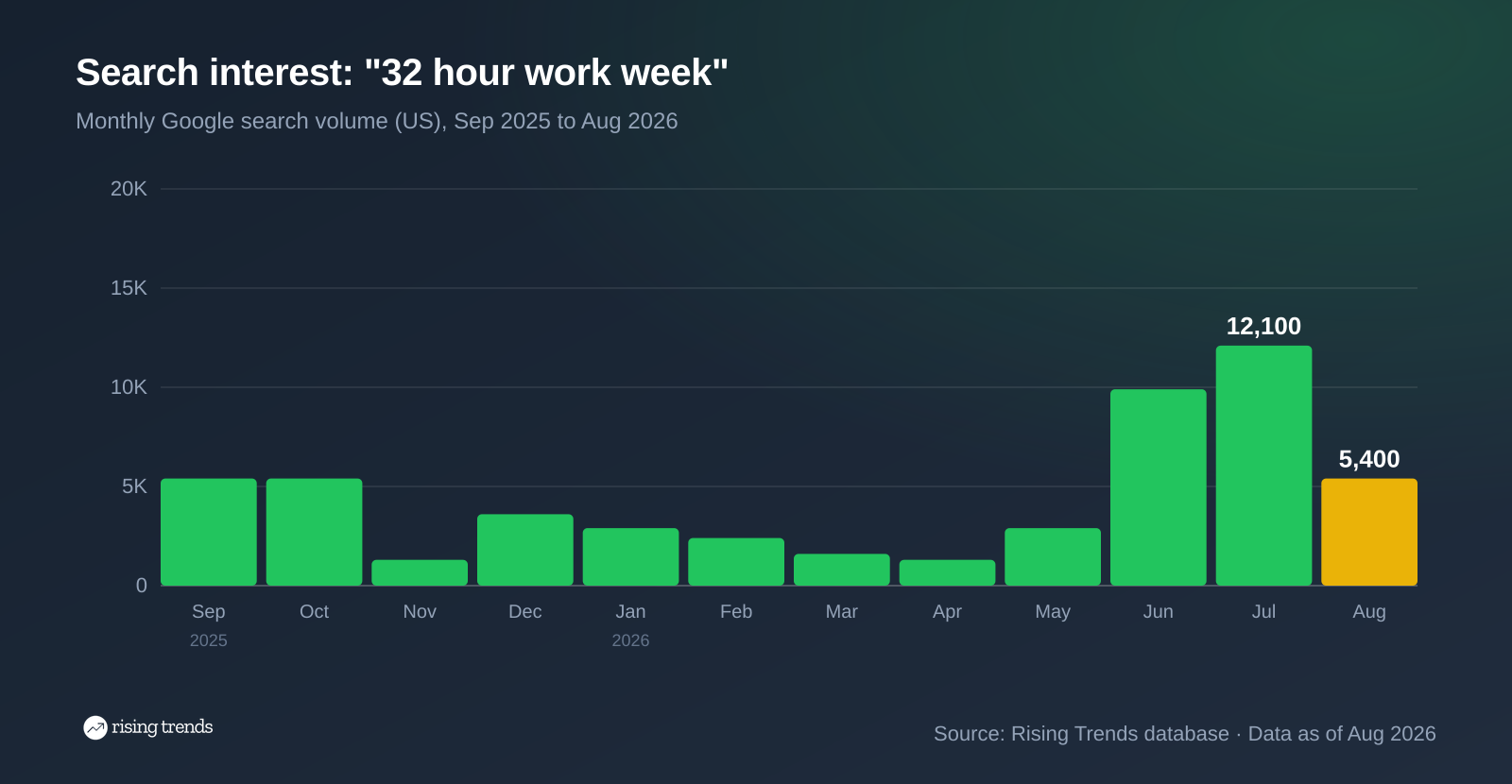
March and April 2026 sat at 1,600 and 1,300. Then June went to 9,900 and July to 12,100. August settled back to 5,400, which is still higher than every month from November 2025 through May 2026. The three-month average of 9,133 against 1,933 for the previous three months is where the 4.72x comes from.
Now zoom out, because the two-year view says something the twelve-month view hides.
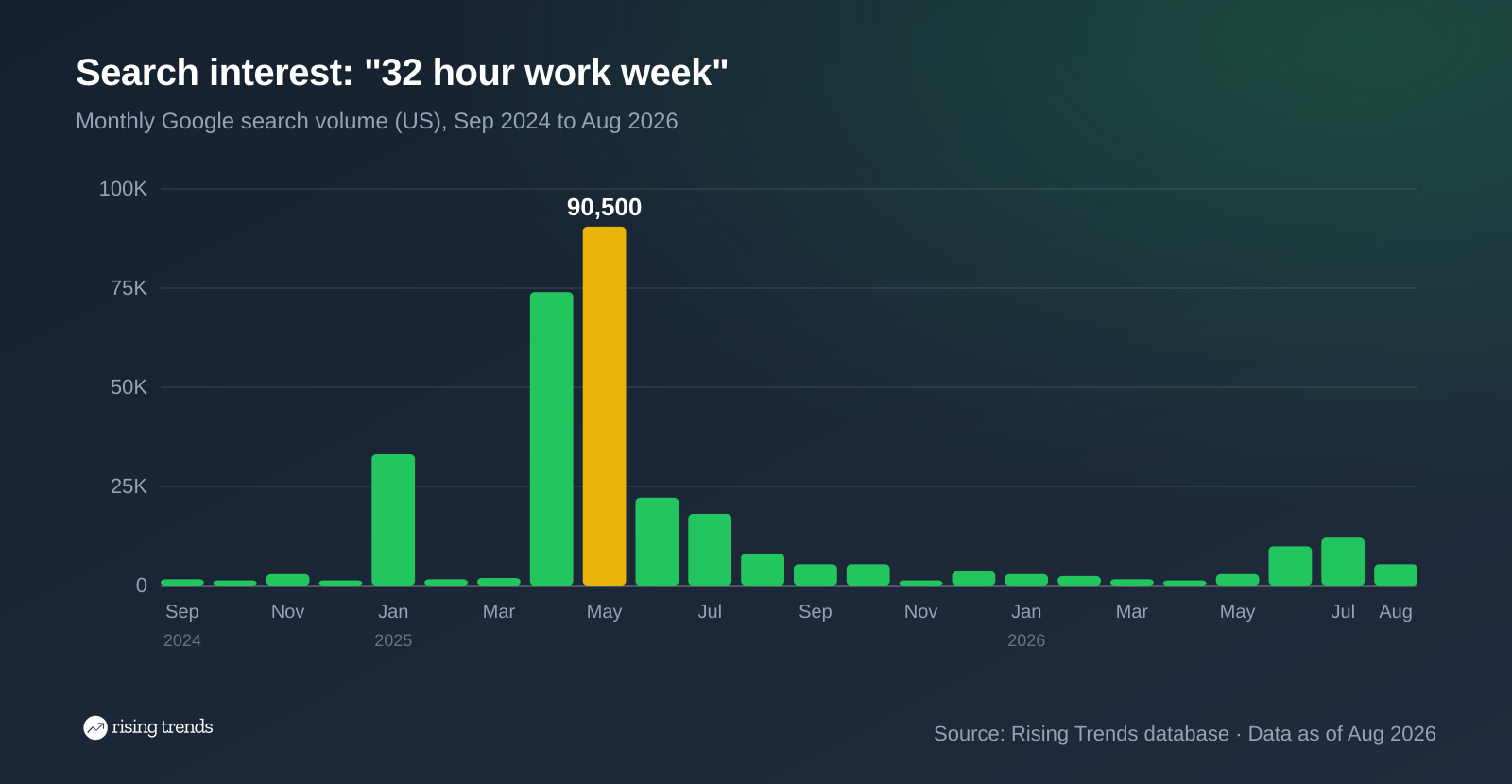
The all-time peak is 90,500 in May 2025, roughly seven times the recent high. This is a second wave, not a first. The term is down 33% year over year against a base of 8,100 and up 184% over two years against 1,900. Our classifier reads that combination as SLOW pace but RISING trajectory, which is the honest description: the spikes are big and the floor keeps moving up. You can watch it live on the 32 hour work week trend page.
The more useful comparison is who the term is competing with.
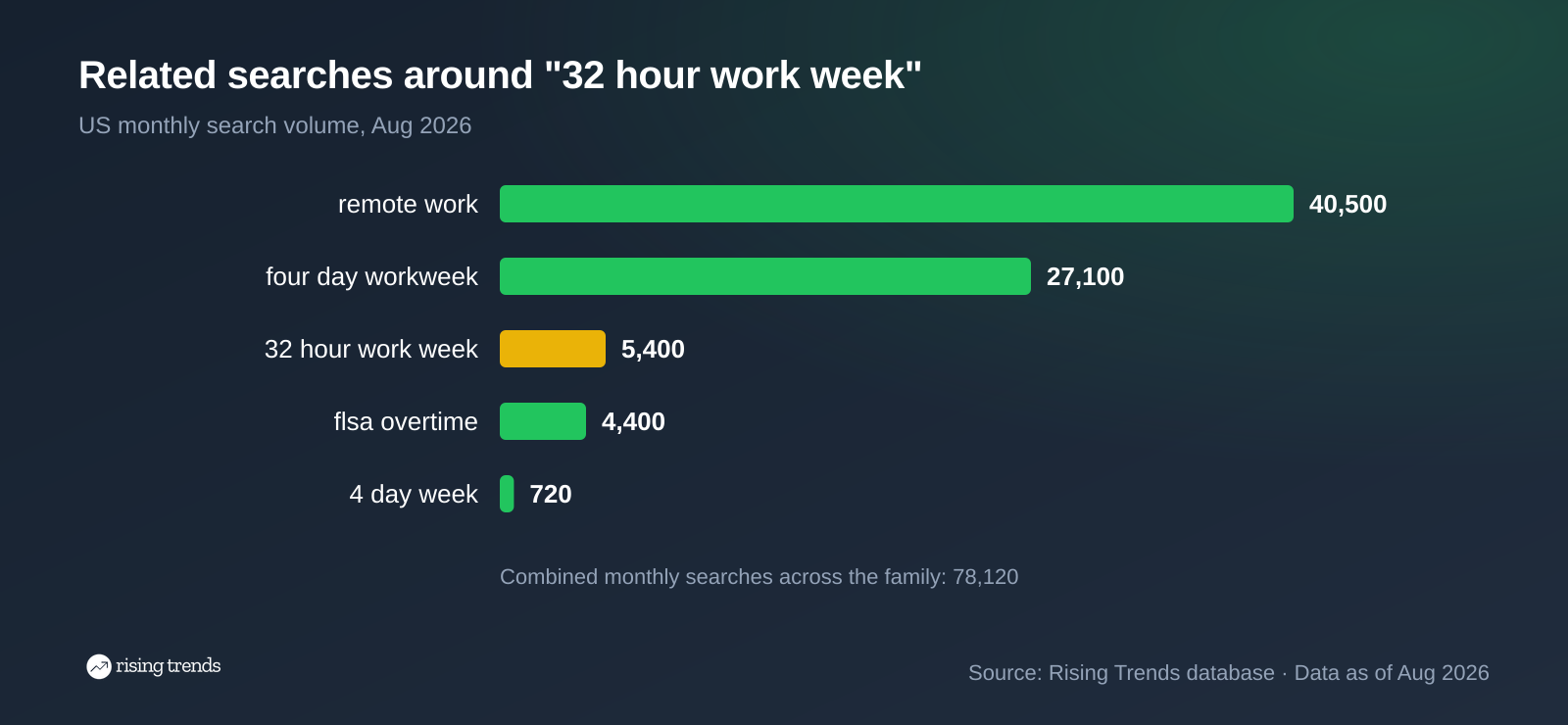
Four day workweek is at 27,100 a month and up 124% in a year, the only term in the set our database classifies as EXPONENTIAL. "32 hour work week" is at 5,400. Same policy, five times the demand, because one name describes a benefit and the other describes a statute. Meanwhile flsa overtime sits at 4,400 and remote work at 40,500 but flat, down 45% over two years. The flexibility argument has moved from where you work to how long.
Start with what it is not. It is not a cap on hours, and it does not cut pay. We read the full bill text rather than the summary, and the mechanism is an amendment to section 7 of the Fair Labor Standards Act, the section that has set the overtime line at 40 hours since 1940.
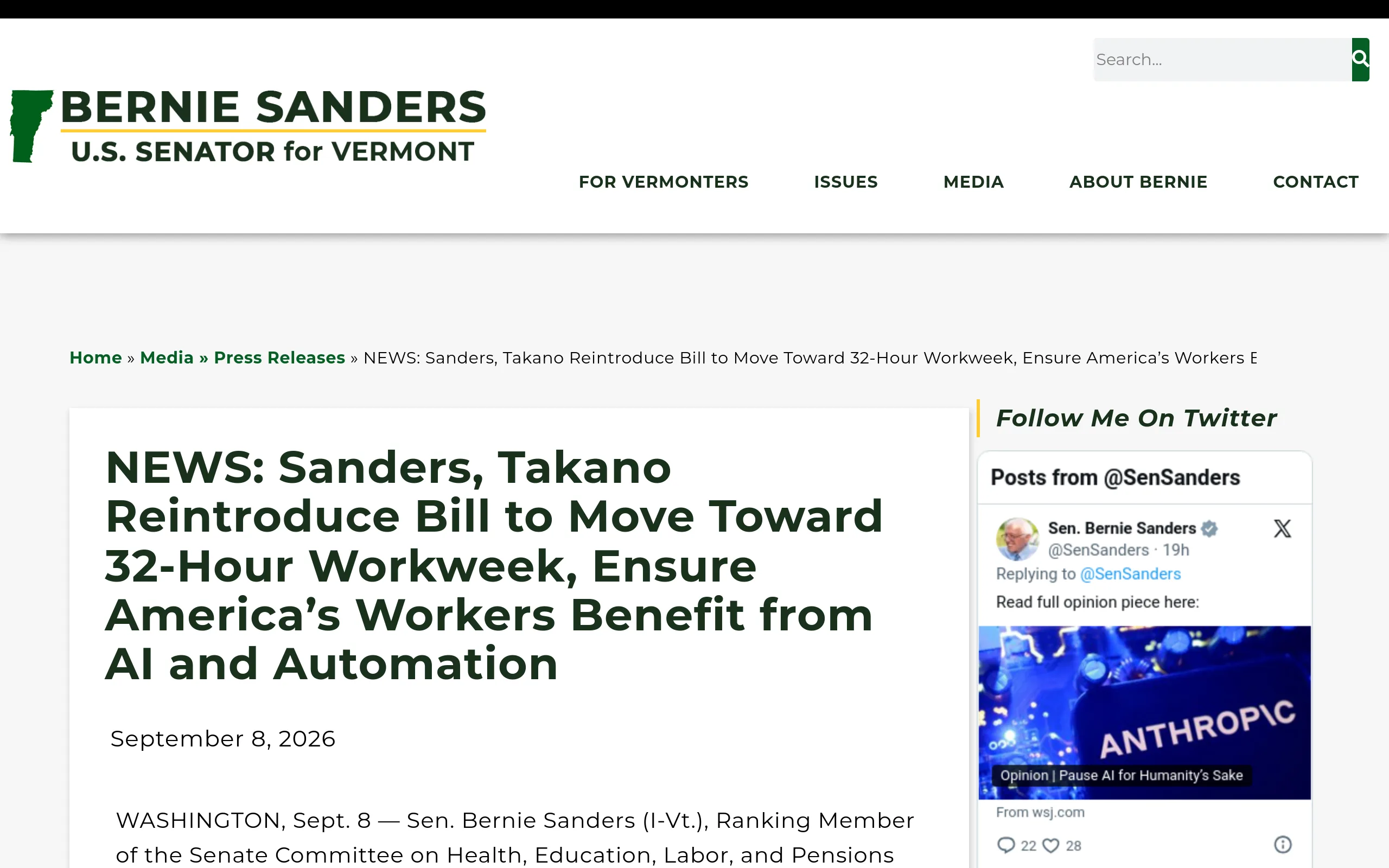
That announcement page is the primary document, and it is worth reading next to the bill, because the bill contains a provision the announcement does not lead with. Here is the whole thing in four rows.
| Provision | What it says | Why it matters |
|---|---|---|
| Weekly threshold | Overtime at 1.5x past 32 hours instead of 40, for nonexempt employees | The headline change. Exempt salaried staff are untouched. |
| Phase-in | 38 hours in year one (beginning no sooner than 180 days after enactment), 36 in year two, 34 in year three, 32 after that | Nothing changes on day one, and the full effect is four years out. |
| Daily overtime | 1.5x past 8 hours in a workday, and not less than 2x past 12 hours | The clause almost nobody is covering. It repriced the shift, not the week. |
| Anti-cut clause | Employers may not reduce total workweek compensation or any other benefit because of the change | Answers the most common objection to the bill directly. |
The daily overtime provision is the part that changes cost structures. A 12-hour nursing shift, a double in a kitchen, a long haul in a warehouse: under current federal law those hours only trigger overtime if the week runs past 40. Under this bill the eighth hour of the day triggers it, and the thirteenth hour costs double. The bill also amends section 18(a) to insert "or workday" alongside "workweek", which lets states set a stricter daily standard on top.
Takano's office frames the case with one comparison. Citing the Economic Policy Institute, its announcement says productivity has risen 93.2% since 1979 while wages rose 33.7%. Sanders puts the same argument in AI terms: "A 32-hour workweek is not a radical idea."
The June and July climb came before the reintroduction, which means something else was driving it. The most likely candidate is the same thing Sanders put in his own headline: automation. His press release ties the bill explicitly to AI and robotics, and the argument that productivity gains should be paid out in time rather than captured at the top has been running through the same feeds that search for this term. The companies building those gains are the ones we covered in our 2026 AI agents report, and the labour market forming around them is documented in our piece on micro1.
The September wave is straightforwardly media. National and local stations ran the story within 48 hours, and most framed it as a cost question rather than a policy one. This clip from FOX 11 Los Angeles, posted September 10, 2026, is the version most people saw, and its comment section, over 7,400 replies on the platform's own count, is a decent proxy for how the argument is going.
The dominant misreading is visible in the threads. On r/antiwork, the top complaint about an earlier version of the bill was "We can get a 32 hour work week but will only get paid for 32 hours. What's the point." That is exactly what the anti-cut clause forbids. Most of the search traffic is people trying to work out which version is true.
Fewer people than the headline suggests, and different people than most readers assume.
The bill touches nonexempt employees only. Salaried staff above the FLSA exemption thresholds, which is most of the office economy, are outside section 7 entirely and would see nothing change. The workers inside it are hourly: retail, hospitality, warehousing, healthcare support, call centres, manufacturing.
That inverts the usual four-day-week story. The trials everyone cites were run at knowledge-work firms where a shorter week means fewer meetings. This bill lands hardest on businesses that schedule by the shift, where the restaurant sector is the clearest case: long shifts, thin margins, and a labour line that already moves with every minimum wage change. Under the daily overtime clause a standard 10-hour restaurant shift carries two premium hours from the first year.
Business groups have read it the same way. The California Chamber of Commerce called the state-level version a job killer, and the Washington Hospitality Association testified against Washington's HB 2611, which would move that state's standard workweek to 32 hours and is still sitting in the House Labor and Workplace Standards committee. The unions on the other side are named in both press releases: AFL-CIO, SEIU, UAW, UFCW, National Nurses United and five more.
Most of the evidence in this debate is a pilot, run by the organisation that advocates for the policy. The exception is a county government in Washington State, and it is the most useful data in the whole file.
San Juan County adopted a 32-hour week in the autumn of 2023, not as an experiment in wellbeing but as a budget move: the union wanted cost-of-living increases the county could not fund, and shorter hours at the same pay was the counter-offer. In December 2025 the county published its two-year final report and made the schedule permanent.
The findings, from the county's own timesheets:
That last line is the one to keep. The productivity question is not whether people do 40 hours of work in 32. It is whether the organisation loses 20% of its capacity, and here it lost 13%, with the gap closed by hiring and retention rather than by intensity. County Manager Jessica Hudson's framing in the release is fiscal, not ideological: "As we face tighter fiscal years ahead, preserving the gains afforded by the 32HWW is even more critical."
Set against that, the advocacy numbers look less like outliers. 4 Day Week Global's UK pilot results report 92% of participating businesses continuing, attrition down 57% and burnout down 71%, though those come from the organisation running the programme and should be read as such. The independent-ish read is the American Psychological Association's 2024 Work in America survey, a Harris poll of 2,027 employed adults: 81% said they could be just as effective on four days, 79% said they would be happier, and the share whose employer already offers a four-day week rose from 14% in 2022 to 22% in 2024.
The cost is in the schedule, not the week. Any employer modelling this bill by multiplying headcount by eight hours is modelling the wrong clause. Daily overtime at 8 hours reprices compressed schedules, and double time at 12 makes the long shift the expensive one. The four-day, 10-hour arrangement that many companies adopted as their version of a short week becomes one of the costliest patterns under this text.
Retention is the line that moves first. San Juan County's biggest measured effect was not output, it was hiring: 216% more applicants and 27% faster fills. In tight labour markets that is worth real money, and it is the argument that will persuade finance teams long before the wellbeing argument does. The staffing pressure showing up across our human resources trends coverage points the same way.
Burnout has become a cost centre with a search curve. Sick time down 18% in a real payroll is a harder number than any survey, and it connects this policy to the demand we track across mental health trends. Employers who have been buying wellbeing apps are being handed evidence that the schedule was the intervention.
Compliance vendors win either way. Daily overtime calculations, a moving weekly threshold across four years, and a no-reduction clause to prove: that is payroll software, time tracking and employment counsel. Those categories get paid whether the bill passes or a state copies it.
The bill will not pass this Congress. It was referred to committee on introduction and has six cosponsors. GovTrack lists H.R. 10323 at the first stage of the process, which is where its three previous versions stopped. Treat the federal bill as a demand signal, not a deadline.
States are the real venue. Washington's HB 2611 is the one to watch, and San Juan County is the proof of concept its sponsors will cite. If a state passes a 32-hour standard, the federal search curve moves within a month.
Watch the terms, not the headlines. Three in our database will tell you where this goes. "Four day workweek" at 27,100 and up 124% is the demand. "Flsa overtime" at 4,400 is the compliance tell, and it will spike first if any legislature moves. "32 hour work week" itself is the politics, and its floor has risen from 1,900 two years ago to 5,400 now even in a quiet month.
The 40-hour week was not handed down. It was phased in by the same statute this bill amends, two years after that statute first set the line at 44. Whether or not H.R. 10323 goes anywhere, the argument it revived has a measurable audience, and that audience is not waiting for Congress to settle it.
Want to see which policy terms are breaking out before the coverage catches up? Read our guide on how to identify market trends, follow the live 32 hour work week trend page, or browse what is moving right now on the Rising Trends dashboard.
Thousands of Emerging Trends
Thousands of Breakout Apps
Mega Trends
Trend Analysis Tool