

A cluster of search terms in the Rising Trends database all started moving in the same month, and they are not the ones you would expect for autumn. "Rodent repellent pouches" is at 12,100 US searches a month as of September 2026, up 831% in a year and 2,421% in two. "Sofyre rodent repellent," a brand nobody searched for two years ago, is at 22,200. Meanwhile "mouse repellent" is down 55% over the same two years, and "rodent exterminator near me" is down 70%.
That is not a category growing. It is a category changing hands. Households that used to buy a bait station or call an exterminator are buying a mesh sachet of peppermint, cinnamon and cedarwood oil instead. Every page ranking for this term is a product listing with no date and no numbers on it, so below we do the part nobody has done: the measured substitution, the law quietly removing rat poison from the consumer shelf, and what the "EPA minimum risk" badge on these packets actually means.
Key takeaways:
- "Rodent repellent pouches" reached 12,100 US monthly searches in September 2026, its peak, up 2,421% in two years and classified EXPONENTIAL in the Rising Trends database (data as of Sep 2026).
- The old terms fell as the new one rose: mouse repellent, grandpa gus mouse repellent and rodent control near me are each down 55% in two years, and rodent exterminator near me is down 70%.
- Rhode Island's new law bans consumer-store sales of first-generation anticoagulant rodenticides from March 1, 2027, second-generation from January 1, 2028, and all use from January 1, 2029.
- EPA says only three actives are on the US consumer shelf: bromethalin, chlorophacinone and diphacinone. Two of the three are first-generation anticoagulants.
- SoFyre went from nothing to 22,200 monthly searches, with 4.9 out of 5 from 4,758 reviews on its page. BugMD's Vamoose shows 4.8 from 2,784. The incumbent, Grandpa Gus, is down 19% in a year.
- The pouches are legal because every oil in them sits on EPA's minimum risk list, and EPA states plainly that it does not review these products or their labels before sale.
Let's get into it.
What we're seeing in the Rising Trends data
Here is the monthly curve for "rodent repellent pouches" over the last two years, straight from our database. For most of that window the line barely registers. Then spring 2026 happens.
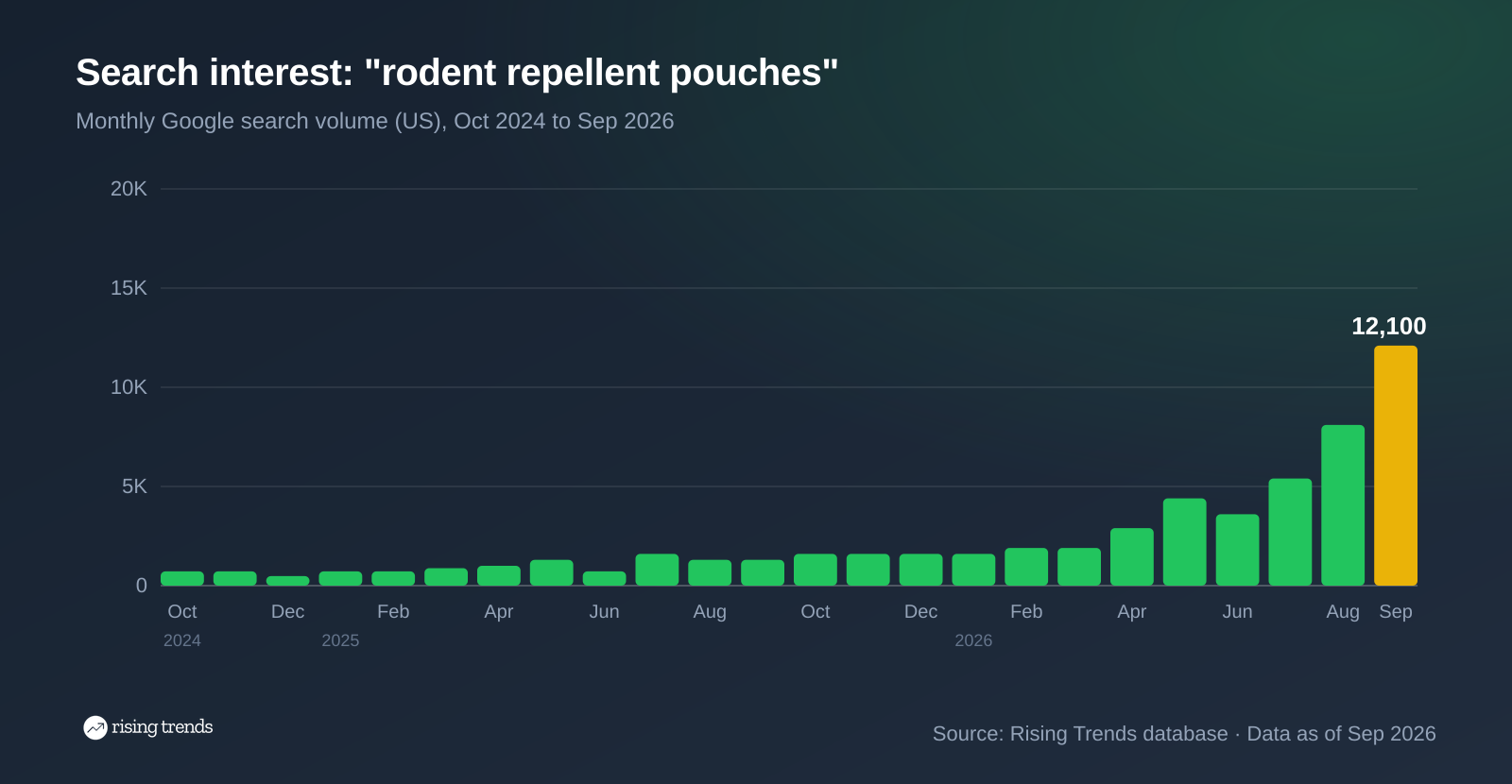
The breakout month is May 2026, when the term first crossed a quarter of its eventual peak. From there it roughly doubles every two months: 4,400 in May, 5,400 in July, 8,100 in August, 12,100 in September. A year earlier it was 1,300, and two years earlier 480.
Rodent searches are seasonal, and autumn always lifts them. That does not explain this one, because the rest of the category went the other way.
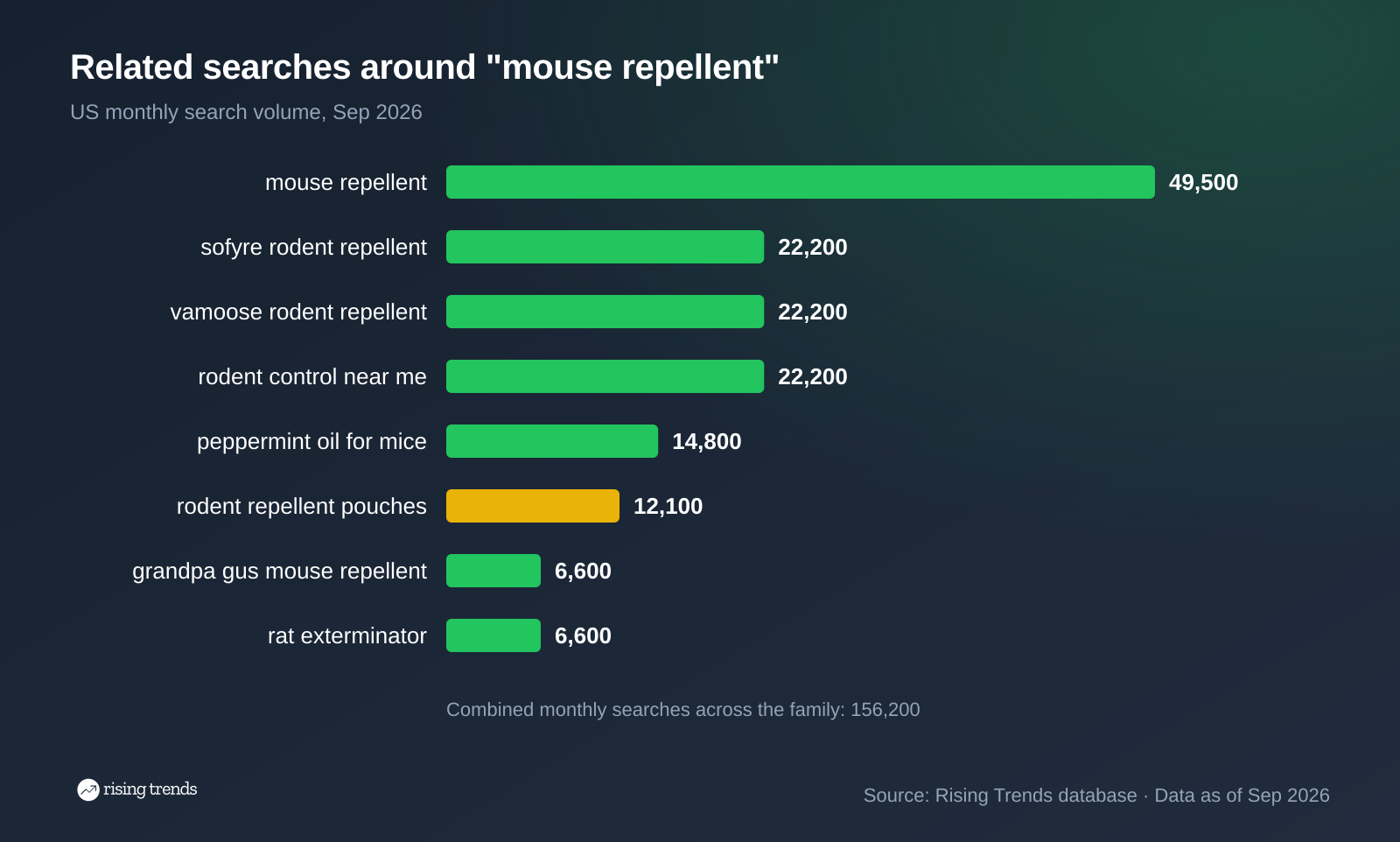
"Mouse repellent" is still the biggest term at 49,500. But two brand names that did not exist in our data two years ago now sit level with "rodent control near me" at 22,200 each, and the generic DIY term "peppermint oil for mice" is at 14,800 and falling.
Put the two-year change on one axis and the swap is unmistakable.
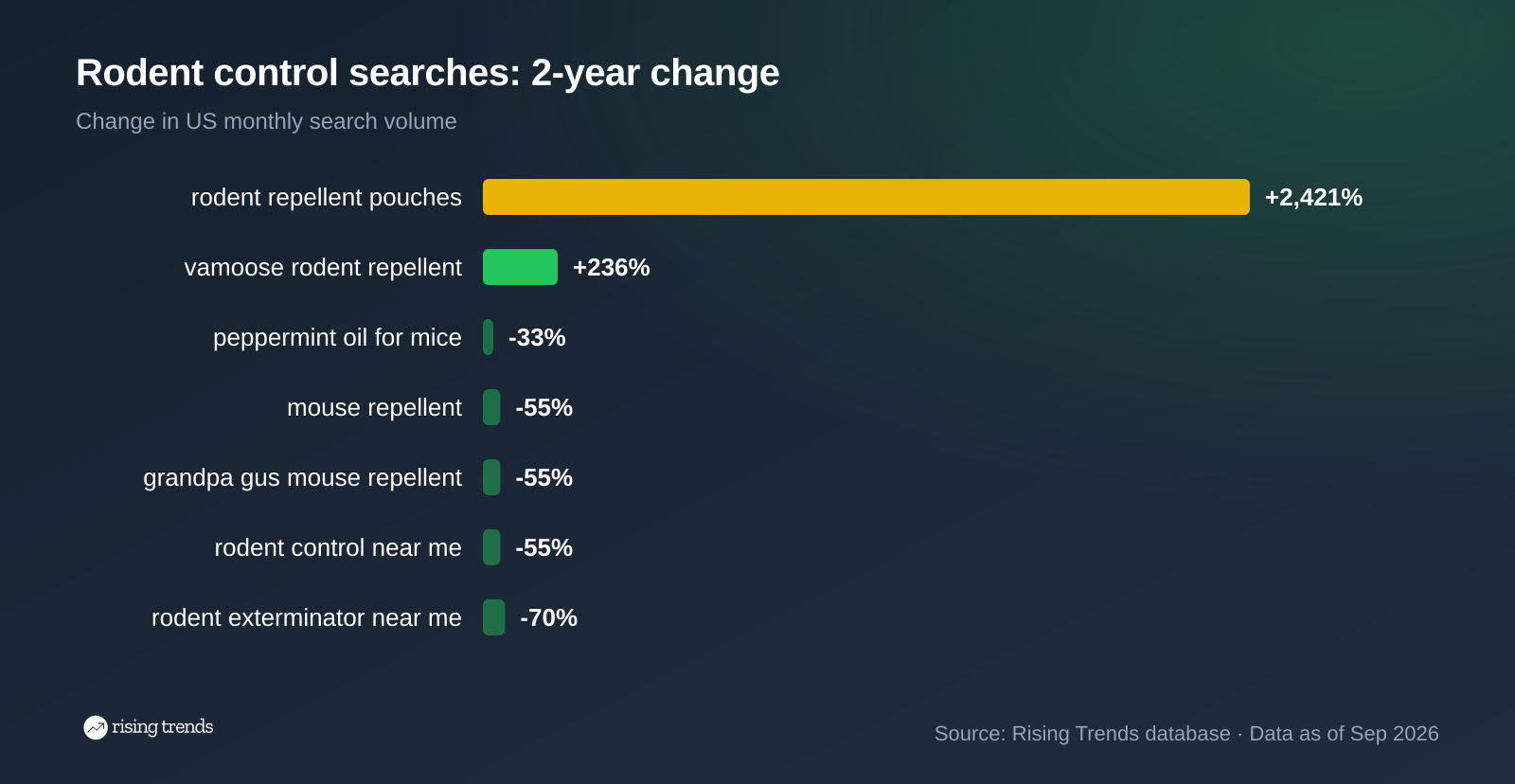
One term up 2,421%. Every legacy term down between 33% and 70%. "Rodent exterminator near me" is down 70%, the most interesting number on this page, because it is demand leaving the professional channel entirely.
What is actually changing on the shelf
Start with what a US consumer can legally buy. EPA's page on restrictions on rodenticide products is blunt: second-generation anticoagulants "no longer are registered for use in products geared toward consumers and are registered only for the commercial pest control and structural pest control markets." What is left for households is a ready-to-use bait station with one of three active ingredients.
| Active ingredient | Class | On the US consumer shelf today |
|---|---|---|
| Bromethalin | Non-anticoagulant neurotoxin | Yes |
| Chlorophacinone | First-generation anticoagulant | Yes |
| Diphacinone | First-generation anticoagulant | Yes |
| Brodifacoum, bromadiolone, difenacoum, difethialone | Second-generation anticoagulant | No, professional and agricultural only |
Now read Rhode Island's new law against that table. The text of 2026-S 2795 adds two sections to the state's Pesticide Control chapter. Section 23-25-41(a): "Effective March 1, 2027, all pesticides registered in the state as a first-generation anticoagulant rodenticide ... shall be prohibited from being sold in 'consumer' stores and online retail stores including, but not limited to, drug stores, grocery stores, hardware stores, club stores and similar retail outlets." The statute defines first-generation as chlorophacinone, diphacinone or warfarin. Second-generation sales stop on January 1, 2028, and from January 1, 2029 the use of either class is banned outright, with carve-outs for municipal public health work, medical waste sites and food production.
Do the arithmetic. Two of the three consumer actives disappear from Rhode Island retail on March 1, 2027, leaving bromethalin as the only poison a Rhode Islander can buy for a mouse. That is the detail every product listing ranking for this term has missed, and it is why a scent sachet stopped looking like an alternative and started looking like the default.
Rhode Island is first, not alone. Vermont's H.758, an act relating to banning the use of rodenticides, was read a first time on January 22, 2026 and sits in committee. Regulation reshaping an aisle before shoppers notice is a pattern we tracked when PPWR came into application.
Why it is trending now
The law is the slow driver. The fast one is that the method went mainstream on video just as rodents move indoors.
The framing in these clips is identical: no poison, no snap traps, nothing a dog or a toddler can get at. This short from the channel Ari Picks, posted on September 20, 2026, has 735,000 views.
View counts on that scale are the demand, not the business. The business is what happened next: somebody packaged the demonstration. "Peppermint oil for mice" is down 63% in a year while the packaged term is up 831%, and that gap is the whole commercial story. People do not want to buy a bottle of oil and soak cotton balls.
The third driver is the car. Our database files this trend under both Home Improvement and Autos and Vehicles, which is unusual, and it reflects where buyers put these things: engine bays, stored RVs, boats and garages over winter. Rodent damage to wiring is a claim nobody wants to make, and a sachet in the air box is a cheap hedge, which is why it sits beside every other preventative in the 2026 auto trends we track.
The players, and who is losing
Three brands carry most of the branded search here, and none of them owns the category.
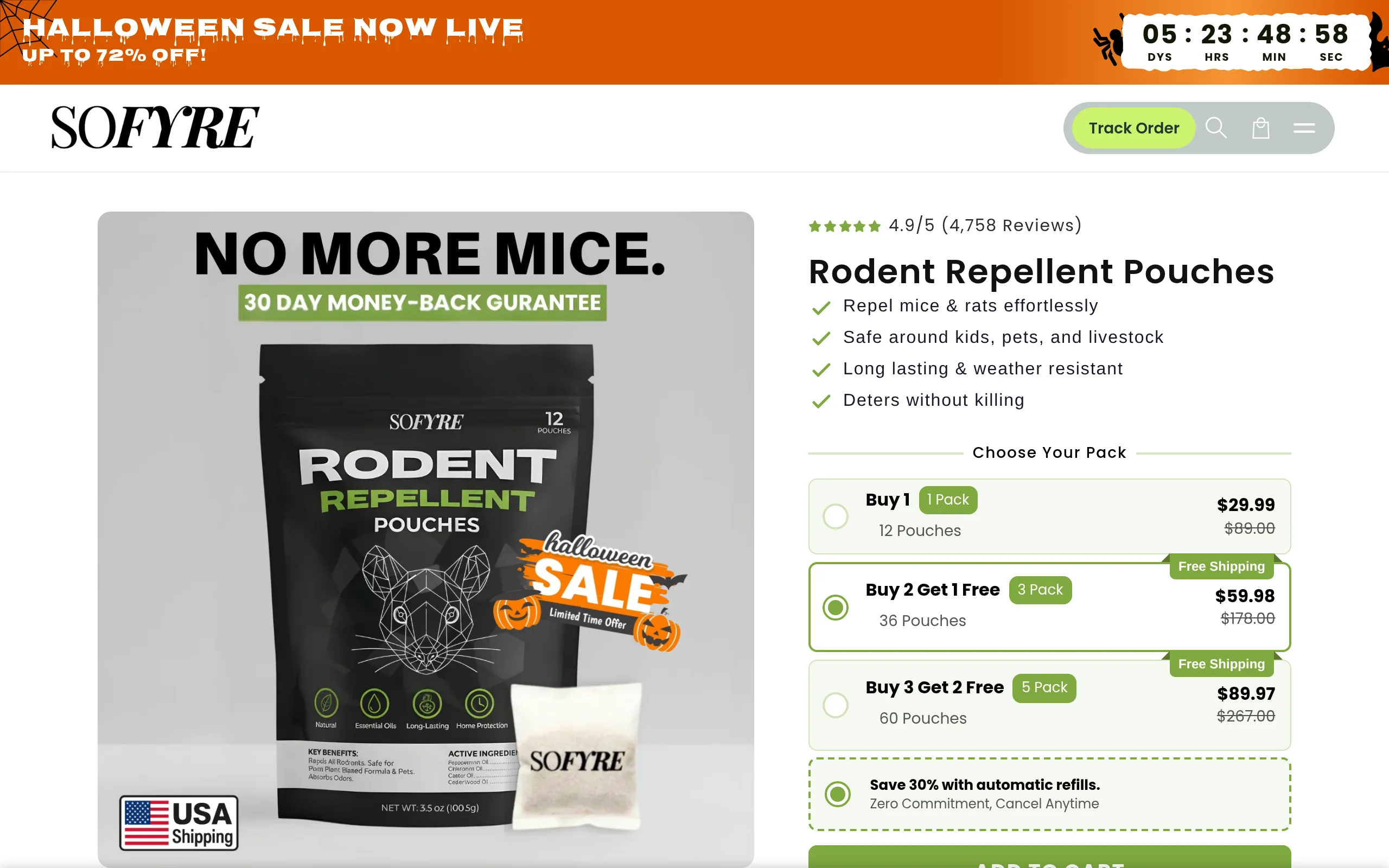
SoFyre is the breakout. Its brand term went from nothing in our data to 22,200 searches a month, with another 3,600 on "sofyre rodent repellent pouches," and the whole business is a single rodent repellent pouch product page with 4.9 out of 5 from 4,758 reviews. The page publishes a full formula, rare in this category: 22% active essential oil concentrate, made of peppermint oil at 8%, cinnamon at 5%, cedarwood at 4% and a proprietary complex at 5%, in a castor oil carrier. It claims up to 90 days per pouch and 65 square feet of coverage. On the day we captured it, 12 pouches were $29.99 against a $89.00 compare-at price, with a 30% discount for automatic refills.
BugMD's Vamoose is the volume play. Its Vamoose rodent repelling pouches page shows 4.8 out of 5 from 2,784 reviews and a $39.97 entry price, on a different oil set: cornmint, citronella and linseed. The brand term is at 22,200 a month, up 236% in two years.
Grandpa Gus is the incumbent being passed. Its mouse repellent pouches use peppermint and cinnamon oil, claim "up to 30 days" per pouch, and the page cites "over 15,000 5-star reviewers," a bigger review base than either challenger. The brand term is still down 19% in a year and 55% in two.
Duration is where the challengers are attacking.
| Brand | Oils on the label | Claimed duration per pouch | Reviews shown on page |
|---|---|---|---|
| SoFyre | Peppermint, cinnamon, cedarwood, castor carrier | Up to 90 days | 4.9 / 5 from 4,758 |
| BugMD Vamoose | Cornmint, citronella, linseed | Not stated on page | 4.8 / 5 from 2,784 |
| Grandpa Gus | Peppermint, cinnamon | Up to 30 days | "Over 15,000 5-star reviewers" |
A 90-day claim against a 30-day claim is a 3x difference in replacement cost, and it is a comparison a shopper makes in five seconds. It is also a claim nobody at EPA has checked.
What "EPA minimum risk" on the packet really means
Every brand here leans on the same phrase. BugMD's page says the product "contains ingredients from EPA's minimum risk pesticide group, so it's safe* to use around kids and pets," asterisk included. The claim is true, and narrower than it sounds.
Peppermint, peppermint oil, cinnamon oil, cedarwood oil, cornmint oil, citronella oil and castor oil are all in table 1 of 40 CFR 152.25, the minimum risk pesticide exemption EPA created in 1996. A product whose actives are all on that list is exempt from federal pesticide registration if it meets the conditions: name every active ingredient and its percentage by weight, give the producer's name, address and phone number, claim no control of disease-carrying pests, and include nothing false or misleading.
What the exemption does not include is any review. EPA's own page on minimum risk pesticide definition and product confirmation puts it in one sentence: "Generally, we do not review products that claim to meet the criteria ... We also do not provide a label review of such products. The producer is responsible to carefully read the criteria and make an evaluation of how the product meets (or does not meet) the criteria."
So "EPA minimum risk" means the ingredients are on a list of substances EPA decided pose little risk. It does not mean a regulator tested whether the pouch repels a mouse, or for how long. We are not going to tell you whether these work, because nobody has published an independent test we would stand behind. We can tell you what is claimed, what is checked and what buyers report, the same discipline we applied to plant-oil health claims.
What buyers are actually saying
The reviews on the brand pages are seller-published, so read them as what customers report rather than as evidence. The pattern in them is still consistent.
Frank Schweitzer, a verified customer on BugMD's page, writes: "I started using vamoose last year. Mice were running everywhere. I put it out in every room, and under each bathroom vanity. The rodents left within a couple of weeks."
The useful reviews are the ones that name a cost. Jonathon Haas: "The Vamoose works great! I use it mostly in the garage and my workshop. My wife does not let me use it in the house as she is sensitive to smells and the Vamoose bothers her." That is the category's real trade-off: the product works by smelling strongly enough to be unpleasant, and some of the people it is unpleasant to live in the house.
Two behaviours recur. People deploy many pouches at once, which is why pack sizes have climbed to 40 and 60 units. And they treat it as prevention on a calendar rather than a response to an infestation, which is the subscription shape SoFyre is already selling.
What this means for the businesses in it
The pest control channel is losing the top of its funnel. "Rodent exterminator near me" is down 70% in two years and "rat exterminator" is down 33%. A household that buys a $30 sachet in September does not call anyone in October, and the jobs that remain are the bad ones: higher cost to serve, no cheap preventative work to balance them.
The category has no owner, which is the opportunity. The terms on our family chart carry over 150,000 searches a month between them, and the largest branded term holds 22,200. There is no Tomcat of repellent pouches yet. The brand that wins will be the one that solves duration credibly, because 30 days versus 90 days is the only axis shoppers can compare without a lab.
Consumables plus a calendar beats hardware. This is a product that expires on purpose, in a category with a season, which is the best possible subscription mechanic. Compare the other route into household pest control, where a laser mosquito zapper arrives at $988 and sells once.
Shelf space is about to be re-cut. Rhode Island retailers have to clear first-generation anticoagulants from consumer aisles by March 1, 2027, and something fills that facing. The brands holding the shelf map will be the ones with retail distribution and a compliant formula, which the DTC breakouts are not.
Where this is heading
Three calls, each with a term in our database to watch.
The brand terms decide whether this is a category or a moment. "Sofyre rodent repellent" at 22,200 is a single-product company's entire demand, built in under two years. If it holds above 10,000 through the spring low season, this is a durable category. If it halves by April, it was a paid-acquisition spike.
The legacy terms will keep sliding, and that is the signal that matters. Watch "mouse repellent" at 49,500 and "rodent control near me" at 22,200. The replacement is confirmed when the new branded terms together pass the old generic one, not when the new term merely grows. The same crossover played out in the non-toxic kitchen, where titanium cookware replaced the PFAS-free wording rather than sitting alongside it.
Someone will test the labels, and the claims will get narrower. A category selling scent-based deterrence on an exemption with no efficacy review, with duration claims varying 3x between brands, is waiting for a regulator or a plaintiff. The condition that matters prohibits false and misleading statements, and it is enforceable even when nothing was reviewed in advance. Watch "rodent shield," a small term at 720 and up 324% in two years, for the kind of framing brands move to when a claim gets harder to make.
The honest summary is the one our data supports and the product pages do not. Rat poison is not being out-competed on performance. It is being legislated off the consumer shelf, one state at a time, and a sachet of peppermint oil is standing where it used to be. It is the same quiet pattern we saw when a bar of persimmon soap replaced a deodorant: the category did not grow, it moved.
Want to catch category swaps like this while they are still in the search data? Read our guide on how to identify market trends, or browse what is breaking out right now in our trending topics list.
Never miss a trend again
- One trend broken down with the numbers
- Who's making money, and what to build
- A website on the rise
- A breakout app
Join 5,000+ founders