
Trends


For most of the last two years, almost nobody typed "truth api" into Google. Our database logged about 10 searches a month, every month, for eleven months straight. Then Trump Media announced a product on July 16, 2026, and the term went to 5,400 in July and 18,100 in August 2026. That is the kind of curve you normally see on a consumer launch, not on a business-to-business data feed sold to high-frequency trading desks.
Truth API is a paid, machine-readable feed of posts from the ten most influential Truth Social accounts, delivered to institutional customers in milliseconds. It costs up to $100,000 a month. It has been sued twice, briefed against by the Electronic Frontier Foundation, and argued over in a Manhattan courtroom. What nobody ranking for the term has is the demand data: Truth API already draws four times the monthly searches of the X API, while the platform it pulls from sits 91% below its own search peak. That gap is the story.
Key takeaways:
Let's get into it.
Here is "truth api" over the last two years, straight from our database. There is no ramp. There is a flat line at 10 searches a month, and then a product announcement.
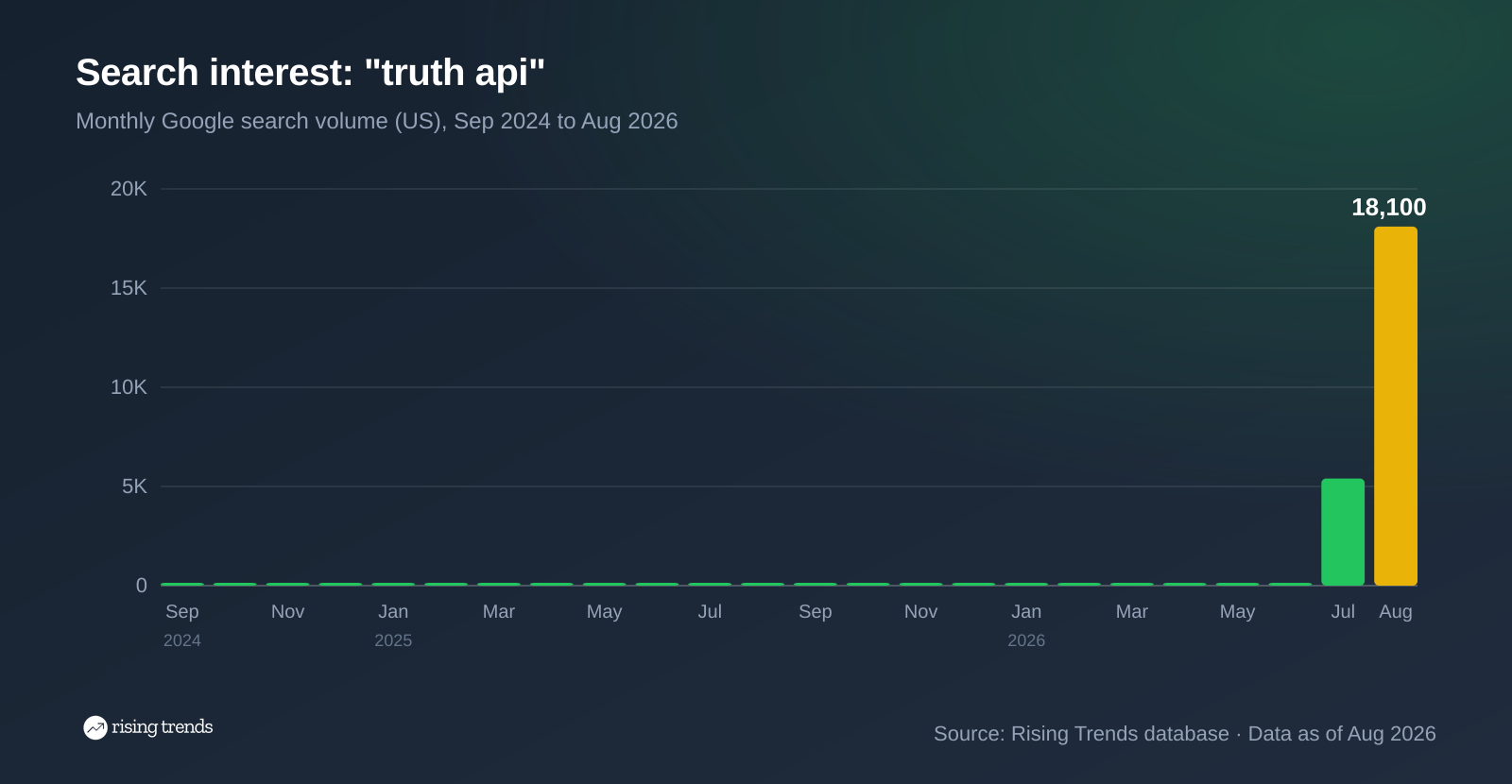
The breakout month is July 2026, when the announcement landed and the term hit 5,400. August, the first full month of availability, took it to 18,100. Our classifier reads the pace as EXPONENTIAL and the trajectory as RISING, which for a term with no search history before this summer simply means it has not peaked and turned yet. You can follow the live curve on the Truth API trend page.
Put it next to the terms around it and the proportions get interesting.
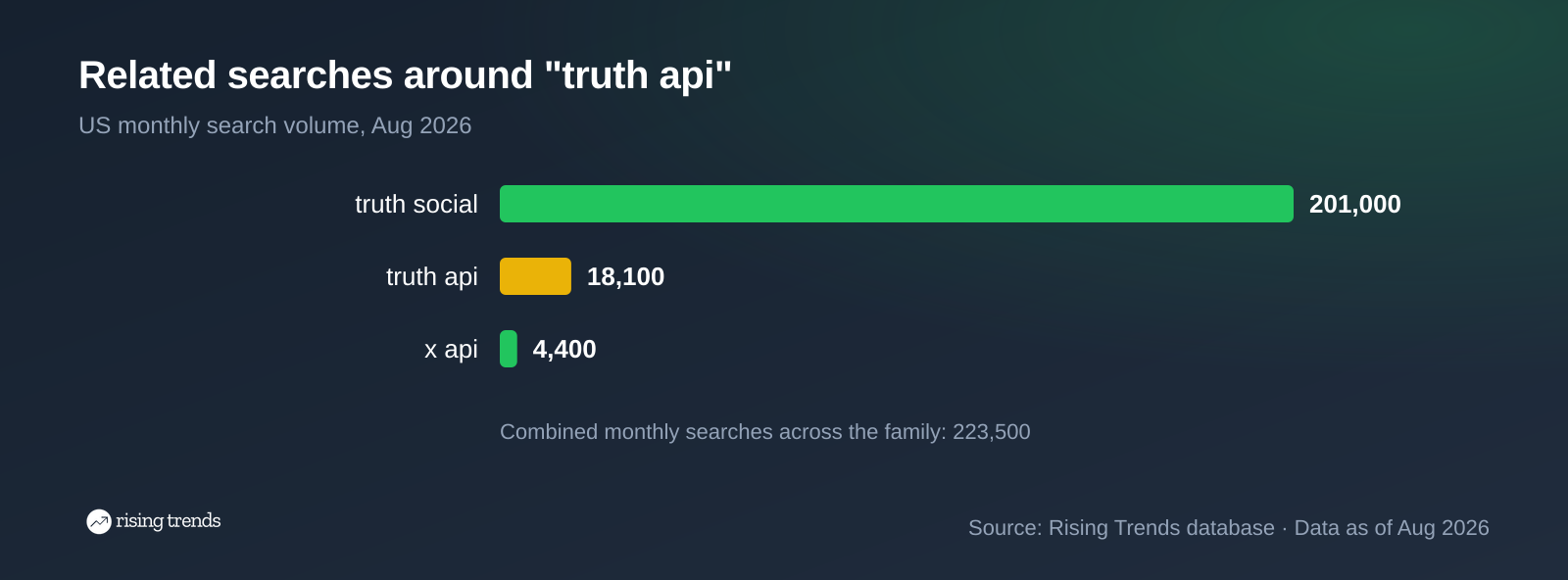
In its first full month of availability, a B2B data feed is pulling 9% of the search volume of the entire platform it sits on. It is also pulling 4.1 times the volume of x api, the paid social data feed that Wall Street and academia have been arguing about since Twitter started charging for it. The X API is a real business with a decade of history and 4,400 monthly searches as of Aug 2026, up 52% on the year. Truth API has been on sale since August 1.
For scale on the other side, bluesky sits at 1,220,000 searches a month. Nobody searches for its API. The interest in Truth API is not developer interest. It is people trying to work out whether what they just read about is legal.
The product was announced in a press release that Trump Media filed with the SEC as an exhibit on July 16, 2026.
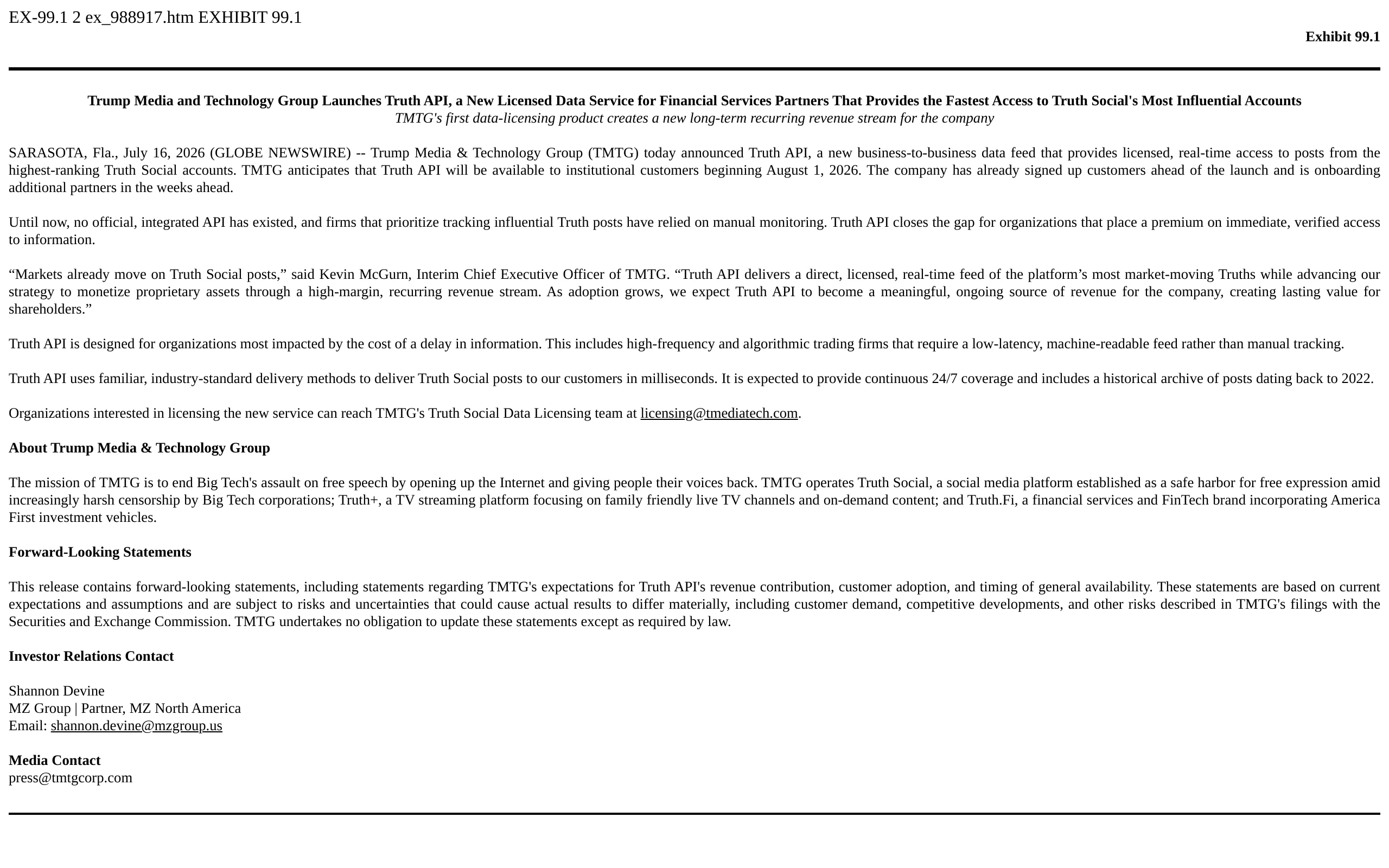
The launch release describes a business-to-business feed with four properties: licensed real-time access to posts from the highest-ranking Truth Social accounts, delivery "in milliseconds" by industry-standard methods, continuous 24/7 coverage, and a historical archive of posts dating back to 2022. Availability was set for August 1, 2026. Interested organisations were pointed at a data licensing inbox. The intended buyer is named outright: "high-frequency and algorithmic trading firms that require a low-latency, machine-readable feed rather than manual tracking."
The release does not print a price. Two other documents do. Senators Adam Schiff and Elizabeth Warren, writing to the SEC on July 28, cited reports of $60,000 to $100,000 for a monthly subscription covering "the 10 most influential Truth Social accounts". San Francisco's complaint, filed two months later, puts the advantage at a specific figure: subscribers pay up to $100,000 a month for a 50 millisecond head start on posts from the president and other senior officials.
Fifty milliseconds is a tenth of a blink. It is also roughly eternity to an execution algorithm. At the top of the range the subscription is $1.2 million a year per firm, which is the number plaintiffs' counsel David Schulz put to the court on October 7.
Almost nobody searching "truth api" wants to integrate it. The search curve starts the week the thing became a controversy, and the coverage that drove it looks like this clip from DW News, published on August 21, 2026.
The framing in that segment is the framing in all of it: the president's posts move markets, and a company he owns 41% of through a revocable trust is now selling a head start on them. Trump Media's own launch release supplied the quote everyone used. "Markets already move on Truth Social posts," said interim chief executive Kevin McGurn, who went on to describe the feed as a way to "monetize proprietary assets through a high-margin, recurring revenue stream."
The company's answer to the criticism is that the posts are public. On the August 10 earnings call, McGurn called the unfair-advantage argument "misinformed" and said the feed carries machine-readable versions of publicly available posts, reaching subscribers only "fractionally faster" than everyone else. In a statement to USA Today, reposted by Representative Sam Liccardo, the company added that information from the president "is disseminated by countless platforms and news outlets, many of which offer subscription APIs."
Paid social data feeds are not new. What is new is the combination of who owns the source and what the source contains.
| Feed | What it carries | Indicative price | Searches (Aug 2026) |
|---|---|---|---|
| Truth API | Posts from the 10 highest-ranking Truth Social accounts, archive to 2022 | Up to $100,000 a month | 18,100 |
| X API | Tiered access to public posts across the whole platform | Free tier to enterprise | 4,400 |
| Truth Social (the platform) | The same posts, free, at normal delivery speed | Free | 201,000 |
Three differences matter. The first is scope: the X API sells a platform, Truth API sells ten accounts, and the ranking of those accounts is the product. The second is the archive. San Francisco and the federal plaintiffs both note that the 2022 archive means subscribers can see posts that are later edited or deleted while nobody else can. The third is the seller. Bloomberg sells speed on data it does not generate. Here the person generating the market-moving statements is the largest shareholder of the company selling faster access to them.
That is also why the search demand looks nothing like normal developer demand. When a trading API breaks out in our data it is usually because retail traders found it, the way Alpaca did in the active-trading cluster we track on the investing hub. This one broke out because of a constitutional question.
Four legal fronts opened in six weeks.
August 12: the federal suit. The Intercept Media and the Freedom of the Press Foundation sued in the Southern District of New York, naming Trump, aides Natalie Harp and Daniel Scavino, and the Executive Office of the President. Trump Media is not a defendant. The claim is First Amendment equal access plus a Fifth Amendment objection to preferential access sold for what the complaint calls unreasonable sums. Seth Stern of the Freedom of the Press Foundation framed it as a records argument: the posts "are records all of the public has a right to, not just those who pay the going rate."
September 21: California. San Francisco City Attorney David Chiu filed under California's Unfair Competition Law, this time against Trump Media itself, seeking an injunction and civil penalties. The filing alleges the company is aiding violations of federal ethics and securities law. It also supplies the two worked examples everyone now cites: an August 1 post calling off a planned strike on Iran, after which oil fell 5%, and an August 21 post on tariff-free ground beef imports, after which cattle futures slid.
September 25: the amicus. The EFF filed a brief supporting the preliminary injunction, arguing that officials' public statements must reach the public on equal terms and that eventual access through other channels does not cure a timing advantage.
October 7: the hearing. Judge Paul Oetken heard argument in Manhattan. A Justice Department lawyer compared Truth Social to Roosevelt's fireside chats and Kennedy's television appearances, and got cut off: "Well, President Roosevelt didn't charge money for his fireside chats, did he?" Oetken also pushed back on the press plaintiffs, calling the lag "a negligible delay to a human being." The government's position is that the pricing was "a completely private commercial decision" by a company the Constitution does not bind. No ruling came from the bench.
Running underneath all of it is the Schiff and Warren letter to the SEC of July 28, which asked the commission to decide before launch whether the arrangement breaks securities law. The academics quoted around the case keep saying the same thing: there is no precedent. "This is a completely new area," the University of Michigan's Nejat Seyhun told USA Today. "It has not been litigated."
The commercial logic is easier to see in our data than in the coverage. Here is "truth social" over five years.
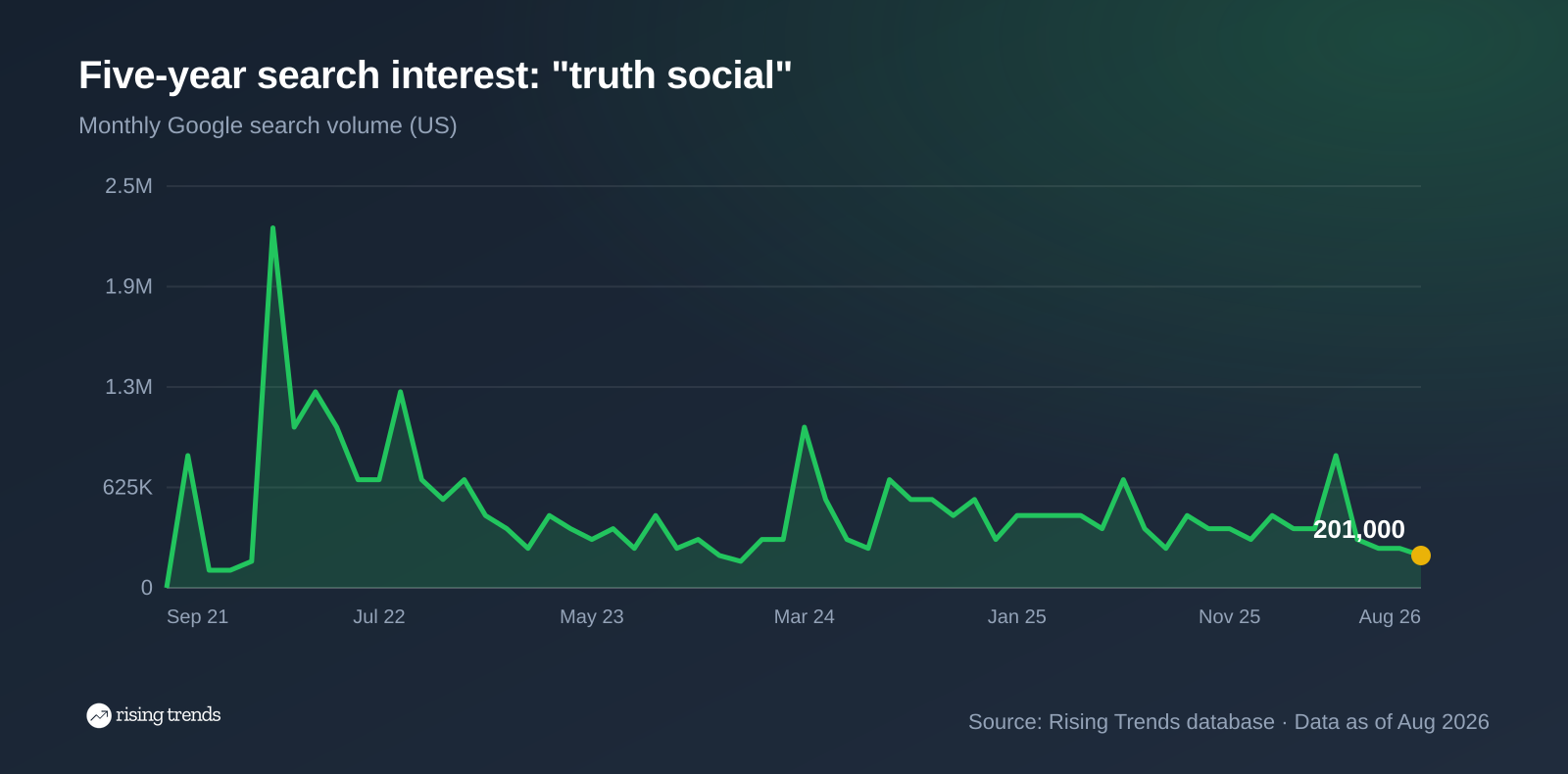
The platform peaked at 2,240,000 searches in February 2022, its launch month. As of Aug 2026 it is at 201,000, down 63% over two years and 91% off that peak. Attention spikes with news events and settles lower each time. You can watch that settle on the Truth Social trend page.
Now the financials. Trump Media's second-quarter results, reported on August 10, show $1.7 million of revenue for the three months to June 30, up 89% year on year, against a net loss of $238.1 million, most of it unrealised losses on digital assets. The company holds about $2.0 billion in total assets. On the same call, McGurn said Truth API had "more than ten customer agreements signed to date."
Do the arithmetic the company has not. Ten subscriptions at $100,000 a month is $1 million a month, or roughly $12 million a year, against $1.7 million of revenue in the entire quarter before launch. If those agreements are anywhere near the top of the reported price range, the data feed is already a larger business than the media company that built it. That is why "monetizing its proprietary assets via long-term data licensing" sits on the company's own list of strategic priorities.
The broader read for anyone watching fintech infrastructure: latency has been a commodity for years, but the scarce input was always the signal. Truth API is the first product to package a head of state's communications as a market data subscription, and it works commercially because the audience business underneath it is shrinking. Expect imitation attempts wherever a platform owner also generates market-moving statements, and expect them to run into the same question about who owns official information. The legal side of that question is the one we track across the legal trends hub.
The injunction ruling. Oetken reserved judgment on October 7. If he enjoins the president from posting to Truth Social while the API exists, the product dies in its current form. If he declines on the grounds that courts cannot direct how a president communicates, it is open season on the model. Watch "truth api" in our database: a ruling in either direction should spike it harder than the launch did.
Whether disclosed revenue ever matches the price talk. Trump Media has published a customer count but not a dollar figure for Truth API. The next quarterly report is the first place a real licensing line could show up, and it is the only way to tell whether subscribers are paying the headline $100,000 or something far below it.
Whether anyone copies it. The tell will not be a press release, it will be search. If terms like x api start climbing alongside new platform-specific feeds, the category is real. If "truth api" fades back toward its pre-launch baseline once the litigation resolves, this was a news story with an API attached rather than a new product category. Our guide to pulling this kind of signal out of search data walks through how to watch a term like this without waiting for the coverage, and the same method is what flagged Kalshi's move into event contracts months before the mainstream wrote it up.
The honest summary is that Truth API is two things at once. It is a small, plausible data-licensing product of the kind every platform eventually builds. It is also the first time the output of a sitting president's communications has been sold by the hour to people whose entire business is reacting faster than everyone else. Our data cannot tell you which of those a court will decide it is. It can tell you that 18,100 people a month went looking for the answer in August 2026, and that almost none of them were developers.
Want to spot the next breakout product before the lawsuits make it famous? Read our guide on how to identify market trends, follow the live Truth API trend page, or browse what is breaking out right now on the Rising Trends dashboard.
Thousands of Emerging Trends
Thousands of Breakout Apps
Mega Trends
Trend Analysis Tool