Trends

Two years ago, 1,900 people a month typed "kalshi betting" into Google. As of July 2026 the term sits at 27,100, and it has barely moved in six months. That flat line is the most interesting thing in the data, because the same search term once hit 49,500 in a single month and then lost 97% of it inside four weeks.
That first spike was the 2024 election. The business that actually got built is the second, quieter wave that started in late 2025 and runs on football. Kalshi now describes itself in Apple's App Store as America's number one prediction market and lists football first. A federal appeals court looked at the same product in August and said a state gaming regulator can treat it as sports betting. Nobody ranking for this term has the search curve that shows which of those two stories the public actually followed, so here it is.
Key takeaways:
Let's get into it.
Here is the monthly search volume for "kalshi betting" over the last two years, straight from our database. It is not a curve. It is two separate events.
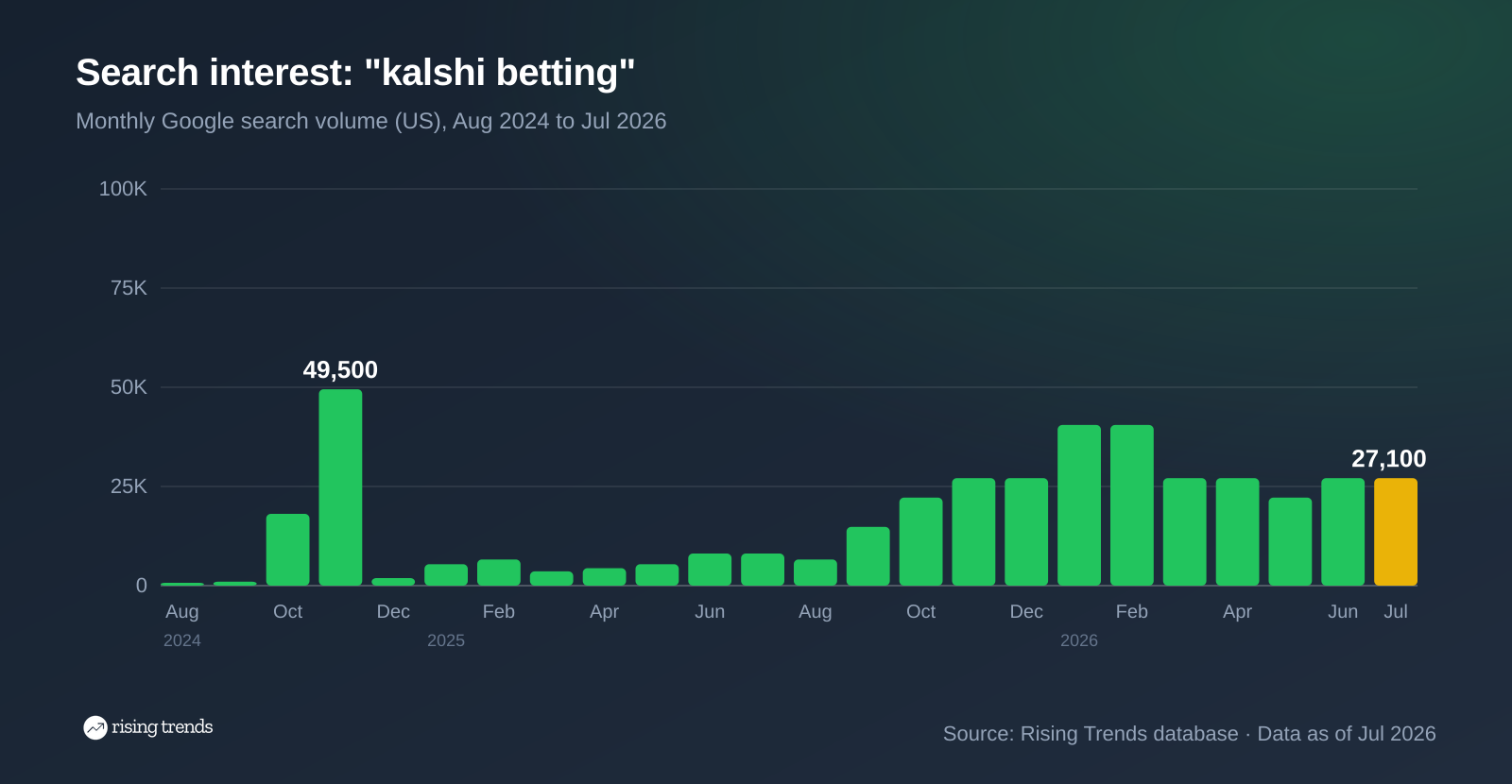
The first event is the 2024 presidential election. The term went from 720 in August 2024 to 18,100 in October and 49,500 in November, then fell to 1,600 by December. Election betting made Kalshi famous and it lasted about eight weeks.
The second event starts in September 2025 and is still running. Volume climbed through the autumn, hit 40,500 in January and February 2026, and has held between 22,200 and 27,100 ever since. Six flat months at a level 15.6x higher than two years ago is not a spike. It is a floor. Our acceleration score for the term is 0.81, which says the growth phase is over and the plateau has begun.
The brand is much bigger than this one phrase, though. Here is the whole cluster people search when they want to bet on an outcome.
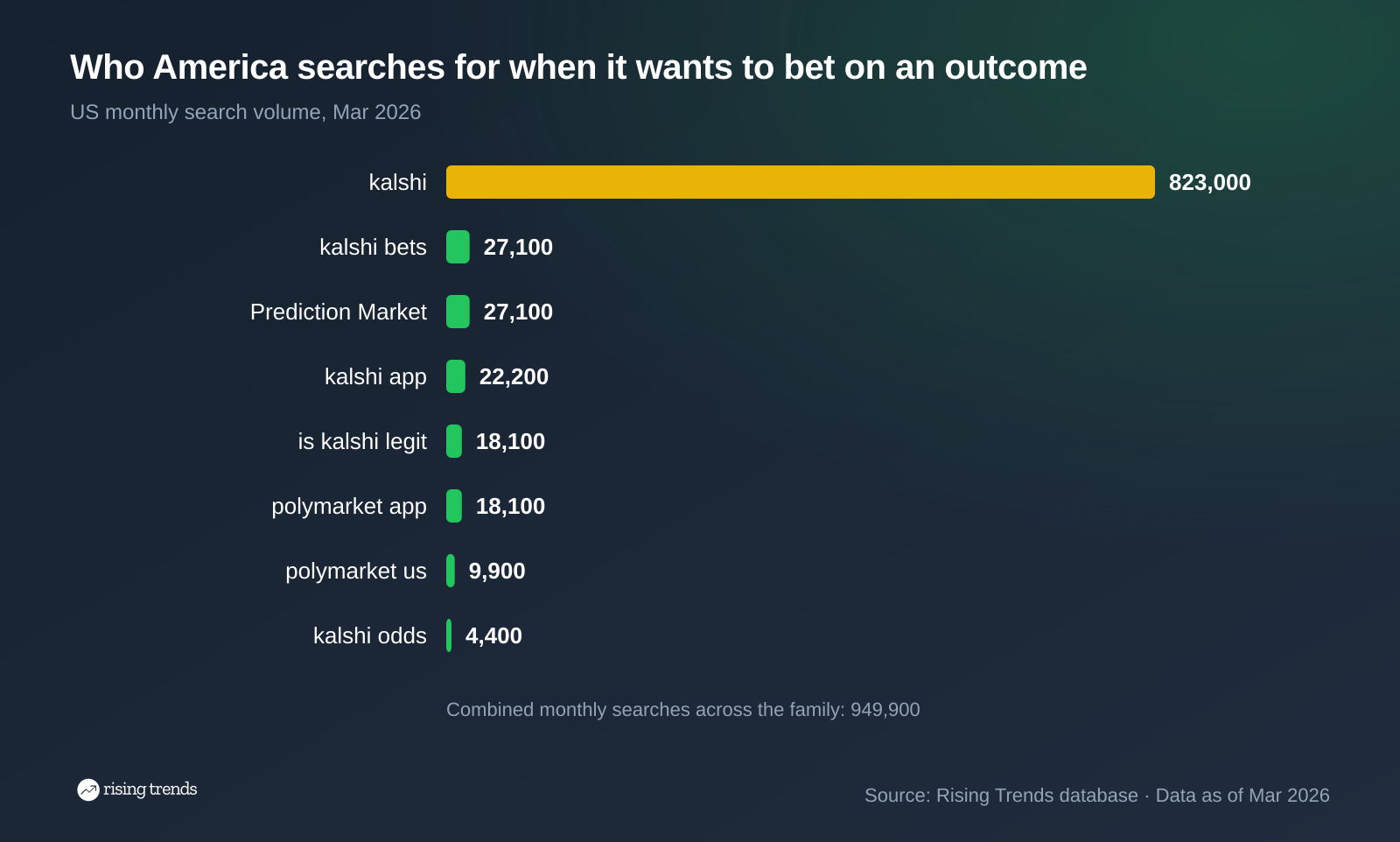
The bare word kalshi draws 823,000 searches a month as of March 2026, the last month all eight of these terms share. The generic term "prediction market" draws 27,100. A single company is now thirty times larger as a search term than the category that describes it, which is the clearest sign we have that this is a brand story rather than a category story.
The mechanic is simple. You buy a yes or no contract on something that has not happened yet, priced from 1 cent to 99 cents, and it settles at $1 if you are right and nothing if you are not. The price is the odds. Kalshi is registered with the Commodity Futures Trading Commission as a designated contract market, the same legal category as a futures exchange, and that registration is the whole basis of its argument that it is not a casino.
Kalshi's own newsroom is the clearest picture of what the product has become, because it publishes the live prices as journalism.
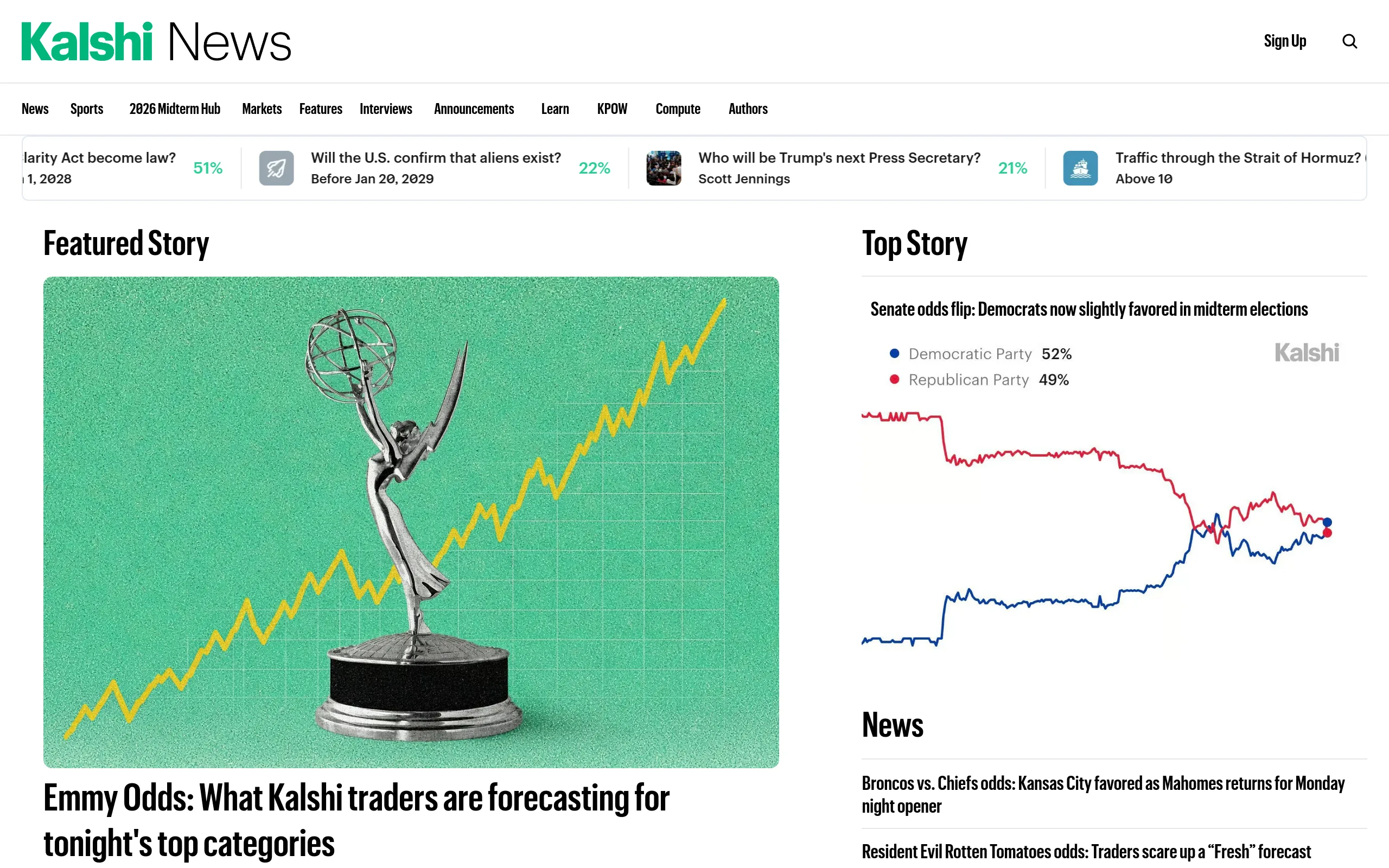
The ticker across the top of that page prices a crypto bill at 51%, alien disclosure at 22% and the identity of the next White House press secretary at 21%. Below it sit a Senate control chart and a Broncos game. Everything is a market, and the company has built a newsroom to tell you what the markets say.
The consumer side is a phone app, and Apple's own listing is the most revealing document Kalshi has. The App Store page is titled "Kalshi: Trade Football & more", carries a 4.8 rating across 523,000 ratings, ranks second in Finance, and is rated 18+. The description opens with the line "America's #1 Prediction Market. Trade football, crypto, weather & more." Football comes first in the title, in the description and in the revenue.
That last part is measurable. An analysis of Kalshi's published fee schedule applied to its own public trading API put 2025 fee revenue at $263.5 million, of which $234.6 million, or 89%, came from sports. In the final four months of the year the sports share passed 90%. Everything else, elections and Federal Reserve decisions included, was under $30 million.
Three dated events sit under the second wave in that chart, and the curve steps up at each one.
December 2, 2025: the money arrives. Kalshi announced a $1 billion Series E at an $11 billion valuation led by Paradigm, and said weekly trading volume had passed $1 billion, more than 1,000% up on 2024, across more than 3,500 markets. Paradigm's Matt Huang called the company "an uncapped cultural and economic phenomenon, similar to how we felt about crypto a decade ago."
February 2026: the Federal Reserve legitimises it. Three economists published a working paper in the Federal Reserve Board's own series, called Kalshi and the Rise of Macro Markets. Its conclusion was that Kalshi prices offer "a high-frequency, continuously updated, distributionally rich benchmark that is valuable to both researchers and policymakers." Our search curve for the term peaked at 40,500 the same month.
May 7, 2026: the valuation doubles. A $1 billion Series F at $22 billion led by Coatue, with Sequoia, Andreessen Horowitz, IVP, Paradigm, Morgan Stanley and ARK Invest. In that post Kalshi said annualised trading volume had gone from $52 billion to $178 billion in six months, institutional volume was up 800%, and it held over 90% of the US prediction market. Chief executive Tarek Mansour's line was the thesis in one sentence: "Event contracts could become a trillion-dollar market, and we're still in the early stages of that transition."
What keeps the name in front of people between funding rounds is the scandals, and they are a genre now. This clip, posted on September 8, 2026, covers the week regulators fined former congressman George Santos and banned him from trading for three years after finding he talked up his own attendance at the State of the Union while holding a position on it. He was a paid spokesman for the platform at the time.
Santos is one of a run. A MrBeast video editor was suspended in February 2026, three congressional candidates were suspended in April for betting on their own races, and a White House teleprompter operator was accused in July of wagering on the words the president would say. Each one lands in the same place: is kalshi legit, a query worth 18,100 searches a month and growing faster than the brand itself.
Kalshi was founded in 2018 by Tarek Mansour and Luana Lopes Lara, two former financial analysts who spent years getting a CFTC licence before they had a product anyone wanted. Here is the capital stack from the company's own announcements.
| Date | Event | Figure | Source |
|---|---|---|---|
| Nov 2020 | CFTC designated contract market licence | The legal basis for everything since | CFTC |
| Dec 2, 2025 | Series E led by Paradigm | $1B at an $11B valuation | Kalshi newsroom |
| Dec 2025 | Weekly trading volume | Over $1B, up more than 1,000% on 2024 | Kalshi newsroom |
| May 7, 2026 | Series F led by Coatue | $1B at a $22B valuation | Kalshi newsroom |
| May 2026 | Annualised trading volume | $178B, from $52B six months earlier | Kalshi newsroom |
Two caveats belong with those numbers. Trading volume is notional turnover, not revenue: Kalshi earns a few cents per contract, which is why billions in volume translate into hundreds of millions in fees. And every figure there is the company describing itself in a funding announcement, because Kalshi is private and files no public accounts.
This is the question the whole valuation rests on, and 2026 has been a year of courts answering it differently.
The federal position is that Kalshi is a market and states have no say. The CFTC has sued New York, Wisconsin, Arizona and others to defend that view. In its April 2026 complaint against New York, chairman Michael Selig said registered exchanges "have faced an onslaught of state lawsuits seeking to limit Americans' access to event contracts and undermine the CFTC's sole regulatory jurisdiction over prediction markets."
The state position is that this is gambling with a costume on. On July 31, 2026, New York's governor and attorney general sued KalshiEX for running an unlicensed gambling operation, asking for forfeiture of the gains, restitution for consumers and fines of three times the profits. Attorney General Letitia James put it plainly: "No matter what they call themselves, prediction markets like Kalshi are gambling platforms, plain and simple."
Then on August 28, 2026, the Ninth Circuit sided with Nevada in a 3-0 decision, holding that Kalshi had not shown the Commodity Exchange Act preempts state gaming law for sports event contracts, and that those contracts are likely not swaps. Judge Lee, concurring, wrote that "the regulation of gambling has been and remains a matter for states and Tribes, not an incidental byproduct of federal derivatives oversight." That splits with an earlier Third Circuit decision that went Kalshi's way, which is the classic setup for a Supreme Court case. The Nevada docket is the place to watch it.
The users have already decided. Every App Store review on the day we checked was dated September 13, 2026. "I took the Redskins and I thought they were getting points. I don't understand why I lost," wrote one. Another asked for earlier payouts and better parlay combining, then signed off: "Other than that yall have officially stolen me from PrizePicks." A one-star review complained that props on an inactive player stayed tradeable all game. Nobody mentions settlement risk. They are discussing spreads of the other kind.
Kalshi says it holds over 90% of the US prediction market, and our data says the competition is growing faster from a smaller base.
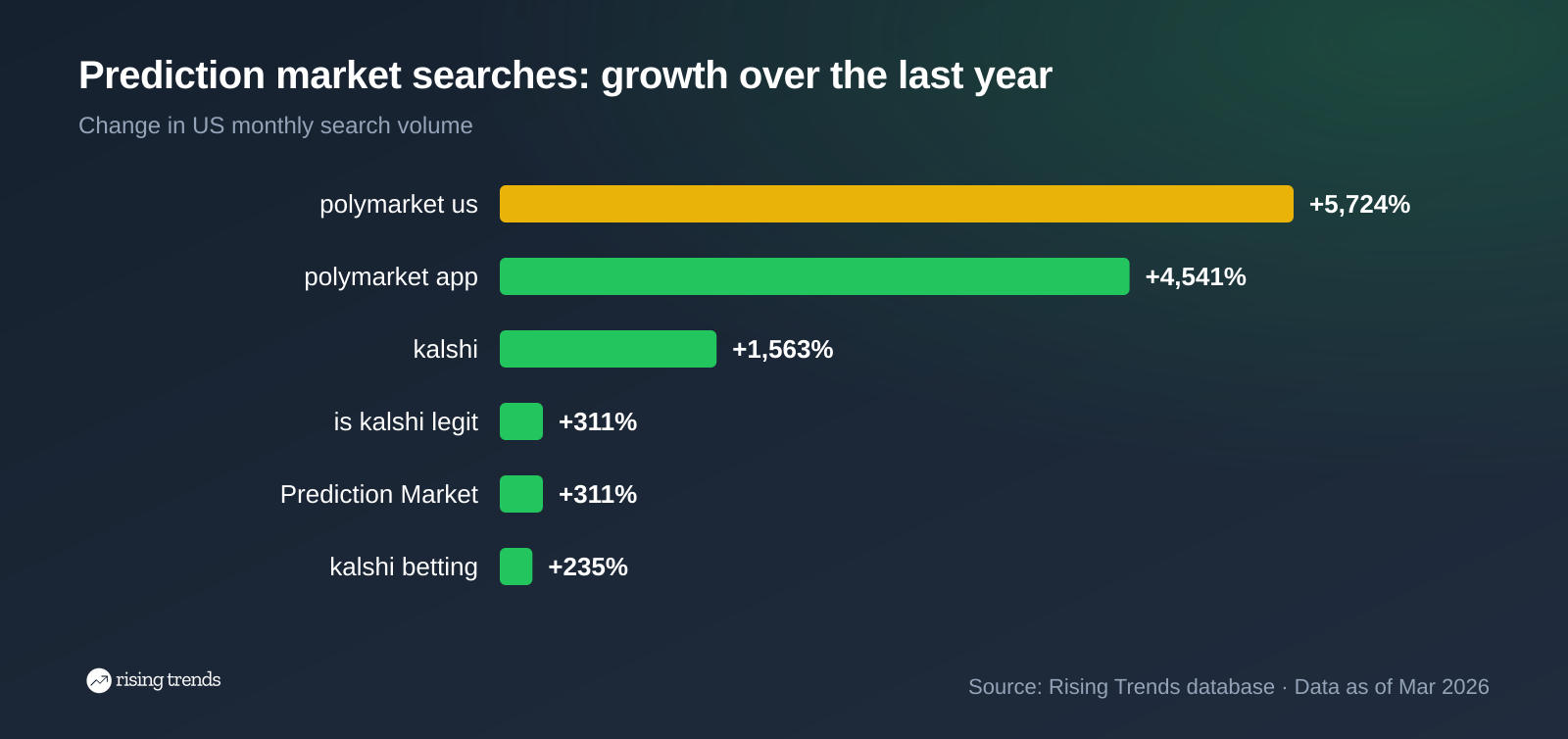
Polymarket is the one to watch. It was locked out of the United States for years, came back in December 2025, and its US-specific search term is up 5,724% in a year, the fastest mover in the set, though still under 10,000 searches a month. Its backer is not a venture fund. Intercontinental Exchange, which owns the New York Stock Exchange, put a further $600 million into the company in March 2026 on top of a 2025 stake.
The other competitor is the incumbent sportsbooks, who stopped complaining and started building. DraftKings and FanDuel both launched CFTC-regulated event contract products between December 2025 and early 2026. The companies that spent a year arguing Kalshi was an illegal sportsbook now run prediction markets themselves. When your critics copy your legal structure, the structure is the product.
A licence arbitrage became a distribution advantage. Sports betting is legal in roughly forty states, each with its own licence, tax rate and age limit. A CFTC registration is one federal permission that, if the argument holds, works in all fifty. That is the reason this exchange can be worth $22 billion, and it is what the Ninth Circuit just put in doubt.
Trading is becoming a consumer app category. Kalshi ranks second in Finance on the App Store, above most banks. The fintech trends we track show every consumer money app racing to add more things you can do with a balance, and an event contract is the cheapest new thing to add: no inventory, no custody, no credit risk. Expect it inside apps that have nothing to do with betting, which is how the investing trends of the last two years have all arrived.
The engagement model is the risk. A contract that resolves in ninety minutes and can be traded out of at any moment is, behaviourally, closer to a slot machine than to a futures position. It is the same loop we described in dopamine shopping, where the ritual is the product and the transaction is almost incidental. Regulators reading those App Store reviews will not see a commodities exchange.
The Supreme Court decides the business model, not the market. With a circuit split on the table, the question of whether a sports event contract is a swap is heading for a definitive answer. If it goes against Kalshi, the 89% of fees that come from sports turns into a forty-state licensing problem and the rest of the company is a very well-funded macro data business. Watch kalshi betting in our data: a term that has been flat for six months will move hard in whichever direction the ruling goes.
Institutions are the growth story now, and they do not use Google. Kalshi's own numbers say institutional volume grew 800% in six months while consumer search interest stayed flat. That gap is the whole shape of the next year. Volume can keep compounding with no new searchers at all, which is why a flat curve here is not the bad news it looks like.
"Is it legit" is the leading indicator. Trust queries usually lag a problem by weeks. At 18,100 a month and up 311% in a year, that term is growing faster than the brand phrase it shadows. If a payout dispute, a state ban or an insider-trading case lands, it shows up there first, before it shows up in the volume figures the company chooses to publish.
The honest read of the curve is that Kalshi already had its cultural moment in November 2024 and spent the two years since converting it into a sports betting business that regulators are now unwinding state by state. The searches are flat. The valuation doubled anyway. One of those two numbers is wrong, and the courts are going to tell us which.
Want to catch the next regulated-category breakout before the funding round? Read our guide on how to identify market trends, follow the live kalshi betting trend page, or see what is breaking out right now on the Rising Trends dashboard.
Thousands of Emerging Trends
Thousands of Breakout Apps
Mega Trends
Trend Analysis Tool