Guides


There is an official Google Trends API, and as of October 2026 you almost certainly cannot use it. Google announced it in July 2025 and it is still an alpha open only to approved testers, so the working routes for most developers are pytrends (free, unmaintained, rate limited), a paid SERP vendor, or the Trends website itself. All four return the same thing: a relative index between 0 and 100, never a number of searches.
That last part is what breaks projects after the integration ships. The index is recalculated against whatever date range you asked for, so the same term in the same month comes back as a different number depending on the window in your request. Below are the four routes, working code for each, and what to do when you need actual search volume.
Key takeaways:
Let's get into it.
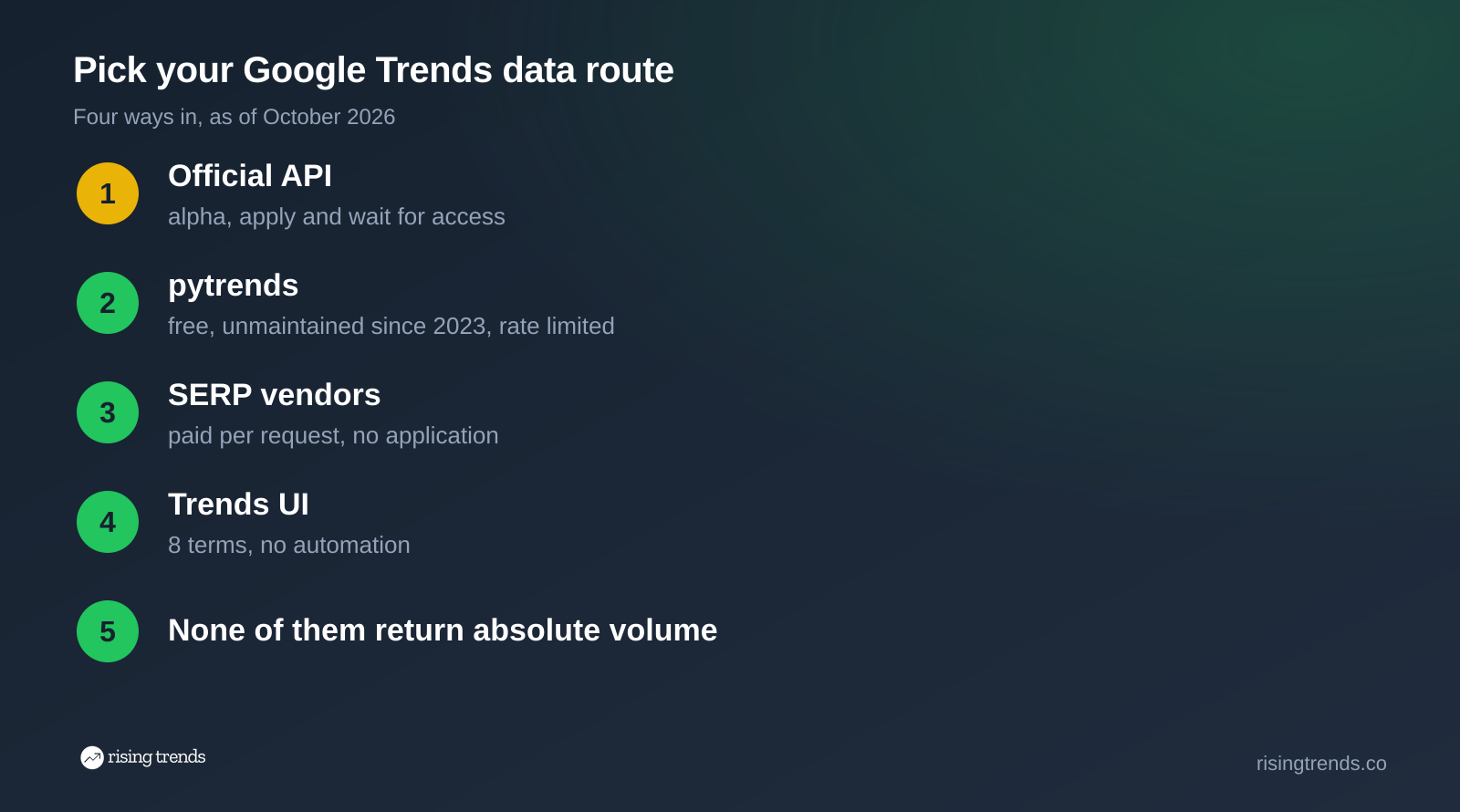
Pick by access, not by features. The feature differences between these routes are small. The access differences are the whole decision.
| Route | Cost | Can you start today? | Returns |
|---|---|---|---|
| Official Trends API (alpha) | No fee published | Only if your application is approved | Consistently scaled index |
| pytrends | Free | Yes, until you get rate limited | 0 to 100 index |
| SERP API vendors | Per request or per credit | Yes | 0 to 100 index |
| trends.google.com | Free | Yes, by hand | 0 to 100 index, 8 terms max |
The rest of this guide takes each one in turn, then deals with the index problem that applies to all of them.
Yes, and it has been in alpha since 24 July 2025. Here is Google's own page for it, captured today.
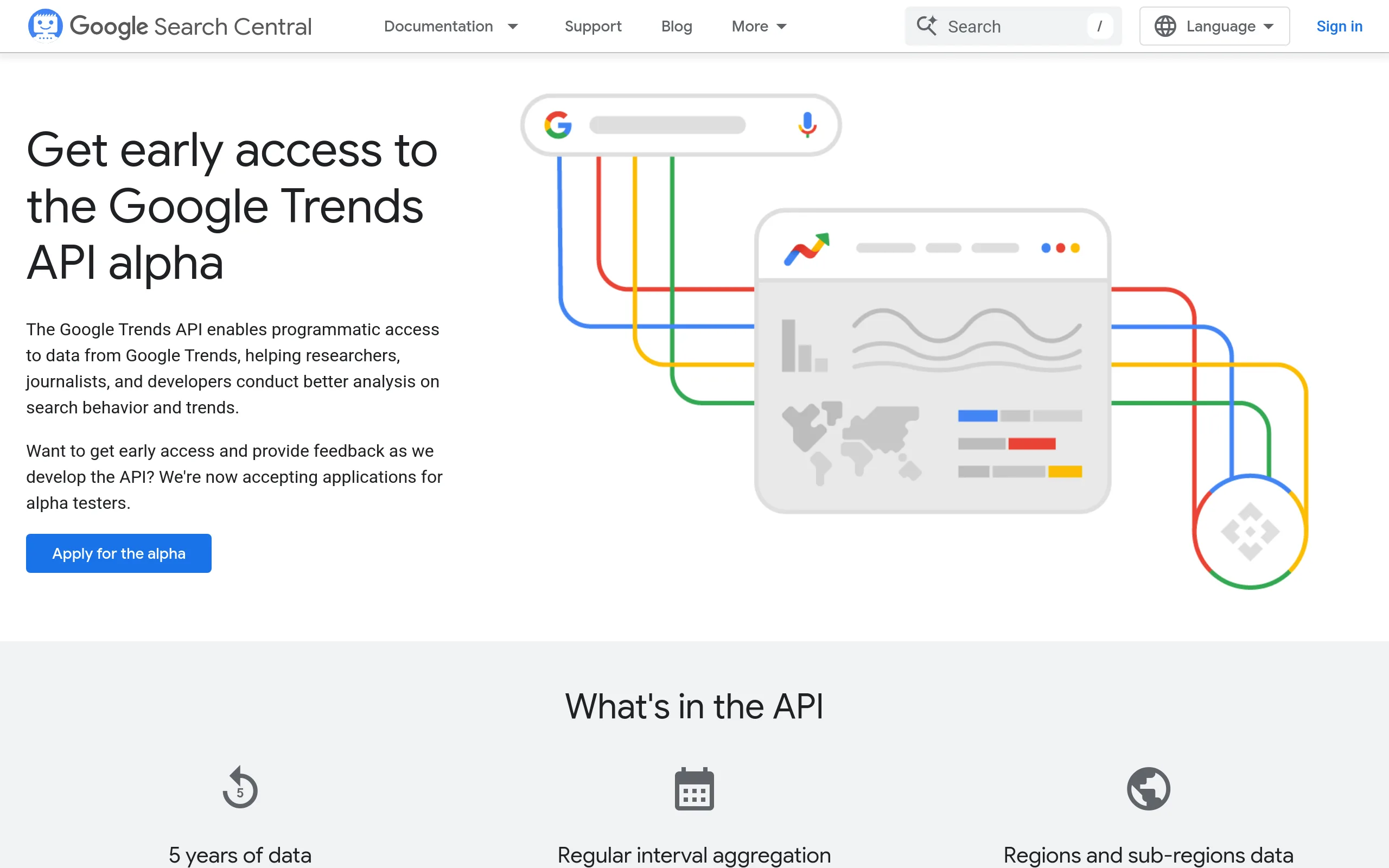
The page still reads "Get early access to the Google Trends API alpha" and "We're now accepting applications for alpha testers". There is no self-serve signup, no published pricing, and no public endpoint reference. You fill in a form and wait.
From Google's announcement post, the alpha covers:
Consistent scaling is worth understanding, because it is the one thing the alpha does that no scraper can replicate. On the Trends website, every request rescales results to 0 to 100 inside that request. Pull January to June, then pull January to December, and January's number changes. The API's scaling holds steady across requests, so you can pull only last month and append it to data you already have.
That also lifts the comparison ceiling. The official API documentation notes that the API makes it easier to compare dozens of terms "while the Trends UI only lets you make comparisons between eight terms".
From the same announcement: "while the API returns consistently scaled data, the numbers don't reflect absolute numbers, they reflect search interest."
So even the official API, if you get in, does not tell you how many people searched for something. Hold that thought.
Use the application form on the official alpha page linked above. Google said it is prioritising developers who already know what they want to build and can give direct feedback, so a specific use case beats a general interest. Approval is not guaranteed and there is no published queue time.
pytrends is the unofficial Python client almost every tutorial on this topic uses. It works by hitting the same internal endpoints the Trends website uses. Its own PyPI summary describes it as a "Pseudo API for Google Trends", which is an honest label.
Install and pull a series:
from pytrends.request import TrendReq

pytrends = TrendReq(hl='en-US', tz=360)
pytrends.build_payload(['claude api'], cat=0, timeframe='today 5-y', geo='US', gprop='')

df = pytrends.interest_over_time()
print(df.tail())
interest_over_time() returns a pandas DataFrame indexed by date, with one column per keyword holding the 0 to 100 index and an isPartial flag on the most recent row. Drop the partial row before you do anything with the numbers.
Check the release history before you build on it. The latest version on PyPI is 4.9.2, uploaded on 13 April 2023. That is more than three years without a release. The project README on GitHub opens with "Looking for maintainers! Please open an issue with a method of contacting you if you're interested."
That does not mean it is broken. It means that when Google changes an internal endpoint, nothing ships a fix on a schedule. If your pipeline cannot tolerate a multi-week outage, do not make pytrends its only input.
The most common pytrends complaint is a TooManyRequestsError. The README states plainly that the "Rate Limit is not publicly known", which is why nobody can give you a safe request-per-minute figure.
What you can do is slow down and route around it. pytrends exposes the knobs in the constructor:
pytrends = TrendReq(
    hl='en-US',
    tz=360,
    timeout=(10, 25),
    retries=2,
    backoff_factor=0.1,
    proxies=['https://your-proxy:port'],
)
retries and backoff_factor use urllib3's exponential backoff, so a factor of 0.1 sleeps roughly 0.0s, 0.2s then 0.4s between attempts. proxies rotates the source IP, which is the usual fix once a single IP is throttled. There is also a requests_args dict passed through to the underlying requests library.
A practical pattern for a nightly job: one keyword per request, a sleep of 60 seconds or more between calls, a cached result on disk, and a retry the next day rather than the next minute.
You can, and people do. The question is whether building and maintaining a scraper is the cheapest way to get an index number you could buy for a fraction of a cent.
Running your own means handling the token request that precedes every data call, the batched URL format, IP rotation, request pacing, and a rewrite every time Google adjusts the response shape. That is ongoing work for data that is identical to what a vendor returns.
The search data reflects that conclusion. Demand for generic scraping tooling is falling in our database, while demand for first-party APIs compounds.
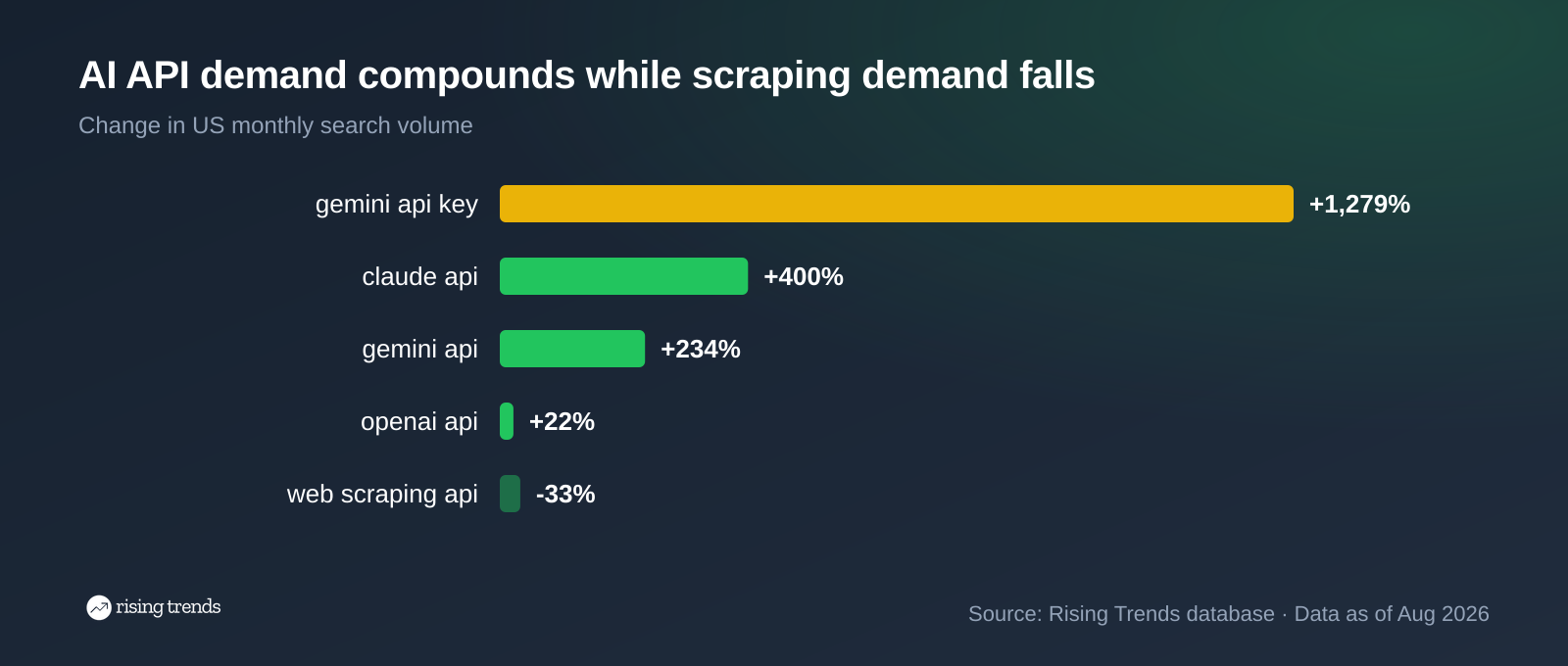
Searches for "web scraping api" are down 33% over two years, at 1,600 US monthly searches as of August 2026, while gemini api key is up 1,279% over the same period. Developers are moving toward sanctioned endpoints, not away from them.
A handful of vendors sell Google Trends extraction as an endpoint: scrape.do, Piloterr, Bright Data, ScrapingBee, Oxylabs, Apify and others. They all do the same job, which is to run and maintain the scraper for you and hand you JSON.
Pricing is normally per request or per credit. Piloterr's own Google Trends endpoint documentation lists it at 1 credit per request, as of October 2026. Check each vendor's current pricing page on the day you buy, because these change often and the comparison posts age badly.
What to check before you commit:
If you want a fuller comparison of trend data tools for non-developer work, we cover that in the best Google Trends alternatives, which looks at these from a researcher's angle rather than an integration one.
This is the part no vendor comparison covers, and it is the thing most likely to cause a bad decision.
Google's FAQ about Google Trends data describes the normalization in two steps. First, "Each data point is divided by the total searches of the geography and time range it represents to compare relative popularity." Then, "The resulting numbers are then scaled on a range of 0 to 100 based on a topic's proportion to all searches on all topics."
Two consequences follow, and both bite in production.
The number is relative to the window you asked for. Change the date range and every value in the response changes, because the peak that defines 100 has moved.
A falling line can mean rising demand. If the whole category grows faster than your term, your term's share drops even as its raw searches climb.
Here is claude api in real monthly US searches, not an index.
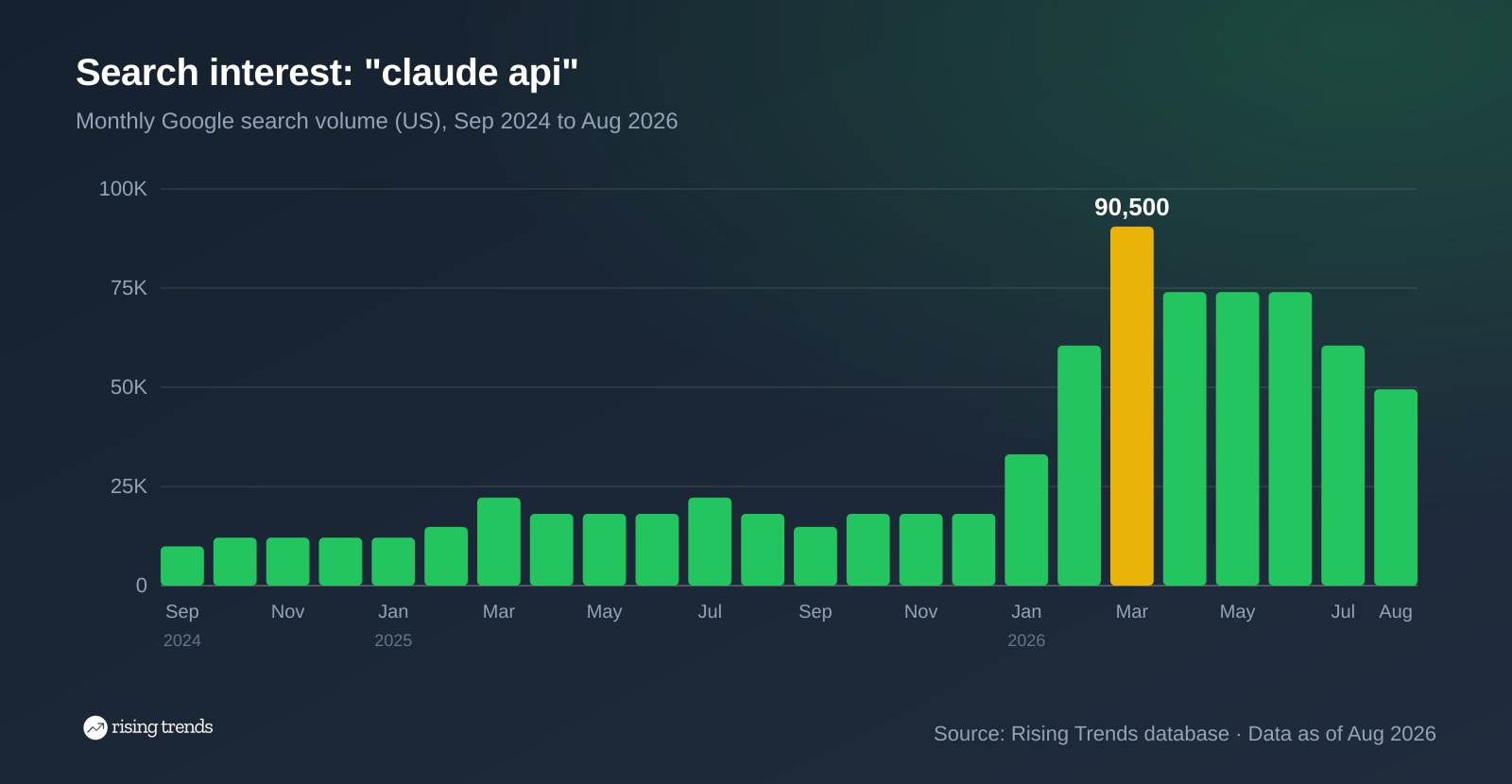
The term peaked at 90,500 monthly searches in March 2026 and sat at 49,500 in August 2026. On a 24 month Google Trends chart, March reads 100 and August reads 55, because 49,500 divided by 90,500 is 0.547.
Now take openai api. In August 2026 it was also at 49,500 monthly searches. Identical real demand, same month.
| Term | Aug 2026 searches | Index vs 24 month peak | Index vs 5 year peak |
|---|---|---|---|
| claude api | 49,500 | 55 | 55 |
| openai api | 49,500 | 82 | 67 |
| gemini api | 33,100 | 45 | 45 |
Three different index readings for openai api and claude api in the same month, at the same actual volume. Nothing is wrong with the data. The index is answering a different question than the one most people think they are asking.
Here is what the absolute numbers look like side by side.
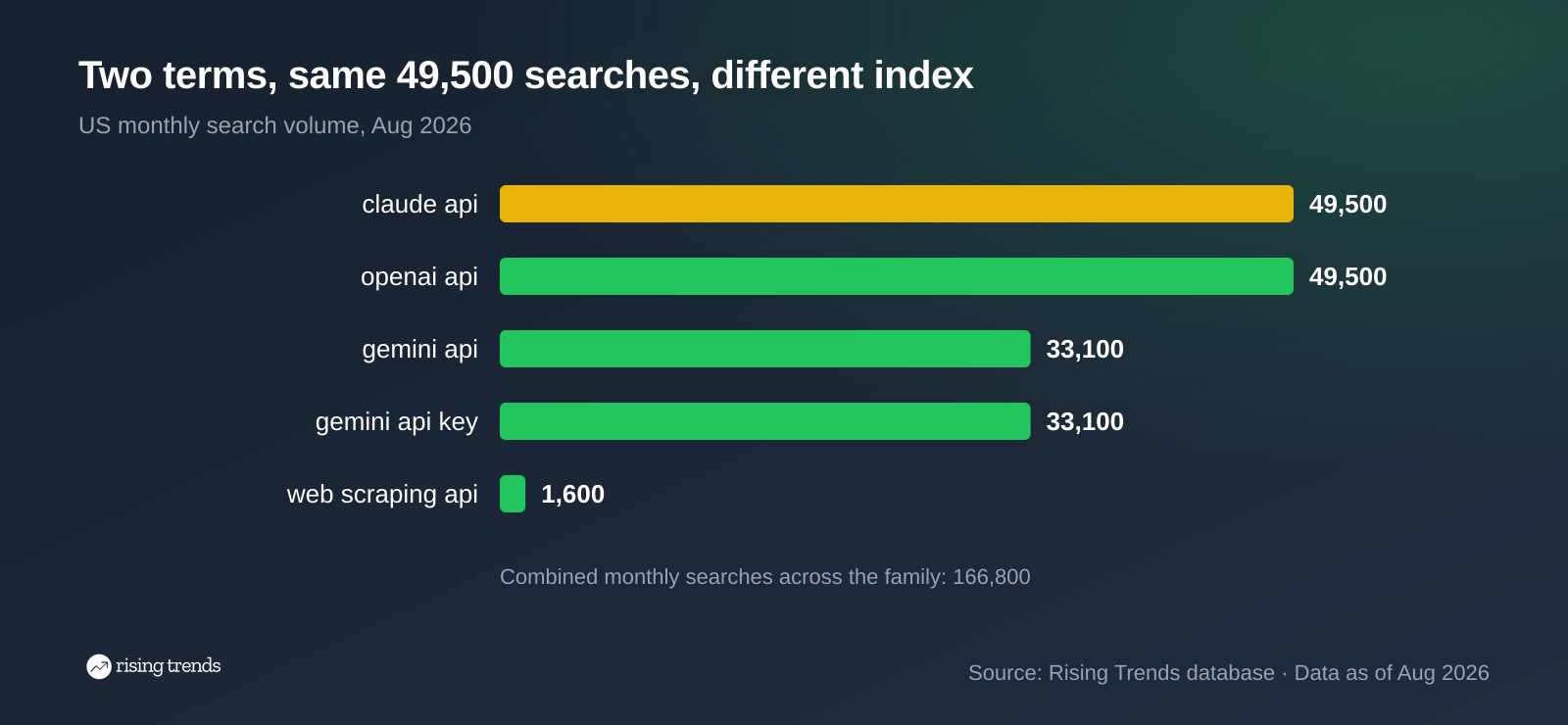
A Google Trends comparison would put claude api and openai api on the same chart and show them converging, which is true. It would not tell you they converged at 49,500 searches each rather than at 500.
The index is the right tool for direction, seasonality, geography and relative interest between terms you put in the same request. Use it for "is this rising", "when does it peak each year", "which states care".
It is the wrong tool for sizing. If you are deciding whether to build a product, bid on a keyword, or forecast traffic, you need a count. For that you need a source that reports volume directly. Our own Trends API returns absolute monthly US volume plus 3 month, 1 year and 2 year growth for every tracked term, which is the gap the index leaves.
The most common reason developers want a Trends API is a recurring check: which of the terms I care about are moving. That is a cron job, and the failure mode is a rate limit at 3am.
If you are pulling our data, one request covers a filtered scan:
curl -H "Authorization: Bearer rt_live_..." \
  "https://www.risingtrends.co/api/v1/trends?min_growth_pct=100&timeframe=1y&min_search_volume=1000&sort=growth&order=desc"
Each result carries its slug, so a second call gets the full monthly series for anything worth a closer look:
curl -H "Authorization: Bearer rt_live_..." \
  "https://www.risingtrends.co/api/v1/trends/claude-api"
The parameters are documented in the API reference, and the API is included in the Pro plan. The endpoints also cover trending Amazon products and fast-growing websites if your watchlist is commercial rather than editorial.
If you do not need an integration at all, the trending topics list is the same data as a page you can read, and our walkthrough of finding trending SEO niches shows how to turn that list into keyword targets.
The official alpha has no published fee, but it also has no open access: you apply and wait. pytrends is free and open source, with no support and no guaranteed uptime. SERP API vendors charge per request or per credit. So "free" exists in two forms, neither of which is a reliable production dependency on its own.
Many Google APIs have free tiers, but the Trends API is not generally available, so there is no free tier to sign up for yet. The Trends website remains free to use by hand, and Google's FAQ documents what the data does and does not represent.
Technically you request a token, then call the batched data endpoints the website uses, handling pacing and IP rotation yourself. Practically, pytrends already implements that and a SERP vendor already runs it at scale. Writing a fresh scraper is rarely the cheapest path, and Google's terms govern automated access, so check them for your use case.
pytrends build_payload accepts a timeframe string such as today 5-y or explicit dates like 2024-01-01 2026-08-31, and there is a get_historical_interest method for hourly data that paginates week by week. The official alpha offers a rolling 1,800 day window. For anything older than five years, no current route provides it.
No. It shows relative search interest scaled from 0 to 100 for the window you requested. Google's FAQ is explicit that each point is divided by total searches for its geography and time range. For actual monthly counts you need a keyword data source, which is what our dashboard and API provide.
You have exceeded an undocumented rate limit on the endpoints Google exposes to its own site. Space requests further apart, add retries and backoff_factor, cache aggressively so you never request the same series twice, and rotate proxies if a single IP is throttled.
Not actively. The last PyPI release is 4.9.2 from April 2023 and the README is openly asking for maintainers. The library still works, but treat it as frozen rather than supported.
If you need Trends data today and cannot wait on an application, start with pytrends behind a cache and a slow schedule, and switch to a paid vendor the moment the job matters enough that a week of 429s would hurt. Apply to the official alpha anyway, because consistent scaling across requests genuinely solves the stitching problem, and it costs you a form.
If what you actually need is how many people are searching for something, no Google Trends route will give it to you. That is a different data source, and pairing the two is the usual answer: Trends for shape and seasonality, a volume source for sizing. The same pairing underpins how to identify market trends and the method in trend analysis, and it is the practical version of what using Google Trends for market research is trying to do.
Before you write the integration, write down which question you are answering. Direction or size. The answer tells you which route you need, and often tells you that you did not need an API at all.
Want absolute search volume instead of a 0 to 100 index? Read our guide on how to identify market trends, check the live claude api trend page, or browse what is breaking out right now on the Rising Trends dashboard.
Thousands of Emerging Trends
Thousands of Breakout Apps
Mega Trends
Trend Analysis Tool