Guides


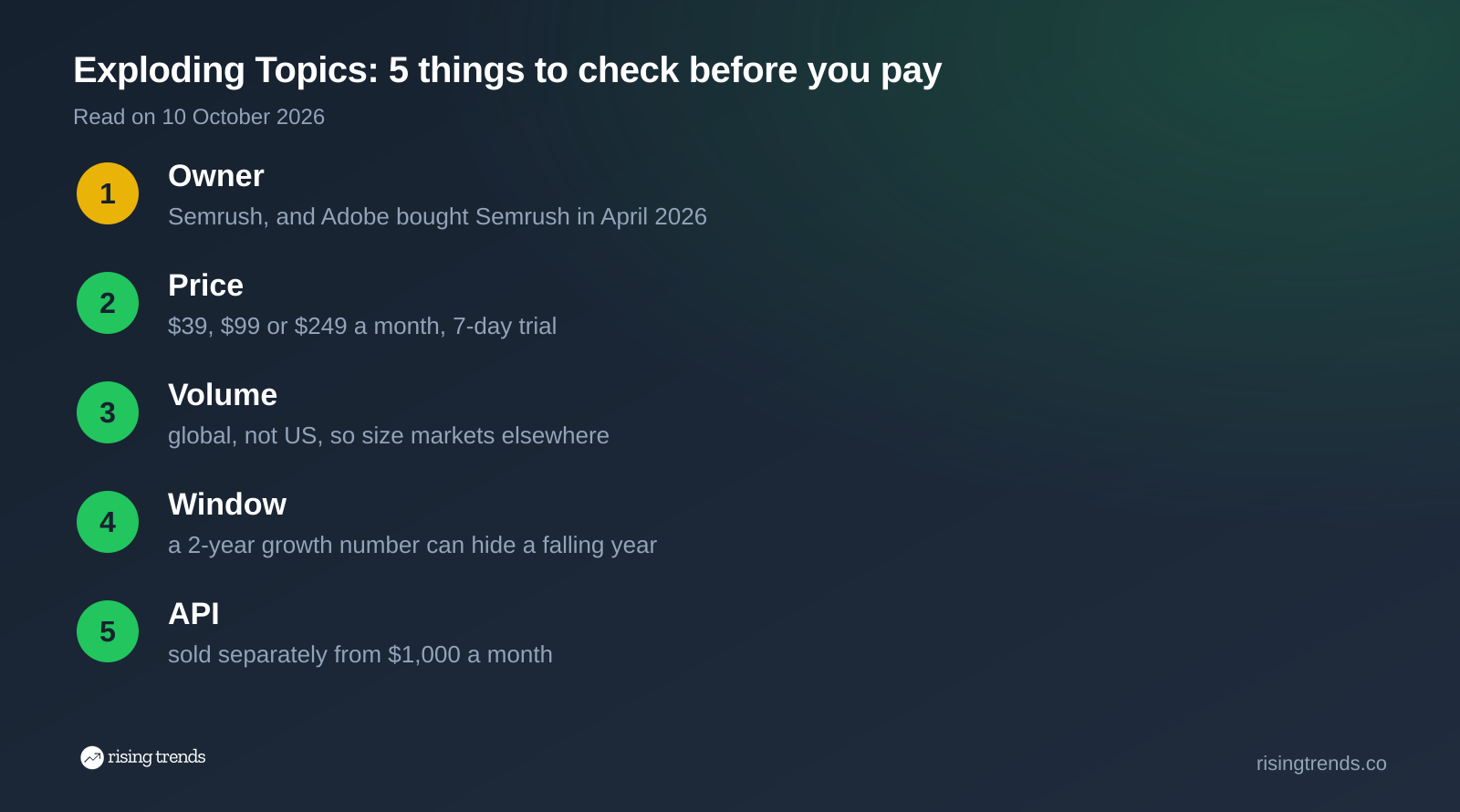
Exploding Topics is a trend discovery database that shows you rising topics you were not looking for, and in October 2026 it costs $39, $99 or $249 a month, billed annually, after a 7-day free trial. It is good at the job it is built for: browsing a category and leaving with five topics you had never heard of. It is weaker as a measurement tool, because its volume figures are global, its default growth window is long enough to make a flat term look like a rising one, and the real search volume data lives behind a separate API that starts at $1,000 a month.
We checked that last part rather than assuming it. Four of the six trends on the Exploding Topics homepage today are also in our database, so we put their headline numbers next to US monthly search volume for the same terms. One of them peaked almost three years ago. Below is the pricing read from the vendor's own page today, what the product actually does, what users complain about, and who should pay for it.
Key takeaways:
Let's get into it.
Exploding Topics is a database of 1.1 million-plus topics with a search volume curve, a growth percentage and an AI summary on each one. You browse by category, filter by how fast something is moving, and track the ones you care about. It also carries trending Amazon products, trending startups, Meta Trends (clusters of related micro trends) and a channel breakdown showing where a topic lives socially.
The ownership chain is longer than most reviews say. Josh Howarth and Brian Dean built it, Semrush bought it in 2024, and it now runs as an app inside the Semrush App Center. Its support address is app-center@semrush.com and its own pricing page footer reads "Exploding Topics is a Trademark of Semrush Inc".
Then on April 28, 2026, Adobe completed its acquisition of Semrush. Semrush published a customer FAQ the same day saying "there will be no immediate changes to your current services, agreements, or points of contact" and "At this time, there will be no changes to our existing contracts and agreements."
Read that carefully before you commit to a year. It is a day-one reassurance about a product that has now changed hands twice in two years, and the same FAQ says integration work is already underway. Nothing has changed for subscribers so far. We are flagging the structure, not predicting a price rise.
Here is the pricing page as it looked when we captured it today.
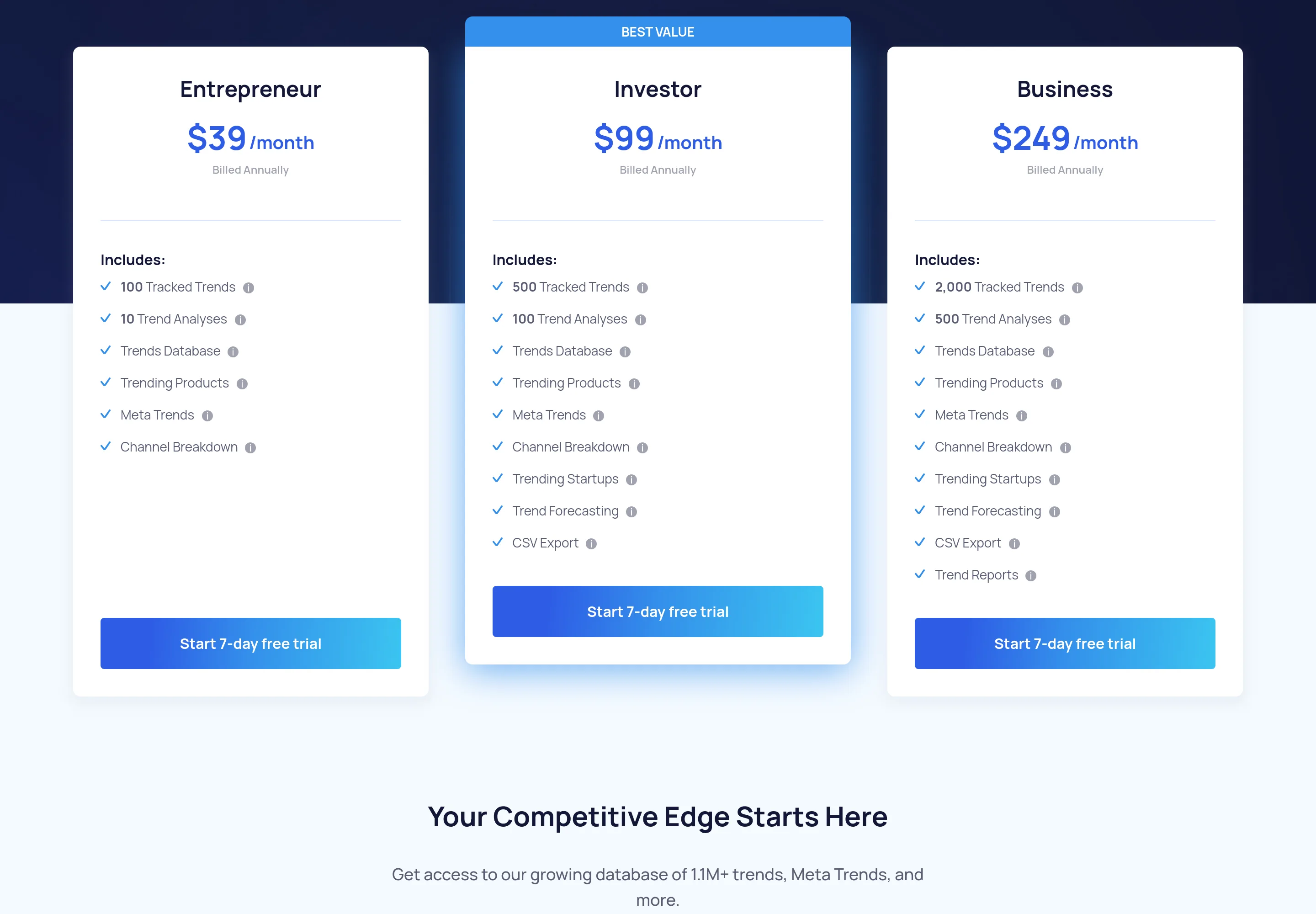
Three plans, one price each, "Billed Annually" in grey under every figure. There is no monthly toggle on the page.
| Plan | Price | Cost for a year | Tracked trends | Trend analyses | Key additions |
|---|---|---|---|---|---|
| Free | $0 | $0 | None | None | Public trend pages and the newsletter |
| Entrepreneur | $39/month | $468 | 100 | 10 | Trends Database, Trending Products, Meta Trends, Channel Breakdown |
| Investor | $99/month | $1,188 | 500 | 100 | Adds Trending Startups, Trend Forecasting, CSV export |
| Business | $249/month | $2,988 | 2,000 | 500 | Adds Trend Reports, and is the base plan required for the API |
Two add-ons sit on top, both documented in Semrush's help centre page for the app. TikTok product insights are $59 a month. API access is sold in packages at $1,000 a month for 1,000 requests, $2,000 for 5,000 and $4,000 for 25,000, with custom pricing for commercial use. If you were planning to pull trend data into a spreadsheet or a script, that is the real number to budget, not $39.
Because every plan is billed annually, the charge that lands when a 7-day trial ends is a full year. On the Entrepreneur plan that is $468 in one go. The pricing page does not spell this out beyond the small "Billed Annually" line, and it does not say what happens at the end of the trial.
That is worth knowing in advance, and it is the single most repeated complaint in the product's public reviews. We come back to those below.
This is the question the search results actually ask, and most reviews answer it by restating the vendor's methodology page. We can do better, because we hold US monthly search volume for the same terms.
Their homepage shows a rotating set of featured trends with a volume and a growth figure on each card. When we read it today, with its filter set to two years, it showed Secops, Lash Clusters, padel racket, Loop earplugs, Bamboo pajamas and Brightwheel. Four of those six are in our database. Here is what the same four terms look like in US monthly searches.
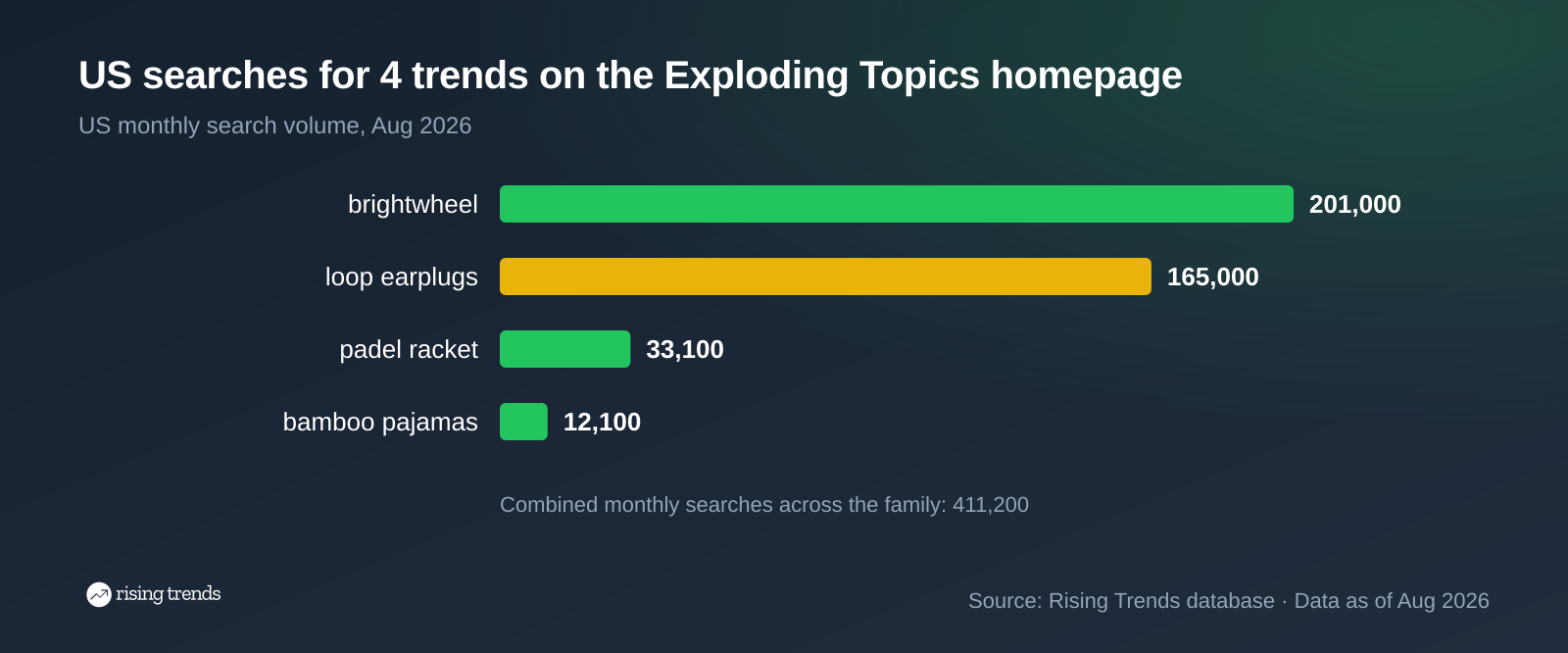
The volumes are not the interesting part. Their figures are global and ours are US, so they should differ, and a global number being larger than a US one is exactly what you would expect. The interesting part is the direction of travel.
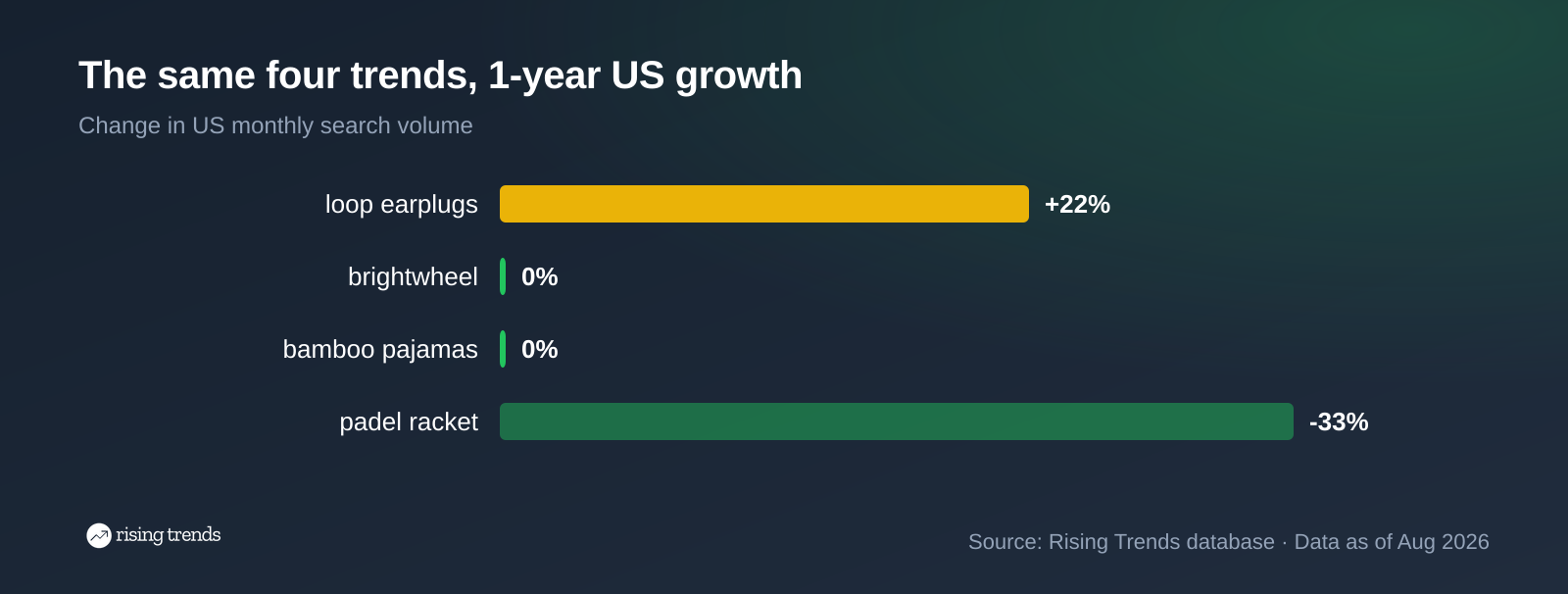
Over the last twelve months in the US, one of these four grew, two were flat and one fell by a third. Every one of them carried a positive growth badge on the homepage, because the homepage filter was set to two years.
Both numbers are true. Padel racket really is up 402% over two years, and it really is down 33% over the last twelve months, at 33,100 US monthly searches in August 2026 after hitting 74,000 in July. A two-year window is a fair way to show that something arrived. It is a poor way to decide whether to start a business this quarter.
The clearest case is loop earplugs.
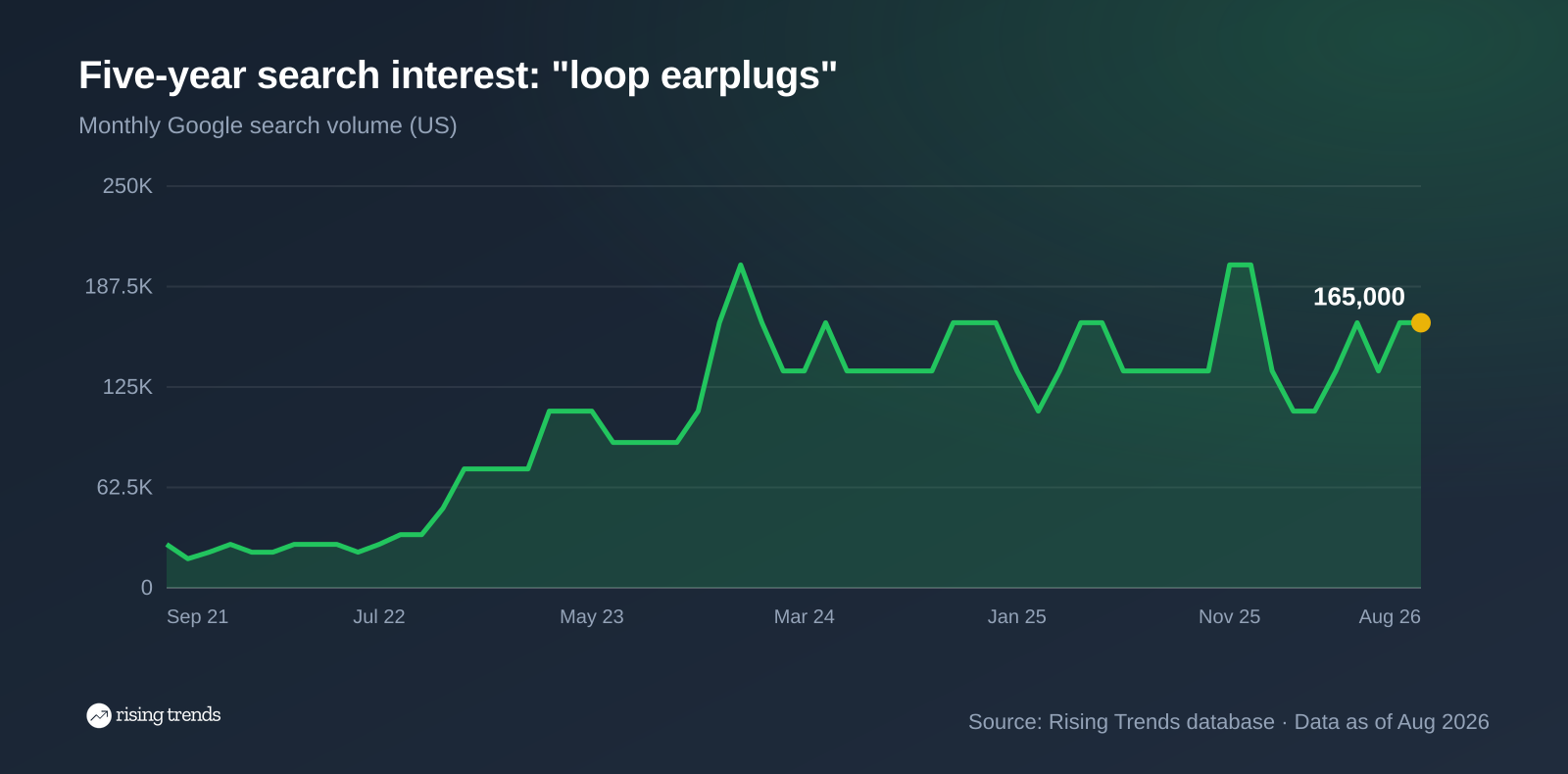
That is a textbook breakout: almost nothing until mid-2022, then a climb to 201,000 US monthly searches in December 2023. And then nothing. Three years of sideways, landing at 165,000 in August 2026. We wrote up what drove the loop earplugs breakout when it was still moving. It is a genuinely successful product. It is not an emerging trend in October 2026, and it is on the homepage of a tool whose promise is finding things 12 months before they take off.
Bamboo pajamas has the same shape with a seasonal twist: 33,100 in November 2024, 22,200 in November 2025, 12,100 in August 2026. The November spikes are holiday gifting, not momentum.
Fairness demands the counter-example. Brightwheel sits at 201,000 US monthly searches in our data against 165K on their card, so our US figure is higher than their global one. Different data sources, measured in different months, will do that. Neither is wrong, and the gap is a good reminder that search volume from two vendors is never directly comparable.
The honest verdict on credibility: the trends Exploding Topics surfaces are real, and its methodology page describes a reasonable process of machine detection plus human review that filters out films and celebrity noise. What it never publishes is where the search volume numbers come from. The growth badges are accurate for the window they are computed over, and that window is yours to check. Treat the platform as a discovery engine, then size and time the opportunity somewhere else. That two-step is the same discipline we describe in how to identify market trends.
Several things, and most of them we do not do at all.
Global volume only. Volumes are "absolute global Google searches per month", and the Trending Products section has no country filter at all. For a US store or a US content plan, that is a number you cannot plan from.
The entry plan is tight. Ten trend analyses a month on the $39 plan, and the analysis limit resets on the 1st. The hands-on review at andrew.marketing found database search capped at roughly ten results without upgrading, and called out loose categorisation and thin data-source transparency. That review is dated in places (its pricing screenshot says July 2024 and it predates Semrush), but those three criticisms still match what the current documentation describes.
The API is priced for enterprises. $1,000 a month minimum, on top of a $249 plan.
Billing complaints are the dominant theme in public reviews. The company's Trustpilot page carries a 2.1 TrustScore, with 80% one-star. Reviewers describe being billed on an annual subscription without expecting it, refunds refused, and a cancel option they could not find. One reviewer wrote "They billed me without notice on an annual subscription" in October 2024; another in June 2026 wrote the company "refused a refund, even if you contact them within 7 days".
Weigh that evidence properly. It is 10 reviews in total, Trustpilot itself notes the company has not invited customers to review, and a self-selected sample of ten skews hard toward people with a grievance. It is not a verdict on the product. But the specific complaint lines up exactly with what the pricing page does and does not say, and that makes it worth acting on: read the billing terms before you start the trial, and diarise the cancellation date.
One more thing worth knowing: cancel, and Semrush documents that your projects and tracked trends are kept for three months, then permanently deleted. Export anything you need first.
Buy it if you are a VC, a strategist or an innovation team whose job is to come back with markets nobody is talking about yet, and $468 a year is a rounding error against the cost of being late. The startups database, Meta Trends and the weekly analyst reports on the Business plan are the parts with no real substitute.
Buy it if you run content or category planning at a company big enough that one good call pays for the year, and you will genuinely use it monthly rather than twice.
Skip it if you need absolute volume for one country, if your budget is in the tens of dollars rather than hundreds, or if you tried it once and let the tab go stale. A 7-day trial on an annually billed plan punishes that pattern hard.
Skip it if what you actually want is validation rather than discovery. Checking whether a term you already have in mind is rising, seasonal or finished is a different job, and a much cheaper one. That method is written up in full in our guide to trend analysis, and the timing side in trend forecasting.
For the record on the comparison you are probably making: our own Pro plan is $19 a month or $97 a year, listed on our pricing page, with US monthly volume per term, 100 tracked trends, 20 analyses a month and API access included rather than sold separately. We also run trending products with Amazon price and sales data. What we do not have is a startups database, Meta Trends, channel breakdowns or daily refresh. If those are what you are buying, Exploding Topics is the better tool and we would rather say so than pretend otherwise.
Short version, because we keep a full comparison elsewhere. The free option is Google Trends, which gives you a 0 to 100 index instead of volume. Glimpse layers absolute volumes and forecasts on top of Google Trends through a Chrome extension. Trend Hunter and TrendWatching sell consumer and cultural trend reports rather than search data. Treendly is the budget option with country filtering.
Each one is compared on features and current pricing in our guide to the best Exploding Topics alternatives, with Google Trends alternatives and alternatives to Glimpse covering the adjacent categories. If you are assembling a stack rather than picking one tool, start with the overview of market research tools.
It depends on whether you need discovery or measurement. If your job is finding topics you did not know existed, $468 a year is reasonable and nothing else does it as smoothly. If your job is sizing or timing a market you have already identified, you will pay for a lot of features you never open, and you will still need a per-country volume source.
There is a free public trend library and a free newsletter, with limited database access and no tracking. Everything in the Pro product needs a paid plan after the 7-day trial.
As of October 10, 2026: $39, $99 or $249 a month, all billed annually, so $468, $1,188 or $2,988 for the year. TikTok insights add $59 a month and API packages start at $1,000 a month.
Yes. Semrush acquired it in 2024 and it runs inside the Semrush App Center. Adobe then completed its acquisition of Semrush in April 2026, so Exploding Topics is now an Adobe-owned product two levels down.
Yes, as a separate purchase requiring a Business plan underneath it, starting at $1,000 a month for 1,000 requests. If an API is the point of the exercise, compare that against our own Trends API, which is included in the Pro plan, and read our guide to the Google Trends API for the free routes and what they do not return.
For discovery, yes, clearly: Google Trends needs you to supply the keyword, and Exploding Topics hands you topics you would never have typed. For validation, Google Trends is free, country-specific and shows the full history, which covers most of what a solo founder needs.
They change weekly, which is the point. Our current list is on the trending topics page, updated with absolute US monthly volume and growth for each term rather than an index.
Exploding Topics answers this with its channel breakdown, which shows how a topic is performing across TikTok, YouTube, Instagram, X, LinkedIn, Reddit, Facebook and Pinterest. We do not break trends down by social channel, so for that specific question their tool is the right one.
Subscriptions are managed through Semrush, and support runs through the App Center address on the pricing page. Projects and tracked trends are retained for three months after cancellation and then permanently deleted, so export first.
Exploding Topics is a good discovery tool with an honest product and a marketing surface that oversells how early its featured trends are. The database, the human curation and Meta Trends are real advantages. The pricing is high for an individual, annual-only, and the most common complaint about the company is about exactly that billing structure rather than about the data.
Use it the way it is actually good: open a category, come out with five topics you had not considered, then verify each one against per-country volume over a window you chose yourself. The tool tells you where to look. It should not be the thing that tells you whether to go.
Want absolute US search volume with the window under your control? Read our guide to how to identify market trends, check the live loop earplugs dashboard, or see what is breaking out right now on the Rising Trends dashboard.
Thousands of Emerging Trends
Thousands of Breakout Apps
Mega Trends
Trend Analysis Tool