
Trends


Two years ago, about 20 people a month typed "xdof" into Google. As of August 2026 it is 2,400, and the company behind the name was in stealth for most of that climb. XDOF sells nothing you can buy. It records robots folding shirts, sorting pills and pulling credit cards out of wallets, then sells the recordings to the AI labs trying to build a general-purpose robot.
That is the whole business, and it is the least glamorous job in AI. Everybody wants to talk about the robot. Almost nobody wants to run the warehouse where a human moves a plastic arm for eight hours so a model has something to imitate. Our database says the attention gap is real and measurable: "humanoid robot" pulls 74,000 searches a month and "robot data" pulls 170. Nothing ranking for XDOF's name has that comparison, or the curve underneath it.
Key takeaways:
Let's get into it.
Here is "xdof" over the last two years, straight from our database. It is flat for eighteen months, then it is not.
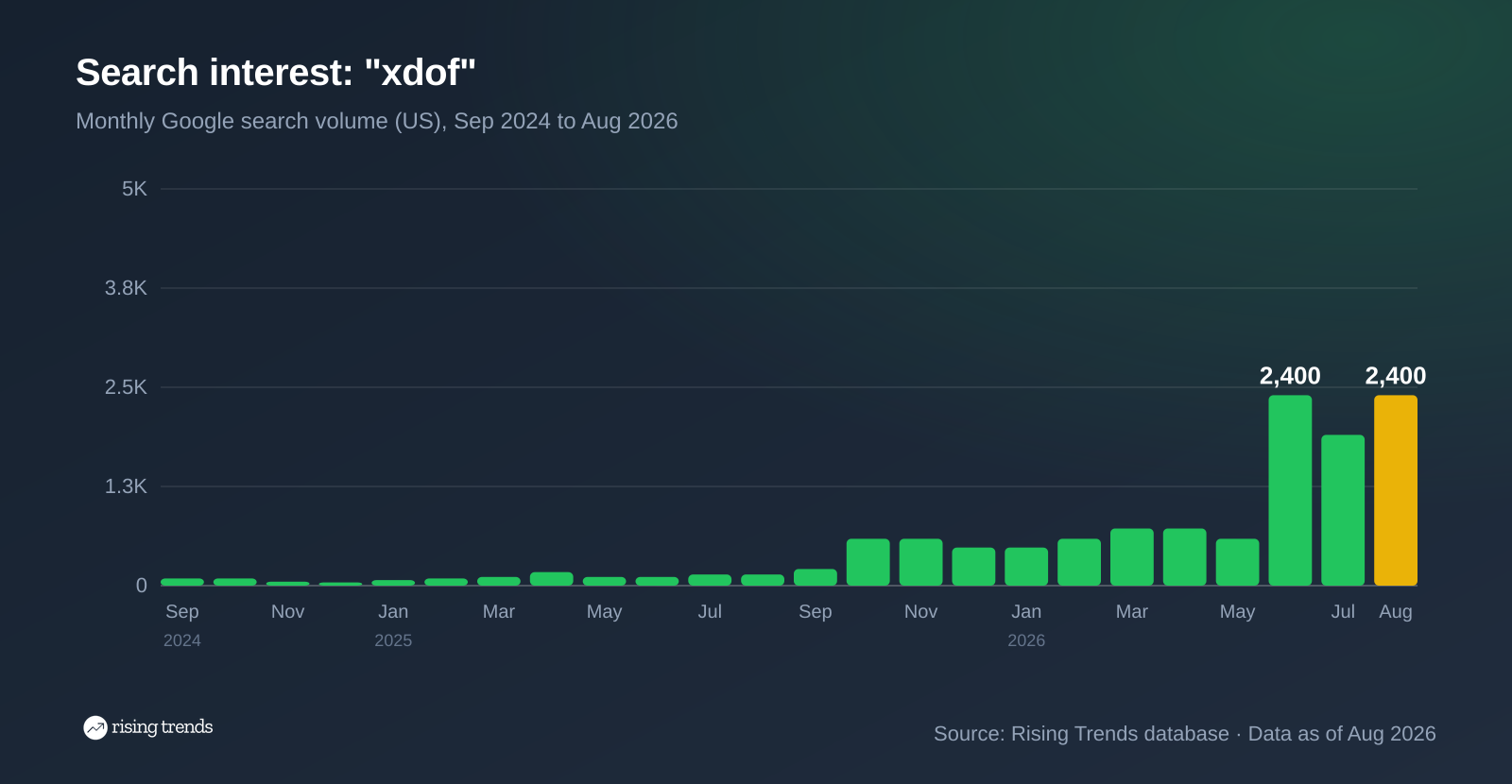
The interesting part is that the curve starts moving before anyone announced anything. Our breakout month, the first month the term crossed a quarter of its peak, is March 2026. XDOF did not come out of stealth until June. Something was leaking: job posts, a GitHub repo, a conference hallway. By June the term hits 2,400, and after a dip to July it is back at 2,400 in August with no funding headline to explain it.
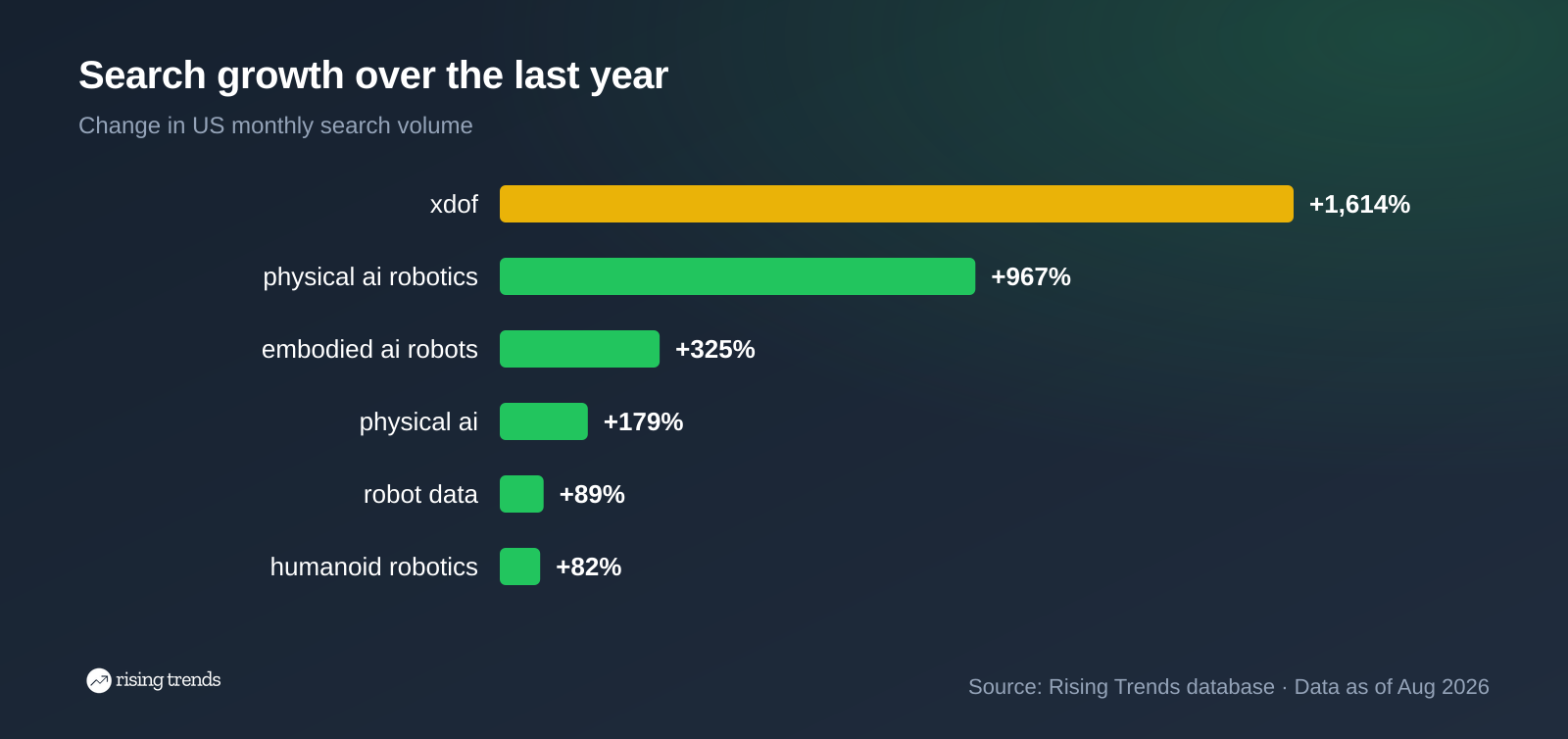
Twelve months ago the term was at 140. In August 2024 it was 20. That is 1,614% growth in a year and 11,900% over two, which works out to 167.5x when you compare the last three months against the same window two years back.
Now put it next to the rest of the category.
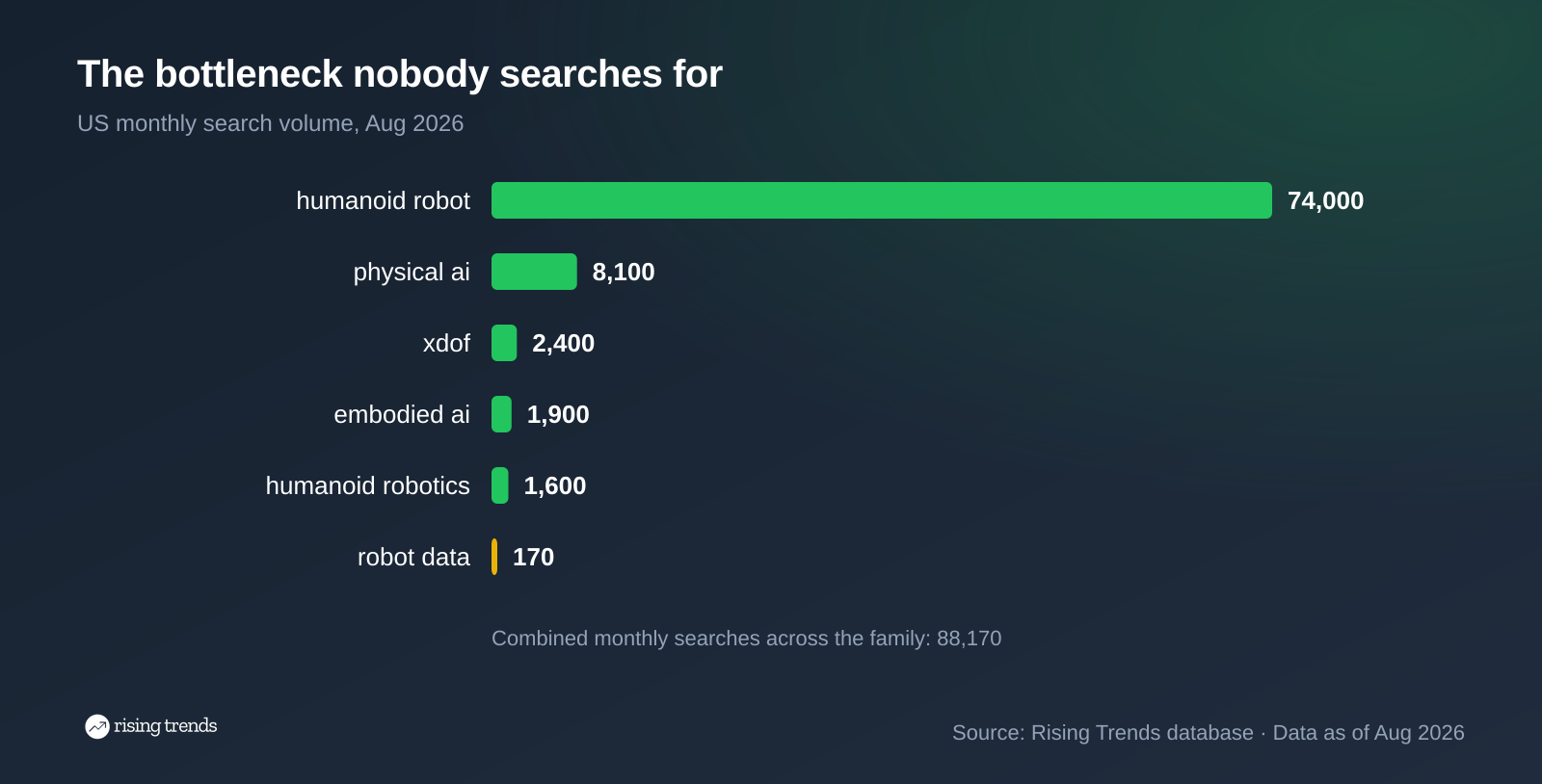
"robot data" gets 170 searches a month. The thing every robotics researcher names as the hardest problem in the field has roughly one four-hundredth of the search demand of the robots it is supposed to train. "physical ai" is at 8,100 and growing fast, "embodied ai" at 1,900 and barely moving. The public is watching the hands. The constraint is in the tape.
XDOF describes itself on its own site as a company building infrastructure for the robotics era, which is vague until you look at what it ships. Three things: datasets recorded to order, the hardware and tooling to record them, and an evaluations service that scores whether your trained policy actually works.
The public proof is ABC-130k, released with UC Berkeley, MIT, Carnegie Mellon and Amazon FAR and hosted on Hugging Face.
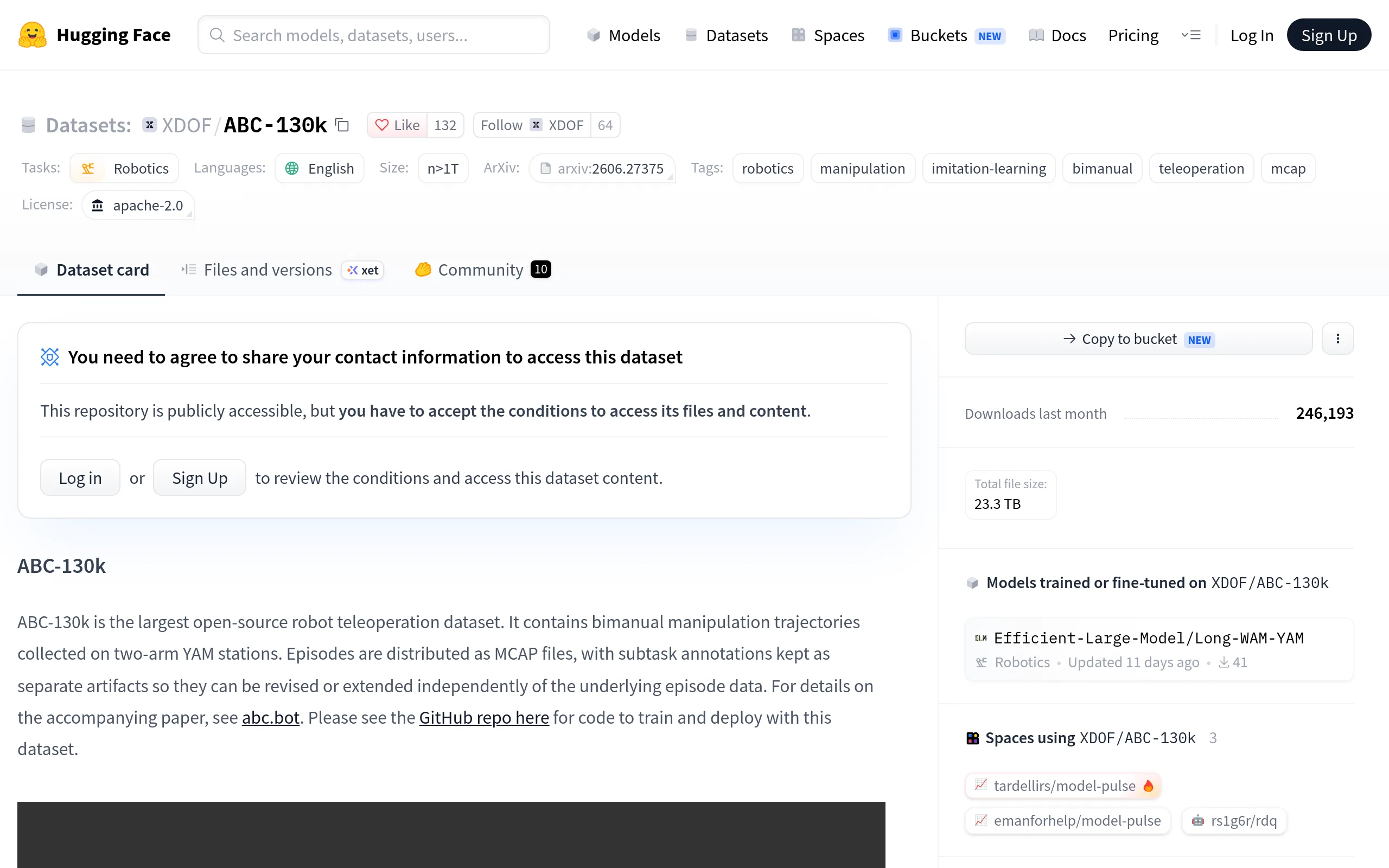
Note the two numbers on the right of that page. 246,193 downloads in a month, against 23.3 TB of files. Note also the banner: the repo is public, but you hand over contact details before you get the files. For a company whose customers are AI labs, a gate on the free dataset is a lead list.
The business model is the one that worked for language data, moved into the physical world. Labs could do this themselves. They do not want to. As CEO Philipp Wu put it to TechCrunch in June, "You need a warehouse of hundreds of thousands of square feet with hundreds of robots. You need to maintain these robots, calibrate their physical parameters, and properly train operators." That is a logistics company, not a research lab, and it is exactly the thing a frontier lab outsources.
This is the part nobody writes about, so here it is in plain terms.
An episode is one recording of one task on one two-armed station. The dataset card gives the shape: two 6-DoF arms with parallel-jaw grippers, a top camera plus one camera on each wrist, joint angles and gripper aperture logged alongside the video. The project page adds the spread: 195 tasks across seven categories, with episodes running from about 7 seconds (put the screwdriver in the bin) to 469 seconds (folding a pile of t-shirts and stacking them).
| What | Figure |
|---|---|
| Episodes | 130,703 |
| Hours of manipulation | 3,590.7 |
| Episodes with subtask labels | 42,980 |
| Tasks | 195, in 7 primitive categories |
| Simulation data released alongside | 400 hours across 20 scenes |
| Physical evaluation time | over 100 hours, 50 trials per task |
| Total files | 23.3 TB |
The three first-party sources do not quite agree, which is worth knowing if you cite them. The dataset card says 130,703 episodes and 3,590.7 hours, the project page says 134,806 episodes and 3,553 hours, and the paper rounds to over 130K episodes and 3,500 hours. The repo has been revised since release, so the card is the figure to use.
Now the hardware. The assembly guide is a shopping list of 3030 aluminium extrusion, foam project board, Irwin mini clamps and three Intel RealSense D405 cameras, every item linked to an Amazon or Office Depot listing. The arms are YAM arms from I2RT at $2,999 apiece. The operator does not use a joystick. They move a passive 3D-printed replica of the arm by hand, a design the XDOF founders published as GELLO at Berkeley, where the parts cost under $300.
So the largest open robot dataset in the world was recorded on roughly six thousand dollars of arms per station and a trip to the hardware store. The expensive part is not the rig. It is the thousands of hours of a human being moving it.
Who is that human? XDOF's careers page answers it more honestly than any press release. Of 25 open roles, 19 are in San Mateo and five are onsite in Jakarta: Environment Design and Build Lead, Project Manager, QC Manager, Retail Operations Manager, Software Engineer. One more is a LATAM Operations Lead in Mexico. The research sits in California. The folding happens somewhere cheaper.
Three dated events, and our curve steps at each one.
February 2026, still in stealth. An employee posts in the Hacker News Who is hiring thread: "we're building the foundation behind the foundation models, the data collection systems, operational capability, exabyte-scale data warehouse, and software toolchain." The same post says the company is "so understaffed relative to demand that I'd like to start semi-public hiring ASAP." That is the first public trace of XDOF, and our breakout month follows one month later.
17 June 2026: out of stealth with $70 million. The company's own launch post names Thrive Capital, a16z, Spark Capital, Lux Capital and WndrCo. TechCrunch, interviewing Wu the same day, added the operating numbers: about 60 employees and 20 customers, several of them frontier labs, none nameable. Wu's account of why he started the company is the whole thesis in one line: "There was this chicken-and-egg problem, we first needed to actually collect data before we could even ask how to train a foundation model for robotics."
25 June 2026: the dataset and the paper go public. ABC lands on arXiv with 18 authors across Berkeley, MIT, Amazon FAR, CMU and XDOF, and the files go up on Hugging Face. Our volume goes from 590 in May to the 2,400 peak in June. A company that sells data to private labs got famous by giving a slice of it away.
The founders are Philipp Wu (CEO) and Fred Shentu (CTO), Berkeley researchers who wrote GELLO, with Nemo Jin as COO. The company was incorporated in October 2024 and spent about twenty months quiet.
| Date | Event | Figure | Source |
|---|---|---|---|
| Oct 2024 | Company founded | 3 co-founders | XDOF, TechCrunch |
| Jun 17, 2026 | Series A, out of stealth | $70M | XDOF announcement |
| Jun 17, 2026 | Headcount and customers | about 60 staff, 20 customers | TechCrunch interview |
| Sep 4, 2026 | Series B talks, led by 8VC | about $1.2B valuation | TechCrunch, unconfirmed |
| Sep 4, 2026 | Annualised revenue | approaching $50M | TechCrunch, unconfirmed |
Two caveats. The Series B report describes late-stage talks, not a closed round, and says the terms could still change. XDOF did not comment. And annualised revenue at a data-operations company is not software revenue: a large share of it goes straight back out as operator wages and robot maintenance, the same way micro1's gross run rate does in the AI expert-data market.
XDOF's rivals are not other dataset vendors. They are the robot companies deciding to collect their own.
The loudest version of the build-it-yourself answer came from Figure in August, when it announced a crowdsourced data project called Index. The claim in the post is a direct shot at the same title XDOF holds.
Figure's post, from 25 August 2026, claims 264,000 app downloads and 16 million uploaded videos, with 3,690 likes on the platform page. Note what kind of data that is: phone video of people doing things, not joint angles from a robot that was actually there. It is the cheap tier of the pyramid Wu described, and it is why XDOF's pitch leans on teleoperation on the exact robot a customer is deploying.
The other competitors are closer to home. Tau Robotics sells a humanoid cleaning service where the footage is arguably the real product, the same trick in a consumer wrapper. Maven Robotics runs its own floor and keeps what it records. And the research bet that would make all of this cheaper, generating experience instead of recording it, is the one we covered in world modeling: if a simulator gets good enough, the warehouse gets smaller.
Data has become the capital expenditure of robotics. For language models the expensive thing was compute. Here it is floor space, arms, operators and quality control, and it does not fall with Moore's law. That reframes the whole AI infrastructure story we track: the shortage is not only GPUs.
Open releases are now sales collateral. XDOF gave away 3,590.7 hours and gated it behind an email box. The paper names its customers' problems. This is the playbook that generative AI companies used on developers, aimed at twenty labs instead of a million users.
The labour question arrives early. The collection roles are already posted in Jakarta and Mexico, before anybody has agreed what this work pays or looks like. Robot data collection will be a job category with a geography, and that geography is being chosen now.
Watch "robot data", not "xdof". The brand term is 2,400 and volatile. The category term is 170 and up 89% in a year. If the category term starts compounding, the bottleneck has gone mainstream and every lab is shopping. That is the signal in our database worth an alert.
Watch whether the Series B closes at the reported price. A $1.2 billion valuation on roughly $50 million of annualised, operations-heavy revenue is a software multiple on a logistics business. If it closes, every robotics data vendor reprices. If it quietly does not, the market has decided this is a services company.
Watch the simulation line. XDOF released 400 hours of simulated teleoperation alongside the real data, and the ABC team reported sim results that track real-world performance closely enough to screen model choices before touching a robot. Every hour of that is an hour nobody has to pay a person to record. The company selling physical collection is also publishing the research that could shrink it, which is either confidence or a hedge.
The honest summary is that XDOF is a bet that the unglamorous layer stays expensive for long enough to build a business on. Two years ago twenty people a month searched its name. The robots are still not folding your laundry, and somebody has to keep moving the arms until they can.
Want to spot the next breakout company before it makes the funding headlines? Read our guide on how to identify market trends, or browse what is breaking out right now in our trending topics list.
Join 5,000+ founders · Free