
Trends


In the summer of 2024, the phrase "maven robotics" pulled zero US searches in our database. As of July 2026 it pulls 1,300 a month, an all-time high, and almost all of that climb happened while the company was still in stealth. On September 10, 2026, Maven Robotics finally said something out loud: a $100 million Series A, a Fortune 250 customer, and eight robots already working shifts.
The order of those events is the story. Our July 2026 snapshot sits two full months before the announcement, and the curve was already stepping up every month. People were looking for this company before there was anything to find. Nothing ranking for the name has that curve. Crunchbase and PitchBook show stubs, the company's own site shows a letter, and there is one interview. Here is what the search data says, what the round actually bought, and how Maven's numbers compare with the humanoid companies everyone else writes about.
Key takeaways:
Let's get into it.
Here is the monthly search volume for "maven robotics" over two years, straight from our database. It is not a spike on a funding headline, because the funding headline had not happened yet when this data was cut.
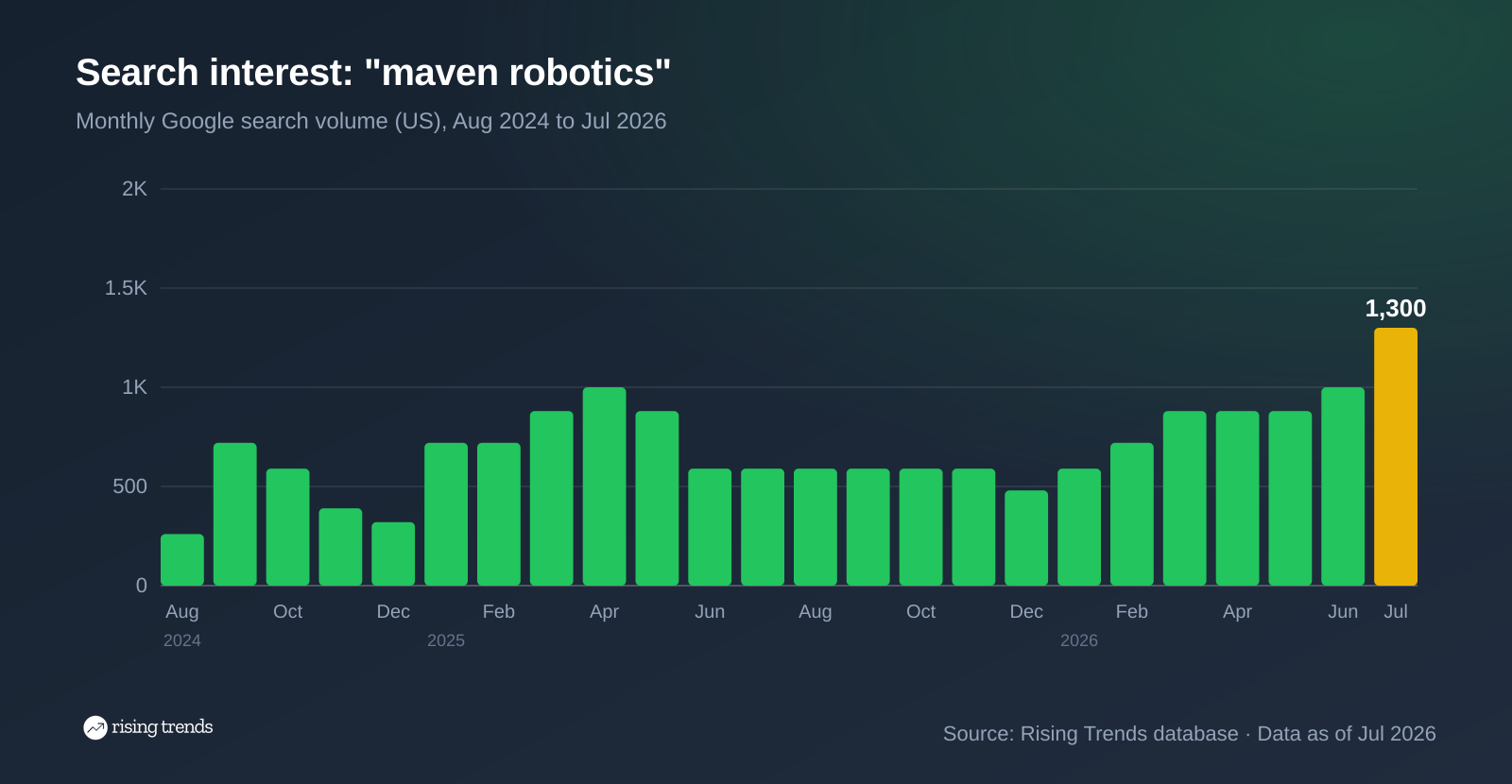
Read it in three parts. Through 2025 the term wanders in a band between 480 and 1,000 a month, which is what a stealth company with a careers page looks like in search. December 2025 is the low point at 480. Then February 2026 starts a clean staircase: 720, then 880 for three straight months, then 1,000 in June, then 1,300 in July 2026, the highest month on record. Growth over the trailing year is 120%, and over three months it is 48%, which means the curve was still accelerating into the summer.
That matters because it dates the interest to the wrong side of the press release. Something was putting the name in front of people seven months before the round: 20 open engineering roles, a Fortune 250 pilot, and the chatter that surrounds both. The live maven robotics trend page is where the post-announcement months will show up first.
Against the rest of the category, Maven is still the smallest name in the room.
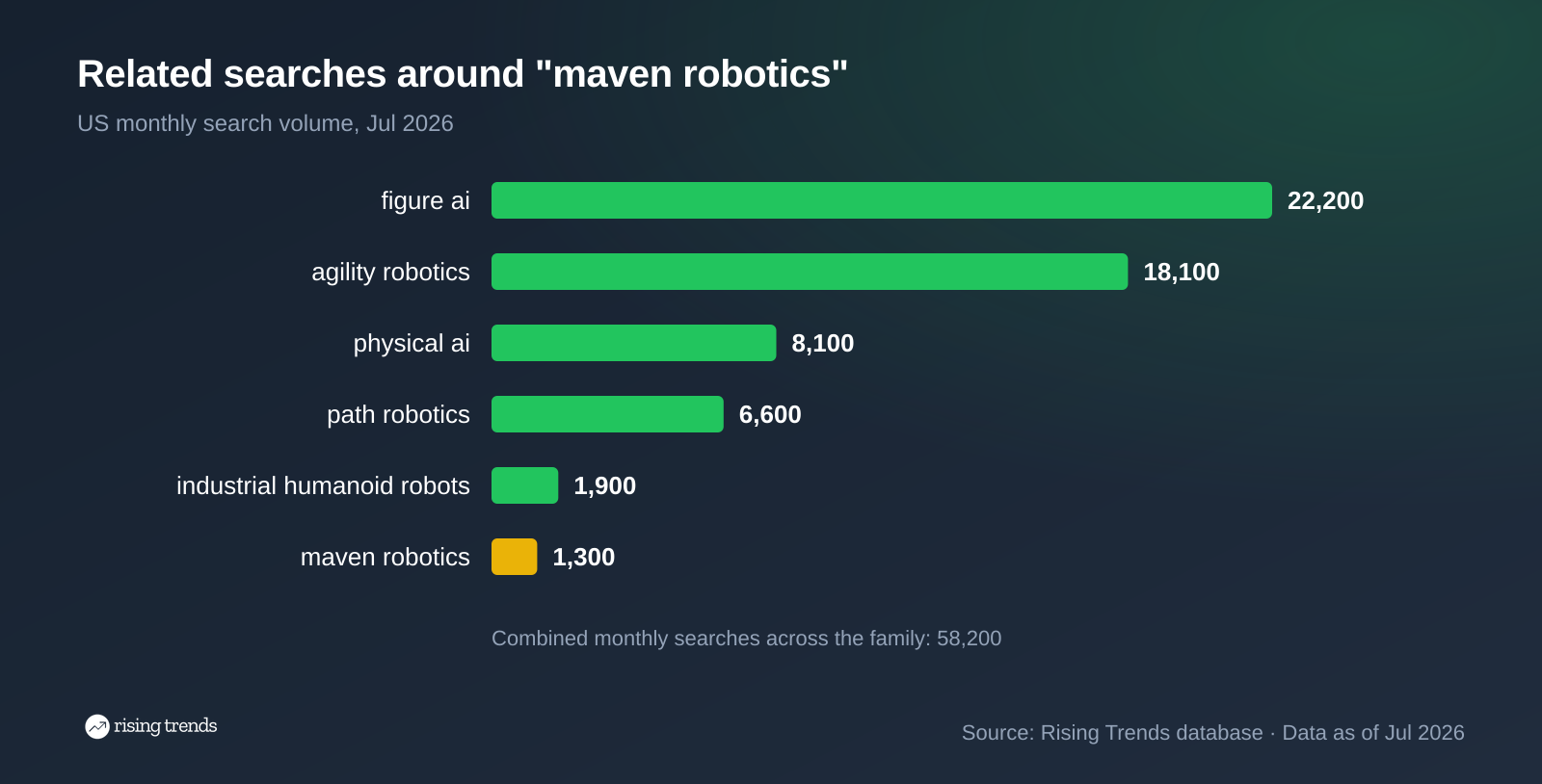
Figure AI at 22,200 searches a month and Agility Robotics at 18,100 are the names the public knows, as of July 2026. The category term "physical ai" sits at 8,100, and Maven at 1,300 is a rounding error next to any of them. Size is not the interesting axis here, though. Direction is, and we will come back to that.
The company's public surface is thin on purpose. Its homepage has no product name, no spec sheet, no customer logos and no pricing. What it has is a letter, and the operative sentence is this one: the first robot is "purpose-built for industry, combining strength, adaptive dexterity, fluid mobility, and the most reliable physical AI," and "its cost-efficiency makes advanced automation accessible to businesses of every scale."
The job is narrower than the language suggests. Maven's robot does mixed-case palletizing: taking cases of different products off incoming pallets and stacking them onto new pallets built for one store's order. It is the least automated job in a distribution centre because every box is a different size, every stack has to be stable, and the mix changes daily. Maven's own release sizes that opening at $80 billion and the broader material handling and assembly market it wants to reach at over $1 trillion, both of which are the company's framing, not an independent estimate.
The hardware is a deliberate rejection of the humanoid form. Founder Hamza Derbas told TechCrunch the robot uses a wheeled base that moves up to 10 miles per hour, with two arms that lift 30 kilograms and vacuum grippers for boxes. On two-legged designs, he was blunt: they "make zero sense for anything they're doing," and are "very complex, unreliable, and add unnecessary cost." That is a competitive position, not a fact about physics, but it is the position the company is spending $100 million on.
If you want to know what a robotics company really does, read its job board rather than its homepage. Maven's careers page lists 20 open roles as of September 16, 2026.
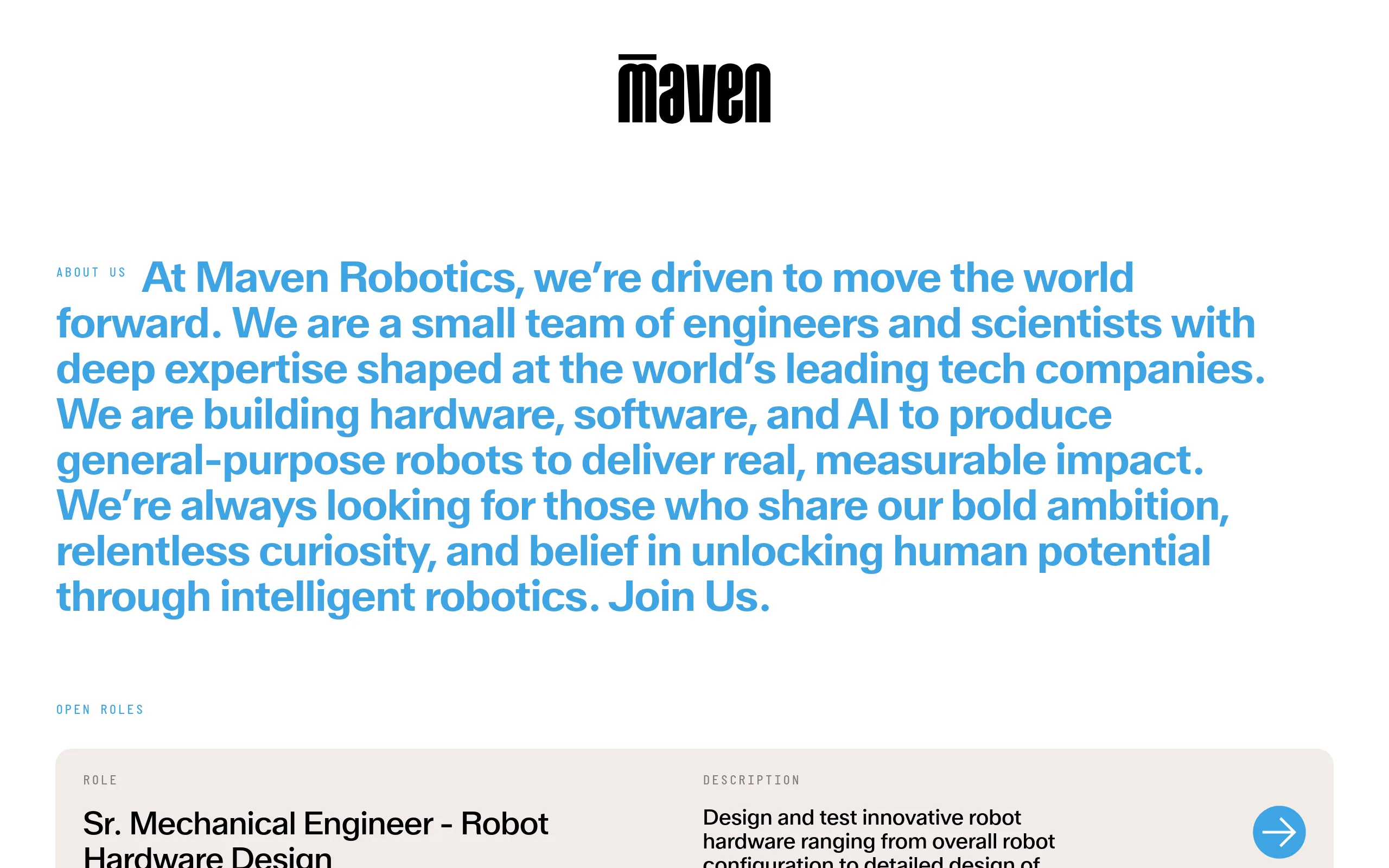
The mix is telling. There is a Robot Field Engineer to "deploy and support robots at customer sites," a Lead Fleet Operations Software Engineer for "a large fleet of robots running reliably," data collection operators, and an applied scientist for robot foundation models. Those are not prototype roles. They are the roles you hire when customers already have your machines and you need them to keep running, which is the same physical AI problem every company in this category is now solving in the field rather than the lab.
The trigger date is September 10, 2026. Maven announced a $100 million Series A led by RoboStrategy, with LocalGlobe, Vine Ventures and XTX Ventures participating, and its Series A release put a number on the ambition: 100,000 autonomous operating hours by the end of 2026, and a million by the end of 2027.
Derbas framed it in labour terms rather than machine terms. "Intelligent industrial robots promise an incredible future," he said in the release. "If we can activate autonomous labor, we can build a world of infinitely elastic industrial capacity."
The round landed on the same day as the only substantive independent write-up, TechCrunch's interview, where the operational numbers came out: eight robots, 16-hour days, 99% or better uptime, and a plan to build 250 third-generation units while starting design on a fourth. Maven won its first large customer in a bake-off against four rivals, which is where the headline about stealing deployment deals comes from.
The lead investor made the case publicly the same afternoon. Andrew Kang of RoboStrategy posted the thesis on X on September 10, and it is worth reading because it explains the team rather than the product.
Kang's argument, in his words, is that "Apple previously had an incredible special projects group building autonomous systems that attracted some of the top talent relevant to building a great AI Robotics company," and that Maven's core team was assembled out of that group. The post had 274 likes and 36 replies at the time of writing. That is a modest number by X standards, and it is a fair reminder that this is an industrial story, not a consumer one.
Maven was founded in 2024 in Santa Clara, California, by two brothers: Hamza Derbas as CEO, who spent nine years in Apple's special projects group after a career in automotive and EV engineering, and Khalid Derbas as CFO, who came from private equity. The release claims more than 200 combined years of experience across the team, drawn from Apple, Tesla, Rivian, Cruise, Zoox, Ford and Archer Aviation. The logo wall on the careers page adds Boeing, Stellantis, McLaren Racing, Disney Imagineering and General Atomics.
Here is what is actually on the record.
| Date | Event | Figure | Source |
|---|---|---|---|
| 2024 | Company founded in Santa Clara, CA | Two co-founders | Series A release |
| Sep 10, 2026 | Series A led by RoboStrategy | $100M | Series A release |
| Sep 10, 2026 | Fleet in production with a Fortune 250 CPG customer | 8 robots, 16 hrs/day, 99%+ uptime | Derbas, to TechCrunch |
| Sep 10, 2026 | Build plan funded by the round | 250 third-generation robots | Derbas, to TechCrunch |
| End 2026 | Autonomous operating hours target | 100,000 hours | Series A release |
| End 2027 | Autonomous operating hours target | 1,000,000 hours | Series A release |
| Sep 16, 2026 | Open roles listed | 20 | mavenrobotics.ai careers page |
Three caveats belong with that table. No valuation has been disclosed, so the Crunchbase and PitchBook entries circulating are estimates rather than filings. The uptime and fleet-size numbers come from the CEO in an interview, not from a customer or an audit. And the hour targets are targets: the only verified operating figure today is eight robots running two shifts.
This is where the search data earns its keep, because the growth ranking does not match the size ranking at all.
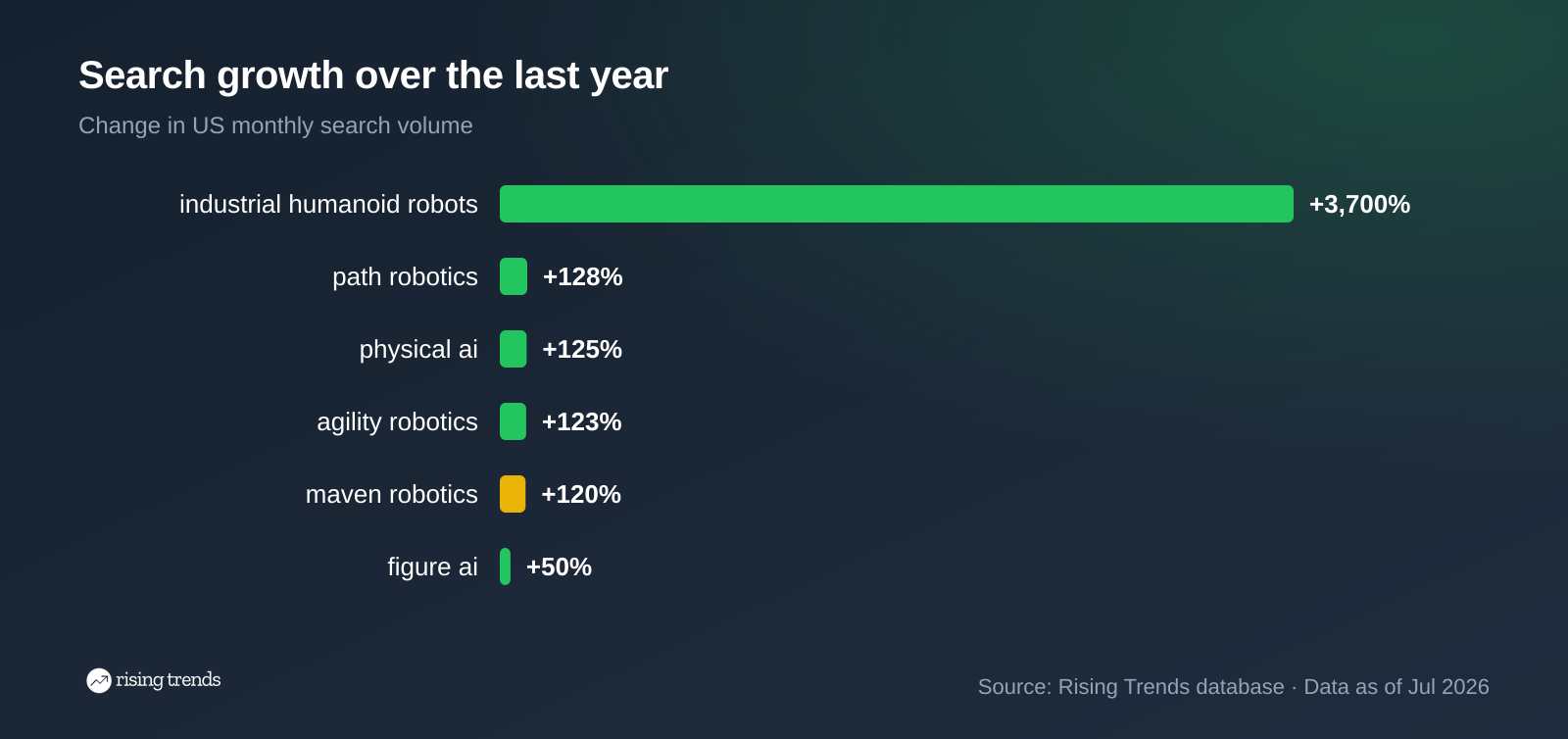
The biggest brand is the slowest grower. Figure AI is up 50% in a year, the weakest number on the chart, and its homepage now says "the future of home help is here" and describes Figure 03 as a robot that "handles household tasks the way you would." Figure has walked its public pitch from the factory into the living room. That is a legitimate strategy, and we covered the consumer end of it in our piece on Tau Robotics, but it leaves the industrial floor to other people.
Agility Robotics is the direct comparison, and it is the one number in this article that nobody else has put side by side. Agility's own site says Digit "has 65,000 hours of real production experience," accumulated over more than a decade of work, with a fleet management platform called Arc and assembly in Salem, Oregon. Maven says it will pass 100,000 autonomous hours by the end of this year, from a standing start, with eight machines. Either Maven's definition of an operating hour is looser than Agility's definition of a production hour, or a wheeled robot doing one job well accumulates experience faster than a bipedal robot doing many jobs adequately. The answer to that decides who is right about legs.
Path Robotics, at 6,600 searches a month and up 128% as of July 2026, is the other shape this can take: pick one hard industrial task, in their case welding, and own it. And the term that beats every brand on this chart is industrial humanoid robots, up 3,700% in a year from a small base. Buyers are searching for the job, not the logo. That is what an early market looks like right before it consolidates, the same pattern we tracked through warehouse automation in our supply chain software report.
The old robot market is shrinking while this one compounds. The International Federation of Robotics counted 542,000 industrial robots installed worldwide in 2024, with an operational stock of 4,664,000. But the Americas took only 9% of those installs, at 50,100 units, down 10% year over year, and US installations fell 9% to 34,200. Classic caged-arm automation in North America is in a down cycle. Search demand for the machines that replace it is up triple digits. Those two facts sit on top of each other, and they are the reason a $100 million Series A gets written for a company with eight robots in the field.
Cost-per-hour beats cost-per-robot. Maven's pitch is explicitly about cost-efficiency making automation "accessible to businesses of every scale," which is a rental economics argument dressed as a hardware one. If a general-purpose machine can be moved from palletizing to tote handling to assembly without a six-figure integration project, the buyer stops comparing capital costs and starts comparing hourly rates against a shift. Every logistics operator we track on our logistics and supply chain trends page is running that arithmetic right now.
The software is the moat, not the arm. The roles Maven is hiring for, fleet operations, behaviour planning, foundation models, are the same stack that turns a demo into a fleet. This is the physical version of what we described in our AI agents report: the model that plans work is worth more than the body that performs it, and the training data comes from real shifts. Companies with robots in production collect it. Companies with prototypes do not.
Watch whether the hours claim survives contact with December. The 100,000-hour target for the end of 2026 is arithmetic, not a forecast: eight robots at 16 hours a day produce roughly 46,000 hours a year, so hitting six figures means the fleet grows several times over in the next three months. If Maven's search volume keeps stepping up without a new funding headline, deployments are why. If it flattens, the round was the whole story.
Watch "industrial humanoid robots" rather than the brands. At 1,900 searches a month and up 3,700% in a year as of July 2026, it is the term buyers use before they know who to call. When a generic category term grows faster than every brand inside it, the market has not picked a winner yet. The physical ai term, at 8,100 and up 125%, is the same signal one level up.
Watch the labour argument, because it is coming. "Infinitely elastic industrial capacity" is a phrase about supply, and the people currently supplying that capacity will read it differently. Warehouse work is the first white-collar-adjacent job to be automated in public, and the politics of who keeps the productivity gain is already a live fight, as we covered in the 32 hour work week, explained. The robots that do well in that argument will be the ones whose operators can point at a job nobody wanted.
The broad signal is simple enough. For three years the humanoid robot was a video, and the companies with the best videos got the most searches. Maven has no video worth watching and eight machines stacking boxes overnight, and its curve went vertical anyway. The market is starting to reward work over demos, and that is a harder thing to fake.
Want to spot the next breakout company before it makes the funding headlines? Read our guide on how to identify market trends, follow the live maven robotics trend page, or browse what is breaking out right now on the Rising Trends dashboard.
Thousands of Emerging Trends
Thousands of Breakout Apps
Mega Trends
Trend Analysis Tool