
Trends


In June 2026, 140 people a month searched for "tau robotics" in the US. In July it was 1,900. One month, 13.6 times the volume, on the back of a San Francisco launch that put a humanoid robot in strangers' kitchens for less than the price of a cleaner.
Two details are missing from every write-up of this company. The price is not $30 an hour, it is $60, and the company's own terms say so. And the reason it can charge that at all is written in plain English in its privacy policy: the video from inside your home is not a byproduct of the service, it is the product.
Key takeaways:
Let's get into it.
Here is the whole search history of this company, and you can see why it is worth looking at now rather than later.
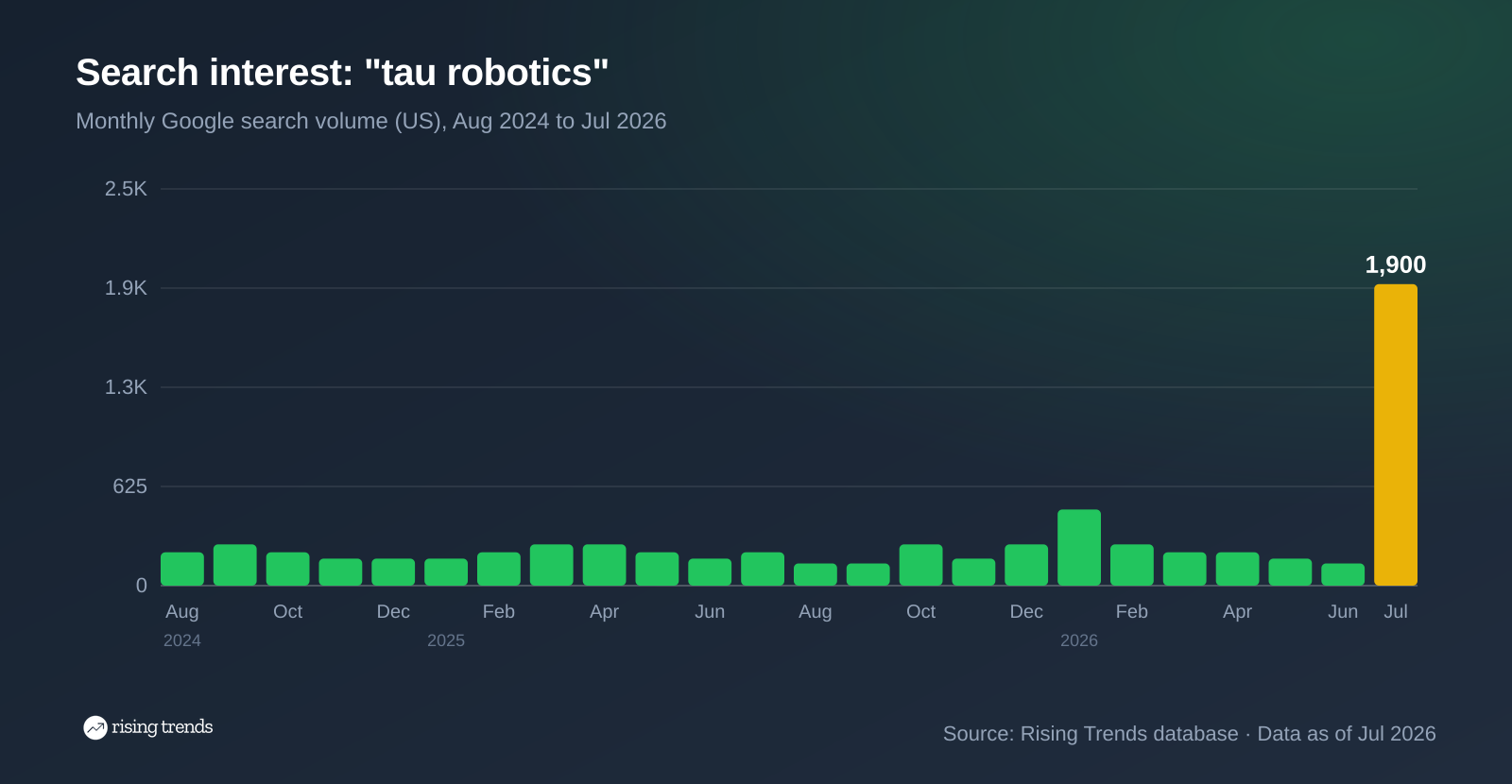
Twenty-three months between 140 and 480, including a decline through the spring of 2026 down to 140 in June. Then 1,900 in July. Three-month growth reads 805% and our acceleration measure is 3.25, which is among the sharpest single-month moves in the database.
This is what a consumer launch looks like when it happens in one city and gets filmed. Nothing about the curve says durable yet. One bar is a launch, not a trend, and the August and September numbers are the ones that will settle it.
The category around it is a different story.
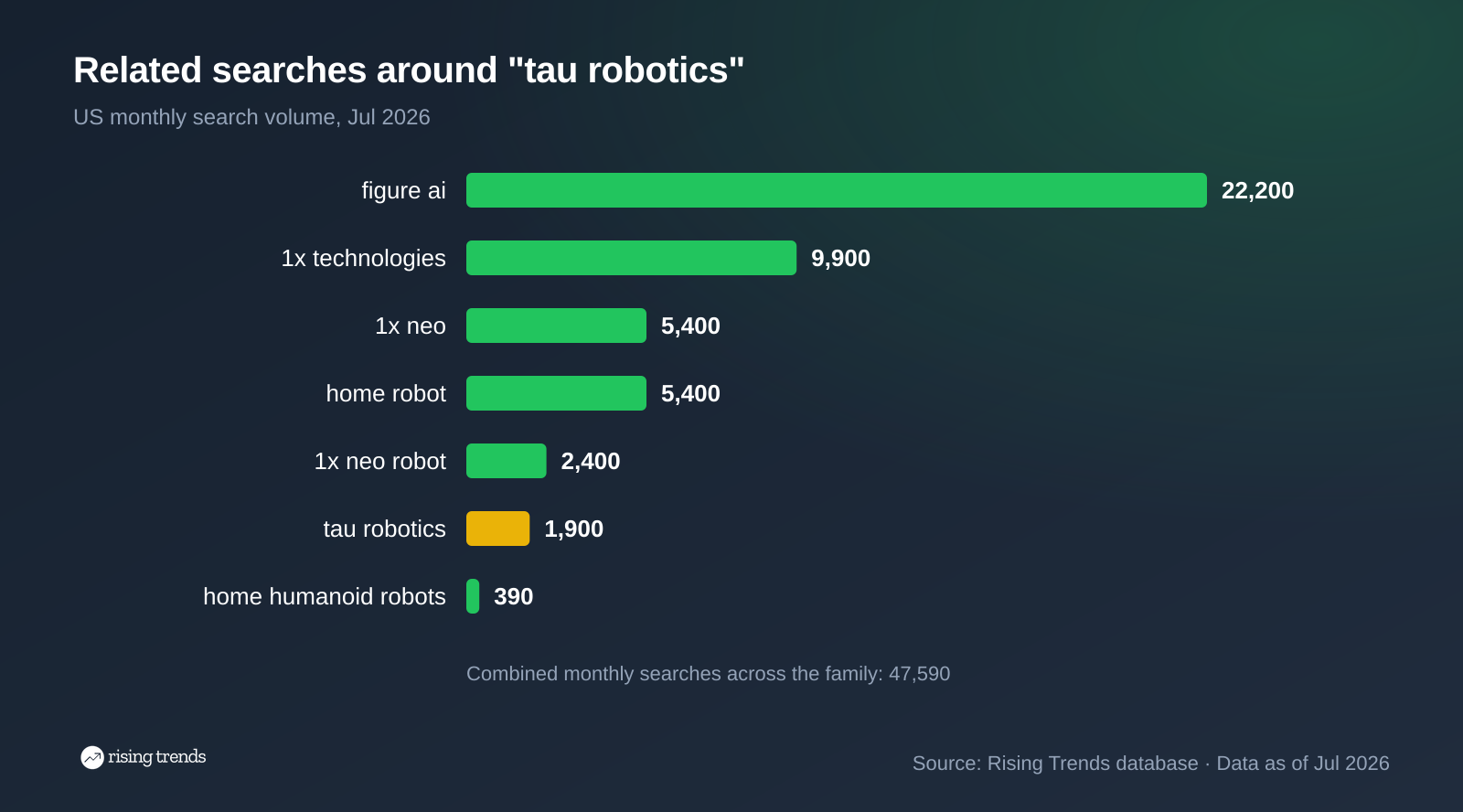
Figure AI at 22,200 searches and 1X Technologies at 9,900 are the established names, and the broader term "humanoid robot" pulls 90,500 a month, up 123% in a year. Tau is the smallest entry on this chart.
Growth reorders it.
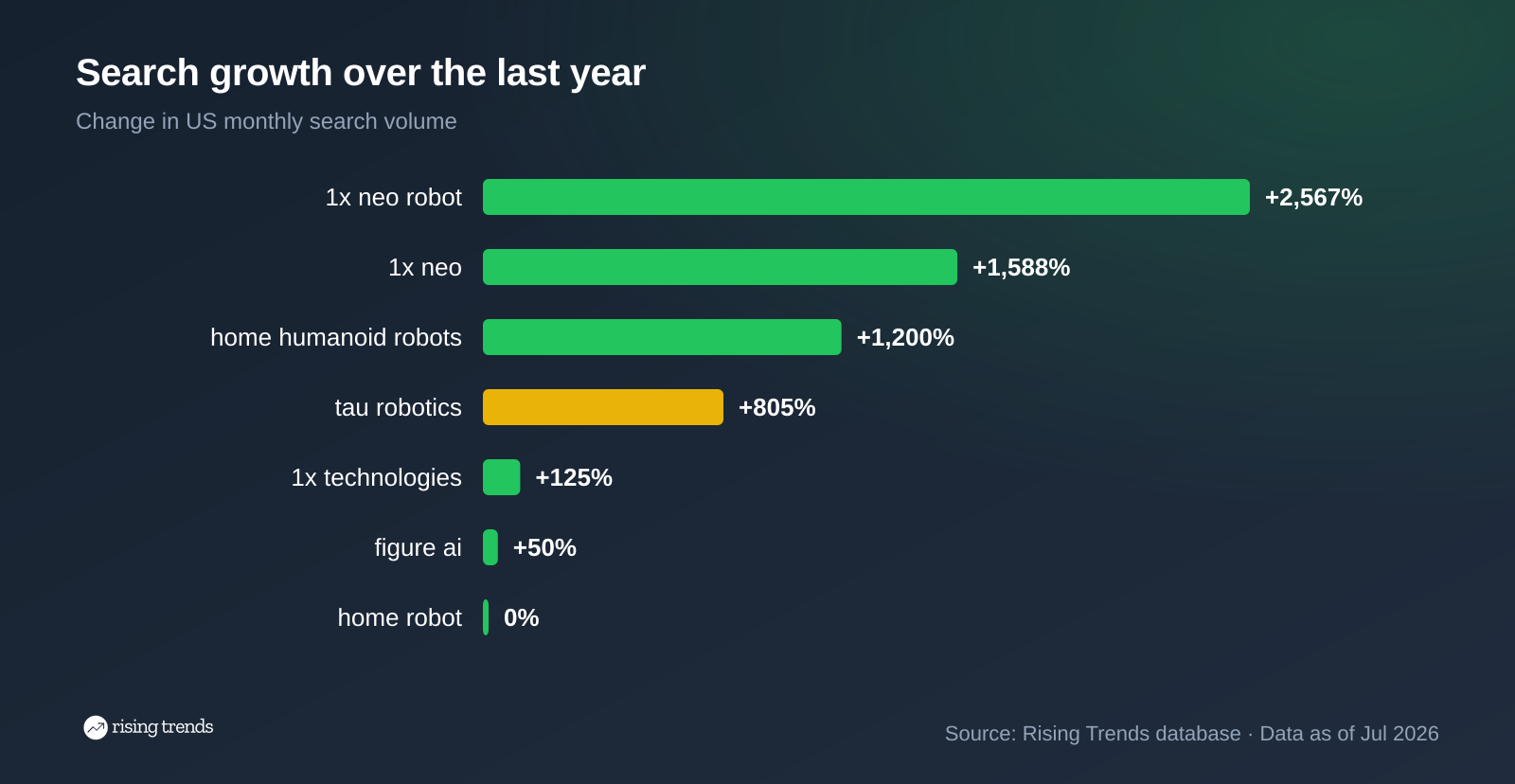
Everything with a home in its description is compounding. 1X NEO is up 1,588% and its product-specific term is up 2,567%, while home robot, the generic phrase, has not moved at all in a year. Factory humanoids are a business story. Household humanoids are the search story, and Tau launched into the middle of it.
A one-hour visit from two robots, driven by people.
The terms of service are specific: "A cleaning is a one-hour visit. The fee is $30 per humanoid for the hour. We send two humanoids to every visit, so a cleaning is $60." Cancel more than 24 hours out and you are refunded in full, inside 24 hours you get half back. Report a problem within 48 hours and they re-clean or refund. Total liability for anything arising from a cleaning is capped at $2,500.
The work itself, from the company's site: vacuuming including the edges along baseboards, wiping counters and tables, taking out the trash, clearing clutter off the floor. Bookings are invite-only with a waitlist.
What is not on the marketing page is how the robot knows what to do. It does not. A person does.
Most startups bury this. Tau put it in the second paragraph of its service privacy policy, updated July 27, 2026.
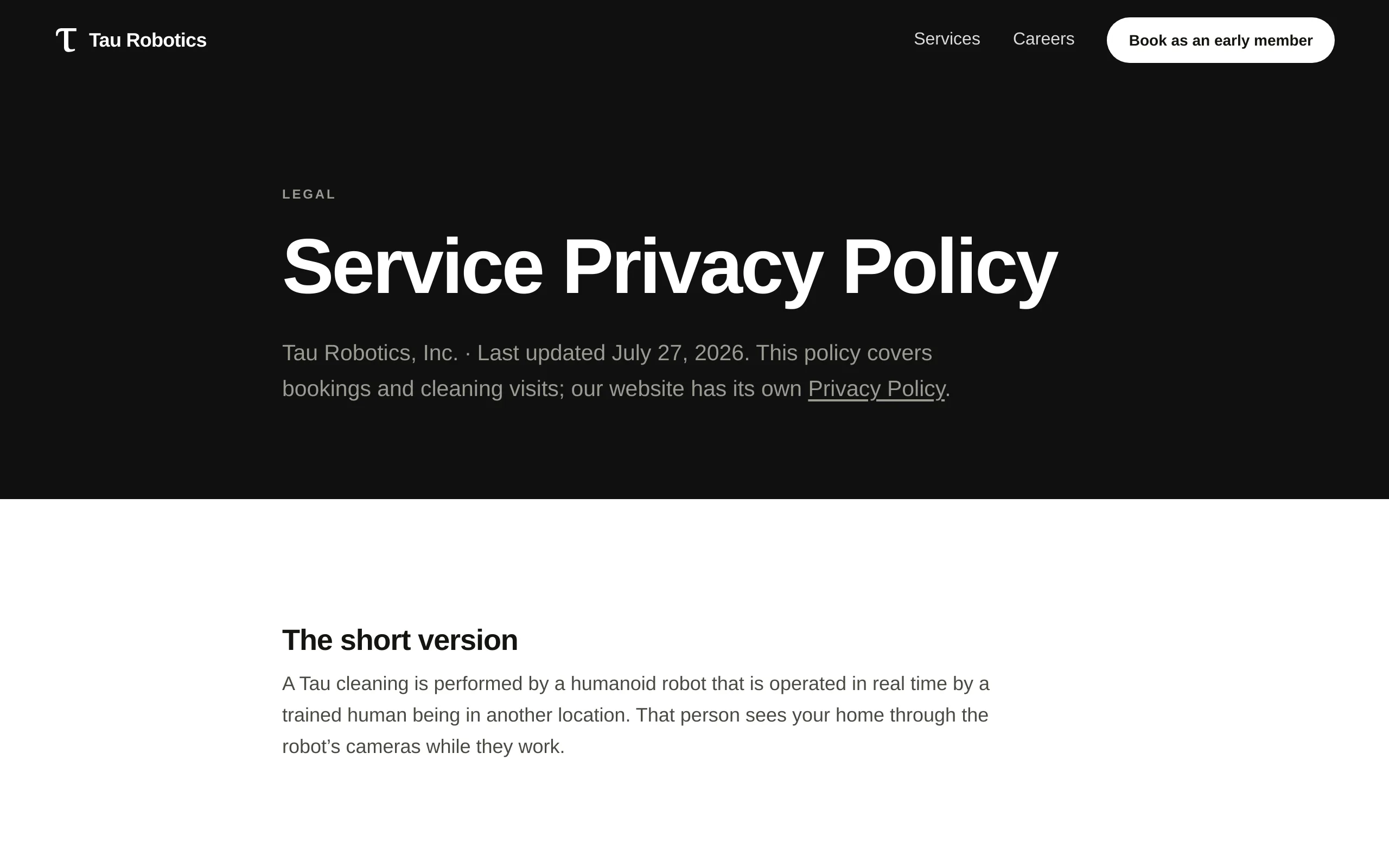
"We record what those cameras see. We use that footage to run the cleaning and to train the AI models that we hope will eventually do the job without a human operator. This is not optional. It is how the service works, and it is why the service is priced the way it is."
Later, under retention, it goes further: "The video our robot records is not a byproduct of the cleaning. It is the training data. There is no separate, sanitized copy. The footage from your home, as recorded and including unblurred faces, is what our models learn from." And then: "So we keep it. We are not putting an expiry date on it and we are not going to imply one."
Here is what is captured, according to that policy:
| Data | Detail | Kept for |
|---|---|---|
| Video | Continuous, from head and wrist cameras, first-person view including any people present | Indefinitely, or until you request deletion |
| Spatial data | A three-dimensional record of room layout and object positions | Indefinitely, or until you request deletion |
| Operator commands | Every motion input and its timing | Indefinitely, or until you request deletion |
| Service records | What was cleaned, how long, what went wrong | 7 years |
| Audio | None. Microphones disabled, speaker is one-way | Not collected |
The controls are better than the headline suggests. Bedrooms and bathrooms are excluded unless you opt in. You can mark any room or object off-limits before the visit. Anyone present can tell the operator to stop and the session ends. Operators are W-2 employees, background-checked, working on-site in San Francisco, and the policy states plainly: "We do not use gig workers or independent contractors for this role."
And one line deserves credit for honesty about a problem the whole category has: "The person who books the cleaning cannot consent on behalf of everyone else in the household."
The early reaction is not about privacy. It is about whether the thing cleans.
The caption on this August 23 clip from @brycegruber gets at both objections at once: "the robot cleaner seemed to hardly...clean? ... And you need to be invited for access to Tau Robotics cleaning robots? Like what?"
That is the correct first question. A teleoperated humanoid is slower than a person with a vacuum, and the invite-only gate means very few people can check. The demand signal in our data is curiosity, not satisfaction, and those are different things.
Teleoperation is a data strategy wearing a service uniform. Every humanoid company needs footage of real work in real homes, and there is no dataset to buy. Tau's answer is to sell the labour at a price people will accept and keep the recordings. It is the same bargain the AI training-data economy runs on, moved from a laptop to a living room.
The price tells you the subsidy. Two robots, two operators' worth of attention, hardware, and a San Francisco facility for $60 an hour is not a business. Human cleaners in that city cost more than that. The gap is being paid for by whoever funds the training run.
Consent gets complicated fast. A camera in a private home, unblurred faces, a policy that cannot be agreed to by everyone it records, and footage retained indefinitely by default. Tau's disclosures are clearer than most, which makes it the test case rather than the villain. The cybersecurity questions enterprises now ask their AI vendors are arriving for consumers, and the answers will look like zero data retention or they will look like this.
Autonomy is the whole bet. If the models trained on this footage can eventually do the job unsupervised, the operator cost disappears and the business works. If they cannot, Tau is an expensive cleaning company. Nothing in between.
August and September volume. One bar is a launch. Our series ends at 1,900 for July 2026, and the question is whether the curve holds when the novelty coverage stops. The live Tau Robotics trend page is where that answers itself.
Whether the waitlist opens. Invite-only limits both the data collection and the scrutiny. A general launch in a second city would be the signal that the unit economics survived contact with San Francisco.
Whether NEO stays ahead. 1X NEO is growing three times faster than Tau and is selling a robot you own rather than a service you book. Those are two different answers to the same question about who wants a humanoid in the house, and the search data is already picking one. We track the same split across home appliance trends, where owning and subscribing keep trading places.
The honest summary is that Tau Robotics has built something interesting and described it more candidly than it had to. Whether you want it is a question about your living room, and the company has made it unusually easy to answer, because it told you exactly what it is taking.
Want to see consumer launches while they are still one bar on a chart? Read our guide on how to identify market trends, follow the live Tau Robotics trend data, or browse what is breaking out right now on the Rising Trends dashboard.
Thousands of Emerging Trends
Thousands of Breakout Apps
Mega Trends
Trend Analysis Tool