Trends


Two years ago, 70 people a month typed "karman industries" into Google. As of August 2026 it is 1,300, and the month it broke was January 2026. The company is barely two years old, sells nothing to consumers, and has not named a single customer. Its search curve still looks like a product launch.
Here is the part nobody ranking for the name has noticed. Every category term around Karman Industries is flat or falling. Data center cooling is at 0% growth over the year. Industrial heat pumps are down 19%. Waste heat recovery systems are down 21%. A company term is outgrowing the entire category it sits in, which almost never happens unless something specific and dateable set it off. Something did, and you can put a date on it.
Key takeaways:
Let's get into it.
Here is the monthly search volume for "karman industries" over two years, straight from our database. It is not a staircase. It is a flat line with one cliff in it.
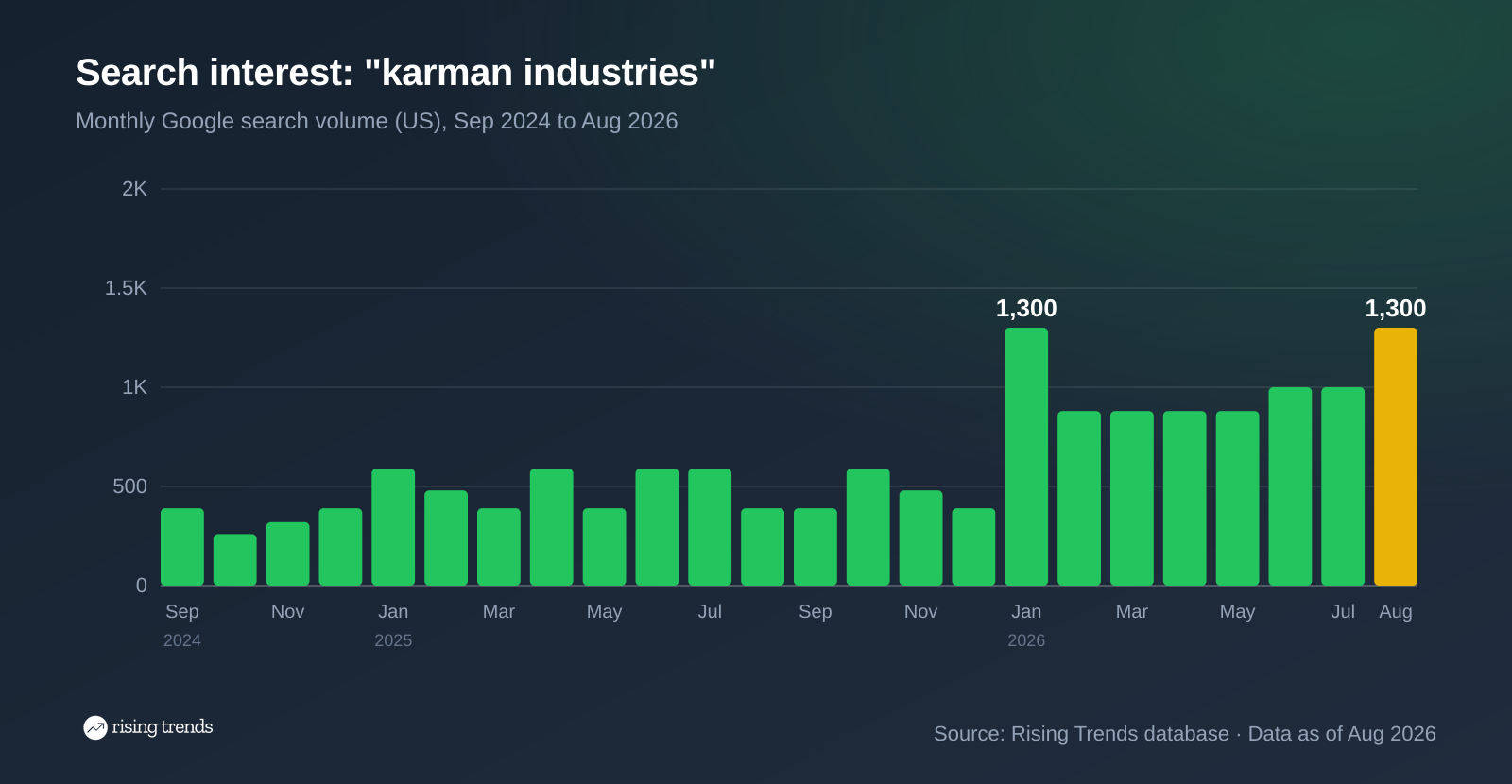
For fifteen months the term sat between 260 and 590 a month. In January 2026 it went to 1,300, more than triple December's 390. It settled at 880 through the spring, climbed back to 1,000 in June and July, and returned to 1,300 in August 2026, matching the January peak. That last part matters more than the spike. Launch bumps usually decay to a new baseline below the peak. This one came back to it.
The breakout month in our data is September 2024, the month the company came out of stealth. Two years later the term is up 1,757%, and the three-month average is 33x what it was two years earlier. Our full history and the live curve sit on the Karman Industries trend page.
Now the comparison that the company's own press coverage cannot give you. Here is Karman against the category terms it belongs to, over the same year.
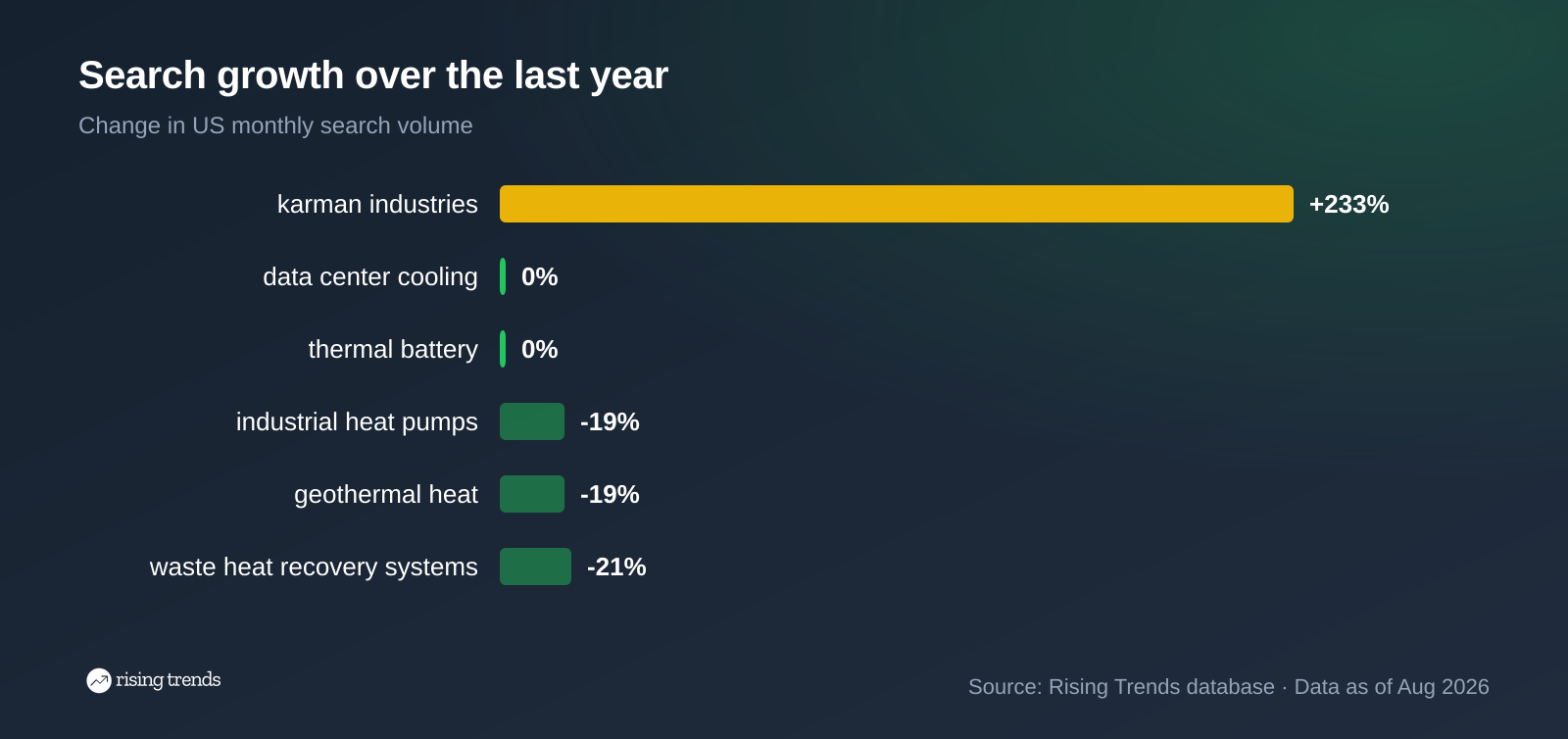
Data center cooling is a bigger term at 1,900 searches a month, and it has not moved in a year. Geothermal heat is four times bigger and shrinking. Immersion cooling is down 45%. The whole electrified-heat vocabulary is losing interest while one two-year-old company's name gains it. That is the information gain here: the demand is company-specific, not a category tide lifting a boat.
One adjacent term breaks the pattern. Data center turbines is tiny at 110 searches a month, but it is up 450% in a year and 10,900% in two. Hold that thought, because it is the same idea as Karman's.
Karman sells a box called the HPU, short for Heat Processing Unit. One unit handles 10MW of thermal load and fits in a shipping container.
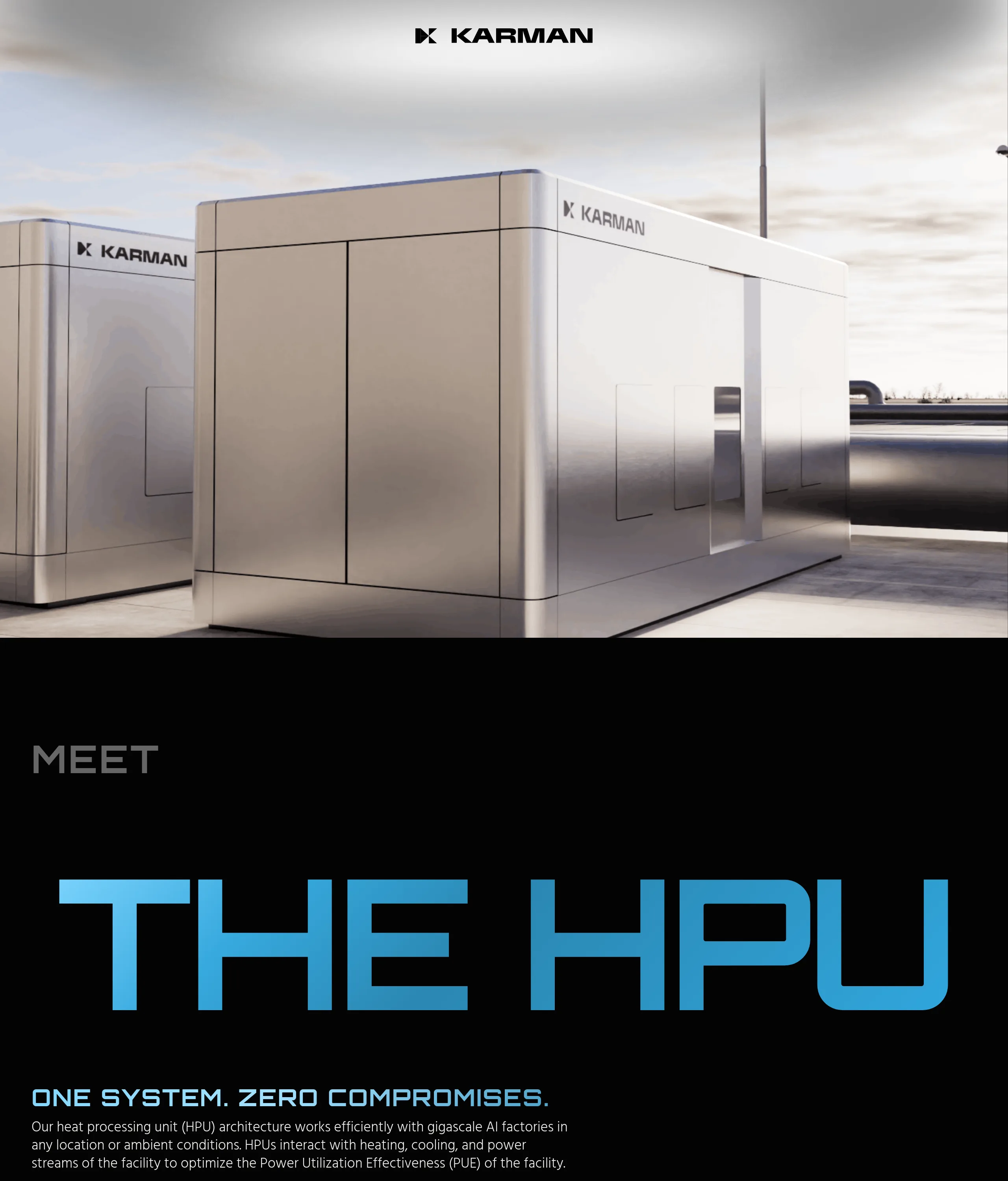
A conventional giga-scale data center cools itself with a mechanical yard: on the company's own HPU technology page, 500 or more separate chillers and dry coolers, miles of piping, months of assembly on site. Karman's pitch is to replace that sprawl with a smaller number of identical modules, and to cut the yard's footprint by 60% to 80%.
Two engineering choices make it unusual. The first is the working fluid. The HPU runs on carbon dioxide rather than an F-gas refrigerant. On the company's comparison table, CO2 has a global warming potential of 1 and forms no PFAS, against 1,430 for R134a and 2,088 for R410A. In a world where refrigerant rules keep tightening, that is a regulatory hedge as much as an environmental one.
The second is what CO2 lets you do after the cooling is done. "When you run CO2 through the expansion process, there's a lot of energy left over which we can harness," CEO David Tearse told Data Center Dynamics in April 2026. "With R134a, there's very little energy left over. With CO2, we have enough to power a turbine."
That is the whole thesis in one sentence. The heat coming off a GPU rack stops being waste and becomes feedstock: more cooling, district heating, or electricity. Karman's published power usage effectiveness figures run from 1.04 annual for plain HPU cooling down to 1.01 when the recovered heat is used to generate power. Those are the company's own numbers for its own product, not independent test results, and worth reading as a target rather than a measurement.
At the centre of it is a compressor the marketing department calls the Kompressor. It borrows from rocket turbomachinery and electric vehicles: metal 3D-printed impellers, silicon-carbide power electronics, an 800V DC architecture, non-contact bearings, and a rotor spinning at 30,000 rpm. The team building it comes from SpaceX, Rocket Lab and GE.
The spike has a date. On 15 January 2026, Karman announced the HPU and, in the same release, disclosed a $20 million Series A it had quietly closed the previous September. The company's newsroom lists the announcement, the Data Center Dynamics write-up four days later, a Los Angeles Times feature on 22 January, and a Facilities Dive piece on 5 February. Searches tripled that month.
What makes a thermal-systems launch land like that is the framing. "In the race to stand up AI capacity, time is the most expensive variable," Tearse said in the launch announcement. "By shrinking the footprint of the mechanical yard by 80%, we don't just save land; we eliminate the 'snowball effect' of infrastructure complexity, allowing hyperscalers to move from 'shovels in the ground' to 'chips in the rack' many months faster."
CTO CJ Kalra put the engineering claim next to it: "We applied an aerospace systems-engineering approach to data center thermodynamics." Tearse later expanded the same interview circuit, including a long Valley of Depth interview in February 2026 walking through how the HPU replaces chillers.
The investors amplified it. This post from Jonathan Lacoste of Space VC, an investor since the pre-seed, is the clearest short statement of why the category suddenly has an audience. It was posted on 16 April 2026, three months after the launch.
"Every GW of new compute brings massive incremental cooling demand," he wrote. That is the sentence doing the work. Karman did not get searched because people care about heat pumps. It got searched because it was filed under AI infrastructure.
David Tearse was a venture partner and entrepreneur-in-residence at Riot Ventures before leaving in July 2024 to found the company. He met his co-founder, CJ Kalra, there. Kalra was head of technology at the thermal battery company Antora and has NASA and GE Global Research on his CV.
The capital stack is short.
| Date | Event | Figure | Source |
|---|---|---|---|
| Aug 2024 | Company founded in Long Beach, California | - | Company press release |
| 19 Sep 2024 | Out of stealth, pre-seed led by Riot Ventures with Space VC | $4M | Company press release |
| Sep 2025 | Series A led by Riot Ventures, with Sunflower Capital, Space VC, Wonder Ventures and Pat Gelsinger | $20M | Disclosed in the 15 Jan 2026 launch |
| 15 Jan 2026 | Total funding disclosed at launch | $30M+ | Launch announcement |
Note what is missing: no valuation has been published, and no customer has been named. Tearse told DCD the company is in discussions with multiple hyperscalers, which is not the same as a contract.
The original pitch was not data centers at all. The stealth-exit release in September 2024 described Thermal01, an electric heat pump meant to replace natural gas boilers in factories. It sized the opportunity at roughly $600 billion a year spent on low-temperature industrial heat, and about 700,000 gas boilers worldwide. Riot's Will Coffield framed it then as a decarbonisation play.
Sixteen months later the same turbomachinery was pointed at GPU racks. That pivot, from factory boilers to AI factories, is the reason the search curve exists.
The ramp is being built now. A partnership with the manufacturing software firm Manufacturo, announced on 17 February 2026, covers build traceability at the GigaWerx factory in Los Angeles, which is designed for 1GW of systems a year with a roadmap to 4GW. "As we move from prototype cycles to repeatable production, our priorities are reliability, traceability, and speed to ramp," said COO Gabrielle Carlisle.
Karman's real competition is not another startup. It is the installed base of chillers that already works, and the liquid-cooling vendors improving every quarter. Our data says the market is not shopping for alternatives yet: immersion cooling searches are down 45% over the year and liquid cooling for servers is down 64%. The buyers are hyperscalers, and hyperscalers do not use Google to pick thermal vendors.
CO2 cooling itself is not proprietary. Several vendors are developing CO2-based systems, and the approach has not been widely adopted in the industry. What Karman is claiming is not the refrigerant but the machine around it: the compressor, the packaging, and the ability to ship a 10MW block instead of wiring up a yard. The nearest thing to a competitive signal in our database is the rise of data center turbines, which is people searching for the same insight from the power side rather than the cooling side.
It is also worth saying plainly: the name is crowded. Karman Holdings, the space and defense supplier listed as KRMN, is a different company entirely. So is the Steelcase Karman office chair, which draws 1,600 searches a month on its own. Some share of any "karman" query is not about this company at all, which makes the January to August shape, moving exactly with Karman Industries news, the more useful signal.
Cooling has become a scheduling problem, not an efficiency problem. The pitch that moved the search needle was not energy savings. It was months. When a gigawatt campus is capital waiting on commissioning, anything that compresses build time gets priced as revenue, not opex. That reframing is what pulled a thermal vendor into the AI conversation, and it is the same logic behind the nuclear-adjacent bets we covered in Radiant Industries.
Heat is being repriced as an input. "At the moment, too many companies treat heat as a liability, when really it's an asset, it's energy," Tearse told DCD. If recovered heat can run a turbine or feed a district network, the thermal system moves from the cost column to the generation column. That is why data center turbines is the fastest-growing term in this family, and why the broader sustainability trends story is shifting from offsetting emissions to capturing waste.
The refrigerant rules are doing quiet work. PFAS restrictions and F-gas phase-downs make a natural refrigerant a procurement argument rather than a values statement. The same pressure is reshaping the equipment market we track in HVAC trends, where the compliance clock is pulling forward replacement cycles.
Hardware startups now depend on manufacturing software from day one. Karman had a production traceability partner in place before it shipped a unit. That is the pattern across capital-goods startups, and it is why the tooling we cover in supply chain software trends keeps compounding while the hardware categories around it flatten.
The delivery gap is the thing to watch. The January launch promised first customer deliveries in Q3 2026. In April, Tearse told DCD that "true deliveries to customers, from a scale manufacturing standpoint, will start in 2027." Q3 2026 has now closed without a named customer. That is not failure, it is the normal physics of hardware, but it is a public slip and it will show up in sentiment long before it shows up in a press release.
The first named hyperscaler will move the curve again. Searches held at their peak in August 2026 without any fresh funding or launch news, which suggests the audience is now people evaluating the company rather than people reacting to a headline. A disclosed customer would turn that into a second cliff.
Watch the power-side terms, not the cooling ones. If Karman's thesis is right, the term that should accelerate next is data center turbines, currently 110 searches a month and up 450% in a year. If cooling demand terms stay flat while heat-to-power terms climb, the market has accepted that waste heat is an asset. If both stay flat and only the company name moves, this remains a story about one well-told launch.
The honest summary is that Karman Industries is a two-year-old company with $30 million, no public customers, a factory that has not shipped at scale, and a search curve that behaves like a much bigger business. The gap between those two facts is the whole investment case, and the next twelve months close it in one direction or the other.
Want to spot the next breakout company before it makes the funding headlines? Read our guide on how to identify market trends, follow the live Karman Industries trend page, or browse what is breaking out right now on the Rising Trends dashboard.
Thousands of Emerging Trends
Thousands of Breakout Apps
Mega Trends
Trend Analysis Tool