Trends


Two years ago, 170 people a month typed "radiant industries" into Google. As of July 2026 it is 4,400, and the line has gone almost straight up since October. The company is not selling anything to those searchers. It builds a nuclear reactor that fits inside a shipping container, and in August it put one on a flatbed truck and drove it 1,000 miles to Idaho.
That is the story in one sentence, and it explains why a nine-person-a-day search term turned into a 4,400-a-month one. Radiant Industries is not a concept render or a Series A deck. There is a physical, fueled reactor sitting at Idaho National Laboratory right now, waiting to go critical. Nobody ranking for the company's name has the search curve, the month it broke out, or the comparison with the rest of the microreactor cohort. We do, and the curve lines up event for event with the public record.
Key takeaways:
Let's get into it.
Here is the monthly search volume for "radiant industries" over the last two years, straight from our database. For eighteen of those months it is flat noise. Then it is a staircase.
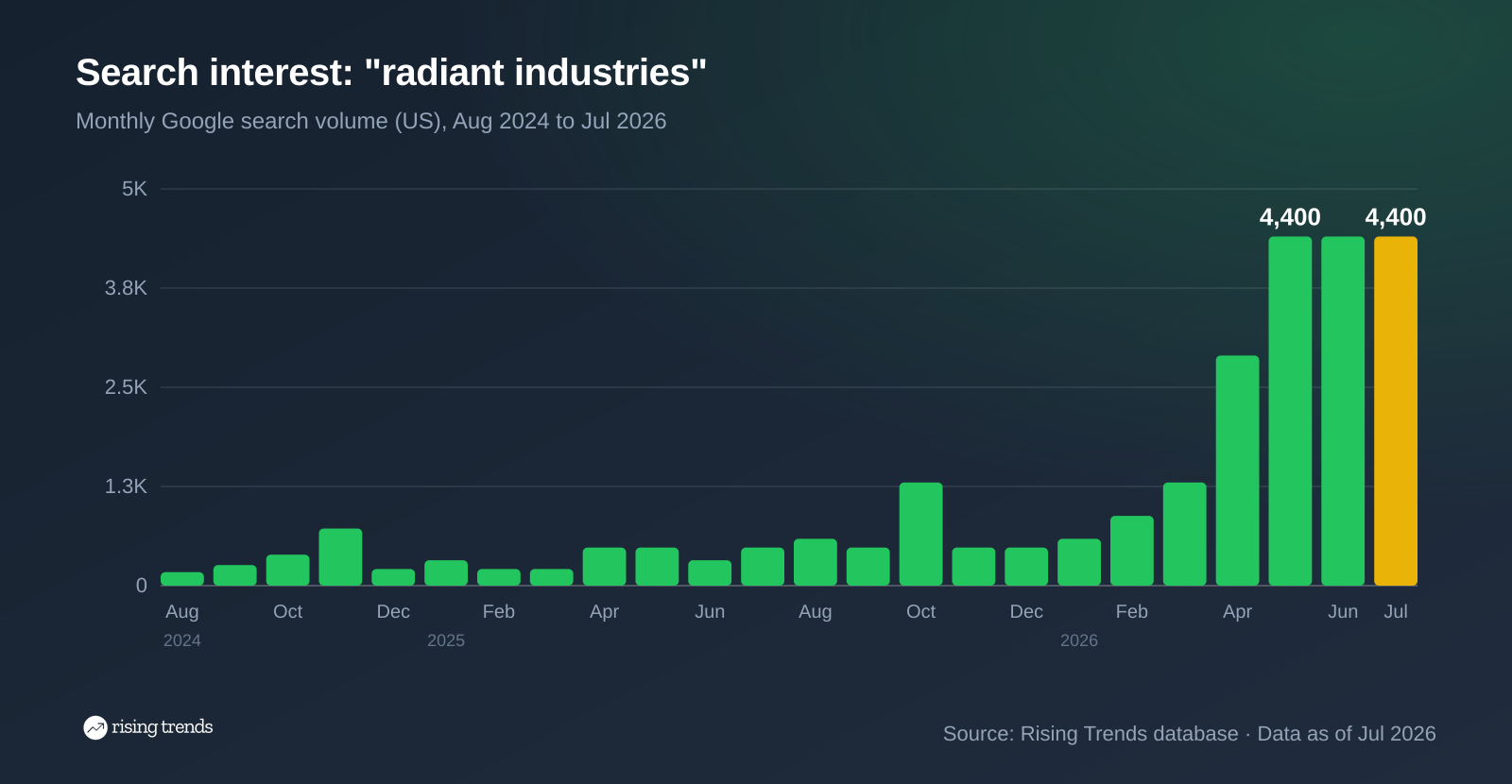
The first step is October 2025, which our data flags as the breakout month: volume went from 480 to 1,300. The second and much bigger step is spring 2026, from 1,300 in March to 2,900 in April to 4,400 in May, where it has held for three straight months. Each step has a date attached to it in the public record, and we walk through all three below.
The scale matters as much as the shape. Radiant is a household name in nuclear trade press and almost invisible next to the category's larger search terms.
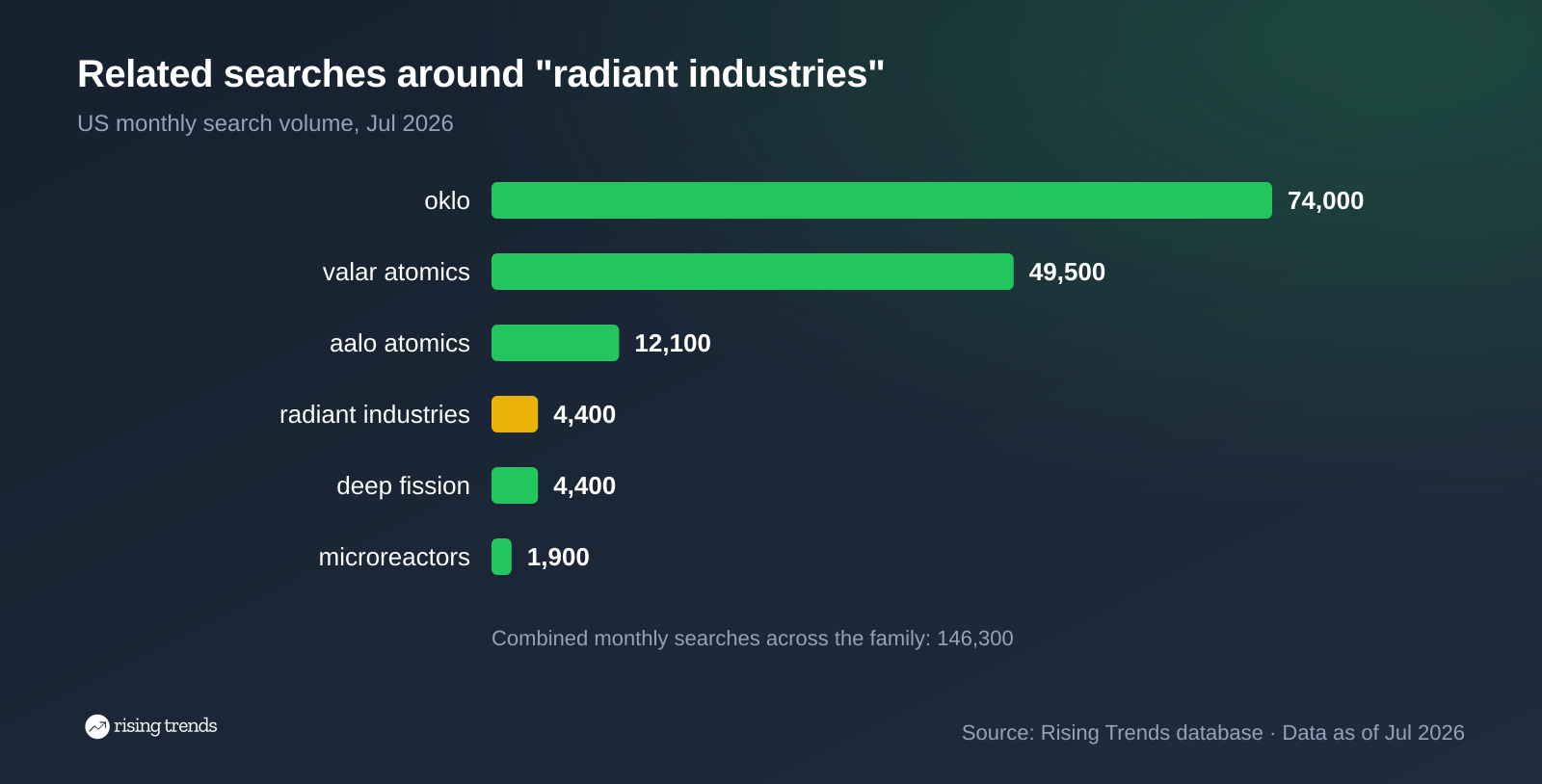
Add those six terms and you get 146,300 monthly searches across the small-reactor cohort as of July 2026. Oklo alone is half of it at 74,000, mostly because it is publicly traded and people are looking up a ticker. Radiant is at one seventeenth of that, tied with Deep Fission at 4,400. The generic term "microreactors" sits at 1,900, which tells you the brands have outrun the category word. People are not searching for the technology. They are searching for the companies.
The regulator's own description is the tightest one available. The NRC has been in pre-application talks with Radiant since October 2022, and its Kaleidos project page calls it "a transportable micro-reactor designed to generate 3MWth and approximately 1MWe", a high-temperature gas-cooled design using TRISO fuel, helium coolant and prismatic graphite blocks, with each unit "fully contained in a single shipping container".
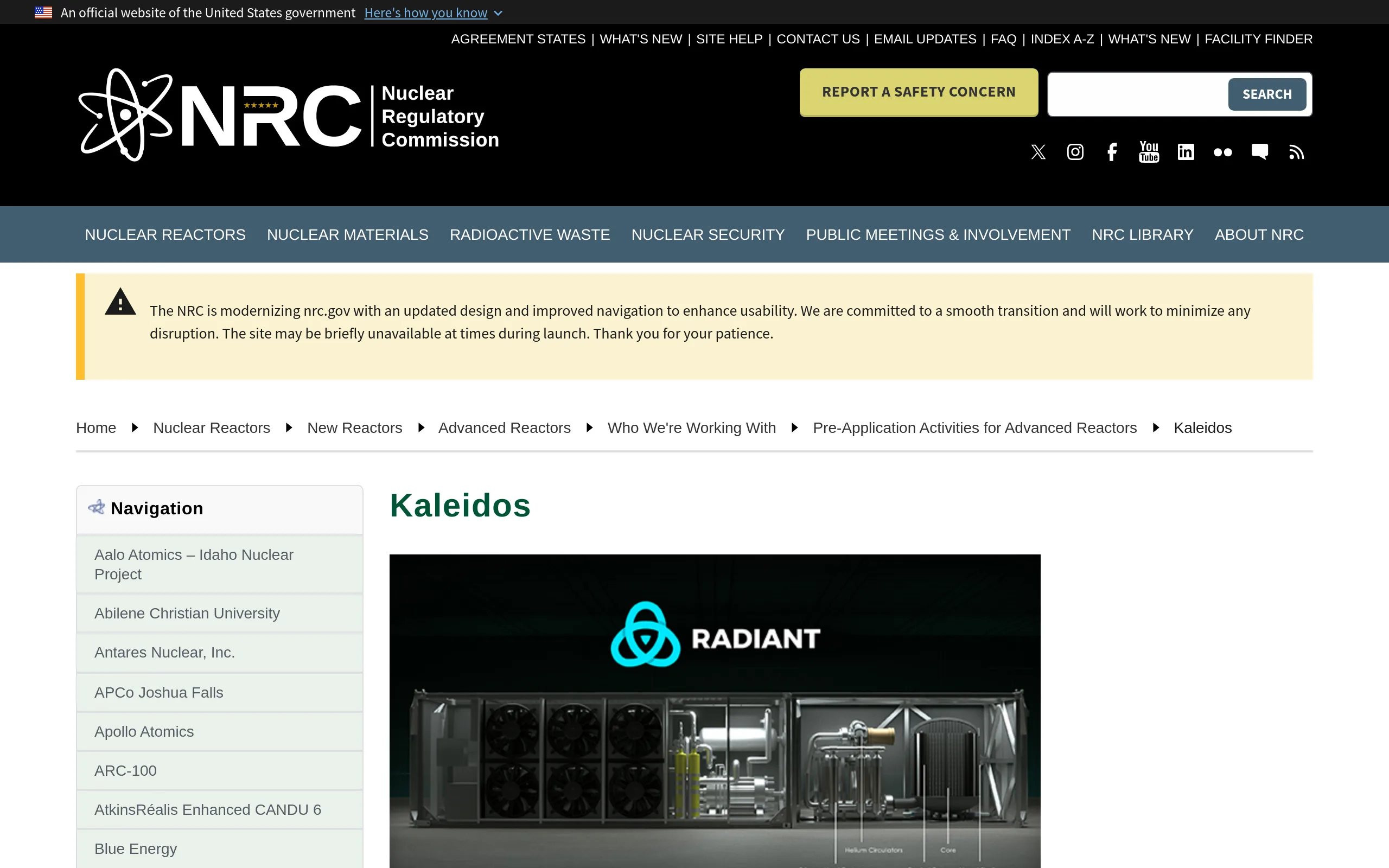
That page is worth reading for the boring part, which is the licensing table underneath the rendering. It lists every white paper Radiant has filed, the gap analyses against four parts of the federal code, and the running docket for the company's factory licence. Boring is the point. This is what separates a reactor company from a reactor pitch.
What the design gives up is scale, and what it buys is logistics. The Department of Energy's write-up of the Kaleidos test programme puts the target at 1.2 megawatts of electricity and five or more years between refuellings, aimed at "replacing diesel generators in remote areas, to providing backup power to hospitals, military installations, and data centers". There is no water in the cooling loop and almost no on-site construction. You drop it on a pad, run it, and eventually send it back to the factory.
The economics follow from that. Radiant has told reporters it expects Kaleidos to compete with diesel wherever fuel costs more than about $6.50 a gallon, which is not the open market. It is islands, mines, disaster zones, forward bases and anywhere a generator convoy is the actual cost. That is a smaller market than the grid and a far easier one to win, and it is the same "replace the incumbent appliance" logic driving the heat-pump shift we cover in our HVAC trends report.
Three dated events sit under the three steps in the chart.
October 13, 2025: the factory. Tennessee announced that Radiant had chosen Roane County for a $280 million plant employing 175 people, built on part of the historic K-27 and K-29 Manhattan Project sites and named R-50. Full-rate target: 50 reactors a year. Tori Shivanandan, then Radiant's COO, explained the choice in a line that says a lot about where this industry can build: "We choose Oak Ridge, Tennessee, because of their strong workforce, the community's rich nuclear heritage and the public's second-to-none nuclear IQ." Radiant had previously picked Bar Nunn, Wyoming, and walked away after state law and a local political fight made spent-fuel storage impossible. Our search curve nearly triples that month.
April 22, 2026: the Air Force. The Department of the Air Force and the Defense Innovation Unit selected Radiant to develop and operate a microreactor at Buckley Space Force Base in Aurora, Colorado, with first delivery by 2028. Mike Starrett, Radiant's chief revenue officer, framed it as a schedule argument rather than a technology one: "The American energy industry needs to make progress now, not in 5 or 10 years. With a full-power reactor already under assembly, Radiant will deliver." Volume goes 1,300 to 2,900 to 4,400 across March, April and May.
August 12, 2026: the road trip. Kaleidos left El Segundo on a trailer bed bound for the DOME test bed at Idaho National Laboratory. World Nuclear News covered the departure and quoted the company making the obvious point out loud: "We said we'd make a microreactor that is transportable by land, sea and air. We did." The same statement pre-empts the usual objection about demo units: "The unit now on its way to Idaho isn't a simplified stand-in. Kaleidos is the same design, at the same scale, with the same commercial fuel load, that will roll off the production line at Radiant's R-50 factory in Oak Ridge."
The test plan is five phases, ending with 150 continuous hours at full power with nobody touching it. That is the number to watch, and the campaign is targeted for completion this quarter.
The news cycle has not slowed since. This clip from @interestingengineering, posted on September 15, 2026, covers the fuel contract Radiant signed with Centrus Energy to lock in enriched uranium through the early 2030s.
The detail in that clip that matters is the word "unobligated". Because Centrus enriches with US-origin technology, the fuel carries no foreign restrictions on its use, which is what makes it usable on a military base. Radiant's chief nuclear officer, Dr. Rita Baranwal, put the strategy plainly when the deal was announced: "You can't deploy nuclear reactors without fuel, so we have approached our fuel supply the same way we have approached the reactor: build it in parallel, and don't depend on any single path."
Radiant was founded in 2020 in El Segundo by Doug Bernauer, a SpaceX engineer who had been looking at how to power a Mars base and discovered nobody built small reactors for the job. He tried to start a nuclear programme inside SpaceX first. The company ran out of a former dance studio before moving into an old Hughes Aerospace warehouse.
The bench is unusually heavy for a company this size. Tori Shivanandan is president. Rita Baranwal, the chief nuclear officer, is a former Assistant Secretary of Energy for Nuclear Energy, which is to say the person who used to run the federal office now reviewing this sector.
| Date | Event | Figure | Source |
|---|---|---|---|
| Apr 2023 | Round led by Andreessen Horowitz | $40M | Forbes |
| May 28, 2025 | Series C led by DCVC | $165M, total funding to $225M | Orrick, company |
| Aug 14, 2025 | Equinix preorder and deposits | 20 Kaleidos units | Equinix, Radiant |
| Oct 13, 2025 | R-50 factory, Oak Ridge | $280M, 175 jobs | State of Tennessee |
| Dec 17, 2025 | Series D led by Draper Associates and Boost VC | More than $300M | Orrick |
| Aug 26, 2026 | US Army Janus award, Fort Benning | Up to $750M for 15 reactors | Army, Radiant |
On the Series D, Bernauer tied the money directly to the two things the company still has to prove: "This funding enables us to build our factory and keep to our DOME schedule, where we will achieve self-sustained chain reaction on a reactor designed by, built by, fueled by, and operated by Radiant."
Two caveats. Valuations circulating for this company come from funding-talk reporting, not filings, so treat them as chatter. And the Army figure is a ceiling, not a cheque: the Janus Program announcement is explicit that payments are milestone-based and vendors "will receive government funding only after successfully hitting specific technical goals".
The commercial side is real too. Equinix announced a preorder and paid deposits on 20 Kaleidos units in August 2025, as part of a portfolio that also includes 500MW from Oklo and 500 MWe from Stellaria. Equinix runs more than 270 data centres. Twenty megawatts is not going to power them, but it is a real purchase order from a real buyer, and it says something about how the AI agent boom is turning power procurement into a supply-chain problem.
The microreactor cohort now has a leaderboard, and search demand splits it cleanly into two groups.
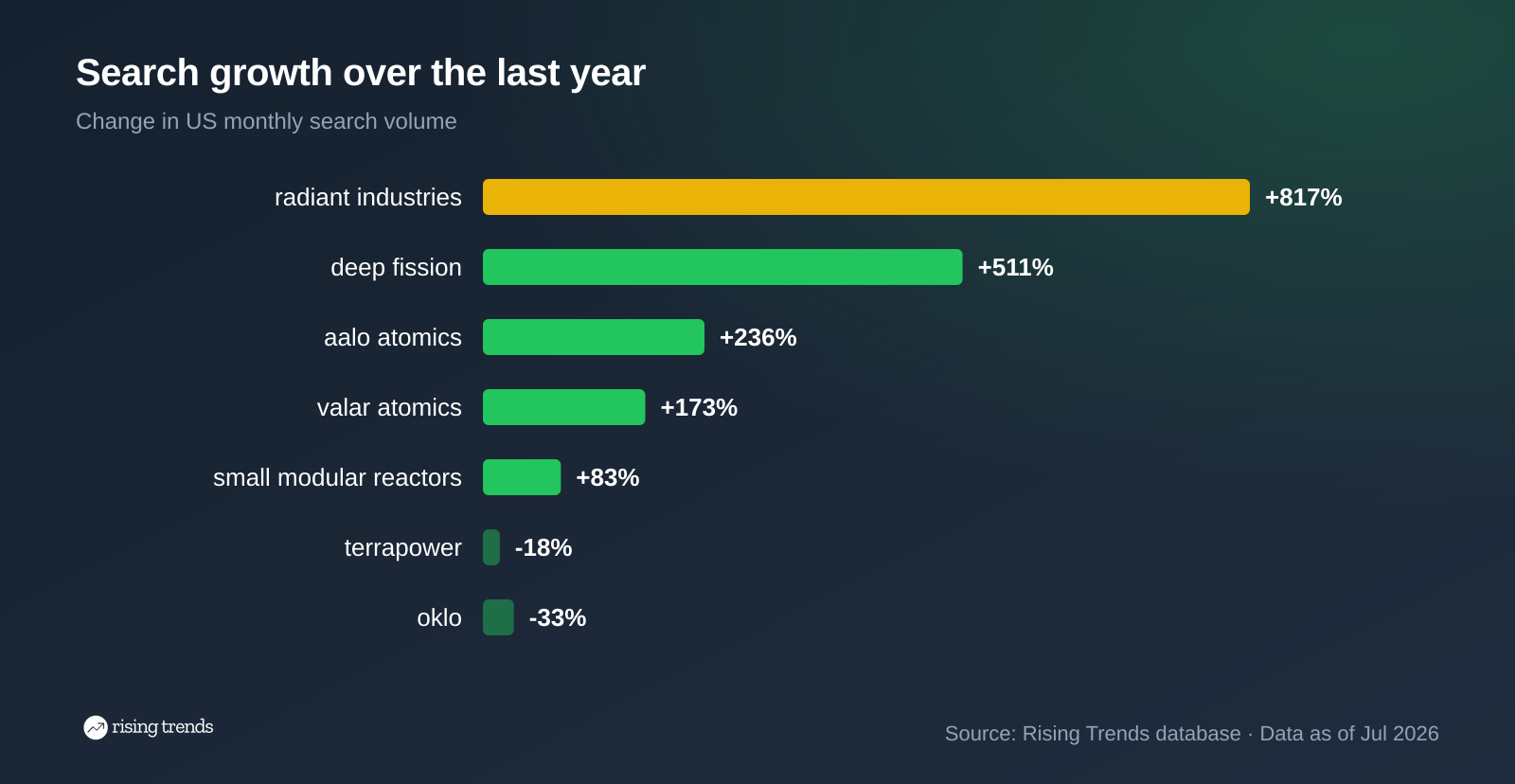
The top of that chart is the new cohort. Radiant leads it. Deep Fission, which puts its reactors down a borehole, is up 511%. Aalo Atomics is up 236% and Valar Atomics, the largest of the startups by search volume at 49,500 a month, is up 173%.
The bottom is the previous generation. TerraPower, the Bill Gates-backed sodium fast reactor company, is down 18%. Oklo is down 33% from a much higher base. Neither of those is a verdict on the technology. It is what happens when a stock stops moving and the retail searches stop with it.
Westinghouse is the competitor that does not show up in a startup chart and matters most. It is the other company that completed the same DOE design-and-test process for a microreactor at DOME, with eVinci, and it took Fort Drum in the same Army award. Radiant's advantage is that its unit is already on site. Westinghouse's advantage is that it has built reactors before.
The customer for first-of-a-kind nuclear is the government, and it is buying power, not reactors. The Janus structure is the tell: contractor-owned, contractor-operated, milestone-paid. The Army is not commissioning reactors. It is buying an outcome and letting five companies carry the construction risk. Dr. Jeff Waksman, who runs the Army's side of it, drew the line himself: "We are seeking not just reactors capable of turning on for a brief demonstration, but rather systems able to deliver power with high-capacity factors for years of operation."
Manufacturing is the moat, not physics. Every company in the growth chart has a credible design. The differences are factory, fuel and licence. Radiant spent 2025 and 2026 on all three at once: R-50 in Oak Ridge, the Centrus supply contract, and a Part 70 licence application working through the NRC. That is a hardware supply chain problem more than a nuclear one, and it looks a lot like the constraints we track in supply chain software.
Data centres changed the buyer profile. Equinix signing five different energy suppliers in one announcement is not a climate decision, it is a hedging strategy against not having enough electricity. The compute demand behind generative AI turned megawatts into a procurement race, and that race is what makes a 1 MW box interesting to somebody other than a mining camp. The same pressure shows up across the sustainability trends we follow.
The next 90 days decide a lot. Kaleidos has to go critical, then reach full power, then run 150 hours untouched. If that campaign finishes on schedule, Radiant becomes the first company in decades with an operating, commercially designed American microreactor and the search curve will step again. If it slips, the Buckley 2028 date and the Fort Benning delivery both slip behind it.
The factory licence is the quieter risk. Radiant's Part 70 application for R-50 is under NRC review, with two rounds of requests for additional information issued over the summer. No licence means no mass production, and mass production is the entire thesis. Reactor number one can be hand-built. Reactor number fifty cannot.
Watch the cohort, not the company. The interesting signal in our data is not that Radiant is up 817%. It is that four microreactor startups are all growing while the two best-funded names in advanced fission are shrinking. If Valar, Aalo and Deep Fission keep climbing alongside Radiant, the money followed the form factor. If Radiant pulls away after the Idaho test, this stops being a category story and becomes a company story. The Radiant Industries trend page is where that shows up first.
One more thing worth sitting with. The opposition Radiant met in Wyoming, where the Freedom Caucus chair complained about "California billionaires" wanting to leave "their radioactive waste" in the state, did not go away. It moved. Every one of those five Army bases sits next to a town, and the siting and environmental reviews have not started yet. The reactor is the easy part.
Want to spot the next breakout company before it makes the funding headlines? Read our guide on how to identify market trends, follow the live radiant industries trend page, or browse what is breaking out right now on the Rising Trends dashboard.
Thousands of Emerging Trends
Thousands of Breakout Apps
Mega Trends
Trend Analysis Tool