
Two years ago, 590 people a month searched for "bot comments" in the US. As of September 2026 it runs at 4,400 a month, up 175% in a year and 646% in two (Rising Trends data as of Sep 2026). In the same database, over the same stretch, "dead internet" fell 57%. One of those terms is the name of a conspiracy theory. The other is what you type after you scroll past four identical replies under a video and feel something go slightly wrong.
That gap is the story, and nobody writing about the dead internet has picked it up. The theory is losing its audience while the thing it predicted is picking up traffic. We pulled the two-year curve for "bot comments", pulled the live bot share off Cloudflare's network on the morning we published this, and read what LinkedIn, YouTube and Etsy have actually committed to in writing. People stopped arguing about whether the internet is dead. They started reporting the symptoms.
Key takeaways:
- "Bot comments" went from 590 to 4,400 US monthly searches in two years, up 646%, classified EXPONENTIAL in the Rising Trends database (data as of Sep 2026). It broke out in September 2025 and has not had a down month since.
- "Dead internet" is going the other way: down 57% in a year and down 77% in two, at 1,900 searches a month. The label is fading while the complaint is compounding.
- "Ai slop" is the big sibling at 90,500 searches a month, up 234% in a year and 2,414% in two. The vocabulary for machine-written filler arrived before the vocabulary for machine-written replies.
- On the 28 days to 25 October 2026, Cloudflare Radar classified 65.1% of web page requests worldwide as bot traffic, up from 57.0% in the week of 27 April 2026. Measured across all HTTP requests rather than page loads, the same window reads 39.4%.
- LinkedIn says it is "catching hundreds of thousands of automated comment attempts" every day, and blocked billions of other automation attempts in the two months to 30 July 2026.
- Etsy banned bot-generated listings on 22 October 2026 and now requires at least one unedited photo of the real item. The anti-bot rules have moved from feeds to storefronts.
Let's get into it.
What we're seeing in the Rising Trends data
Here is the monthly US search volume for "bot comments" over two years, straight from our database.
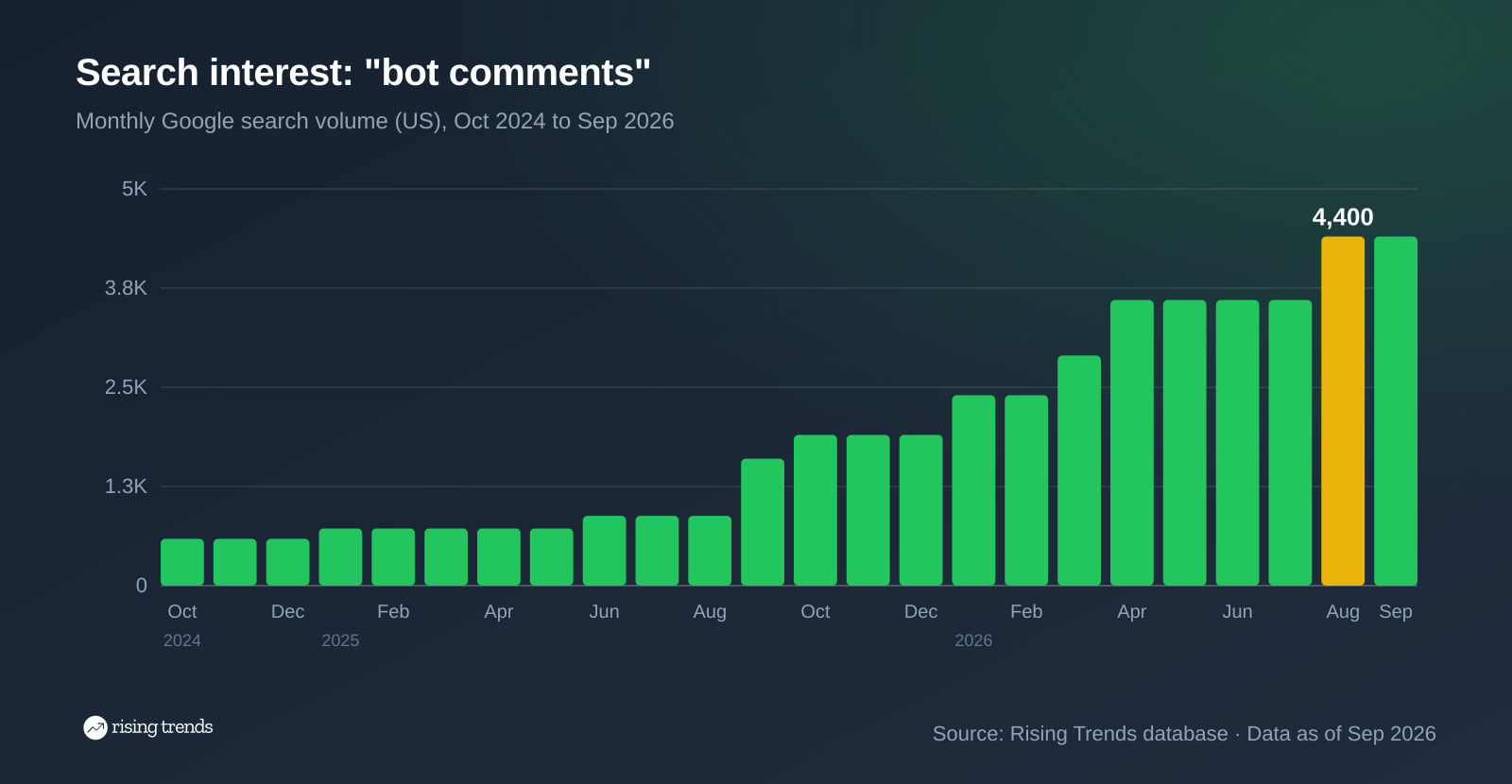
This is a staircase, not a spike. The term sat near 590 for most of 2024, first crossed a quarter of its eventual peak in September 2025, then climbed every quarter: 2,400 in January 2026, 3,600 in April, 4,400 in August, holding 4,400 in September. The last three months average 4,133 searches a month, 5.7 times the three months two years earlier. News bumps do not look like this. Habits do.
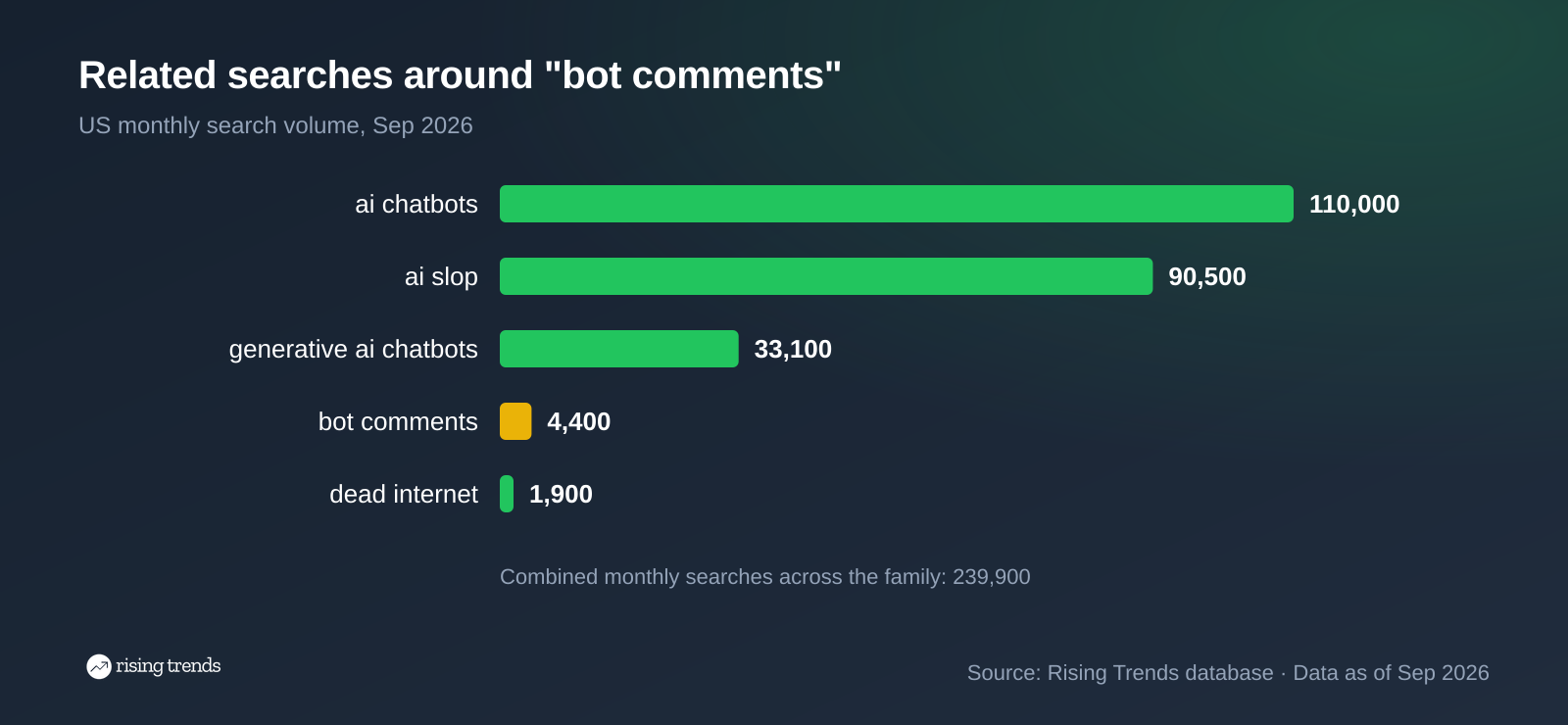
Now compare the growth rates of the terms around it, which is where the real finding is.
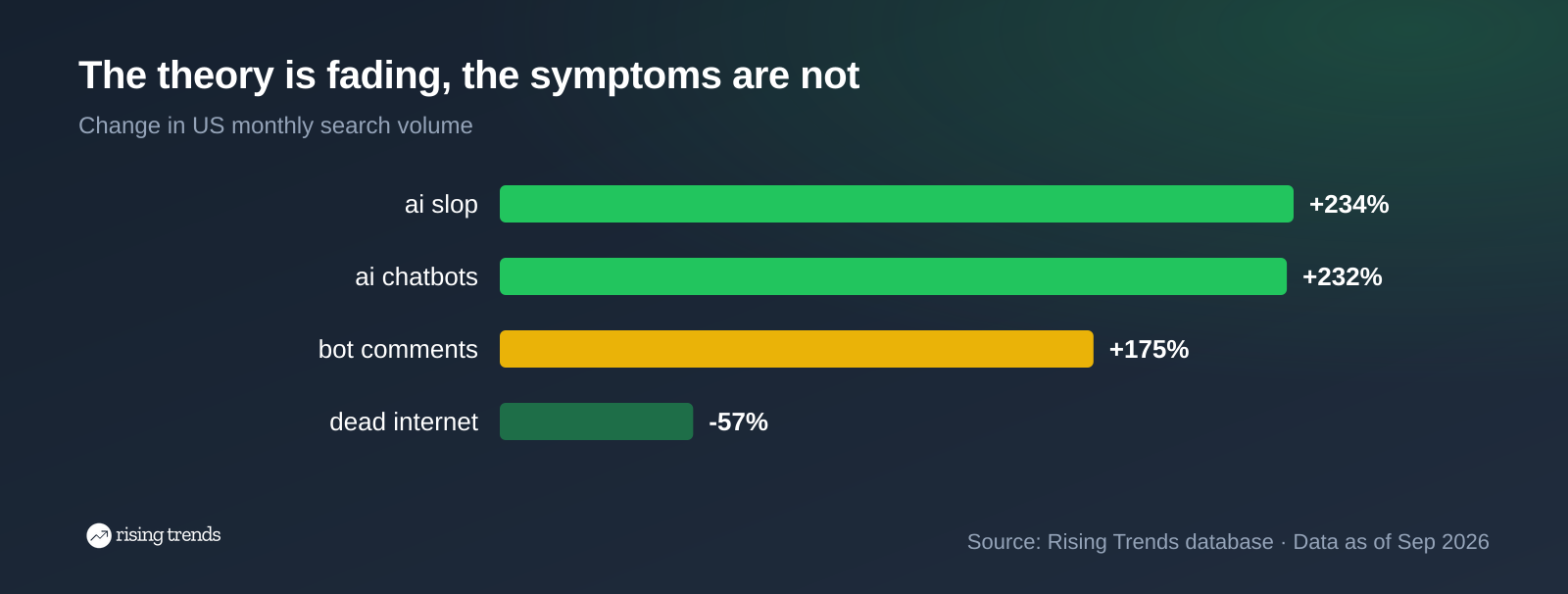
Three of those four bars go up and the fourth is the name of the theory. "Dead internet" is the only term in the family that is shrinking, and it is shrinking fast. Meanwhile the descriptions of what a dead internet would actually feel like are all growing: "ai slop" is up 234% in a year to 90,500 searches a month, "ai chatbots" up 232% to 110,000, "bot comments" up 175%.
Searching a theory is an argument. Searching a symptom is a complaint. Over the last year, this topic moved from the first to the second.
What a bot comment actually is
A bot comment is an automated reply posted by a script rather than a person, usually to inflate engagement, push a link, test a filter, or build posting history on a new account so it looks legitimate later. Cloudflare's own explainer on spam bots covers the mechanics: accounts created in bulk, content posted at machine speed, and comment fields treated as free distribution.
What changed is the quality. The old spam comment was "Nice video check out my channel" with a link. The 2026 version is three sentences of plausible agreement with a point the video actually made. That is the same shift the AI text cleaner trend runs on at the other end: output that no longer announces itself.
The phrase people have mostly abandoned started in one place, on a date. On 5 January 2021 a user called IlluminatiPirate posted Dead Internet Theory: Most of the Internet is Fake on a retro forum called Agora Road's Macintosh Cafe. The thread has since been viewed 391,982 times and drawn 502 replies. Its claim was that most supposedly human content online is machine-generated to manufacture consumers, and the line that travelled was this one: "The Internet feels empty and devoid of people."
Treat that post as an origin, not as evidence. It is an anonymous forum argument with a conspiracy at its centre. It also described, five years early, a user experience that millions of people now have before breakfast.
Why it's trending now
The honest trigger is not one news story. It is three platforms writing anti-bot language into their rules inside three months, and a measurement that finally has a number on it.
Start with the measurement. On the 28 days to 25 October 2026, Cloudflare Radar classified 65.1% of requests for web pages worldwide as coming from bots. In late April 2026 that figure was 57.0%. It crossed 60% in the week of 27 July and has not been below it since early September.
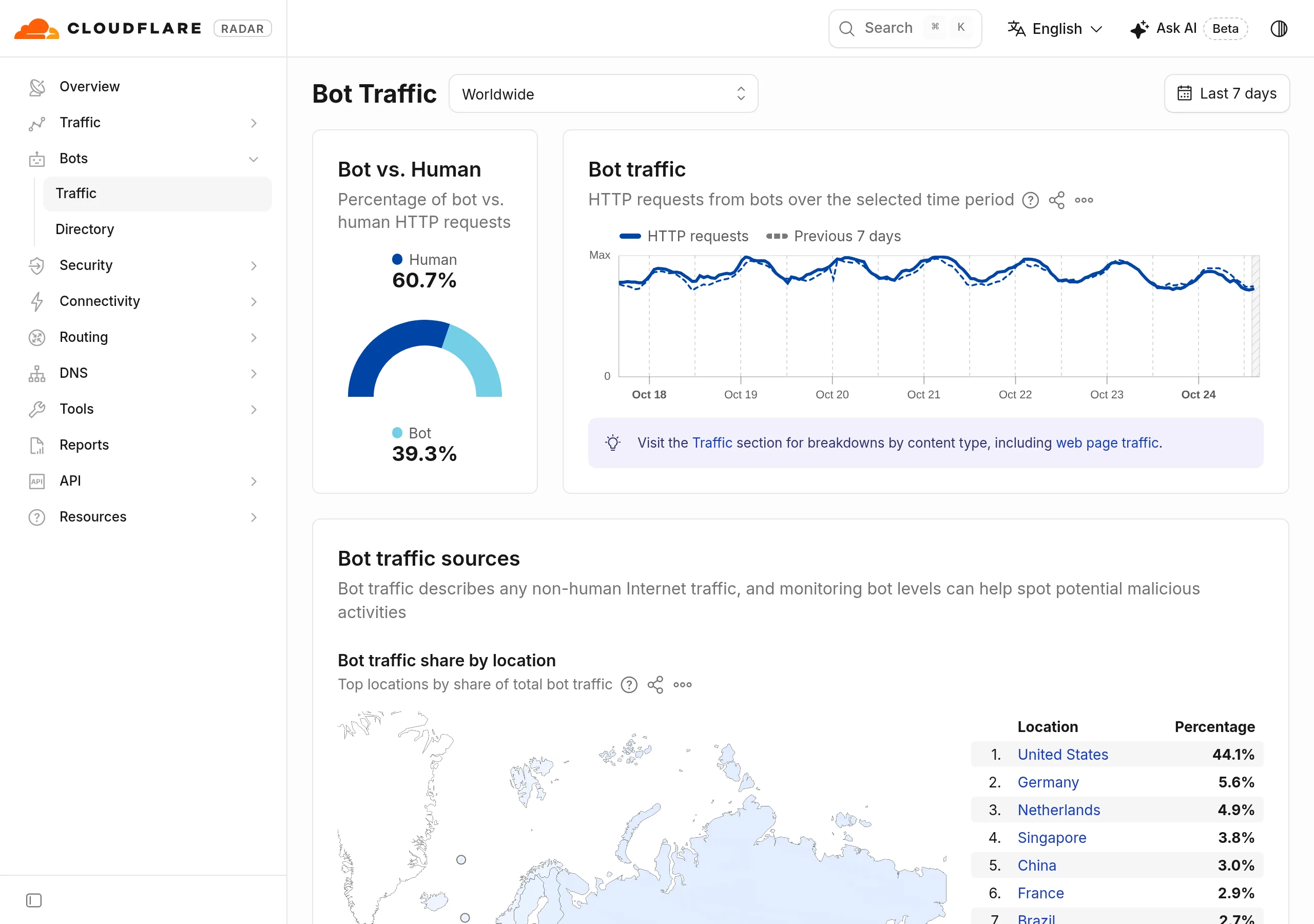
Look closely at that panel, because it is where most coverage goes wrong. Radar's headline card reads 39.3% bot for the seven days to 25 October. That is bot share of all HTTP requests, which includes images, scripts, fonts and video. Filter to web page requests only and the same network reads 65.1%. Both numbers are Cloudflare's. They answer different questions.
| What is measured | Bot share | Window |
|---|---|---|
| All HTTP requests | 39.4% | 28 days to 25 Oct 2026 |
| Web page (HTML) requests | 65.1% | 28 days to 25 Oct 2026 |
| Web page (HTML) requests | 57.0% | Week of 27 Apr 2026 |
Neither figure says what share of comments are bots. Nobody publishes that. Requests are not people, and a crawler fetching a page is not a reply under a video. That gap between what gets measured and what people actually see is exactly why the search term grew: there is no authoritative answer, so everyone goes looking.
Mainstream coverage caught up in September. CNN built an episode around it, and this clip from @cnn, posted on 26 September 2026, has 4,600 likes and 240 comments according to Instagram.
Its framing is the one that has won: not a plot, just an outcome. "We're approaching a dead internet where bots talk in circles and AI slop is the norm."
What people are doing differently
The behaviour used to be arguing. You would see a thread about the dead internet theory and someone would call it paranoid, and someone else would post a screenshot, and that was the whole ritual.
The behaviour now is triage. People are not asking whether the internet is dead. They are asking which of these eleven replies under their own video is a person, and what to do about it.
How do you spot a bot comment?
The tells that people actually trade are behavioural, not linguistic. One widely upvoted answer on r/AskReddit puts it as a pattern rather than a style: an account that "drops comments in random subs literally every minute", and replies that look "like they're trying way too hard to seem like a human."
That second half is the uncomfortable part, and the people doing the spotting know it. On LinkedIn's own announcement thread, Allison Rossi pushed back hard: "People are constantly correctly and incorrectly accusing others of using AI on LinkedIn based on random 'tells' like words and punctuation. Now LinkedIn has given them another tool to falsely accuse people." Jan Tegze, a talent acquisition director, put the cost in one line: "Careful writing reads as fake writing."
That is the same trap we covered in the polyester slang backlash, where readers started treating competent prose as evidence of a machine. Detection by vibe punishes the careful writer and misses the well-funded bot.
What percent of comments are from bots?
Nobody knows, and anyone giving you a clean percentage is extrapolating from traffic data that does not measure comments. What exists is the platforms' own counts of what they stop, which is a floor and not a share.
Under the long-running r/youtube complaint that "Youtube comments are dead, its all bots", the top replies are mostly people arguing about whether the perception is real. Six months ago that thread would have been the end of it. Now there are numbers to check it against.
Who's building on it
LinkedIn has published the most specific figure in the category. In a post on 30 July 2026, chief product officer Hari Srinivasan wrote that the platform is "catching hundreds of thousands of automated comment attempts" every day, and has "blocked billions of other automation attempts" in the preceding couple of months. The same post shipped a member report control for posts and comments, new classifiers that demote suspected slop in suggested content, and the removal of LinkedIn's own "enhance your post" button in favour of a proofreader that does not rewrite you. That last item is the admission: the platform had been handing out the machine voice it is now filtering.
YouTube has the policy but not the counter. Its fake engagement policy bans anything that "artificially increases the number of views, likes, comments, or other metrics either by using automatic systems", applies explicitly to comments, and terminates a channel after three strikes in 90 days. The spam policy adds high-volume repetitive comments that push traffic elsewhere. What neither page gives a creator is a report reason that says "this is a bot", which is a large part of why people search rather than report.
Etsy moved the fight to commerce. On 22 October 2026 it announced new AI restrictions that prohibit "bot-generated listings and AI-generated functional guides, such as patterns, recipes, and instructions", and now require at least one unedited photo of the actual item against a real background. It also added member reporting for misleading AI imagery, with the honest caveat that at first those reports "won't trigger immediate enforcement."
Cloudflare sells the measurement. Radar is free, which is the point: it makes bot share a public number, and a public number is what turns a vibe into a market. The same dynamic plays out across the cybersecurity trends we track for 2026, where detection became a product once the problem became countable.
The comment-bot vendors are still right there. Search "bot comments" today and roughly half the first page is software that sells automated commenting, sitting next to the people complaining about it. Both halves are growing on the same keyword.
What it means for business
Engagement metrics are quietly becoming unaudited. If a meaningful share of replies under a post are automated, comment counts stop being a quality signal and become a volume signal. Anyone pricing influencer deals or creative performance on engagement rate is buying a number with an unknown denominator. Expect the measurement questions already reshaping advertising in 2026 to arrive next for social proof.
Verification becomes a feature people will pay for. LinkedIn is expanding profile and page verification in the same breath as its slop controls, and Etsy is asking for an unedited photo of a real object. Both are doing the same thing: attaching a human cost to a listing or a profile that a script cannot pay. One commenter on Srinivasan's post, Rashi Kakkar, called the end state exactly right: "human written" under a post will "have the same feel that 'organic' has in the produce aisle."
Detection as a consumer product is not where the growth is. "Ai detector" sits at 5,000,000 searches a month in our database and has not grown at all in a year, while the terms describing the problem grow triple digits. People are not buying classifiers. They are learning heuristics and complaining in public. The durable version of this is provenance rather than detection, which is the bet we unpacked in AI text watermarking, explained.
Moderation cost shifts to whoever owns the comment field. Every platform above is now spending money to keep its own replies credible. For smaller publishers and communities running their own comments, that cost does not have a vendor yet, which is the gap worth building in.
Where this is heading
Three calls, each with a term in our database to watch.
"Bot comments" overtakes "dead internet" in meaning, not just in volume. It already passed it in searches: 4,400 against 1,900 as of September 2026. The theory will keep shrinking because it was always unfalsifiable, and the symptom will keep growing because it is checkable. Watch the two curves cross further apart.
The next number to be published is comment-level, not traffic-level. Cloudflare can tell you what share of page requests are automated. Nobody tells you what share of replies are. The first platform to publish an audited figure sets the benchmark, and the EU transparency reporting regime is the most likely forcing function. Watch "ai slop" at 90,500 searches a month as the pressure gauge.
Human-made becomes a label, with all the problems labels have. The verification push will produce badges, and badges produce a market for faking badges. That is the arc the AI mods trend is already on, and it ends with the same question this article started with: not whether the internet is dead, but how much it costs to prove you are not.
The honest summary is the one the data gives you. A phrase coined on a retro forum in 2021 is losing its audience right as the experience it described became ordinary. People do not need the theory any more. They can see it in their own replies, and 4,400 of them a month are now typing the symptom into a search box instead.
Want to catch shifts like this while they are still at 590 searches a month? Read our guide on how to identify market trends, or see what else is breaking out in AI trends for 2026.
Never miss a trend again
- One trend broken down with the numbers
- Who's making money, and what to build
- A website on the rise
- A breakout app
Join 5,000+ founders