Trends


A term in the Rising Trends database just did something we almost never see. "Polyester slang" sat at 10 US searches a month for 22 straight months. In July 2026 it crept to 40. In August 2026 it hit 1,600, up 15,900% year over year and the fastest entry in our entire slang table as of August 2026.
Every page that ranks for this term will tell you what polyester means. None of them tells you when the word changed jobs, because none of them has the monthly series. Ours dates the handover to a single month: July belonged to the video editors, August belonged to everybody else. So below we walk through where the word actually came from, the weeks it stopped describing videos and started describing people, who is making money from it, and what it is doing to real clothing searches.
Key takeaways:
Let's get into it.
Here is the monthly search volume for "polyester slang" over the last two years, pulled straight from our database. For 22 of those 24 months the line is flat at the floor.
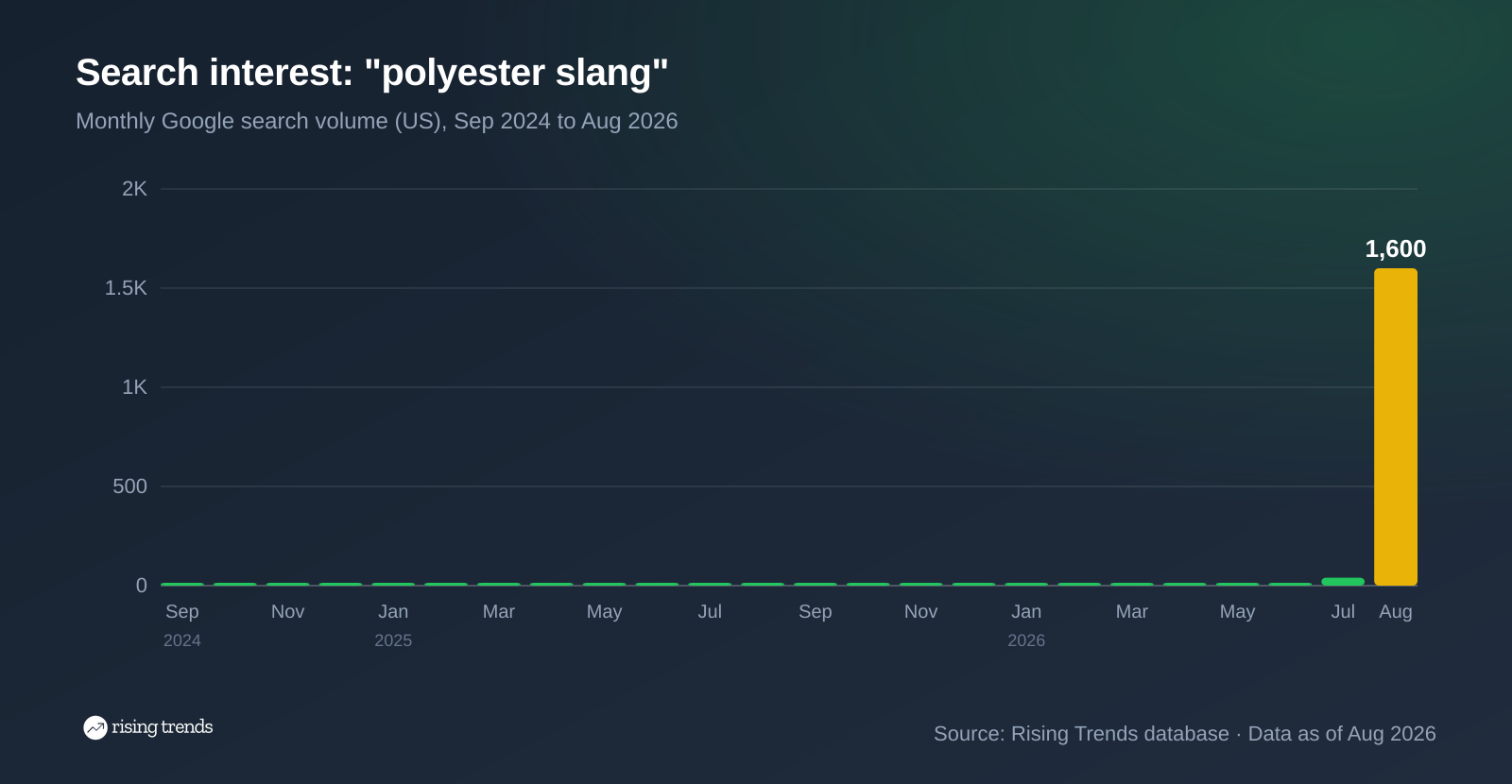
Look at the two bars on the right rather than the big one. July 2026 is 40 searches. August is 1,600. The viral posts that gave the word its name all landed in the middle of July, and they barely registered. What registered was August, when people who had never watched a fan edit started hearing the word applied to a person's whole personality and went looking for what it meant.
That is a 15,900% move in twelve months, and it is the steepest we have in this corner of the database.
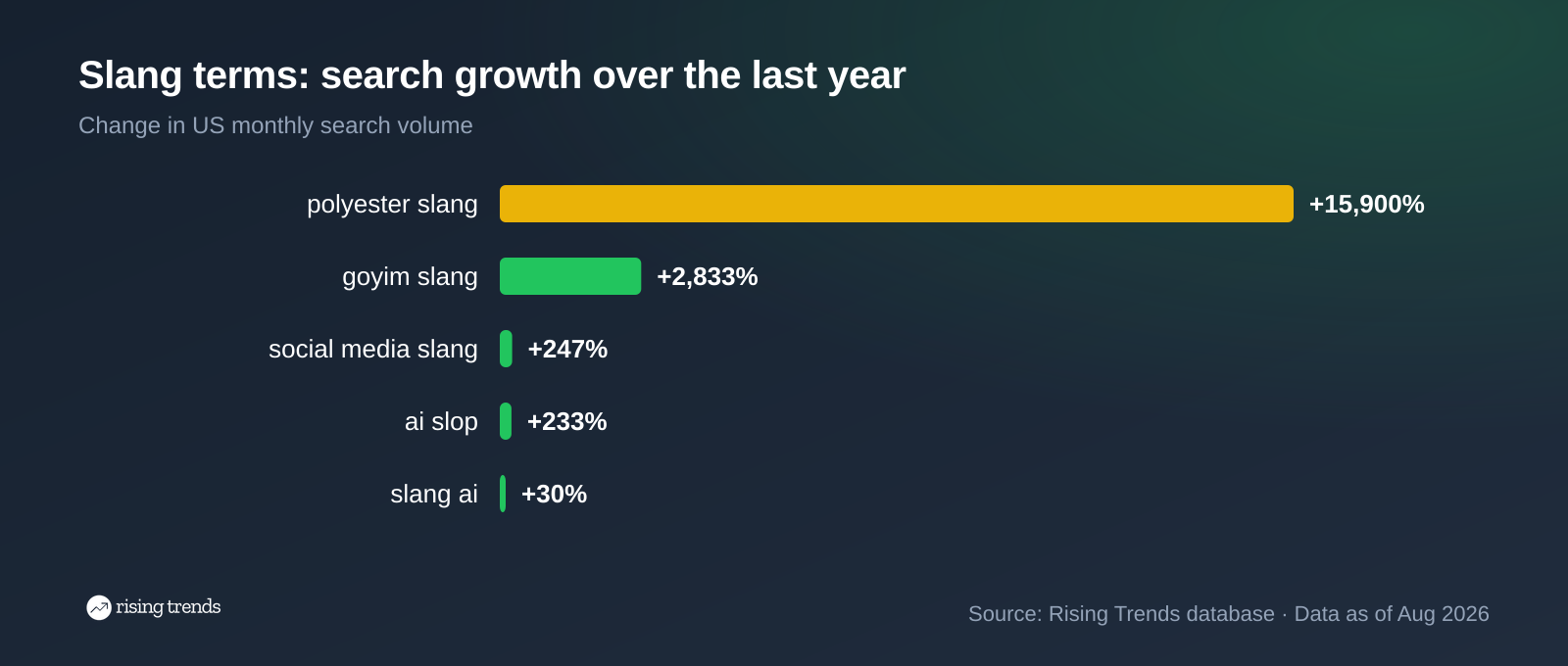
The honest read on that chart is that growth and size are different things. Polyester slang grew 5.6 times faster than goyim slang over the last year, but it is growing from 10 searches a month. The term it is really competing with, ai slop, grew only 233% and still sits at 74,000 a month. One is a word people already use. The other is a word people are still looking up.
The plain version: calling something polyester means it looks fine from a distance and falls apart up close. Staged candour, a scripted apology, an influencer selling something they have never used, a lifestyle assembled out of trending signifiers. Not simply bad. Cheap, synthetic and trying.
Before it meant any of that, it meant a video. A "polyester edit" is a fan edit in which a character poses in the foreground while clips from their films flash past behind them, usually at high saturation, usually over a metallic sound. Know Your Meme's entry traces the format to 17 October 2025, when @jjeditzfilms posted an Iron Man version that went on to take 5.7 million views in nine months. A Spider-Man version by @foryouamvv followed on 16 November 2025 and took 4.4 million.
Nobody called them polyester at the time. That came later, as an accusation, and it stuck fast enough that the crowd-written dictionaries caught up within weeks.
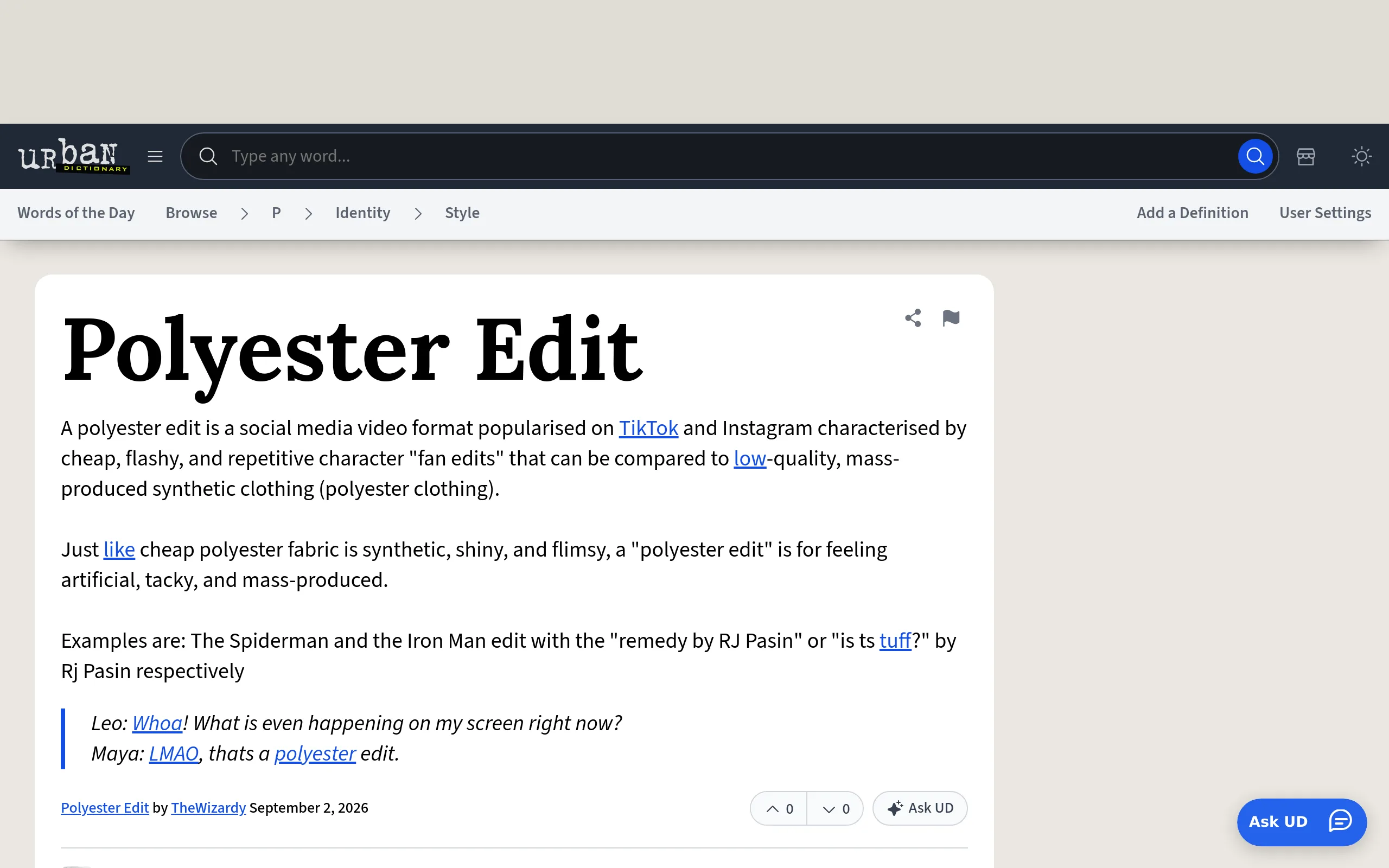
That Urban Dictionary entry, submitted on 2 September 2026, does the metaphor explicitly: "Just like cheap polyester fabric is synthetic, shiny, and flimsy, a polyester edit is for feeling artificial, tacky, and mass-produced." The same site has carried the insult sense of the bare word since June 2008, when someone filed polyester as "the grossest cheapest fabric ever. poser material." The raw material of this slang has been sitting there for eighteen years.
A small vocabulary has grown around it. A polyester edit is the video. A "polyester lifestyle" is the aspirational montage. "Polyester Prince" is the nickname critics gave streamer LowTierGod over his all-polyester merch. "Polyester jester" is whoever is wearing the synthetic fast-fashion outfit in the room.
The trigger was not one post, it was a promotion. In July 2026 the algorithm resurfaced the Spider-Man edit, and the replies turned on it. On 16 July, @useruxia8ob7j1 posted a mockery of an Iron Man edit captioned "WHAT ARE THEY FEEDING THESE EDITORS" and called it a "100% polyester ahh edit", taking 3.5 million views in five days. Know Your Meme credits that post with popularising, and possibly coining, the name. Two days later @zekkonic filed a parody under the hashtags #polyester and #slop together, which is the moment the two words became interchangeable. By 4 August, Backrooms versions of the joke were pulling 404,700 likes in a day.
All of that is July, and July is 40 searches.
August is when the word escaped. A TikTok by @problemsolver150, in which an 18-year-old narrates his imagined adult life (6am in a New York penthouse, Bible study with the boys, organic yerba mate, blue-light glasses, an AI agent running his work while he eats lunch), drew one comment above all the others. Vice reported that roughly 40,000 people agreed on it: polyester lifestyle. Euronews called the clip algorithm-designed yearning. The word had found a target bigger than a video format.
The clearest proof that the format outgrew the joke is that people started teaching it. This After Effects tutorial, posted on 19 August 2026, walks you through making a polyester edit on purpose, and has taken about 30,000 views since.
An insult with a tutorial attached is not really an insult any more. It is a genre.
Three things changed, and only one of them is about clothes.
The judgement moved from the object to the effort behind it. "Basic" accused you of having no taste. "Cringe" accused you of trying. Polyester accuses you of manufacturing: of having assembled a self the way a factory assembles a jacket, from parts, at volume, to be seen rather than worn. That is why it lands on an 18-year-old's morning routine as easily as on a fan edit.
Fake became a materials question. This is the shift worth watching, because it is showing up across the whole vocabulary our database tracks.
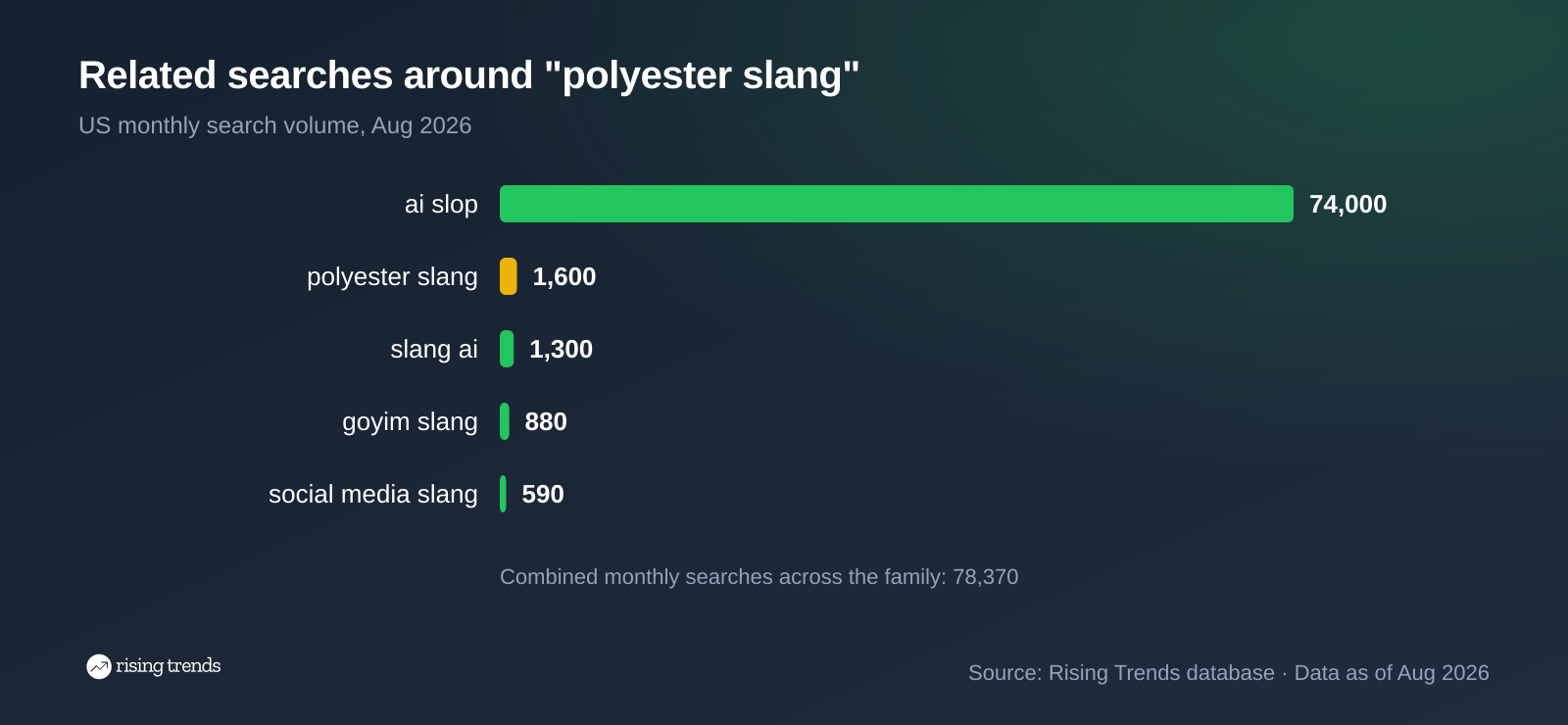
Slop, slang, polyester: the terms people use for inauthenticity are increasingly borrowed from things you can hold. That is new. It also explains why this word arrived so fast on top of an existing complaint, which it did not invent. The same instinct is running underneath the self-optimisation language we covered in the maxxing trend, where everything about a person becomes an input to be upgraded.
The distrust is the default setting, not the reaction. Morgan Hurlock, 24, told USA Today in its explainer that "everyone, especially in Gen Z, scrolls inherently with this feeling of distrust for every video." Media psychologist Don Grant put it to the same paper more bluntly: "Gen Z is very insecure, cautious. They grew up with everything online becoming their social currency and the litmus of who they are." Polyester is what that posture sounds like when it finds a word.
Not everyone thinks the word is an improvement. The lexicographer Kory Stamper told Grist that TikTokers are "just leaning into the inauthentic and low-quality edge" of a meaning the dictionary already had. Anneke Smelik, an emeritus professor at Radboud University who wrote a cultural history of the fabric, was harsher about the discourse: "It is so uninformed, and it leaves out all complexity. You know, it becomes very polarized, like, natural is good, and artificial is not."
For a word three months old, the supply chain behind it is unusually clear.
The sound is one producer. Almost every edit in the original wave runs on music by RJ Pasin, a New York producer whose tracks are the audio signature of the format. When Create Music Group signed him in April 2025, it put him at 6 million monthly Spotify listeners, 5 million followers across TikTok and Instagram, and more than 500 million streams in producer credits. The thing being mocked for cheapness is built on a catalogue with real money in it.
The tool is CapCut. The look that reads as low-effort is a specific stack of saturation, speed ramps and overlays that the app makes cheap to apply. CapCut runs at 1,000,000 US searches a month in our data, up 22% year over year as of August 2026. Format mockery always arrives a little after a tool gets good enough for everyone.
The creators are a mixed economy. @foryouamvv's Spider-Man edit took 4.4 million views in eight months before anyone named it. @rdylt09's tutorial has about 1,200 likes on 30,000 views. The parody accounts that coined the term have bigger numbers than most of the edits they were mocking, which is the familiar pattern: criticising a format is itself a format.
The targets are monetised too. LowTierGod's polyester merch is what earned him the Polyester Prince nickname in the first place. Nobody involved is outside the machine, which is part of why the word is so sticky. It is an accusation anyone can make and nobody can quite survive.
Here is the part that should interest anyone selling clothes. While the word spikes, the actual fast-fashion search terms in our database are collapsing, and the natural-fibre side is not.
| Search term | Monthly searches | Change, 1 year |
|---|---|---|
| comoco cotton | 3,600 | +2,471% |
| organic cotton undies | 22,200 | -45% |
| dresses at shein | 22,200 | -55% |
| shein sales | 880 | -70% |
| fast fashion clothing | 1,900 | -99% |
Three consequences follow.
Fibre content is becoming a marketing claim, not a care label. A brand with a cotton story now has a word doing its advertising. Comoco cotton is a small brand at 3,600 searches a month, but it is up 2,471% in a year, which is the shape of a term people are telling each other rather than finding in an ad. Anyone tracking the clothing trends we follow should expect composition to move onto the front of the product page.
The sustainability case is stronger than the discourse. The complaint is crude, but the numbers are not. The Apparel Impact Institute's 2025 report put virgin polyester at 57% of global fibre production and sector emissions at 944 million tonnes, the first rise since tracking began. Its 2026 follow-up, published on 1 September, found a second consecutive rise, 6.3% from 2023 to 2024, again driven by growing fibre use and especially polyester. That is a genuine problem sitting underneath a joke, and it belongs in the sustainability trends conversation rather than the slang one.
The word will be used against brands faster than brands can respond. Polyester is a cheap accusation to make and expensive to disprove, because it is about perceived effort rather than any measurable property. Any campaign that looks assembled is exposed. We saw the same mechanic eat a product category in the Labubu trend, where the feeling wore out well before the supply did, and the same distrust of staged wanting underneath the dopamine shopping trend.
Three calls, each with something in our data to watch.
The search term will fade, the usage will not. A 1,600-a-month spike built on one news cycle usually gives most of it back. Watch whether polyester slang holds above 500 a month through the winter. Above that, it has stopped being a thing people look up and started being a thing people say.
The materials vocabulary keeps growing. Slop, polyester, plastic: each one borrows a substance to describe a feeling. The signal to watch is whether the family terms rise together rather than in sequence, which would mark a durable register rather than a run of memes.
Somebody sells the opposite. The gap in the market is not more cotton, it is proof. Composition disclosure, repair counts, a resale price: the brand that makes the anti-polyester case with numbers instead of adjectives will get the cycle. If cotton-brand searches keep compounding while the fast-fashion terms keep falling, that is the trade.
The thing we keep coming back to is the two bars at the end of that first chart. Forty searches in July, 1,600 in August. A word does not move like that because a video format got mocked. It moves like that when a lot of people recognise something they had already noticed and finally have a name for it. Polyester was lying around since 2008. August 2026 is just when everyone picked it up.
Want to catch shifts like this before they get a name? Read our guide on how to identify market trends, follow the live polyester slang trend page, or see what is breaking out right now on the Rising Trends dashboard.
Thousands of Emerging Trends
Thousands of Breakout Apps
Mega Trends
Trend Analysis Tool