Trends


Two years ago, "ai text cleaner" was a dead search. Twenty people a month looked it up. By August 2026 it was running at 3,600 monthly searches, up 650% in a year and 17,900% in two, with a 5,400 spike in July 2026 (Rising Trends data as of Aug 2026). The tools behind the term all do roughly the same job: you paste text out of a chatbot, they strip the zero-width spaces, the em dashes, the curly quotes and the stray markdown, and you paste the result somewhere that matters.
Every page ranking for the term is a tool page telling you what it removes. None tells you whether removing those things still does anything. That is the question worth asking in October 2026, because between 2 August and 5 October the two biggest model providers both shipped text watermarks, and both published, in their own words, that the mark is not a hidden character. We pulled the curve, read what Anthropic and OpenAI say their watermarks actually are, and looked at what is rising and falling around the term in our own data.
Key takeaways:
Let's get into it.
Here is the monthly search volume for "ai text cleaner" over the last two years, straight from our database. For the first fourteen months the line is effectively flat.
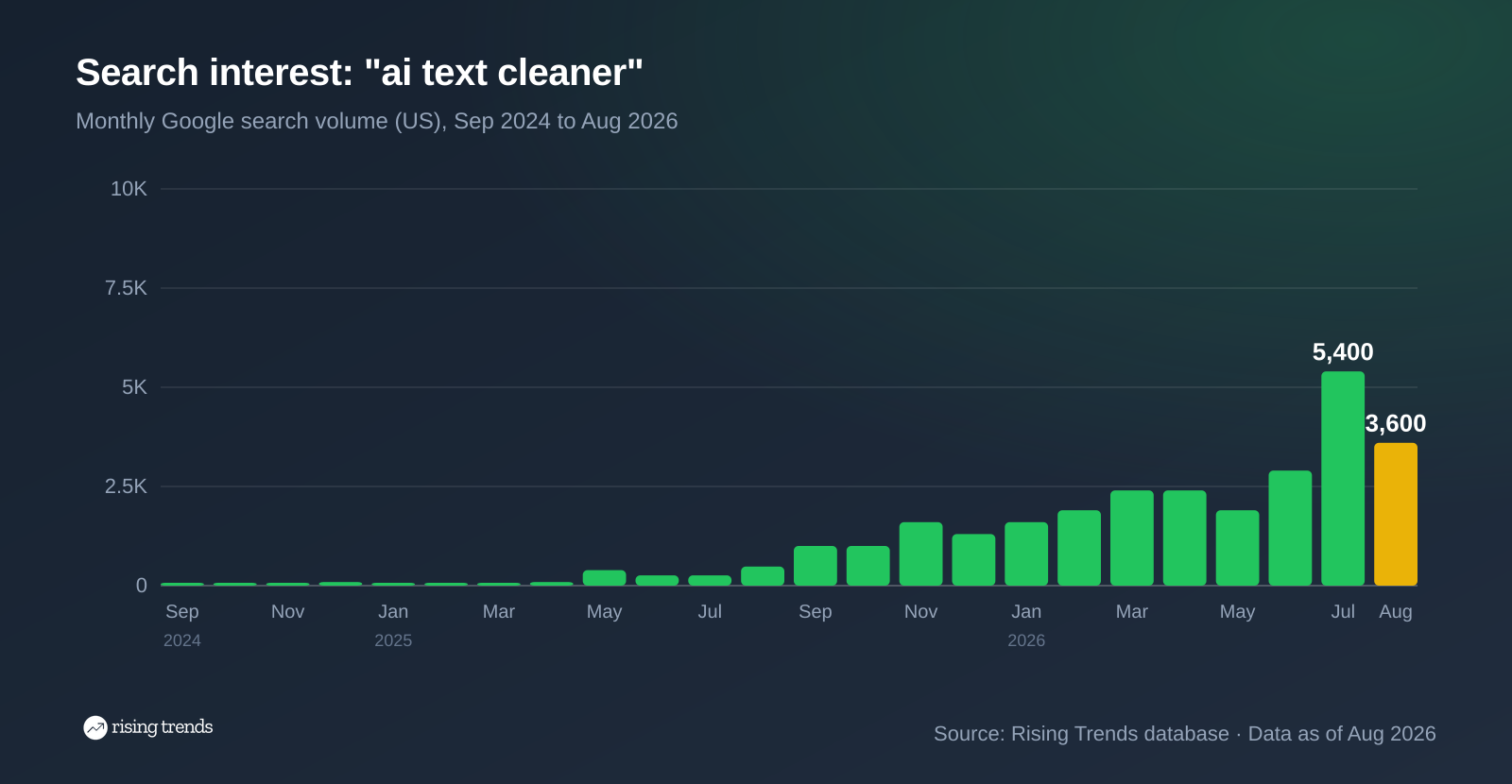
The shape is a staircase, not a spike. The term first crossed a quarter of its eventual peak in November 2025, climbed through the spring, then jumped to 5,400 in July 2026 before settling at 3,600 in August. The last three months average 3,967 searches, 1.78 times the three before them. That is an accelerating curve, not a news bump, and you can follow it on the live ai text cleaner trend page.
The more interesting picture is around it. We pulled every term in our database that belongs to the same fight: the marks, the removers, the humanisers and the detectors.
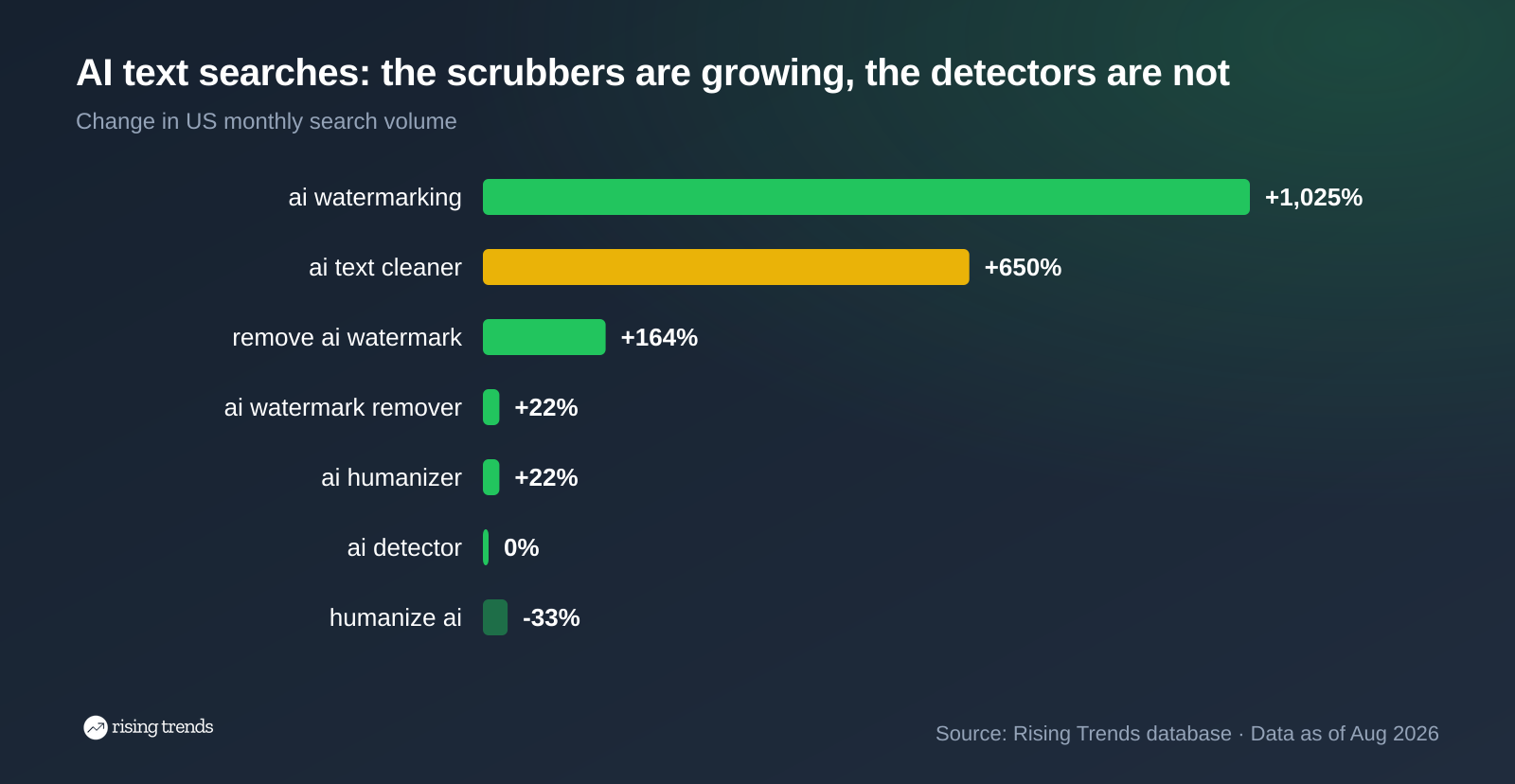
Two things stand out. First, the top of that chart is the marking side and the cleaning side growing together: "ai watermarking" is up 1,025% in a year to 8,100 searches a month, and "ai text cleaner" is up 650%. Second, the bottom of the chart is the old industry stalling. Ai detector is enormous at 2,240,000 searches a month and has not grown at all in a year. Humanize ai is down 33%. Ai humanizer crawled up 22%.
That is the finding. The humaniser era ended and the scrubber era started, and almost nobody using these tools has noticed that the thing they are scrubbing changed underneath them.
A cleaner is a text box with a list of checkboxes. You paste on the left, you get normalised text on the right, and nothing leaves your browser. The top-ranking one, AI Text Cleaner, ships ten toggles: remove hidden characters, convert non-breaking spaces, normalize dashes and quotes, convert ellipsis, strip trailing whitespace, asterisks and markdown headings, convert lookalike characters, and normalize Unicode forms.
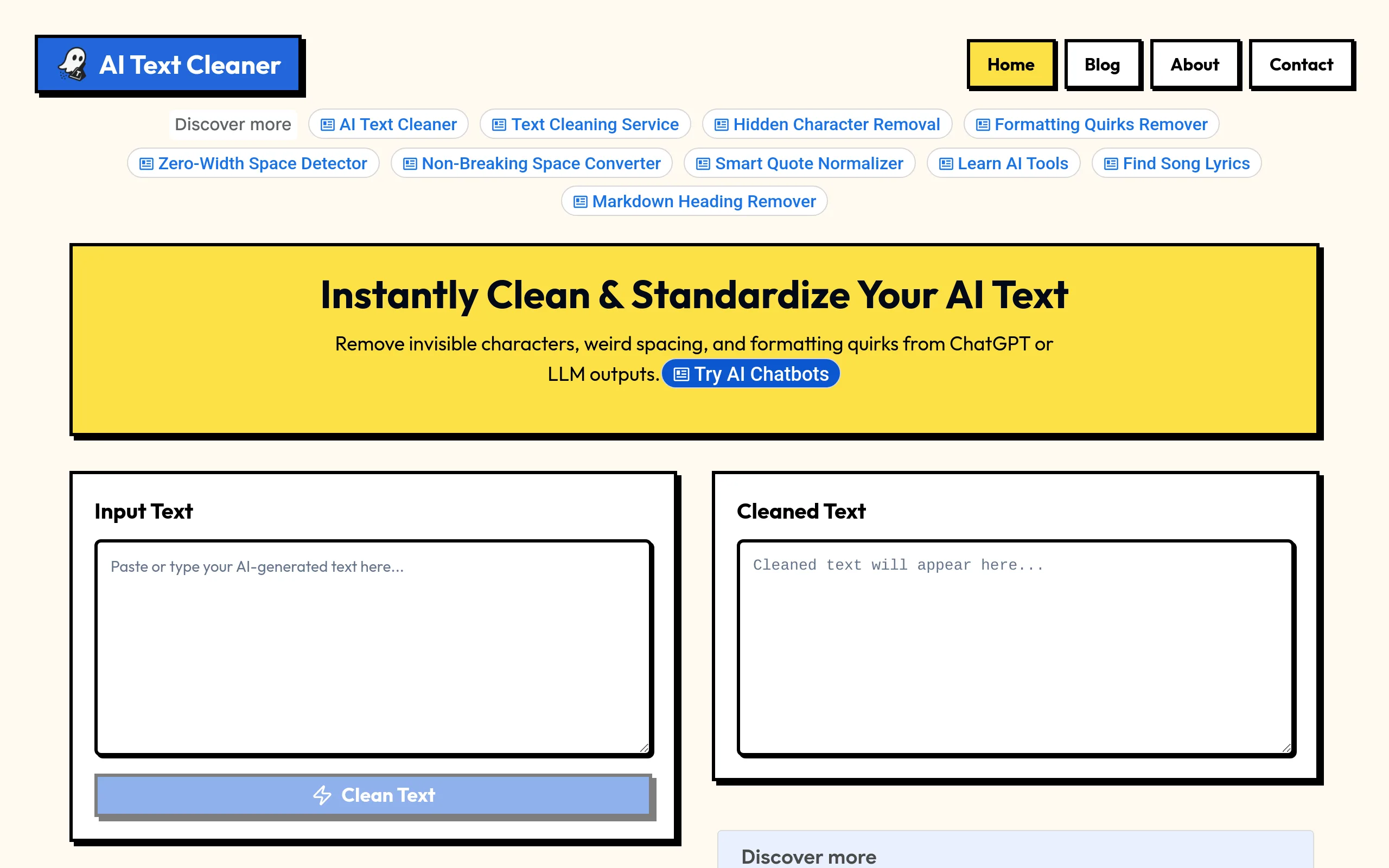
That screenshot is the whole category in one page. No account, no paid tier, every transform running in JavaScript on your machine. Its own copy is honest about the original problem: zero-width spaces and word joiners "silently break on-site search and regex", and markdown leftovers "clutter content management systems that don't render them."
Those are real complaints, and they are plumbing complaints. Somewhere on the way to 3,600 searches a month, the pitch changed. Keep's cleaner now sells itself as a way to "strip the tell-tale AI characters." Clean Paste goes all the way: "Remove hidden metadata and AI watermarks from generated text," it says, to "make it look human." Same nine or ten regular expressions. Completely different promise.
The trigger is regulatory, and it has a date on it.
On 31 July 2026 the European Commission reported that about 190 organisations had signed the Code of Practice on Transparency of AI-generated Content, 95 of them as providers. Three days later the AI Act's marking obligations started applying. Anthropic, Google, Meta, Microsoft, Mistral, Cohere and OpenAI are all on that list.
Anthropic went first on the detail. On 14 August it published how Claude's text watermark works, and the summary bullets do most of the work for this article:
Nothing is added to the text and there are no hidden characters.
What it does instead is change where the randomness comes from. When the model is choosing between two equally good words, it normally settles the tie with a random number. Watermarking settles it with a secret key and the words just before. The output reads the same, but anyone holding the key can check whether the sequence matches what the key would have produced. OpenAI followed on 5 October with the same approach under a different name.
That post, from 5 October 2026, has about 11,000 likes according to X. Note the hedge in it: OpenAI is shipping this "while recognizing the significant limitations of current text watermarking technology." Its help centre page on provenance signals names the method textGrain and repeats Anthropic's point in almost the same words: the watermark "does not add hidden characters, invisible spaces, or unusual punctuation."
So here is the sequence. The marking rules land in August, the word "watermark" is suddenly everywhere, and tools that already existed for a boring formatting problem get rebranded within weeks as watermark removers.
The old move was to run a draft through a humaniser: an LLM that rewrites your LLM output until a classifier stops flagging it. That market is flat or shrinking in our data. The new move is a paste-through: a two-second detour between the chat window and wherever the text is going.
What changed is the step, not the intent. A humaniser rewrites your words. A cleaner leaves every word as it was and touches only the characters between them. For the people using it to stop their CMS breaking, that is the appeal. For the people using it to look human, it is the reason it fails.
For formatting, yes, completely. For hiding a 2026 watermark, no, and the providers say so.
Anthropic's page is explicit that light editing probably will not remove the mark and only "a complete rewrite where every word is replaced" will. Normalising a dash does not replace a word. OpenAI makes the same point from the other side: the signal survives copy-paste because "the watermark is part of the model's word choices."
Sebastian Raschka put the engineering problem cleanly on 17 August: removal needs "moderate to severe editing and rephrasing via a different, non-watermarking LLM", and because nobody outside the lab knows which positions carry the signal, "a good de-watermarker would have to edit many positions."
A rewriter, and it costs you the writing. James Padolsey built Declaude, a web app that rewrites AI-flavoured prose into plain prose. In his own write-up the screenshot of his tool reports three em dashes removed and 7.7% of the original phrasing surviving. That is the honest exchange rate: you can defeat a word-choice watermark, but only by giving up the words.
Padolsey's verdict on the rule that caused all this doubles as the best argument for why the cleaners sell so well: a watermark "broad enough to implicate harmless and assistive use, yet fragile enough to be removed by a motivated person through substantial recomposition." He calls it compliance theatre.
John Gruber's reaction on 16 August ran to a few thousand words and 731 comments on Hacker News. His objection is that a word-choice watermark means the model is not always picking the best word: "The idea that anything other than my needs should factor into the generation of text for me is patently offensive."
The comment threads are where you see the behaviour forming. One Hacker News reader, demibabs, worked out the practical loophole in two sentences: "For the watermark to be detectable, the text needs to be like 75% AI generated. If you have an LLM touch one section of the article, it's not gonna be detectable." Another, nomel, went straight to the terms of service clause: "So, you don't own the generated text, and can't use it freely then." Those are opinions, not findings. But they are the opinions that send someone to Google looking for a cleaner.
For a category this young, the shape is already clear: free client-side utilities at the bottom, funnels in the middle, rewriters at the top.
The free utilities. AI Text Cleaner, the one in the screenshot above, is the one ranking first, and it is not a content farm. It was built by Gary Meehan, the author of the next-seo library, which pulled 472,622 npm downloads in the week to 12 October 2026. It runs entirely in the browser, has no sign-up and no paid tier, and shows a side-by-side diff of what it changed.
The funnels. Keep's cleaner is the same nine toggles with a signup button under it, pointing at a paid notes library that connects to Claude, Codex and Cursor. Expect more: the tool costs an afternoon to build and the keyword is growing 650% a year.
The claim-stretchers. Clean Paste sells removal of "hidden metadata and AI watermarks" to make text "look human". On the evidence of both providers' own documentation, a character-level tool cannot deliver the second half of that.
The rewriters. Declaude is the honest version of the ambitious pitch, run by Stylometrics, which also sells an AI detector. One brand, both sides of the trade, which is usually the sign a market has matured.
The model providers are the fifth player, because they control detection. Anthropic's detector is in private preview for regulators, law enforcement, media, fact-checkers, researchers and educational organisations; OpenAI's is limited to approved academic and research bodies. Neither is open to the teacher or the hiring manager who would actually use it, which is a large part of why the amateur detection market is flat.
The detector industry has a ceiling and the numbers show it. Classifier detection looks at phrasing tells; watermark detection looks for an embedded signal, and the EU rule asks for the second one. A 2,240,000-searches-a-month category that has not grown in a year, while the regulated version of the same function sits behind an application form, is waiting to be repriced. If you sell detection, your moat is now a key you do not hold.
Publishing workflows are the real customer. Strip away the watermark marketing and these tools solve the problem that made them: pasted model output breaking content systems. Normalise characters on ingest rather than asking writers to visit a website. The same shift shows up across the generative AI trends we track, where the money has moved from making the text to handling it.
The limits are published, so plan around them. OpenAI's own figures, across the 24 official EU languages at a 1% false-positive rate, run from 69.0% detection in Spanish down to 42.2% in Romanian. The Code of Practice does not require marking for outputs under 200 tokens, roughly 150 words, or for code, and proofreading carries almost no signal because there is no free word choice to use. A system this partial will not settle an academic misconduct case.
There is a disclosure business here, not an evasion one. The durable version of this category is the opposite of Clean Paste: tools that record provenance rather than remove it. C2PA is at 4,400 searches a month in our data, up 132% in a year, and "ai provenance" is up 467%. Same curve as the cleaners, one layer down the stack. As the shift toward self-improving systems shows, the infrastructure question outlasts the consumer panic.
Three calls, each with a term in our database to watch.
The category splits in two, and the formatting half wins. "Clean my paste" is a permanent job. "Remove the watermark" gets harder to claim each time a provider publishes its method. Watch ai watermarking against ai watermark remover: the first is up 1,025% in a year, the second up 22%. If that gap widens, the market has worked out that the remover does not do what it says.
The em dash stops being a tell. It was never the watermark, and now that both providers have said so in writing, the folk wisdom has an expiry date. Scrubbing them makes text look more processed, not less, which is the instinct the ai slop backlash is running on. Readers are getting better at spotting manufactured sincerity than any classifier is.
Detection moves to the enterprise. Both detection APIs are gated to institutions today, and the consumer checkers that 2,240,000 people a month still search for cannot see the new signal at all. The term to watch is c2pa: when provenance gets boring enough to be a checkbox in a CMS, the argument moves from the chat window to the publishing tool. The same quiet shift already happened in bookkeeping, where automated accounting stopped being a debate and became a setting, and it runs through the broader AI trends we track for 2026.
The honest summary is the one the data gives you. A term goes from 20 searches a month to 3,600 in two years because a real problem got worse: model output is everywhere and it breaks things when you paste it. The watermark story arrived afterwards and gave an existing utility a better headline. The tools are useful. The thing most people now think they are buying is not in the box.
Want to catch shifts like this while they are still at 20 searches a month? Read our guide on how to identify market trends, follow the live ai text cleaner trend page, or see what is breaking out right now on the Rising Trends dashboard.
Join 5,000+ founders · Free