Trends


Meta introduced Meta One on September 15, 2026. By then the name had already been one of the fastest-climbing terms in our database for four months. In February, 50 people a month typed "meta one" into Google. By August it was 2,900, up 5,700% in a year, and that was the peak before Meta had formally launched anything.
That is the part nobody ranking for the term can tell you, because every page about Meta One was written on or after launch day. We have the monthly curve, and the curve says the demand showed up in May. It also says something less flattering about the category the bundle is joining: the incumbent paid-AI term, "chatgpt subscription", is down 33% in a year, and "no subscription" is up 3,782%.
Key takeaways:
Let's get into it.
Here is the monthly search volume for "meta one" over the last two years, straight from our database. It is flat for twenty months and then it is not.
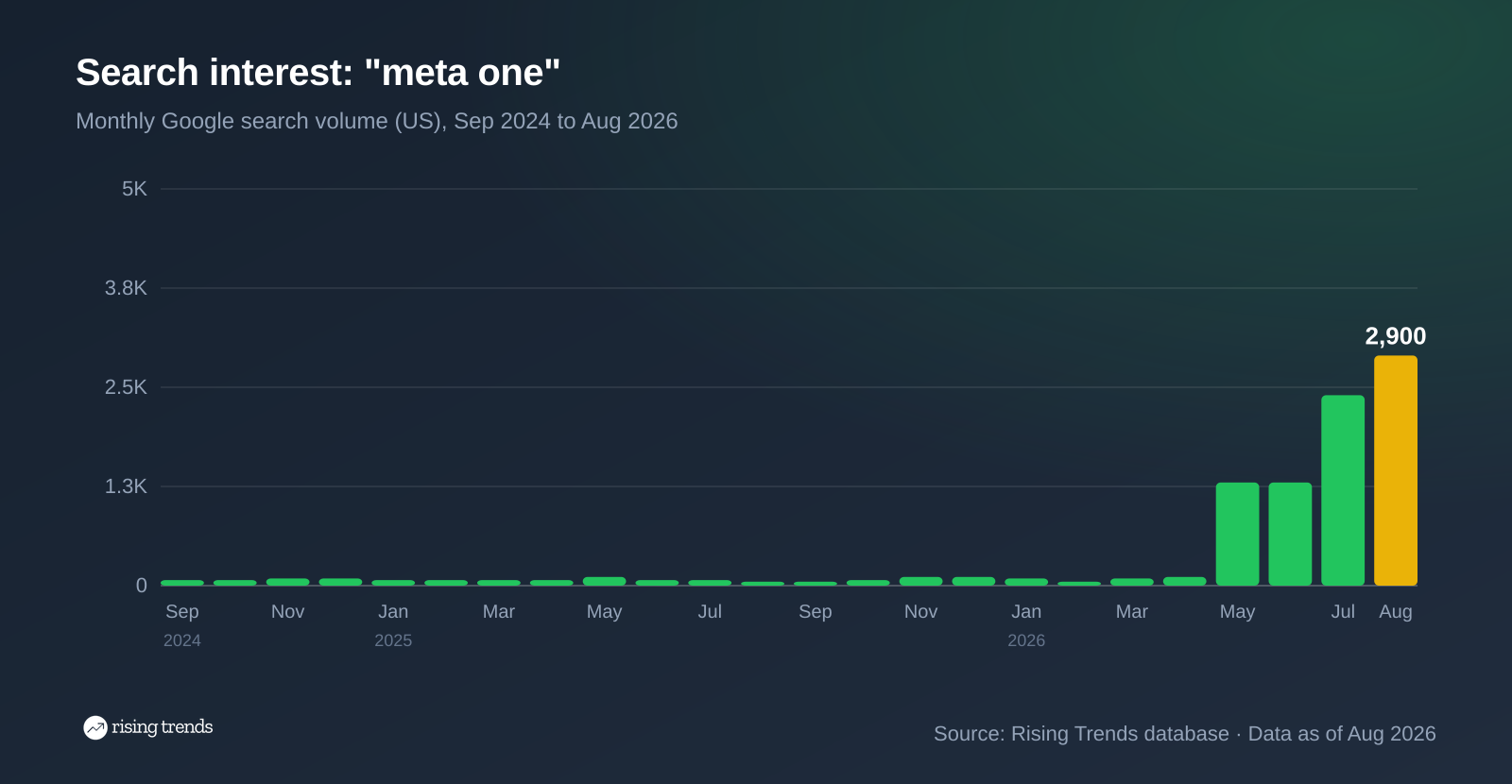
Read the last six months left to right: 90 in March, 110 in April, then 1,300 in May, 1,300 in June, 2,400 in July and 2,900 in August 2026. The breakout is May. Meta's own launch post is dated September 15. The demand arrived a full quarter before the product it describes.
What happened in May was the quiet version of the launch. Meta shipped the single-app subscriptions globally and began testing the Meta One branded bundles in a short list of countries. People met the name in an upgrade prompt, not a press release, and went to Google to find out what it was. Our data has it as an EXPONENTIAL riser with a 16.5x lift on a two-year view, and the three months to August ran 4.4 times hotter than the three before them.
The growth number only means something next to its peers, and this is the comparison that does not exist anywhere else.
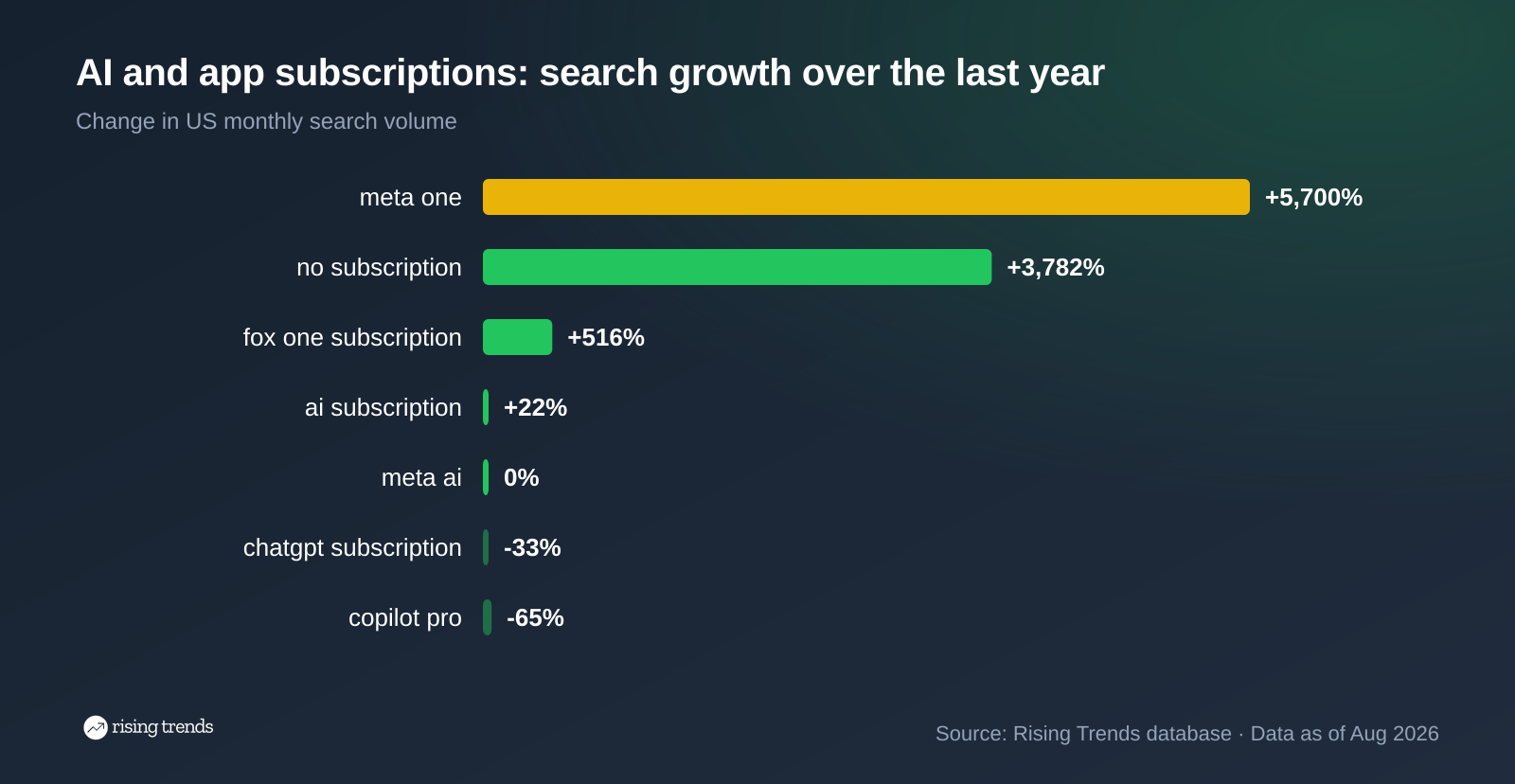
Three things fall out of that chart. Meta's free AI brand, meta ai, is flat at 246,000 searches a month, so the parent product is not growing and the paid one is. The two paid-AI terms people already know, chatgpt subscription and copilot pro, are down 33% and 65%. And the second-fastest riser in the set is "no subscription", up 3,782%. Meta is launching a subscription into a market that is actively searching for ways out of them.
It is not one product with one price. It is a shelf.
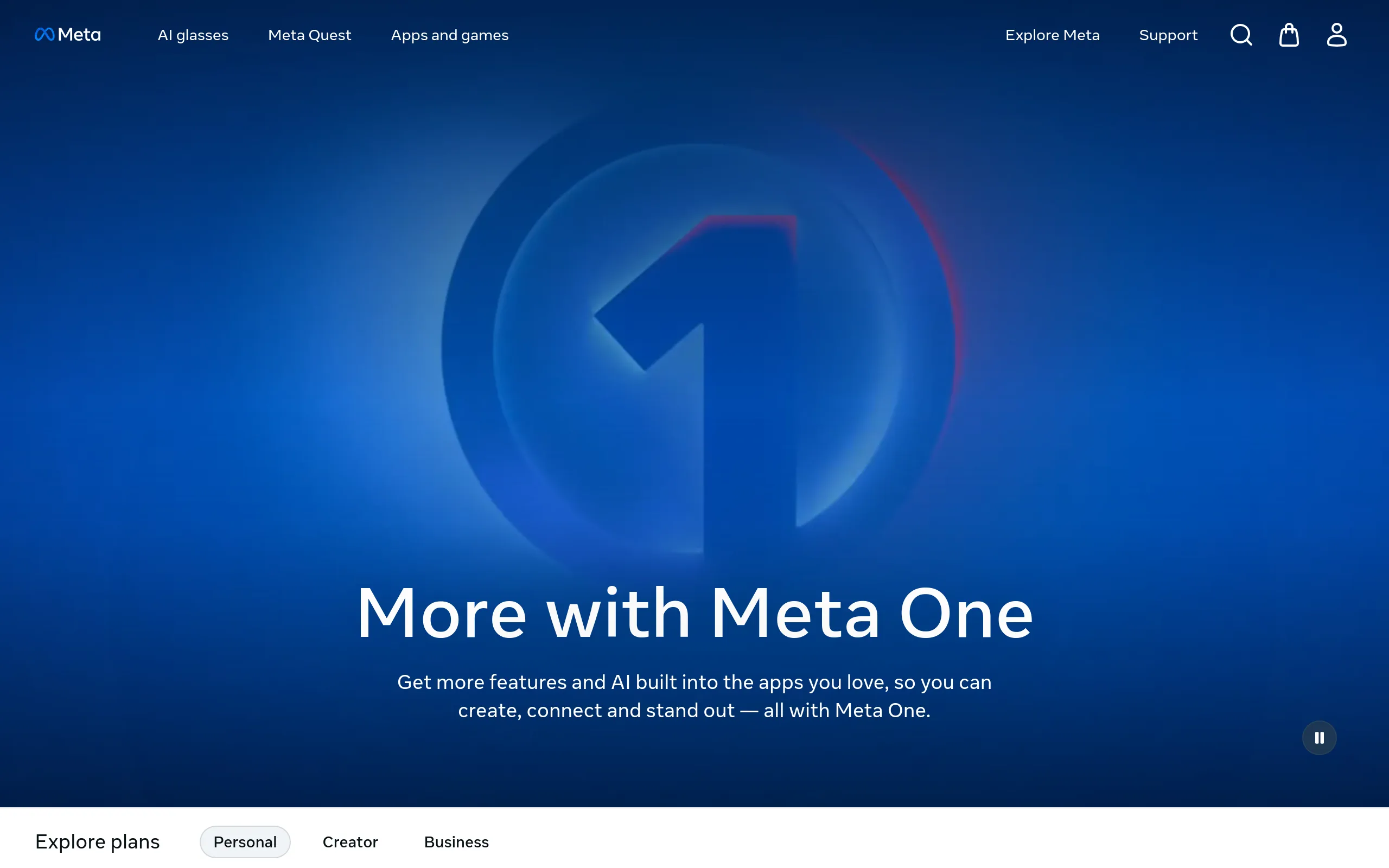
At the bottom are the three single-app plans that started all this, each adding cosmetic and organisational extras to one app. WhatsApp Plus is the clearest example: $2.99 a month buys custom themes and icons, exclusive ringtones, special-effect stickers, and the ability to pin up to 20 chats. Above those sit two consumer bundles, and above those five tiers for businesses and creators.
| Plan | Price | Who it is for | The headline benefit |
|---|---|---|---|
| WhatsApp Plus | $2.99/mo | One app | Themes, icons, ringtones, pin more chats |
| Instagram Plus / Facebook Plus | $3.99/mo each | One app | Custom fonts, story viewer insights, super reactions |
| Meta One Core | $7.99/mo | Individuals | All three Plus plans, plus more AI usage |
| Meta One Premium | $19.99/mo | AI heavy users | The highest consumer image and video generation limits |
| Meta One Essential | from $14.99/mo | Small business | Verified badge, impersonation protection, business agent replies |
| Meta One Advanced | from $49.99/mo | Growing accounts | Feed featuring, search placement, links in posts, scheduling |
| Meta One Expert / Max | from $149 / $499/mo | Teams at scale | Highest feature and agent capacity |
The AI in the bundle is Meta's Muse image and video models. Meta is explicit that this is a usage ceiling, not a paywall: the company's launch announcement says the core experience across the apps and Meta AI stays free, and the plans page answers the question directly with "Yes. Meta AI is free for everyone." What you buy is headroom on the expensive parts, mainly generating and restyling images and video.
One caveat that only shows up in the documentation. The newsroom post says plans are "now available globally", but the Meta One Premium help page opens by saying the service "is currently in limited testing and isn't available everywhere yet". The same page notes billing runs through the Apple App Store or Google Play, so Meta hands a platform cut to its two biggest distribution rivals on every dollar of this.
Because the prompt found them before the news did. The pattern in our data is a product people bumped into rather than read about.
The clearest reaction so far is not about the AI at all. It is about a line in Meta's help docs. This clip from marketer Avi Shenkar, posted on September 16, 2026, points at the Advanced tier and what it quietly includes.
"Buried in their own help docs is a feature called Featured in feed," he says. "For $49.99 a month, your competitor can get placed ahead of you." His summary of what that means for everyone else is the sharpest line anyone has written about this launch: "Your free account doesn't get worse, but it doesn't compete evenly with a subscriber either."
We checked it against the source. He is right. Meta's About Meta One Plans page lists, under the Advanced plan's audience growth block, "Featured in feed: Have the opportunity to be featured in Feed on Facebook" and "Optimized search: Make it easier for people to find your profile". Neither appears in the launch announcement.
Set against the other AI subscriptions, Meta One is cheap and shallow. Core is $7.99 against the $20 that has been the standing price of a consumer AI plan for three years, and it does not buy you a better model. It buys more turns on image and video tools inside apps you were already using.
That is a real strategic difference. OpenAI and Microsoft sell a destination you go to. Meta is selling more of something you already do, which is why its competitor set in our database is less "AI assistant" and more "app subscription". The closest analogue by search behaviour is not ChatGPT at all. It is fox one subscription, a streaming bundle up 516% in a year, because both are established free-to-cheap audiences being converted to recurring revenue.
The gap in the middle is the business tiers, and there Meta has no real competitor. Nobody else can sell a small business a verified badge, an AI agent answering WhatsApp messages overnight, and placement in a feed, because nobody else owns all three. The pitch lands squarely in the same place as the tooling we covered in our digital marketing trends and small business trends reports: fewer separate tools, more of the work happening where the customers already are.
Mixed, and split cleanly by who you are.
Consumers are lukewarm. Amanda Caswell, the AI editor at Tom's Guide, bought Core and wrote it up the day after launch. Her answer to whether you need it: "Probably not, at least not yet." Her sharper complaint is about the thing the pricing page does not tell you. "Meta hasn't published one simple universal number telling users exactly how many AI generations or edits they get for free," she wrote, which means most people will find the ceiling by hitting it.
Creators are more interested, and more transactional about it. Jade Beason, whose reaction video went up on September 16, called the feature list a wishlist come true for creators, singling out links in posts, longer-lived stories and multiple story audiences. She still ended on the price: would you pay $49.99 for these features?
Meta's own number is the one to hold on to, with a caveat. It says 15 million subscriptions and trials to date. Trials counted alongside subscriptions is not a revenue figure, and the company has not split them.
Meta is building a second revenue line because the first one is almost all it has. In Q2 2026, Meta reported $60.801 billion of revenue, of which advertising was $59.363 billion and Family of Apps Other revenue, the line subscriptions sit in, was $1.007 billion. That is 1.7%. With 3.60 billion daily active people across the apps in June 2026, converting even a sliver at $7.99 changes the shape of the business. The investment case for AI spending we sketched in our generative AI trends piece needs an answer to "who pays"; this is Meta's.
Paid reach changes the deal for everyone who posts. Organic reach on Facebook and Instagram has been shrinking for a decade, but it was at least free. Selling feed featuring and search placement to $49.99 accounts sets a floor that unpaid accounts now sit below. For a small business, that is a new fixed cost to stay level, not an upgrade.
AI is becoming a metered utility inside apps rather than a product you visit. The AI agents we track are heading the same way: capability bundled into the surface where the work happens, sold by consumption. Meta One is that idea applied to three billion people.
The September number, which lands in October. Everything above is as of August 2026 and therefore entirely pre-launch. If the launch was the real event, "meta one" should step up again. If May was the real event, it will flatten. Our meta one trend page updates monthly and will settle that.
Whether "no subscription" keeps climbing. At 6,600 searches a month and up 3,782% in a year (as of August 2026), it is the clearest reading available of subscription fatigue. If Meta One converts at scale while that term keeps rising, the fatigue is about price, not principle.
Whether the free tier gets tighter. Meta has not published the free AI limits. The honest test of "the core experience stays free" is what those limits look like in six months, once the compute bill for Muse is real and 15 million trials have to convert into something.
The launch is the least interesting thing about Meta One. A company with 3.60 billion daily users spent four months letting people find a paid product through an upgrade prompt, and built 2,900 monthly searches of demand before it ever held a launch. That sequence, not the price list, is the playbook worth watching.
Want to catch the next product while the search curve is still flat? Read our guide on how to identify market trends, follow the live meta one trend page, or see what is breaking out right now on the Rising Trends dashboard.
Thousands of Emerging Trends
Thousands of Breakout Apps
Mega Trends
Trend Analysis Tool