
Trends


Jev is an AI model that cannot write you a sentence. Ask it a question and it returns a typed value, a probability distribution and a confidence score, and that is all it returns. TypeSafe AI shipped it on September 15, 2026, the same day it came out of two years of stealth with a $40 million seed round. In our database, searches for the company had already climbed from 50 a month to 590 over the preceding year, as of August 2026, with the breakout landing in March, six months before anything was public.
That gap between the curve and the launch is the first thing worth noticing. The demand was building while the product was still private, which usually means developers and recruiters rather than buyers. The second thing is what the launch numbers actually say when you read past the headline. TypeSafe's own evaluation site puts Jev at roughly the accuracy of a mid-tier reasoning model for about a four-hundredth of the cost, which is a genuinely interesting trade and a very different claim from the one on the homepage. Nobody ranking for this model has the demand curve, and nobody has laid the eval numbers side by side. We have both.
Key takeaways:
Let's get into it.
Here is the monthly curve for "typesafe ai" over the last two years, straight from our database. Read it as demand for the company, not for the model: the term "jev" on its own is dominated by Japanese encephalitis virus and a musician of the same name, and "jev ai", "jev model" and "typesafe jev" all return no data at all. The company term is the only clean signal we have for this story.
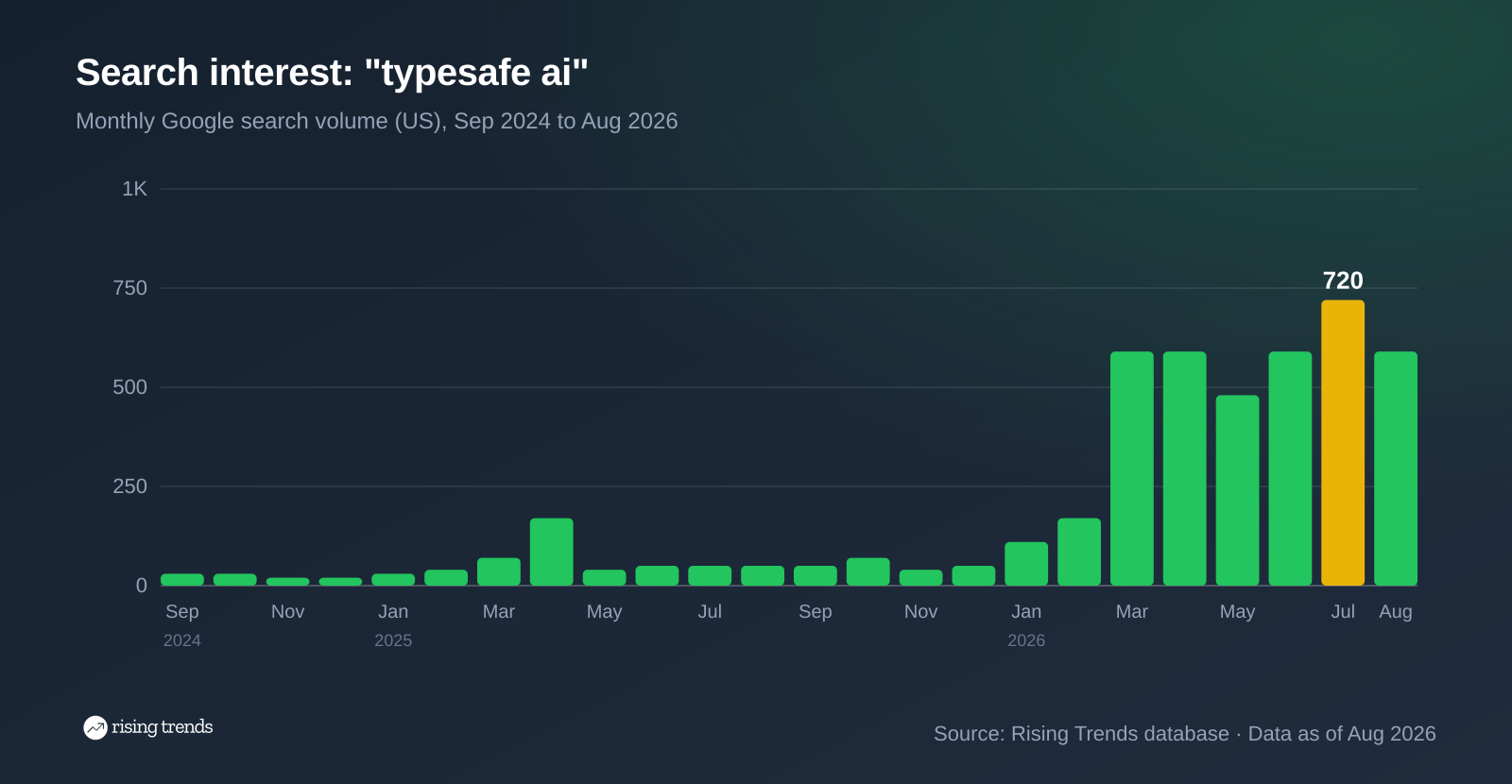
The step is unmistakable. Volume sat between 30 and 170 for eighteen months, then jumped to 590 in March 2026 and never went back. July peaked at 720 and August settled at 590. Every one of those months is before the product existed publicly, which rules out the usual explanation. People were searching a private company, most likely because it was hiring, because investors were circling, or because the founder was talking at conferences.
The comparison that makes the story is the vocabulary around it. If typed, reliable model output were a category rising on its own, the words people use for the problem would be rising too. They are not.
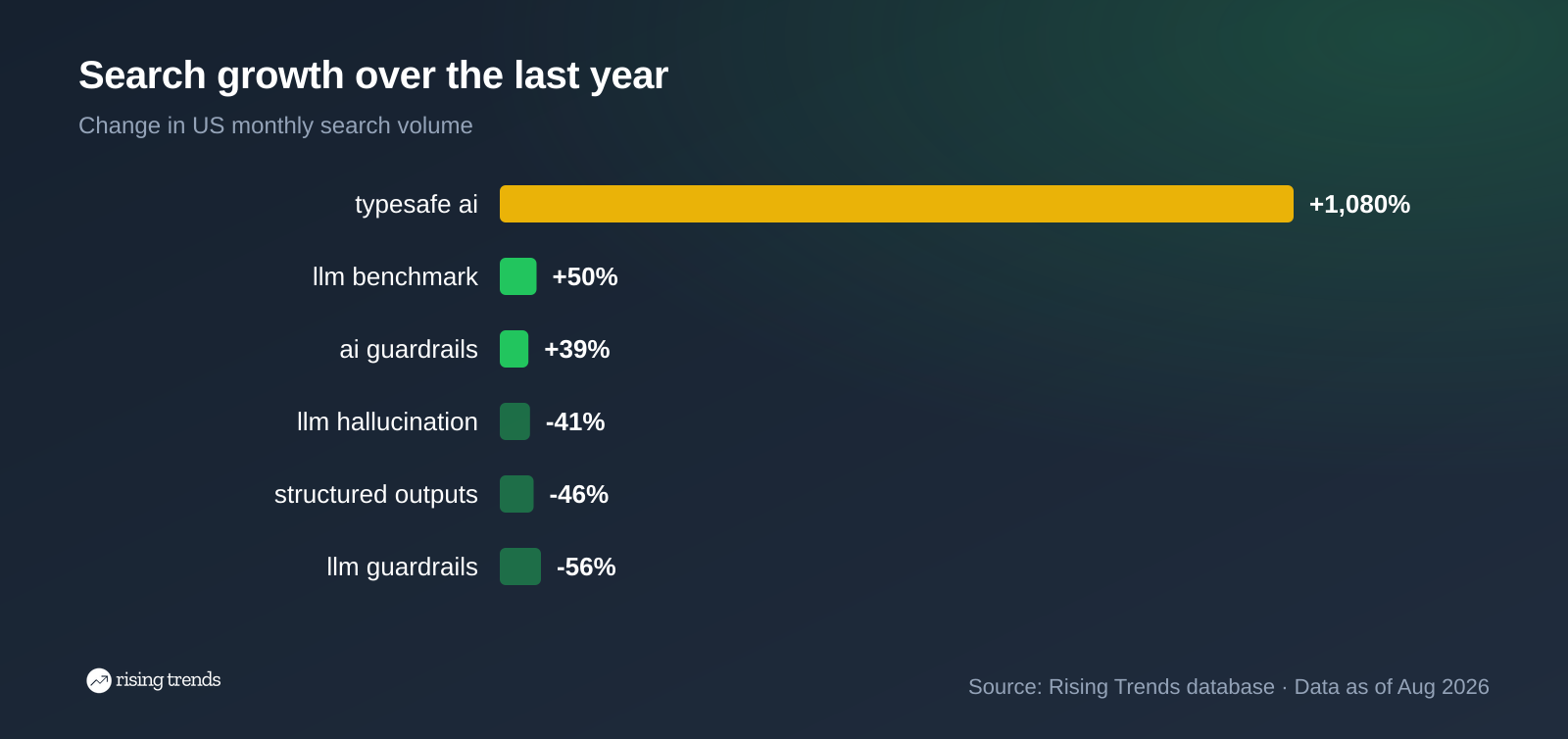
Structured outputs is down 46% year over year at 320 searches a month. LLM hallucination is down 41% at 590. LLM guardrails is down 56%. Only llm benchmark is holding, at 6,600 a month and up 50%. The problem language is fading while one brand name climbs, which is what it looks like when a company is being searched as a company rather than as the answer to a question people are already asking.
TypeSafe calls Jev a System One Model, a name borrowed from Daniel Kahneman's split between fast intuitive judgment and slow deliberate reasoning. The practical definition in the documentation is simpler: you POST a state and a set of typed questions to one endpoint, and you get typed answers back. No text, no JSON to parse, no retry when the model wraps its output in prose.
There are three question types. Choice picks one option from a list you define and returns the full probability distribution plus a confidence score. Score rates the state on a rubric. Noul answers a yes-or-no question with a probability between 0 and 1. All three can be mixed in a single call, and because every question is evaluated independently against the same state, adding more of them barely changes the response time.
The part that matters architecturally is the confidence number. TypeSafe's confidence documentation describes a three-band pattern: act automatically when confidence is high, flag for review in the middle, refuse to act at the bottom. The doc puts the reasoning bluntly: "If an intelligent system, whether human or machine, cannot express honest uncertainty, the system cannot be trusted." That is the actual product. Not speed, not price, but a number your code can branch on.
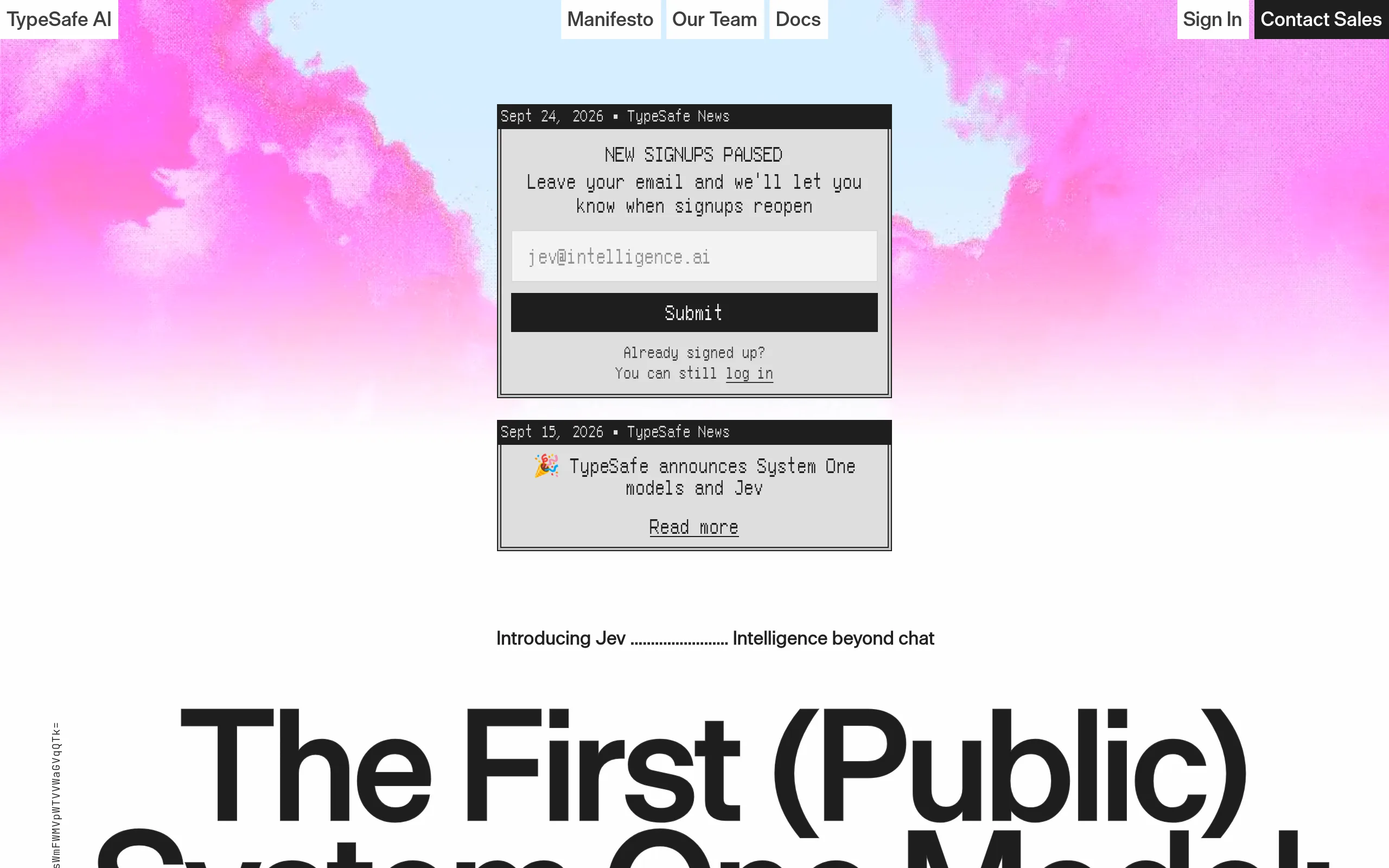
Note the banner at the top of that capture. Nine days after launch the company had paused new signups and gone back to collecting emails. Early access is still a waitlist.
Three things happened on one day, and they compound.
The founder. Diogo Almeida co-invented reinforcement learning from human feedback at OpenAI, the technique behind InstructGPT, ChatGPT and GPT-4. He then spent two years building the argument that the technique is the problem. DCVC, which led the round, published its own note on the investment with a long interview attached. Almeida's framing: "in a world where AGI has automated most of the economy, over 99% of AI calls will be made by and for software, not humans."
The money. A $40 million seed led by DCVC, with Forbes putting the post-money valuation at about $200 million. For a company with a waitlisted product and no pricing page, that is a bet on the thesis rather than the traction.
The receipts. The launch post is unusually specific for a model announcement. It publishes the architecture comparison, the training method, the price, the latency range and four complete evaluation workflows, and it flags its own weak points as it goes. That is why it travelled.
The clips followed within days. This one from The AI Update Pro, published September 22, 2026, is the version of the story that spread fastest: a former ChatGPT researcher built a model that refuses to talk.
The framing in that clip is the one doing the work everywhere: the model's limitation is the pitch.
TypeSafe published four workflows on its evaluation site and ran every model through the same harness. Reference answers come from GPT-6 Astra and Claude Fable 5.1 at high thinking, which the site states plainly. Here is the average across all four, in the workflow configuration where each model does best.
| Model | Accuracy | Cost per case | Time per case |
|---|---|---|---|
| Claude Opus 5 | 73.1% | $0.1761 | 37.8s |
| GPT-5.6 Terra | 67.9% | $0.0304 | 10.1s |
| Jev | 67.8% | $0.0004 | 0.4s |
| Claude Sonnet 5 | 67.8% | $0.1174 | 78.1s |
| Claude Haiku 4.5 | 53.6% | $0.0195 | 12.5s |
Read the middle column. Jev matches Sonnet 5 on accuracy at roughly a three-hundredth of the cost, and gives up 5.3 accuracy points to Opus 5 while costing 440x less per case. Against Terra, the closest model on accuracy, it is 76x cheaper and 25x faster. That is the honest version of the pitch, and it is more persuasive than the "193.6x faster, 444.6x cheaper" banner on the homepage, which the launch post itself admits sits "on the higher end of real world gains".
Pricing works out at $0.042 per million input tokens with output free. The company addresses the obvious question directly rather than dodging it: "We can't prove it isn't subsidized; we'll need the long-term to prove the sustainability of our pricing." There is no pricing page and no published rate limits yet, so treat the number as directional. If you are modelling inference spend, the same caution applies to every launch price, which is the argument we made in prompt caching, explained.
The Hacker News launch thread reached 1,979 points and 513 comments in a day, which puts it among the biggest model launches of the year. The reaction split cleanly in three.
The builders recognised their own workaround. "After much fumbling around with prompts and evals, this is exactly how I am using LLMs in production, to narrowly make choices and return structured data," wrote lubujackson. "If this does at all what it claims, I think this is going to quickly become the new standard approach for agentic systems."
The sceptics went after the comparison. "'70-500ms vs 3-329 seconds' are apples-to-oranges unless the LLM baseline is doing comparable work," wrote ramon156, before adding, "Nonetheless i want this to be true." A generative model emitting schema, type names and prose is doing more work than a model emitting a constrained decision, so some of the multiple is definitional rather than architectural.
The sharpest objection was to the wording. "'Can't hallucinate' seems wrong?" wrote jacobgold, in the thread's top comment. "Sure, it can't emit an invalid type, but it can still emit a completely wrong answer." Another commenter, quoted in eesel's hands-on review, put it more directly: "if it puts a high confidence value on a wrong answer, thats still hallucinating, no?" The defence is fair, and it is the whole design: a calibrated 0.1 is a model telling you not to trust it. But type safety is not the same thing as being right, and the marketing slides between the two.
Outside the thread, the strongest signal came from a user rather than a reviewer. Vercel's chief executive Guillermo Rauch reported it in production: "Jev is up to 18x faster (p95) and more accurate. It's coming to @vercel AI Gateway and likely new default." An 18x p95 improvement in a real gateway is a smaller number than the homepage claims and a much more useful one.
A lot of production AI is classification wearing a chatbot costume. Routing a ticket, scoring a lead, deciding whether an invoice gets paid: none of those need prose, and teams have spent three years coercing chat models into emitting JSON anyway. If a model priced like infrastructure does that job at a fortieth of the cost, the cheap decisions come out of the frontier models' bill. The AI agent stacks being built right now are full of exactly these calls.
Calibration becomes a spec line. The useful idea here is not speed, it is a confidence number a system can act on. Once one vendor exposes calibrated probabilities as a first-class output, "how do you know when it is unsure" becomes a procurement question for everyone else. That pressure will reach the open-source agent projects before it reaches the big labs.
It is a complement, not a replacement. eesel's trial of the model across 284 support chats found the typed decisions hit 93% triage accuracy while the generated drafts in the same system still carried a 7% factual-error rate. Different jobs. The realistic architecture is a cheap model making the small decisions and an expensive one writing the words, which is roughly how generative AI settled into enterprise stacks in the first place.
The bet is on composition, not scale. TypeSafe's manifesto argues that "the bottleneck isn't raw intelligence. It's that today's intelligence is hard to build on." That is a different thesis from the one funding the largest training runs, and it sits closer to the world models argument than to anything in the chat race.
Whether the price holds. $0.042 per million input tokens with free output is a launch price on a waitlisted product from a company that will not claim it is unsubsidised. The first published rate card is the real test.
Whether distribution arrives before a competitor does. Rauch's gateway comment is the thing to track, because a model nobody can sign up for spreads through aggregators or not at all. Ten days after launch there were already open-source projects rebuilding the interface on top of ordinary LLMs, which is what happens when demand exceeds access.
Whether the search curve moves after the launch. Our August 2026 reading predates the announcement entirely, so the interesting number is the next one. The TypeSafe AI trend page is where that will show up first. Watch hallucination detector and agent guardrails alongside it: if the reliability vocabulary starts rising with the brand, this is a category forming. If the brand keeps rising alone, it is one company's story.
The honest summary is that Jev is narrower than the announcement suggests and more useful than the sceptics allow. It is a very fast, very cheap classifier with a calibrated confidence score, sold by people who helped build the thing it is reacting against. Whether that becomes a new layer of the stack or a good feature other labs copy, the interesting part was never the speed. It was somebody shipping a model whose main feature is knowing when to say it is not sure.
Want to catch the next model launch while the search curve is still forming? Read our guide on how to identify market trends, follow the live TypeSafe AI trend page, or browse what is breaking out right now on the Rising Trends dashboard.
Thousands of Emerging Trends
Thousands of Breakout Apps
Mega Trends
Trend Analysis Tool