Trends


A year ago, about 20 people a month typed "krea 2" into Google. As of August 2026 it is 6,600, after a July peak of 8,100. In the same twelve months, searches for the company that built it went the other way: "krea ai" is down 55% and "krea" is down 18%. The product is shrinking in search while the model inside it explodes.
That inversion is the story. Krea spent years as a company that wrapped other people's image models in a nicer interface. In May 2026 it shipped one of its own, and in June it gave the weights away. Now the thing people look up is not the website. It is the checkpoint they can download and run on their own graphics card. Nobody ranking for "krea 2" has the monthly curve, the brand-versus-model split, or a check on whether Krea's own leaderboard claim still holds four months later. We have all three.
Key takeaways:
Let's get into it.
Here is the monthly search volume for "krea 2" over the last two years, from our database. It is not a staircase like a company with repeated funding news. It is a wall.
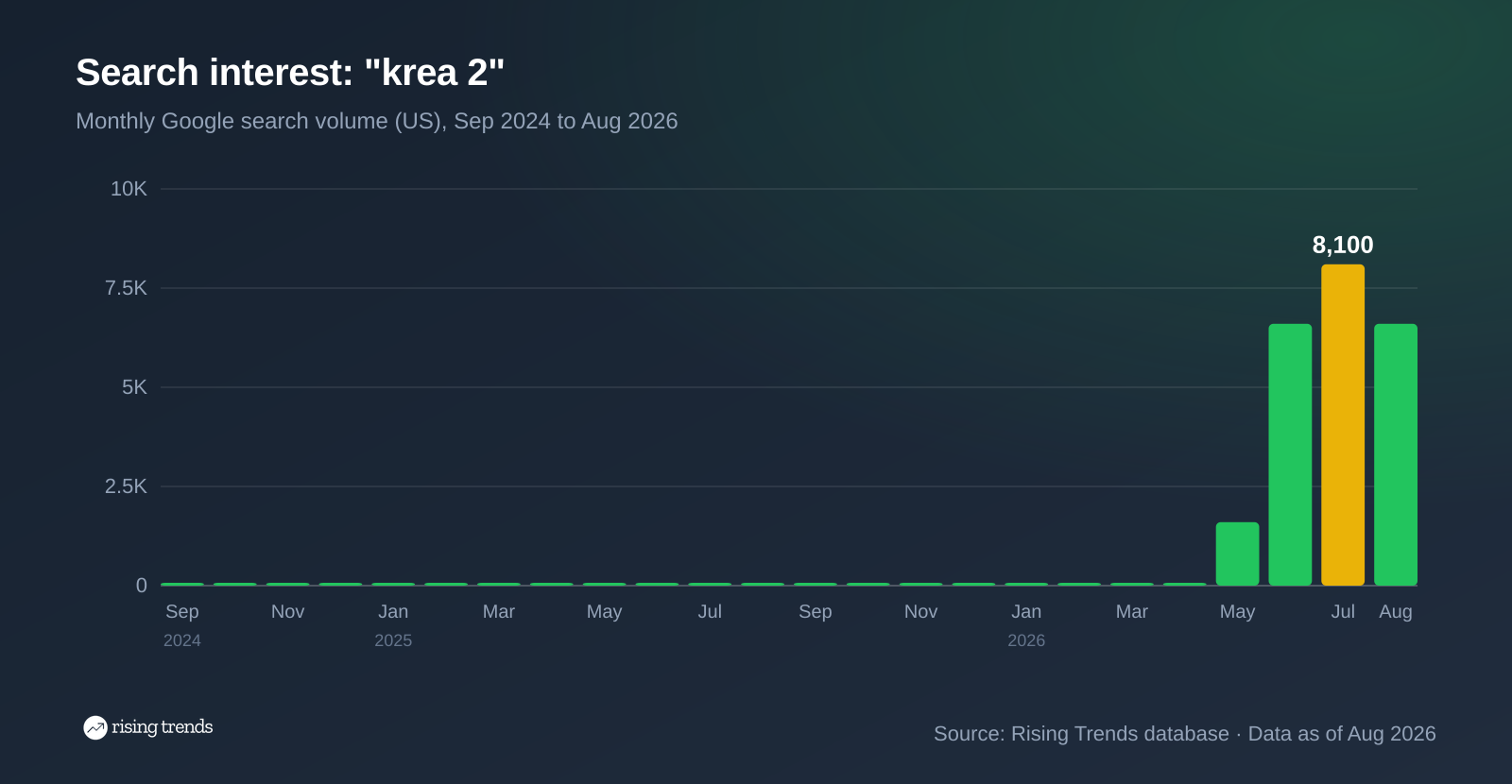
For twenty-two of those twenty-four months the term is effectively zero. April 2026 sits at 40. May 2026, the month of the announcement, jumps to 1,600. June, the month the weights went out, hits 6,600. July peaks at 8,100 and August settles back to 6,600, which is where the term is now. Our breakout month is June 2026, and the pace is classified as EXPONENTIAL with a RISING trajectory.
The more interesting number is what happened to everything else with Krea's name on it.
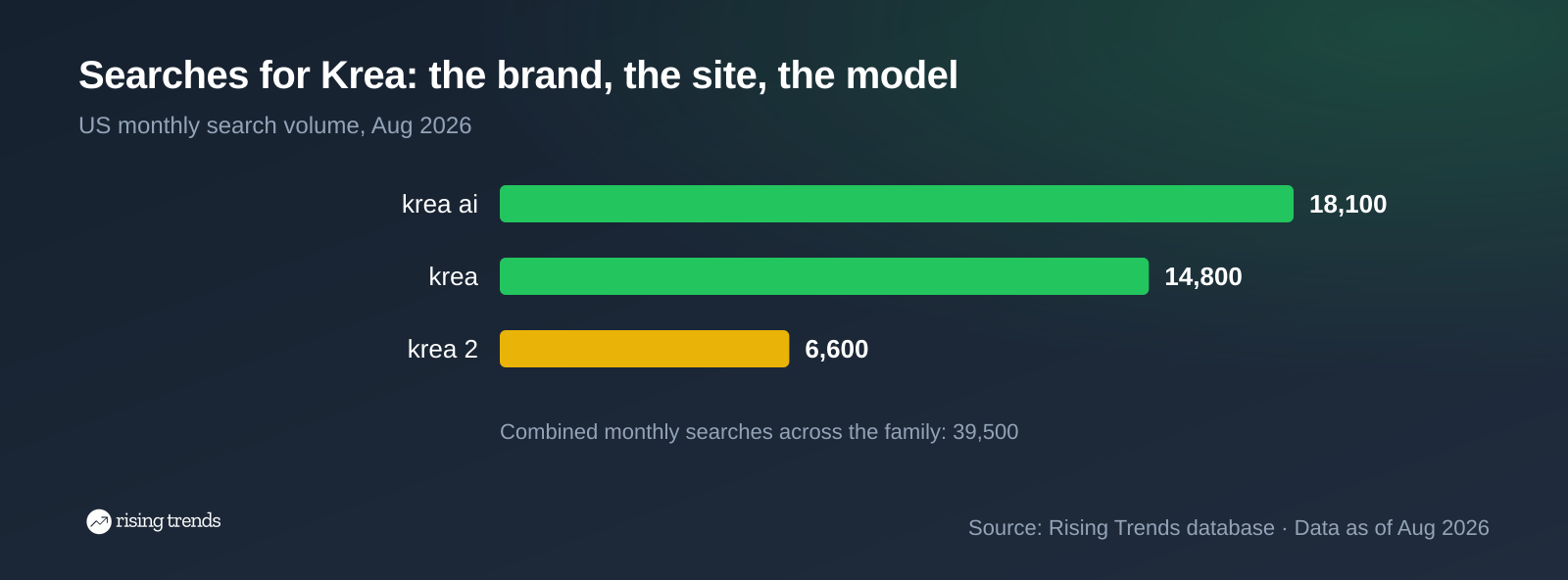
Three Krea terms, 39,500 searches a month between them as of August 2026, and the two older ones are both falling. The model now accounts for roughly one in six searches in its own brand family, from a standing start. We have seen this shape once before this year, when Ox Alpha out-searched the lab that made it, and it tends to mean the same thing: the audience has shifted from people shopping for a product to people evaluating a component.
Krea 2 is a text-to-image foundation model that Krea built from scratch, rather than fine-tuning someone else's base. The open-source release page describes the architecture in one line: a Qwen Image VAE, a 12B dense diffusion transformer backbone, and a Qwen3-VL text encoder with multi-layer feature aggregation.
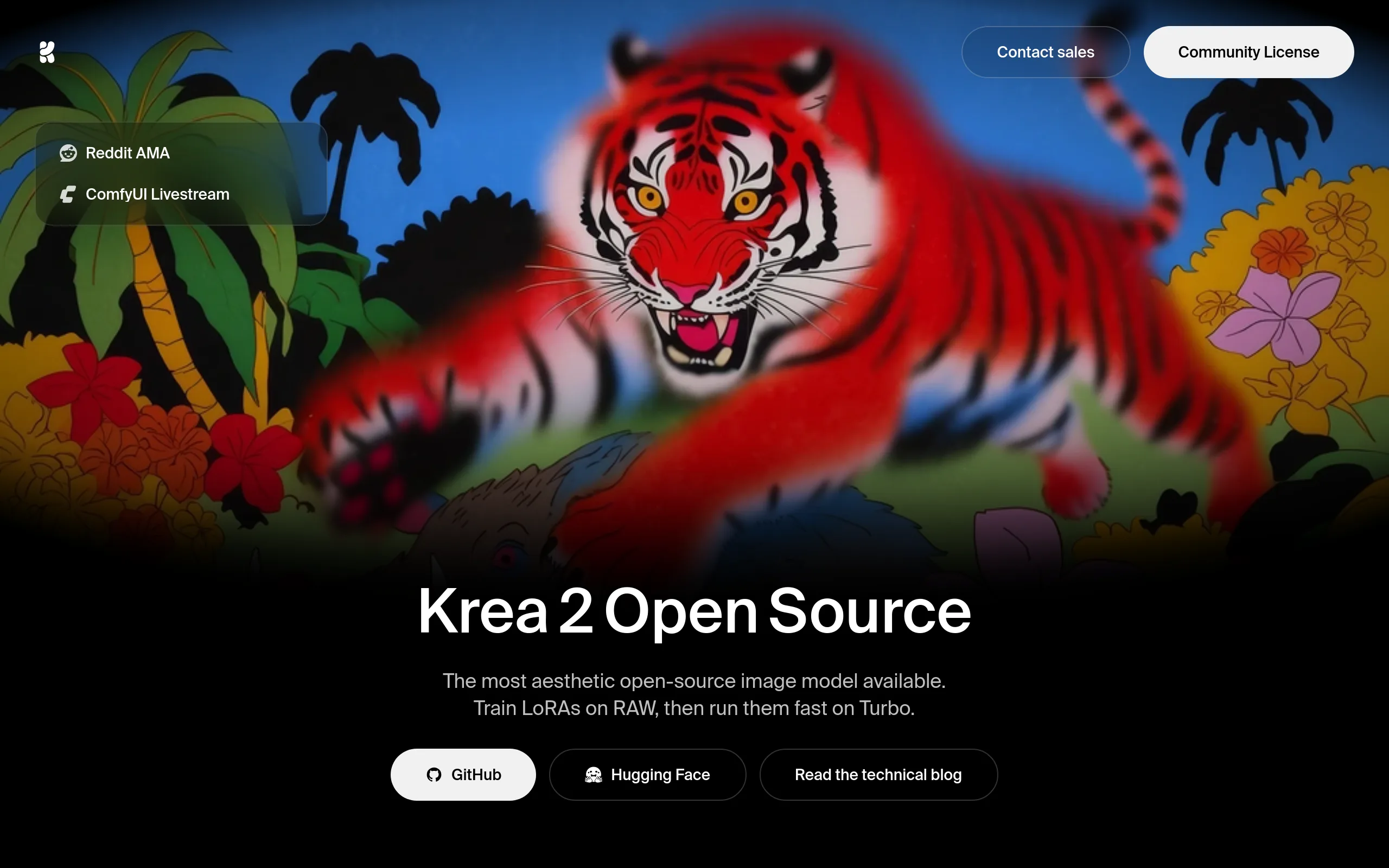
That page is the whole pitch in two buttons. There are two checkpoints and they are meant to be used together. RAW is the undistilled base, which Krea describes as "diverse, malleable, and intended for fine-tuning, post-training, and LoRA training". Turbo is an 8-step distilled checkpoint for fast inference. The instruction Krea repeats everywhere is to train a LoRA on RAW and then run it on Turbo. The model card gives the release date as June 22, 2026 and the size as a diffusion transformer with 12 billion parameters, and the official inference code says Turbo runs with 8 steps and classifier-free guidance switched off, at 1,024 to 2,048 pixels.
The design goal is unusual, and it is the reason the model exists. Krea's 59-minute technical report, published June 23, 2026 with seventeen named authors, argues that the field optimised itself into a corner: "as the field has optimized for reliability on these capabilities, many systems have converged toward a narrow set of default aesthetics." Their fix is to refuse the usual quality filters. Krea deliberately kept blurry and imperfect images in the pretraining mix, on the grounds that motion blur "can be a deliberate artistic choice", and excluded AI-generated images entirely, because even a small share of them "introduces biases into the model's output distribution".
The commercial terms are where it stops being a gift. The Krea 2 Community License, dated June 22, 2026, lets you use the model commercially only if your company-wide trailing-twelve-month revenue is under $1,000,000. Cross that line and you need an enterprise licence before any commercial use. Krea's self-hosting price list starts at $1,000 a month per model for 10,000 images, one domain and ten users, explicitly "not for client or downstream use". Several write-ups described the threshold as a seat count. The licence text says revenue.
The search curve has two steps and they map exactly onto two dates. Krea announced Krea 2 on May 12, 2026, as its first foundation image model built completely from scratch, with style references, moodboards and real-time sliders as the headline features. Volume that month went from 40 to 1,600.
Then the weights went out, and the number multiplied by four. That second step is the one that matters, because it changed who was searching. Before June, "krea 2" was a product question. After June it was a deployment question: what quantisation, how much VRAM, which sampler, which LoRA. The community has not stopped tuning it. This test of 2-step and 4-step distillation LoRAs against the stock 8-step Turbo checkpoint went up on September 18, 2026 and has 3,787 views on YouTube.
The download numbers back that up. Hugging Face reports 89,387 downloads in the last month for Krea 2 Turbo and 87,339 for RAW, 176,726 between them, with 2,683 likes. Both repos were created on June 18, four days before the public release.
Krea's technical report makes a specific claim: Krea 2 "is among the top 10 models on the Artificial Analysis leaderboard for text-to-image, and scores 2nd place among models from independent labs." That was published in June. We read the live AA-Image-T2I v2.0 arena board on October 14, 2026. It no longer says that.
| Model | Rank | Elo | Released | API price per 1,000 images |
|---|---|---|---|---|
| GPT Image 2.5 Sunburst (max) | 1 | 1199 | Sep 2026 | $210.70 |
| Nano Banana 2.1 | 4 | 1159 | Oct 2026 | $33.60 |
| Krea 2 Large | 25 | 1027 | May 2026 | $60.00 |
| Krea 2 Medium Turbo | 29 | 1022 | Jun 2026 | $15.00 |
| Krea 2 Medium | 38 | 1012 | May 2026 | $30.00 |
| Krea 1 | 141 | 820 | Jun 2025 | No API |
Both things are true. Krea 2 was a top-10 model in June and it is a rank-25 model in October, because the board filled up with GPT Image 2.5, Nano Banana 2.1, Grok Imagine 2.0 and MAI-Image-2.6 in the months after. What has not changed is the gap to Krea's own past: Krea 1 sits at 820 Elo, more than 200 points below Krea 2 Large. The in-house model was a genuine jump for the company even as it slid down the field.
The pricing row is the one buyers should read twice. Krea 2 Medium Turbo costs $15.00 per 1,000 images through an API while scoring within five Elo points of Krea 2 Large at $60.00. If you are running the open weights yourself, both numbers are zero until you hit the revenue threshold.
The honest read on Krea 2's reception is that it is admired by people who run models locally and ignored by everyone else. The model's own Hugging Face discussion board opened with a VRAM question on June 23, the day after release, and never really moved on.
The first answer set expectations: "based on the size of the weights of the diffusion model it should be somewhere around 16Gb of minimum VRAM," wrote jsob7 on June 24, "less than it the only way is use a GGUF or FP8 version." Within a week people were reporting otherwise. Pheeby, on July 1: "3060 ti here, 8GB VRAM, fp8 quant gets about 3.9 seconds per iteration... The speed is supremely tolerable in exchange for the image quality." Andyx1976 got it running on a six-gigabyte laptop GPU and called it "relatively slow (but not unusable)."
The criticism is specific and it is about faces. "Krea2 has poor control over the expressions of characters," wrote wange1002 in a July 10 thread that drew five sad reactions. "Every time it generated an image, it was always one with a blank expression." Other open threads ask for ControlNet support and complain about Chinese text rendering. For a model whose entire pitch is aesthetic control, a reputation for flat faces is the sharpest thing anyone has said about it.
There is also a tension inside Krea's own documents worth flagging. The technical report says no AI-generated images were used in pretraining. The model card describes the training data as including "synthetic data generated through proprietary methods". Both can be reconciled if the synthetic data sits in later stages, but Krea has not said so plainly.
Open weights are a distribution strategy, not charity. Krea gave away a 12B model and charges from the first dollar of real revenue. That is the same trade the open-source AI agent wave made this year, and it works for the same reason: the free tier buys you the hobbyists who write the LoRAs, the ComfyUI nodes and the quantisations, and those artefacts are what make the paid tier worth buying.
Generation is not where the money is going. Our data on the wider category is blunt about this.
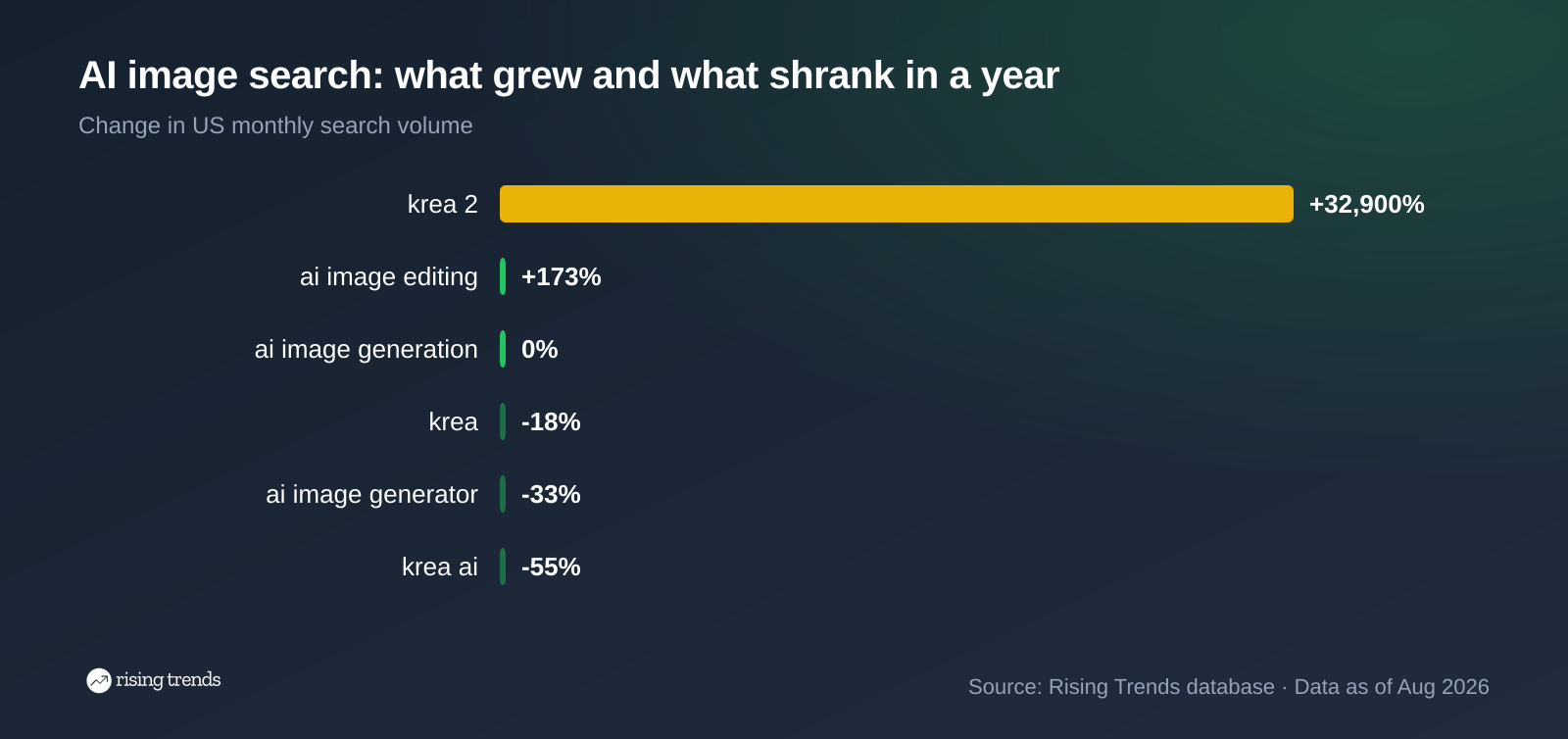
AI image editing is up 173% in a year at 165,000 monthly searches. "ai image generator", the giant at 550,000, is down 33%. People have stopped shopping for a generator and started looking for a specific fix, which is the shift we track across the whole AI trends category. Krea 2's own roadmap admits as much: the technical report's future-work section names "robust editing, image reference, and native 2K/4K generation" as the next targets.
The brand is now downstream of the model. This is the part that should worry Krea. Model names travel through developer channels, benchmark boards and ComfyUI workflows, and they do not carry a subscription with them. That is a very different acquisition funnel from the one that built the generative AI products of 2026, and it is closer to how a developer tool like Jev gets adopted: someone installs the weights, never visits the website, and the company sees nothing until a licence email arrives.
Whether 6,600 holds or decays. The August number is already down from the July peak, which is normal for a release spike. The test is the next two quarters. A model that keeps a floor near 6,600 has become infrastructure; one that drifts back toward 1,600 was a news event. The live krea 2 trend page is where that settles.
Whether the parent terms recover. "krea ai" at 18,100 and falling is the number that decides whether the open-weights bet paid for itself. If the next release lifts the brand terms as well as the model term, the funnel works. If "krea 2" keeps climbing while "krea ai" keeps sliding, Krea has built a popular model and lost a product.
Whether the next checkpoint ships with editing. Krea has said editing, image reference and native 2K to 4K generation are the next capabilities. An editing checkpoint would put the model directly into the 165,000-search lane that is actually growing. Watch for a "krea 3" or "krea 2 edit" term appearing in our database, which is usually the first signal that a release is close.
The broader lesson is cheap to state and expensive to learn. Krea built a model good enough to make its own name redundant. The searches went to the checkpoint, the checkpoint went to Hugging Face, and the company is now in the business of licensing something that 176,726 people already downloaded for free. Plenty of labs will take that trade. Not all of them will like where it leads.
Want to spot the next breakout model before the leaderboards catch up? Read our guide on how to identify market trends, follow the live Krea 2 trend page, or browse what is breaking out right now on the Rising Trends dashboard.
Thousands of Emerging Trends
Thousands of Breakout Apps
Mega Trends
Trend Analysis Tool