
Trends


The best business to start in 2026 is the one where demand is rising faster than supply, and you can measure that before you spend a dollar. The twelve ideas below are ranked by one number: how much the search term behind each one grew in the last year, pulled from our database in August 2026. Drain and sewer cleaning tops the list at 135,000 monthly US searches, up 1,945% in a year. Every entry carries its volume, its growth, its startup cost range and the first thing to do this week.
Key takeaways:
Let's get into it.
Every "best business to start" list you can find works the same way: someone lists forty things, attaches an average salary or a guessed hourly rate, and publishes. The largest one ranking today gives forty ideas with an employee salary attached to each, which tells you what a laundry attendant earns, not whether anyone near you wants a laundry service. Another gives sixty ideas with "potential earnings" of $25 to $60 an hour and no source for the figure. None of them orders the list by anything.
We ranked ours by one measurable thing: how much the search demand for each idea grew over the last twelve months.
Search volume is a decent proxy for commercial demand because searching costs the searcher something. Somebody typing "drain cleaning companies" has a blocked drain. Somebody typing "in-home senior care" has a parent who needs help. They are not browsing.
The catch is that most tools cannot show you volume at all. Google Trends gives an index scaled 0 to 100, so a term at 100 might be a thousand searches or a million, and you cannot compare two terms from different charts. Our database stores the absolute monthly count and the growth across three months, one year and two years, which is what makes a ranking like this possible. If you want the longer version of that argument, our guide on how to identify market trends walks through it.
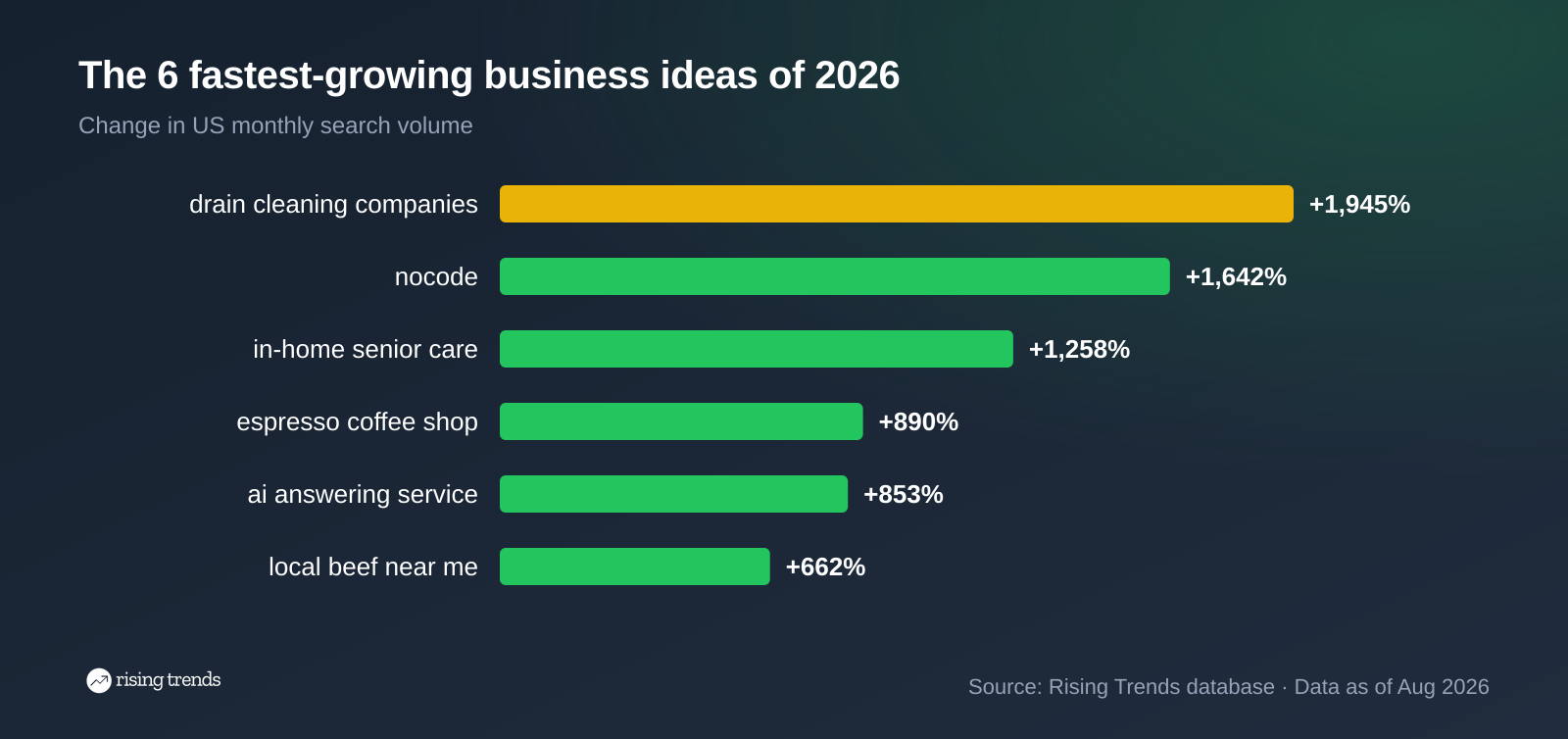
Those six lead the ranking. Note what is missing: no app ideas, no "start a podcast", no dropshipping. Those are the ideas that rank in listicles. They are not the ideas growing in the data.
One honest caveat before the list. Rising search demand tells you people want something. It does not tell you they will pay you specifically, or that your market is not already full of competitors. The validation section near the end covers how to check both.
Ranked by 1-year search growth. All volumes are US monthly searches as of August 2026.
| # | Business | Monthly searches | 1-year growth | Startup cost |
|---|---|---|---|---|
| 1 | Drain and sewer cleaning | 135,000 | +1,945% | $15k to $60k |
| 2 | No-code build studio | 33,100 | +1,642% | Under $1k |
| 3 | In-home senior care | 201,000 | +1,258% | $5k to $40k |
| 4 | Espresso bar or coffee cart | 9,900 | +890% | $20k to $150k |
| 5 | AI answering service | 18,100 | +853% | Under $2k |
| 6 | Local meat and beef share | 9,900 | +662% | $5k to $30k |
| 7 | Private dog park | 12,100 | +656% | $10k to $80k |
| 8 | Micro coffee roastery | 14,800 | +517% | $8k to $45k |
| 9 | AI consulting for small business | 6,600 | +313% | Under $1k |
| 10 | Air duct cleaning | 18,100 | +174% | $3k to $20k |
| 11 | Resale and reselling | 12,100 | +124% | Under $1k |
| 12 | Outsourced bookkeeping | 22,200 | +83% | Under $1k |
Startup cost ranges are our own estimates from equipment and licensing costs, not survey data. The SBA deliberately publishes no typical startup cost figures and tells you to price your own one-time and monthly costs instead, then add about 10% for what you forgot. That is better advice than any range, ours included.
135,000 monthly searches, up 1,945% in a year and 3,650% in three months (August 2026). The drain cleaning companies trend page has the full curve, and it is the steepest in this entire list.
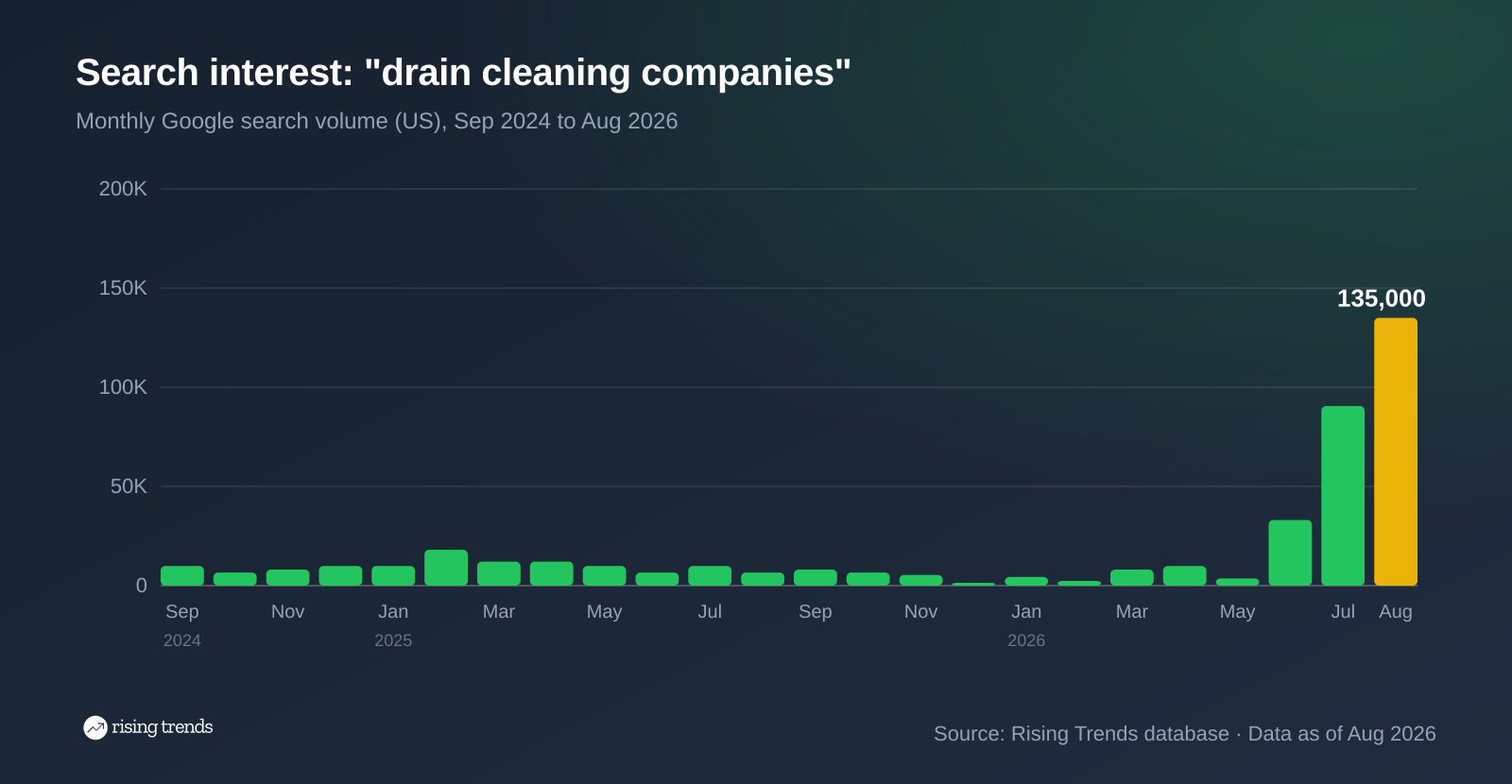
For two years the term sat between 1,000 and 20,000 a month. In June 2026 it went to 33,100, in July to 90,500, in August to 135,000. A sibling term moved with it: "trenchless sewer repair" is at 12,100 searches, up 175% in a year and 236% in three months. When a term and its siblings rise together, that is demand rather than a news cycle.
Who it suits: anyone willing to do unpleasant physical work with a van. Plumbing trades had a median wage of $63,800 in May 2025 with 42,000 openings a year, and the typical entry requirement is a high school diploma.
First step: check your state's licensing rules. Drain cleaning is often exempt from the full plumbing licence while sewer repair is not, and that single distinction decides your startup cost.
33,100 monthly searches, up 1,642% in a year and still climbing 513% over three months. The nocode trend page shows a clean staircase: 5,400 in May 2026, 14,800 in June, 27,100 in July, 33,100 in August.
You build internal tools, dashboards and small apps for businesses that have an obvious software need and no engineering team. The work is assembling, not coding.
Who it suits: operations people and analysts who already automate things at work. Startup cost: under $1,000, mostly software subscriptions.
First step: rebuild one messy spreadsheet from a business you know into a working tool, free, and use it as the entire portfolio.
201,000 monthly searches, up 1,258% in a year and 1,930% over two (August 2026). The largest raw demand in this list by a distance. See the in-home senior care trend page for the curve.
This is the one idea here where the labour statistics point the same way as the search data. The BLS projects employment of home health and personal care aides to grow 18% between 2025 and 2035, with about 760,500 openings a year and a median wage of $35,800. It also notes that health care and social assistance is among the highest-surviving industries for new businesses, while construction is among the lowest.
Who it suits: people with care experience and the patience for state regulation, which is heavy here. Startup cost: $5,000 to $40,000 depending on whether your state requires a licensed agency.
First step: read your state's home care agency licensing requirements before anything else. In some states non-medical companion care needs no licence at all, and in others it needs a full agency application.
9,900 monthly searches, up 890% in a year and 519% in three months. The term "espresso coffee shop" sat near 1,300 a month for most of the year and hit 9,900 in August 2026, which you can check on the espresso coffee shop trend page.
The volume is modest and the growth is recent, so treat this as the riskiest high-growth entry on the list.
Who it suits: people who want a physical business and have somewhere specific in mind. Startup cost: $20,000 for a cart, up to $150,000 for a small fit-out.
First step: work a weekend shift at a busy independent shop before you commit. It is the cheapest due diligence available.
18,100 monthly searches, up 853% in a year and 853% in three months (August 2026), per the AI answering service trend page. The three-month and twelve-month numbers matching means all of the growth is recent.
You run phone answering and booking for trades and clinics that lose calls while they work. The customer pays for captured jobs, not for the technology.
Who it suits: anyone comfortable configuring software and selling to local businesses. Startup cost: under $2,000. Note how this pairs with idea 1: drain cleaners are exactly the kind of business that misses calls.
First step: pick one trade, call ten of them at 2pm on a weekday, and count how many answer.
9,900 monthly searches, up 662% in a year, three months and two years alike. The local beef near me trend page shows a flat line at about 1,300 for a year, then 9,900 in August 2026.
A "near me" term is worth more than a generic one. Someone searching it is choosing a supplier within driving distance, and that is a market a small operator can actually win.
Who it suits: people with rural access or an existing farm connection. Startup cost: $5,000 to $30,000 for freezer capacity, processing and delivery.
First step: find your nearest USDA-inspected processor and ask for their waiting time. If it is twelve months, that is your real constraint.
12,100 monthly searches, up 656% in a year and 1,110% over two. Rentable private fields for dogs that cannot be around other dogs. The private dog park trend page tracks it.
Who it suits: anyone with access to an acre of unused land. Startup cost: $10,000 to $80,000, almost all fencing.
First step: price secure fencing for one acre in your area. Everything else in this business is scheduling software.
14,800 monthly searches, up 517% in a year and 517% in three months, on the coffee roasting trend page. Wholesale to cafes and offices beats retail bags for a new roaster, because one account replaces fifty customers.
Who it suits: people who will spend six months getting consistent before selling anything. Startup cost: $8,000 to $45,000, driven entirely by roaster size.
First step: rent time on someone else's roaster. Most small roasteries sell off-peak hours.
6,600 monthly searches, up 313% in a year and 650% over two. Smaller than the rest, and the three-month growth is only 50%, so the pace has eased. The small business AI trend page has the detail.
Who it suits: people who can map a business process, not just use a chatbot. Startup cost: under $1,000.
First step: pick one repetitive task in one industry, automate it end to end, and sell that single result rather than consulting hours.
18,100 monthly searches, up 174% in a year and 123% in three months. Less dramatic than drain cleaning and considerably steadier, which is the point. The air duct cleaning trend page shows a term that has climbed through most of 2026 rather than spiking once.
Who it suits: the same van-and-equipment profile as idea 1, with lower licensing friction. Startup cost: $3,000 to $20,000.
First step: buy used equipment from an exiting operator. This industry has steady turnover and cheap second-hand gear.
12,100 monthly searches, up 124% in a year and 404% over two, on the eBay reseller trend page. The slowest grower on this list and the easiest to test, because you can start this weekend with items you already own.
Who it suits: anyone who wants proof they can sell something before quitting anything. Startup cost: under $1,000. If you want to go deeper on picking what to sell, our walkthrough on finding products to sell with Google Trends covers the sourcing side, and the trending products list shows what is moving on Amazon right now with price and monthly sales attached.
First step: sell ten things from your own house. The number you net tells you whether this is a business or a hobby.
22,200 monthly searches, up 83% in a year. The slowest growth here, and it comes with a genuine warning. The BLS projects employment of bookkeeping and accounting clerks to decline 6% between 2025 and 2035, with a median wage of $50,670.
Those two facts are not in conflict. In-house clerk roles are being automated away, and the work is moving to outside firms that serve many small clients at once. That is the business, and it is also the reason to build it on software from day one. The bookkeeping services trend page tracks the demand side.
Who it suits: detail people who want recurring monthly revenue. Startup cost: under $1,000.
First step: get certified on one accounting platform and target one industry, because industry-specific bookkeepers charge more than general ones.
This is the part no listicle includes, and it matters more than any single idea above.
A big one-year growth number can be an artefact. If a term spends eleven months near zero and spikes once, the year-on-year figure looks spectacular and means nothing. Three terms in our database looked like strong entries until we opened the monthly series.
| Term | Volume | 1-year growth | Why we cut it |
|---|---|---|---|
| gym franchise | 110,000 | +809% | Sat at 1,300 in July 2026, then 110,000 in August. One month is not a trend. |
| zero gravity pedicure near me | 8,100 | +1,273% | Down 45% over two years. Peaked at 40,500 in July and gave back 80% in August. |
| gpu repair | 135,000 | +2,400% | Down 70% over three months. The annual figure is the residue of a spike that already unwound. |
Each of those would have looked like a top-three idea if we had sorted by one column and stopped. The rule we use: a term needs a rising shape across twelve months, not a rising endpoint.
Four checks, about twenty minutes per idea. This is the same process behind the ranking above.
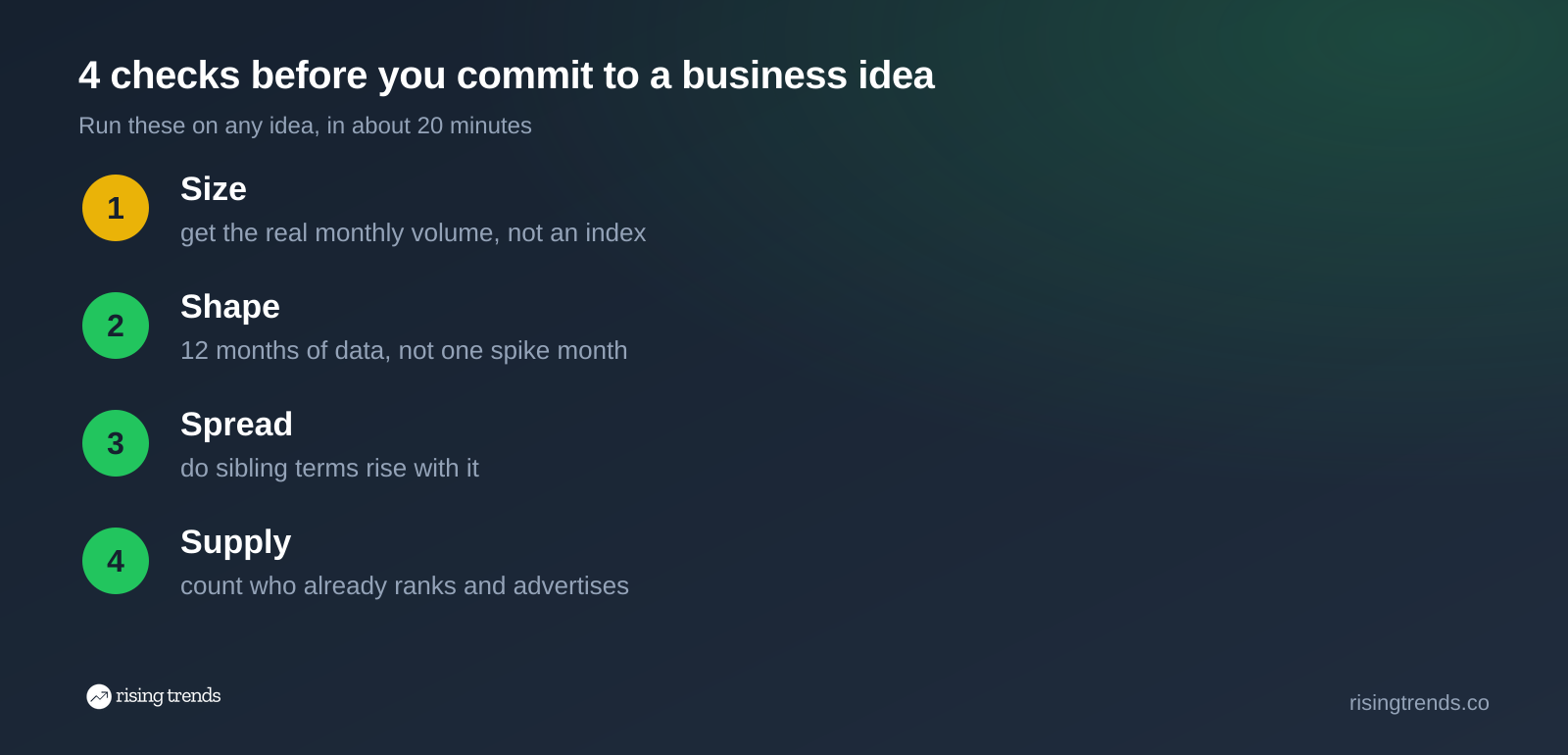
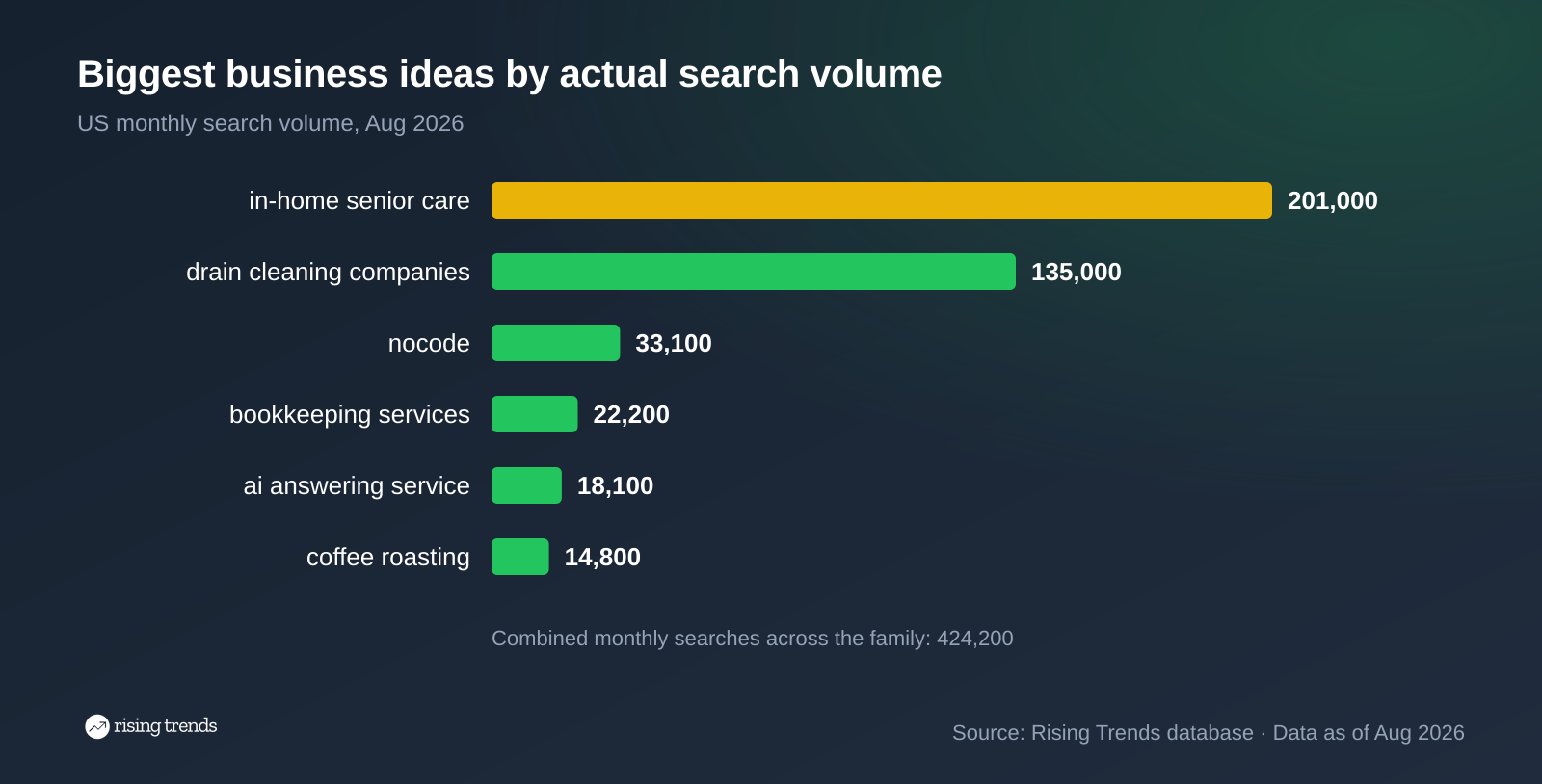
1. Size. Get the absolute monthly search volume, not an index. A term doing 500 searches a month nationally cannot support a full-time business in one city. Below is the whole list of twelve sorted by volume rather than growth, and the order changes completely.
2. Shape. Open twelve months of monthly data and look at the line. A staircase is a trend. A single tall bar is a news event. This check alone removed three ideas from this article.
3. Spread. Check whether sibling terms are rising too. Drain cleaning passed because "trenchless sewer repair" rose alongside it. A term rising entirely on its own is usually a story, not a market. Our guide to spotting trends before they peak goes deeper on this signal.
4. Supply. Search the term yourself and count the paid ads and the local results. High demand with twelve established competitors in your city is a worse bet than moderate demand with two. Search data measures want, never competition, and this is the step people skip.
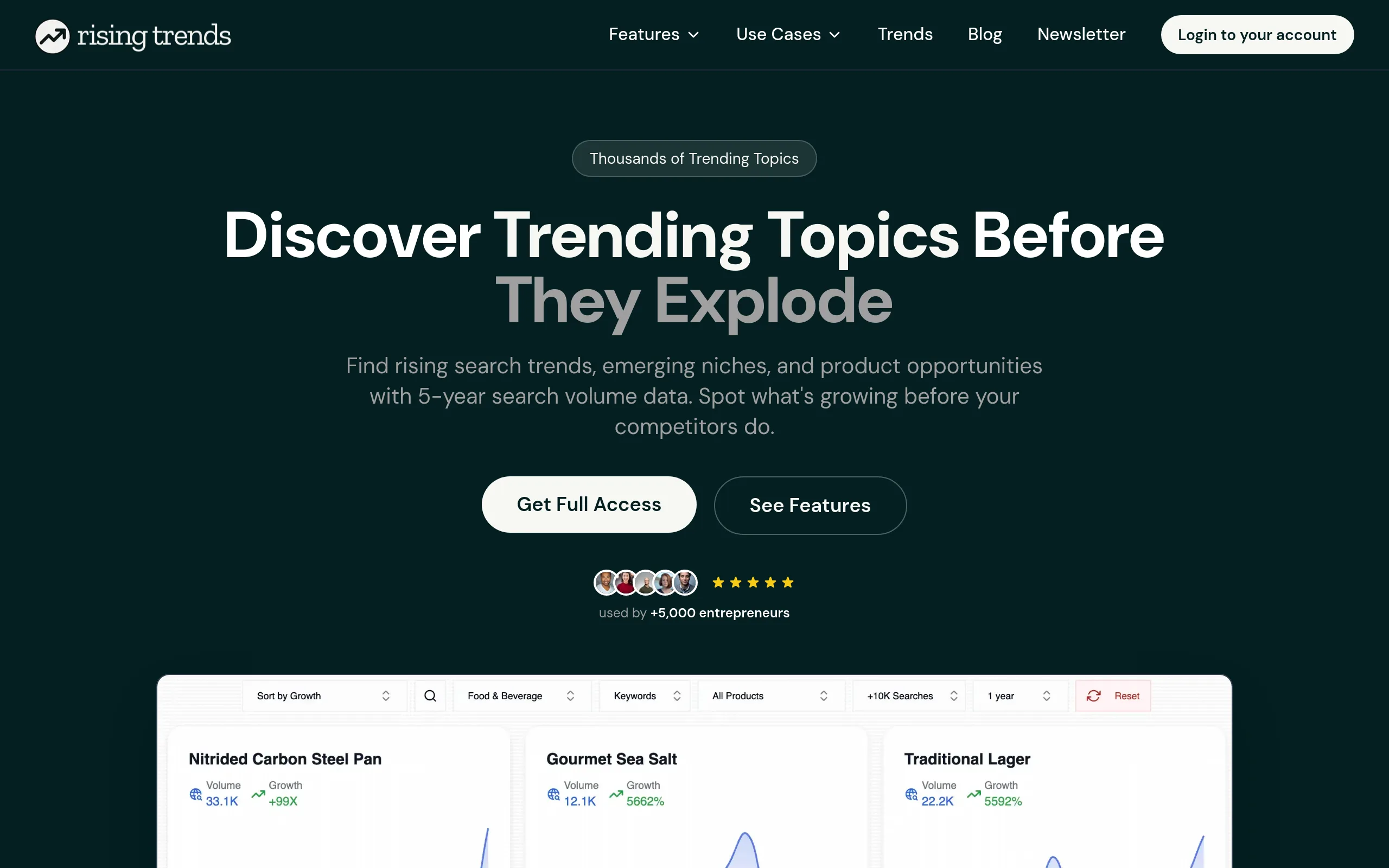
You can run checks 1 to 3 on any term from the trending topics list, which carries the volume and growth on each card.
If you plan to re-run this scan every month rather than once, the Trends API does it in one request:
curl -H "Authorization: Bearer rt_live_..." \
  "https://www.risingtrends.co/api/v1/trends?is_brand=false&min_growth_pct=100&timeframe=1y&min_search_volume=5000&sort=growth&order=desc"
Diff this month's result against last month's and the new rows are your candidate list. Then run checks 2 to 4 on each by hand, because no filter can judge local competition for you. There is a fuller walkthrough of the demand side in our guide on validating market demand.
One number is worth knowing before you start anything: new business formation is slowing. The Census Bureau recorded 531,728 business applications in August 2026, a 7.8% decrease from July, and projects 28,501 of that cohort will become employer businesses within four quarters.
That is not a reason to wait. Fewer applications means fewer new competitors chasing the same rising demand. The demand in the twelve terms above did not fall in August. The number of people starting businesses did.
For the wider picture of what is changing for small operators this year, see our rundown of small business trends to watch in 2026.
By our data, local wins on growth right now. Six of the top ten entries above are physical or location-bound: drain cleaning, senior care, coffee, meat, dog parks, duct cleaning. The online ideas on this list (no-code, AI answering, AI consulting, resale, bookkeeping) are cheaper to start and face far more competition, because anyone anywhere can start them. Local work is harder to begin and much harder to copy.
The SBA lists nine structures: sole proprietorship, partnership, LLC, C corp, S corp, benefit corporation, close corporation, nonprofit and cooperative. For most of the businesses on this list the practical choice is between a sole proprietorship and an LLC, and the deciding factor is liability. Anything where you enter homes, handle food, or care for people points to an LLC. The SBA also warns that converting later can be restricted by your location, can trigger tax consequences and can cause unintended dissolution, so it is worth getting right at the start rather than cheaply.
We can tell you what people search, not how old they are, so treat any precise demographic claim about this with suspicion. What the search data does show is that the fastest-growing ideas of 2026 are not the ones usually attached to young founders. Drain cleaning, senior care and duct cleaning are growing faster than any app or content business in our database.
Six of the twelve ideas above start under $5,000 and three start under $1,000. The SBA's own guidance is to total your one-time costs and at least twelve months of monthly costs, then add roughly 10% for what you did not anticipate. Be sceptical of any article giving you a single startup figure for a whole category, including the ranges in our table, which are estimates rather than survey data.
Nobody can answer that from search data, and any page claiming to is guessing. Search volume measures demand, not margin. What this ranking tells you is where demand is growing fastest, which is the first filter, not the last one. Margin depends on your pricing, your local competition and your costs, which is why check 4 above exists.
Monthly. Every figure in this guide is from August 2026, and the term pages linked throughout update as new volume arrives, so the numbers you see on them may have moved since publication. That is the point of linking them rather than only printing a table.
Want to run these four checks on your own shortlist? Read our guide on how to use Google Trends to find profitable niches, see the live drain cleaning trend page, or browse what is breaking out right now on the Rising Trends dashboard.
Thousands of Emerging Trends
Thousands of Breakout Apps
Mega Trends
Trend Analysis Tool