
To do market research with Claude, connect it to a live data source first, then work through five prompts: scope the category, size it, find the movers, name the shift behind them, and list who is building in the space. Claude on its own is excellent at structuring a research brief and terrible at the numbers inside it, because it answers demand questions from training data that is months old. Give it a connector that returns real monthly search volume and the same five prompts produce a sourced one-page category report in about ten minutes.
Key takeaways:
- Claude cannot see live demand without a connector. Anthropic's own Research mode searches the web and your connected tools, and its support page states plainly that it cannot use tools from local MCP servers in Claude Desktop. A hosted connector is the way in.
- The numbers are the part that breaks. Ask Claude unaided which beverage brands are growing and you get the 2024 answer: prebiotic soda. In our database "prebiotic soda" is down 63% over the year to 33,100 US monthly searches in October 2026 (early estimate).
- Five prompts is the whole report. Scope, size, movers, mega trend, builders. Each one is a single tool call, and the output is a category brief you can paste into a deck.
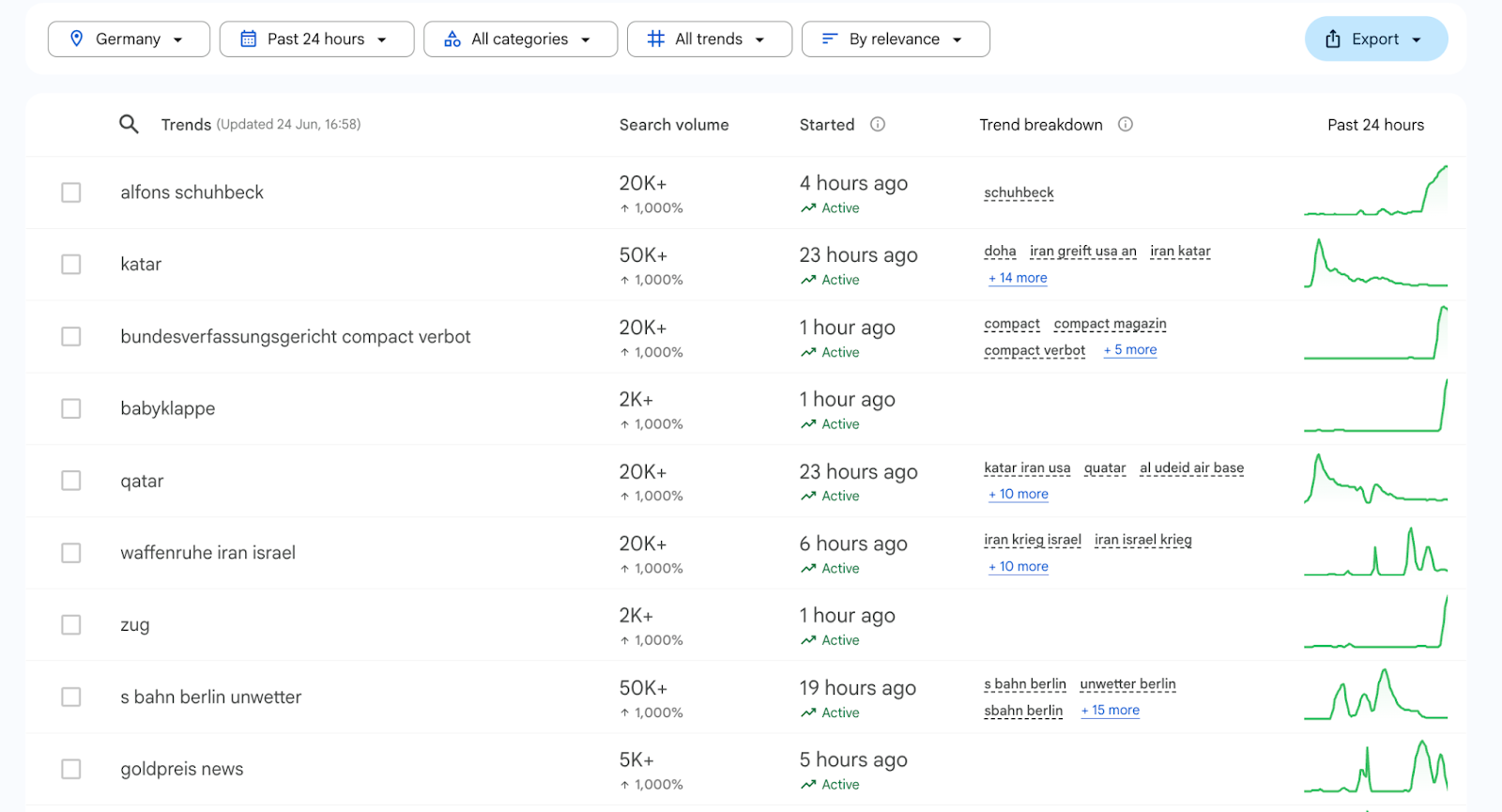
- Real volume beats an index. Google Trends gives a 0 to 100 score. Rising Trends gives 2,240,000 monthly US searches for "7 brew coffee", which is a number you can put in a model.
- Search demand and product launches agree more often than you think. 7 Brew is the biggest beverage search term in our data and shipped the most-reviewed new Food and Drink app of the year, with 122,224 reviews since August 2026.
- Budget ten minutes, not an afternoon. Setup is pasting one URL into Claude's connector settings.
Let's get into it.
What Claude is actually good at here
Claude is very good at the shape of research. It will turn a vague brief into a structured one, hold a hundred pages of your own documents in context, apply a framework like TAM, SAM and SOM without being reminded what the letters mean, and write up the result. Anthropic's own market sizing use case shows that end of it well: describe the market, get back a presentation, a workbook and a cited source document.
What it cannot do is know what people searched for last month. Every guide on page one of this query ends up saying the same thing in its limitations section: verify the statistics independently. That is the real job, and the rest of this page is about removing it.
The fix is not a better prompt. It is a data source Claude can call mid-conversation.
Step 0: give Claude a live data feed
The Model Context Protocol is the standard that lets an assistant call someone else's database during a chat. You add a connector once and Claude can query it the way it queries the web.
We run one for search demand. Rising Trends returns absolute US monthly search volume, growth over three months to five years, mega trends, fast-growing websites and newly released apps, which covers four of the five steps below. Setup is three clicks.
In Claude, open Settings, go to Connectors, add a custom connector and paste https://mcp.risingtrends.co/mcp. Sign in and approve access. In ChatGPT the same URL goes in as a custom MCP server with OAuth. For Claude Code or Cursor, create an API key and send Authorization: Bearer rt_live_.... The connector is included with Pro, which is $97 paid once as of November 2026 on the pricing page.
Everything below was run on 16 November 2026. The database runs to October 2026, and that month is an early estimate.
The five-prompt category report

The order matters. Scope before you size, size before you look at growth, and never look at growth without a volume floor. The worked example below is the beverage category, but the five prompts work on any of them.
1. Scope it: what is in this category
Start by asking what the data actually holds, so you filter on names that exist rather than names you invented.
Example conversation (Rising Trends MCP in Claude, data through October 2026, an early estimate)
You
I want to research the beverage market. What categories can you filter on?
list_categories({})
Claude
Beverages sits inside the Food and Beverage group, alongside Alcohol, Cooking and Recipes, and Food. You can also filter by what kind of thing a trend is: products, companies, brands, topics, places. For a category report I would use Beverages and leave the type open, then narrow once we see what comes back.
This call is free and does not count against the quota, so there is no reason to guess.
2. Size it: where the searches actually are
Sort by volume, not growth. This tells you what the category is before it tells you what is changing in it.
You
Give me the biggest beverage terms by real monthly search volume.
find_trends({ "category": "Beverages", "sort": "search_volume", "limit": 6 })
Claude
Biggest Beverages terms by US monthly searches, October 2026 (early estimate):
- "7 brew coffee": 2,240,000 a month, up 49% over the year and 307% over two years.
- "tropical smoothie cafe": 1,500,000 a month, flat over the year.
- "smoothie king": 1,500,000 a month, flat over the year and over two years.
- "matcha near me": 1,000,000 a month, up 49% over the year, from 246,000 in October 2024.
- "mixue": 550,000 a month, up 2,939% over the year.
- "juice cleanse": 450,000 a month, up 1,561% over the year.
The category is dominated by drive-through and chain searches rather than packaged drinks. Three of the six are store brands people are looking for near them.
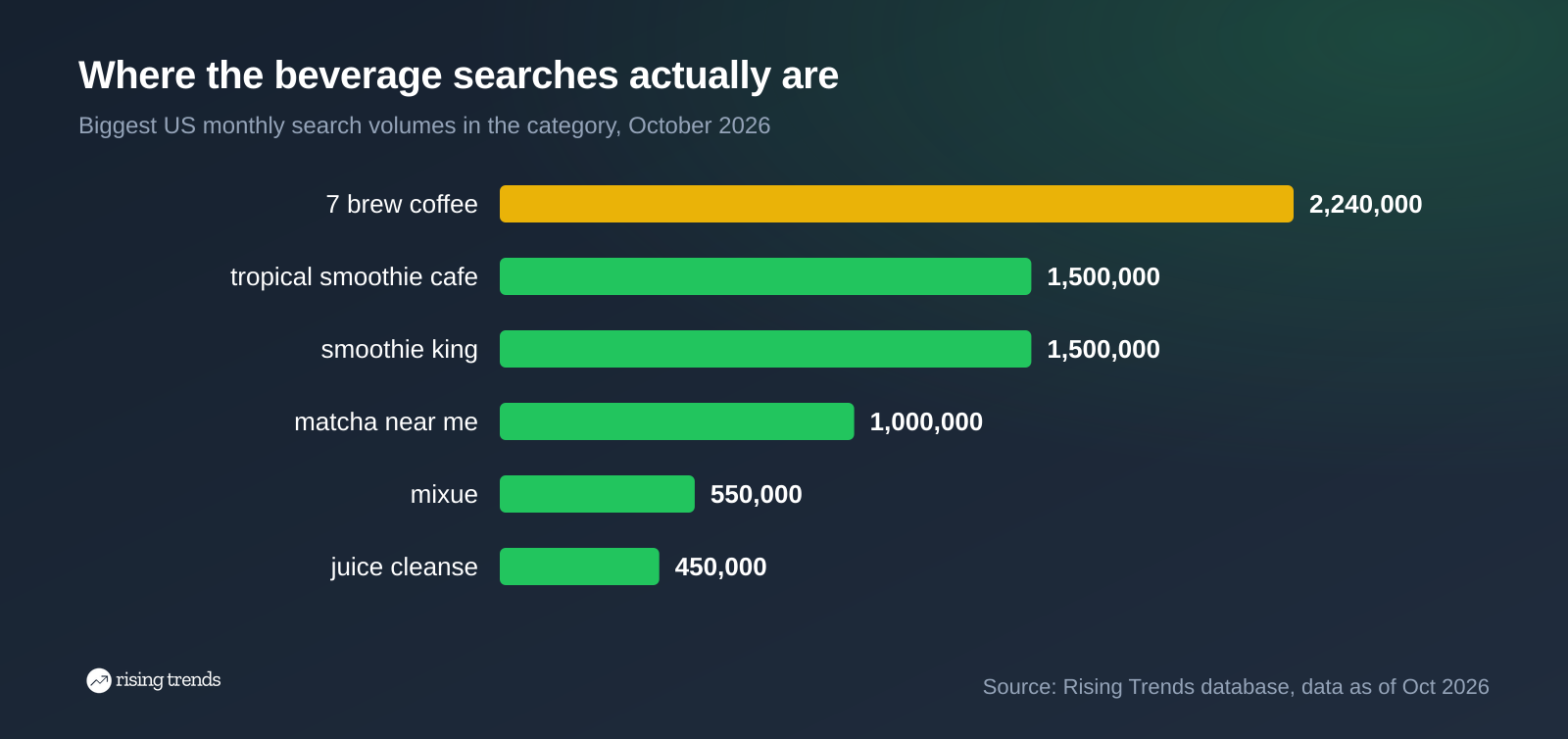
That first answer already contains something no prompt alone would give you: the beverage category's centre of gravity is physical locations, not shelf products. If you were about to size a canned drink market, the volume table just told you where the attention is instead.
3. Find the movers, with a volume floor
Growth on its own is a trap. A term that went from 2 searches to 200 is up 9,900%, and it will sit at the top of any growth ranking you build. Always pass a minimum volume.
You
Now the fastest growing beverage terms over the last year, but only ones with at least 50,000 monthly searches. Flag anything that started from near zero.
find_trends({ "category": "Beverages", "timeframe": "1y", "min_volume": 50000, "sort": "growth", "limit": 5 })
Claude
Fastest growing Beverages terms with 50,000 or more monthly searches, October 2026 (early estimate):
- "mixue": 550,000 a month, up 2,939% over the year. It was 18,100 in October 2025 and 3,600 two years ago, so this is a real ramp rather than a zero base.
- "juice cleanse": 450,000 a month, up 1,561% over the year and 173% over three months. Jumped from 90,500 in April to 550,000 in May 2026.
- "7 brew coffee": 2,240,000 a month, up 49%. The biggest term in the category is also still growing.
- "matcha near me": 1,000,000 a month, up 49%.
- "bloom energy drink": 246,000 a month, up 49% over the year and 507% over two years, from 40,500 in October 2024.
One caveat on the history: 7 brew coffee peaked at 3,350,000 in July 2026 and has come off that, which is the usual summer shape for a cold-drink chain rather than a decline.
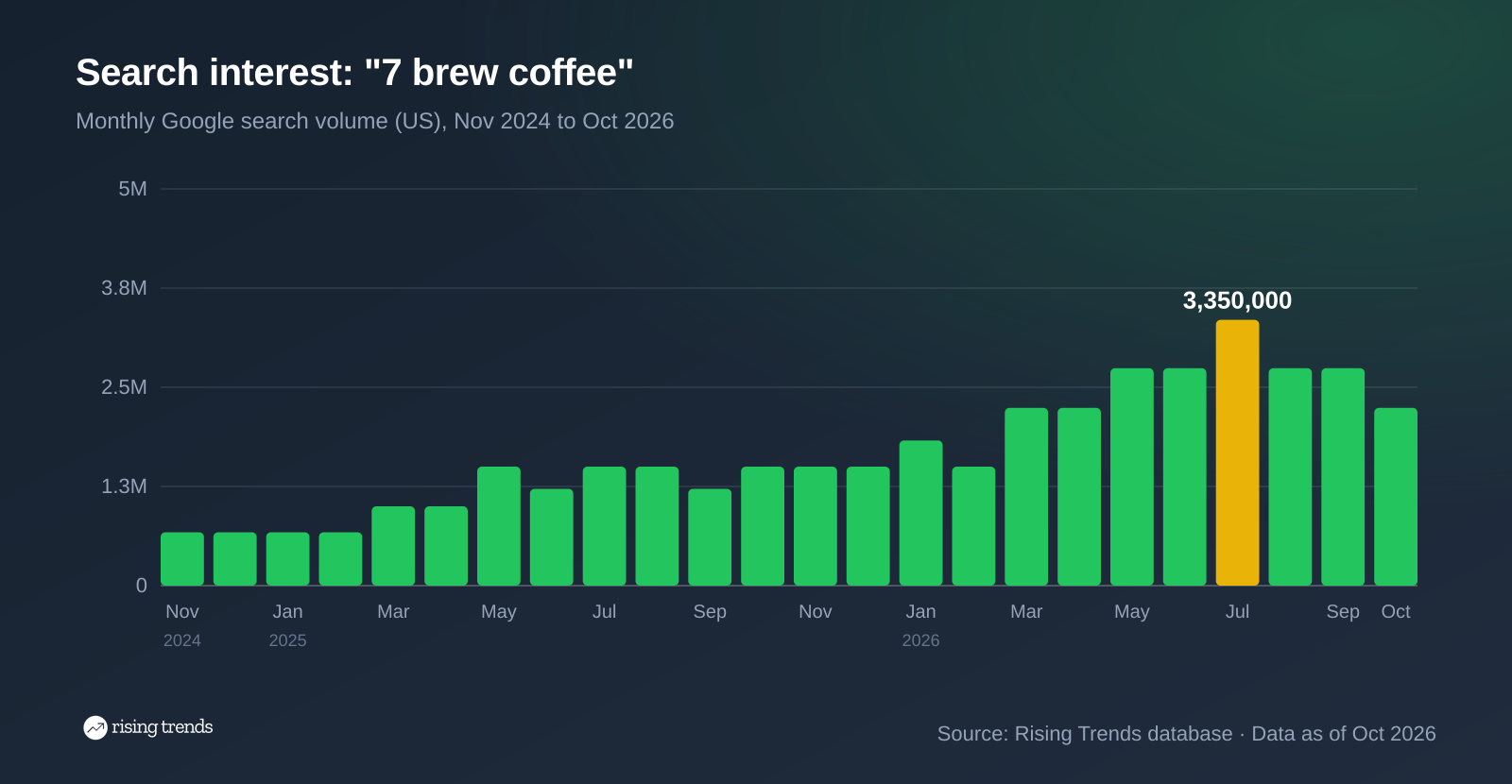
Four times the searches in two years, with a clean summer peak each year. That curve is the difference between a brand that is growing and a brand that is seasonal, and you cannot read it off a 0 to 100 index. If you want the longer version of this check, our guide to trend analysis walks through reading a curve properly.
4. Name the shift behind the movers
Individual terms are noisy. Themes are not. Ask which mega trend the movers belong to, then pull it.
You
Which mega trends cover this category, and how is the gut-health soda one doing?
get_mega_trend({ "slug": "gut-health-sodas" })
Claude
Gut-Health Sodas groups 20 trends. Combined US monthly searches are 370,450 in October 2026, down 29% over the year and 28% over two years. The theme peaked at 728,590 in January 2026 and has fallen every month since July.
Inside it: "olipop" 135,000 a month, down 18% over the year; "poppi" 90,500, down 18%; "poppi soda" 74,000, down 33%; "prebiotic soda" 33,100, down 63% over the year and 70% in three months.
The two neighbouring themes tell a similar story. Electrolyte Drink Mixes is 738,030 combined, down 15% over the year. Healthy Energy Drinks is 710,680, down 14% over the year but still up 147% over two years.
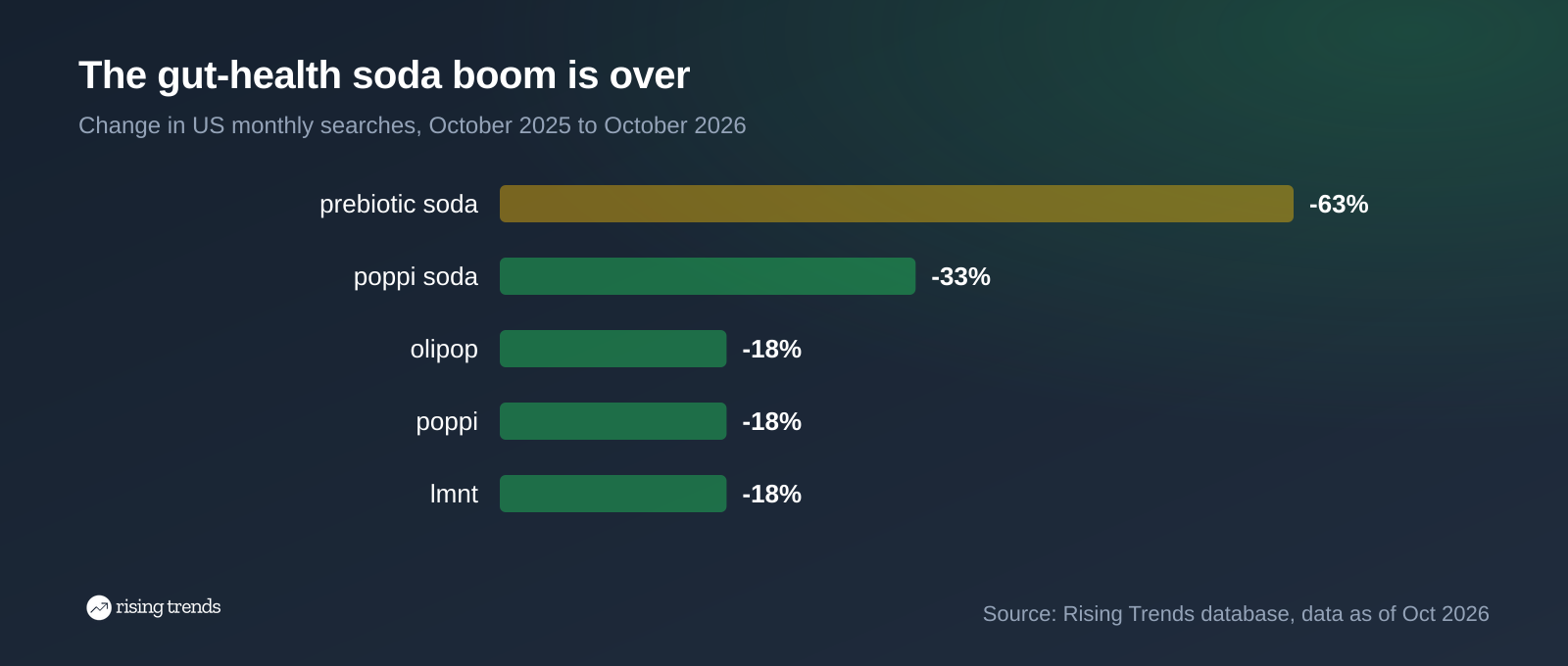
This is the moment the live feed pays for itself. Ask Claude about functional drinks without a connector and it will tell you prebiotic soda is the story of the category, because that is what the internet looked like when the model was trained. The data says the boom ended around January 2026. We wrote up the longer version of that shift in our piece on functional soda, and the whole category view sits on the beverage trends page.
5. See who is building in the space
Two calls, one for websites and one for apps. This is the part that turns a demand report into a competitive one.
You
Which beverage websites are growing fastest, and what new apps have launched in the space?
find_websites({ "category": "Beverages", "sort": "growth", "timeframe": "1y", "limit": 5 })
find_apps({ "category": "Food & Drink", "released_within": "last_year", "sort": "reviews", "limit": 4 })
Claude
Fastest growing beverage sites by traffic growth over the year:
- brewatlas.co, 30,576 monthly visits, a content site on a domain registered in November 2025.
- thecuriousdrinker.com, 9,528 monthly visits, e-commerce.
- flavorcatalyst.com, 6,511 monthly visits, services, domain registered December 2025.
- milkywaymatcha.com, 2,731 monthly visits, e-commerce.
- keelfarms.com, 310,164 monthly visits, up 1,027% over the year, services.
New Food and Drink apps released in the last year, by review count:
- 7 Brew Coffee, iOS, released 11 August 2026: 122,224 reviews, 4.96 rating, free.
- The Cheesecake Factory, iOS, released 18 March 2026: 28,253 reviews, 4.93.
- Localize - Farmers Market, iOS, released 30 December 2025: 20,517 reviews, 4.82.
- mise - meal planner, Android, released 3 August 2026: 5,195 reviews, 4.61.
Worth noting: 7 Brew is both the largest search term in the category and the most-reviewed new app in the vertical. Demand and product launch agree.
Three of those five domains were registered inside the last two years, which is the signal a traffic ranking gives you that a brand list never will. The full version of that list is the trending websites database, and the app side is trending apps.
The whole thing as one prompt
If you do not want to run five turns, paste this and let Claude make the calls in order.
Build me a one-page market research report on the [CATEGORY] category using Rising Trends. In this order: (1) confirm the category name with list_categories; (2) the six biggest terms by monthly search volume; (3) the five fastest risers over one year with at least 50,000 monthly searches, and say which started from near zero; (4) the mega trends covering this category, with combined volume and one-year growth for each; (5) the five fastest growing websites and the four most-reviewed apps released in the last year. State the data month on every number. Where a term's growth comes from a tiny base, say so. End with three things that changed in this category in the last six months.
Two notes on the output. Ask for the data month on every number, or the report will read as though it is current forever. And ask it to flag small bases, because that one instruction removes most of the nonsense from any growth ranking.
What the live data changed
Here is the same category answered both ways, which is the clearest argument for the connector.
| Question | Claude on its own | Claude with the demand feed |
|---|---|---|
| What is growing in beverages? | Prebiotic and functional soda, electrolytes | Prebiotic soda down 63% in a year, electrolyte theme down 15% |
| How big is the biggest term? | No figure, or an estimate with no date | "7 brew coffee", 2,240,000 a month, October 2026 |
| Who is entering the market? | Named brands from training data | Domains registered in the last 12 months, with traffic |
| Is this seasonal? | Usually a guess | Five years of monthly history per term |
None of this makes Claude a worse writer. It makes the paragraph it writes true on the day you publish it.
Make it a monthly job
A category report is more useful repeated than perfected. If you are going to run the same brief every month, do it in code rather than in chat. The Trends API returns the same rows as JSON, and it is included in Pro:
curl -H "Authorization: Bearer rt_live_..." \
  "https://www.risingtrends.co/api/v1/trends?category=Beverages&min_search_volume=50000&timeframe=1y&sort=growth&order=desc"
Drop the response into Claude with "compare this to last month's file and tell me what moved" and you have a monitoring loop rather than a one-off. Our guide on how to identify market trends covers what to watch for between runs, and our guide to trend forecasting shows how to read the direction between runs.
Where Claude still wins without any data source
Being honest about this matters, because connecting a database does not solve every research problem.
- Synthesis. Give Claude forty customer interview transcripts and ask for the recurring objections. No demand feed helps with that.
- Frameworks. TAM, SAM and SOM, Porter's five forces, a positioning map. Claude applies these correctly and shows the arithmetic.
- Your own documents. Pricing sheets, win-loss notes, a competitor's annual report. This is Claude's strongest ground, and it is what Anthropic's Cowork workflow is built around.
- Drafting. Turning the five answers above into a deck or memo in the voice of your company.
And the honest gaps on our side: we have no qualitative data, no panels, no financial filings and no social listening. For reviews, filings and live SERP data you want other connectors, which we compared in our roundup of the best MCP servers for market research. A good research setup usually has two or three of these connected at once.
Common questions
Can Claude do market research?
Yes, for structuring, synthesis and writing. For the figures, it needs a source. On its own it answers demand questions from training data, which is why every guide on this topic tells you to verify the statistics separately. A connector removes that step by putting a real, dated number in the answer.
Can Claude access real-time data?
Only through web search or a connector. Anthropic's support page on Research says Research is available on paid plans and searches the web plus your connected tools, and that it cannot use tools from local MCP servers configured in Claude Desktop. A hosted connector works in both ordinary chats and Research.
Can Claude calculate TAM, SAM and SOM?
It can run the arithmetic and lay out the methodology properly. The inputs are the problem. Feed it real demand figures and your own revenue data and the model holds up. Let it source its own market size and you get a number that looks authoritative and is not.
Is Claude better than ChatGPT for market research?
They are close enough that the deciding factor is what you connect to them. Claude holds long documents well and writes cleaner analysis. ChatGPT's deep research is strong at wide web sweeps. Both speak MCP, so the same demand feed works in either, and our guide to the best trends MCPs and skills covers the options for both.
Do I need a Claude market research skill?
A skill is a packaged set of instructions, not a data source. It can make Claude's output more consistent, which is genuinely useful for report formatting. It cannot tell Claude what people searched for last month. If you install one, still connect a data source underneath it.
Is Claude free for market research?
The free tier handles brainstorming and document work. Research mode needs a paid plan. Most data connectors need their own subscription, so budget for both.
How do I stop Claude inventing statistics?
Three habits. Ask for the source and the date of every figure in the same sentence as the figure. Make it call a tool rather than recall a fact, by naming the connector in your prompt. And give it a volume floor on anything ranked by growth, which is where most fake-looking numbers come from. The companion piece on using Google Trends for market research covers the same checks on the free tooling.
Want the numbers without the setup? See how to identify market trends, or browse what is breaking out right now in our trending topics list.
Never miss a trend again
- One trend broken down with the numbers
- Who's making money, and what to build
- A website on the rise
- A breakout app
Join 5,000+ founders