
The best ecommerce MCP server depends on which half of the job you are doing. For product research, the question of what to sell next, connect Rising Trends MCP: it returns absolute US monthly search volume plus the Amazon revenue, price and sales figures behind a category. For everything after that decision, connect Shopify's Catalog MCP to see what is already listed, Bright Data or Oxylabs for marketplace and price data, DataForSEO for Amazon and Google Shopping keyword data, and Firecrawl for a competitor's page as it reads today. Two or three is a working setup. Eight is a mess.
Key takeaways:
- Research and operations are two different stacks. Deciding what to sell needs demand data. Running the store needs catalog and order access. Almost every roundup on this topic only covers the second one.
- Only one server here answers "is this worth selling". Rising Trends MCP returns a real number per term, such as 110,000 US searches a month for "magnesium bisglycinate" in October 2026, up 306% over the year, against $1,068,305 of average monthly Amazon revenue in that category.
- Shopify's Storefront MCP catalog and cart tools were removed. Shopify now points developers at the Universal Commerce Protocol instead, so a lot of the Shopify MCP advice still ranking was written against an endpoint that no longer serves those tools.
- Five of the eight have a real free tier. Bright Data gives 5,000 requests a month, Firecrawl 1,000 credits, Apify $5 of usage, Oxylabs a one week trial, and Shopify's Catalog MCP costs nothing to query.
- Sellers are already reaching for this. Searches for "ai dropshipping" went from 2,900 a month in September 2025 to 40,500 in October 2026 (early estimate), up 514% over the year.
Let's get into it.
What an ecommerce MCP server actually does
An MCP server is a standard connector that lets Claude, ChatGPT or Cursor call someone else's database directly, mid-conversation. You add a URL once, and the assistant stops guessing and starts making real requests.
For ecommerce that matters in two places. Before you sell anything, you want to know whether demand is real, growing and big enough to bother with. After you sell something, you want the assistant reading your catalog, your competitors' listings and your keyword data without you exporting a CSV first.
Those two jobs need different servers. Most of what is written about this topic covers only the second, because the loudest story of 2026 has been merchants making their stores legible to shopping agents. That is a real shift, but it is not product research.
The demand curve for the research side is the steeper one.
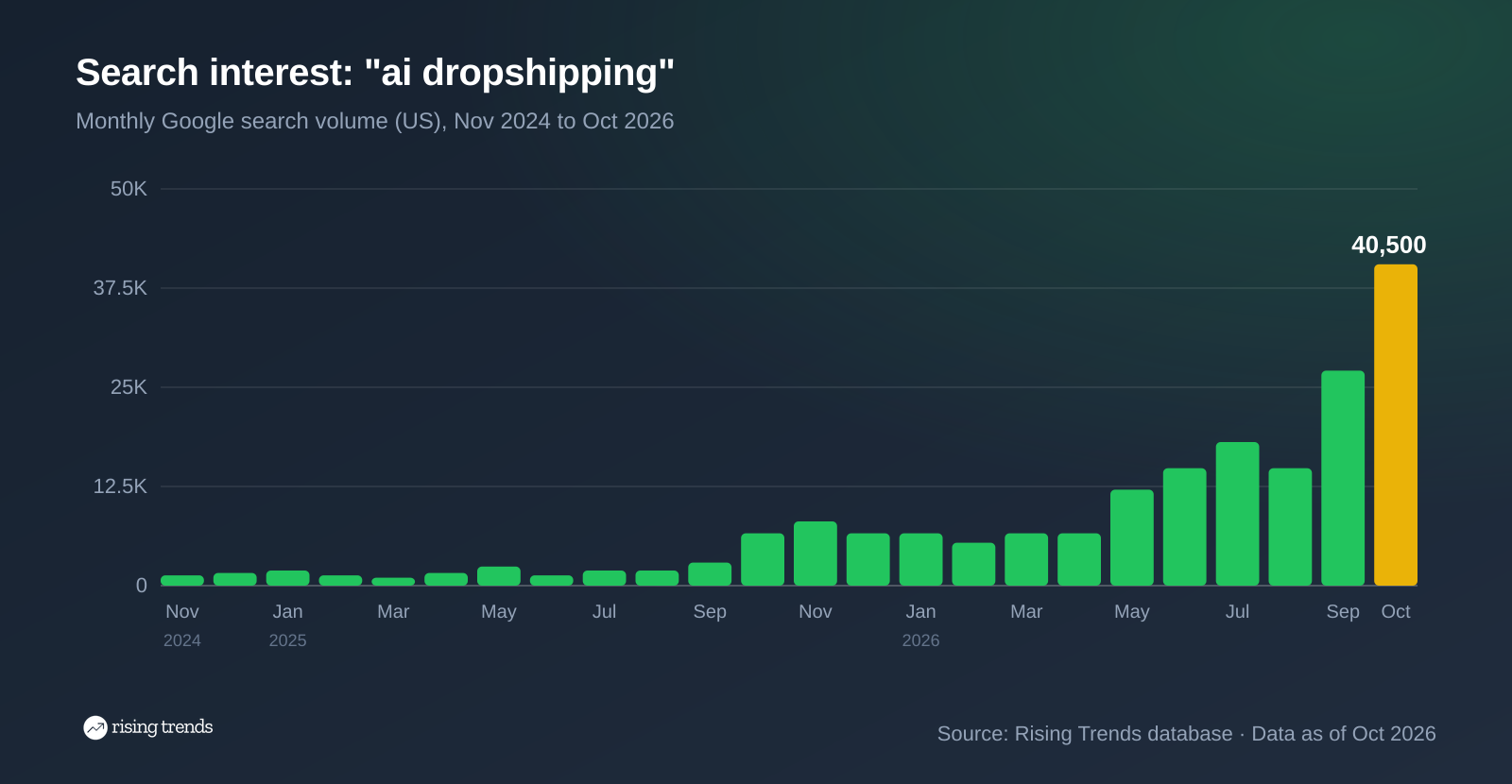
In the Rising Trends database, "ai dropshipping" ran at 2,900 monthly US searches in September 2025 and hit 40,500 in October 2026 (early estimate), up 514% over the year. "ai ecommerce" sits at 3,600 a month, up 89%. "shopify agent" is small at 880 a month but growing 83% a year. The people typing those queries are not asking how to expose a catalog. They are asking what to sell.
How we picked and checked these
Every server below was checked on 18 November 2026 against its own repository, package registry entry or pricing page. Nothing here is copied from another roundup, and dozens of official-registry listings from unknown publishers that could not be verified were dropped.
- Real and installable. A published package or a hosted endpoint you can connect today.
- Maintained. Last release inside twelve months.
- Useful to a seller. Not a generic developer utility that happens to fetch a URL.
- Priced in public. Where the price is "contact sales", we say so.
Version numbers and publish dates, read from npm and PyPI on the day: Shopify Dev MCP 1.19.0 (17 Nov 2026), Apify 0.21.12 (17 Nov 2026), Firecrawl 3.40.0 (12 Nov 2026), Bright Data 4.8.0 (10 Nov 2026), Oxylabs 0.10.2 (29 Oct 2026), DataForSEO 3.1.3 (2 Oct 2026).
Two more were cut for age: the PayPal MCP package was last published in October 2025, commercetools MCP Essentials in November 2025. Both fall outside the twelve month rule, and neither answers a product research question anyway.
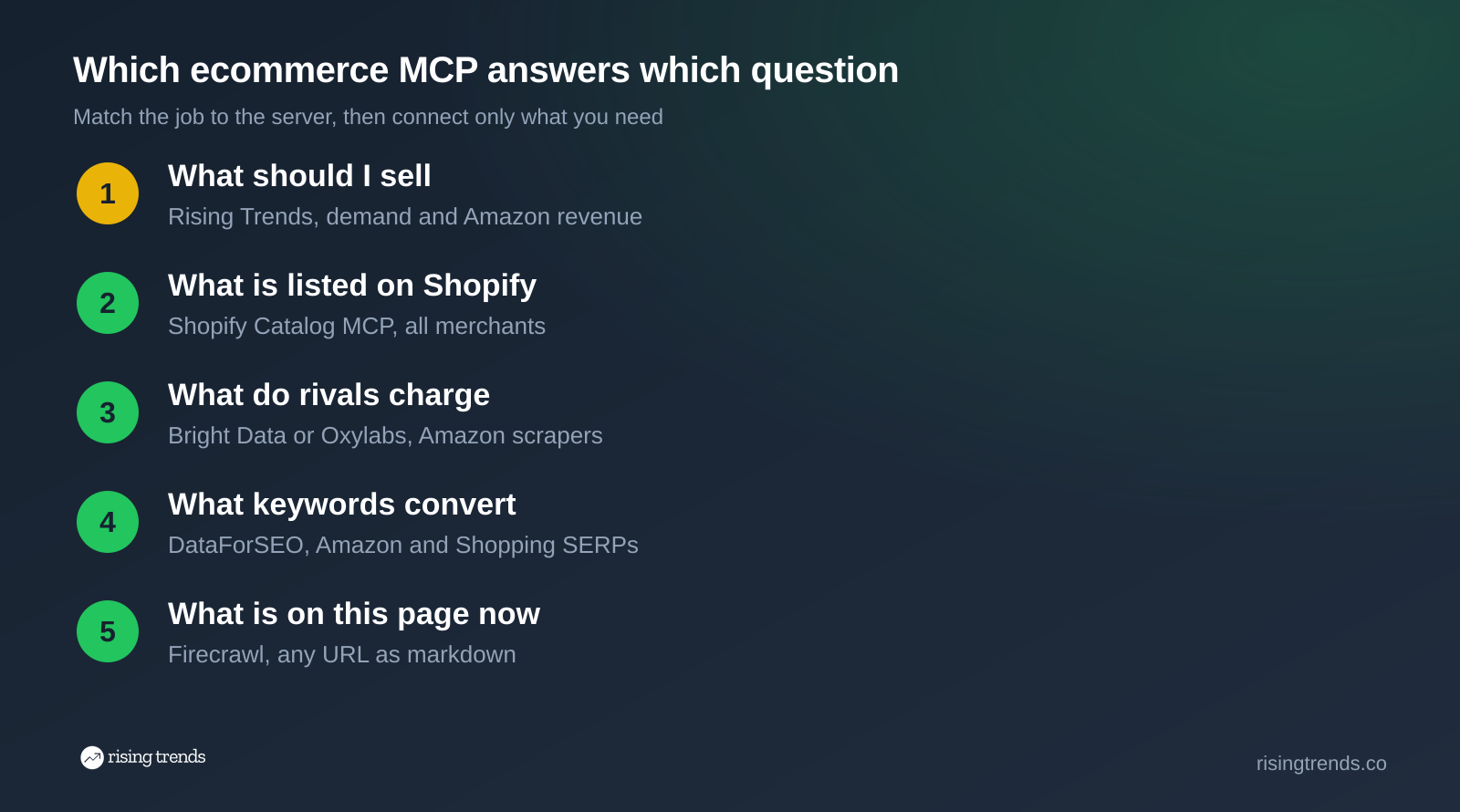
That map is the shortlist. Work down it, pick the two rows that match this month's job, and ignore the rest until you need them.
The 8 best ecommerce MCP servers, compared
| Server | Answers | Data source | Free tier | Paid from |
|---|---|---|---|---|
| Rising Trends | What should I sell, and is it growing | US search volume, Amazon categories | No | $97 one time |
| Shopify Catalog (UCP) | What is already listed, across all of Shopify | Shopify Global Catalog | Free | Free |
| Bright Data | What rivals list, charge and get reviewed for | 1,200+ site scrapers | 5,000 requests monthly | Usage based |
| Oxylabs | Amazon search and product pages, parsed | Amazon Scraper API | 1 week trial | $15 a month |
| DataForSEO | Which product keywords people actually use | Amazon and Google Shopping SERPs | No | $50 minimum top-up |
| Apify | Anything needing a custom marketplace scraper | Marketplace of hosted actors | $5 of usage monthly | $19 a month |
| Firecrawl | What is on a competitor's page right now | Any URL, as clean markdown | 1,000 credits monthly | $19 a month |
| Shopify Dev | How do I build this on Shopify | Shopify developer docs and schemas | Free | Free |
1. Rising Trends MCP
Answers: what should I sell, is demand growing, and how much is the category already making.
This is the research entry, and the only one here that returns a number rather than a page. Every tracked term carries absolute US monthly search volume with five years of history, growth over three months to five years, and the date it entered the database. Product categories carry Amazon figures alongside: average price, monthly sales, revenue and rating.
That pairing is the useful part. Search growth alone says people are curious. Revenue alone says a category is busy. Together they say whether curiosity is turning into orders, which is the real question behind "what should I sell".
Connect it at the Rising Trends MCP page, which takes one URL in Claude, ChatGPT or Cursor. For the task rather than the server, our walkthrough of how to find trending products with AI covers the same job in five steps.
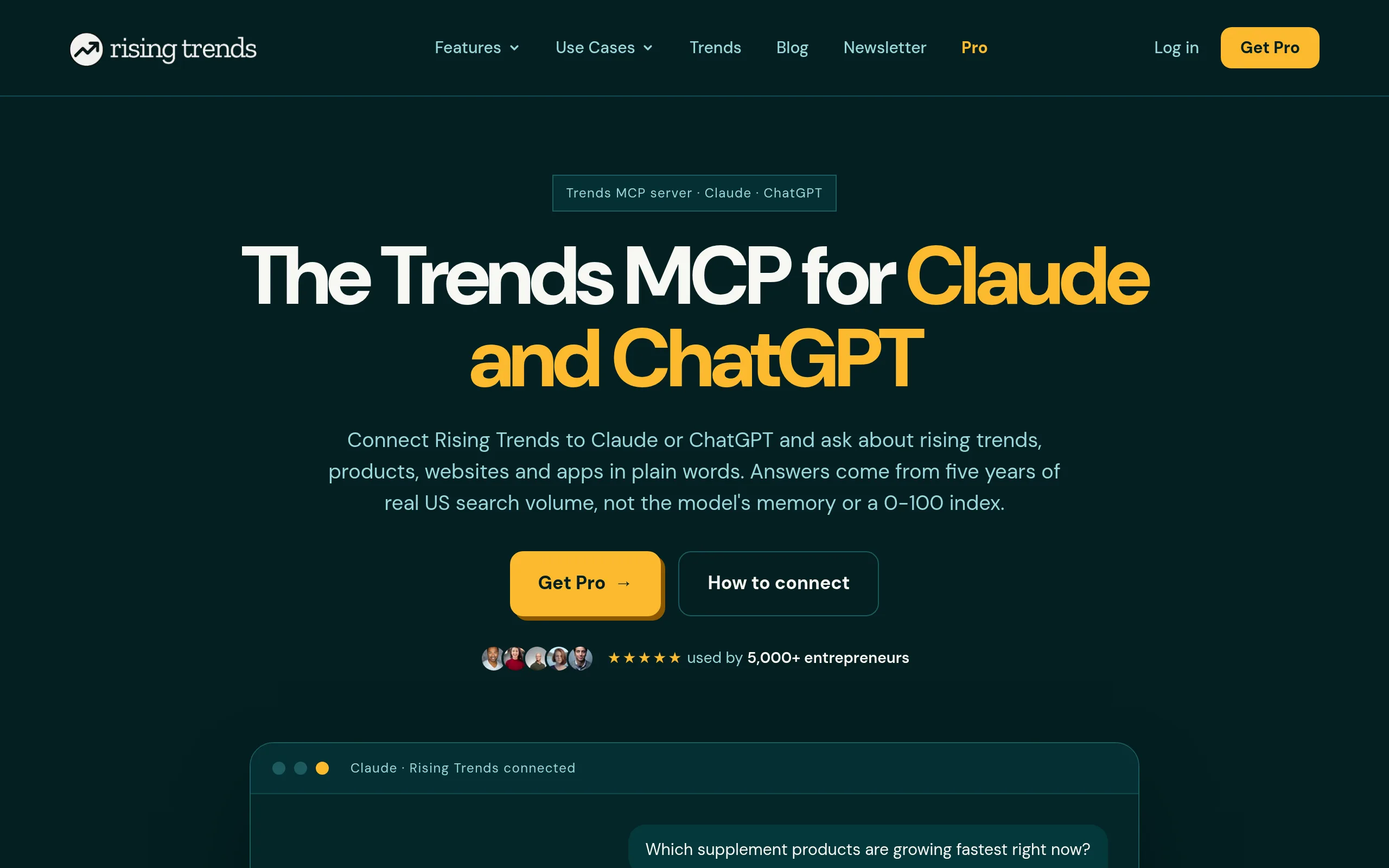
The tools are find_trends, search_trends, get_trend, get_trends, list_mega_trends, get_mega_trend, find_products for Amazon categories with price and monthly sales, find_websites for traffic growth, find_apps, and list_categories. Searching is free and does not count against the quota.
Price: Pro, $97 as a one-time payment, which covers the connector, the REST API and a 100-trend watchlist with monthly alerts. There is no free tier, and that is the honest trade here: every other research server on this list lets you try before you pay.
What it does not do: no live competitor listings, no reviews, no price tracking, no order or catalog access, and no live Google Trends index or regional breakdown. For those, use Bright Data, Oxylabs, Shopify's Catalog MCP or DataForSEO.
Example conversation (Rising Trends MCP in Claude, data through October 2026, October is an early estimate)
You
I have about $5,000 to put into first inventory. Which supplement categories are growing and actually selling on Amazon?
find_products({ "category": "Vitamins & Supplements", "timeframe": "1y", "sort": "growth", "limit": 5 })
Claude
Five supplement categories with rising search demand and Amazon sales behind them, October 2026 (early estimate):
- "magnesium supplement": 673,000 US searches a month, up 235% over the year. $1,258,855 average revenue a month, 50,500 units, $22.95 average price, 4.67 rating.
- "probiotics": 673,000 searches a month, up 174%. $1,024,595 revenue, 39,000 units, $26.58 average price, 4.60 rating.
- "creatine monohydrate": 450,000 searches a month, up 124%. $1,122,465 revenue, 40,000 units, $28.03 average price, 4.65 rating.
- "magnesium bisglycinate": 110,000 searches a month, up 306% over the year and 82% over three months. $1,068,305 revenue, 39,000 units, $29.71 average price, 4.65 rating.
- "pure creatine": 4,400 searches a month, up 83%. $1,349,884 revenue, 42,632 units, $34.90 average price, 4.66 rating.
At a $29 average price and a 4.65 rating, "magnesium bisglycinate" is the one with the steepest recent curve. The others are larger but slower.
You
Show me the monthly history for magnesium bisglycinate. I want to know if this is a spike or a real climb.
get_trend({ "name_or_slug": "magnesium bisglycinate" })
Claude
"magnesium bisglycinate" entered the database on 4 December 2025, running at about 27,100 US searches a month. The monthly series since: 27,100 in September and October 2025, 22,200 in November, 27,100 in December, 40,500 in January 2026, 33,100 in February, 40,500 in March, 33,100 in April, 40,500 in May, 49,500 in June, 60,500 in July, 74,000 in August, and 110,000 in September and October 2026 (October is an early estimate).
That is a climb, not a spike. Eleven months of steady steps with no single month doing the work, up 306% over the year and 395% over two years. Categories: Nutrition, Vitamins and Supplements.
Every figure in both answers came back from those two calls. That is what connecting a demand server changes: the assistant quotes the database instead of its training data.
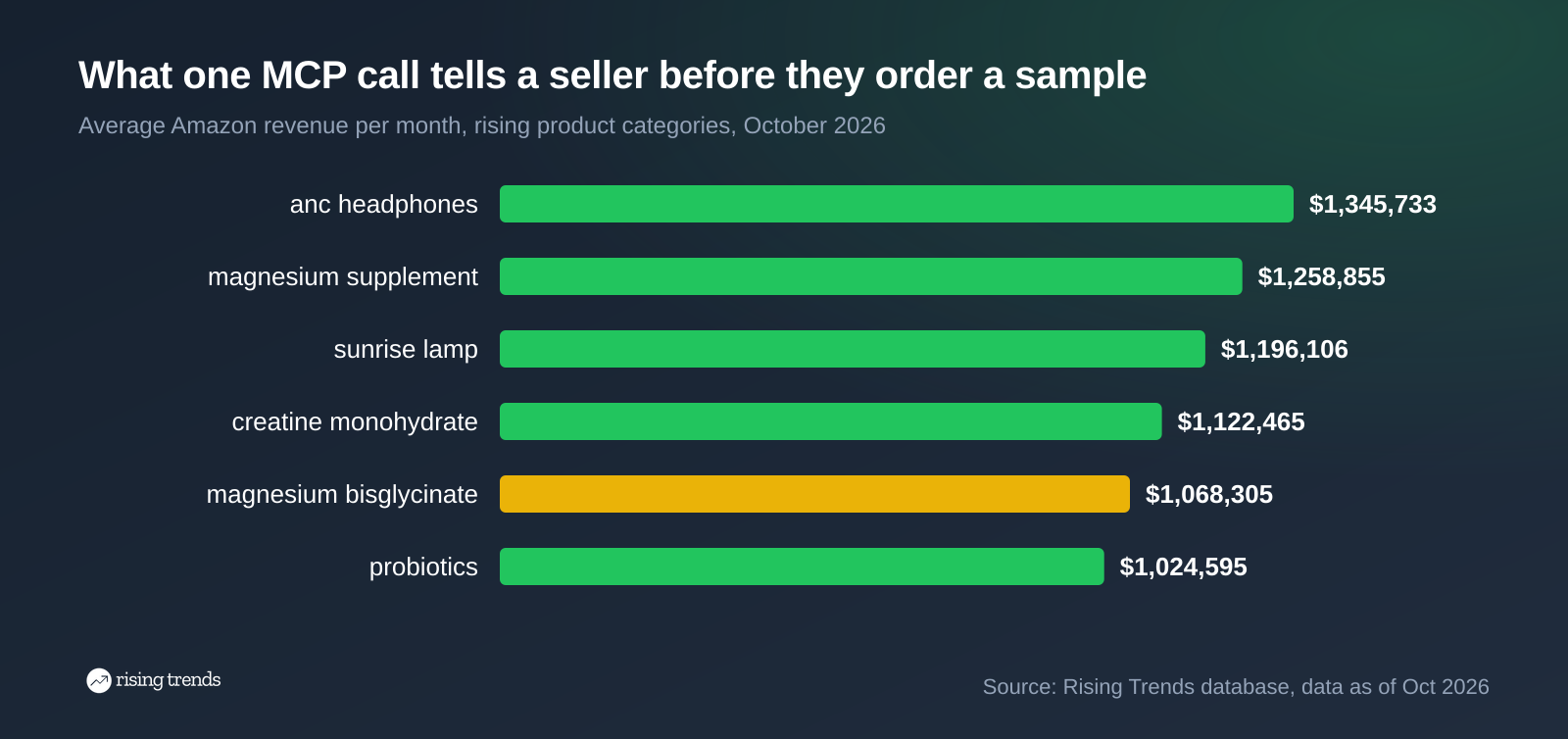
Note what the chart does not say. A million dollars of average monthly revenue signals demand, not opportunity: it also means established sellers and real ad costs. Read it next to the search growth, never instead of it. Our guide to trend analysis covers reading a curve without talking yourself into it.
2. Shopify Catalog MCP (UCP)
Answers: what is already listed and priced across the Shopify ecosystem.
This is the entry most roundups get wrong, because it changed. Shopify removed the catalog and cart tools from Storefront MCP at https://{shop}/api/mcp and now points developers at the Universal Commerce Protocol. The migration page maps each old tool to its replacement: search_catalog and get_product_details became search_catalog, lookup_catalog and get_product on /api/ucp/mcp.
For research the interesting piece is the Global Catalog at https://catalog.shopify.com/api/ucp/mcp, which searches products across every Shopify merchant from one endpoint. Ask what a category looks like on Shopify right now and you get who sells it, at what price, in what variants. That is landscape work that used to mean an afternoon of tab-opening.
Setup: npm install -g @shopify/ucp-cli, then install the Shopify AI Toolkit plugin for your client. Requires Node 22.19.0 or higher, and every request to the UCP endpoint must carry an agent profile.
Price: free.
Weakness: it is Shopify only, so it tells you nothing about Amazon, Etsy, TikTok Shop or anywhere else. The profile and trust tier requirement also makes it the most setup-heavy entry on this list.
3. Bright Data MCP
Answers: what competitors list, charge and get reviewed for, at scale.
Thirty tools, six of which find and run any of 1,200+ pre-built scrapers, Amazon among them, returning clean JSON rather than HTML you have to parse. Requests route through unblocking infrastructure, so marketplace pages that reject ordinary scripts come back normally. The tool list is in the Bright Data MCP repo.
For a seller this is the review-and-price entry. One prompt gets the top twenty listings for a keyword with prices, ratings and review counts, which is the gap between knowing a category is growing and knowing whether you can win in it.
Setup: the hosted endpoint at https://mcp.brightdata.com/mcp with your API token, or npx @brightdata/mcp locally. MIT licensed, version 4.8.0 published 10 November 2026.
Price: 5,000 requests a month free, no card required, renewing monthly. Beyond that it is usage based, and Bright Data does not publish a flat rate.
Weakness: scraped review text is evidence of what buyers say, never a fact about the world. Do not let an assistant turn two hundred reviews into a market share estimate.
4. Oxylabs MCP
Answers: Amazon search results and product pages, parsed into structured data.
The most Amazon-specific entry here. Alongside general scraping tools it ships amazon_search_scraper for search result pages and amazon_product_scraper for product pages, both with optional parsing into structured JSON. The full list is in the Oxylabs MCP repo. If your research is entirely Amazon, this is a narrower and cheaper start than Bright Data.
Setup: the hosted server, or locally with uvx oxylabs-mcp and an API token. MIT licensed, version 0.10.2 published 29 October 2026.
Price: one week free trial. Amazon Scraper API plans start at $15 a month, and the published rate card runs from $1.22 per 1,000 results down to $0.25 per 1,000 at volume, charging only for successfully delivered results.
Weakness: it scrapes what is on the page today. There is no history, so it cannot tell you whether a category is rising or fading.
5. DataForSEO MCP
Answers: which product keywords people actually type, on Amazon and Google Shopping.
The keyword entry. DataForSEO's Merchant API covers Amazon and Google Shopping product and merchant data, and DataForSEO Labs adds keyword, competitor and ecommerce intelligence. For listing optimisation, which words go in a title and which in bullets, this is the one with data behind it.
Pair it with a demand server rather than choosing. DataForSEO tells you how people phrase it, Rising Trends tells you whether the thing itself is growing.
Setup: npx dataforseo-mcp-server@latest, OAuth on the HTTP transport or login and password on stdio. Apache-2.0, version 3.1.3 published 2 October 2026.
Price: pay as you go with a $50 minimum top-up and balances that do not expire. On DataForSEO's merchant pricing page, Amazon and Google Shopping requests run at $0.001 and $0.0015 per product or SERP, and DataForSEO Labs is $0.012 a task plus $0.00012 an item.
Weakness: no free tier, and the per-endpoint pricing makes your first month hard to forecast. If keyword volumes are all you need, our rundown of the Google Trends API and its alternatives covers cheaper routes.
6. Apify MCP
Answers: anything that needs a scraper nobody has built into an MCP server yet.
One connection to https://mcp.apify.com gives an agent thousands of ready-made Actors from the Apify Store, including marketplace and social scrapers. The agent searches the store, checks an Actor's input schema and pricing, runs it and reads the results, so you are not installing a server per site.
For ecommerce that covers the long tail: TikTok Shop, AliExpress, Etsy, regional marketplaces, anywhere a scraper exists but a dedicated MCP server does not.
Setup: OAuth to the hosted server, or npx @apify/actors-mcp-server over stdio. MIT licensed, version 0.21.12 published 17 November 2026.
Price: the free plan carries $5 a month of prepaid usage. Starter is $19 a month plus pay as you go, per Apify's pricing page.
Weakness: Actor quality varies, because anyone can publish one. Check the run count and the last update before you trust an output.
7. Firecrawl MCP
Answers: what is on a specific page right now.
The simplest entry, and the one you will reach for most often. Point it at a URL and it returns clean markdown: a competitor's product page, a supplier's catalog, a new collection. No parsing, no selectors.
Setup: the hosted endpoint, or npx firecrawl-mcp with an API key. MIT licensed, version 3.40.0 published 12 November 2026.
Price: 1,000 credits a month free, refreshed monthly, no card required, per Firecrawl's pricing page. Paid plans start at $19 a month, and one credit is one page on a basic scrape.
Weakness: one page at a time. It is a reader, not a dataset, and it has no idea whether the page it just read matters.
8. Shopify Dev MCP
Answers: how do I actually build this on Shopify.
Not a research tool, included because the question comes up as soon as the research ends. It gives a coding assistant Shopify's developer docs and API schemas, so generated Liquid, GraphQL and app code matches the current API, not whatever the model remembers.
Setup: npx -y @shopify/dev-mcp@latest. ISC licensed, version 1.19.0 published 17 November 2026, which makes it the most actively maintained package on this list.
Price: free.
Weakness: it knows the docs, not your store. It cannot see your products, orders or customers.
Can I do this without an MCP server?
Yes, and for anything repetitive you probably should. An MCP server is built for conversation: you ask, it answers, the context goes when you close the tab. A weekly check that runs the same six queries every Monday does not need a conversation. It needs a script.
Rising Trends ships both, and the Pro plan includes the Trends API as well as the connector. The same product data from the example above comes back from one request:
curl -H "Authorization: Bearer rt_live_..." \
  "https://www.risingtrends.co/api/v1/products?min_rating=4.5&min_monthly_sales=10000&max_price=50"
Filter by min_price, max_price, min_rating and min_monthly_sales, drop the result into a sheet, and your Monday scan is a cron job instead of a habit. Use the connector when you are thinking, the API when you are repeating. That applies to every server above: most are a thin MCP wrapper over a REST API that was already there.
If you would rather not pay for either yet, finding products to sell with Google Trends covers the free version of the research step, and our list of dropshipping products ranked by real demand is already worked out.
How to connect one in under ten minutes
- Pick the one job you are doing this week. Sourcing, competitive pricing, listing copy. Not all three.
- Add the server URL to your assistant. In Claude that is Settings, Connectors, Add custom connector. ChatGPT and Cursor take a URL the same way.
- Sign in when prompted. Most use OAuth now, so there is no key to paste.
- Ask one question you already know the answer to. If the reply matches, the connection works. If it reads like a confident guess, the tool did not fire.
- Add a second server only when the first fails you. Each one adds tool definitions the model has to choose between, and accuracy drops as that list grows.
Three copy-paste prompts to start with, once Rising Trends MCP is connected:
Try these
- "Which product categories under $40 are growing fastest right now, with their Amazon revenue and rating?"
- "Show me the five year monthly history for [product]. Is it seasonal, rising or already past its peak?"
- "Find rising ecommerce trends in [category] with at least 10,000 monthly searches, and tell me when each one was first picked up."
Frequently asked questions
Which MCP is best for finding products to sell?
Rising Trends MCP, because it is the only one here that returns absolute search volume and growth next to Amazon revenue, price and sales for the same category. The scrapers tell you what is listed today. They cannot tell you whether demand is rising. For the categories themselves rather than the tooling, our rising retail trends page lists what is moving now.
Is there a Shopify MCP server, and does Storefront MCP still work?
There are several, and Storefront MCP's catalog and cart tools were removed. Shopify's migration page sends developers to UCP, with the Global Catalog at https://catalog.shopify.com/api/ucp/mcp. The separate Shopify Dev MCP, for building on the platform, is unaffected and was updated on 17 November 2026.
Can ChatGPT or Claude read Amazon data?
Not on their own. Connect Oxylabs or Bright Data for live Amazon pages, or Rising Trends for category figures with search demand attached. Without a connector, any Amazon number an assistant gives you came from training data of unknown age.
Are ecommerce MCP servers free?
Several are. Shopify's Catalog MCP and Dev MCP cost nothing, Bright Data gives 5,000 requests a month, Firecrawl 1,000 credits, Apify $5 of usage, Oxylabs a one week trial. Rising Trends and DataForSEO are paid from the start.
Do I need to code to use one?
No. Every server here except the local installs is a URL you paste into Claude, ChatGPT or Cursor once. The code blocks in this article show what the assistant sends, not what you type.
Is it safe to let an agent touch my store?
Read-only research servers are low risk: the worst case is a wrong answer. Anything that can change a cart, an order or a listing is a different decision, which is why Shopify requires an agent profile and trust tier before granting write access. Keep research and operations on separate connections.
How many should I connect at once?
Two or three. One for demand, one for competitive data, and optionally one for the platform you sell on. Swap rather than stack.
Where this goes next
The split in this list is probably temporary. Research servers and store servers are built by different companies for different buyers, which is why no single connector answers both halves of the question. Sellers want one conversation that runs from "what should I sell" to "list it", and every platform wants to host it.
Watch three things. Whether UCP spreads past Shopify, since a cross-platform catalog standard would make the Global Catalog look narrow fast. Whether "webmcp", at 9,900 monthly searches and up 2,438% over the year, becomes a real distribution channel for store data. And whether demand data stays a separate purchase or gets folded into the platforms, the way keyword tools got folded into ad managers. Our rundown of ecommerce trends for 2027 covers the wider shifts those three sit inside.
Until then, the honest answer to "what is the best ecommerce MCP" is: two of them, chosen for the week you are having. For the neighbouring categories, see our roundups of the best MCP servers for market research and the best trends MCPs and skills, plus MCPs for finding business ideas for the step before you pick a product at all.
Want the data without the chat? Read our guide on how to identify market trends, or browse what is selling right now in our trending products list.
Never miss a trend again
- One trend broken down with the numbers
- Who's making money, and what to build
- A website on the rise
- A breakout app
Join 5,000+ founders