
The biggest ecommerce trends for 2027 are AI assistants turning into a real source of shoppers, stores outgrowing the templates they launched on, and a squeeze on margins from ad prices, shipping rates and new rules. Online sales are still growing faster than retail overall: US nonstore sales were up 8.2% in September 2026 against 6.3% for all retail. Here are all seven shifts, with the number behind each:
- AI assistants become a traffic source. Adobe expects AI-referred visits to US retail sites to rise 130% this holiday season, and orders from AI searches at Shopify stores are up 3.3x in a year.
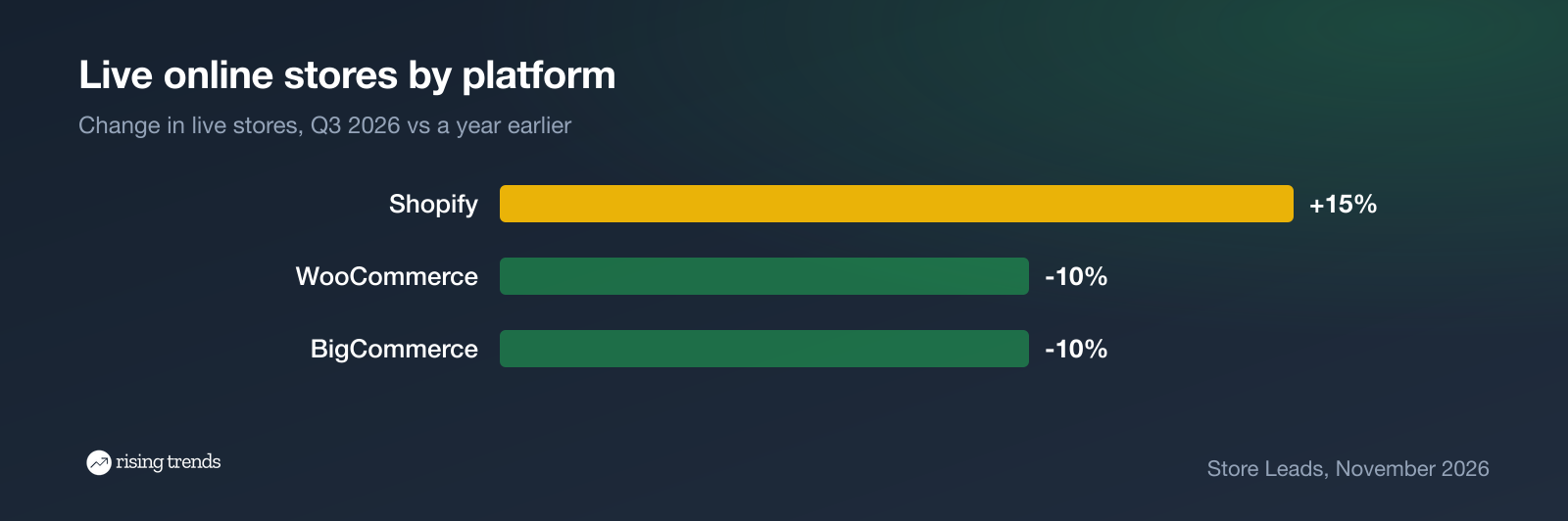
- Stores outgrow their templates. WooCommerce and BigCommerce each lost 10% of their live stores in a year while Shopify grew 15%, and 17% of shoppers who abandon a checkout blame site errors or crashes.
- Creators become the storefront. Adobe expects social media's share of holiday online revenue to grow 17%, against 4% for paid search, and YouTube Shopping sales are up 13x in two years.
- Paid ads keep getting pricier. Meta's average price per ad rose 14% in a year, and the FTC alleges Amazon pushed ad prices up to 250% above auction results on peak days.
- Fulfilment costs reset for 2027. UPS and FedEx both raise rates by an average 5.9%, and Amazon's FBA fees rise an average $0.19 per unit from January 15, 2027.
- The tariff and de minimis reset. Duty-free imports under $800 are suspended, CBP had accepted $136.6 billion in tariff refund claims by October 2, and US searches for "made in usa" are up 174%.
- Rules for online stores tighten. Illinois requires all-in prices from January 1, 2027, the FTC sued Toast over hidden fees and hard cancellation, and 2,805 website accessibility lawsuits were filed in nine months.
Every figure comes from the organization that measured it (the US Census Bureau, company earnings releases and calls, Adobe, the FTC, carriers and named research firms), plus our own search data from the Rising Trends database. For wholesale and B2B selling, see our B2B ecommerce trends, and for checkout and card fees, our payment trends article.
Let's get into it.
1. AI Assistants Become a Traffic Source
A year ago, AI shopping was mostly a demo. In 2026 it started sending real customers to online stores.
Adobe's holiday forecast, published September 28, expects AI-referred traffic to US retail sites to rise 130% from November 1 to December 31, with Thanksgiving up 159%. That is traffic from links inside AI chat and browser tools. Shopify said on its Q3 2026 call on November 3 that orders from AI searches at its merchants grew 3.3x in a year, while its president added that "the volume is still small here."
The biggest marketplaces are building their own assistants rather than waiting. Amazon's Q3 2026 results say more than 400 million customers used Alexa for Shopping in the last 12 months, with interactions up 570%. Meta's new Muse agent passed 10 million accounts in the US and Canada by October 21. Platforms are opening the door too: on October 21, Commerce.com (formerly BigCommerce) and Cloudflare switched on a standard that lets shoppers' browser AI agents search and fill carts on BigCommerce stores by default.
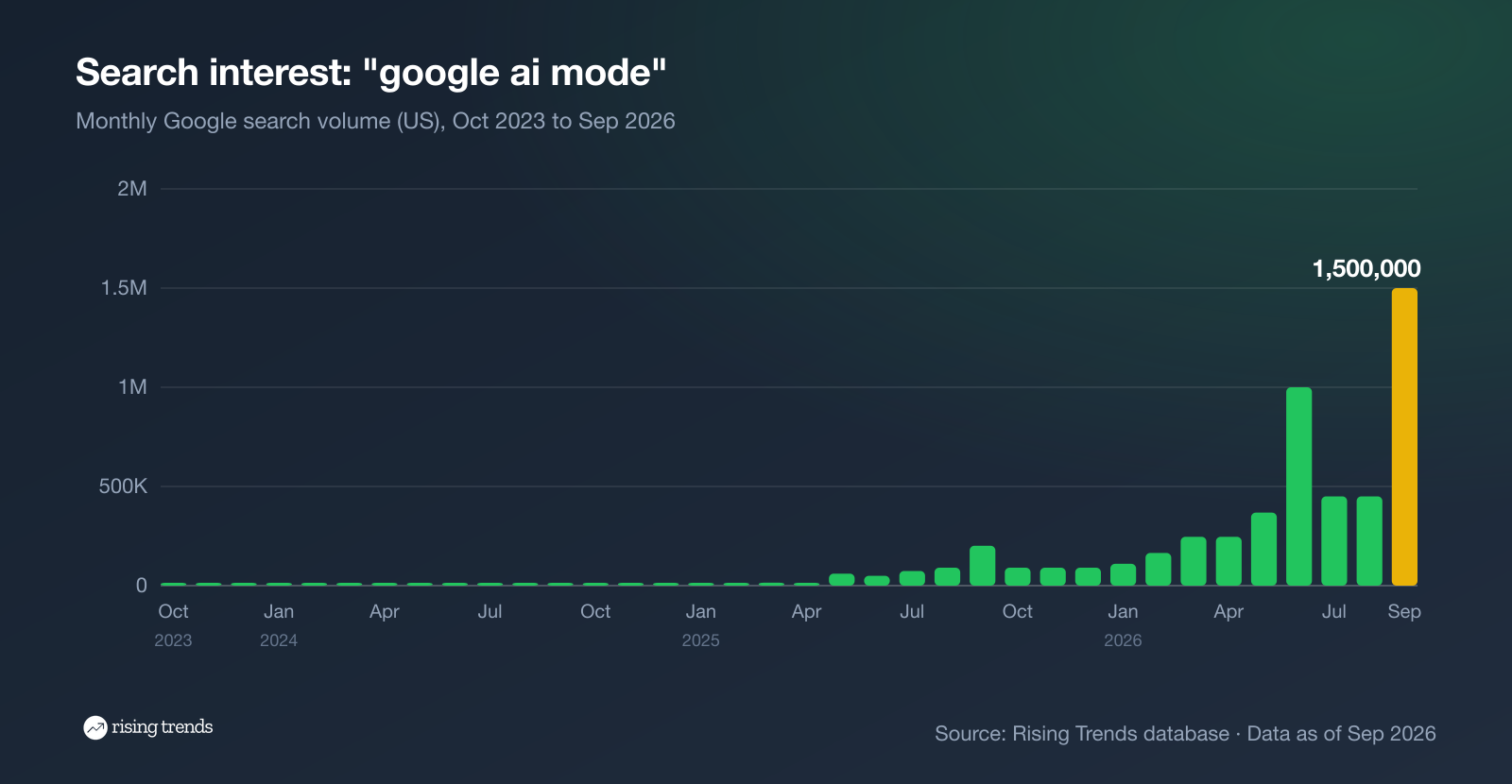
Not every bet paid off. OpenAI ended its in-chat Instant Checkout in March 2026 and now sends shoppers to merchants' own sites and apps, and US searches for "chatgpt instant checkout" are down 91% in a year. Searches for Google's AI Mode went the other way, reaching 1.5 million a month in September 2026, up from 201,000 a year earlier.
What to do about it
Treat AI tools like a new search engine. They read product data, not banner images, so complete titles, specs, sizes, prices and stock levels matter more than ever. Check that your product feed is clean and your pages load without heavy scripts.
Track AI referrals as their own channel in analytics. The volume is small, but you want to know which products these tools recommend before your competitors do.
2. Stores Outgrow Their Templates
The template that launched a store is often the thing holding it back two years later.
Store Leads, which crawls live stores, shows the shift in its November 2026 data: live WooCommerce stores fell 10% in a year, and WooCommerce lost a net 14,987 merchants to other platforms in 90 days. BigCommerce also fell 10%, while Shopify grew 15% to about 3.25 million live stores. At the platform level, Commerce.com reported Q3 revenue down 2.1% and $60 to $80 million in planned cost cuts, while Shopify's GMV grew 29% to $119.1 billion.
Speed is part of the reason stores move. On Google's real-user data compiled by CoreWebVitals.io for November 2026, 94% of Shopify stores pass the main loading test, against 57% of WooCommerce stores. Shopify's own figures show how quickly a store fills up: the average merchant runs 8 apps, from a catalog of more than 33,000. Every extra app, script and plugin adds weight to the page and one more thing that can break.
The cost shows up at checkout. Baymard's cart abandonment research, updated October 28, puts average abandonment at 70.22%, and 17% of US shoppers who abandon a checkout blame site errors or crashes, as many as blame a checkout that is too long. Those failures pile up on the busiest days: Adobe expects Cyber Monday alone to bring in $15.1 billion, a single-day record.
When the problems are deep customizations, inventory that falls out of sync or integrations that fail every update, another plug-in rarely fixes them. That is usually the point where brands bring in a software development company to map each failure to its technical cause and decide which parts of the store to keep. A phased rebuild, moving search, checkout or accounts one at a time, carries less risk than replacing everything before a peak season. Our software development trends article covers how those teams are working now.
What to do about it
Audit your apps every quarter: what each one does, who owns it, what it costs and what it adds to page load. Remove the ones nobody uses in a staging copy first, then test product pages and checkout.
Load test before every big promotion, at traffic above your forecast, and set alerts on checkout speed and error rates. If the same integration keeps failing, write down what it costs you in lost orders and staff time before deciding between a fix and a rebuild.
3. Creators Become the Storefront
More of the shopping journey now starts with a person on a screen, not a search box.
In its holiday forecast, Adobe expects social media's share of online holiday revenue to grow 17% and affiliates 12%, against 4% for paid search. Creators and influencers make up 22% of affiliate traffic. YouTube said on September 23 that more than 1.3 million creators are in its Shopping affiliate program, that Shopping sales are up 13x in two years, and that US creators can now tag Amazon products. Meta's partnership ads, which brands run through creators' accounts, grew more than 97% and passed a $15 billion annual run rate.
Live selling is growing too. eBay reported US GMV up 27% in Q3 and added AI moderation to eBay Live, and US searches for the live shopping app "whatnot" rose 22% in a year to 673,000 a month.
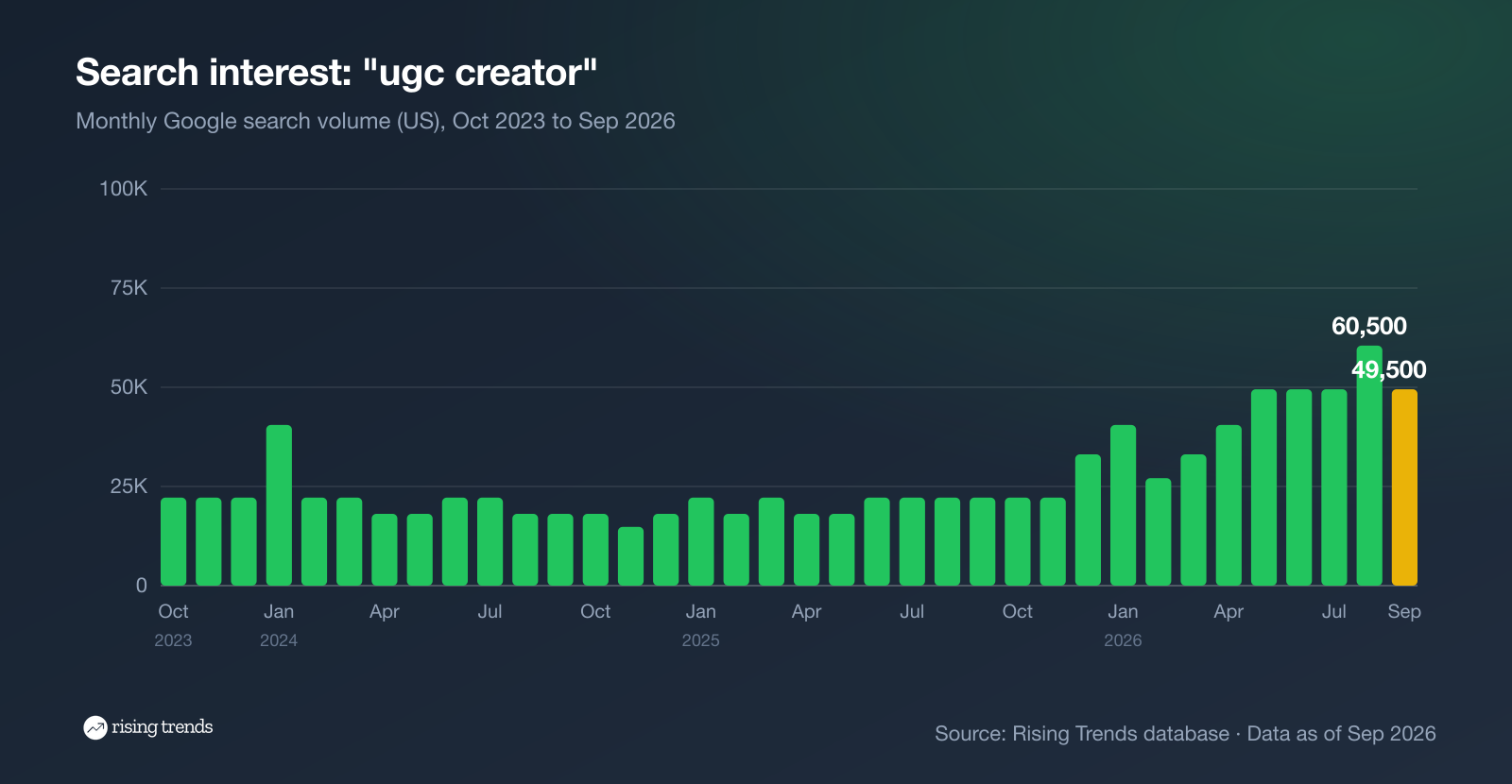
Brands are hiring for it. US searches for "ugc creator" more than doubled, from 22,200 to 49,500 a month, as stores pay creators for the short, unpolished videos that work in ads and on product pages.
What to do about it
Start with a small affiliate or creator program on the platform where your customers already watch, and pay on sales rather than posts so you can see what works.
Reuse creator videos on your product pages and in ads. A short clip of a real person using the product answers questions a photo can't.
4. Paid Ads Keep Getting Pricier
The cost of buying a customer is rising fastest on the channels online stores rely on most.
Meta's Q3 2026 results show the average price per ad up 14% in a year, on 10% more impressions. Google is calmer: its Q3 filing shows paid clicks up 8% and cost per click up 4%. Amazon's ad business grew 11% to $19.6 billion in Q3 and is guided back to high-teens growth in Q4.
Marketplace ads are now under legal scrutiny too. In an amended complaint on November 5, the FTC and 22 states allege Amazon added hidden surcharges that pushed ad prices up to 50% above auction results on normal days and up to 250% on peak days such as Prime Day and Black Friday. Amazon is fighting the case, but sellers paying for sponsored products should watch it.
Some of the biggest advertisers are testing how much of their spend actually works. Shopify said it paused some US marketing channels for a few weeks in Q3 to measure their real effect and saw no hit to sales.
What to do about it
Run your own holdout test: pause one channel or campaign in one region for a few weeks and compare sales. It is the cheapest way to find spend that isn't earning its keep.
Watch your cost per order, not just return on ad spend, and move budget toward owned channels (email, SMS, repeat buyers) and creator content that keeps working after the ad stops.
5. Fulfilment Costs Reset for 2027
Shipping and marketplace fees go up at the start of every year, and 2027 is no exception.
UPS raises its rates by an average 5.9% from December 21, 2026, with a 5% fuel surcharge for small-business shippers. FedEx follows with an average 5.9% from January 4, 2027, its fourth year in a row at that level, plus a $25 fee for paper trade documents from January 18. USPS holiday surcharges, up to $7.70 per Ground Advantage parcel, run until January 17.
Amazon sellers face their own changes. Amazon told sellers on November 5 that FBA fulfilment fees rise by an average $0.19 per unit from January 15, 2027, the 3.5% fuel and logistics surcharge stays, and the low-inventory fee jumps from $0.32 to $3.50 per unit. Storage surcharges are replaced by one age-based storage fee from February 1.
Customers' expectations keep rising regardless. Amazon delivered more than 1.5 billion items same day or overnight to Prime members in Q3, its fastest third quarter ever.
What to do about it
Re-run your shipping math before January: check your dimensional weights, packaging and zones against the new rate cards, and ask your carrier or 3PL what discount they will give on the increase.
On Amazon, plan inventory to avoid the low-inventory fee without falling into the new age-based storage fee. Both reward a steady, well-forecast flow of stock.
6. The Tariff and De Minimis Reset
Cross-border selling changed more in the last 18 months than in the previous decade.
The de minimis exemption, which let goods worth under $800 enter the US duty-free, is suspended for all shipments under CBP rules from June 2026, and the law repealing it takes effect on July 1, 2027. On October 8, CBP proposed a new filing process for all imports worth $2,500 or less, with comments open until December 7.
Some sellers have money coming back. After the Supreme Court struck down the IEEPA tariffs in February, CBP had accepted about $136.6 billion in refund claims by October 2, and began paying out on finally liquidated entries in October. Other tariffs, including those on China and on metals, remain.
Search shows the shift from panic to planning. US searches for "tariffs" fell 76% in a year and "de minimis" 55%, while "made in usa" rose 174% to 14,800 a month, its highest level in three years.
What to do about it
If you imported goods and paid IEEPA duties, ask your customs broker whether you can claim a refund and what the deadline is.
If you sell US-made products, say so clearly and correctly: the FTC's "Made in USA" standard means all or virtually all of the product. If you ship small parcels into the US, read the October proposal; it will change how those shipments are filed.
7. Rules for Online Stores Tighten
Regulators are focusing on the details of how online stores show prices, sell subscriptions and build their sites.
Illinois's junk fee law takes effect on January 1, 2027: advertised prices must include every mandatory fee. California and several other states already have similar rules. On October 29, the FTC, California and seven other states sued Toast over hidden fees, auto-renewing subscriptions and hard cancellation, using the federal online subscription law even though the FTC's click-to-cancel rule was struck down in 2025. A day earlier, the FTC ordered retailers including Walmart, Target and Instacart to explain how they use personal data to set individual prices.
Website accessibility is a legal risk for small stores too. EcomBack counted 2,805 accessibility lawsuits against websites from January to September 2026. 46% targeted Shopify stores, and 24% hit sites that already had an accessibility widget installed.
Shoppers are pushing back on fees as well. In a Morning Consult survey published September 30, three-quarters of US consumers called return fees unreasonable.
What to do about it
Show the full price, including any mandatory fee, on the product page, and make cancelling a subscription as easy as signing up.
Test your store with a keyboard and a screen reader, or pay for a manual accessibility audit. A widget alone doesn't fix the underlying code, and the lawsuit numbers show it.
What We're Seeing in Search
Our database tracks US search demand for tens of thousands of trends. Here is what it shows for ecommerce as of September 2026, compared with September 2025.
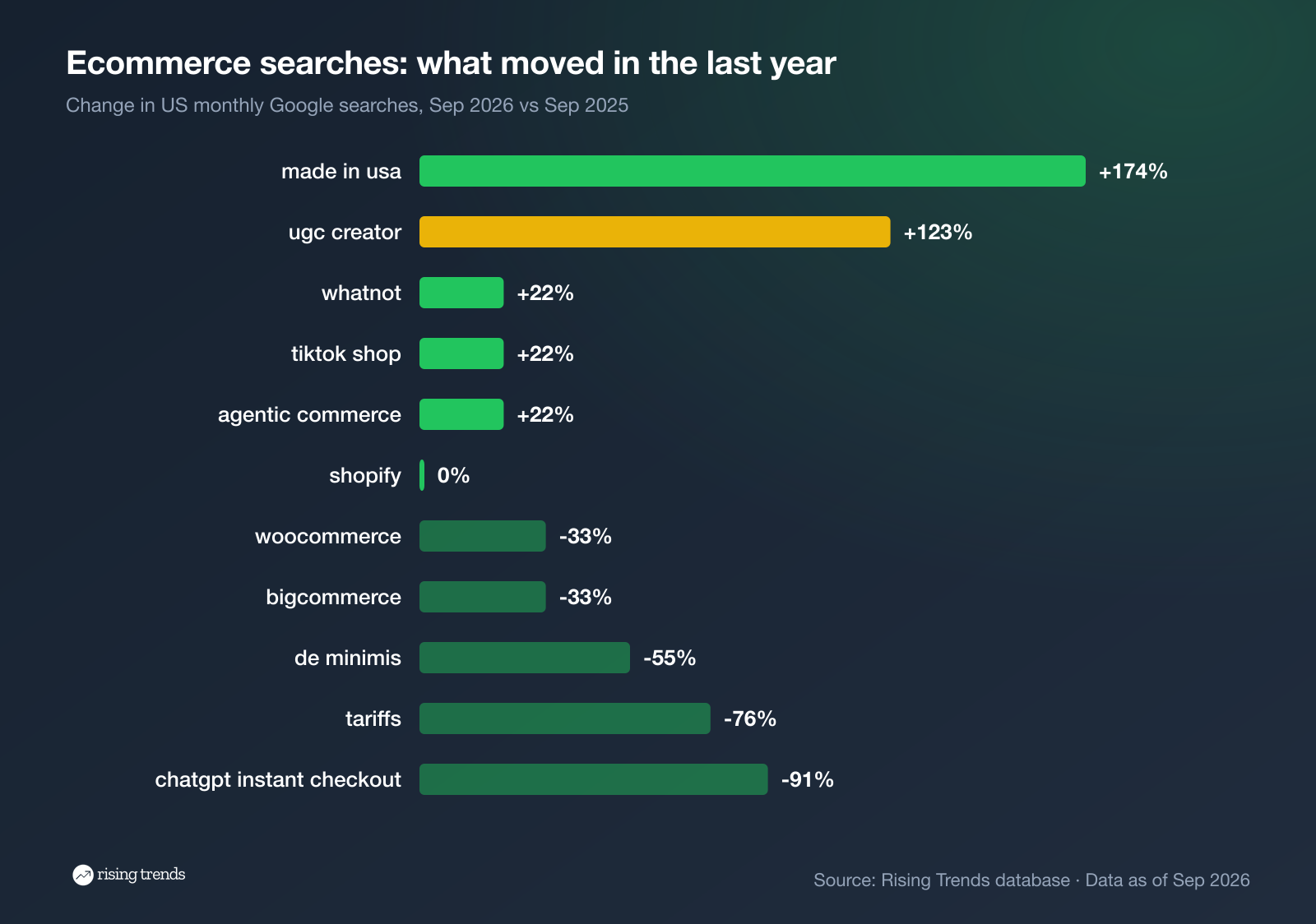
- Domestic is a selling point. "made in usa" (+174%) leads as tariffs reshape sourcing, backing trend 6.
- Creators are in demand. "ugc creator" (+123%) more than doubled as brands pay for video content, in line with trend 3.
- Social selling keeps growing. "whatnot" and "tiktok shop" (both +22%) are at or near record levels.
- Platform interest is concentrating. "shopify" held flat at about 1 million a month while "woocommerce" and "bigcommerce" (both -33%) fell, matching the store counts in trend 2.
- The panic phase is over. "tariffs" (-76%) and "de minimis" (-55%) fell from their 2025 peaks, and "chatgpt instant checkout" (-91%) collapsed after OpenAI dropped the feature.
If you want to find products with rising demand before you stock them, our guide on finding products to sell walks through the method.
The Common Thread
Put the seven shifts side by side and one pattern runs through them: demand is still growing, but every step between the shopper and the sale is getting more expensive or more regulated. Shoppers arrive from more places than ever, including AI assistants, creators and live streams. At the same time, ads, shipping, marketplace fees and compliance all cost more, and a slow or broken store loses the shopper it paid to bring in.
The online stores that do well in 2027 will run on a fast, simple stack, know their real cost per order, and win customers through product data and creators rather than paid ads alone.
If you only fix three things before 2027: clean up your product data for AI tools, audit your apps and load test checkout before the next sale, and re-price your shipping against the new carrier rates.
Frequently Asked Questions
What are the biggest ecommerce trends for 2027?
AI assistants sending shoppers to online stores, brands moving off templates and platforms that can't keep up, creator and live selling, rising ad prices, higher shipping and Amazon fees, the end of duty-free small imports into the US, and new rules on pricing, subscriptions and website accessibility.
Is ecommerce still growing in 2026?
Yes. US nonstore retail sales, which are mostly online, were up 8.2% year over year in September 2026, against 6.3% for all retail, according to the Census Bureau. Adobe forecasts US online holiday spending of $275.1 billion, up 6.7%.
How much traffic do AI shopping assistants send to online stores?
It is still a small share but growing fast. Adobe expects AI-referred traffic to US retail sites to rise 130% this holiday season, and Shopify says orders from AI searches at its merchants grew 3.3x in a year from a small base.
What are the 2027 shipping rate increases?
UPS raises rates by an average 5.9% from December 21, 2026, and FedEx by an average 5.9% from January 4, 2027. Amazon's FBA fulfilment fees rise by an average $0.19 per unit from January 15, 2027.
When should an online store move off its template or platform?
When template limits start costing revenue or staff time: orders corrected by hand, inventory falling out of sync, updates breaking key features, or checkout slowing down during promotions. Document those failures and their cost first, then compare targeted fixes with a phased rebuild.
Want to spot the next shift before your competitors do? Read our guide on how to identify market trends or see what's changing in stores in our retail trends report.
Never miss a trend again
- One trend broken down with the numbers
- Who's making money, and what to build
- A website on the rise
- A breakout app
Join 5,000+ founders