
The biggest event marketing trends for 2027 are budgets that keep rising while planners grow more cautious, consumers who say they want experiences away from screens, and a shift in where the money goes: away from the standard trade show booth and toward hands-on activations, smaller invite-only events and sponsorships attached to big crowds. Here are all seven, with the number behind each:
- Budgets rise, optimism cools. 91% of meeting professionals expect bigger budgets in 2027, but only 45% are "very optimistic," down from 62% a year earlier.
- People want something they can touch. 80% of US consumers say they are drawn to real-world experiences that don't revolve around screens, and 69% go out of their way to shop in person.
- Experiential activations replace the booth. US searches for "event production" are up 81% in a year, while "trade show booth" is down 45% and "booth design" 55%.
- Events get smaller and more personal. 37.6% of marketers are moving to fewer, higher-value events, and 30% of planners are cutting attendee numbers in response to geopolitical risk.
- Sponsorship follows the crowds. Live Nation's sponsorship revenue rose 14% to $505.7 million in Q3 2026, and the World Cup fan festivals drew 9 million visitors to 113 sponsor spaces.
- ROI is still hard to prove. 68.9% of marketers have given leadership an event ROI figure they didn't fully trust, and only 39.2% tag every lead to its event.
- Costs rise and ticket rules tighten. Planners expect cost per attendee to rise for every meeting type in 2027, and the FTC's case over hidden ticket fees of up to 44% is heading to discovery.
Every figure comes from the organization that measured it (survey publishers, company earnings releases, FIFA, the IPA, CEIR and the FTC case record), plus our own search data from the Rising Trends database. For the online side of the marketing mix, see our digital marketing trends article.
Let's get into it.
1. Budgets Rise, but Optimism Cools
Almost everyone running events expects more money next year. Fewer of them are excited about it.
Amex GBT's 2027 Global Meetings and Events Forecast, based on a YouGov survey of 500 meeting professionals in 11 countries in August 2026, found 91% expect their budgets to increase in 2027, with one in ten expecting a rise of more than 11%. They also expect to hold more meetings of every type. But only 45% are "very optimistic" about the year, down from 62% in the 2026 edition. North America is the most upbeat region, at 51%.
Marketers are moving money the same way. The Content Marketing Institute's 2027 B2B content marketing research, published November 4 from a survey of 861 B2B marketers, ranks events and experiential as the second-biggest investment area for 2027 (35%), behind owned media (42%) and ahead of AI marketing tools (30%). In 2026, 82% of B2B marketers put budget into experiences, and 31% gave them a large or majority share of the budget, up from 17% in 2025. In the UK, the IPA's Q3 2026 Bellwether report shows the events budget balance rising to a nine-quarter high of +15.1%, second only to PR.
What to do about it
Ask for the budget increase, and plan for not all of it to arrive. Rank your events by what they produced last year and decide in advance which ones you would cut first if the money stays flat.
Treat events as a channel with its own targets, not a line item that rolls over. The marketers getting a majority share of budget for experiences will be asked to prove it.
2. People Want Something They Can Touch
The demand side of event marketing is a backlash against the screen.
Harris Poll's survey for Quad, "Return of Touch," published October 14 from 2,004 US adults surveyed in July and August 2026, found 80% of consumers are drawn to real-world experiences that don't revolve around screens. 69% go out of their way for an in-person shopping experience, rising to 84% among Gen Z, and 71% say experiencing a brand in a store deepens their connection and loyalty to it. Nearly half of Gen Z (49%) say social scrolling makes them feel drained. Quad sells print and in-store marketing, so it has an interest in these findings, but the direction matches what event buyers report.
Planners see it in their audiences. In Amex GBT's forecast, event professionals say attendees now want more personalized interactions (35%), richer, curated networking (31%) and hands-on, interactive sessions (31%). The report's own summary: "The 'instagrammable' era is receding."
Search data shows the same move toward showing up in person. US searches for "in person events" are up 306% in a year, "run club" is up 83% to 22,200 a month and "community events" is up 22% to 6,600.
What to do about it
Design for hands, not phones. Give people something to try, taste, build or test, and make the photo a by-product of the experience rather than the point of it.
Pick formats people already search for. Run clubs, workshops and community nights are growing on their own; a brand that hosts one well gets an audience that was already looking.
3. Experiential Activations Replace the Booth
The standard booth is losing ground. Brands want spaces people can step into and use.
Search shows the shift. In our database, US searches for "event production" are up 81% in a year and "experiential marketing" is up 22% to 6,600 a month, while "trade show booth" is down 45% and "booth design" is down 55%. People are still going to shows: "trade show" searches are up 50% to 27,100. They are just looking for something different once they get there. CEIR's 2026 midyear report, released October 21, says the exhibition industry's gap to 2019 "is narrow, and closing slowly," and warns that "the easy part of the recovery is over." In CMI's research, 36% of B2B marketers now run sponsored experiences or activations at third-party events.
The best activations give visitors something to do and something to remember. A skincare brand lets people compare textures at a temporary counter. A footwear brand runs a five-minute fit check and hands each visitor a card naming their collection. A home goods company builds a small room where people test storage products in a realistic setting. Each one leaves the visitor with a product name to search later, which is the link between the physical moment and the online sale.
The build is where most activations succeed or fail. A hands-on space needs installation, interactive tech that has been tested before the doors open, on-site support and custom pieces made to fit the venue, and a touring version has to be set up the same way in every city so the last stop isn't a weaker copy of the first. That is why many brands bring in a production partner that specializes in experiential activations instead of stretching an in-house team or a booth vendor. Operational details decide the result: a striking installation loses its value the moment a screen freezes or visitors can't tell what to do.
What to do about it
Start with the action you want visitors to take, then design the space around it. One clear action (try the product, get a result, search the collection name later) beats a scan-the-code, enter-the-contest, follow-three-accounts checklist.
Test everything before opening day: screens, sensors, registration forms and how fast your mobile pages load on the venue's network. Make sure staff can explain the activity in one or two sentences, and give passersby a strong visual centerpiece, since they are part of the audience too.
4. Events Get Smaller and More Personal
Fewer people, more attention per person.
Amex GBT's forecast shows planners reshaping events rather than cancelling them. Only 25% are holding fewer events because of inflation, but 30% are cutting attendee numbers or running smaller meetings in response to geopolitical instability, and 39% are changing destination. A September 2026 survey of 841 marketing, sales and business development professionals, published by Outcomes Rocket on October 15, found 37.6% are shifting to fewer, higher-value events.
The formats B2B marketers use reflect the change. In CMI's research, 82% run in-person events and 70% virtual events, but the smaller formats are well established: 33% run community programs, 22% advisory boards and 20% executive VIP experiences. Hybrid events, the big bet of 2021, are down to 18%, and US searches for "hybrid events" fell 19% in a year to 260 a month.
What to do about it
Build a tiered calendar: one or two large moments a year, and a steady run of dinners, roundtables, workshops and customer advisory sessions in between. The small events are where deals move; the big ones are where they start.
Invite by account, not by list size. A room of 30 people who match your best customers is worth more than a hall of 3,000 badge scans.
5. Sponsorship Follows the Crowds
Brands are buying their way into events that already draw huge audiences, and the numbers just hit records.
The 2026 World Cup showed the scale. FIFA reported on July 27 that its Fan Festivals drew more than 9,017,000 visitors across 13 host cities, a tournament record, with 113 commercial partner activation spaces. Bank of America ran its Fan Band program through the sites. Fans planned around the matches too: US searches for "world cup watch party" went from almost nothing to 60,500 in June 2026.
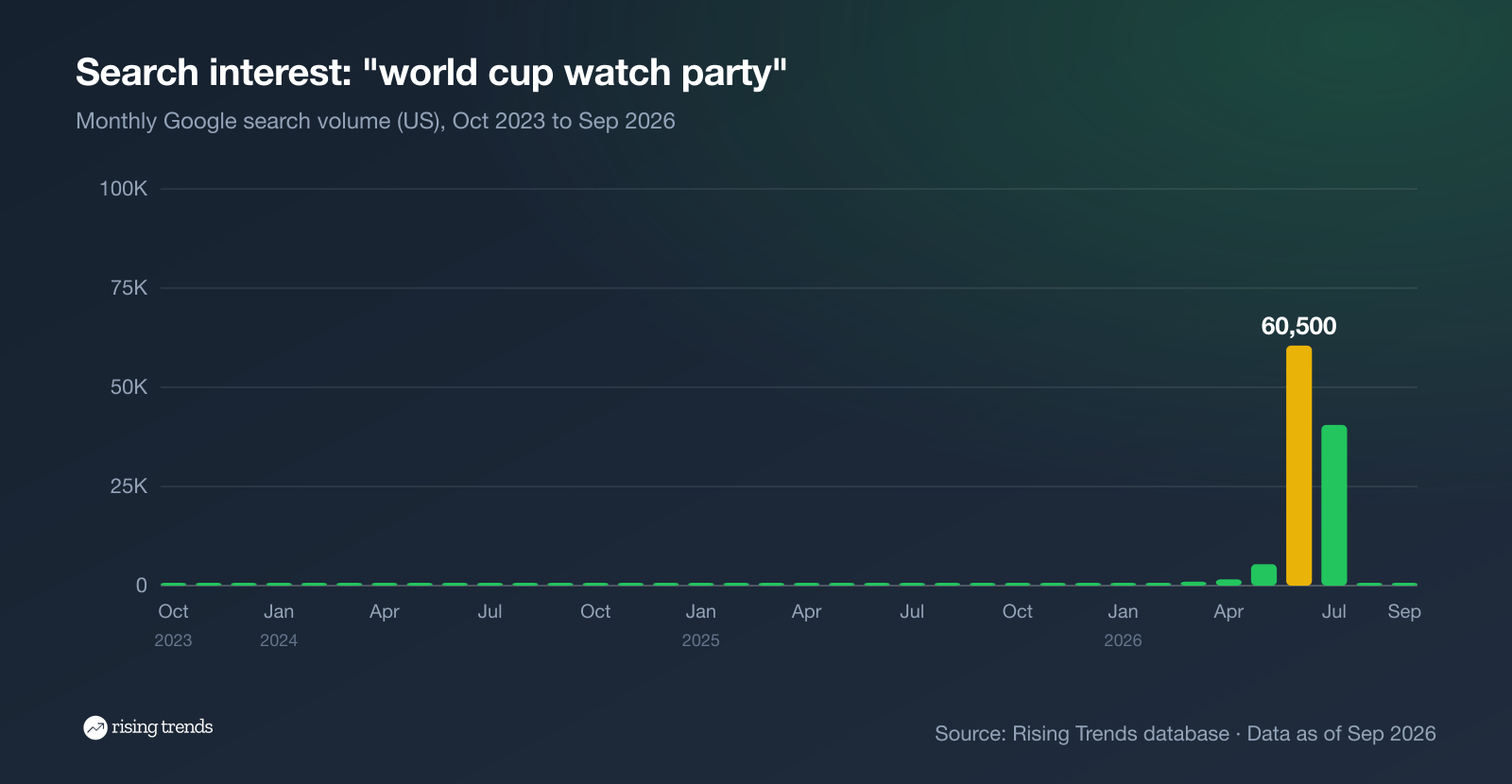
The spike also shows the limit of tentpole events. Omnicom told investors on its Q3 2026 call on October 22 that experiential growth was "strong double digit in the quarter," driven by World Cup work, then added: "we do not expect growth in this discipline in Q4." Searches for "world cup watch party" were back to 210 by September.
Live music is the steadier option. Live Nation's Q3 2026 results, released November 5, show sponsorship and advertising revenue up 14% to $505.7 million, and $1.15 billion for the first nine months, up 15%. Fan attendance rose 19% to 61 million in the quarter, and the company says it has sold about 170 million tickets for 2026 shows, up 13%, with ticket sales for 2027 shows up double digits. US searches for "live events" are up 83% in a year and "event sponsorship" is up 30%. For more on the fan side, see our sports trends page.
What to do about it
Plan the follow-up before you book the tentpole. Super Bowl LXI in Los Angeles in February 2027 and the 2028 Olympics will produce spikes like the World Cup's; budget for what you do with the audience in the months after, not just the week itself.
Look at recurring sponsorships (tours, festivals, venues, sports leagues) for steady reach. They repeat every year, so you can measure, adjust and come back.
6. ROI Is Still Hard to Prove, and AI Moves Onsite
Event budgets are rising faster than the ability to show what they return.
The Outcomes Rocket survey found 68.9% of marketers have given leadership an event ROI figure they weren't confident in. Only 39.2% tag every conference lead to its event source, 74.2% of booth conversations at their last major event were unplanned, and 37.9% face more pressure to prove ROI than before. The publisher is a small agency, but the pattern matches what larger studies have found for years: events influence deals that the CRM never credits.
Planners are turning to AI for the onsite part. In Amex GBT's forecast, the top planned AI use for 2027 is equipping onsite staff with insights to personalize service (34%), followed by event communications (32%), tracking attendee engagement (31%) and optimizing logistics (30%). Only 23% call using attendee data to design experiences a priority. Searches for "event management software" are down 70% in a year and "event app" 47%, as the category consolidates into fewer, bigger platforms.
What to do about it
Measure before the event opens. Record a baseline for branded search, direct traffic and searches that include your featured product name, then compare 24 hours, seven days and 30 days after, against the same weeks a year earlier so seasonality doesn't flatter the result. Segment by city and date when you can.
Tag every lead at the source and give one person ownership of event pipeline. Use AI where it helps staff in the room (who is this, what did they ask last time) before you use it for content.
7. Costs Rise and Ticket Rules Tighten
Every part of an event costs more, and the rules on how you price tickets are getting stricter.
Amex GBT's forecast says cost per attendee is expected to rise for every meeting type in 2027: product launches top the list, with 91% of planners expecting higher costs, and the other types sit between 82% and 84%. To cope, 36% are using more virtual tech, 35% are changing destination, 33% are changing venue and 31% are cutting food and beverage spend per attendee. Cost has dropped from the top challenge in 2026 to fifth for 2027, which suggests planners are getting used to it rather than seeing relief. Amex GBT's Hotel Monitor 2027 forecasts room rates up 1.6% to 2.5% in New York and 3.6% to 5.4% in San Francisco.
Ticketed brand events face new pricing rules. The FTC's all-in pricing rule for live-event tickets has applied since May 2025, and on September 29 a federal judge let the FTC's case against Ticketmaster proceed, which alleges hidden mandatory fees of up to 44% of the total price. States are adding their own limits: North Carolina capped resale markups at 20% from October 6, 2026, according to Hypebot's roundup of state laws.
What to do about it
Cut cost where guests won't notice and protect what they will. Shorter programs, regional venues and smaller rooms save more than cheaper catering, and the experience is what people remember.
If you sell tickets to a brand event, show one all-in price from the first screen. It is now the law in the US for live events, and it is what attendees expect anyway.
What We're Seeing in Search
Our database tracks US search demand for tens of thousands of trends. Here is what it shows for events as of September 2026, compared with September 2025.
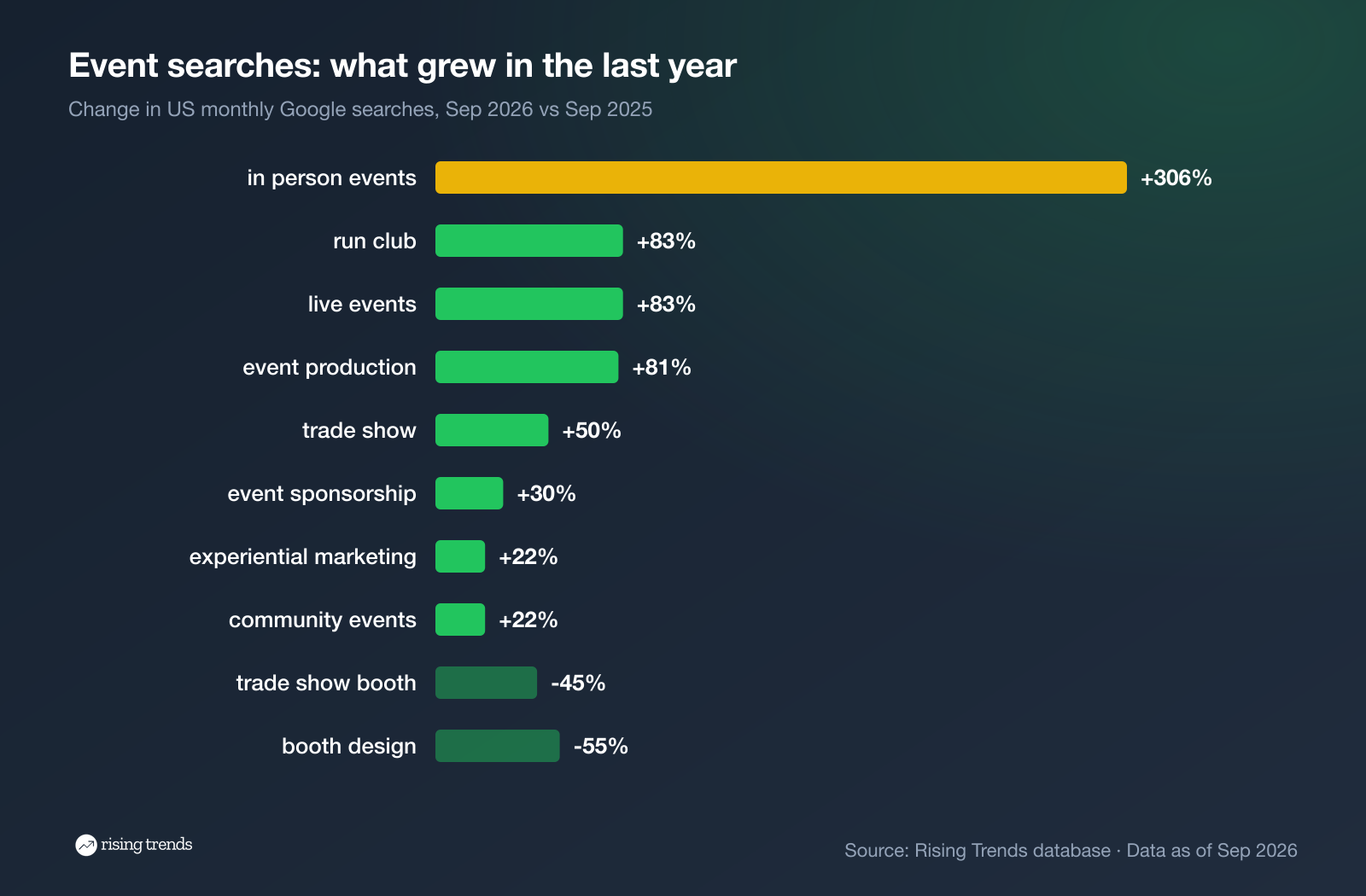
- In-person is the fastest riser. "in person events" (+306%) leads the list, backing trend 2.
- Community formats are growing. "run club" (+83%) and "community events" (+22%) show people looking for recurring, social formats that brands can host or sponsor.
- Production is replacing booths. "event production" (+81%) and "experiential marketing" (+22%) rose while "trade show booth" (-45%) and "booth design" (-55%) fell, in line with trend 3.
- Sponsors follow live crowds. "live events" (+83%) and "event sponsorship" (+30%) grew alongside Live Nation's sponsorship revenue in trend 5.
- Event tech is consolidating. "event management software" (-70%) and "event app" (-47%) declined as buyers settle on fewer platforms.
If you want to use search data like this to test a market before you invest in it, our guide on validating market demand walks through the method.
The Common Thread
Put the seven shifts side by side and one pattern runs through them: attention has moved back to the room. People are tired of screens, marketers are moving budget into experiences, and the events that win are the ones visitors can touch, try and remember by name. The standard booth, the giant hybrid conference and the unmeasured sponsorship are giving way to activations, smaller rooms and deals that can be traced back to the event.
The brands that do well in 2027 will build fewer, better experiences, put real production behind them, and measure what happens in search and pipeline afterwards.
If you only fix three things before 2027: give every event one clear action for visitors to take, tag every lead to its source, and record a branded-search baseline before the doors open.
Frequently Asked Questions
What are the biggest event marketing trends for 2027?
Rising event budgets with cooler optimism, consumer demand for real-world experiences away from screens, hands-on experiential activations replacing the standard booth, smaller and more personal events, sponsorship money following big live crowds, a persistent gap in proving event ROI, and higher costs per attendee alongside stricter ticket pricing rules.
Are event marketing budgets going up in 2027?
Mostly yes. Amex GBT's 2027 forecast found 91% of meeting professionals expect budgets to rise, and the Content Marketing Institute ranks events and experiential as the second-biggest B2B investment area for 2027 at 35%. But only 45% of planners are "very optimistic," down from 62% a year earlier.
What is experiential marketing?
Experiential marketing invites people to take part in a brand experience in person, such as a pop-up, a hands-on product demo, a touring installation or an activation at a festival or sports event. The goal is a memorable interaction that leads people to search for, talk about or buy from the brand later.
How do you measure the ROI of an event?
Set a baseline before the event for branded searches, direct traffic and searches for the featured product, then compare results after 24 hours, seven days and 30 days against the same period a year earlier. Tag every lead to its event source in your CRM. A September 2026 survey found only 39.2% of marketers do this for every conference lead.
Are trade shows still worth it in 2027?
Yes, but the format is changing. US searches for "trade show" are up 50% in a year, while "trade show booth" is down 45%. CEIR says the exhibition industry is close to its 2019 level but recovering slowly. Brands are getting more from hands-on activations and hosted side events than from a standard booth.
Want to spot the next market shift before your competitors do? Read our guide on how to identify market trends or browse what's gaining traction in our trending topics list.
Never miss a trend again
- One trend broken down with the numbers
- Who's making money, and what to build
- A website on the rise
- A breakout app
Join 5,000+ founders