
The biggest hotel industry trends for 2027 are a demand picture that looks strong on paper but leans on one-off events, AI platforms that now shape where guests look before they ever reach a booking page, and a stay that is being pulled apart into pieces (short trips, paid checkout windows, day rooms, luggage storage) that hotels can either sell or lose to someone else. Here are all seven, with the number behind each:
- Demand is strong but uneven. Marriott's worldwide RevPAR rose 6.5% in Q3 2026 and Hilton's 5.8%, yet Hilton guides to just 3.0% to 3.5% for Q4 and UN Tourism cut its 2026 arrivals forecast to 1% to 2%.
- AI changes discovery before it changes booking. Google now completes hotel bookings inside AI Mode with ten partners, while Booking Holdings says referrals from AI assistants are still "significantly less than 1%" of its room nights.
- Direct and loyalty keep gaining. Direct bookings reached 51.3% of European hotel bookings in 2025, and Marriott Bonvoy passed 309 million members in September 2026.
- The stay gets unbundled. US searches for "late checkout" are up 132% in a year, "day use hotel" is up 22% to 49,500 a month and "luggage storage" peaked at 110,000 searches in July 2026.
- New supply stays thin and goes extended-stay. The US pipeline shrank 4.9% to 5,901 projects, 40% of them extended-stay, and openings add only 1.2% to supply in 2026 and 1.3% in 2027.
- Labor costs rise faster than the economy. Leisure and hospitality hourly pay is up 3.9% in a year against 3.0% for all private workers, while accommodation and food services openings fell a third.
- Taxes and fee rules multiply. Venice extends its access fee to 72 days in 2027, Edinburgh's 5% levy started in July 2026, and Wales begins charging in April 2027.
Every figure comes from the organization that measured it (company earnings releases, UN Tourism, the Bureau of Labor Statistics, Lodging Econometrics, HOTREC, national statistics offices and city tax pages), plus our own search data from the Rising Trends database. For the consumer side of travel, see our travel trends page.
Let's get into it.
1. Demand Is Strong on Paper and Uneven Underneath
The big operators just posted their best quarter in two years. The question is how much of it repeats.
Marriott's Q3 2026 results, released November 2, show worldwide RevPAR up 6.5%, with the US and Canada up 7.4% on occupancy of 73.9% and an average rate of $197.93. Marriott raised its full-year outlook to 4.5% to 5.0%. Hilton's Q3 release on October 27 reported RevPAR up 5.8%, but its Q4 guidance is only 3.0% to 3.5%. Hyatt's results (RevPAR up 7.2%, US up 8.2%) say the quarter benefited "in part from the FIFA World Cup and the timing of the Jewish holidays." IHG's Q3 trading update shows the mix: global RevPAR up 5.3%, with groups up 10%, leisure up 5% and business up 4%, while Greater China fell 3.3%.
The weekly data is still hot. CoStar's release for the week of October 18 to 24, republished by Lodging, puts US RevPAR at $125.31, up 12.6%, on an average rate of $179.55. The forecast behind it is cooler: CoStar and Tourism Economics' August outlook expects RevPAR growth to slow from 4.4% in 2026 to 2.1% in 2027, with profit per room up just 1% and expenses "increasing by more than the rate of inflation in both 2026 and 2027."
International travel is the soft spot. UN Tourism's September barometer counts about 690 million international arrivals in the first half of 2026, up only 0.4%, with Europe up 3% and the Middle East down 22%, and it cut its 2026 forecast to 1% to 2% growth from 3% to 4%. In the US, the National Travel and Tourism Office's July figures show overseas arrivals down 7.0%, offset by Canada (up 7.6%) and Mexico (up 8.0%). Statistics Canada's September release adds the longer view: Canadians' car trips home from the US were up 5.6% from a weak 2025 but still 31.1% below September 2024.
Europe is steadier but flat in the cities. Germany logged a record 340.8 million overnight stays from January to August, up 0.5%, per Destatis, while Berlin's statistics office shows the capital's nights down 2.6% over the same months, with foreign nights down 6.3%.
What to do about it
Separate the event lift from the base. If your 2026 comps include a World Cup week, a convention or a holiday shift, price 2027 off the weeks around them, not through them. Groups and business travel are carrying the growth at the chains, so shift sales effort toward them and treat leisure rate growth as a bonus, not a plan.
Watch your source markets, not the national average. A hotel that depends on Canadian or European arrivals faces a different 2027 than one fed by domestic drive-in demand.
2. AI Changes Discovery Before It Changes Booking
Every hotel company now has an AI distribution story. The booking numbers behind it are still tiny, and that is the opportunity.
Google announced on August 27 that hotel booking in AI Mode is rolling out in the US with ten partners: Booking.com, Choice, Expedia, Hilton, Hotels.com, IHG, Marriott, Priceline, Trip.com and Wyndham. The guest picks a room, reviews the cancellation policy and pays with Google Pay, while "the hotel or booking platform will act as the merchant of record." Meta's Muse agent, launched September 8, can also book travel, and Cloudbeds announced an integration on October 20 that pushes Muse bookings straight into a hotel's property system.
The volumes are small. On its November 3 earnings call, Booking Holdings' CFO said referrals from large language models "still account for significantly less than 1%" of Booking.com's room nights, on a base of 345 million room nights in the quarter. Expedia's CEO told investors the next day that AI-platform traffic is "very small so far" and that "agentic AI's real strength is in discovery," on 115.7 million room nights. Hyatt's CEO called bookings that originate on AI platforms "very, very small" but said agentic booking "will be a significant portion of our total distribution picture." Hilton's CEO called the channel "early and insignificant" while confirming Hilton works with every AI platform.
Travelers are already using the tools to look. IATA's 2026 Global Passenger Survey, published October 28 with more than 10,000 responses, found 49% have used AI for travel planning, from 35% in Europe to 72% in the Middle East. In our database, searches for "google ai mode" reached 1.5 million a month in September, up 646% in a year, while "ai trip planner" fell 58% to 1,000, a sign that planning is moving inside general assistants rather than dedicated travel apps. We covered the advertising side in our AI hotel advertising trends article.
What to do about it
Make your hotel legible to machines. Rates, room types, cancellation terms, amenities and photos need to be structured, current and identical across your site, your channel manager and your Google Business profile, because an AI agent compares the record, not the brochure. Ask your property system vendor what it has shipped for Google's AI Mode and Meta's Muse, and decide now whether you want to be merchant of record for agent bookings.
Measure AI referrals separately from organic search from day one. The volumes are small enough that a few test bookings will tell you what the channel costs you.
3. Direct and Loyalty Keep Gaining Share
The quiet result of the last decade's OTA fight is that hotels are winning more of it.
HOTREC's European Hotel Distribution Study 2026, published September 15 from a survey of 2,713 hotels, puts direct bookings at 51.3% of European hotel bookings in 2025. OTAs took 29.9%, up from 19.7% in 2013, and the market is concentrated: Booking Holdings handles 68.8% of OTA bookings and, with Expedia Group, 85.4%. Half of hotels (51%) report OTAs undercutting their rates.
Loyalty programs are the chains' answer, and they are growing fast. Marriott reported about 309 million Bonvoy members at the end of September. Hilton counts 270 million Honors members. Hyatt told investors World of Hyatt passed 72 million, up 19% in a year. IHG has more than 160 million and Wyndham about 129 million.
The OTAs are playing the same game. Booking Holdings says its direct channel mix "was a mid-fifties percentage" of room nights over the past four quarters, and that its Genius loyalty tiers now account for a high-50s share of room nights. Expedia says two-thirds of its bookings come direct. Guests are looking for the direct rate too: "direct booking" searches are up 48% in a year in our database, to 1,300 a month, and have risen almost every month since spring.
What to do about it
Give the direct channel a reason to exist beyond price parity: a member rate, a flexible cancellation window, a room choice or a guaranteed late checkout that the OTA listing does not carry. Then make the direct booking path shorter than the OTA path, on a phone, with the total price shown up front.
Track the cost of each channel per booked night, including commission, payment fees and cancellation rates, and move marketing budget toward the cheapest acquisition that still fills the hotel.
4. The Stay Gets Unbundled
Trips are getting shorter, checkout is becoming a product, and the hours between checkout and departure are a market of their own.
Hilton's 2027 Trends Report, published September 29 from a survey of 14,744 travelers in 14 countries, found 24% plan to take more short trips in 2027, and 88% of US travelers call anything under three or four days "short." Two-thirds (67%) want to experience a lot in a short time and 63% prefer a central base. Short trips change what guests carry, too: a two-night city break travels with a cabin bag and a pared-down kit of skincare products rather than a full case, which turns the bathroom amenity set from a given into a differentiator. The city data agrees: Berlin's statistics office reports an average stay of 2.3 days from January to August 2026, and 2.2 days in hotels proper.
Short stays make the edges of the stay matter more. Hilton says more than 8 million guests completed a Digital Check-Out in the first half of 2026, up 25% in a year. Marriott's Bonvoy terms, updated October 2026, guarantee a 4 p.m. checkout for Platinum members and above at most properties. Hilton's new Diamond Reserve tier, effective January 1, 2026, carries Hilton's first guaranteed 4 p.m. checkout. Premier Inn sells it outright: its UK FAQ offers paid early check-in from 11 a.m. and paid late checkout to 2 p.m. Guests are asking: US searches for "late checkout" are up 132% in a year, to 4,400 a month, and "day use hotel" is up 22% to 49,500, 83% above its level two years ago.
Then there is the gap after checkout. A guest who leaves a room at 11 a.m. with a 7 p.m. flight has eight hours and a suitcase, and a network of marketplaces now sells that problem back to them. Radical Storage lists 16,082 storage locations in 2,342 cities and more than 9 million bags stored. A visitor checking out in Mitte can look up where to store luggage in Berlin and choose from 236 shops, hotels and cafés from €1.90 a day, then spend the afternoon in the city instead of at the station lockers. Bounce claims 32,000 storage spots in 4,000 cities and runs a hotel program with more than 1,000 partner hotels that pays a revenue share per bag; its own pitch is that a 300-room hotel can earn over $50,000 a year from it. Day-use is the same logic applied to the room: Dayuse's 2025 recap, published in February, reported $250 million in business volume across 10,500 partner hotels.
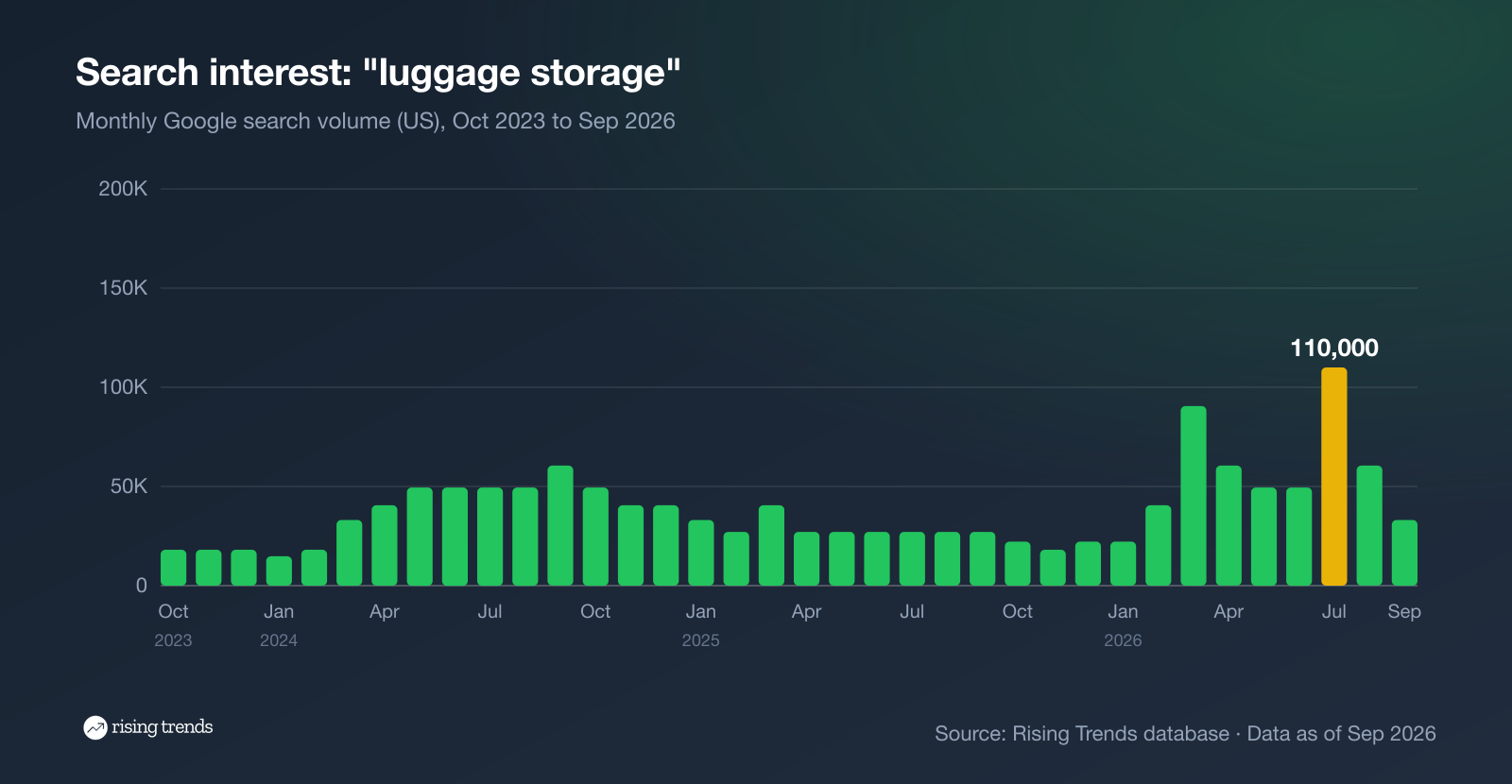
Searches for "luggage storage" show how seasonal and how large the demand is: 110,000 US searches in July 2026, and 33,100 in September, up 22% from a year earlier, with "luggage storage near me" also up 22% to 18,100. Even Airbnb is moving on the checkout edge: a new policy for bookings from November 20, 2026 bars hosts from requiring chores like stripping beds or washing dishes at checkout, and from imposing fines.
What to do about it
Price the edges of the stay instead of giving them away or refusing them. Sell early check-in and late checkout as inventory with a yield rule (free for top-tier members, paid when occupancy allows, declined when it does not), and publish the price so guests can plan. Offer day rooms on the days your departures outnumber arrivals.
Stock the bathroom for light packers: full-size toiletries and a few skincare basics cost little and are the first thing a short-stay guest notices.
Keep the guest after checkout. Hold bags for your own guests as standard, and consider a storage partnership for non-guests if you sit near a station or a shopping district: it brings foot traffic through the lobby and pays for the bell desk.
5. New Supply Stays Thin and Goes Extended-Stay
Fewer hotels are being built, and the ones that are look more like apartments.
Lodging Econometrics' Q3 2026 pipeline report, published October 26, counts 5,901 projects and 692,999 rooms in the US pipeline, down 4.9% in projects from a year earlier, with 1,094 projects and 137,371 rooms under construction. Openings add 1.2% to supply in 2026 (598 hotels) and 1.3% in 2027 (668 hotels). CoStar and Tourism Economics' forecast is tighter still: supply growth of 0.4% in 2026 and 0.6% in 2027.
Within that pipeline, extended-stay is 2,352 projects, 40% of the total, and luxury hit a record 108 projects. Conversions are another 1,516 projects, as owners rebrand rather than build. The chains confirm the direction. Marriott's StudioRes brand went from 4 open hotels at the end of 2025 to 18 hotels and 2,232 rooms by September 30, on a record pipeline of more than 634,000 rooms. Hilton's LivSmart Studios reached 7 hotels and 795 rooms within a 543,100-room pipeline. Wyndham says about 17% of its record 264,000-room pipeline is extended-stay. Hyatt's pipeline grew 12.1% to about 158,000 rooms.
Demand is following the product. "Serviced apartments" searches are up 123% in a year to 18,100 a month in our data, peaking at 33,100 in March 2026.
What to do about it
If you own an older limited-service hotel, run the numbers on an extended-stay or midscale conversion before your next renovation cycle: the pipeline says that is where franchisors are putting their new flags and where the construction lenders are comfortable. If you operate in a market with no new supply through 2027, hold rate and invest in the product; you will not be undercut by a new opening.
Add weekly and monthly rate plans to your direct site. Guests searching for serviced apartments are not looking for a nightly rate.
6. Labor Costs Rise Faster Than the Economy
The staffing crisis has eased. The wage bill has not.
The Bureau of Labor Statistics' September jobs report counts 1,916,500 accommodation jobs, essentially flat against a year earlier. Pay is another story: average hourly earnings in leisure and hospitality reached $23.90, up 3.9% in a year, against 3.0% for all private workers. The October report lands on November 6.
The JOLTS release of November 3 shows the market loosening: accommodation and food services had 659,000 job openings in September, down from 989,000 a year earlier. But quits in the sector jumped by 197,000 to 719,000 in the month, a preliminary figure, so turnover is not solved. Searches for "hotel jobs" are flat at 22,200 a month, which fits a market where hiring is easier but not cheap.
Hotels are answering with self-service. Hilton's 2027 Trends Report notes Digital Key was used more than 67.4 million times in the first half of 2026. HOTREC's survey found only about 26% of European hotels using AI tools so far, which leaves room for the back office.
What to do about it
Budget 2027 wages above inflation and above your rate growth, because the CoStar forecast of 1.6% ADR growth in 2027 will not cover a 3.9% pay rise. Put automation where the labor hours are (check-in, keys, messaging, housekeeping scheduling), not where the guest expects a person. Then measure turnover by role each month: a quits spike shows up in the roster weeks before it shows up in the reviews.
7. Taxes and Fee Rules Multiply
Cities have found that visitors are easier to tax than residents, and regulators are policing how prices are shown.
Venice's official portal confirms its day-visitor access fee will run 72 days in 2027, from March 26 to August 15, up from 29 days in 2024, 54 in 2025 and 60 in 2026. Edinburgh's 5% visitor levy took effect on July 24, 2026, capped at five nights and expected to raise up to £50 million a year. Wales will charge £1.30 per person per night, with Cardiff starting April 1, 2027 and providers required to account for it on bookings taken from September 28, 2026. Amsterdam already charges 12.5% of the room price, and the hotel association KHN says the council votes this month on raising it to 16% in 2027. Berlin's city tax is 7.5% of the net room price and now covers business travelers. Kyoto's lodging tax has run up to ¥10,000 per person per night since March 1, 2026, ten times the old maximum. Hawaii's accommodations tax rose to 11% on January 1, 2026 under its Green Fee law.
In the US the pressure is on price display rather than tax. The FTC's rule on unfair or deceptive fees, in force since May 12, 2025, requires hotels and short-term rentals to show the total price including any resort fee up front. Its first enforcement case, a $10 million refund order against StubHub in April 2026, was about tickets, but the same rule covers lodging. Guests are checking: "resort fee" searches are up 26% in a year in our database.
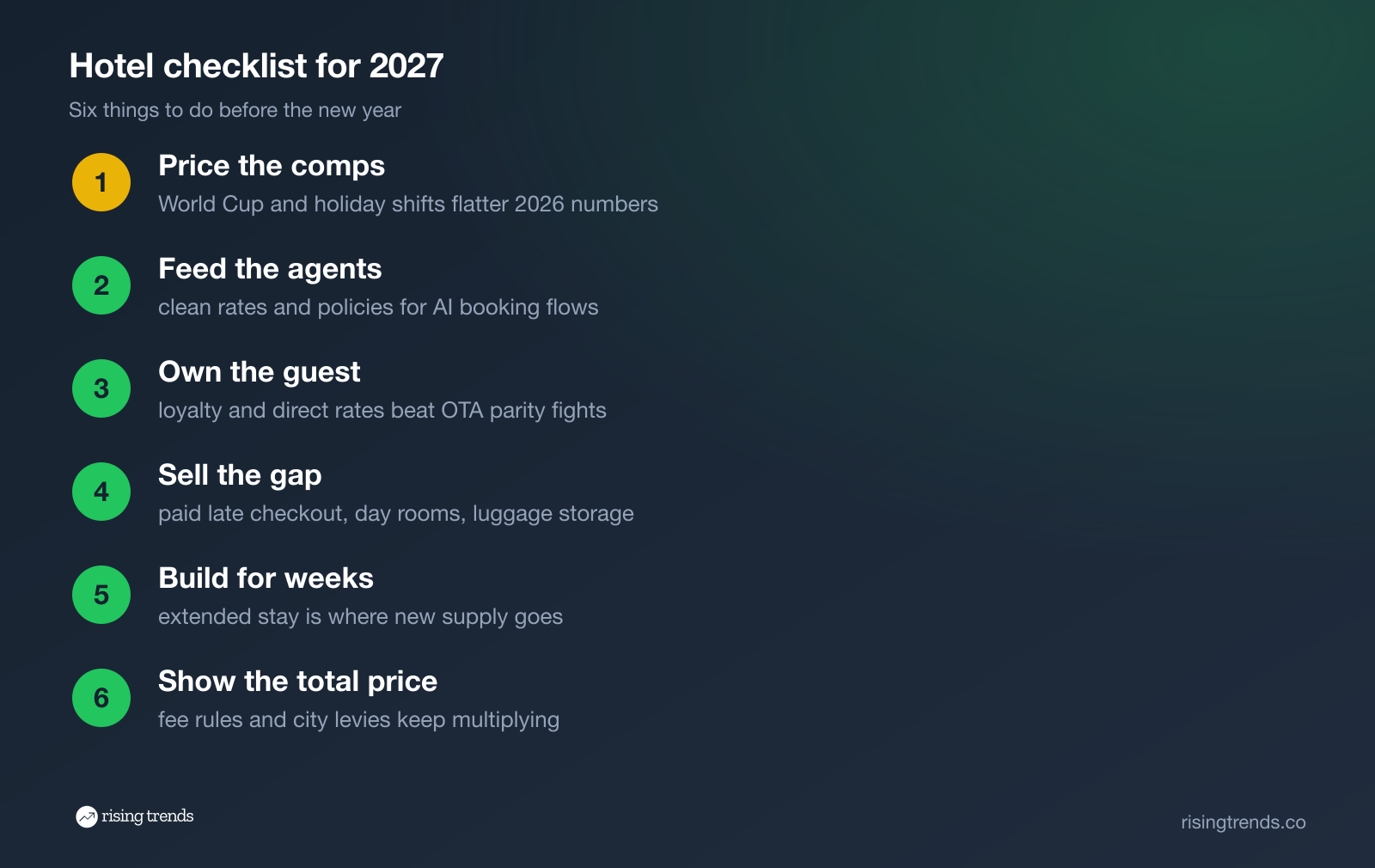
What to do about it
Keep a dated list of every levy in every market you sell, with the effective date and who collects it, and build it into the total price on your own site before the OTAs do it for you. Where a city adds a per-night or percentage levy, decide whether you absorb or pass through, and say so on the booking page.
Audit your rate display against the FTC rule and the EU total-price requirement: one all-in price, with only taxes and genuinely optional add-ons outside it.
What We're Seeing in Search
Our database tracks US search demand for tens of thousands of trends. Here is what it shows for hotels as of September 2026, compared with September 2025.
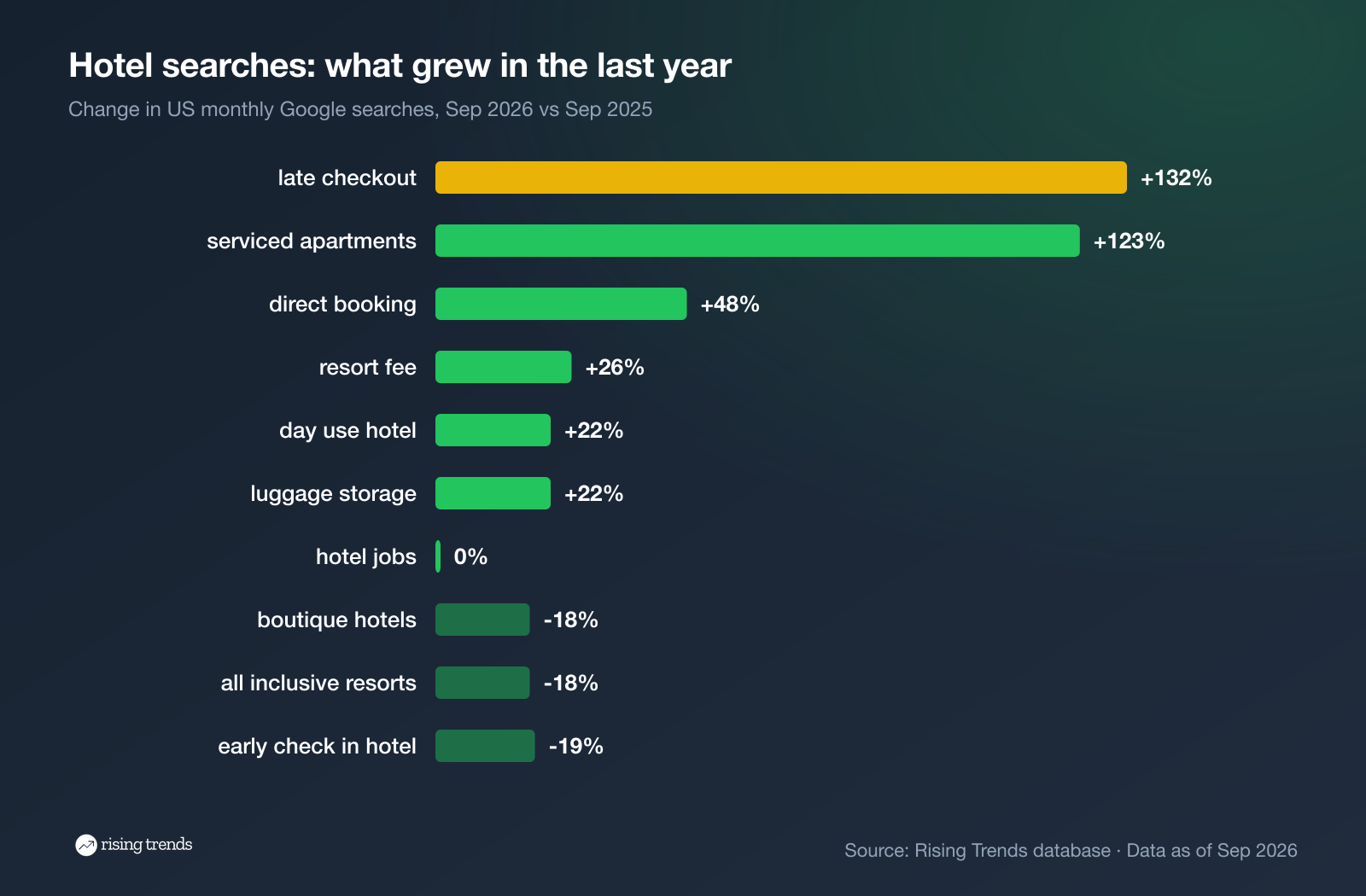
- The edges of the stay are the fastest risers. "late checkout" (+132%), "day use hotel" (+22%) and "luggage storage" (+22%) all grew, backing trend 4.
- Long stays are in demand. "serviced apartments" (+123%) is the second-biggest riser, in line with the extended-stay pipeline in trend 5.
- Guests want the direct deal. "direct booking" (+48%) and "resort fee" (+26%) both rose as travelers compare channels and check for hidden costs.
- Discovery moved into AI. "google ai mode" is at 1.5 million searches a month (+646%) while "ai trip planner" fell 58%.
- Big-ticket leisure cooled. "boutique hotels" (-18%), "all inclusive resorts" (-18%) and "early check in hotel" (-19%) all declined from a year ago.
If you want to use search data like this to test a market before you invest in it, our guide on validating market demand walks through the method.
The Common Thread
Put the seven shifts side by side and one pattern runs through them: the hotel room is no longer the unit of sale. Guests buy a short window of time in a city, discover it through an assistant, want the direct rate and the guaranteed checkout, and pay a levy on the way in. New supply is built for weeks, not nights. Labor is priced by the hour and taxed by the city.
The hotels that do well in 2027 will price the pieces (the early arrival, the late departure, the day room, the stored bag, the member rate) instead of giving them away, and will keep their data clean enough that an AI agent can sell them.
If you only fix three things before 2027: publish one all-in price everywhere, give your direct channel a benefit no OTA can copy, and turn checkout from a deadline into a product.
Frequently Asked Questions
What are the biggest hotel industry trends for 2027?
Uneven demand that leaned on events in 2026, AI assistants that shape discovery before booking, direct and loyalty channels gaining share, a stay that is being unbundled into short trips and paid checkout windows, thin new supply tilted to extended-stay, wage growth above inflation, and a wave of new tourist taxes and fee-display rules.
Is hotel demand growing in 2026 and 2027?
Yes in 2026, more slowly in 2027. Marriott's RevPAR rose 6.5% and Hilton's 5.8% in Q3 2026, but Hilton guides to 3.0% to 3.5% for Q4 and CoStar's August forecast has US RevPAR growth slowing to 2.1% in 2027. UN Tourism cut its 2026 international arrivals forecast to 1% to 2%.
Are people booking hotels through ChatGPT or Google AI Mode?
Very few so far. Google launched hotel booking inside AI Mode in August 2026 with ten partners, but Booking Holdings says AI referrals are "significantly less than 1%" of its room nights and Expedia calls the traffic "very small." IATA's October 2026 survey found 49% of travelers have used AI for planning, so discovery is moving even if booking has not.
How much do hotels pay in commissions versus direct bookings?
HOTREC's 2026 study of 2,713 European hotels found direct bookings at 51.3% and OTAs at 29.9% of bookings in 2025, with Booking Holdings and Expedia handling 85.4% of OTA bookings between them. Booking Holdings reports its own direct mix at a "mid-fifties percentage" of room nights.
Which cities are adding tourist taxes in 2027?
Venice extends its access fee to 72 days from March 26, 2027. Cardiff starts the Welsh visitor levy on April 1, 2027. Edinburgh's 5% levy began July 24, 2026. Amsterdam's council is voting on a rise from 12.5% to 16% for 2027, and Kyoto's lodging tax has reached up to ¥10,000 per night since March 2026.
Want to spot the next market shift before your competitors do? Read our guide on how to identify market trends or browse what's gaining traction in our trending topics list.
Never miss a trend again
- One trend broken down with the numbers
- Who's making money, and what to build
- A website on the rise
- A breakout app
Join 5,000+ founders