
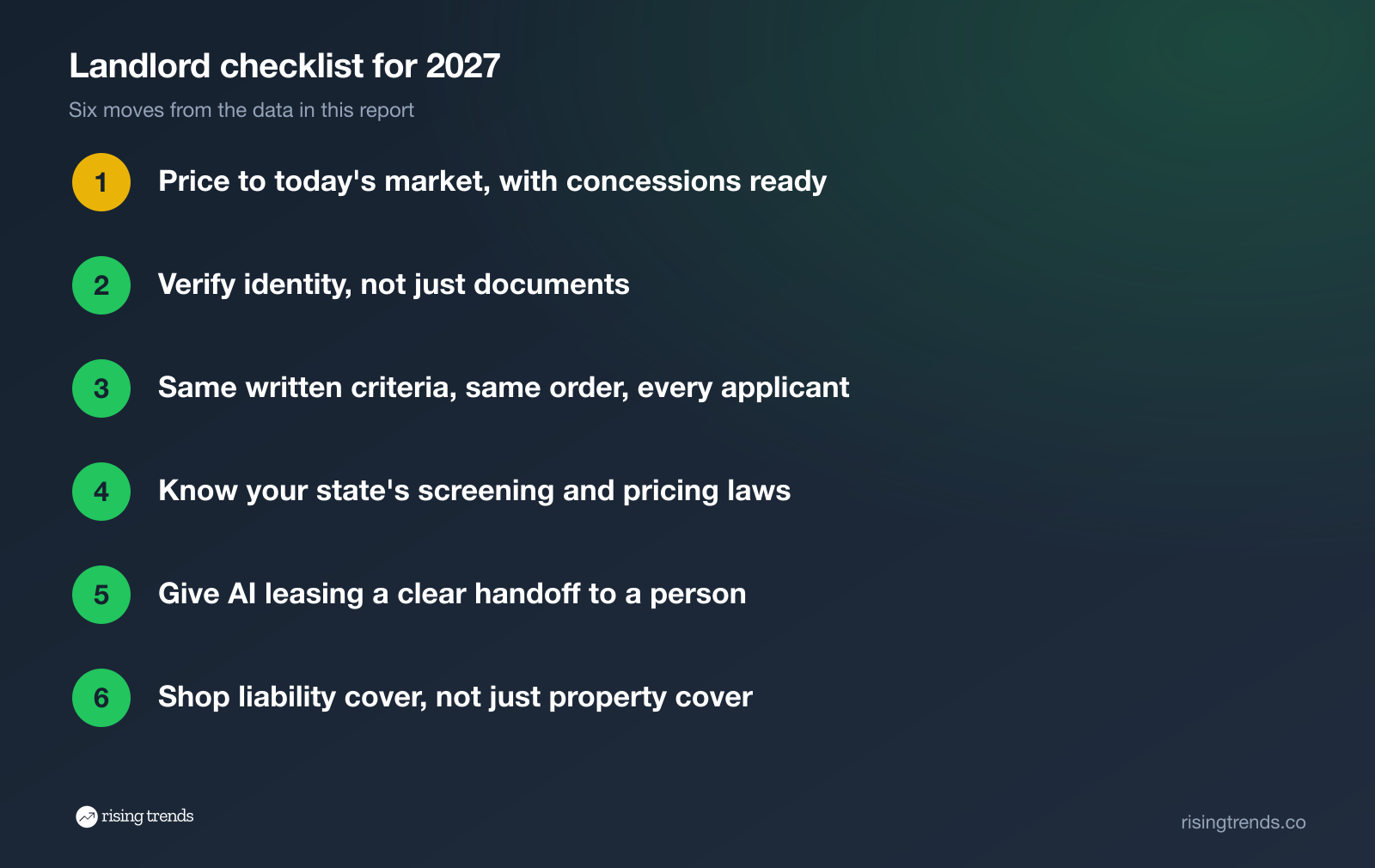
The biggest rental property management trends for 2027 are a renter's market that rewards fast, well-priced listings, application fraud that documents alone no longer catch, and a wave of rules on how landlords screen tenants and set rents. Here are all six, with the number behind each:
- Renters have the upper hand. The national rental vacancy rate hit 7.6% in Q3 2026, up from 7.1% a year earlier, and 43.9% of listings now offer a concession.
- Fraud moves into the application. 82% of landlords in a September survey worry about application fraud, and 42% say the person who moved in was not the person they approved.
- Screening rules get stricter. Maryland's Fair Chance Housing Act took effect on October 1, 2026, moving criminal background checks to after a conditional offer.
- Algorithmic rent pricing is in court. A federal judge blocked New York's ban on algorithmic rent-setting on September 29, while 10 states keep pushing their own case against RealPage.
- AI leasing agents go mainstream. Searches for "apartment ai" are up 421% in a year, and the biggest AI leasing vendor says it touches about 1 in 6 US apartments.
- Costs shift from property to liability. Florida multifamily property premiums fell from $797 to $479 per unit, but liability premiums keep climbing.
Every figure comes from the organization that measured it (the US Census Bureau, Realtor.com, Yardi Matrix, Cotality, Checkr, state legislatures, court reporting and insurance data), plus our own search data from the Rising Trends database. For the wider market picture, see our real estate trends page.
Let's get into it.
1. Renters Have the Upper Hand Again
After three years of new supply, 2026 is ending as a renter's market in most of the country.
The US Census Bureau's Q3 2026 housing vacancy report, released October 28, puts the national rental vacancy rate at 7.6%, up from 7.1% a year earlier and 7.3% in the second quarter.
Asking rents are flat to slightly down. Realtor.com's September 2026 rent report found a median asking rent of $1,694 for 0 to 2 bedroom units in the 50 largest metros, down 0.4% from a year earlier, the 38th straight month of annual declines. 43.9% of listings offered a concession, up 1.3 points in a year. Yardi Matrix's September national report shows the average advertised apartment rent at $1,775, up just 0.7%, with occupancy at 93.9%.
Units also sit longer. Apartment List data reported by CRE Daily on September 30 shows the typical unit took 34 days to lease, the longest September reading since 2019.
The exception is single-family rentals. Cotality's single-family rent index, published October 15, shows rents up 2.0% a year, the sixth month in a row of faster growth.
Renters are shopping harder too. In our database, "apartment rental agency" searches are up 173% in a year to 49,500 a month, and "pet friendly apartments near me" is up 83% to 33,100.
What to do about it
Price to the market you are in, not the one from 2022. Check comparable listings and their concessions every time a unit turns, and decide in advance what you will offer (a reduced deposit, a free first month, a flexible move-in date) rather than discounting after the unit has sat for a month.
Speed matters as much as price when units take 34 days to lease. Answer inquiries the same day, offer tour times outside office hours and publish rent, deposit, pet rules and screening criteria in the listing, so the applicants who reach you already fit.
2. Application Fraud Is the New Screening Problem
Fake pay stubs used to be easy to spot. AI tools have made them cheap and convincing.
Screening company Checkr's State of Rental Fraud 2026, a survey of 1,400 landlords and property managers published September 10, found that 82% worry about application fraud and 67% say AI-generated fraud is harder to catch than a year ago. 42% have found that the person who moved in was not the applicant they approved, and 46% lost at least $5,000 to a fraudulent or bad-fit tenant. Only 22% trust their current provider to catch AI-made fakes.
States are starting to treat it as a crime. Florida's new rental fraud law, which took effect October 1, 2026, makes using a false identity or fake documents on a rental application a third-degree felony and lets landlords serve a 7-day notice with no chance to cure.
What to do about it
Check the person, not just the paperwork. Confirm identity against the documents, verify income at the source where the applicant authorizes it, and make sure the person who signs the lease and picks up the keys is the one you screened.
Then run the same process for everyone. Landlords can use tenant background check services to review background, credit and eviction reports as part of a documented screening process, then apply the same written criteria in the same order to every applicant. A consistent process catches more fraud, and it is also your best record if a decision is ever challenged.
Don't treat a gap as proof of fraud. A missing page or an unusual pay format from a self-employed applicant calls for a follow-up request, not a rejection.
3. Screening Rules Get Stricter, State by State
The other side of the screening question is how much landlords are allowed to ask.
Maryland's Fair Chance Housing Act (SB 937) took effect on October 1, 2026. It limits which criminal records landlords can ask about or consider, allows criminal background checks only after a conditional offer, and requires landlords to consider evidence the applicant provides. Two more Maryland renter laws started the same day, including a ban on rejecting housing-subsidy users over their credit history.
Florida tightened the rules against fraudulent applicants while Maryland tightened them on landlords. Both happened in the same week, which shows why there is no longer one national screening playbook.
What to do about it
Write your screening criteria down, tie each one to a real rental requirement and check them against your state and city rules before every leasing season. Keep the order of the checks fixed (income and rental history first, criminal history only where and when the law allows), and keep a short note on why each applicant was approved or declined.
Collect only what you need and set a retention schedule. Sensitive applicant records should not stay accessible forever just because storage is cheap.
4. Algorithmic Rent Pricing Moves Into the Courts
The fight over rent-setting software is now spread across federal court, state attorneys general and city councils.
On September 29, a federal judge in New York granted RealPage a preliminary injunction against the state's ban on algorithmic rent-setting, on First Amendment grounds. Similar local bans remain on the books in Jersey City, Providence, Philadelphia, Minneapolis, San Francisco and Seattle.
At the same time, 10 state attorneys general opposed RealPage's bid to end their case, arguing the federal settlement does not cover their claims. A separate Tennessee class action has already produced $141.8 million and then $218 million in settlements from landlords.
Renters are following the story. Searches for "realpage rental settlement" went from zero to 33,100 in August 2026 in our database and were still at 12,100 in September, as people looked up whether they could claim.
What to do about it
If you use revenue management software, know what data it pools and whether your city or state restricts it. Keep a person accountable for the final rent on each unit and document why it was set where it was. In a soft market with high concessions, a pricing tool that recommends holding rents while units sit empty costs you money as well as legal risk.
5. AI Leasing Agents Go Mainstream
The first reply to a rental inquiry is increasingly written by software.
EliseAI, the largest AI leasing vendor, raised $350 million at a $4 billion valuation in late September and says its platform touches about 1 in 6 US apartments (the company's own figure). Two weeks later, RealPage paused new EliseAI integrations with its property management system, a sign that the fight is now over who controls leasing data.
Search interest is climbing fast. "Apartment ai" is up 421% in a year to 9,900 searches a month, and it has risen almost every month since January.
People are not leaving leasing. A CRETI jobs report covered by Multifamily Dive on October 9 counted 423 open residential leasing jobs in Q3, about two-thirds of the roles it tracked, at a median of $20 an hour.
What to do about it
Let automation handle the questions with fixed answers (availability, tour booking, application status, maintenance intake) and decide in advance where a person takes over: a recurring repair, a dispute, a screening decision. Test any tool as a renter first. Count the steps, try it on a phone and check that staff can see the full conversation history in one place.
6. Costs Shift From Property Insurance to Liability and Debt
Some landlord costs are finally easing. Others are not.
Insurance Journal reported on October 26 that the median Florida multifamily property premium fell from $797 per unit in early 2025 to $479 in April 2026, after the state's insurance reforms. Liability is going the other way: Georgia rose from $119 to $151 per unit, and Florida sits around $169.
Debt is the bigger pressure for leveraged owners. Trepp data reported by Multifamily Dive on October 19 puts the multifamily CMBS delinquency rate at 8.04% in September, up from 6.59% a year earlier.
What to do about it
Re-shop insurance at every renewal and split the property and liability lines when you compare quotes, since they are moving in opposite directions. Reduce liability risk where it starts: documented maintenance responses, lighting, entry controls and fast follow-up on safety complaints.
Then measure what each tool saves. Review rent collection timing, vacancy days, maintenance response times and admin hours after one full leasing cycle, and drop any subscription that does not move one of them. Our insurance trends page tracks the wider insurance market.
What We're Seeing in Search
Our database tracks US search demand for tens of thousands of trends. Here is what it shows for rental property as of September 2026, compared with September 2025.
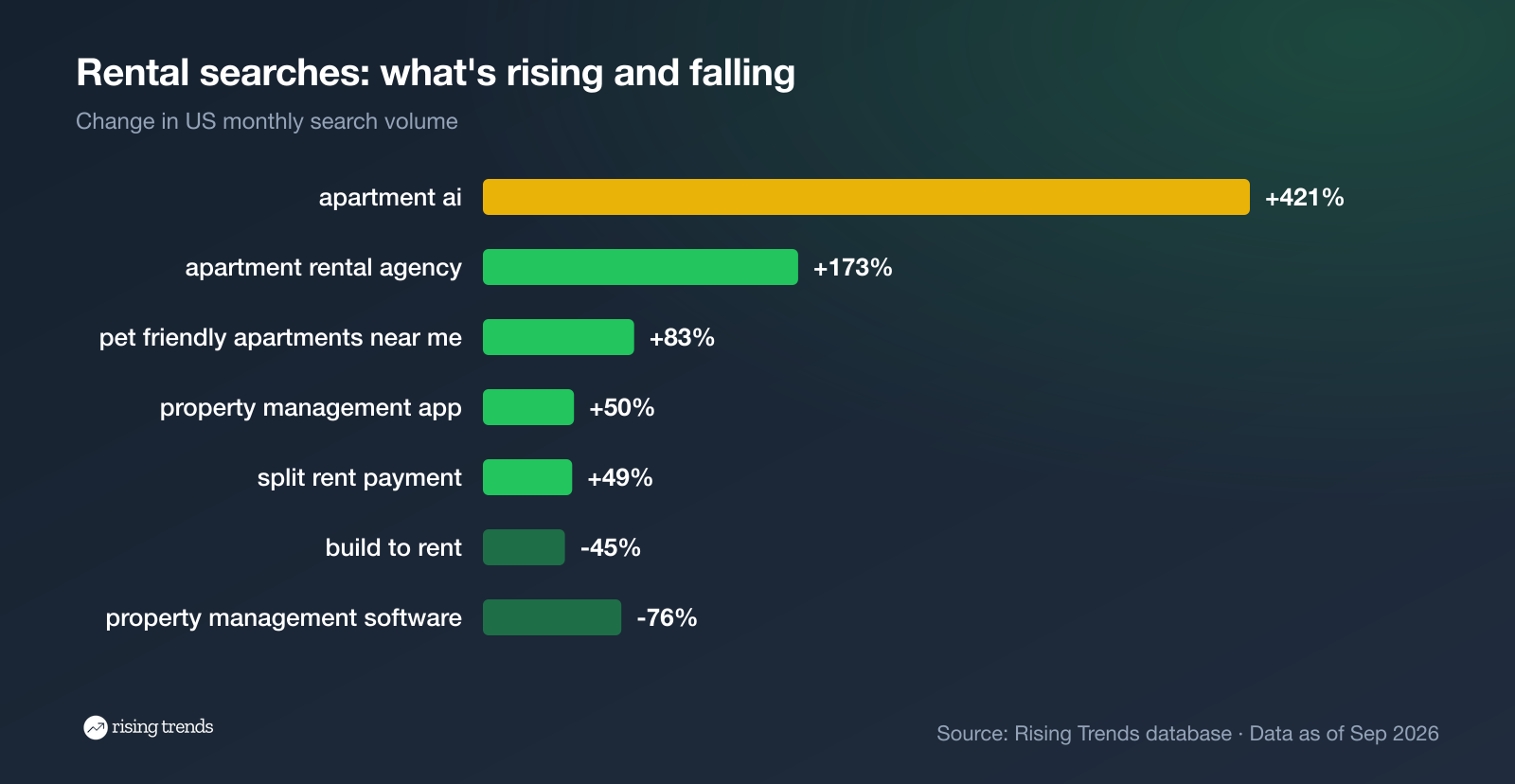
- AI is the fastest riser. "apartment ai" (+421%) leads the set, backing trend 5.
- Renters are shopping around. "apartment rental agency" (+173%) and "pet friendly apartments near me" (+83%) both climbed as vacancy rose.
- Apps over suites. "property management app" is up 50% while "property management software" is down 76%. Smaller landlords want tools they can run from a phone.
- Payments get flexible. "split rent payment" is up 49% to 12,100 searches a month.
- New supply cools. "build to rent" is down 45%, in line with the slower construction pipeline.
If you want to use search data like this to test an idea before you invest in it, our guide on validating market demand walks through the method.
The Common Thread
Put the six shifts side by side and one pattern runs through them: rental management is being judged on process, not just on rent.
In a soft market the landlord who answers first and prices honestly fills the unit. With AI-made fraud, a consistent screening process is the only reliable defense. With new rules on screening and pricing, that same written process is what protects you in a dispute.
If you only fix three things before 2027: write down your screening criteria and apply them the same way to everyone, verify the identity of every applicant, and set a clear point where automation hands off to a person.
Frequently Asked Questions
What are the biggest rental property management trends for 2027?
A renter's market with rising vacancy and frequent concessions, AI-driven application fraud, stricter state screening laws, legal fights over algorithmic rent pricing, the spread of AI leasing agents, and a shift in landlord costs from property insurance to liability and debt.
Are rents going up or down in 2026?
Mostly flat. Realtor.com's median asking rent was $1,694 in September 2026, down 0.4% from a year earlier, while Yardi Matrix measured apartment rents up 0.7%. Single-family rents rose faster, up 2.0% a year according to Cotality.
How common is rental application fraud?
Common enough that most landlords now plan for it. In Checkr's September 2026 survey of 1,400 landlords and property managers, 82% said they worry about application fraud and 42% had found that the person who moved in was not the approved applicant.
What changed in tenant screening laws in October 2026?
Maryland's Fair Chance Housing Act took effect October 1, 2026, limiting the criminal history landlords can consider and moving criminal checks to after a conditional offer. Florida's rental fraud law took effect the same day, making fake identities or documents on a rental application a felony.
Is algorithmic rent pricing legal?
It depends on where you are. Several cities, including Philadelphia, Minneapolis, San Francisco and Seattle, ban it. New York's statewide ban was blocked by a federal judge on September 29, 2026, and state attorneys general are still pursuing claims against RealPage.
Want to spot the next market shift before your competitors do? Read our guide on how to identify market trends or browse what's gaining traction in our trending topics list.
Never miss a trend again
- One trend broken down with the numbers
- Who's making money, and what to build
- A website on the rise
- A breakout app
Join 5,000+ founders