
The biggest payment trends for 2027 are tap to pay becoming the default way Americans pay in store, a legal fight that could change what merchants pay to accept cards, and a wave of pricing rules that decide how fees and cash are handled at the register. Here are all eight, with the number behind each:
- Tap to pay becomes the default. 75% of Visa's in-person transactions in the US are now contactless, and US searches for "tap to pay" are up 50% in a year.
- The phone becomes the terminal. More than 25 million mobile devices now accept Visa as a payment terminal, and 30% of the sellers using them are new to Visa this year.
- Swipe fees hit a record while the rules get rewritten. US merchants paid $198.25 billion in card fees in 2025, and the Visa and Mastercard settlement faces its final approval hearing on November 16, 2026.
- Pricing rules tighten: all-in prices, surcharges and cash. Illinois bans hidden mandatory fees from January 1, 2027, and Maryland began requiring stores to accept cash on October 1, 2026.
- The wallet race heats up. Searches for the bank-owned wallet Paze went from 27,100 to 201,000 a month after its June relaunch, while PayPal's branded checkout grows 1% to 2%.
- Instant payments grow, pay by bank lags. FedNow handled 6.4 million payments in Q3 2026, up 154% in a year, but checkout use of pay by bank is still small.
- Fraud moves to scams and refund abuse. 16% of US adults say they were scammed while holiday shopping online, and Visa changed its dispute evidence rules on October 24, 2026.
- AI agents bring shoppers before they bring payments. Shopify's AI-driven orders are up 3.3x in a year, but Visa and Mastercard both call agent payment volumes small.
Every figure comes from the organization that measured it (Visa, Mastercard, the Federal Reserve, court filings, state laws, company earnings releases and named surveys), plus our own search data from the Rising Trends database. For the banking and crypto side of payments (stablecoins, bank charters, open banking), see our fintech trends article.
Let's get into it.
1. Tap to Pay Becomes the Default
In the US, tapping a card or phone is now the normal way to pay in person.
Visa's CEO Ryan McInerney told investors on the company's fiscal Q4 2026 earnings call on October 27 that tap to pay is close to 85% of Visa's face-to-face transactions globally and 75% in the US, after "the final top 100 seller" switched it on in 2026. Two days later, Mastercard said on its Q3 2026 call that contactless is 81% of its in-person purchase transactions, up 5 points in a year.
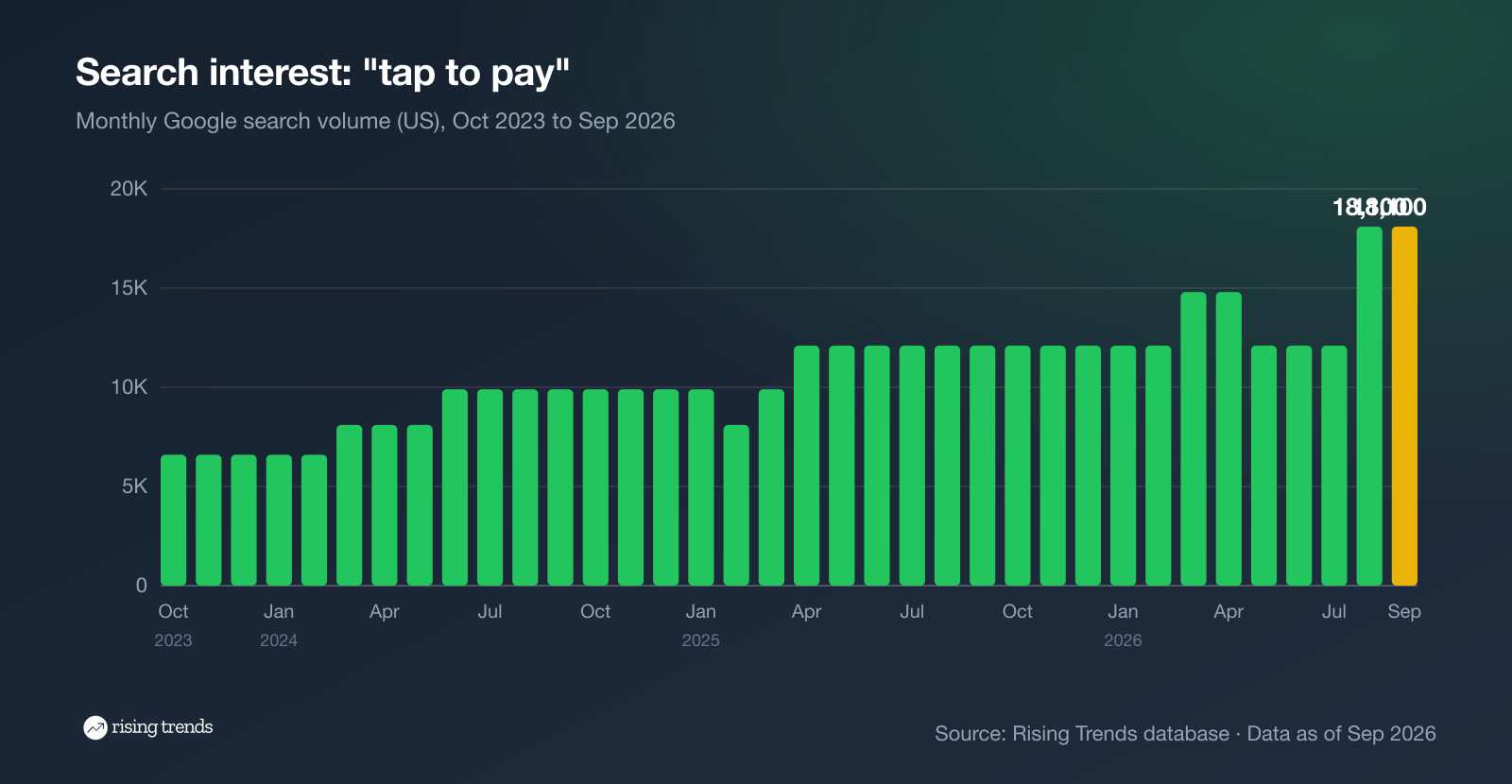
Shoppers are noticing. US searches for "tap to pay" reached 18,100 a month in September 2026, up 50% from a year earlier, the highest level in the three years we track.
For a merchant, that changes what a working checkout looks like. A customer who taps everywhere else will notice a terminal that asks them to insert a card or doesn't recognize a phone or watch. Before you replace equipment, check that each terminal accepts contactless cards and the major phone wallets, how it connects to your point-of-sale system, and what happens to sales when the internet drops. Countertop terminals suit a fixed register; portable readers let restaurant and service staff take payment where the customer is.
Price the whole setup, not just the reader. Processing rates, how quickly payouts reach your bank, installation, software updates and who answers when a terminal fails all matter more over a few years than the hardware price. Businesses comparing equipment, processing and account support in one contract can look at a merchant account provider North alongside the POS platforms below. A cheap reader gets expensive if staff have to type every sale into a second system by hand.
What to do about it
Audit every place you take money: registers, tables, delivery, pop-ups, phone orders. Any spot that can't take a tap is now the slowest part of your checkout.
Ask customers and staff which payment methods people ask for that you don't accept. Repeated requests are the clearest sign an upgrade is overdue.
2. The Phone Becomes the Terminal
The cheapest card terminal is now a phone the seller already owns.
Visa says more than 25 million mobile devices are active as Visa-accepting terminals through its Tap to Phone program, they handled over 1 billion transactions in 2026, and 30% of the sellers using them are new to Visa this year (same October 27 call). Apple extended Tap to Pay on iPhone to eight more Latin American countries in September. Taking cards no longer needs a separate device or a setup visit, which is why so many first-time sellers show up in Visa's numbers.
As the hardware gets cheaper, the money moves into software and payments. Toast's Q3 2026 results show about 189,000 locations, up 21%, and $61.8 billion of payment volume, up 20%. At Lightspeed, payments now make up 45% of transaction volume, up from 40% a year earlier. Square's payment volume grew 14% to $76.4 billion, but its shareholder letter notes that only 16% of its US sellers pay for its software, which is where Square wants to grow. Square's new AI voice-ordering kiosk, launched October 14 at $1,999 plus $99 a month, shows where the hardware that remains is heading: devices that take the order as well as the payment.
Search fits the shift. US searches for "pos system" fell 45% in a year and "card reader" 18%, while "tap to pay on iphone" held steady at 3,600 a month.
What to do about it
Use phones as extra lanes. A phone that can take a tap turns a queue, a market stall or a busy patio into more checkouts without buying more terminals.
When you compare POS platforms, look at the payment rate and the software fee together. Platforms that discount one often make it up on the other, so compare the total cost per month at your real sales volume.
3. Swipe Fees Hit a Record While the Rules Get Rewritten
Card acceptance is one of the biggest costs a merchant has, and 2027 could be the year it changes.
According to Nilson Report data published by the Merchants Payments Coalition on September 14, US merchants paid a record $198.25 billion in credit and debit card swipe fees in 2025, and the average Visa and Mastercard credit card fee was 2.36% of the sale. The coalition is a merchant lobbying group, but the totals come from Nilson.
Three fights could change those costs:
- The Visa and Mastercard settlement. The revised deal would cut credit card fees by 10 basis points for five years, cap standard consumer card rates at 1.25% for eight years, let merchants decline some premium cards and widen their right to surcharge. 978 merchants and trade groups objected, Walmart is trying to opt out, and the final approval hearing is set for November 16, 2026 in Brooklyn. US searches for "visa mastercard settlement" jumped from 1,000 in August to 9,900 in September.
- The debit fee cap. On October 26, the 8th Circuit struck down the method the Federal Reserve used to set the 21-cent cap on large banks' debit fees, ruling that the law allows fewer costs to be counted. The Fed now has to rewrite the rule, which points to a lower cap, but nothing changes at the terminal until it does.
- The Credit Card Competition Act. The White House renewed its push in October for the bill, which would require cards from big banks to run on at least two unrelated networks. It still hasn't passed.
What to do about it
Know your real rate. Pull last quarter's statements and divide total fees by total card sales; many merchants pay well above the headline rate once premium cards and add-on fees are counted.
Watch the November 16 ruling. If the settlement is approved and survives appeal, it gives you new options, such as declining some premium cards or surcharging them, and you will want a policy ready rather than deciding at the register.
4. Pricing Rules Tighten: All-In Prices, Surcharges and Cash
How you show fees, add surcharges and handle cash is now set more and more by law rather than by each store.
The trend is toward one honest price. The Illinois Junk Fee Ban Act takes effect on January 1, 2027: advertised prices must include mandatory fees, and restaurants must show automatic tips and mandatory charges before the check arrives. California, Colorado and Massachusetts already have similar all-in pricing rules. Abroad, Australia went further and banned card surcharges on Visa, Mastercard, Amex and eftpos from October 1, 2026. In the US, Visa has capped credit card surcharges at 3% since 2023, and the pending settlement would widen merchants' surcharging rights.
Cash is getting legal protection at the same time. Maryland's cash acceptance law took effect on October 1, 2026: between 6 a.m. and 10 p.m., stores may not refuse cash or charge more for it on essentials such as food, hygiene products and fuel, for in-person purchases from $5 to under $300. Restaurants are exempt, and fines of $500 and then $1,000 apply only after two warnings. New York's statewide cash law took effect in March. Congress also passed the Common Cents Act in September, which would end penny production and set rules for rounding cash totals to the nearest nickel.
Consumers are paying attention. US searches for "cash only" rose 50% in a year to 9,900 a month, and "cash discount program" rose 24%.
What to do about it
Put every mandatory charge in the listed price. If you add a service fee, kitchen fee or card surcharge, show it before the customer orders, not on the receipt.
Check the cash rules where you trade. If you went card-only, confirm your state or city allows it, and keep a simple way to take cash or a free cash-to-card option where the law requires one.
5. The Wallet Race Heats Up
Apple Pay and Google Pay no longer have the wallet market to themselves.
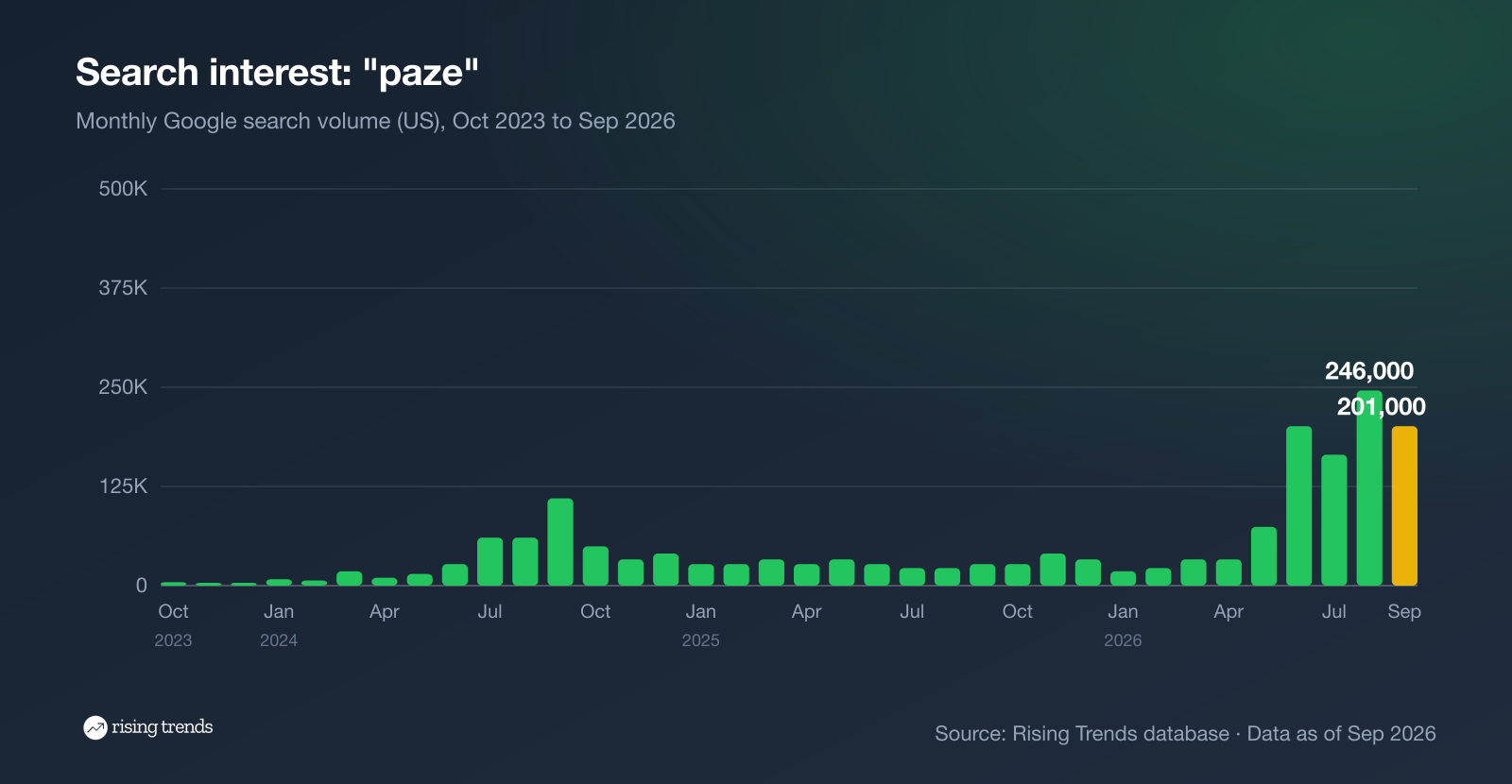
Paze, the wallet owned by seven big US banks including JPMorgan Chase, Bank of America and Capital One, relaunched on June 15, 2026 after a year-long redesign, backed by a national TV campaign starring Elizabeth Banks and Gabrielle Union and a $10 statement-credit promotion that ran until September 11. US searches for "paze" went from 27,100 a month in September 2025 to 201,000 in September 2026, after peaking at 246,000 in August. Paze says about 220 million cards are loaded, it will beat its 2026 transaction goal four times over, and it wants the 100 largest US merchants on board within three years. It runs on card rails, so normal card fees still apply.
The older wallets are moving in different directions. PayPal said on its Q3 2026 call that its branded checkout has grown only 1% to 2% for four straight quarters, while Pay with Venmo volume grew 43% and Pay Later grew 25%. US searches for "google wallet" are up 22% in a year; "apple pay" is down 18%, though still at 301,000 a month. Behind all of them, Visa says over 60% of its online transactions now use tokens rather than the real card number.
Buy now, pay later is becoming one more button in the wallet. Affirm's quarter to September 30 showed $14.4 billion of volume, up 34%, across 621,000 merchants, up 48%, and Adobe forecasts $21.3 billion of BNPL spending this holiday season, 82% of it on mobile. Searches for "buy now pay later" fell 18%, a sign people use it without looking it up.
Merchants expect more of this. In Oliver Wyman and the Merchant Advisory Group's September 2026 merchant study, 89% of large merchants expect wallet use to stay the same or grow in 2027.
What to do about it
Show the wallets your customers already have at the top of checkout, especially on mobile. Each extra step to find a payment button costs sales.
Track what each wallet costs you. Wallets that run on cards carry card fees, BNPL providers charge more, and the cheapest option for you isn't always the one your customer picks.
6. Instant Payments Grow, Pay by Bank Lags
Money now moves between US bank accounts in seconds, but very little of it is shoppers paying at checkout.
The Federal Reserve's FedNow statistics show 6.38 million payments in Q3 2026, up 154% from 2.51 million a year earlier, worth $370.9 billion. The average payment fell from $122,616 to $58,161, which means more everyday-sized payments are moving over the system. The Clearing House's private RTP network handled 150 million payments worth $621 billion in the same quarter.
At checkout, pay by bank hasn't caught on in the US the way it has in Europe. US searches for "pay by bank" fell 32% in a year to 1,300 a month, and we found no major new US pay-by-bank checkout launches this fall. The rule that would give shoppers free access to their bank data is still being rewritten by the CFPB, and the draft is expected to let banks charge for that access, which would raise costs for pay-by-bank providers.
What to do about it
Use instant payments where they already pay off: faster payouts to your own account, paying suppliers and contractors, and refunds that land the same day.
Treat pay by bank at checkout as a test, not a plan. It can cost less than cards for large tickets such as rent, tuition or bills, but few shoppers will choose it until the rules settle.
7. Fraud Moves to Scams and Refund Abuse
Stolen card numbers matter less. Tricking people, taking over accounts and abusing refunds matter more.
Sift's Q3 2026 Digital Trust Index found the payment fraud attack rate fell 14% to 2.8%, while scams and account takeovers grew, and retailers were the most impersonated brands in scams (40%). Norton's holiday report, published November 5 from a September survey of 1,000 US adults, found 16% were scammed while holiday shopping online, losing $394 on average, and fake-shop activity up 129%. In Europe, a Ravelin survey of 6,282 shoppers found 27% admit to abusing refunds.
The networks are responding. From October 24, 2026, Visa's Compelling Evidence 3.0 rules let the two earlier undisputed purchases used to fight a "this wasn't me" chargeback come from other merchants, not only your own store, and logins at an agent payment provider now count as matching data. Visa is also buying BioCatch, which spots fraud from how people type and swipe, for $2.4 billion. In search, "chargeback fraud" fell 55% in a year, while "card testing" held at 1,900 a month.
What to do about it
Keep the evidence. Store device, IP address, account and delivery data for every order for at least a year, since those are what win disputes under the new rules.
Write your refund policy for abuse, not just mistakes. Require returns before refunds for high-value items, flag accounts with repeated "item not received" claims, and protect your brand from impersonation by registering obvious lookalike domains.
8. AI Agents Bring Shoppers Before They Bring Payments
AI assistants are already sending customers to stores. They aren't paying for much yet.
Shopify said on its Q3 2026 call that AI traffic to its merchants is up 2.6 times and AI-driven orders up 3.3 times in a year, and that Shop Pay works inside several AI shopping agents. Adobe found that in September, visitors referred by AI tools to US retail sites spent 83% more per visit and converted 90% better than other visitors, and it expects AI-referred traffic to rise 130% this holiday season. Google launched Universal Cart in the US on October 15, one cart across stores inside Search and Gemini.
Payments by the agents themselves are still tiny. Visa has "nearly 50 AI partners live" but described agent transactions as "albeit limited" in number. Mastercard said it is "still early days, and the numbers are not yet significant." In the Oliver Wyman study, 84% of large merchants have seen no customer demand for agent checkout. US searches for "agentic commerce" are up 22% to 4,400 a month, but "chatgpt instant checkout" fell 91% after OpenAI folded the feature into ChatGPT apps in March.
What to do about it
Make your products easy for AI tools to read: complete product data, clear prices and stock, and fast pages. That is what brings AI-referred visitors now.
Don't build a special agent checkout yet. Support the wallets and tokenized cards the agents already use, and decide how you will handle a dispute when a customer says "my assistant bought that, not me."
What We're Seeing in Search
Our database tracks US search demand for tens of thousands of trends. Here is what it shows for payments as of September 2026, compared with September 2025.
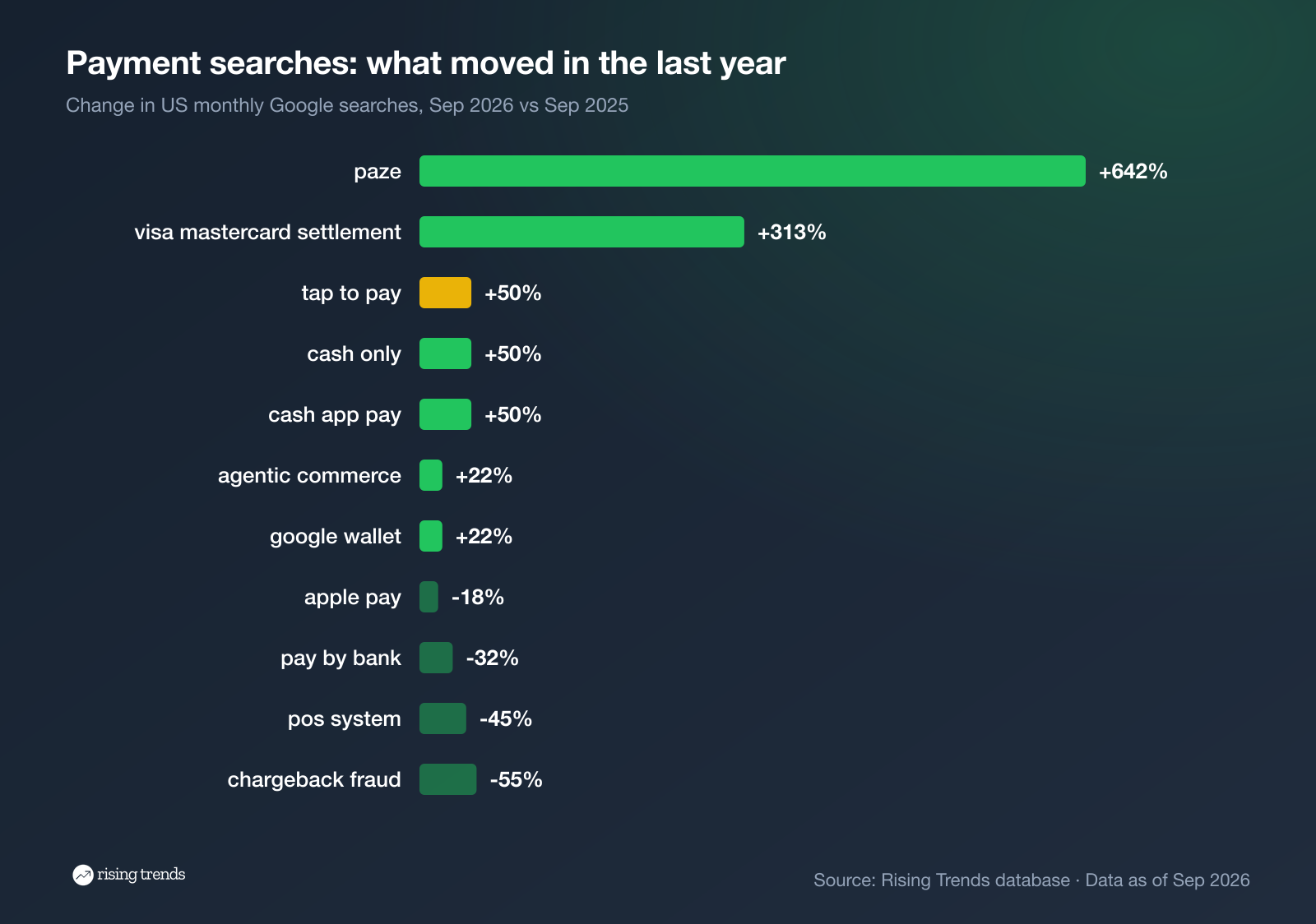
- A new wallet broke through. "paze" (+642%) leads after the June relaunch and TV campaign, backing trend 5.
- Fees are news. "visa mastercard settlement" (+313%) spiked ahead of the November hearing in trend 3.
- Tapping is mainstream. "tap to pay" (+50%) reached a three-year high, in line with trend 1.
- Cash is back in the conversation. "cash only" (+50%) rose as states passed cash acceptance laws in trend 4.
- Hardware shopping is cooling. "pos system" (-45%) and "card reader" (-18%) fell as phones take on the terminal's job in trend 2.
If you want to use search data like this to test a market before you invest in it, our guide on validating market demand walks through the method.
The Common Thread
Put the eight shifts side by side and one pattern runs through them: the checkout is getting cheaper to run, but the rules around it are getting stricter. Taking a payment now needs little more than a phone, and customers tap, use wallets and split payments without thinking about it. At the same time, courts, regulators and states are deciding what merchants pay in fees, how they show prices, whether they must take cash and how disputes are settled.
The merchants who do well in 2027 will accept every common way to pay, know exactly what each one costs them, and keep their pricing and records clean enough to meet the new rules.
If you only fix three things before 2027: make sure every checkout point takes a tap, calculate your real card acceptance rate, and put every mandatory fee in the listed price.
Frequently Asked Questions
What are the biggest payment trends for 2027?
Tap to pay becoming the default in US stores, phones replacing card terminals, record card fees alongside a court fight over the Visa and Mastercard settlement, all-in pricing and cash acceptance laws, new competition among digital wallets, faster growth of instant bank payments, fraud shifting to scams and refund abuse, and AI shopping assistants sending customers to stores.
What percentage of payments are contactless in the US?
Visa says 75% of its in-person transactions in the US were tap to pay as of October 2026, and about 85% globally. Mastercard says contactless is 81% of its in-person purchase transactions worldwide, up 5 points in a year.
What is happening with the Visa and Mastercard swipe fee settlement?
The revised settlement would cut credit card fees by 10 basis points for five years, cap standard card rates at 1.25% for eight years and give merchants more rights to decline premium cards and surcharge. 978 merchants and trade groups objected. The final approval hearing is on November 16, 2026, and objectors have said they may appeal.
Can merchants charge a credit card surcharge?
In most US states, yes, within limits: Visa caps credit card surcharges at 3% or your actual cost, whichever is lower, and the surcharge must be disclosed before payment. Some states restrict or ban surcharges, debit cards can't be surcharged, and new all-in pricing laws such as Illinois's from January 2027 require mandatory fees to be included in the advertised price.
What is Paze?
Paze is a digital wallet owned by seven large US banks, including JPMorgan Chase, Bank of America and Capital One. It lets shoppers check out online with cards their bank has already loaded, without typing the card number. It relaunched in June 2026 and has about 220 million cards loaded.
Want to spot the next market shift before your competitors do? Read our guide on how to identify market trends or see what's changing in stores in our retail trends report.
Never miss a trend again
- One trend broken down with the numbers
- Who's making money, and what to build
- A website on the rise
- A breakout app
Join 5,000+ founders