
Two years ago nobody searched for "no ai slop." Our database has the term at zero in late 2024 and at 20 searches a month a year ago. As of September 2026 it runs at 1,900 monthly US searches, up 9,400% in twelve months, and it broke out in July. That is not a vocabulary shift. That is people typing a demand into a search box.
Most coverage of this has been about the complaint: AI slop is everywhere, platforms are drowning, here is a manifesto. That misses the more interesting number. Over the same twelve months, "ai slop" itself grew 122%. The phrase for rejecting the stuff is growing roughly 77 times faster than the phrase for the stuff. Below we show the curve, the dated trigger that actually set it off (it was not the manifesto), what the new behaviour is, who is already selling against it, and what it does to pricing.
Key takeaways:
- "No ai slop" went from 20 to 1,900 US monthly searches in a year, a 9,400% rise, classified EXPONENTIAL in the Rising Trends database (data as of September 2026).
- The breakout month was July 2026, four months before the No AI Slop Manifesto that most write-ups treat as the origin story.
- The trigger was a false positive, not a flood: on 31 July 2026 Kurzgesagt said YouTube's systems had treated its hand-animated video as AI slop and its reach collapsed.
- Searches for "ai content detector" are down 64% in a year to 8,100 a month. People stopped trying to catch AI and started asking for a label instead.
- The label economy is already real: Not By AI badges appear on 95,000-plus pages, and the Authors Guild has certified thousands of books as Human Authored at $10 a title.
- Ipsos and Syracuse Newhouse tested 20 ads with 3,000 US consumers and found human-made ads 14% stronger on short-term effectiveness, while only 25% of viewers could confidently spot the AI ones.
Let's get into it.
What we're seeing in the Rising Trends data
Here is the monthly search volume for "no ai slop" over the last two years, straight from our database. For most of that window the line is flat on the floor.
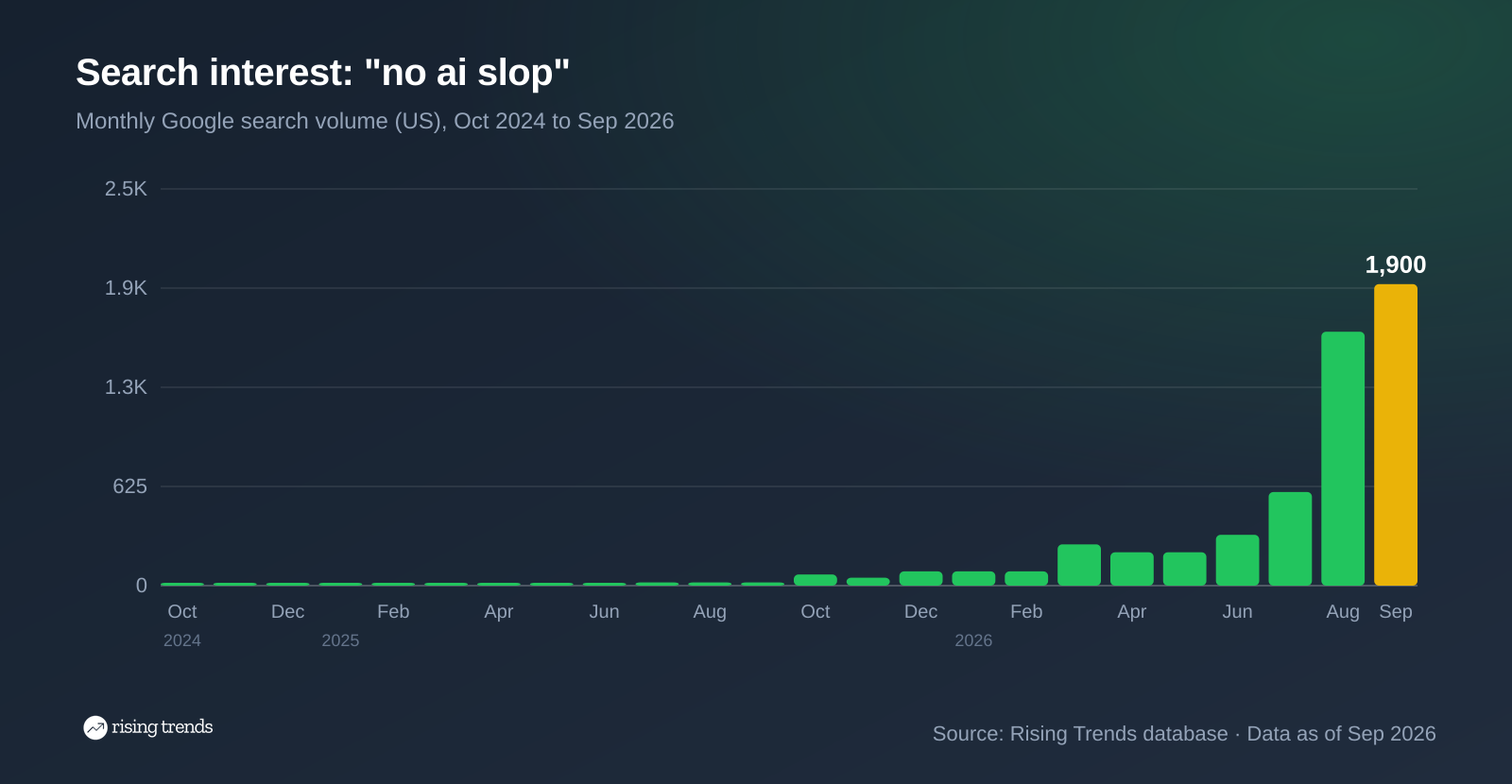
The shape is the story. Nothing through 2025. A first step up in spring 2026. Then 320 searches in June, 590 in July, 1,600 in August and 1,900 in September, a 494% rise in three months and an acceleration ratio of 5.53 against the prior quarter.
One caveat, because it cuts against us. Our latest Google figure is September. Everything that made this term famous, the manifesto and the Hacker News thread and the dictionary announcement, happened in November. The 1,900 is the level before the biggest news event in the term's short history, not after it.
Now the comparison that nothing ranking for this term has.
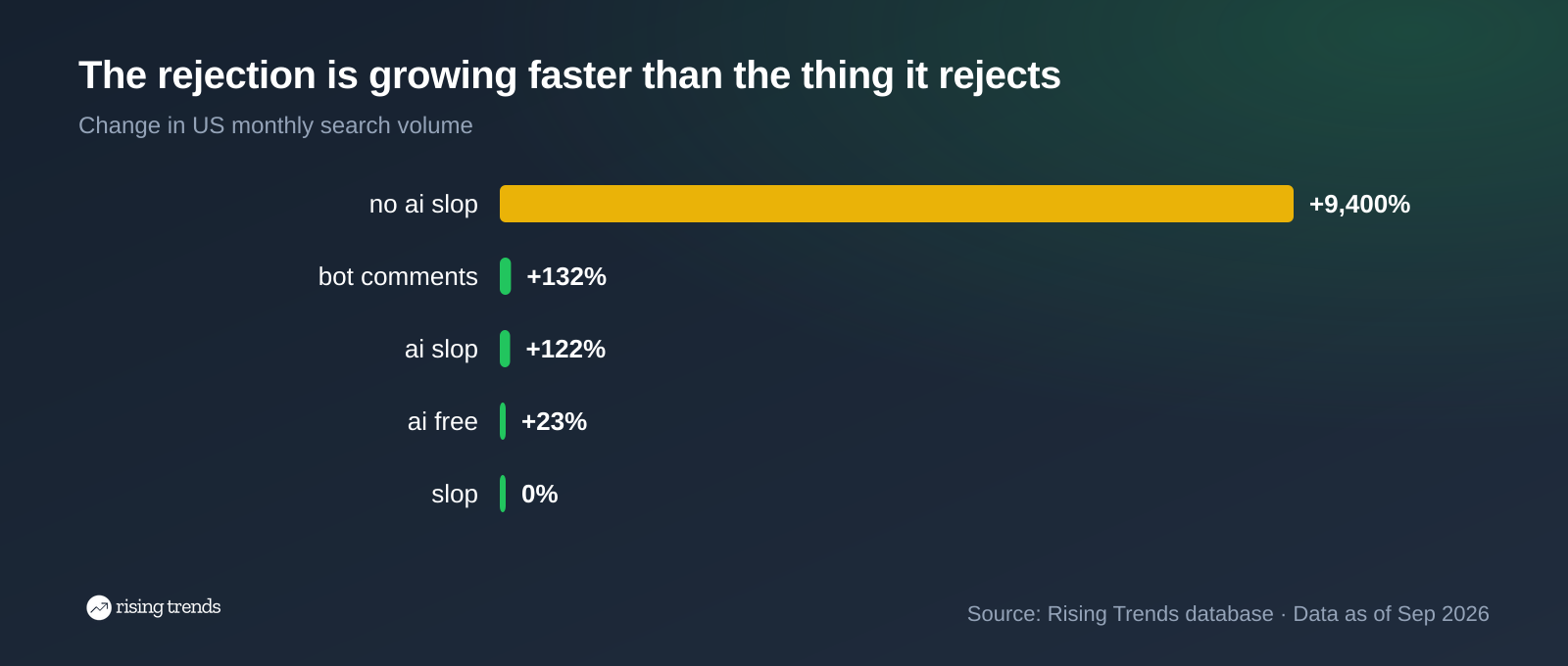
Read the bars in pairs. "Ai slop" is the complaint and it grew 122% in a year. "Slop" on its own is flat at 0%. "Ai free" grew 23%. The only bar that moves is the one that states a requirement rather than an observation. The naming phase is done. The demanding phase has started.
Scale is the other half of the picture, and here we are blunt. "No ai slop" is a small term inside a very large family.
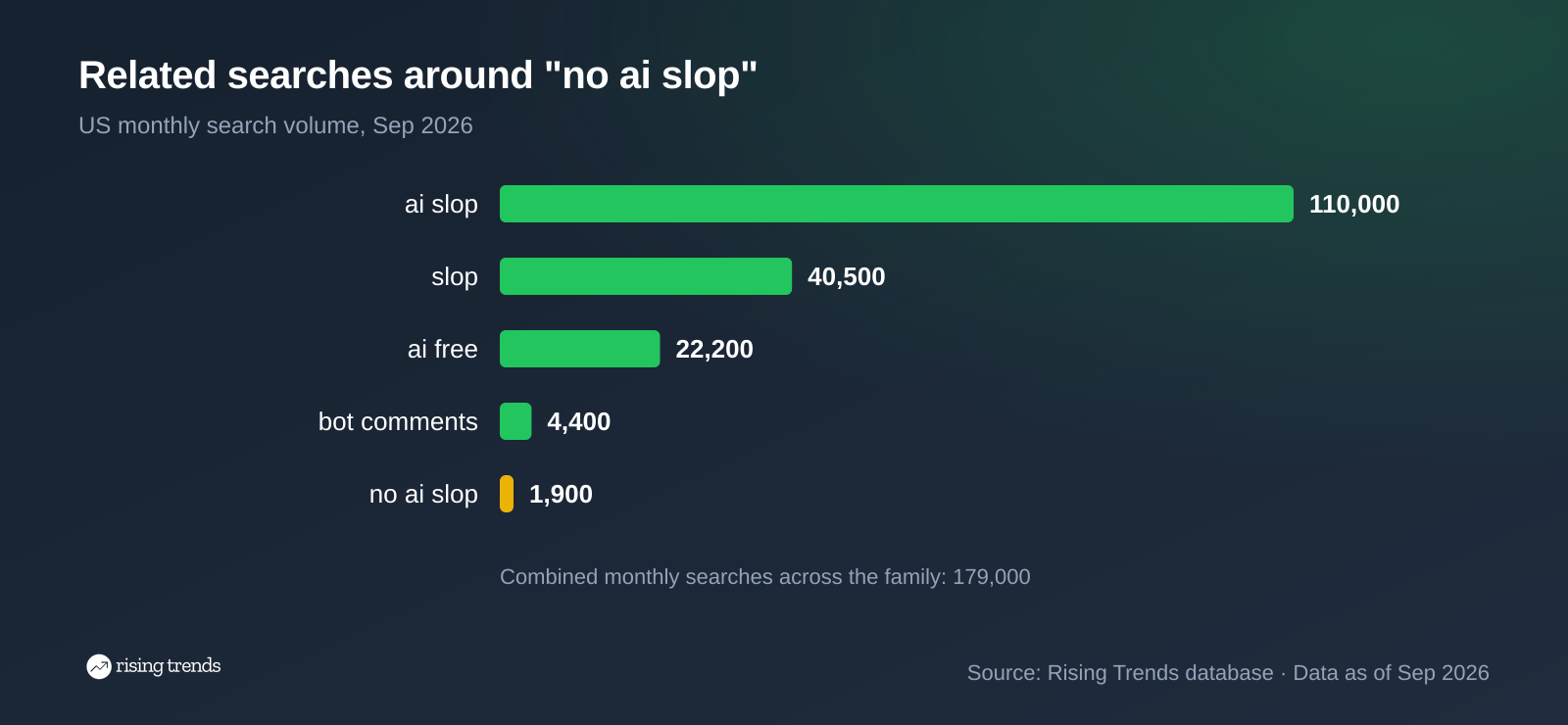
"Ai slop" takes 110,000 searches a month, "slop" 40,500, "ai free" 22,200, "bot comments" 4,400. At 1,900, "no ai slop" is under 2% of the family. It is the leading edge, not the market. The useful read is direction: the 110,000 term is the audience, and the 1,900 term is what that audience is starting to ask for.
What "no ai slop" actually means
The phrase has two lives. The older one is a complaint, roughly "I do not want machine-made filler in my feed." The newer one, the one driving the curve, is a standard: a written rule about what a person, a team or a product will accept.
The clearest version of that standard is the document below, published in November 2026 by the speakers and attendees of the AI Engineer Code Summit and modelled on the Agile Manifesto of 2001.
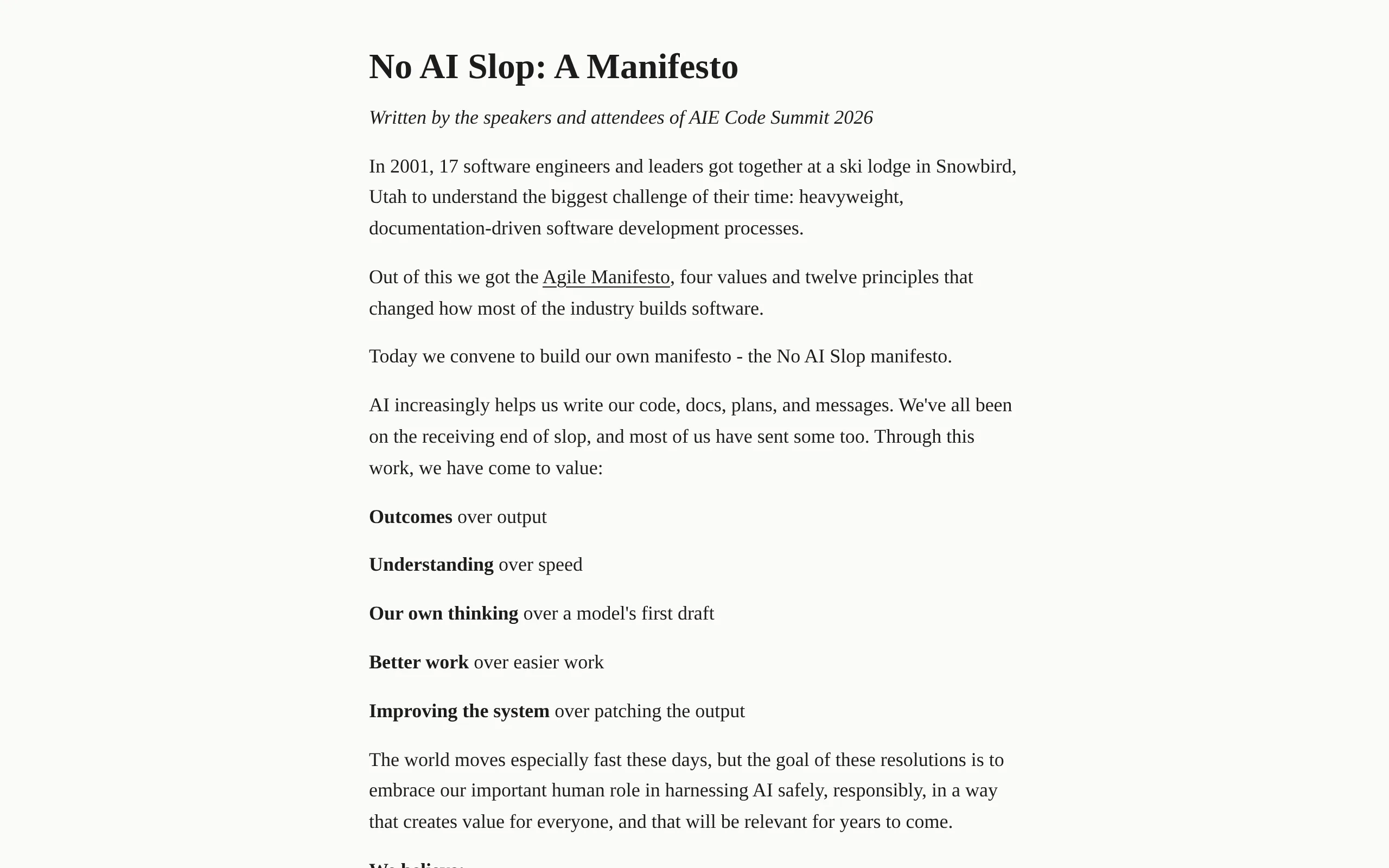
What makes the manifesto worth reading is that it refuses the easy definition. It does not say AI output is slop. It says: "Slop is when we put less effort into producing something than we ask the consumer to spend understanding it." And then: "Using AI doesn't necessarily make something slop. Slop happens when we pass AI output along without taking responsibility for the quality or the reader's experience."
The mechanism it names is the one that matters commercially. "Slop is asymmetric. The cost of producing a thousand-line PR or a ten-page doc is approaching zero, while the cost of reviewing it remains constant." Production got cheap. Attention did not.
The vocabulary follows the same split. "Ai free" and "human made" are claims about inputs. "No ai slop" is a claim about effort. That distinction is why the manifesto can be signed by engineers who use AI all day, and why the term keeps growing while "ai free" sits almost flat.
Why it's trending now
The trigger was not the manifesto. Check the dates: the curve broke out in July 2026, and the manifesto is a November document.
On 31 July 2026, the science channel Kurzgesagt posted a thread titled "YouTube's AI Detection Kicked Us in the Face." The channel said its hand-animated video had been caught by YouTube's systems and buried, despite strong click and watch-time numbers. The post has 7,058 likes. August is the month our search line triples, from 590 to 1,600.
That sequence is the interesting part. What sent people looking for "no ai slop" was not more slop. It was proof that the machines cannot reliably tell the difference, which means humans have to say so themselves, on the label.
The November wave stacked on top. The manifesto reached the front page of Hacker News on 13 November with 230 points, and the next day its lead author posted this.
That post, from 14 November, counted 300-plus signatures from people at Baseten, SpaceX, OpenAI, PostHog and Shopify. Two days later the same account put the count at 660. When we read slopmanifesto.com on 19 November the page listed 913 signatures. Tripling in five days is what adoption looks like before the search data catches up.
On 18 November, Cambridge Dictionary named "human" its Word of the Year 2026, citing "a renewed appreciation for human creativity, connection and authenticity in an AI-driven world." When a dictionary and a room full of AI engineers land on the same instinct in the same week, the thing has stopped being a niche gripe.
The new behaviour: labelling instead of detecting
Here is the before and after, and it is measurable in our own data.
Before: you tried to catch the machine. Searches for "ai content detector" peaked and have since fallen 64% in a year, to 8,100 a month as of September 2026. Detection turned out to be unreliable in both directions, as Kurzgesagt discovered from the wrong end.
After: you declare, and you accept accountability for the declaration. That is what every one of these schemes has in common. Not By AI's badge program says it outright: it "is not an AI detection tool," and the user is accountable for meeting its 90% rule. The Authors Guild verifies the author's identity, not the manuscript. The manifesto is signed, not audited.
Which brings the obvious objection, and the people arguing about this got there first. On Hacker News, one commenter wrote that "this manifesto itself feels rather slop-like to me." Another asked for the byline to state its own method: "Very much need a statement in there as to if AI was used in the making of the manifesto, goes to the heart of the ethical soul of the manifesto." Three days later the manifesto's lead author told an interviewer that the first draft had been written entirely by Claude and that he had not read a word of it before he and a collaborator rewrote it by hand.
You can read that as hypocrisy. We think the manifesto already answers it, in a resolution most pledges would not have survived writing down: "When an agent wrote something we're sending, we make that clear, and we check the parts that matter before it goes out." The claim is not purity. The claim is that a named human took responsibility. A lower bar, and a far more sellable one.
A third commenter put the scale problem better than any press release: "If it was cheaper and easier to make shovelware before, it is 10,000x cheaper and easier now." The same force that made bot comments a 4,400-a-month search term is what makes a human signature worth something.
Who's building on it
For a behaviour this young, the supply side is already crowded, and each of these has a number attached.
| Who | What they sell | The number |
|---|---|---|
| No AI Slop Manifesto | A signed pledge, Agile-style, for engineering teams | 913 signatures on 19 Nov 2026, up from 300-plus on 14 Nov |
| Not By AI | Human-made badges for writing, art, music and film | Badges on 95,000-plus pages; paid for commercial use |
| Authors Guild Human Authored | A book certification mark with a public searchable register | $10 per title for non-members, free for members, capped at ten titles a year |
| Ghostty | An open-source project with a written AI contribution policy | No AI-generated media allowed; repeat offenders go on a public list |
| The Human Made Mark | A film and TV trust mark: an ident, then a numbered end credit | Launched 23 April 2026 for live action and stop motion |
The Authors Guild is the most instructive, because it has been running longest. Its public launch in March 2026 followed a members-only beta that started in January 2025, and by then members had "added the certification to thousands of books." Its definition is narrow on purpose: a work qualifies if the text "was fully authored by one or more human beings and not generated by AI, except for a de minimis amount," with research, outlining and brainstorming explicitly allowed.
Ghostty shows what the same idea looks like in software, and it is blunter. Its policy requires all AI use to be disclosed, bans AI-generated art and audio entirely, and warns that contributors shipping obvious slop go on a published list. The section titled "There are Humans Here" explains why: low-effort work "puts the burden of validation on the maintainer." Then it undercuts the easy reading of itself: "Our reason for the strict AI policy is not due to an anti-AI stance... It's the people, not the tools, that are the problem."
What it means for business
The first question any marketer asks is whether the label sells anything. The best evidence we found is a controlled test rather than a survey.
In May 2026 Ipsos ran 20 ads past 3,000 US consumers, half human-made and half generated entirely with AI, using its Creative Spark system. The human-made ads came out 14% stronger on short-term effectiveness and 17% stronger on long-term brand equity. Worth noting what those indices are: Ipsos model predictions of business impact, not measured in-market sales.
The second finding should worry anyone planning to charge a premium. Only 25% of viewers who saw an AI ad were at least somewhat confident it was AI-made, and 40% were unsure either way. Audiences cannot tell. So the gap between human and AI work is real but invisible, and invisible advantages do not price themselves. They have to be declared, which is exactly what the badges and marks exist to do.
Three consequences follow.
Disclosure becomes a label, not a disclaimer. For three years the convention was to admit AI use quietly in a footer. The schemes above invert it: the human claim goes on the cover. Teams planning 2027 marketing should treat provenance as packaging, not compliance.
Review capacity becomes the bottleneck. The manifesto's asymmetry point is an operations problem with a budget line. If generation is free and review is not, the constrained resource in every content, code and design team is qualified human attention. The teams that win fund reviewing, not more generating. It is the same squeeze we traced in self-improving AI, where the bottleneck moved from producing candidates to evaluating them.
Categories that cannot verify get hit anyway. Stock media, SEO content farms, royalty-free music and template design are markets where the buyer cannot tell and the seller cannot prove. Expect price compression at the bottom, a certified tier at the top, and very little left in the middle. The same dynamic runs across the AI trends we track.
Where this is heading
Three calls, each with a term in our database to watch.
The rules side grows faster than the badge side. "Ai disclosure" sits at 1,000 searches a month as of September 2026, up 285% in a year and classified EXPONENTIAL. Badges are voluntary and unverified; disclosure is becoming contractual, which is where the money and the lawyers are. Watch whether it clears 2,000 a month before "no ai slop" does.
Provenance tech gets a second look. "C2pa," the content credentials standard, is at 4,400 a month and up 83% in a year. It solves the problem the badge schemes admit they do not: cryptographic provenance instead of an honour system. If a major platform adopts it by default, the self-declared badge becomes a stopgap rather than a category.
The mood hardens before it softens. "Anti ai movement" is up 233% to 1,600 searches a month and "anti ai protests" is up 333%, both EXPONENTIAL. That is the version of this story that goes from product claim to politics. It is also why "no ai slop," which is deliberately not anti-AI, is the more durable commercial position: it lets a company that uses AI still make the promise. Our guide to trend forecasting covers the signals we watch for shifts like this, and the one on finding profitable niches shows how to size them.
One last signal, because it rhymes. The cohort rejecting machine-made content is the same one that turned a fabric into an insult: searches behind the polyester slang trend describe anything mass-produced and fake-feeling. "No ai slop" is the software version. The word is new. The instinct is old.
The honest summary is that this is still a small term with a steep slope and a four-month lag in its own data. But the direction is unambiguous, and the supply side has already priced it: badges on 95,000 pages, a certification mark with a public register, a pledge that tripled its signatures in five days, and a dictionary telling everyone the word of the year is "human."
Want to catch behaviour shifts like this before they get a name? Read our guide on how to identify market trends, or browse what is breaking out right now in our trending topics list.
Never miss a trend again
- One trend broken down with the numbers
- Who's making money, and what to build
- A website on the rise
- A breakout app
Join 5,000+ founders