
Two years ago nobody in the United States searched for "clipping campaigns". Not a handful of people. Zero. As of September 2026 the term runs at 1,300 searches a month, up 829% in a year, and it peaked at 1,600 in July (Rising Trends data as of Sep 2026). Around it, a whole vocabulary has arrived at once: "clipping agency" is up 631%, "whop clipping" is up 238%, "ai clipping" is up 260%.
Here is the part nobody writing about this has noticed. In the same database, over the same year, "clipper jobs" fell 33% and "paid clipping" fell 55%. The money words are compounding. The work words are shrinking. That is not a gig economy taking off. That is an advertising channel being bought, and the people doing the buying are brands, streamers and record labels who found a way to pay for reach that arrives looking like someone just happened to post about them.
Key takeaways:
- "Clipping campaigns" went from 0 to 1,300 US monthly searches in two years, up 829% year over year, classified EXPONENTIAL in the Rising Trends database (data as of Sep 2026).
- The buy side and the sell side are moving in opposite directions. "Clipping agency" is up 631% while "clipper jobs" is down 33% over the same year.
- A census of every live campaign on the biggest marketplace on 17 October 2026 found 719 campaigns holding $3.17M in budgets, with 2.9 billion views already paid against and 217,663 approved clips.
- The median campaign pays $1.00 per 1,000 views. Counting every view, including the ones past per-clip caps that nobody got paid for, advertisers actually pay about $0.52 per 1,000.
- Clips now outrun the thing they were cut from. One daily tech show averages 7,000 views an episode and about 257,000 views a clip, a 37x gap.
- None of it is labelled. US rules already say a paid endorsement has to be disclosed, and buying views generated by bots has been an unfair or deceptive practice since October 2024.
Let's get into it.
What we're seeing in the Rising Trends data
Start with the curve. For most of the last two years "clipping campaigns" is a flat line at the bottom of the chart, because for most of the last two years it did not exist as a thing people looked up.
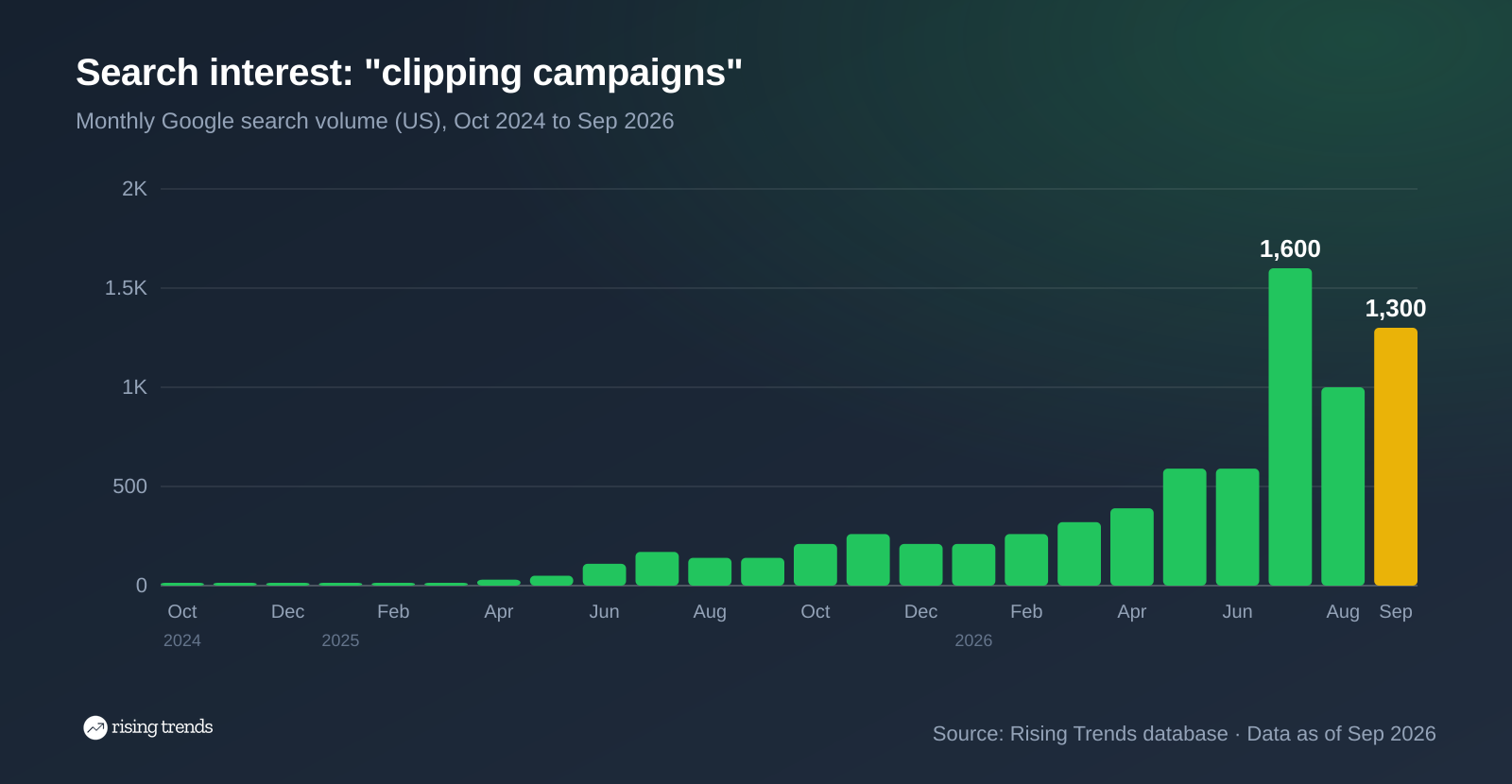
The breakout month is May 2026, when the term first crossed a quarter of its eventual peak. July hit 1,600, August fell back to 1,000, September recovered to 1,300. A single spike would be a news cycle. A spike that holds two thirds of its height three months later is a budget line.
The term does not travel alone. Here is the family of searches sitting around it.
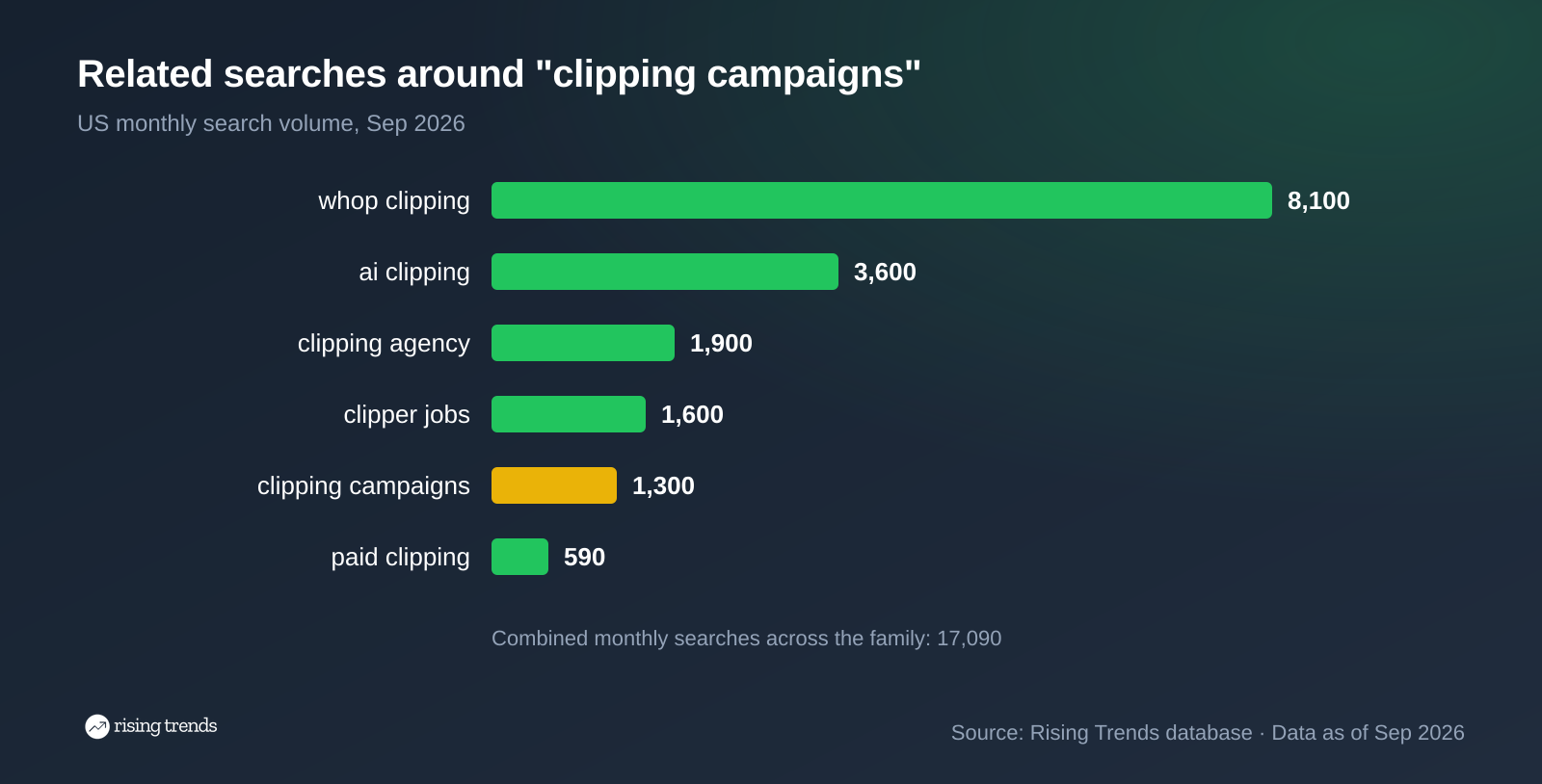
Read that list as a supply chain. "Whop clipping" at 8,100 is the marketplace. "Ai clipping" at 3,600 is the tool that cuts the footage. "Clipping agency" at 1,900 is the middleman who runs the brief. "Clipping campaigns" at 1,300 is the thing being bought. Every one of those is a purchase. Only one term in the family describes a person looking for work, and that is the one going backwards.
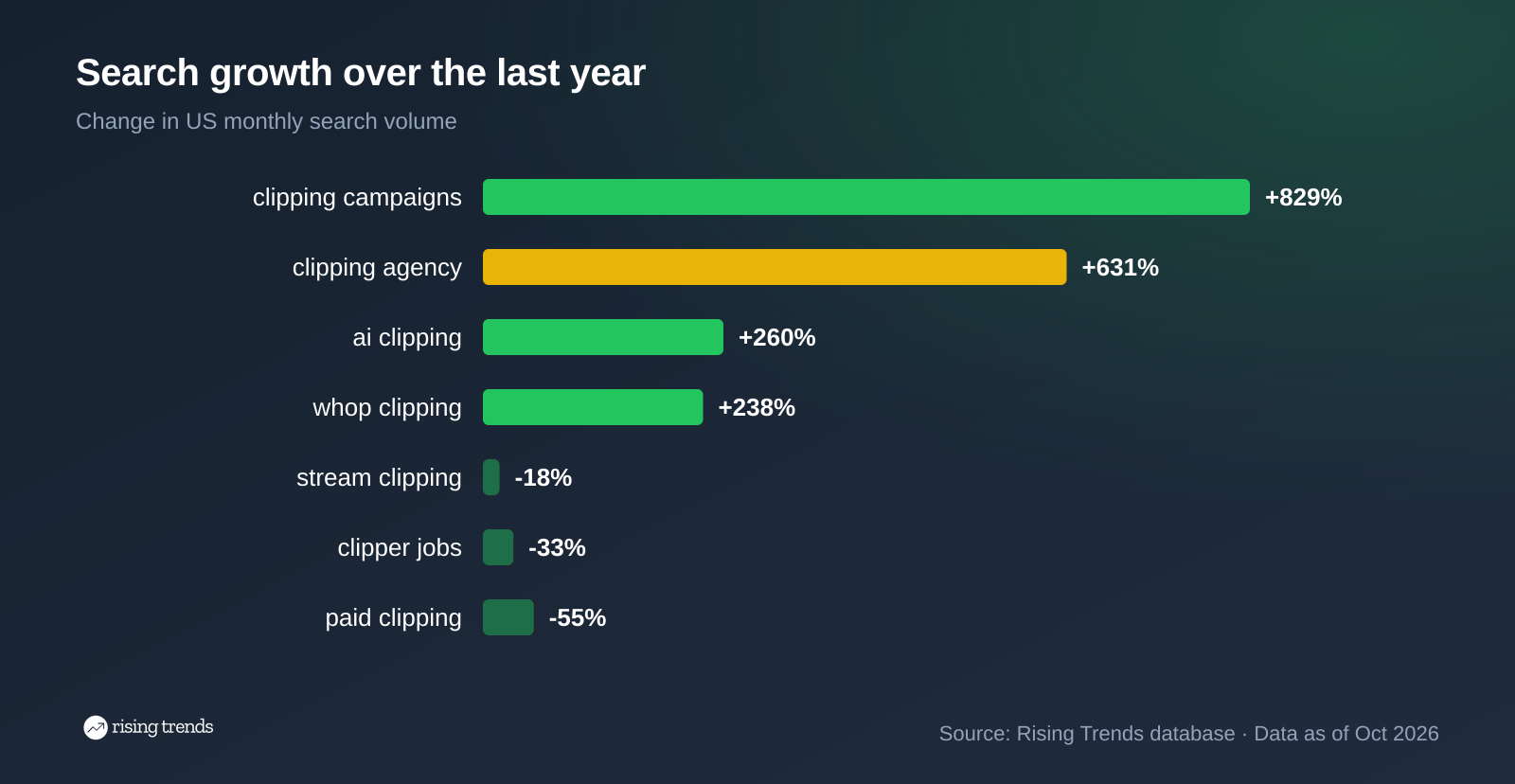
The split in that chart is the whole argument. "Clipping agency" is up 631% in a year. "Paid clipping" is down 55% and "clipper jobs" is down 33%. Twelve months ago the searches were from people hoping to get paid to cut video. Now they are from people with a budget looking for someone to spend it.
What's changing: the brief replaced the hire
A clipping campaign is simple enough to describe in one sentence. You hand over your long-form footage, you say what you will pay per thousand views, you put the money in escrow, and strangers post the cuts from their own accounts.
Whop, the marketplace most of this runs through, documents the mechanics plainly. You choose clipping or user-generated content, set a reward rate per 1,000 views and a total budget, creators post to their own social accounts, you approve or reject each submission, and payment follows approval automatically. The guardrails are the interesting part. A minimum payout keeps small videos out of your review queue: Whop's own example says a $3 rate with a $6 minimum means only clips above 2,000 views ever reach you. A maximum payout stops one hit draining the pot, and their example caps a creator at $3,000, which at a $3 rate means they stop earning at a million views.
Nothing about that resembles hiring an editor. There is no contract, no day rate, no creative review before the thing goes out. There is a price per thousand views and a queue. That is a media buy, and it is why the search behaviour flipped from "clipper jobs" to "clipping agency" inside a year. The same shift is running through the rest of the channel mix we tracked in this year's advertising trends: the money is moving to places where the ad does not look like an ad.
Why now: the clip stopped being the trailer
The reason budgets moved is that clips stopped being promotional material and became the product.
Ed Elson, who co-hosts Prof G Markets, made the case with numbers in an essay called The Clip Economy in April 2026. His example is TBPN, a daily tech show that averages roughly 7,000 views an episode while its average clip pulls about 257,000, a 37x gap. Nick Fuentes draws under 20,000 live and over half a million per clip. The looksmaxxing streamer Clavicular averages 16,000 viewers and a quarter of a million per clip.
Elson's own moment of recognition is the line worth keeping. People kept stopping him in the street to say they loved his clips. "I thought our clips were the promotional material for our content," he writes. "For much of our audience, the clips are the content."
Once that is true, the economics invert. Spending on the show is spending on a thing almost nobody watches. Spending on distribution of the cuts is spending on the thing everyone watches. And the cuts are cheap, because OpusClip alone says it is used by more than 20 million creators and businesses to turn long footage into vertical clips automatically. When the editing cost goes to roughly zero, the only scarce input left is accounts willing to post.
That is what the recruitment pitch sounds like now. This Short, posted in October 2026, is a clipper telling other clippers which campaign to join and what it pays.
There is no agency in that video, no pitch deck and no rate card. There is a link and a number.
The players: a board of live briefs
The market has a shop window, and it looks like a job board crossed with an app store.
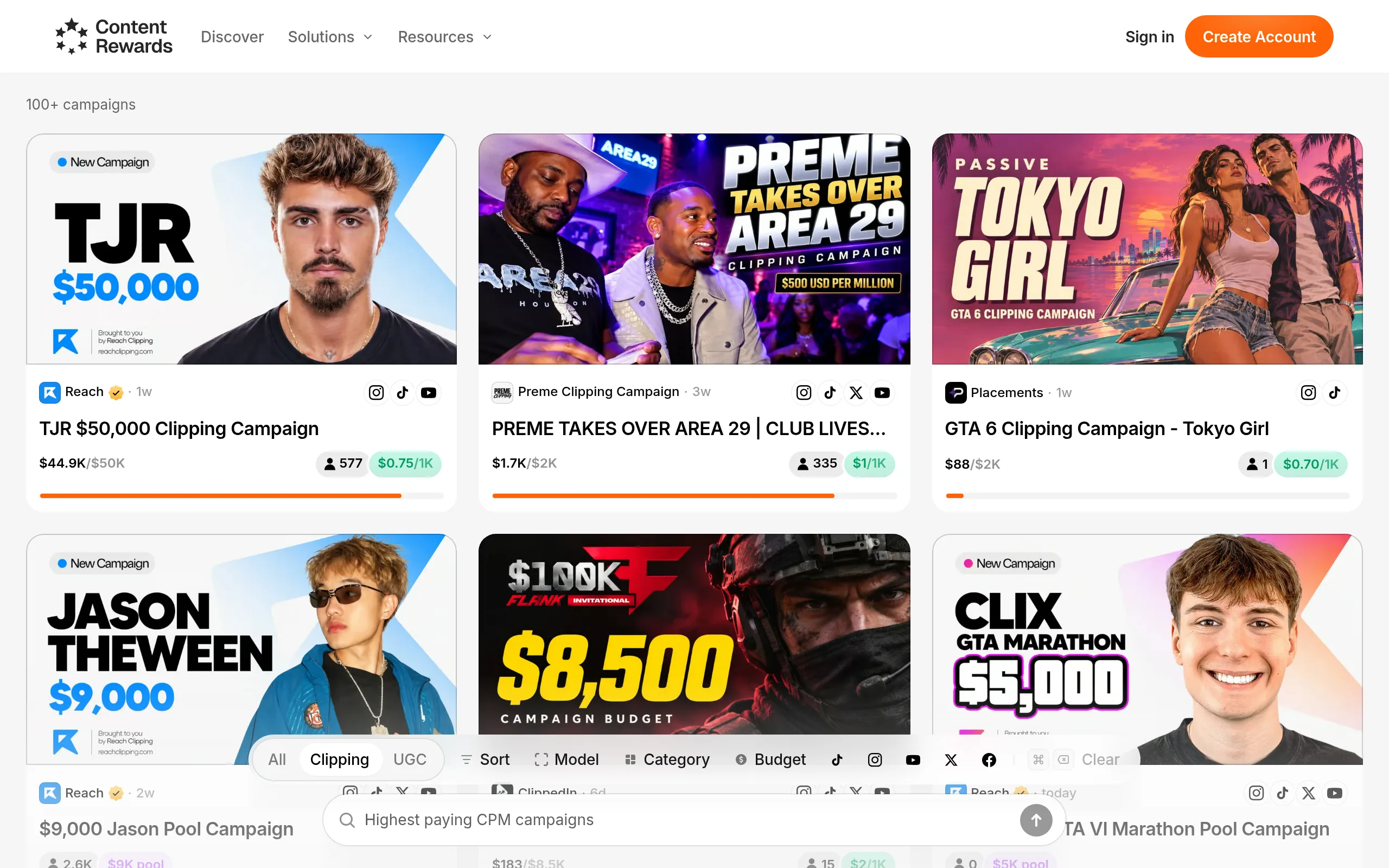
Every tile on that board is an advertiser. A $50,000 clipping campaign for the DJ TJR at $0.75 per 1,000 views, 577 clippers signed up and $44.9K of the budget already spent. A rapper's club takeover paying $1 per 1,000. A game-launch campaign at $0.70. The format is identical whether the thing being sold is a single, a game or a software product.
Clipping Collective read every live campaign on the marketplace on 17 October 2026 and published the census: 719 live campaigns, $3,165,206 in budgets, $1,522,322 already spent, 2.9 billion views and 217,663 approved clips. The median campaign pays $1.00 per 1,000 views and the middle half pays $1.00 to $2.00. The median budget is $1,468; the largest live one was $301,635.
The rate card by category is where the music angle shows up.
| Category | Live campaigns | Median rate per 1,000 views | Real cost per 1,000 views |
|---|---|---|---|
| Entertainment | 124 | $1.00 | $0.49 |
| Music | 100 | $1.00 | $0.60 |
| Personal brand | 60 | $1.00 | $0.53 |
| Technology | 54 | $1.50 | $0.76 |
| Finance | 33 | $1.50 | $0.98 |
Two numbers in that table matter more than the rest. The first is the gap between the advertised rate and the real cost: advertisers quote $1.00 per 1,000 and actually pay about $0.52 per 1,000 across the whole market, because views past a clip's cap are free. The second is that music is the second-biggest category on the board. A hundred live campaigns, cheaper views than tech or finance, and the most views per approved clip of any category except finance. That is why "clipping campaigns" sits in Marketing and Music in our database rather than Marketing alone, and why it belongs next to the tooling shifts in our music industry trends.
The platforms are in it too, not just the marketplaces. Kick pays streamers for short-form cuts through a feature it calls Bounties, which its own revenue documentation describes as "short-form video content opportunities where KICK or brand partners pay Streamers for clips". Nobody is pretending this is organic on the supply side. The pretending happens on the way out.
The new behaviour: strangers posting for you
Three things changed in how reach gets bought, and all three are visible in the briefs.
The account doing the posting is not yours. In a normal influencer deal you pay a named person with a known audience. In a clipping campaign you pay whoever shows up, and the same clip goes out from dozens of accounts at once. Emrah Bayraktar, a 25-year-old in Antwerp, told NPR he went from cleaning cars and working night shifts to running a network of 40,000 freelance clippers after a $12 payout turned into $2,500 two weeks later. "Maybe I could just quit my jobs and go all-in on this," he said he thought at the time. He puts the average age of his contract clippers at 16 to 24.
Volume is the strategy. Bo Lucenko, a 19-year-old college freshman who says he makes around $4,000 a month clipping for influencers and tech founders, described the mindset to NPR as "micro things you can do to make something go viral". Clippers upload the same cut to several platforms and wait to see which one catches. The marketplace census bears it out: TikTok is in 91% of campaigns, Instagram 79%, YouTube 58%, X 18%.
The original maker is usually not the one earning. Lou Paskalis of AJL Advisory put the objection bluntly to NPR: "Arbitrage players are taking this ability to re-package content as clips, and it's not satisfying the consumer, doesn't deliver good value to the advertiser and strips the originator of the content the ability to monetize it." His question about the platforms is the one nobody has answered. "Are they getting gamed by these clippers, or are they enabling it? Or are they enabling it so they don't become a victim of it?"
What it means for business
For anyone buying attention, three consequences follow, and the third is the one with a legal edge on it.
It is the cheapest reach currently on sale, and that will not last. At $0.52 per 1,000 real views, clipping undercuts every bought impression in the digital marketing mix by an order of magnitude. Cheap channels stay cheap only while they are obscure. The census found 25% of live campaigns had spent nothing at all, which tells you supply of clippers is not evenly distributed, and that the good ones are already oversubscribed. Rates in technology and finance are already 50% above the entertainment floor.
Face-to-camera costs three times as much as clipping. The same census puts pure clipping at $0.67 per 1,000 real views and face-to-camera user-generated content at $1.77. If your brief needs a human being to vouch for something, you pay the premium. If it only needs the footage to travel, you do not. This is the same unbundling we have watched happen to display and to advertising inside chat interfaces: the expensive part gets separated out and sold on its own.
Nothing here is labelled, and two US rules already apply. The FTC's Endorsement Guides say that if a connection between an endorser and a marketer would not be expected and would change how people weigh the endorsement, it should be disclosed clearly and conspicuously, and the guides add that "each new endorsement made without a disclosure could be deceptive because viewers might not have seen the prior posts". Paying a stranger per thousand views to post about your single is a material connection. Separately, since October 2024 it has been an unfair or deceptive practice under 16 CFR Part 465 to buy or sell fake indicators of social media influence, and the rule's own definitions list views and plays among those indicators and name bots and hijacked accounts as what makes them fake. When a campaign pays per view and nobody verifies the viewer, that is not an abstract risk. It is the business model's weak point, and it is the same rot we traced through the bot comments trend, where the symptom outgrew the theory.
Where this is heading
Three calls, each with a term in our database to watch.
"Clipping agency" overtakes "clipping campaigns" as the buyer's search. Agency searches are at 1,900 a month and growing faster off a bigger base than the campaign term. Buyers start by looking up the format and end by looking for someone to run it. If "clipping agency" clears 3,000 while "clipper jobs" keeps falling, the channel has finished professionalising and the arbitrage window is closing.
The view-verification fight starts next. Advertisers paying per thousand views have no independent count. Platforms have every incentive to inflate and no obligation to audit. Watch "ai clipping" at 3,600: if the tools start selling verification and fraud screening rather than faster cuts, it means the buyers asked.
Music keeps paying the lowest rates and getting the most reach. A hundred live music campaigns at a $1.00 median and $0.60 real cost is an anomaly that should close. Either rates rise as labels compete for the same clippers, or labels discover that cheap views do not convert to streams and the category thins out. We expect the first before the second.
The signal we trust most is still the one we opened with. A term goes from zero to 1,300 searches a month in two years because money started moving, not because a word got popular. The clippers were always there. What arrived in 2026 was the invoice. If you want to catch the next channel at the same stage, the trick is the one we wrote up in our guide to spotting market trends: watch the buy-side word and the sell-side word separately, and believe the one that is growing.
Want to spot shifts like this before the budgets arrive? Read our guide on how to identify market trends, or browse what is breaking out right now in our trending topics list.
Never miss a trend again
- One trend broken down with the numbers
- Who's making money, and what to build
- A website on the rise
- A breakout app
Join 5,000+ founders