

Robotic cooking spent two years as a trade-show joke. In our database the term sat between 2,400 and 4,400 searches a month from late 2024 through May 2026, which is roughly the demand profile of a hobby. Then June 2026 happened. The term hit 27,100 monthly searches, six times its own two-year baseline, and it has not gone back to where it started. It is running at 9,900 a month as of October 2026.
What makes this a category story rather than one product's news cycle is that the terms around it moved too. "Cooking robot" is up 125% in a year. "Posha cooking robot", a brand almost nobody had typed into Google two years ago, is now the biggest search in the family at 33,100 a month. Meanwhile the older vocabulary of this category, "robot chef" and "moley kitchen robot", is shrinking. The page you get when you search any of this is a stack of YouTube reviews and listicles, none of which has a single demand number in it. So here is the curve, the family, and what the split between them actually tells you.
Key takeaways:
- "Robotic cooking" broke out in June 2026 at 27,100 US monthly searches, up from 4,400 in May, and still sits at 9,900 as of October 2026. That is 6.5x the level of two years ago, and our database classifies the pace as EXPONENTIAL.
- The branded term is bigger than the category. "Posha cooking robot" runs at 33,100 searches a month, 3.3x the generic "cooking robot" at 9,900. In this category, one product currently is the category.
- The format war is over and the box won. The countertop terms are up about 125% in a year while "robot chef" is down 33% and "moley kitchen robot", the luxury robotic-arm kitchen, is down 61%.
- Demand has outrun supply. Posha's own buy page lists $1,750, discounted to $1,500, and warns that estimated delivery for new orders is 6 to 8 months, with the next batch shipping in May 2027.
- The commercial side is already at industrial scale. Chef Robotics says its meal-assembly robots have completed over 70 million servings in the US and Canada, and SoftBank Robotics brought its STEAMA and FLAMA cooking robots to the US restaurant market in May 2026.
Let's get into it.
What we're seeing in the Rising Trends data
Here is the monthly curve for "robotic cooking" over two years, straight from our database. For 20 of those 24 months the line is flat and low. Then one month does all the work.
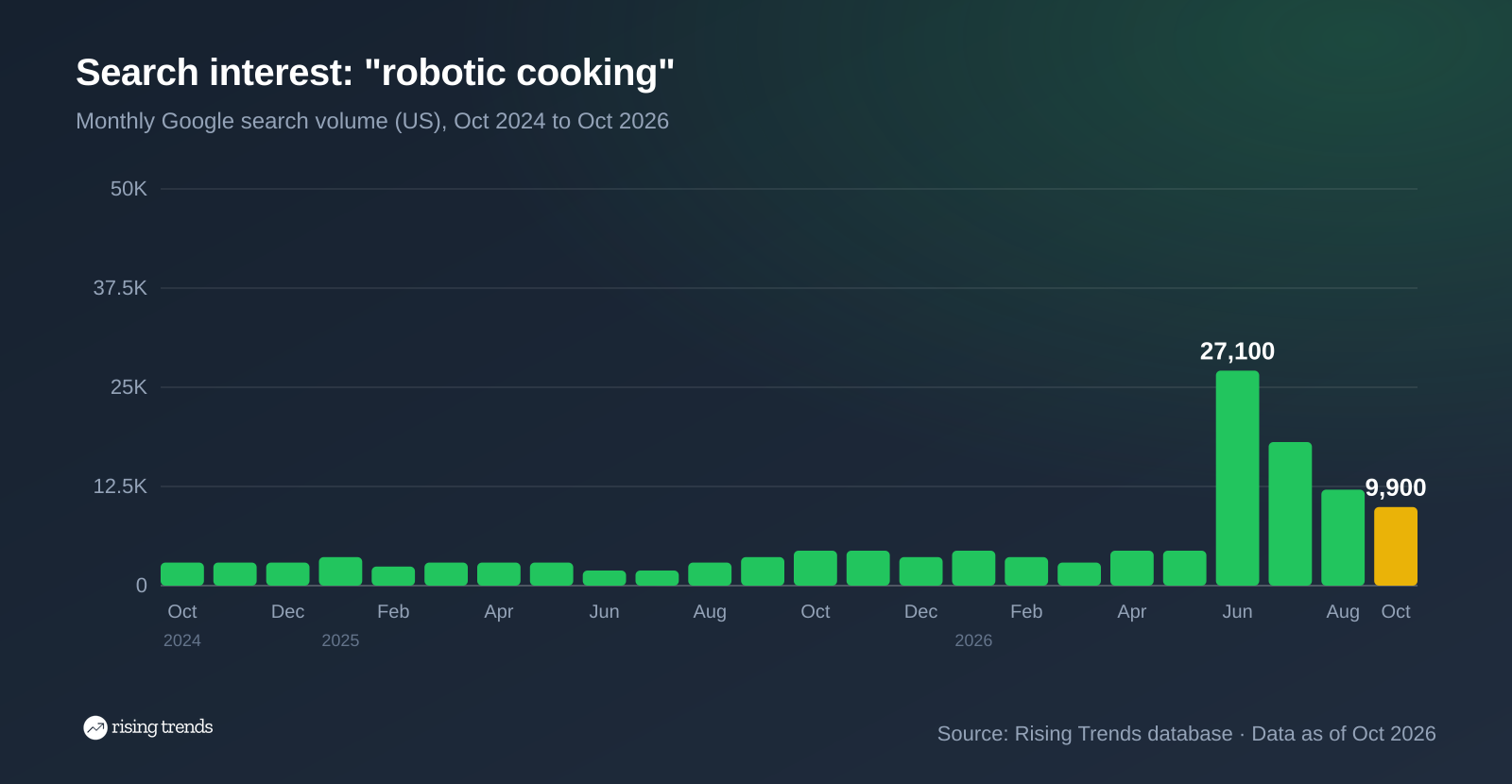
The shape is the point. A term that bounced between 2,900 and 4,400 for two years went to 27,100 in June 2026, then settled. The three months since the spike are down 45%, which reads like a collapse until you compare against the right baseline: the current 9,900 is still 175% above the 3,600 of a year earlier and 6.5x the 2,400 the term was doing two years ago. Spikes that fall back to four times their old floor are not spikes. They are step changes with a news bump on top.
Now the useful part, which is what else moved with it.
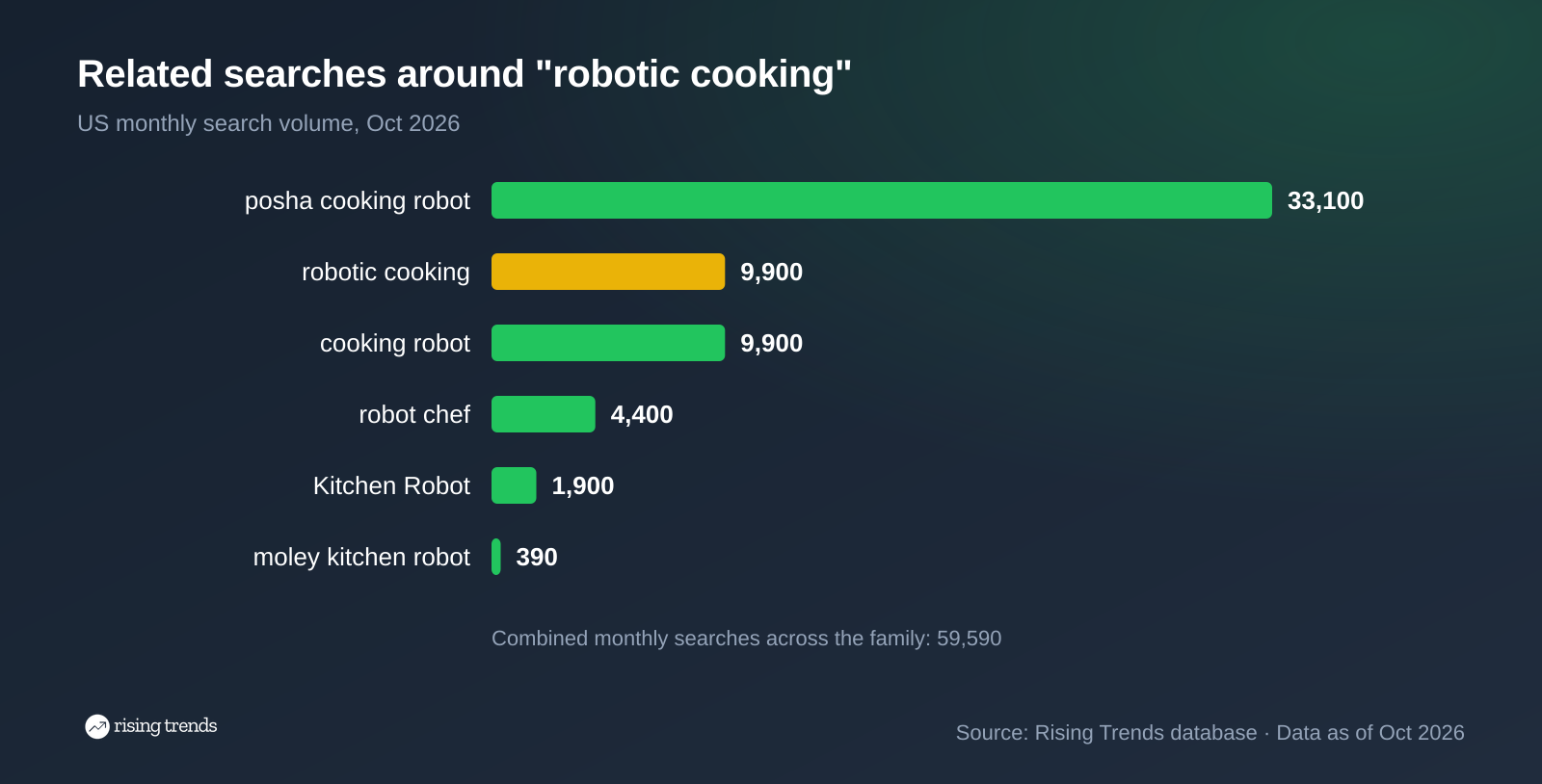
One brand is bigger than the category that contains it. "Posha cooking robot" is at 33,100 searches a month against 9,900 for the generic "cooking robot". That ratio is unusual and it is the single most useful fact on this page. When a brand term runs 3.3x the category term, buyers are not comparison shopping a product class. They have one name and they are checking whether it is real.
The growth ranking tells you which half of the category is dying.
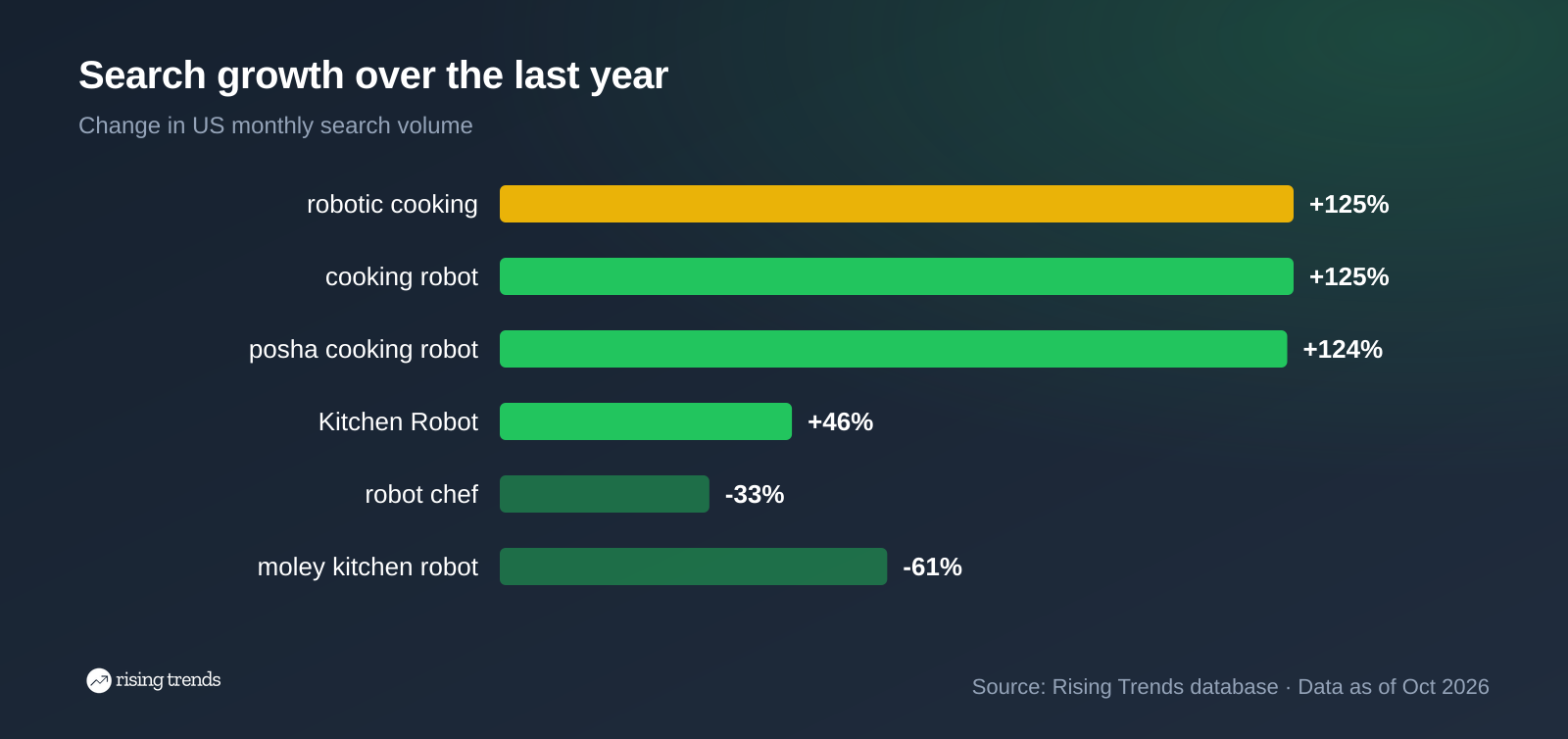
The three rising terms all describe a machine that sits on a counter. The two falling terms describe the older dream: a robotic arm installed in your kitchen, cooking like a human. "Robot chef" is down 33% to 4,400 a month and "moley kitchen robot" is down 61% to 390. The humanoid idea lost, quietly, while everyone was arguing about humanoids.
What changed: the arm became a box
For a decade the robotic kitchen was sold as a pair of arms. Moley Robotics still markets what it calls the world's first fully robotic kitchen, now repositioned for the luxury residential market with Italian cabinetry. It is beautiful and it is a bespoke installation, which is why its search term is down to 390 a month.
The thing that actually sold is duller. It is an enclosed box about the size of a large microwave with an induction plate, four ingredient hoppers, a spice drawer, a stirring arm and a camera looking down at the pan. You chop, you load, you walk away. That is the whole product, and the limitation is the feature: a sealed box with six degrees of freedom is manufacturable at $1,500, while an arm that can use your actual kitchen is not.
The same simplification is running through the rest of the counter. We saw it in cookware, where titanium replaced the PFAS-free label as the thing people search for, and the pattern is consistent across the cooking and recipe trends we track: buyers reward the narrow, legible upgrade over the ambitious one.
Why now: time, labour, and a camera that finally works
Three things arrived at once.
The first is time, and it has a number. The Bureau of Labor Statistics' American Time Use Survey puts average daily food preparation and cleanup at 0.71 hours, about 43 minutes, across the whole population in its 2025 annual averages. Only 65.2% of people do any of it on a given day, and the ones who do spend 1.09 hours. The gap between those two figures is the market: a third of adults have already opted out of cooking entirely on any given day.
The second is that the vision models got good enough to replace the timer. Posha's pitch is that a top-mounted camera watches the pan and decides when to act, rather than running a fixed program. You can see what that means in practice in the commercial lane, where Chef Robotics published its own numbers: a burger-assembly model trained on 1,249 human demonstrations hit a 75.0% success rate, and adding 56 of the robot's own successful runs, about 4.5% more data, took it to 91.3%. Food is a hard manipulation problem because it deforms, and the fix turned out to be a data flywheel rather than better hardware. That is the same loop powering the AI agent trends we cover elsewhere, pointed at a frying pan.
The third is labour, and the people selling into restaurants say so out loud. When SoftBank Robotics announced the US debut of its STEAMA and FLAMA cooking robots at the National Restaurant Association Show in May 2026, it named the reason in the release: "chronic labor shortages, rising labor costs, workforce instability driven by low retention, and inconsistent quality across multi-location operations." STEAMA finishes a frozen noodle dish in about 90 seconds. FLAMA handles ingredients, seasoning, stir-frying, plating and its own cleaning.
What the search curve actually caught in June, though, was none of those three. It was video. The category went viral the way air fryers did, through creators cooking dinner on camera, and the clips kept coming all summer. This one, posted on 1 October 2026, has 1.4 million views and 49,200 likes on a premise that is three seconds long: the robot made the kid's school lunch.
That clip is the format: no specs, no price, just a pan finishing itself. Dozens of creators ran the same shot through the autumn, which is why the search curve looks like a media curve with a floor under it.
The players: who is actually shipping
The honest ranking is short.
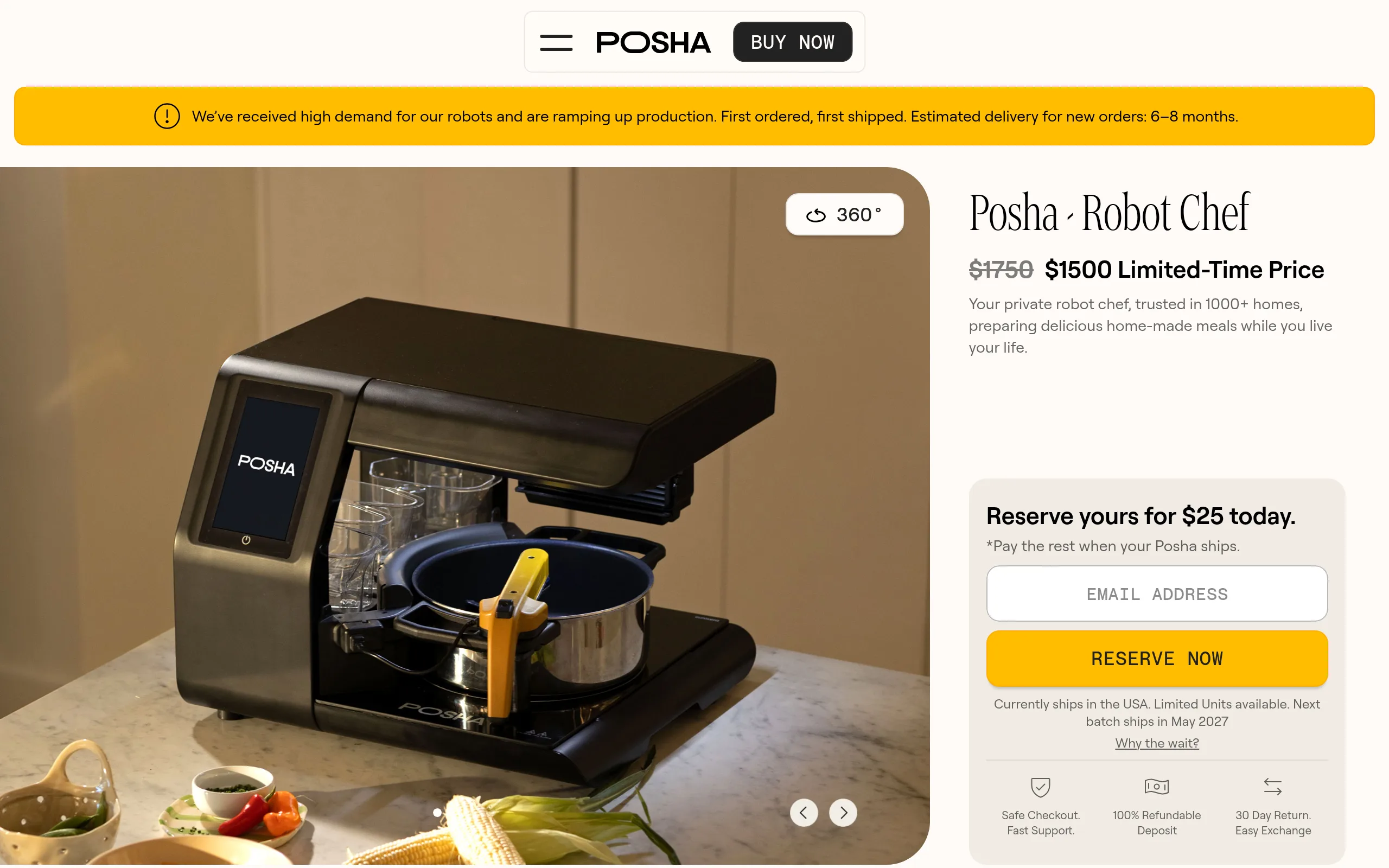
Posha is the category, for now. Founded in 2017 as Nymble by Raghav Gupta, it renamed in 2025 and raised an $8 million Series A led by Accel. Its buy page today lists $1,750 with a $1,500 limited-time price, says the robot is trusted in over 1,000 homes, and carries a banner most hardware startups would kill for: estimated delivery for new orders is 6 to 8 months, with the next batch shipping in May 2027. The software is sold separately but gently. Posha's own cost breakdown puts the Circle membership at $14.95 a month or $139.95 a year, with a 90-day trial, and keeps manual mode and a starter recipe set free forever.
Nosh is the challenger, out of CES in January 2026. Its own page claims 650 or more recipes and takes a refundable $29 to hold a unit. Same form factor, same promise, no shipping history yet.
Chef Robotics is the one making money. It does not sell to homes at all. Its robots assemble meals in food plants, and the company says they have completed over 70 million servings for customers across the US and Canada. That is the quiet version of this trend, and it is already enormous.
SoftBank Robotics is buying its way into the restaurant lane, taking an exclusive global licence from Yo-Kai Express in September 2026 to push STEAMA abroad.
Moley is the cautionary tale: first to the idea, last in the demand data.
The new behaviour: buying back the weeknight
Talk to the people who own one and the pitch is never "the food is better". It is a schedule argument. Gupta told GeekWire during a taste test in Seattle that his buyers "cook regularly, anywhere between two and six times a week" and "want to feed their families fresh meals but not want to spend a ton of time in the kitchen". His description of the value is literally a list of errands: "you can go take a shower, you can go for a run, you can take the dog out for a walk, you can go to the gym, come back, and your food will be ready and warm."
The creator videos say the same thing in fewer words. One of the biggest Posha clips of the autumn is captioned "POV: you're at the gym while your robot is home making dinner." Nobody is filming the food.
Two things are worth flagging because the review sites miss them.
The first is accessibility. A meaningful slice of the organic posting about these machines comes from disability and caregiving accounts, where the appeal is not time saved but a hot meal cooked without standing, lifting or tracking steps. That use case has nothing to do with the dual-income professional the marketing describes, and it is the one that would survive a recession.
The second is that the sceptics are not wrong. GeekWire's reviewer ate the robot's spaghetti alfredo and wrote that he "couldn't help but feel a little cheated by the lack of effort it took to create the meal". His colleague's complaint was blunter: it still leaves the chopping to you, and takes a lot of counter for something not that different from a pressure cooker. The Verge's smart-home reviewer landed in the same place, calling it a decent chef and then asking whether $1,500 plus a monthly fee is worth the help. Those objections are why the category sits at 9,900 searches a month and not 99,000.
What it means for business
Meal kits are the ones being attacked, not restaurants. Posha's own math frames the robot against HelloFresh-style boxes: you buy your own groceries, the machine does the execution, and the per-serving premium disappears. The company's published tally puts a meal-kit household about $1,400 better off in year one. Treat vendor math as vendor math, but the positioning is correct. A box of pre-portioned ingredients sells convenience that a camera and a stirring arm can now sell more cheaply.
Hardware margin is moving into membership. A $1,500 appliance with a $139.95 annual recipe subscription is a razor-and-blades model with the blades made of software. Expect every countertop brand to copy it, and expect the first consumer backlash the moment someone's recipe library goes behind a paywall it did not used to be behind.
The restaurant lane will scale first and be invisible. Seventy million servings have already been assembled by robots in plants that no customer will ever see, and the labour pressures driving that are the same ones reshaping the food industry trends we tracked for 2027. The home robot gets the TikToks. The factory robot gets the volume.
Distribution is the bottleneck, not demand. A six to eight month lead time on a $1,500 appliance means the category's leader is currently rationing. Whoever can actually manufacture at volume in 2027 inherits a market that has already been advertised for them.
Where this is heading
Three calls, each with a term in our database to watch.
The brand term will stop being bigger than the category. Right now "posha cooking robot" at 33,100 dwarfs "cooking robot" at 9,900. When competitors ship, that ratio inverts, because people start comparing. Watch for "cooking robot" to cross the brand term. That is the moment this becomes an appliance aisle instead of one company.
The arm comes back, but not in the kitchen. General-purpose home robots are a separate and much slower search story: humanoid services like Tau Robotics are selling labour by the hour rather than hardware by the unit. The countertop box wins the kitchen because it is cheap and bounded. Anything that has to navigate your house is on the AI trends timeline, not the appliance one.
The next spike will be a price cut, not a launch. The entry tier of this category, per Posha's own survey of it, already starts at $300 to $500 for machines that chop and stir. The moment a credible camera-guided unit lands under $800, the curve that peaked at 27,100 gets tested again. Watch "kitchen robot", flat at 1,900 a month and up 46% in a year, as the cheap-seats term that would move first. The broader tech and gadget trends we track usually spike on affordability, not capability.
The reason to take this seriously is in the first chart. A term does not hold four times its old baseline five months after a viral month unless something underneath it changed. People did not fall in love with robots in June 2026. They found out that the thing finally exists, costs the same as a decent fridge, and has a waiting list.
Want to catch category shifts like this while the volume is still small? Read our guide on how to identify market trends, or see what is breaking out right now in our trending topics list.
Never miss a trend again
- One trend broken down with the numbers
- Who's making money, and what to build
- A website on the rise
- A breakout app
Join 5,000+ founders