
Two years ago "switch 2 emulation" was a rounding error in our database: 50 monthly searches, the kind of number that usually means a handful of people and a typo. As of September 2026 it runs at 4,400 a month, up 8,700% over those two years, and for the first time the people typing it will find something that works.
What makes the curve interesting is not the growth. It is the order of events. The searches peaked in June 2025, the month the Switch 2 launched, when no Switch 2 emulator existed anywhere. The software arrived sixteen months later, in a rush that lasted less than a fortnight. Most coverage of this story is a list of which games boot. Below is the thing nobody else has put together: the dated chain from the first exploit to six competing forks, what our data says about emulation as a category, and why a scene moving this fast is a worse problem for Nintendo than any single emulator.
Key takeaways:
- "switch 2 emulation" sits at 4,400 US monthly searches as of September 2026, up 8,700% in two years and classified EXPONENTIAL in the Rising Trends database.
- The curve peaked at 6,600 in June 2025, the Switch 2's launch month, when there was nothing to emulate. Demand ran sixteen months ahead of supply.
- On 18 October 2026 security researcher Sammy Hajhamid published ns2jb, a software-only, tethered exploit. Eleven days later, on 29 October, a developer called Takoroka shipped the first public Switch 2 emulator build.
- AI wrote a meaningful share of both. Hajhamid credits OpenAI's Codex with finding the entry bug. One Android fork describes itself as "written largely with an AI coding assistant".
- The scene outgrew its founder in days. Takoroka's original has 53 stars; the Eglantine fork has 2.1k stars and 251 forks, and one Android build changed its upstream base three times in three days.
- The scale gap is the business answer. Mario Kart World has sold 15.39 million copies (Nintendo, as of 30 June 2026). The first emulator release logged 2,628 source downloads.
Let's get into it.
What we're seeing in the Rising Trends data
Here is the monthly search volume for "switch 2 emulation" over the last two years, straight from our database.
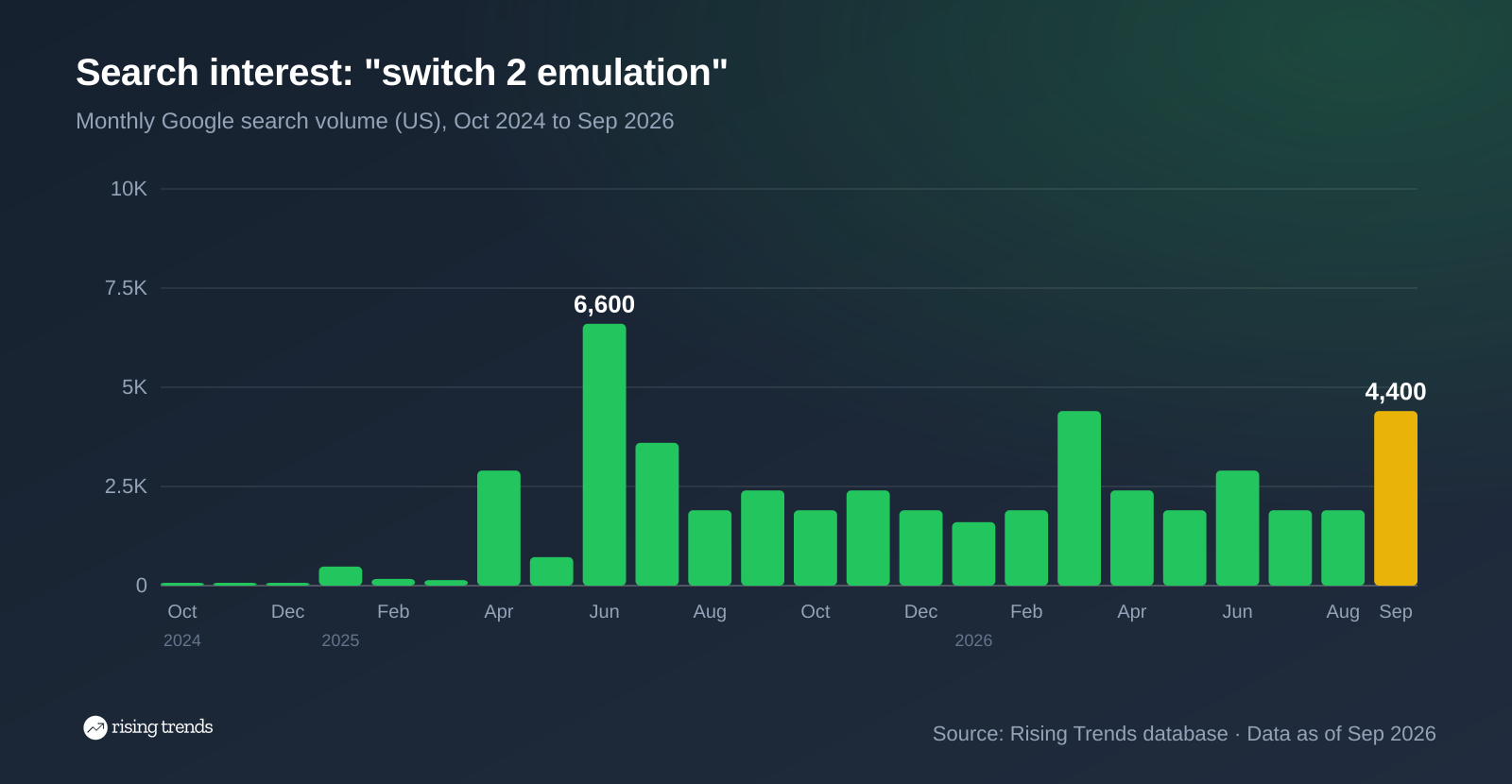
Read that shape carefully, because it is doing something unusual. The spike is 6,600 in June 2025, the month the console went on sale. Nothing existed then. No exploit, no emulator, no dumped games. That spike is pure anticipation: people searching for a thing on the assumption that someone, somewhere, must already be building it.
Then it settles. For most of the following year the term holds between 1,600 and 2,900 a month. And then it climbs again, to 4,400 as of September 2026, which is the last full month in our data and the month before the software actually landed. The term is now 91 times its level of two years earlier, and the three-month growth is 52%.
The comparison that matters sits next door.
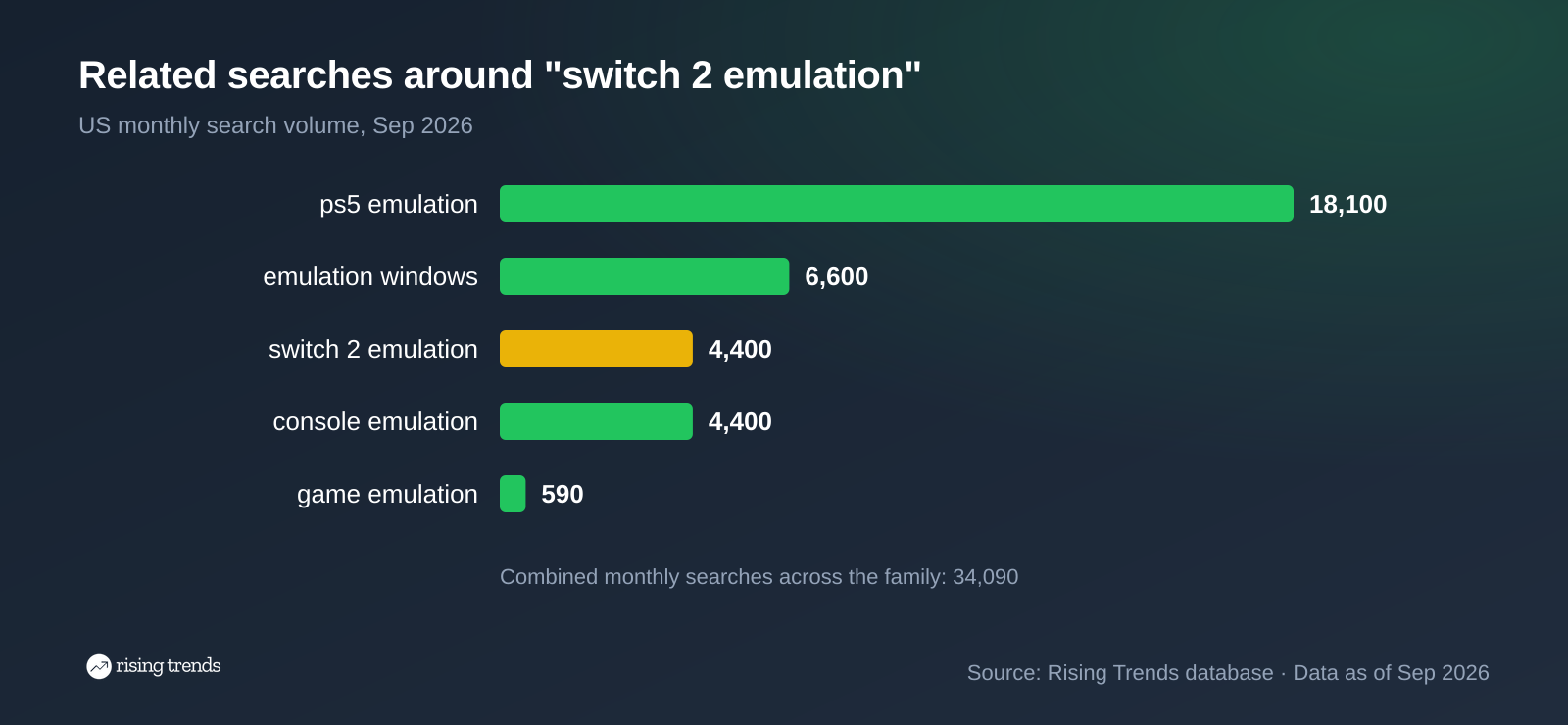
"ps5 emulation" is four times bigger at 18,100 searches a month as of September 2026, and we have already pulled that one apart: there is no working PS5 emulator, the real projects are research experiments, and the honest compatibility number is brutal. Read what actually runs on a PC today if you want the detail. The useful contrast is that Switch 2 emulation now has a quarter of that demand and all of the supply. For context, the console itself draws 1,500,000 searches a month under "nintendo switch 2" and another 1,000,000 under "switch 2". Emulation is a rounding error against the console, and that gap is the whole business story.
What Switch 2 emulation actually is
Strip the drama out and there are two separate problems.
The first is getting the games off the console. A Switch 2 game is encrypted and signed, and until late October there was no public way to run your own code on a retail unit. That is what the jailbreak solved.
The second is running those files on a PC. That needs an emulator: software that pretends to be the Switch 2's ARM processor, its NVIDIA GPU and its operating system, well enough that a commercial game cannot tell. Nobody built one from scratch. Every Switch 2 emulator in existence today is a fork of Eden, a free and open-source Nintendo Switch emulator that already existed, with Switch 2 support bolted on.
The first of those forks went public on 29 October 2026.
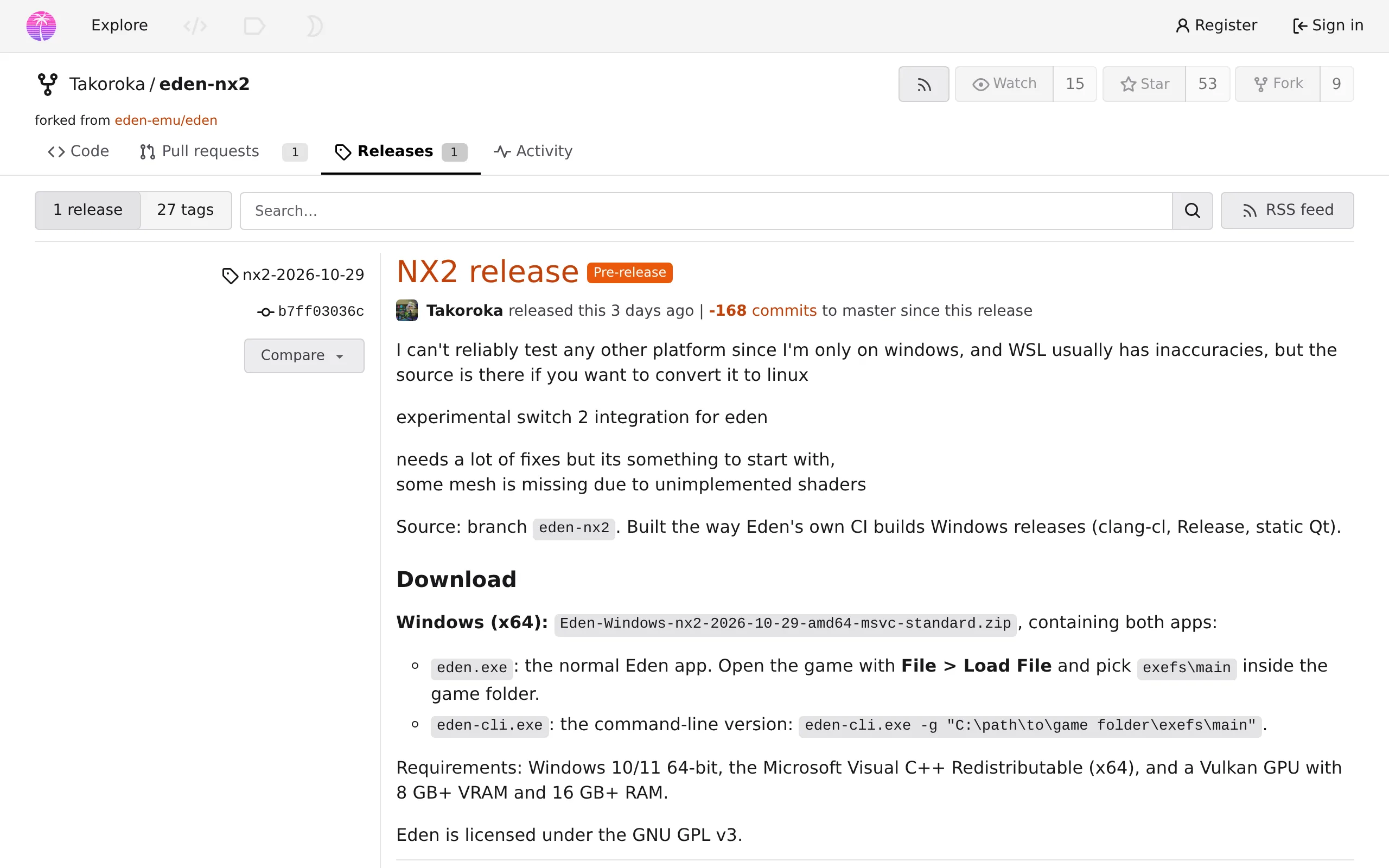
The release notes are worth reading as an artefact of how small this moment was. Takoroka calls it "experimental switch 2 integration for eden" and adds, in lower case, that it "needs a lot of fixes but its something to start with, some mesh is missing due to unimplemented shaders". The developer also says plainly: "I can't reliably test any other platform since I'm only on windows." You need a Vulkan GPU with 8 GB of video memory and 16 GB of system RAM to run it at all, which is roughly the spec of a mid-range gaming PC and several times the hardware inside the console it is imitating. The same mismatch shows up whenever a spec outruns what can feed it, which is the story behind the 720Hz monitor.
Here is that release page in full. One release, 27 tags, 53 stars.
Why it's trending now
The trigger is dated and public.
On 18 October 2026, security researcher Sammy Hajhamid, who goes by pepsipu, published a write-up of ns2jb. He describes it as "a software-only, tethered jailbreak for the Switch 2" on the then-current firmware. The entry point was an arithmetic bug in SmileBASIC 4, a programming app sold on the older Switch: the bounds check on an array operation added two numbers that could wrap around and go negative. Hajhamid says "the jailbreak itself took substantial effort for ~2 weeks", and that OpenAI's Codex found "a useful 32-bit integer overflow in the interpreter". For the demo, he had Codex mod Mario Kart World, which he says "was entirely vibecoded in a day, and was just for fun".
He is also careful about the limits: "this jailbreak is tethered, and we don't currently have a way to compromise built-in sysmodules other than fs". Tethered means it has to be re-run from a computer every time the console reboots. It is not a free console. It is a door into the filesystem, which is exactly enough to dump the games an emulator needs.
Eleven days later the emulator appeared, and the videos started. This one, from the emulation channel Mr. Sujano, went up on 29 October 2026, the same day as Takoroka's release.
That ordering is the point. The jailbreak was the news story. The emulator is the thing people searched for.
The new behaviour: forking faster than anyone can ship
What changed is not that people emulate consoles. People have emulated consoles for thirty years. What changed is the speed and the shape of the work.
In the old model, one project carried a console for years. Yuzu did it for the Switch, slowly, with a core team and a release cadence. The Switch 2 is not being emulated that way. It is being emulated by a swarm of forks that copy each other's fixes within hours.
The clearest record of this is an unofficial Android build whose release notes read like a logbook of the whole scene. Here is what it rebased onto, and when.
| Date | Version | Upstream base |
|---|---|---|
| 29 Oct 2026 | first builds | Takoroka's eden-nx2 |
| 31 Oct 2026 | v0.2.1 | Eden-NS2, by 0x2593 |
| 1 Nov 2026 | v0.3.0 | PokeDinner, a fork of Eglantine |
| 1 Nov 2026 | v0.3.1 | PokeDinner, plus two speedups from a second Eglantine fork |
Three base changes in three days. The developer's stated reason for the first switch was simply that the other fork "is more actively developed". That is a scene where the fastest-moving code wins the week and nobody waits for anyone.
The second change is who is writing it. The Android build's own release notes open with a disclaimer most projects would never print: "Unofficial, experimental build. Not Eden, not supported by the Eden team. Written largely with an AI coding assistant (Claude), tested by hand on one phone." The exploit was found with help from Codex. The mod demo was, in the author's word, vibecoded. Emulator work used to be a specialism with a decade-long apprenticeship. It is now something a competent developer can attempt in a fortnight with a coding agent, which is the same shift we traced in the AI mods trend.
The third change is what "playable" now means. The honest answer is in the bug trackers, and it is not flattering. Issues filed on Eglantine on 1 and 2 November 2026 include "Performance regression in Mario Kart World (60 FPS in Build 64 drops to 30-45 FPS since Build 73)", "[Mario Kart World] Lighting or material issues, everything is black", and "Mario Kart World crashes during race intro on AMD RX 5700 (RDNA 1)". The tracker carried 62 open issues within days of launch. On phones it is worse: the Android build reports Pokemon Pokopia at about 20 to 30 frames per second and Donkey Kong Bananza at about 10, on a handset with 16 GB of RAM.
Who's building on it
Six names carry this, and the gap between them says more than any compatibility list.
Takoroka shipped first, on 29 October 2026, and is already the smallest player in the story: 53 stars, nine forks, one release. The Windows build logged 70 downloads while the source archive logged 2,628.
Eglantine, by Djihads80, is where the attention went. It describes itself as a "VERY experimental Nintendo Switch 2 emulator" and claims Mario Kart World runs "at decent/full speed depending on specs and configurations". The repository shows 2.1k stars and 251 forks, roughly forty times Takoroka's following, a few days after the original.
Eden-NS2, by 0x2593, is the quieter engineering effort at 426 stars. Its compatibility notes are the most specific published anywhere: Pokemon Pokopia and Splatoon Raiders playable at a stable 60 frames per second, Donkey Kong Bananza and Mario Kart World playable but slow in places, Nintendo Switch 2 Welcome Tour booting but very slow.
PokeDinner, by Franseven, exists to merge the others. It is a fork of Eglantine that collects fixes from Takoroka, Eden-NS2 and the rest, which makes it the closest thing the scene has to a mainline.
moceure ports all of it to Android and publishes release notes more candid than most funded products: "This is an experiment, not an actively maintained project: updates may stop at any time."
Eden itself is not part of any of this. It is a Switch 1 emulator under GPLv3, and every fork above carries a disclaimer distancing the Eden team from Switch 2 work.
What it means for business
Start with the number that calibrates everything. Nintendo has sold 23.68 million Switch 2 consoles and 58.17 million Switch 2 games as of 30 June 2026, per its own investor relations data. Mario Kart World alone has sold 15.39 million copies. Against that, an emulator with a few thousand downloads that needs a 16 GB gaming PC to limp along at half speed is not a revenue event. Anyone telling you emulation is denting Switch 2 sales is reading a forum, not a balance sheet.
Three things do follow from it.
The category is shrinking while this one term compounds. This is the comparison that is on none of the pages ranking for the term.
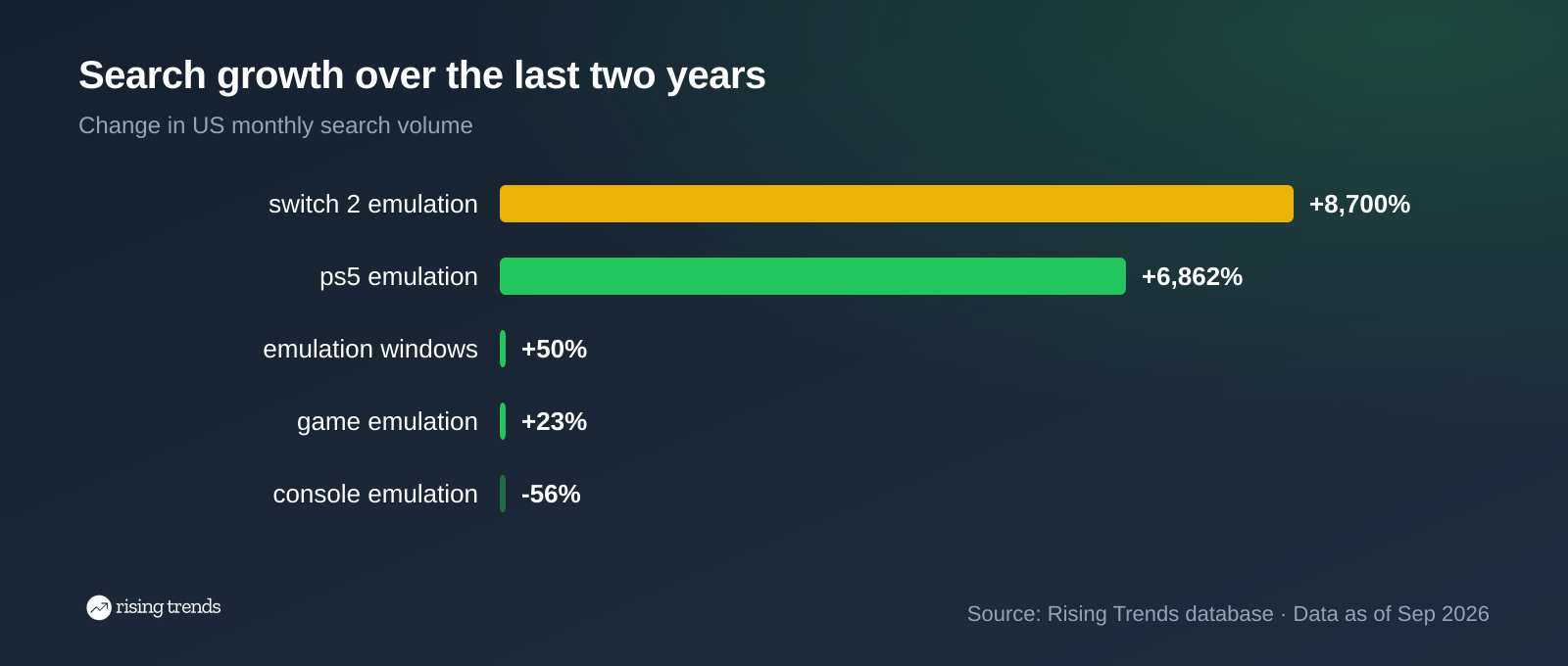
"console emulation", the generic hobbyist term, is down 56% over two years. "game emulation" has added 23%. Emulation as a pastime is in decline. What is growing, violently, is emulation of two specific locked current-generation consoles. People are not looking for a hobby. They are looking for a way around one company's control of one box, which is the same instinct behind what you actually own after a disc-to-digital conversion.
Nintendo's lever is contractual, not technical. Section 2 of the Nintendo Switch 2 User Agreement, effective October 2026, states that "any existing or future unauthorized modification of the Console or the Software" may "render the Console and/or the Software permanently unusable in whole or in part". Nintendo also pulled SmileBASIC 4 from its store, and Hajhamid notes the company "has already started removing dynamic code features". The pattern is clear: close the hole, keep the kill switch, say nothing about the emulators. Nintendo has made no public statement about any of the forks named here.
The real exposure is the modding scene, not the piracy one. A tethered exploit that needs a laptop on the same network every boot will never be a mass piracy channel. What it does enable is custom content on a platform that has never allowed it, and custom content is sticky. That matters more to a publisher's roadmap than a leaked ROM does.
Where this is heading
Three calls, each with a term in our database to watch.
The fork count consolidates before Christmas. Six projects cannot all survive; PokeDinner's merge-everything approach is the shape that usually wins. Watch whether "switch 2 emulation" holds above its 4,400 level as of September 2026 once the novelty cycle passes. Holding means a user base; falling back to 1,900 means a news spike.
Nintendo patches, and the searches move to the firmware. The exploit targets one firmware version through one delisted app. Both are easy to kill. The signal will show up in adjacent queries: "nintendo switch 2 backwards compatibility" is already at 2,400 searches a month, up 85% on the year as of September 2026, and that is the term where people ask what their console still does after an update.
AI-assisted reverse engineering becomes the default, not the headline. Two weeks of work with a coding agent produced a console exploit that a dedicated scene had not found in sixteen months. That is the durable finding in this story, and it runs well beyond games: the same economics are reshaping the open-source agent scene and every security team that assumed obscurity was a defence.
The thing to remember about the curve we opened with is that it was right too early. People were searching for a Switch 2 emulator in June 2025, when the honest answer was "not for years". It took sixteen months and then eleven days. Next console, the gap will be shorter, and the searches will be waiting again.
Want to catch shifts like this while they are still a search curve? Read our guide on how to identify market trends, or see what else is moving in gaming right now.
Never miss a trend again
- One trend broken down with the numbers
- Who's making money, and what to build
- A website on the rise
- A breakout app
Join 5,000+ founders