
Two years ago, "sleep score" was a niche query in the Rising Trends database: 1,600 searches a month in October 2024, mostly from people who owned an Oura ring or a Garmin watch. In October 2026 the same term runs at 9,900 a month, 5.1x higher, with a peak of 40,500 in January. Meanwhile "sleep tracker", the search people used to make when they wanted to buy one of these things, is down 33% year over year.
That gap is the story. Attention has moved off the device and onto the number it produces. Most of what ranks for "sleep score" right now is a vendor explaining its own formula, or a listicle telling you what counts as good. None of it shows you the curve, none of it puts the three big formulas side by side, and none of it mentions that the thing you are optimising is agreed by its own makers to be an estimate. So we pulled our data, read the support pages, read Oura's SEC filing, and read the lab study that tested six of these devices against real polysomnography.
Key takeaways:
- "Sleep score" runs at 9,900 US monthly searches as of October 2026, up 175% in a year and 5.1x over two years, with an all-time peak of 40,500 in January 2026 (Rising Trends data).
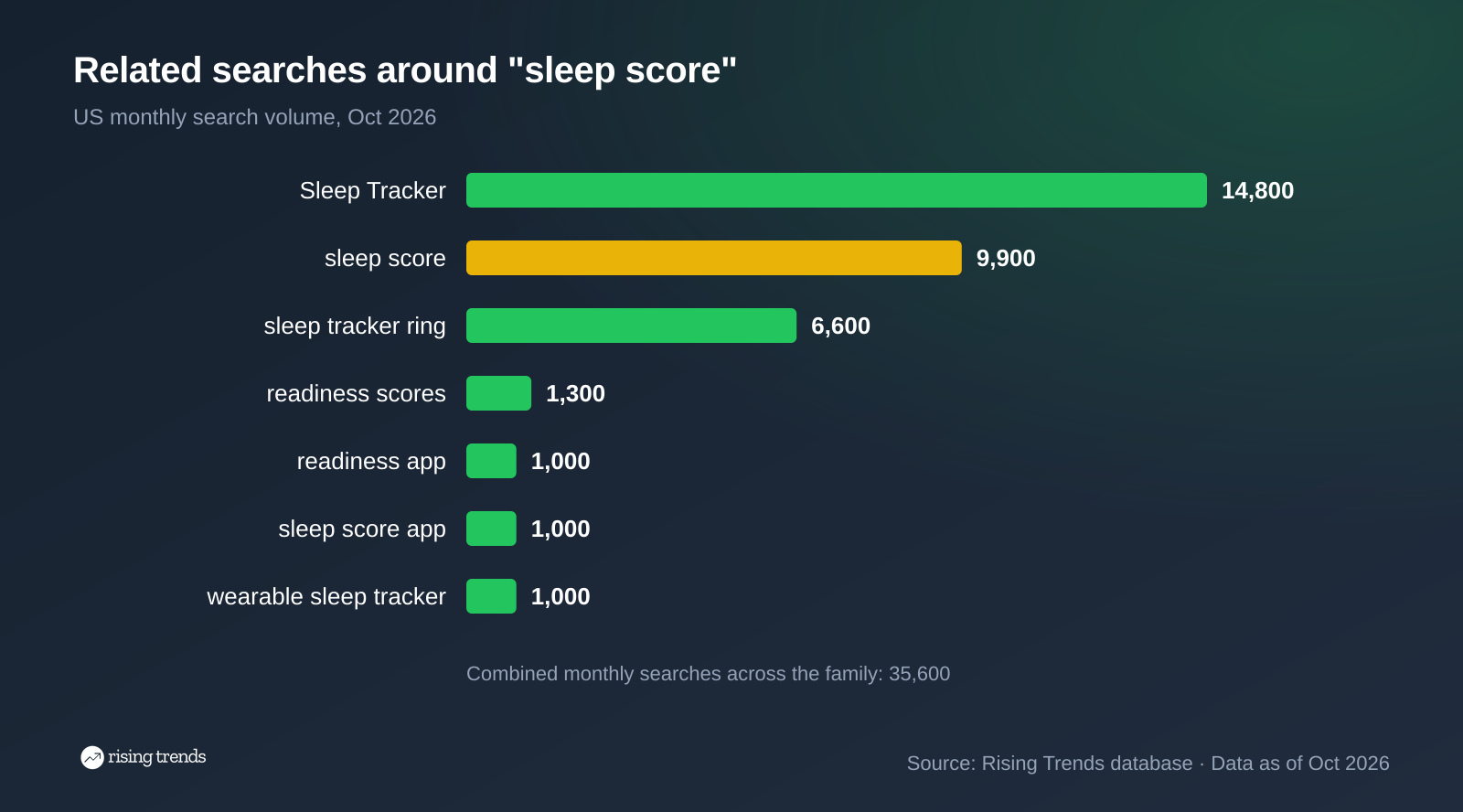
- "Sleep tracker" is down 33% year over year to 14,800 a month while "readiness scores" is up 306%. People stopped shopping for hardware and started interrogating the output.
- Apple put a sleep score on hundreds of millions of wrists when watchOS 26 shipped in September 2025, and it reached Apple Watch Series 6 and later, not just the new hardware.
- The three biggest scores do not measure the same thing. Apple weights duration 50 points, bedtime consistency 30 and interruptions 20. Oura scores heart rate, body temperature, movement and sleep stages. Garmin adds a heart-rate-variability recovery term.
- A 2025 validation study of six wrist wearables found every device overstated sleep efficiency, by 2.20 to 10.19 percentage points, and understated time spent awake in the night by 12.38 to 47.94 minutes.
- The American Academy of Sleep Medicine found 48% of US adults have used a sleep tracker, up from 35% in 2023, and that 76% have lost sleep worrying about sleep.
Let's get into it.
What we're seeing in the Rising Trends data
Here is the monthly search volume for "sleep score" over the last two years, straight from our database.
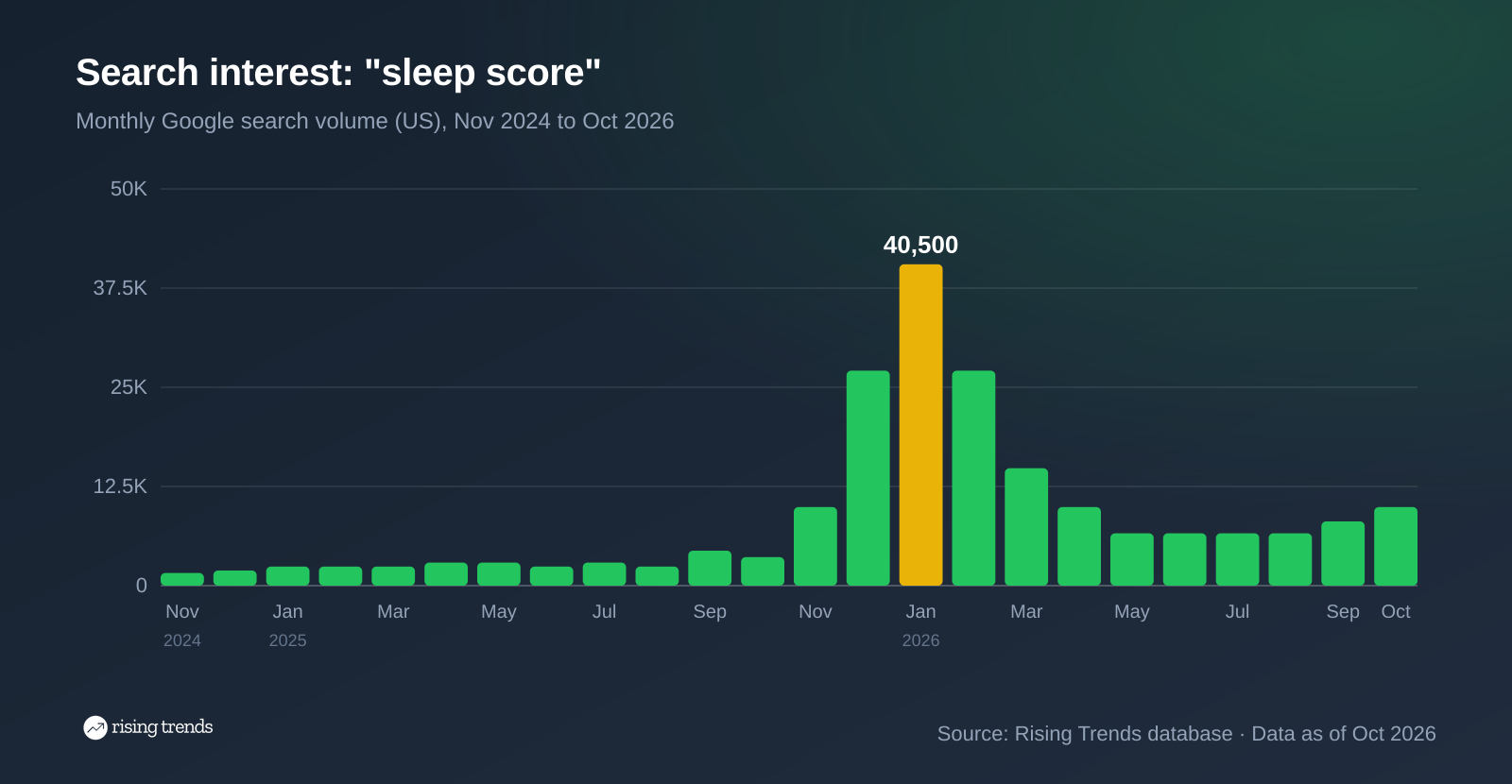
Two things in that shape matter. The spike is seasonal: January is when people resolve to fix their sleep, and the 40,500 peak in January 2026 is the biggest month in eight years of history for this term. But look at the floor rather than the ceiling. October 2024: 1,600. October 2025: 3,600. October 2026: 9,900. The quiet months keep getting louder, which is what a behaviour looks like as opposed to a news cycle. Our acceleration reading for the last three months against the three before it is 1.24, and the trajectory flag is rising.
The comparison nobody else is running is the one against the hardware.
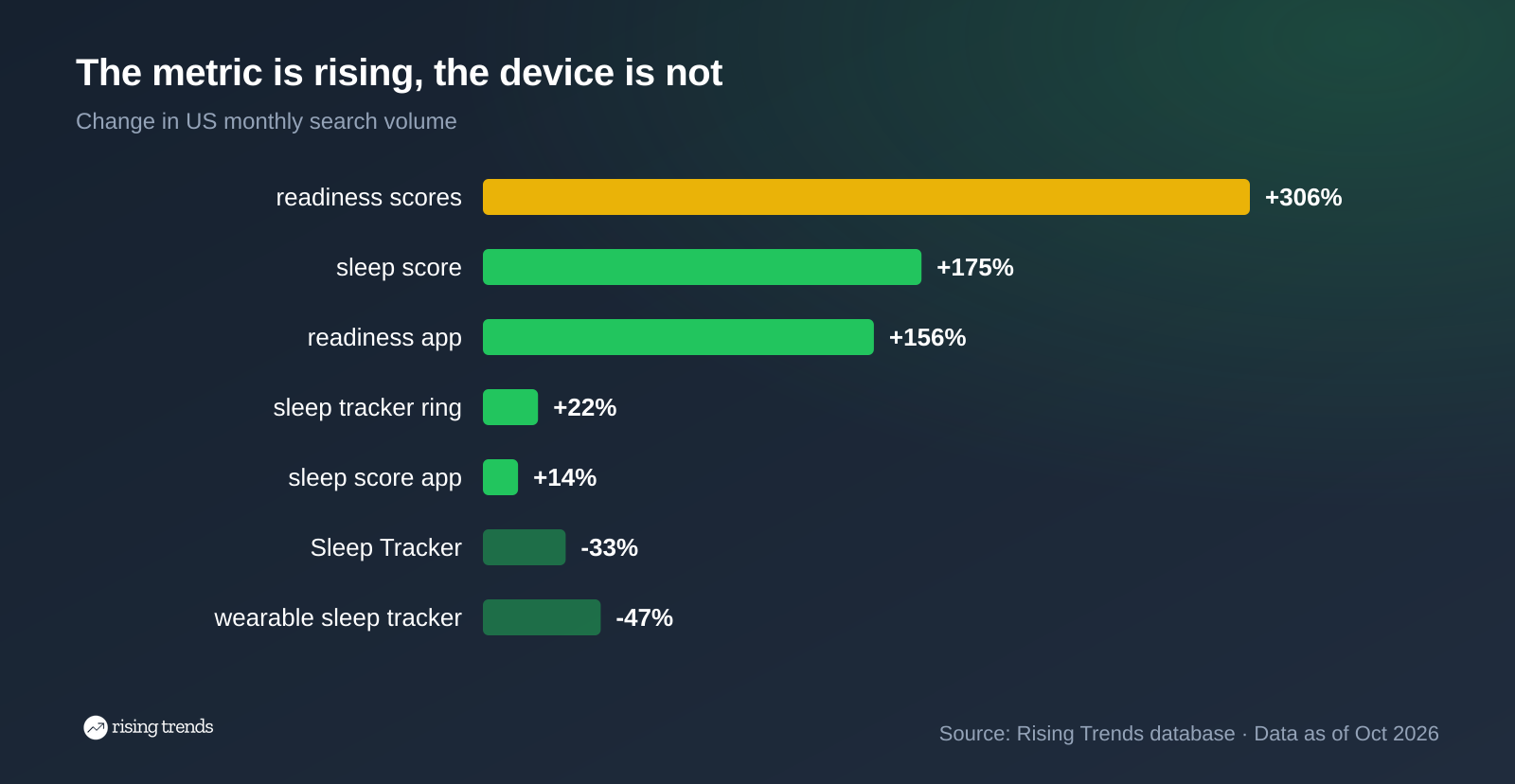
"Sleep tracker" is down 33% in a year, to 14,800 a month, and "wearable sleep tracker" is down 47%. The scores built on top of them are going the other way: "readiness scores" is up 306%, "sleep score" up 175%, "readiness app" up 156%. That is a market past the acquisition phase. People already own the thing. What they want now is help reading it, which is exactly the shift we tracked across the category in our wearable technology trends breakdown.
What a sleep score actually is
It is a single number from 0 to 100 that a wearable assigns to last night. That is the whole concept, and it is why it travels: you can say it out loud at breakfast.
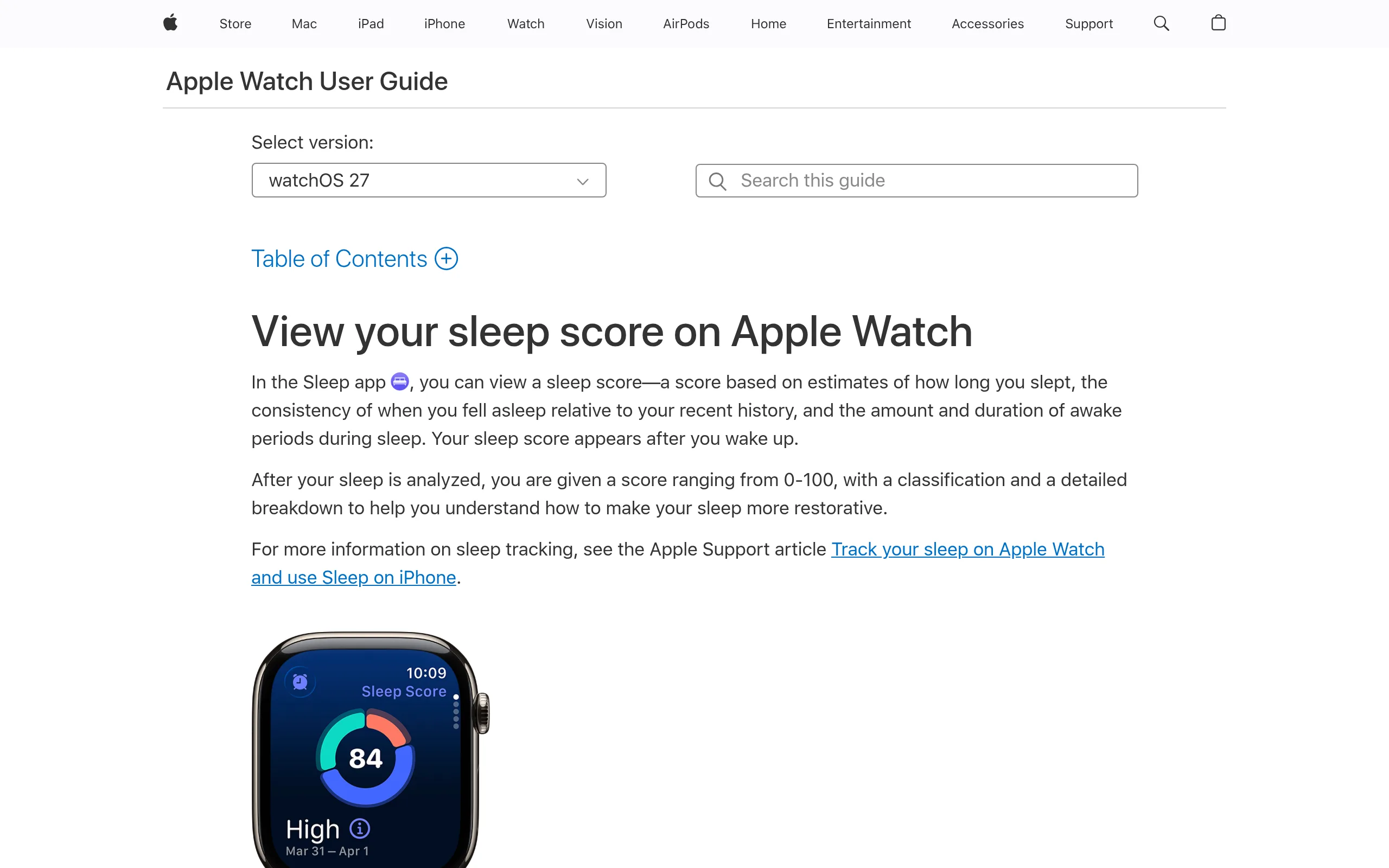
What it is not is a measurement. Apple's own support page is unusually clear about this. Your watch gives you a sleep score based on estimates of how long you slept, how consistent your bedtime was against the last 13 nights, and how often you woke up. The weighting is published: duration is worth 50 points, bedtime consistency 30, interruptions 20. Anything from 81 to 95 is "High".
Now compare that with the others. Oura's sleep score support article says it analyses "the dynamics of your resting heart rate, average body temperature, movement, and time spent in specific sleep stages", and its contributors include efficiency, latency and timing. Its top band, "Optimal", starts at 85. Garmin describes its sleep score and sleep insights as "a blend of how long you slept, how well you slept and evidence of recovery activity", where the recovery part is derived from overnight heart rate variability.
| Score | What it weighs | Where the top band starts |
|---|---|---|
| Apple Watch | Duration 50 points, bedtime consistency 30, interruptions 20 | 81 (High), 96 (Very High) |
| Oura | Resting heart rate, body temperature, movement, sleep stages, efficiency, latency, timing | 85 (Optimal) |
| Garmin | Duration against age-based norms, sleep quality, overnight HRV recovery | Not published as a fixed cutoff |
Three vendors, three formulas, three verdicts on the same night. An 84 means "High" on an Apple Watch and "Good" on an Oura ring. Nobody tells you that, because no vendor has any reason to.
Why it's trending now
The trigger is Apple. Sleep Score shipped with watchOS 26 in September 2025, and crucially it was not reserved for the new watch: Series 6 and later, SE 2 and later, and every Ultra got it. In one software update, a metric that belonged to a few million ring and strap owners landed on the wrist of anyone who had bought an Apple Watch in the previous five years.
Our curve agrees. The first month that crossed a quarter of the eventual peak was December 2025, the first full quarter of Apple scores in the wild, when the term jumped to 27,100. January did the rest.
The second ingredient was the backlash, which arrived almost immediately. In January 2026 the American Academy of Sleep Medicine published survey results showing that 48% of US adults have used a sleep tracking device, up from 35% in 2023, that 55% have changed their behaviour because of what one told them, and that 76% have lost sleep worrying about sleep. The AASM's advice on that page is blunt: check the data in the morning, never at night, and do not obsess over it.
Plenty of people are failing that test in public. This video from creator Tyler Haven, posted on 16 October 2026, is called "I Tried to Get a Perfect Sleep Score (it made me insane)", and it is a fair summary of the whole genre.
The format is the tell. A year ago the popular sleep video was a product review. Now it is somebody narrating their relationship with a number.
The new behaviour: what people are doing differently
Before, you checked whether you felt rested. Now you check the phone first and decide afterwards.
What is considered a bad sleep score? The honest answer is that it depends which company sold you the watch. The useful answer is that people treat anything under about 70 as a bad night and plan around it. Bethan Morgan, home editor at T3, wrote in March 2026 that "I'd become so obsessed with tracking my sleep that I was actually ruining it", and that the fix was removing the ring at night and logging sleep by hand. "By not fixating on my sleep score, I got back into a good sleep routine," she wrote.
That loop is old. On an insomnia support forum in 2022, a poster described being "addicted to the data to the point that it is negatively impacting my mental health", adding that she was "obsessed with getting 1.5 hours of REM and Deep, and when I fall short of that, it ruins my entire quality of life". What changed between then and now is not the psychology. It is that Apple shipped the number to everyone.
Clinicians already had a word for it. In 2016 a team led by Kelly Glazer Baron coined "orthosomnia" in the Journal of Clinical Sleep Medicine, modelled on orthorexia, after a run of patients who were spending longer in bed purely to raise the duration their trackers reported. It is not a formal diagnosis and the paper described three cases, not a population. It is, though, a nine-year-old warning that arrived a decade before the mass-market version of the problem. If a score is making your nights worse, that is a conversation for a doctor, not a settings menu.
The third change is vocabulary. Sleep is now scored the way work got scored, and the same people doing it are the ones we wrote about in optimization OCD and the broader maxxing movement. A score turns rest into a performance with a league table.
Who's building on it
The score is now the product, not the sensor.
Oura is the clearest case. Its Form S-1, filed with the SEC in September 2026, reports 5.0 million paid members as of 30 June 2026 and weighted-average 12-month retention of about 85%. It sold 3.6 million rings in the twelve months to that date, roughly 2% of the 212 million wearables IDC counted in the same period. Oura has filed to list on Nasdaq under the ticker OURA and set terms at $40 to $44 a share in September. The filing's own glossary defines Sleep Score as a feature of the app, not the ring. The hardware is the subscription's delivery mechanism.
Apple is the volume play, and the reason the search term broke out at all. It charges nothing extra for the score, which is precisely the competitive problem for everyone selling a membership.
Garmin and Whoop compete on the recovery framing rather than the sleep number itself, which is why "readiness scores" and "training readiness" are rising in our data alongside the main term.
Everything downstream is now a business too: mattress brands, magnesium, sleep peptides, cooling bedding. We covered that second wave in the peptides for sleep trend, where the behaviour was the same and only the purchase changed, and in our longer piece on sleep hygiene as self-care currency.
What it means for business
Three consequences are already visible.
The score is the moat, and the moat is leaky. Oura's filing is explicit that members stay for the app. But Apple now ships a competent score for free on hardware people already own, and a free score that is 80% as good is the classic way subscription businesses get squeezed. Watch the retention line, not the ring count.
Accuracy is the exposed flank. A 2025 validation study in Sleep Advances put six wrist wearables against laboratory polysomnography across 62 adults. Every device significantly overestimated sleep efficiency, by 2.20 to 10.19 percentage points, and every device underestimated time awake after falling asleep, by 12.38 to 47.94 minutes. Agreement with lab scoring ran from fair to moderate, with the Apple Watch Series 8 top of the six and a Garmin band bottom. The authors are direct: these devices do not match a sleep lab and should not replace one for diagnosis. Every vendor is one viral teardown away from having to defend a number it calls an estimate in its own documentation.
Retail sells to a scored customer now. If a shopper believes a device told them their deep sleep was short, the pitch for a pillow, a supplement or a mattress writes itself, and conversion gets easier the more the customer trusts the number. That is a gift to the categories in our sleep trends tracking and a risk the moment regulators or clinicians start asking what the number means.
Where this is heading
The January test. Our seasonality flag for this term is low, but the two Januaries we have both spiked. If January 2027 clears 40,500, "sleep score" is a fixture rather than a resolution. If the floor holds near 9,900 through the spring instead of falling back to 6,600, that is the better signal.
Readiness eats sleep. "Readiness scores" is the fastest riser in the family at 306% in a year from a small base, and "training readiness" is up 56%. The one-number habit is spreading from the night to the whole day, which is the same compression we saw push buyers toward screenless wearables: fewer inputs, one verdict.
Someone will publish the disagreement. The gap between three vendors scoring the same night is the obvious next story, and the first brand to publish a transparent, auditable formula gets to own the complaint everyone already has. Watch "sleep score app" and "sleep score accuracy" in our database. Independent score interpretation is an open lane, and it sits squarely inside the tech and gadget trends we track.
The number we keep coming back to is the quiet one. A term that sat at 1,600 searches a month two years ago does not settle at 9,900 because of one January. It settles there because several million people now wake up, look at a two-digit estimate, and let it tell them what kind of day they are going to have.
Want to catch shifts like this while they are still small? Read our guide on how to identify market trends, or see what is breaking out right now in our trending topics list.
Never miss a trend again
- One trend broken down with the numbers
- Who's making money, and what to build
- A website on the rise
- A breakout app
Join 5,000+ founders