
For two years the phrase "no discs" sat in our database at around 70 searches a month, and most of those were people whose Blu-ray player could not read a scratched film. Then it broke out in May 2026 and kept climbing. It hit 1,000 monthly searches in September 2026 and held there through October, which is 11.5x where it sat two years ago. The searches are not about a dirty lens any more. They are about whether you will be able to buy a game you own.
Every page currently ranking for the term is either day-of news from July or a forum thread, and Google's own AI summary still thinks you need to wipe the disc from the centre outward. Nobody has published the demand curve. So we pulled it, read Sony's announcement and the petition against it line by line, and checked what the rest of the family of searches around it is doing. The short version: the boycott is the loud part, and it is not the biggest number here.
Key takeaways:
- "No discs" went from 70 to 1,000 US monthly searches in two years, up 614% in the last year alone and classified as EXPONENTIAL in the Rising Trends database (data as of October 2026).
- The breakout month is May 2026, before Sony's July announcement. The demand showed up ahead of the news, which is the part every write-up missed.
- Sony confirmed on 1 July 2026 that disc production for all new PlayStation games ends in January 2028. Its announcement post carries 9,207 comments.
- The "Don't Kill the Disc" petition, started the same day by a Winnipeg game shop, stands at 389,479 verified signatures as of 23 November 2026.
- The bigger search story sits next door: "game preservation" is at 4,400 a month, up 1,995% in a year, while the older term "video game preservation" is down 19%. The vocabulary moved.
- Grand Theft Auto VI, the biggest launch of 2026, shipped on 19 November with a boxed edition that contains a download code and no disc.
Let's get into it.
What we're seeing in the Rising Trends data
Here is the monthly search volume for "no discs" over the past two years, straight from our database.
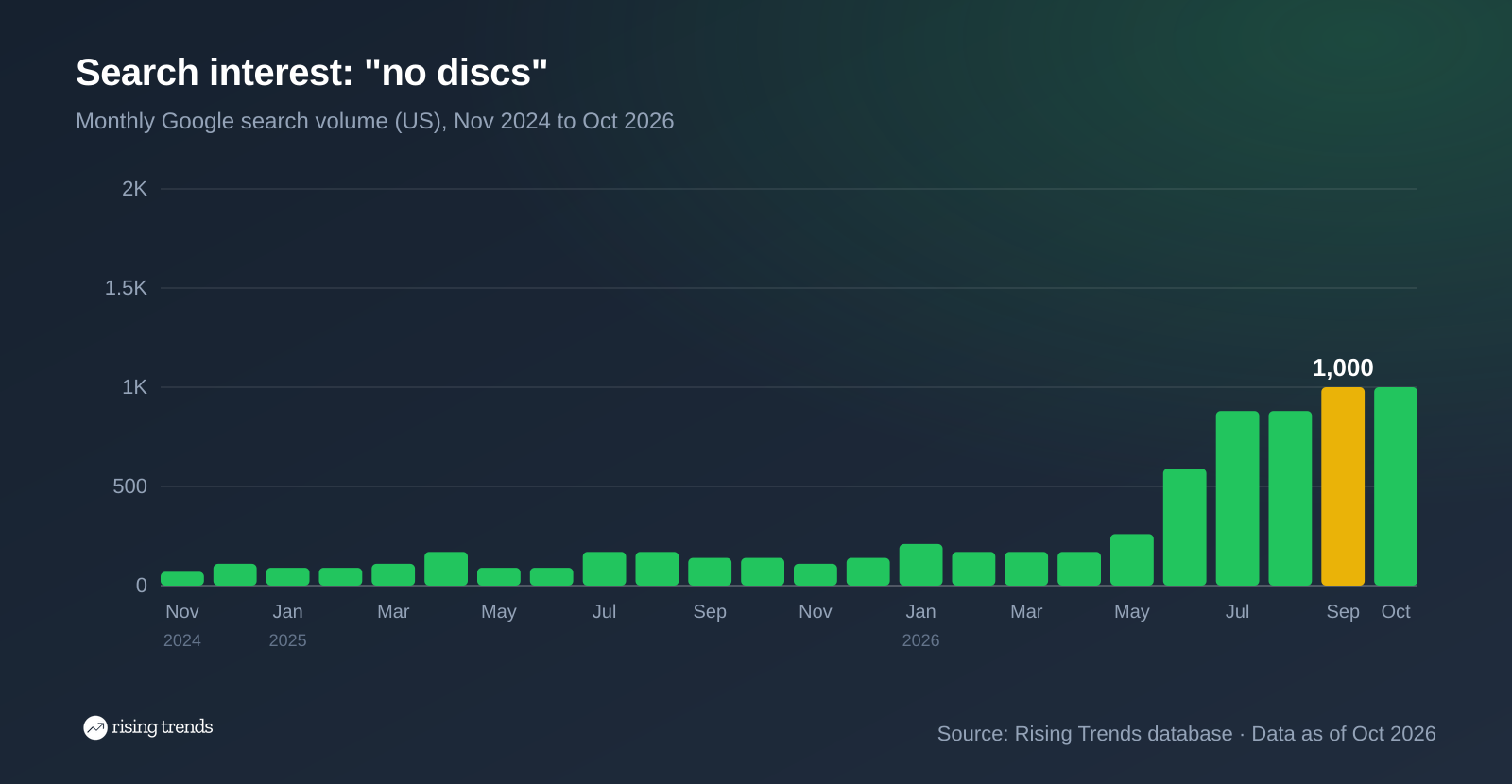
Two things in that shape matter. The first is when it moves: 170 in April 2026, 260 in May, 590 in June, 880 in July. Sony's announcement landed on 1 July. The curve had already more than tripled before the press release existed, which means the search was being driven by something earlier, and the likeliest candidate is the late-June Grand Theft Auto VI pre-order page.
The second is what happened after. News spikes come back down. This one did not. September and October both sit at 1,000, the highest the term has ever been, four months after the story stopped being news. Our acceleration score for the last three months against the three before it is 1.66, and the trajectory is still marked RISING.
The more useful view is what sits around it.
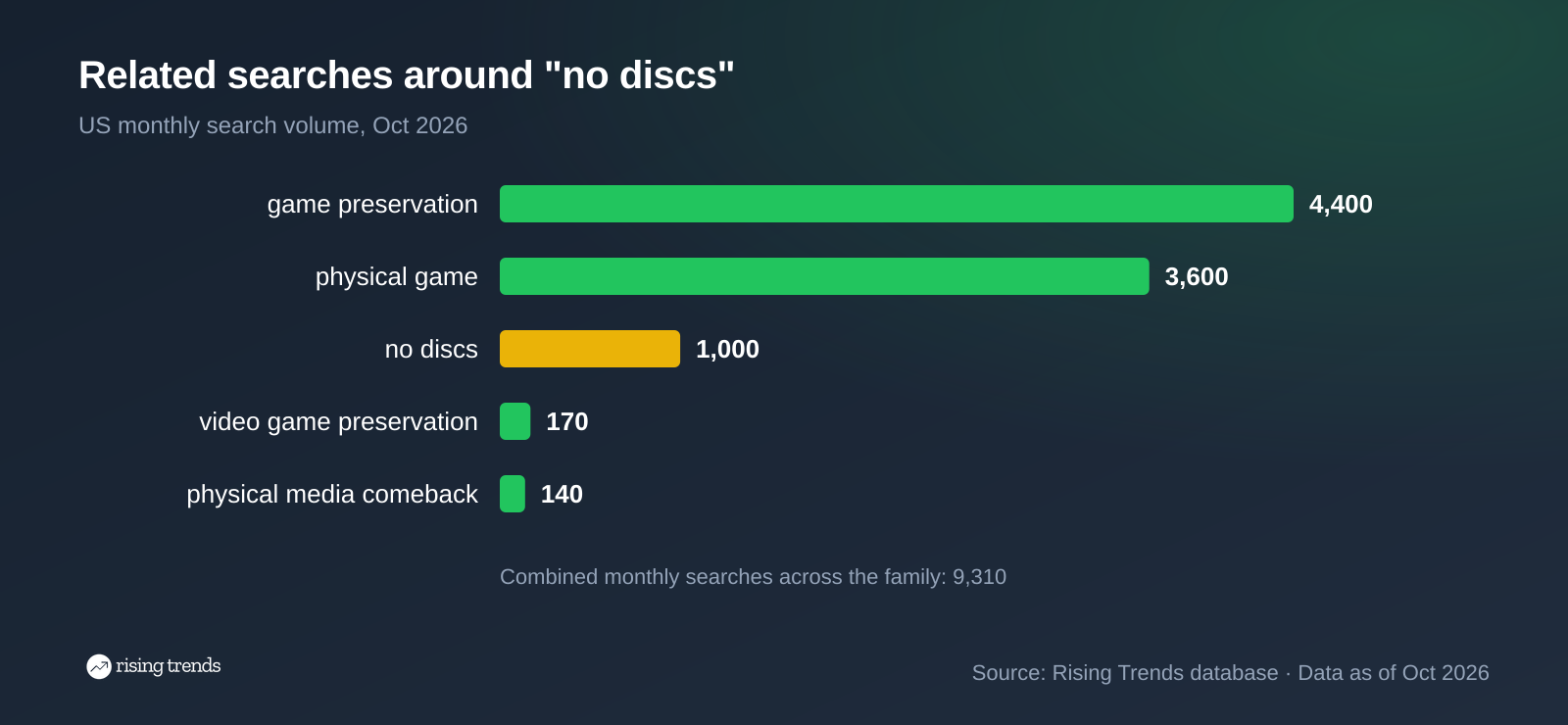
"No discs" is the small term in its own family. "Game preservation" is running at 4,400 searches a month and is up 1,995% in a year; "physical game" is at 3,600 and up 260%. Together the five terms are worth 9,310 searches a month as of October 2026.
Now look at which ones are shrinking. "Video game preservation" is down 19% year over year, and "physical media comeback" is down 18%. The archival vocabulary is losing ground while the consumer vocabulary explodes. That split is the tell. A nostalgia wave lifts the old words along with the new ones. A behaviour change replaces them, because the people searching now are not archivists. They are buyers deciding what to do at the checkout.
What the no discs trend actually is
Strictly, "no discs" describes a product decision: games sold only as downloads, consoles shipped without an optical drive, boxes that contain a code instead of a disc. In practice the search has become shorthand for the consumer response to that decision, which organised itself around a three-word slogan: no disc, no buy.
The decision it is responding to is specific and dated. On 1 July 2026, Sid Shuman, Senior Director of Content Communications at Sony Interactive Entertainment, posted on PlayStation.Blog that "physical game disc production for all new games releasing on PlayStation consoles will be discontinued starting January 2028." After that date, new games will be sold "on PlayStation Store and at retailers in digital formats only." Games already out, or out before January 2028, are not affected. The reason Sony gave was one line: "the general preference for digital media significantly outpaces physical discs."
The post is still up and the comments are closed at 9,207. That is the first number in this story, and it came from Sony's own page.
The counter-move arrived the same day. Jade Pearce, who owns the specialist retailer PNP Games Inc. in Winnipeg, started a petition called "Don't Kill the Disc". Its argument is about ownership, not nostalgia: "A box with only a download code is not the same thing. It is a digital license in plastic packaging. You do not own it. You are renting access that can be revoked."
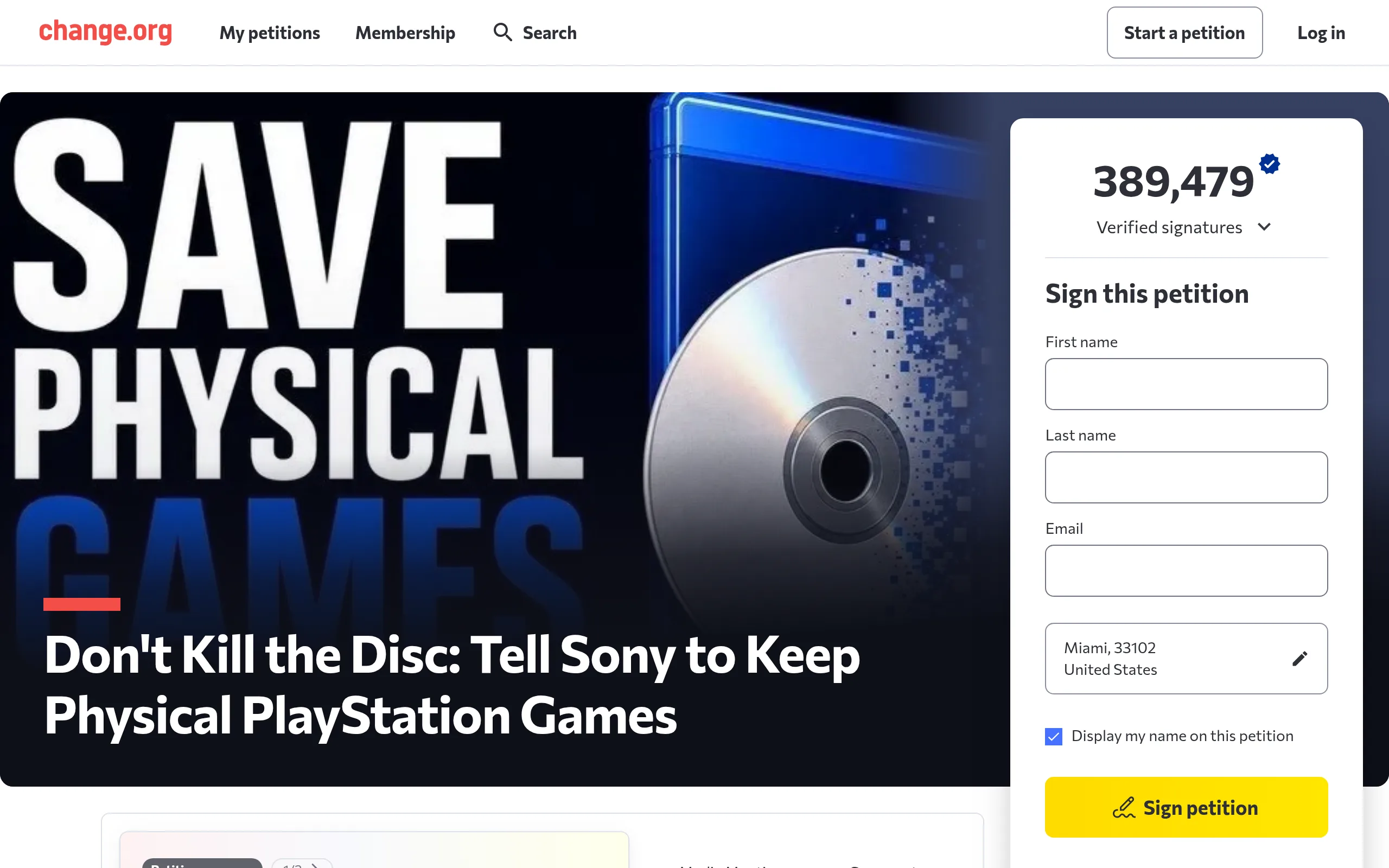
That counter in the screenshot read 389,479 verified signatures when we captured the page on 23 November 2026. It is also adding only about 360 a week now, which tells you the campaign has plateaued even though the search demand has not. Those two curves pulling apart is the most interesting thing in this story, and we come back to it at the end.
Why it's trending now
The trigger people name is Sony. The trigger the data points at is Rockstar.
Grand Theft Auto VI opened pre-orders in late June 2026, a week before Sony's post. Rockstar's own editions page lists exactly one standard option: "Standard Edition Digital or Code in Box." There is no disc. The biggest game launch in a decade quietly confirmed that the boxed version of a blockbuster is now a cardboard sleeve with a code in it, and our curve jumped from 260 to 590 that month.
The game shipped on 19 November 2026. Within hours, unboxing videos were doing the thing the format invites: showing the empty disc hub to camera. This one went up on 18 November and had 132,410 views when we checked five days later.
What makes an unboxing with nothing in it work as content is that the disappointment is physical. You can see the empty tray, and that is a far more portable argument than any press release.
Underneath both events sits a slower one. In June 2026 the European Commission replied to "Stop Destroying Videogames", the 14th successful European citizens' initiative, which gathered over 1.29 million valid signatures and cleared the national threshold in 24 of 27 Member States. That campaign is about publishers switching off games people paid for, not about discs, but it did the groundwork: it taught a lot of players that "buy" and "own" are different words.
The new behaviour: what people are doing differently
The change is small, deliberate and easy to measure at a till: people are choosing the disc version on purpose, and some are declining to buy when there is not one.
Before, format was a convenience question. Disc if the shop was nearby and the download was slow, digital if it was not.
After, format is a position. The petition's organiser spelled out the ask in an update on 21 July 2026: "if you want to send the loudest possible message, buy the disc. Every purchase is proof the format still has a market." That is a consumer boycott with the polarity reversed. Instead of withholding money, it tells you where to spend it.
Who is doing it? Overwhelmingly console-first buyers, which is the group with the most to lose. As Pearce put it in the same update, collectors and physical buyers "are disproportionately console-first, they're not the demographic gaming on Steam, they're the ones who could still be won back with the right moves."
The second change is sharper, and it is the one the search data actually captures. People have started checking before they buy. "Does this come on a disc" is now a pre-purchase question for a meaningful number of buyers, which is why the volume held through September and October rather than decaying like a news story. The same checking behaviour showed up next door last year, when 14,800 people a month suddenly wanted to know what they kept after converting a disc, which is the whole subject of our breakdown of Xbox Disc to Digital.
The third is the quiet one: preservation went mainstream as a shopping concern rather than an archivist's concern. That is the 4,400-a-month term, and it has a factual spine. The Video Game History Foundation's study with the Software Preservation Network found that 87% of classic video games released in the United States are critically endangered, with only 13% commercially available, and that no era of game history it measured cracked 20% availability. Once you know that number, "I will just buy it again later" stops being a plan.
Who's building on it
Sony is the decision maker and has stayed almost entirely silent since the post. The petition update notes "three weeks of complete silence while this petition became national and worldwide news," and as of today Sony has not publicly revisited the January 2028 date.
Rockstar Games is the proof of concept. GTA VI's boxed standard edition is a code, and nothing about its launch suggests the format cost it anything. That is the data point every other publisher is reading.
Nintendo took the middle path, and it is worth understanding precisely because it is the compromise everyone will be offered. Switch 2 sells both ordinary game cards and what Nintendo calls game-key cards. Its support page is admirably blunt about the difference: game-key cards "don't contain the full game data. Instead, the game-key card is your 'key' to downloading the full game to your system via the internet." The card still has to stay in the console to play. You can lend it, and you cannot play it without a download. It is half a disc.
Independent retailers are the organised opposition, and PNP Games is the one that got the number. Pearce says the shop's physical sales are up year over year and grew further after Sony's announcement, which, if it holds across the specialist channel, is the only evidence in this story that points the other way from Sony's.
The emulation and preservation scene is the overflow valve, and our data shows it filling. When a format stops being sold, the demand does not vanish, it relocates: this is exactly what we traced in PS5 Emulators, Explained and again in the Switch 2 emulation trend, where a community shipped a working emulator eleven days after the jailbreak. Those curves and this one are the same people.
What it means for business
Specialist retail loses a category and gains a cause. After January 2028 a game shop cannot sell a new PlayStation release as an object. Trade-ins, the margin engine of that channel, stop refilling with new stock. The counter-argument from inside the channel is that undersupply, not disinterest, has been suppressing physical numbers: the petition's 21 July update claims Resident Evil Requiem "sold out at launch and didn't see a restock for a month," and argues the shop "would have sold two to three times what we did if physical copies had actually been available." Treat that as a retailer's account rather than audited data, but it is a testable claim and publishers have the receipts.
Publishers gain margin and lose a price floor. No disc means no pressing, no freight, no retail cut and no second-hand market competing with the storefront. It also means no used copy at $25 anchoring what the game is worth, and no lending. Expect the complaints about $80 games to get louder, because the comparison that made that price feel survivable was a disc you could sell on.
The ownership question becomes a product feature. The petition's framing, "whether you own what you pay for," is a consumer-protection argument, and in Europe it already has 1.29 million signatures behind a different version of it. Any platform that offers a credible answer, whether that is offline installers, transferable licences or a guaranteed archival mode, gets to own a differentiator its rivals have just given up. The broader gaming trends we track show how fast that kind of positioning moves once one player commits.
Hardware gets a decision to make. A console without a disc drive is cheaper to build and ships a worse answer to this crowd. The next generation's drive, or lack of one, is now a public argument rather than a cost line, in the same way that repairability turned from a niche concern into a marketing claim across the tech and gadget trends we follow.
Where this is heading
Three calls, each with a term in our database to watch.
The boycott plateaus and the behaviour sticks. The petition is adding about 360 signatures a week against 389,479 total: that campaign has done what it is going to do. The search curve has not plateaued. Watch whether "no discs" holds above 880 a month through the winter. If it does, the slogan has outlived its news cycle and turned into a shopping habit, which is a much harder thing for a platform to wait out.
Preservation becomes the mainstream word. At 4,400 a month and up 1,995% in a year, "game preservation" is already four times the size of the term that made the headlines, and it is growing from the consumer side rather than the archive side. It is the term to watch, not ours. If it clears 10,000 a month, publishers will be answering preservation questions in product briefings, not just in legal ones.
Emulation absorbs the gap. Every format that stops being sold ends up archived by people who are not supposed to be archiving it. The 87% figure is what that gap looks like after a few decades. Watch "physical game" at 3,600 and the emulation cluster together: if physical keeps climbing while discs stop being pressed, the difference goes somewhere, and it is not going back to the storefront.
The signal we trust most is still the first chart. A term that sat at 70 searches a month for two years does not go to 1,000 and stay there because one company published a blog post. The post gave an existing worry a date to point at. January 2028 is the date everyone is arguing about, but the argument started earlier, and the data says it will outlast it.
Want to spot behaviour shifts like this before they get a name? Read our guide on how to identify market trends, or browse what is breaking out right now in our trending topics list.
Never miss a trend again
- One trend broken down with the numbers
- Who's making money, and what to build
- A website on the rise
- A breakout app
Join 5,000+ founders