

A term in our database spent two years flat at 70 searches a month. Then it did this: 390 in August 2026, 720 in September, 1,600 in October 2026. "Camera earbuds" is now up 2,186% year over year, and the thing it is replacing is going the other way. Searches for "camera glasses" are down 18% in the same window.
That is the whole story in two lines, and nobody ranking for the term has either of them. Search "camera earbuds" today and you get retail listings and affiliate roundups ranking products nobody has tested. So we pulled the curve, mapped the term against the five search families around it, read the research paper that made the hardware possible, and checked what the devices actually cost on the manufacturers' own pages.
Key takeaways:
- "Camera earbuds" went from 70 to 1,600 US monthly searches in a year, up 2,186% and classified as EXPONENTIAL in the Rising Trends database (data as of Oct 2026). September 2026 was the breakout month.
- "Camera glasses" fell 18% over the same year and still sits at 18,100 a month. The bigger category is shrinking while the smaller one explodes, which is what a form-factor handoff looks like early.
- The enabling research is public. University of Washington's VueBuds, presented in April 2026, runs each earbud camera at under 5 milliwatts and matched Ray-Ban Meta glasses for answer quality across 17 visual tasks.
- Rollme's AirCam sells for $79.99 on the company's own store. The same brand's camera glasses cost $99.99, so the earbud version now undercuts the glasses by 20 dollars.
- Marketplace clones have pushed the floor to roughly 42 euros, with 8MP sensors, 1080p video and a 10-minute cap per clip.
- The whole family (open-ear, bone conduction, camera glasses, AI earbuds, camera earbuds) is worth 75,000 searches a month combined, so this is a shift inside a real category, not a novelty on its own.
Let's get into it.
What we're seeing in the Rising Trends data
Start with the family, because the comparison is the point. "Camera earbuds" is the smallest term in its neighbourhood and by far the fastest.
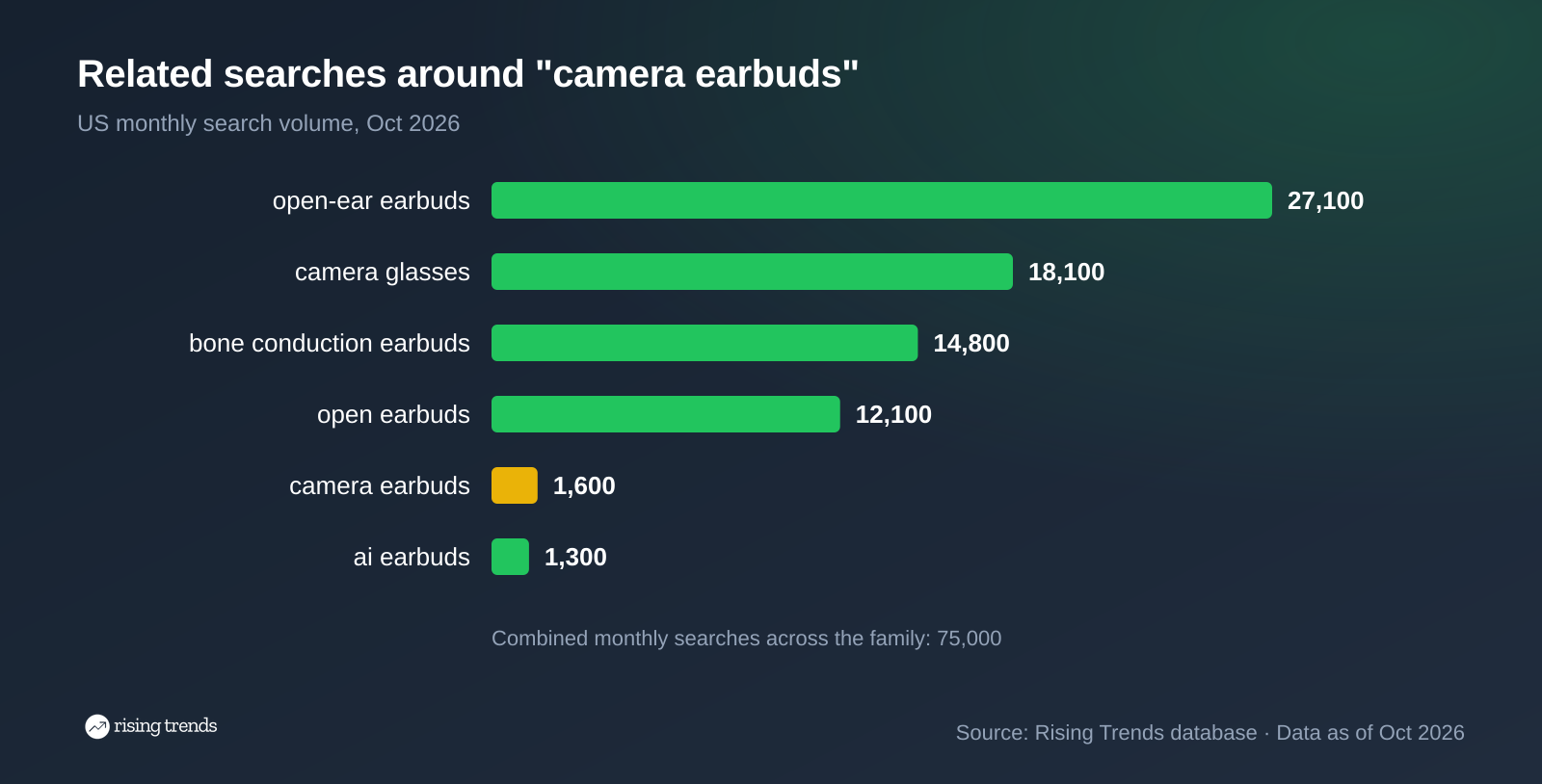
Read that chart as a map of where attention already is. "Open-ear earbuds" at 27,100 a month is the installed audience. "Camera glasses" at 18,100 is the behaviour people already understand. "Camera earbuds" at 1,600 is the new wiring between them. Now put growth next to volume and the ranking inverts.
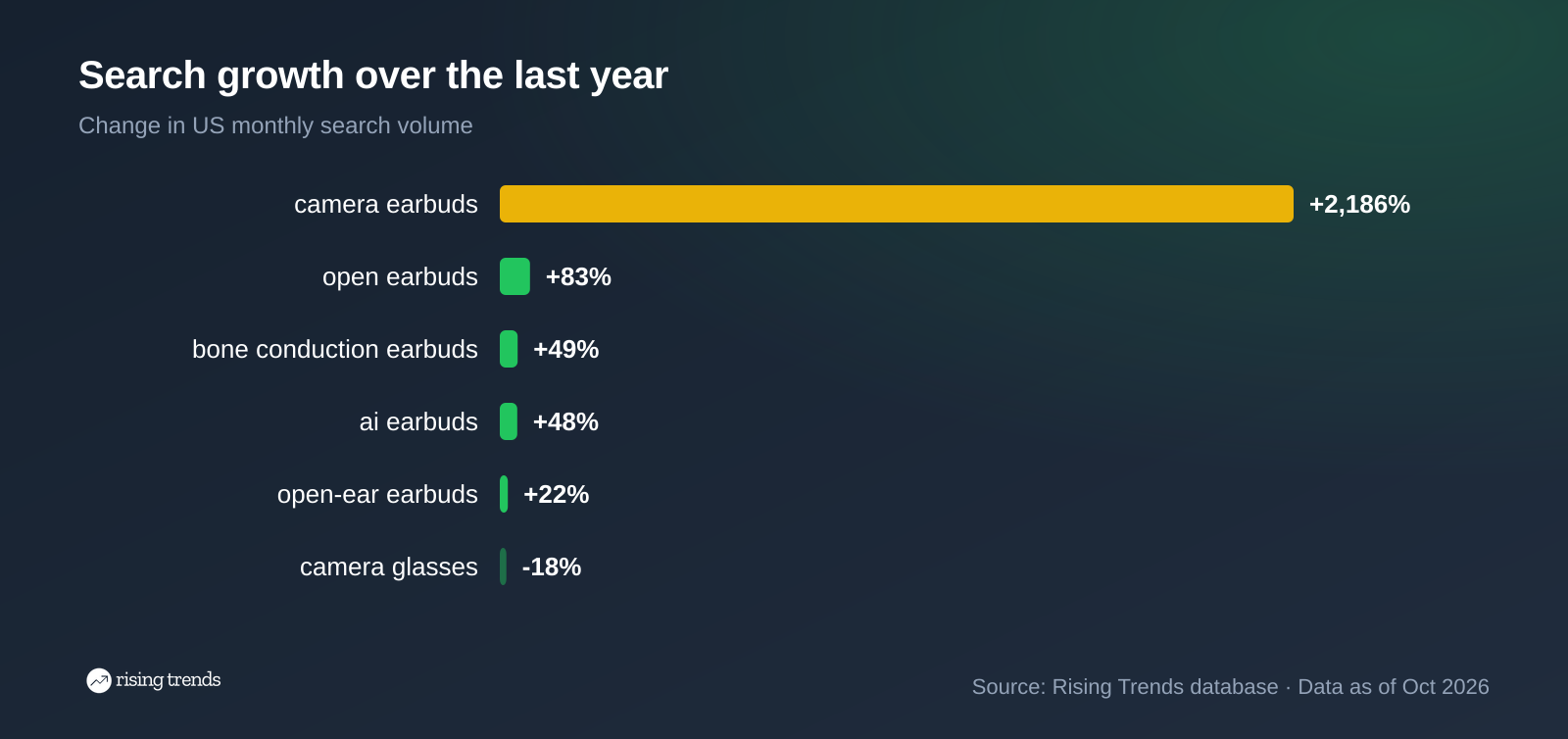
One term is up 2,186%. The next fastest in the family is up 83%. And the only term falling is the one this category takes its idea from. That is the comparison nothing else ranking for this term has: the form factor people are leaving is 11 times bigger than the one they are joining.
The curve itself is short and steep. Two years at a flat 70 a month, then a near-vertical quarter.
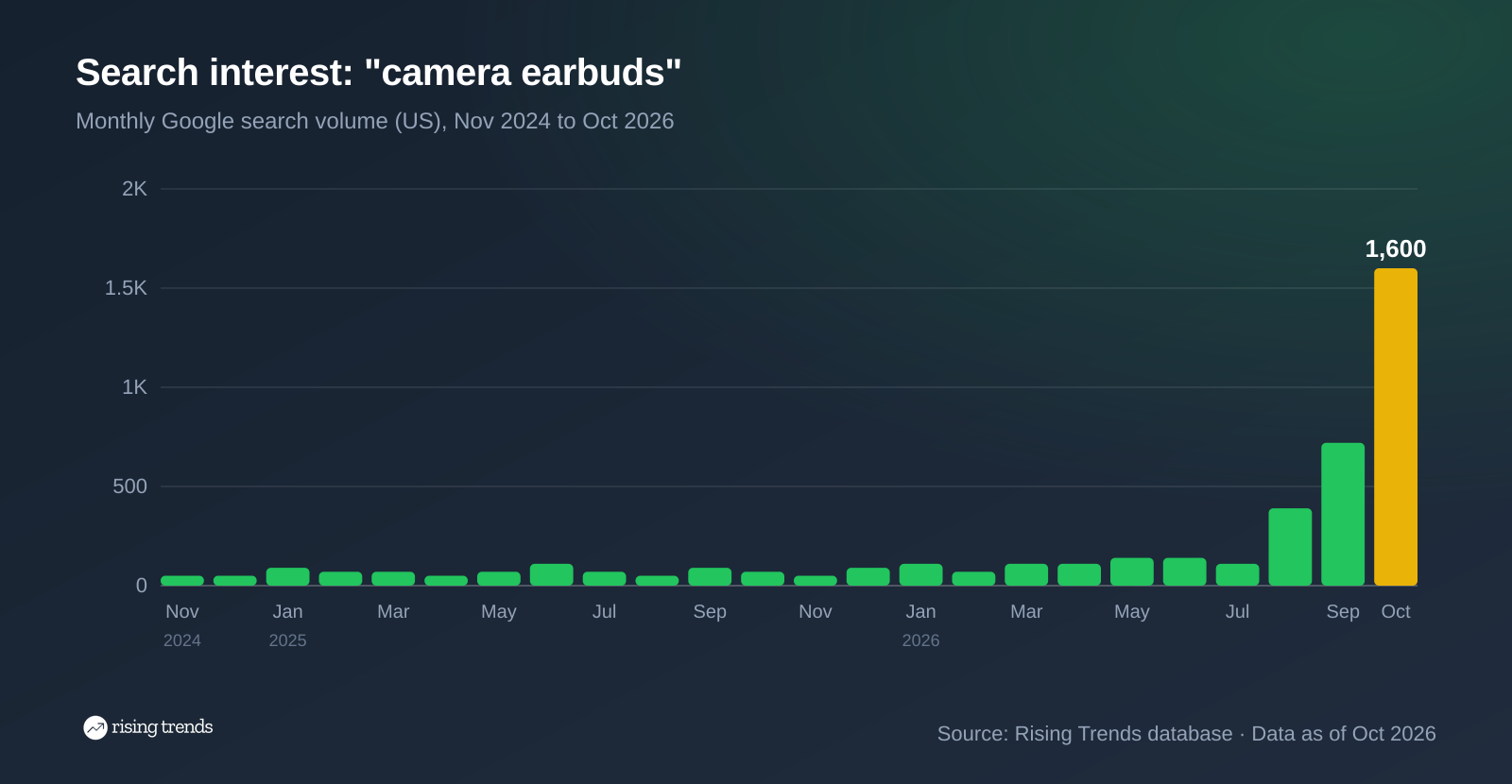
The three-month average sits at 903 against 70 two years earlier, a 12.9x lift, and the last three months are running almost seven times the three before them. Steep curves off a tiny base are usually noise. This one has products, prices and a research paper behind it, which is the difference between a spike and a category.
What's changing
For three years, "wearable camera" meant something on your face. Snap put it on sunglasses, Meta scaled it with Ray-Ban, and the whole pitch was that glasses were a socially acceptable place to hide a lens.
The shift is that the lens moved to the ear, and it moved down-market on the way. Buyers are no longer choosing between a phone in their hand and a 300-dollar pair of smart glasses. They are choosing between a phone and an 80-dollar pair of open-ear buds that already sit in their ears for other reasons. That is the same unbundling logic we tracked across wearable technology trends: a feature leaves the dedicated device and shows up inside something people already wear.
Three things changed at once:
| Before | Now | Since |
|---|---|---|
| Camera lives on glasses you have to buy and wear | Camera lives in buds you already wear for audio | Jul 2026 retail, Apr 2026 research |
| Entry price 200 to 400 dollars | Entry price 42 euros, mainstream around 80 dollars | Aug to Oct 2026 |
| Recording is the feature | Recording plus on-device translation and object recognition | 2026 product cycle |
The audio part matters more than it sounds. These are open-ear and bone-conduction designs, which means the camera arrives inside the one headphone category people buy specifically so they can still hear traffic. The lens is a passenger on a purchase that was already happening.
Why now
The honest answer is that the physics stopped being the blocker in April 2026.
University of Washington researchers published VueBuds, the first camera-integrated wireless earbuds for first-person vision, at the CHI conference in Barcelona. They took off-the-shelf Sony buds, put a camera roughly the size of a grain of rice into each one, and made the thing answer questions about what is in front of you.
"We haven't seen most people adopt smart glasses or VR headsets, in part because a lot of people don't like wearing glasses, and they often come with privacy concerns, such as recording high-resolution video and processing it in the cloud," said senior author Shyam Gollakota. "But almost everyone wears earbuds already, so we wanted to see if we could put visual intelligence into tiny, low-power earbuds, and also address privacy concerns in the process."
The engineering numbers on the VueBuds project page are the ones that unlocked the category. Each camera draws under 5 milliwatts by firing on demand rather than streaming, which is what makes a lens survivable inside a battery that small. Angling each camera 5 to 10 degrees outward gives a 98 to 108 degree field of view, with a blind spot only for objects held closer than 20 centimetres. Stitching the left and right images into one cuts the answer time from two seconds to about one.
Then the result that should worry the glasses makers: across 17 visual question-answering tasks with 90 participants, low-resolution monochrome earbud cameras matched Ray-Ban Meta for answer quality. Participants preferred the earbuds for translation. The glasses only won at counting objects.
Lead author Maruchi Kim framed the question the team started with plainly: "One big question we had was: Will your face obscure the view too much? Can earbud cameras capture the user's view of the world reliably?" The answer, with two cameras instead of one, was yes.
Six weeks after that paper, the cheap versions started shipping. This walkthrough of a bone-conduction camera headset, posted on 15 October 2026 and sitting at 1,657 views, is the clearest look at what buyers actually receive in the box.
Note what the video is not: a launch event, a keynote, or a brand campaign. It is an owner explaining a device to other prospective owners. That is usually the point in a category's life where search volume starts compounding.
The players
The clearest read on the market is one brand's own price list, because Rollme sells the camera in three places at once.
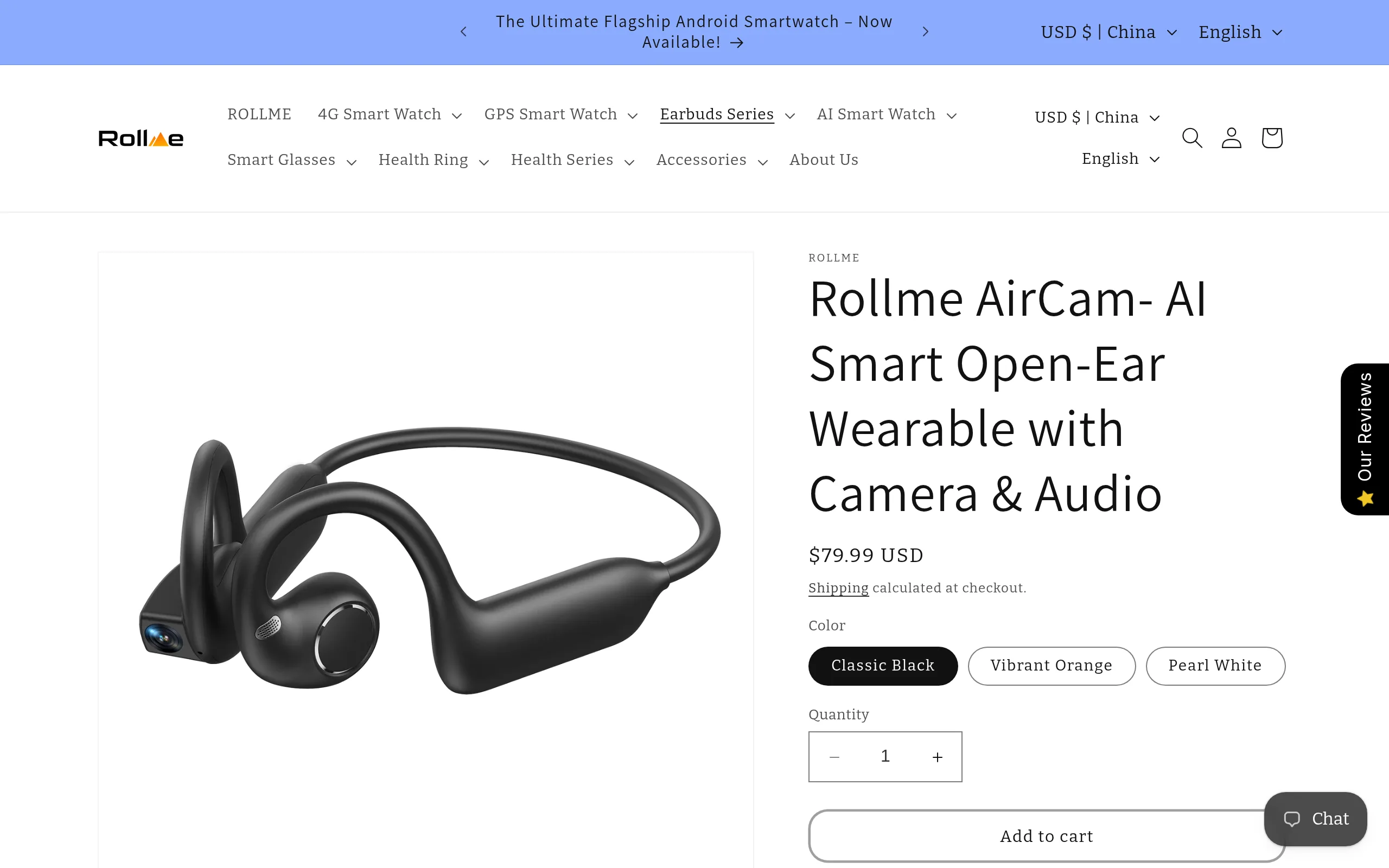
The AirCam product page lists an open-ear wearable with a forward-facing 8MP lens on the ear hook at $79.99, in three colours, in stock. On the same store, the over-ear AuraCam is $89.99 and the AirView and AuraView camera glasses are $99.99 each. So inside one catalogue, the earbud camera is the cheapest way to buy a camera, and the glasses are the premium tier.
| Player | Form factor | Price or number |
|---|---|---|
| Rollme AirCam | Open-ear buds, 8MP side camera | $79.99 |
| Rollme AuraCam | Over-ear headphones with camera | $89.99 |
| Rollme AirView / AuraView | Camera glasses | $99.99 each |
| Marketplace clones (E12 and similar) | Bone-conduction camera headset | About 42 euros |
| University of Washington VueBuds | Research prototype in Sony buds | Under 5 mW per camera |
| Meta Ray-Ban | Camera glasses, the incumbent | Matched, not beaten, in a 90-person study |
The gap in that table is the interesting part. There is a research-grade version and a 42-euro version, and almost nothing credible in between from a company you have heard of. Categories that look like this usually get one serious entrant within a year, which is the same pattern we watched play out in camera robotics when Beni's $549 tracking camera arrived in a market of cheap gimbals.
The new consumer behaviour
What people are buying is not a camera. It is the removal of a gesture.
The pitch across every listing is identical: you do not take your phone out. Cyclists, parents, travellers and badminton players are all being sold the same thing, which is footage of something that would have ended before a phone came out of a pocket. The 10-minute clip cap on the cheap models tells you these are not vlogging rigs. They are moment-catchers.
The second behaviour is translation, and it is the one the research backs rather than the marketing. Participants in the UW study preferred earbud cameras to glasses specifically for reading foreign text, which makes sense: you point your head, you hear the answer, nothing appears on a screen. A traveller does not want a heads-up display. They want a whisper.
And then there is the question buyers keep asking out loud. One of the more-watched hands-on tests of a 42-euro model, published on 25 October 2026, puts it directly in the title: "is it legal or dangerous". That is not a reviewer being dramatic. It is the actual purchase objection.
Regulators already wrote the problem down, years before this product existed. The UK Information Commissioner's Office guidance on body-worn video says that because such cameras "can be quite small or discreet", the people around them "may not be aware that they are in fact being recorded". The remedy the ICO names for organisations is a warning light or visible signage on the device. Earbuds point the only available indicator light away from everyone it is meant to inform, and the UW team flagged the same limitation in its own paper. Rules written for organisations are not consumer law, but they describe the failure mode precisely.
Business implications
The accessory tier gets squeezed first. If a camera is a $79.99 feature on buds you were buying anyway, the standalone action camera loses its entry-level customer and the 200-dollar camera-glasses tier loses its price story. The declining "camera glasses" line in our data is the early version of that.
Audio brands have a decision to make this quarter. The buyers are already theirs. "Open-ear earbuds" at 27,100 searches a month and "bone conduction earbuds" at 14,800 are exactly the customers being targeted, and right now those customers are being served by brands with no audio reputation to protect. Every month a known name waits, the category's defaults are set by 42-euro clones, which is how a category gets a reputation problem before it gets a leader. For anyone sourcing product rather than building it, this is the textbook window that our guide on finding trending products with AI is built for.
The margin is in software, and almost nobody has it. Translation and object recognition are what justify a premium, and both now run on-device at low power. A company that ships good on-device translation in buds can charge for buds. A company that ships an 8MP sensor and a companion app cannot.
Retail and marketing will be reshaped by the footage, not the device. Hands-free POV clips are cheap to produce and native to short video, which lowers the cost of the one asset every brand is now buying. Creator economics already bent that way once this year, as the clipping campaigns trend showed when brands started paying per view for cut-up footage.
And there is a real downside case. A single viral story about a camera earbud used badly in a gym, a school or a changing room could cost the category a year. Workplace bans are the obvious first response, because no colleague can tell which buds have lenses.
Where this is heading
Three calls, each tied to a term in our database you can watch.
The curve holds, but not at 1,600. October was the first month this term existed at scale, and first months overshoot. The signal to watch is whether "camera earbuds" settles above 700 a month through the winter. Above that line it is a category with a floor; below it, 2026 was a retail push. Either way, "open earbuds" rising 83% in a year says the host form factor is healthy.
A name brand enters, and the privacy fight starts properly. The open question is whether that entrant ships a recording camera or a sensing one. A camera that recognises but cannot record is a different legal product, and it is the design the research community already favours. Watch "ai earbuds", which sits at 1,300 a month and up 48%, as the term that absorbs this if the answer is sensing rather than filming.
The glasses do not die, they move upmarket. Down 18% in a year does not mean over. It means the cheap half of that category is being eaten from below, which usually ends with glasses keeping the display and the premium price while earbuds take the camera. If you want the broader frame on where this sits among the other hardware shifts we are tracking, our tech and gadget trends page follows the whole set.
The thing we trust most is the shape of the handoff. A term does not go from 70 to 1,600 a month while its parent category drops 18% unless buyers have quietly decided something. They have decided they want the camera, and they have decided they do not want it on their face.
Want to catch category handoffs like this while they are still at 70 searches a month? Read our guide on how to identify market trends, or browse what is breaking out right now in our trending topics list.
Never miss a trend again
- One trend broken down with the numbers
- Who's making money, and what to build
- A website on the rise
- A breakout app
Join 5,000+ founders