
Two years ago almost nobody was googling GLP-1 hair loss. Our database has the term at 880 monthly searches in October 2024. In September 2026 it hit 12,100, up 49% in a year and 20.3x in two, and it has held that level for three straight months.
Here is the part the explainer pages miss. Every write-up you can find tells you the same mechanism story: rapid weight loss, telogen effluvium, it grows back. None of them show you that this is the GLP-1 side effect that refuses to fade. "Ozempic face", the first one to go mainstream, is down 33% in a year. GLP-1 hair loss is up 49% in the same window, and in September 2026 it got something ozempic face never had: a genetic finding in a dermatology journal.
Key takeaways:
- "GLP-1 hair loss" reached 12,100 US monthly searches in September 2026, up 49% year over year and 20.3x in two years, classified RAPID in the Rising Trends database (data as of Sep 2026).
- The side-effect terms are not one wave. Ozempic face is down 33% in a year at 135,000 searches a month. Hair loss terms and vision terms are the ones still compounding.
- On 3 September 2026, NYU Langone Health published a genetic study linking higher GLP-1 receptor activity to about 7% higher odds of male-pattern hair loss. Nobody in the data was taking the drug.
- The current ZEPBOUND label already splits it by sex: 7.1% of women reported hair loss versus 0.5% of men in the pooled weight-loss trials.
- A market is forming on top of the side effect. A randomized placebo-controlled trial of a supplement aimed only at GLP-1 users is recruiting, and 21% of current GLP-1 households told Circana they bought medication for side effects in the last three months.
Let's get into it.
What we're seeing in the Rising Trends data
Here is the monthly curve for "glp1 hair loss" over the last two years, straight from our database.
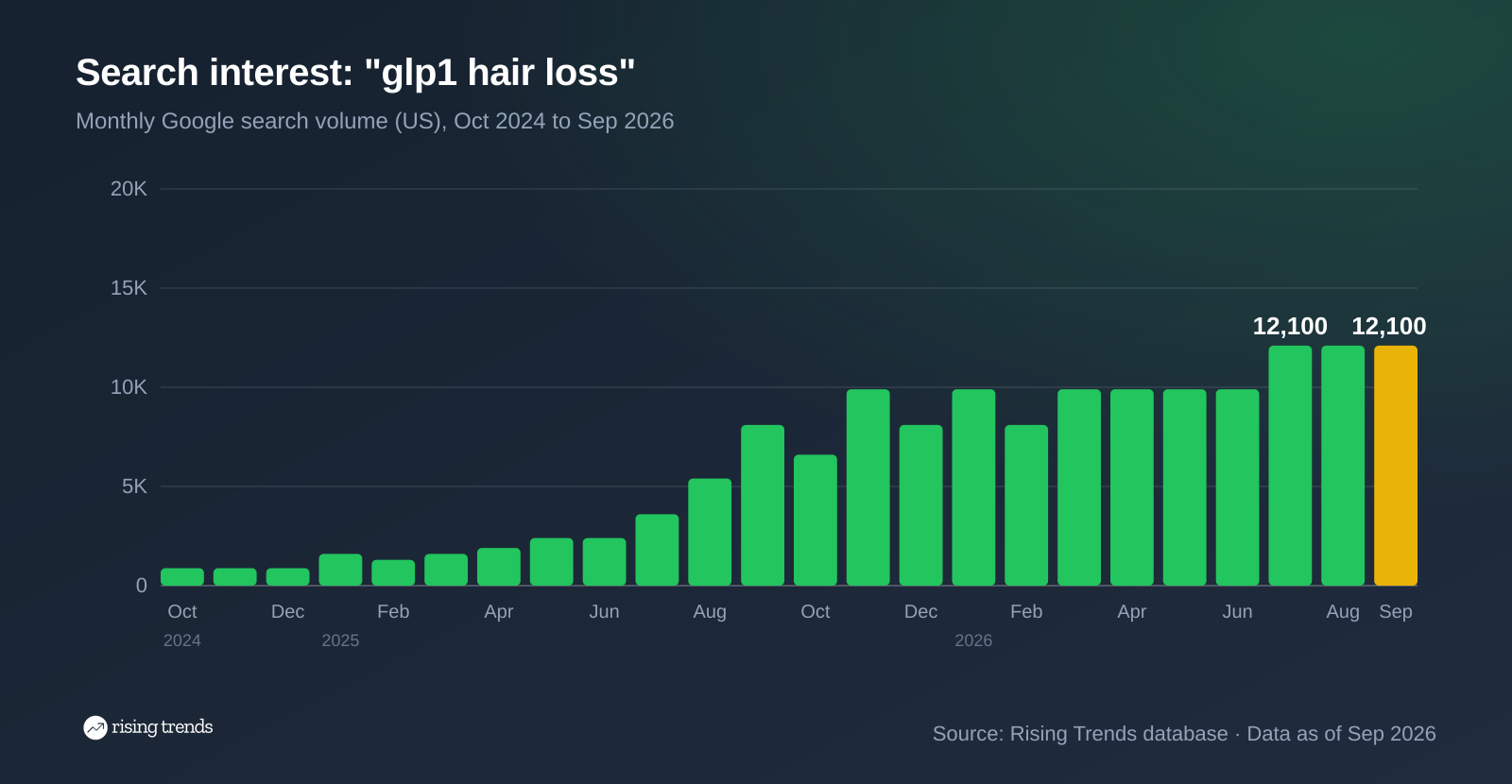
The shape is a ramp with two shelves. The term crossed a quarter of its eventual peak in July 2025, climbed through the back half of that year, then sat on a plateau for most of the first half of 2026. In July 2026 it stepped up to 12,100 and stayed there through August and September. A year earlier it was 8,100. Two years earlier, 880.
A plateau that breaks upward is the interesting pattern. It means the pool of people asking the question got bigger, not that one news cycle landed.
The second chart is the one that makes this a story rather than a symptom.
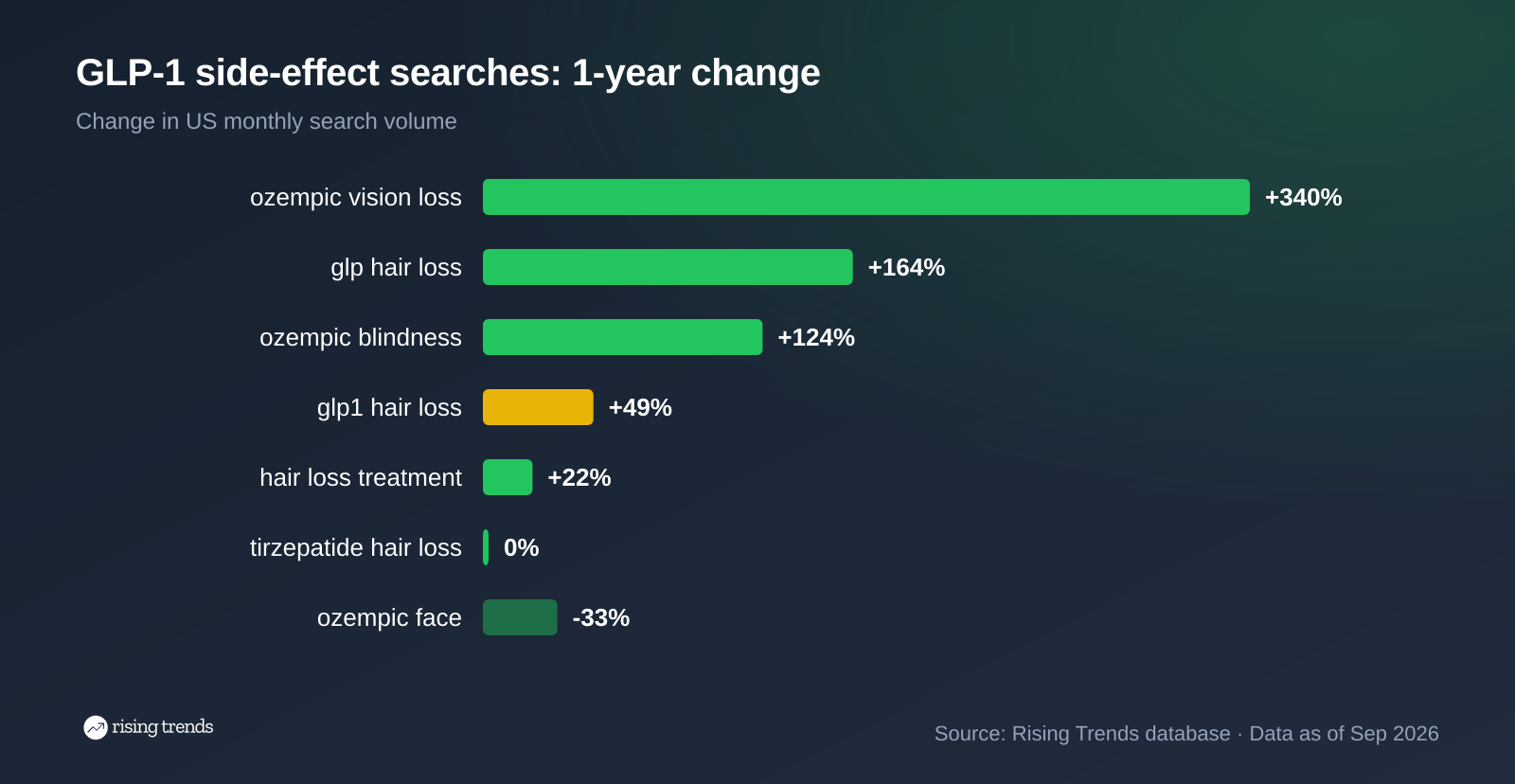
Read it as a queue. Side-effect searches arrive, peak and retire, and they do not all do it at once. Ozempic face is down 33% in a year and 55% over two. It was the side effect everyone had a name for in 2024, and the question is now mostly answered in people's heads. Hair terms and vision terms sit on the other end: glp hair loss up 164%, ozempic blindness up 124%, ozempic vision loss up 340%.
The scale is worth seeing too, because the label everyone uses is not the biggest term in the group.
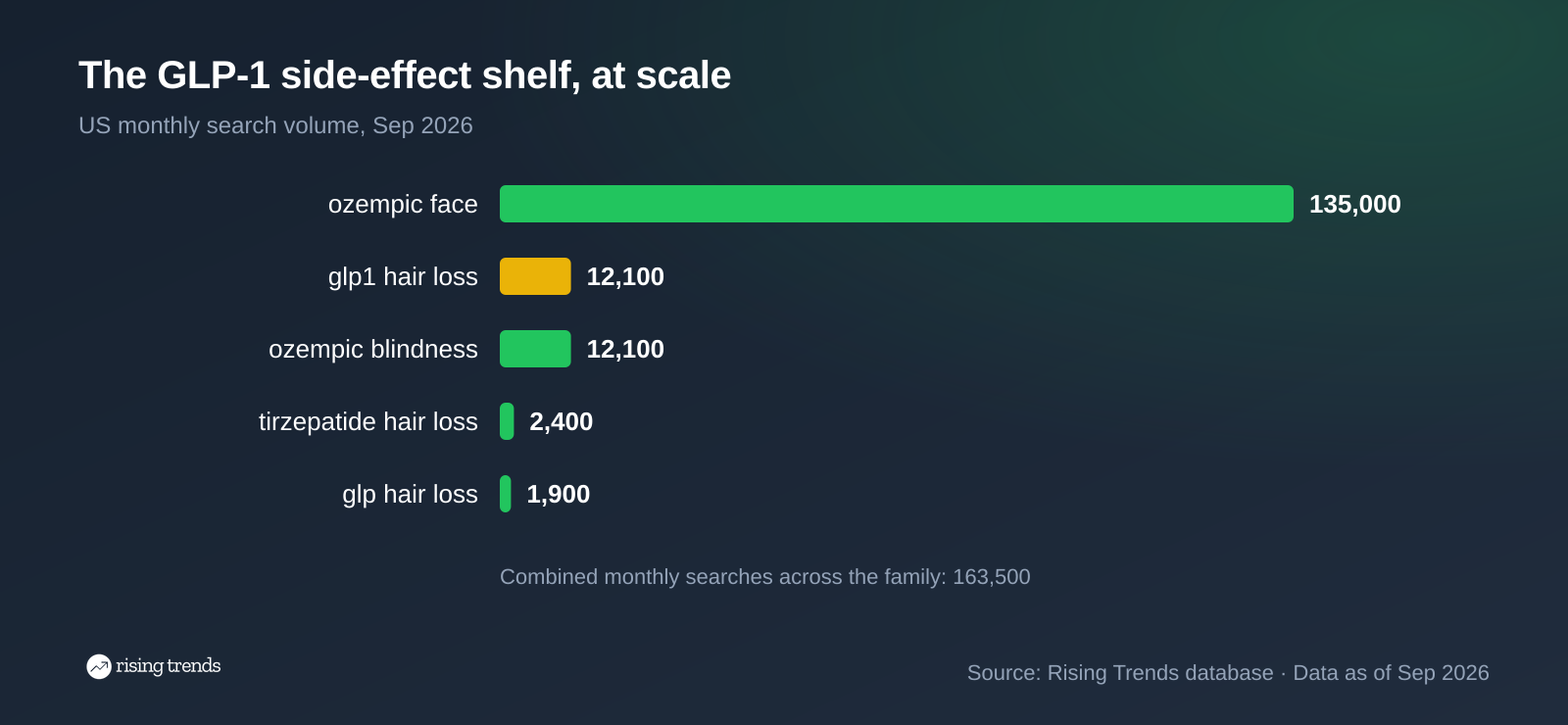
Ozempic face still carries 135,000 searches a month on a falling line. GLP-1 hair loss carries 12,100 on a rising one. Underneath both, the generic category is moving: "hair loss" is at 90,500 a month and up 173% in a year, and "hair loss treatment" is at 550,000 and up 22%. That is a lot of new demand arriving in an aisle that was flat for a decade, and we traced part of the same shift in the hair peptides trend.
What GLP-1 hair loss actually is
The clinical name is telogen effluvium: diffuse shedding that happens when a shock pushes too many follicles out of their growing phase at once. Rapid weight loss is a classic trigger. So is low protein intake, which is exactly what appetite suppression produces if nobody is watching.
The numbers are not folklore. They are in the trials and on the labels.
| Source | Hair loss on treatment | On placebo |
|---|---|---|
| ZEPBOUND US label, pooled trials, women | 7.1% | 1.3% |
| ZEPBOUND US label, pooled trials, men | 0.5% | 0% |
| SURMOUNT-1, tirzepatide, by dose | 5.1% / 5.3% / 4.9% | 0.9% |
| Wegovy trials, semaglutide 2.4 mg | 3% | 1% |
| Oral semaglutide 50 mg, OASIS 1 | 7% | 3% |
The ZEPBOUND prescribing information is the document to read if you only read one. It carries a named Hair Loss subsection, it attributes the effect to weight reduction, and it reports the sex split plainly: 7.1% of women versus 0.5% of men. One patient in those trials stopped treatment because of hair, and that patient was on placebo.
The published reviews are more careful than either the forums or the brand copy. A systematic review of 24 studies published in Science Progress in April 2026 by Aditya Gupta, Elizabeth Teasell, Vasiliki Economopoulos and Paradi Mirmirani concluded that "Patients can be reassured that there is no strong evidence of permeant follicular damage associated with GLP-1 RA use," and that shedding "may occur with a delay of approximately 2-3 months after beginning treatment." A smaller Cureus review of five studies and 2,905 adults was blunter about the state of the evidence: "Our review yielded conflicting findings." Three of the studies it included reported regrowth on tirzepatide rather than loss.
That gap, between a real and measured effect and a mechanism nobody has pinned down, is the space the search curve is growing into.
Why it's trending now
The trigger has a date. On 3 September 2026, NYU Langone Health published a genetic analysis that moved the question off the forums.
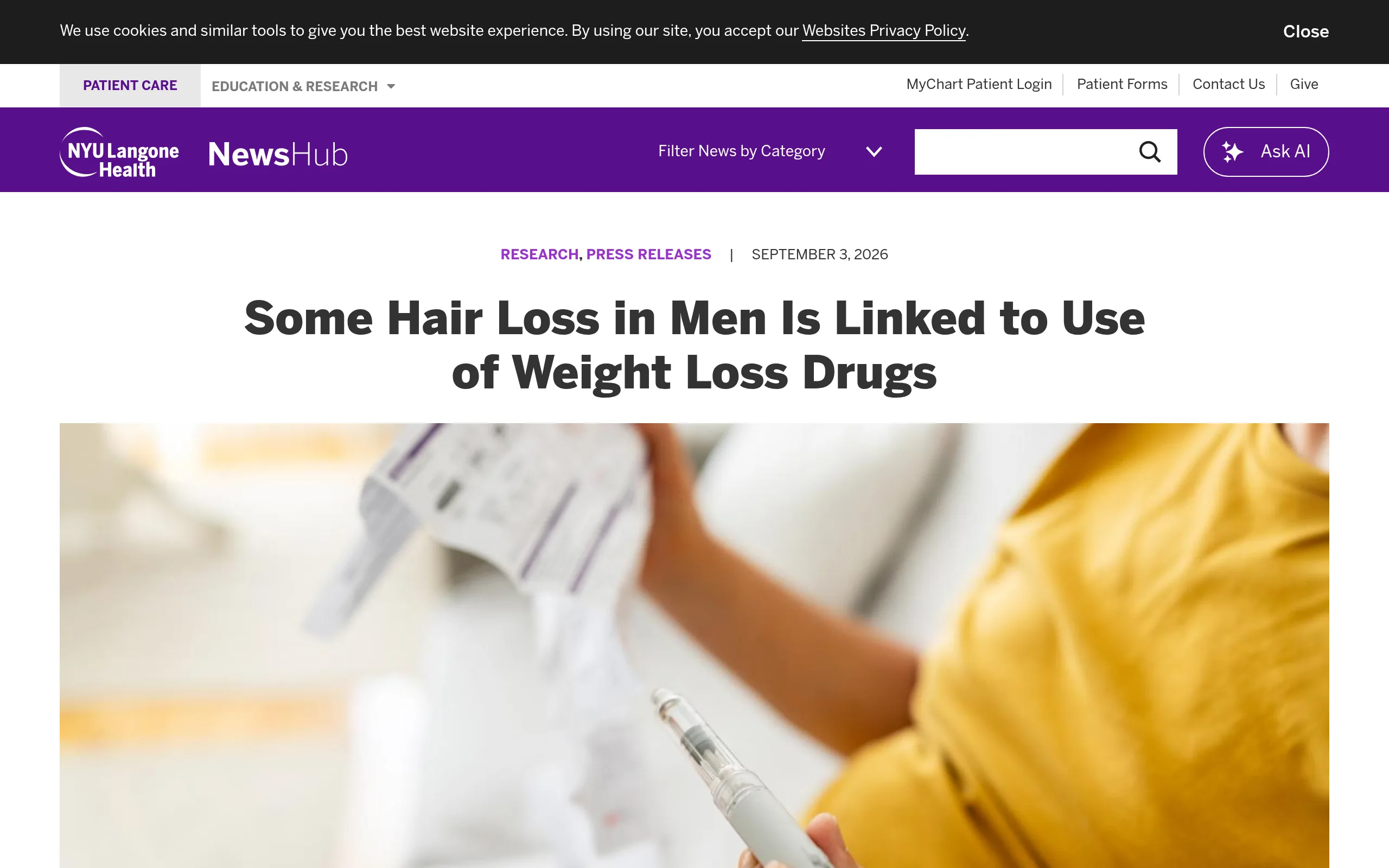
The study, published in the Journal of Investigative Dermatology, used the GLP1R gene as a stand-in for drug activity and compared it against genes linked to male-pattern hair loss across two public databases, one of 31,684 men and women and one of 205,327 men. Genetically higher GLP-1 receptor activity came with roughly 7% higher odds of androgenetic alopecia, and the estimate held after adjusting for hypertension, insulin resistance and lower testosterone.
Be precise about what that is and is not. Nobody in those databases was taking a GLP-1 drug. It is a genetic association, not a trial, and the researchers say so. But it is the first result that points at the receptor rather than at the weight loss, which is why it travelled. Lynn Petukhova, the senior investigator, put it this way in the release: "Our study provides the first genetic link between GLP-1 use and an increased risk of male-pattern hair loss." She also floated where it leads: "some men, and possibly women too, could be screened and benchmarked for their risk of hair loss."
Creators picked up the open question within weeks. This clip from the SHE MD Podcast, posted on 30 October 2026, asks it in the first line: "Is it the GLP-1 or the weight loss causing hair thinning?"
Look at the caption on that post and you can see the commercial layer arriving at the same time. It says researchers are "still investigating whether GLP-1 medications may also play a direct role", and it is tagged as a Nutrafol partnership. A supplement brand is paying to be present on the unanswered question.
The new behaviour: what people are doing differently
The behaviour change is small and it starts before the first injection. People now ask about hair in month zero instead of month four.
You can watch the shift in the subreddits. In one r/Zepbound thread about the research, the top reply is someone doing the trade-off out loud: "I've definitely had crazy thinning. Sucks, but I can walk up stairs without feeling like death is on the next floor so... RIP hair." That is the honest version of what most people decide.
The more interesting posts are the ones where the standard explanation does not fit. In an r/antidietglp1 thread, the person asking opens with: "I'm shedding way more than I used to, and can feel how thin my hair is getting." Then the detail that makes it a question rather than a complaint: "I am on Zepbound with very gradual weight loss." If the shedding only tracked rapid loss, that post would not exist. A reply in the same thread lands where the reviews do: "I lost a bunch about 6-9 months in but it seems to have all grown back."
So the new behaviour is three things, in order. Ask before starting. Prepare protein and routine rather than react. And treat hair as a line item in the cost of the drug, the way people already treat the clothing bill or the gym membership.
None of this is medical advice, and the drugs are not the problem here. If your hair is shedding in a way that worries you, that is a conversation for a doctor or a dermatologist, not for a comment thread.
Who's building on it
The supply side is further along than you would expect for a side effect this young.
Olistic Research Labs is running the first registered trial aimed at exactly this population. NCT07484061 is a double-blind, 1:1 randomized, placebo-controlled study of a drinkable nutraceutical in women over 35 who are starting a GLP-1 or GIP agonist, run with Grupo Dermatologico y Estetico Pedro Jaen. It is small, at 40 participants, it started on 16 March 2026 and it reads out in 2027. The product is investigational for this use and has not been shown to work.
Nutrafol is taking the marketing route rather than the trial route. Its own six-month study of 180 women, published in Dermatology and Therapy in July 2026, reported linear hair growth 19% to 37% faster than baseline. That study was not about GLP-1 users at all, which is the point: the brand has the clinical file and the GLP-1 audience is where it is spending to be seen.
Hair restoration clinics are the fastest movers. Dr Parsa Mohebi, a transplant surgeon, has been posting straight "Ozempic and hair loss" explainers to his TikTok account since mid-October 2026. When a surgical practice starts making content for a side effect, the side effect has become a funnel.
Eli Lilly is the quiet player. By naming hair loss on the label and publishing the sex split, it set the number everyone else now argues against.
What it means for business
The haircare aisle is getting a new customer, not a bigger one. Circana's latest GLP-1 research, published on 10 November 2026, found that 37% of surveyed US households now report someone has used a GLP-1, up from 17% in 2024, and 30% report a current user. Among current-user households, 21% bought medication to address side effects in the previous three months. That is a side-effect economy with a measurable size, sitting inside a population Circana projects could account for 41% of US non-food units purchased by 2030.
Prevention sells better than rescue here. The reviews agree shedding shows up two to three months in. That means the product that wins is the one bought in week one, bundled with the prescription, not the one bought in a panic in month four. Telehealth platforms that already handle the GLP-1 prescription own that moment, and nobody else can get to it.
The sex split is a targeting instruction. 7.1% versus 0.5% is not a rounding difference. Any brand building a GLP-1 hair product for a general audience is paying for the wrong half of it.
The risk is a proof standard arriving. Right now every product in this space sells against an unanswered question. If the Olistic trial reads out negative in 2027, or if a larger study separates the drug from the weight loss, the marketing room closes fast. That is the same dynamic we described in the peptide trend: categories built on a mechanism story get repriced the moment the mechanism gets tested.
Where this is heading
Three calls, each with a term in our database to watch.
Hair stops being the newest side effect. Ozempic vision loss is up 340% in a year to 4,400 searches a month, and ozempic blindness is up 124% to 12,100, now level with hair loss. The queue is moving. Watch whether hair loss terms flatten in the first quarter of next year the way ozempic face did after its peak.
The branded terms fragment. "Tirzepatide hair loss" is flat at 2,400 a month while the generic GLP-1 phrasing climbs. People are learning to search the drug class rather than the brand, which is the same move we saw when the market shifted from brand names to molecules in the Embody tirzepatide story and again around retatrutide.
Screening becomes a product. Petukhova's line about benchmarking risk is the commercial seed in that paper. A genetic risk score sold alongside a weight-loss prescription is an obvious thing for a telehealth platform to try, and the health trends we track are already full of consumer tests looking for a question to answer.
The signal we trust most is still the first chart next to the second. One side-effect term falling 33% while another climbs 49% is not noise. It is a population working through a list, in order, and arriving at hair.
Want to catch shifts like this while they are still a search curve? Read our guide on how to identify market trends, or browse what is breaking out right now in our trending topics list.
Never miss a trend again
- One trend broken down with the numbers
- Who's making money, and what to build
- A website on the rise
- A breakout app
Join 5,000+ founders