

Two years ago "hair peptides" was a niche ingredient query sitting at 1,300 monthly searches in our database. In September 2026 it hit 6,600, up 313% in a year and 8x in two. Four peptide terms are now compounding together while almost every other phrase in the hair-growth aisle shrinks.
That second half is the part nobody writing about peptides for hair has shown you. The round-ups tell you what peptides do. They do not tell you what people stopped buying to make room. We pulled both sides out of the Rising Trends database, and the picture is a straight swap: rosemary oil, biotin gummies and generic growth serums are losing searches at the same speed the ingredient terms are gaining them.
Key takeaways:
- "Hair peptides" reached 6,600 US monthly searches in September 2026, up 313% year over year and classified as EXPONENTIAL in the Rising Trends database (data as of Sep 2026).
- The ingredient family moves together: copper peptide at 40,500 a month and up 174%, peptide hair serum at 1,000 and up 108%, blue copper peptide at 720 and up 324%.
- Everything it is replacing is falling. Hair growth supplements are down 80% in a year, hair growth serum down 63%, hair growth products down 55%, and rosemary oil for hair growth, the TikTok hit of 2023, down 33%.
- Our breakout month is October 2025, the same month Pelage Pharmaceuticals raised a $120 million Series B for a hair-follicle drug. The science headlines moved first, the shelf followed.
- The price spread on the same ingredient story runs from $5.99 to $119, and every product makes the same careful claim about the appearance of density, because the FDA treats "restore hair growth" as a drug claim.
- In October 2026 alone, two unrelated companies launched copper peptide hair serums 48 hours apart, and Pelage dosed the first patient in a 600-man Phase 2/3 trial.
Let's get into it.
What we're seeing in the Rising Trends data
Here is the monthly search volume for "hair peptides" over the last two years, straight from our database.
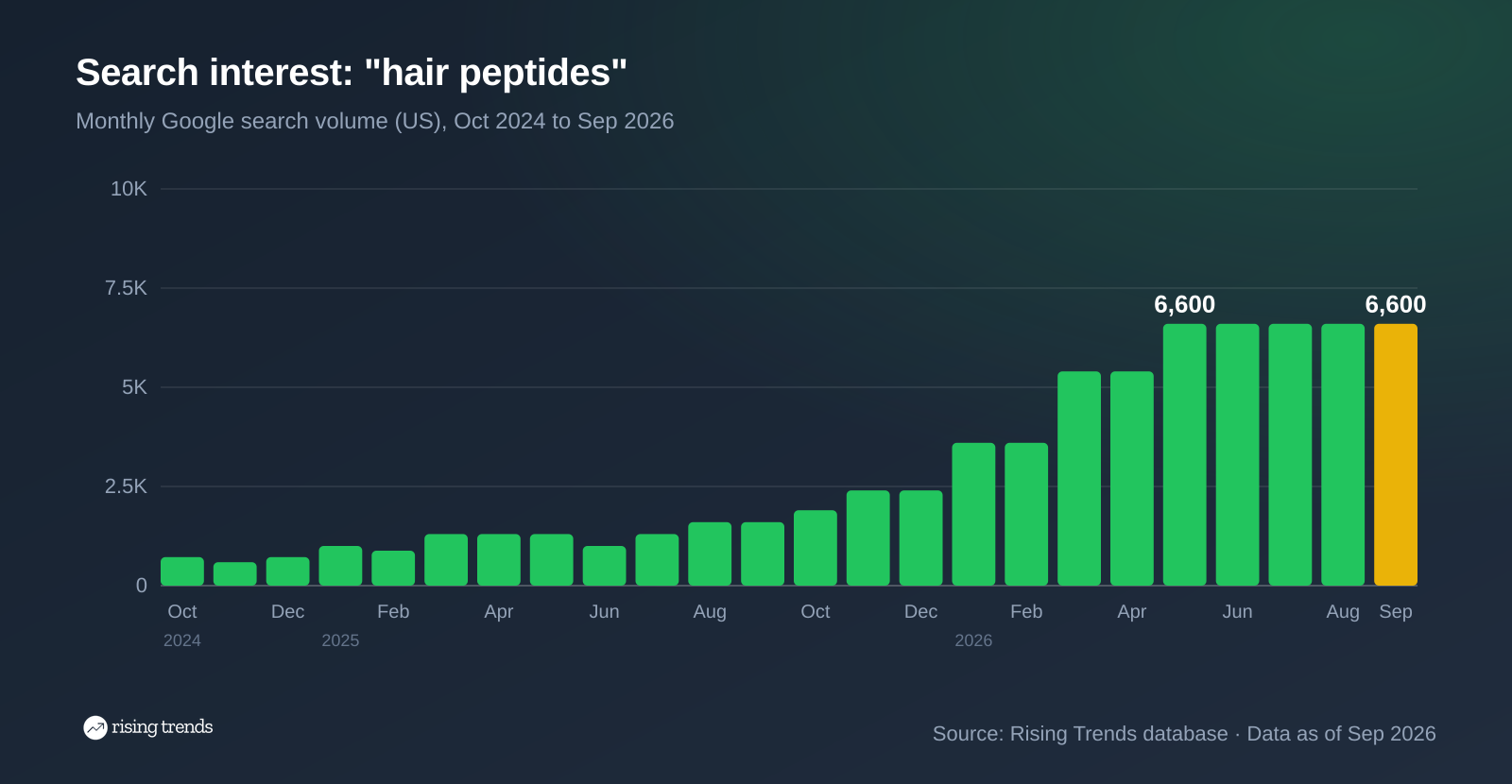
The shape is a staircase, not a spike. The term crossed a quarter of its eventual peak in October 2025, then stepped up roughly every two months: 2,400 in November 2025, 3,600 in January 2026, 5,400 in March, 6,600 in May. It has held 6,600 for five straight months. A year earlier it was 1,600. Two years earlier, 1,300.
Staircases matter more than spikes. A spike is a news cycle. A staircase is a product cycle, where each step is a new wave of buyers finding the category.
The second chart is the one that makes this a market story rather than an ingredient story.
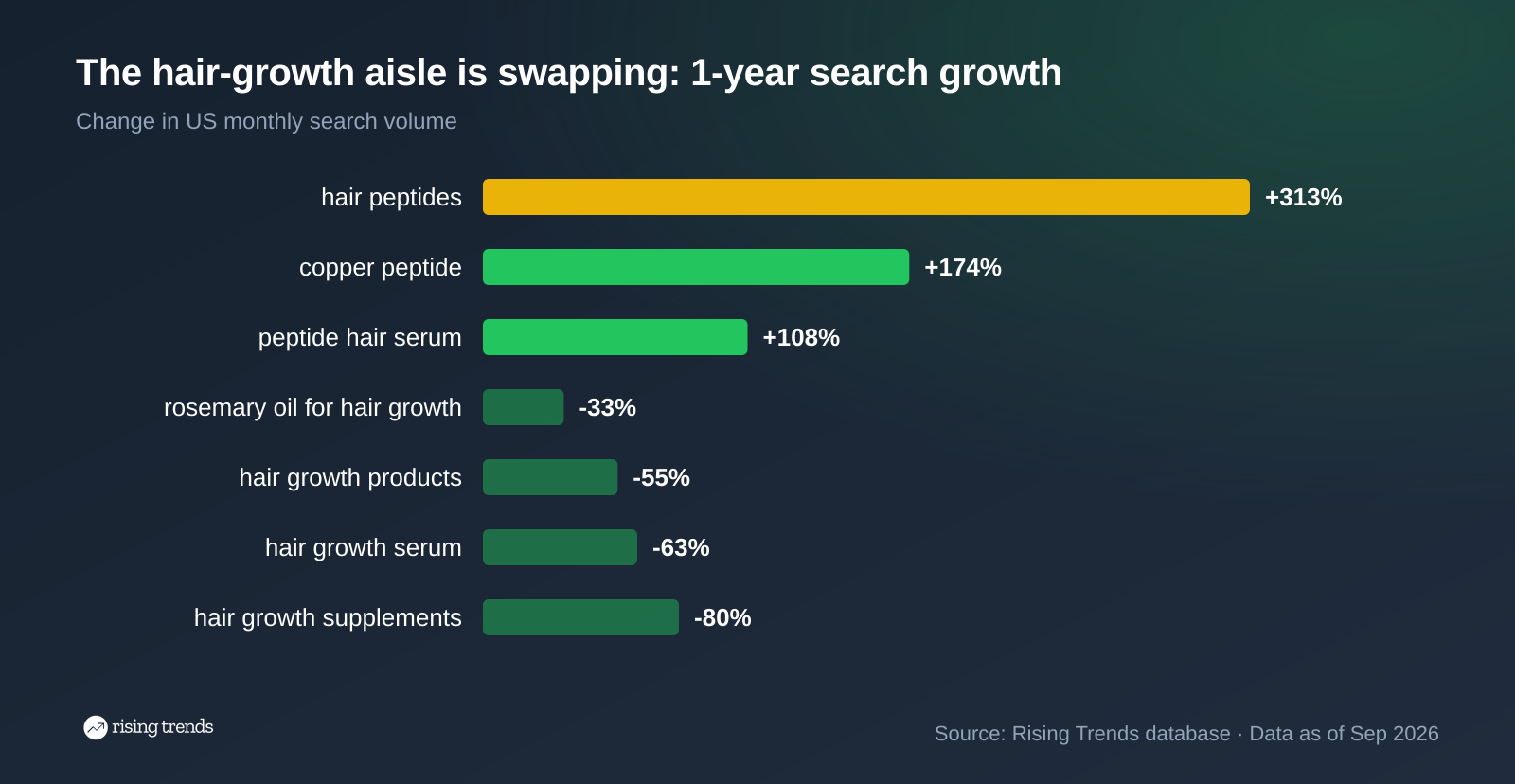
Read it as one line. Everything with "peptide" in it is up by triple digits. Everything that describes the old aisle is down. Hair growth supplements fell 80% in a year, to 27,100 searches a month. Hair growth serum fell 63%, to 40,500. Hair growth products fell 55%, also to 40,500. Rosemary oil for hair growth, which owned 2023, is down 33% to 33,100 and down 33% over two years as well, meaning it never recovered.
And here is the family at its actual scale, because "hair peptides" is the label, not the biggest term.
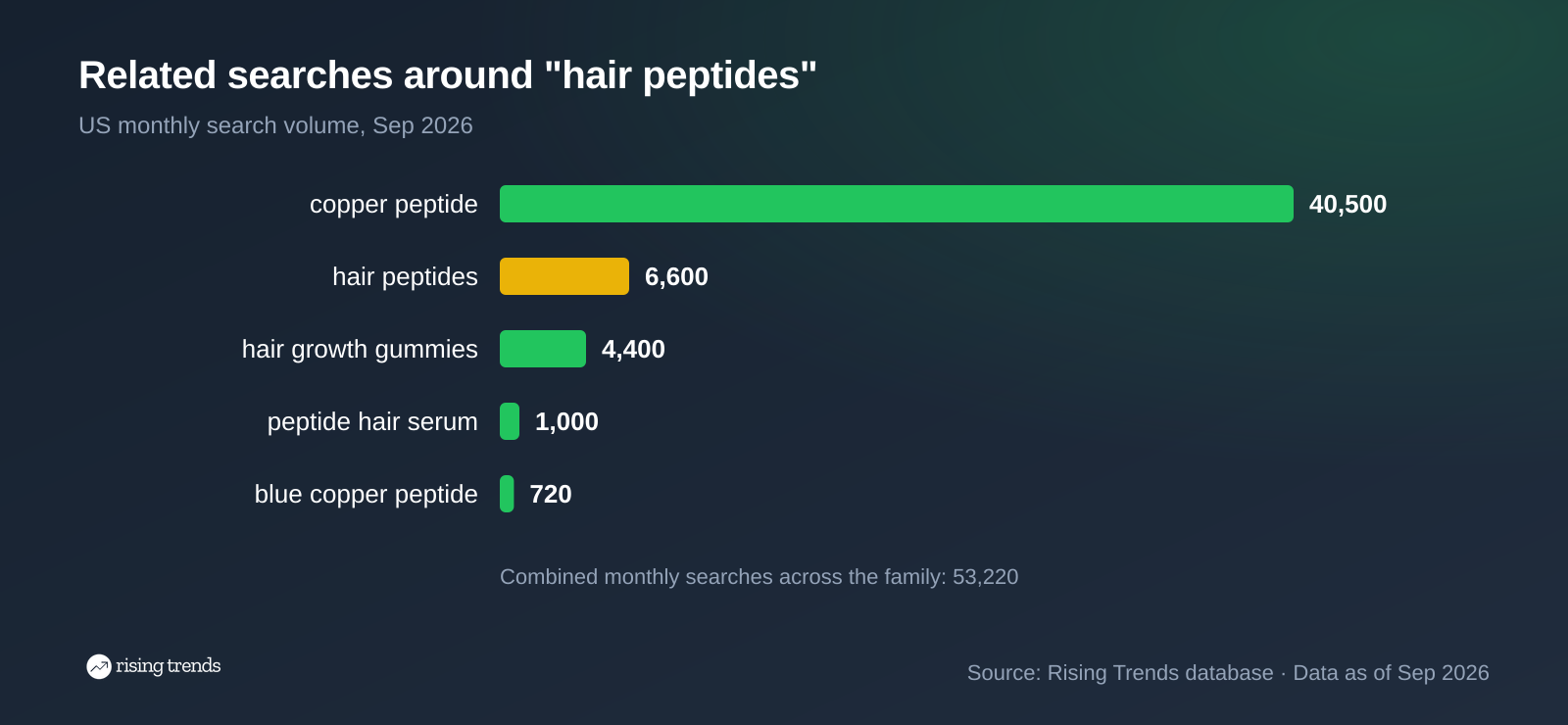
Copper peptide at 40,500 a month is the anchor. It is the molecule people name, the one with a chemical shorthand (GHK-Cu) that reads like evidence. "Hair peptides" is the category word that formed above it. Hair growth gummies, at 4,400 and flat for a year, is what the same shopper used to buy.
What's changing in the hair-growth aisle
The swap is easier to see side by side.
| Search term | Monthly searches (Sep 2026) | 1-year change |
|---|---|---|
| copper peptide | 40,500 | +174% |
| hair peptides | 6,600 | +313% |
| peptide hair serum | 1,000 | +108% |
| blue copper peptide | 720 | +324% |
| hair growth serum | 40,500 | -63% |
| rosemary oil for hair growth | 33,100 | -33% |
| hair growth supplements | 27,100 | -80% |
| hair growth gummies | 4,400 | 0% |
Three changes sit behind those rows.
People are searching the ingredient, not the outcome. "Hair growth serum" is an outcome query. "Copper peptide" is an ingredient query. The shift from one to the other is the same thing that happened in skincare a decade ago, when shoppers stopped asking for anti-ageing cream and started asking for retinol by name. It is the behaviour that drove our PDRN trend story too: the molecule becomes the brand.
Topical is beating oral. The supplement side of this category is collapsing faster than anything else on the chart. Hair growth supplements down 80% and gummies flat tells you the biotin-chewable era is over. Peptides arrive as a scalp serum you apply, not a pill you swallow, and that is a different purchase with a different proof standard.
Peptides stopped being an injection story. Most of the peptide search volume we track still sits in the needle economy, which we covered in the peptide trend and again in peptides for sleep. Hair is where the word crossed back into a shelf you can buy from without a clinic. That crossing is what created a 6,600-a-month category term.
Why it's trending now
The breakout month is October 2025, and that is not a coincidence. On 15 October 2025, Pelage Pharmaceuticals announced a $120 million Series B co-led by ARCH Venture Partners and GV to push a topical hair-loss treatment toward late-stage trials. The coverage that followed taught a lot of people a new sentence: hair follicles can be switched back on. Peptides were the nearest thing on a shelf that sounded like that sentence.
Then the mass market arrived. L'Oreal Paris put its Elvive Collagen Peptide + Lifter collection into Walmart on 1 May 2026, with a $5.99 volumizing shampoo, and expanded it to stores nationwide from 1 August. Laura Branik, President of L'Oreal Paris USA, described the launch in one sentence that explains the whole curve: "We are continuing our skinification journey by bringing one of the most trusted ingredients in skincare into the haircare aisle."
The supply side has been stacking since. In October 2026, ProGlow Labs shipped eight peptide formulas including two for hair, and 48 hours later TheraCopper launched a copper peptide collection with a GHK-Cu and AHK-Cu hair serum. Neither company caused the trend. Both are evidence that the category is now worth building a line around.
What the search curve does not show is the argument happening underneath it. This reel from @ayman._.diaries, posted on 30 September 2026, is the clearest version of it we found: someone who bought two bottles of a peptide serum with his own money and measured what actually happened.
His verdict, from the caption: "Peptides + caffeine strengthen your scalp, they don't regrow hair." And then the line that sums up the whole category: "Yeah, it works. Just not how influencers are selling it."
Who is building on it
The products span a 20x price range and say almost exactly the same thing.
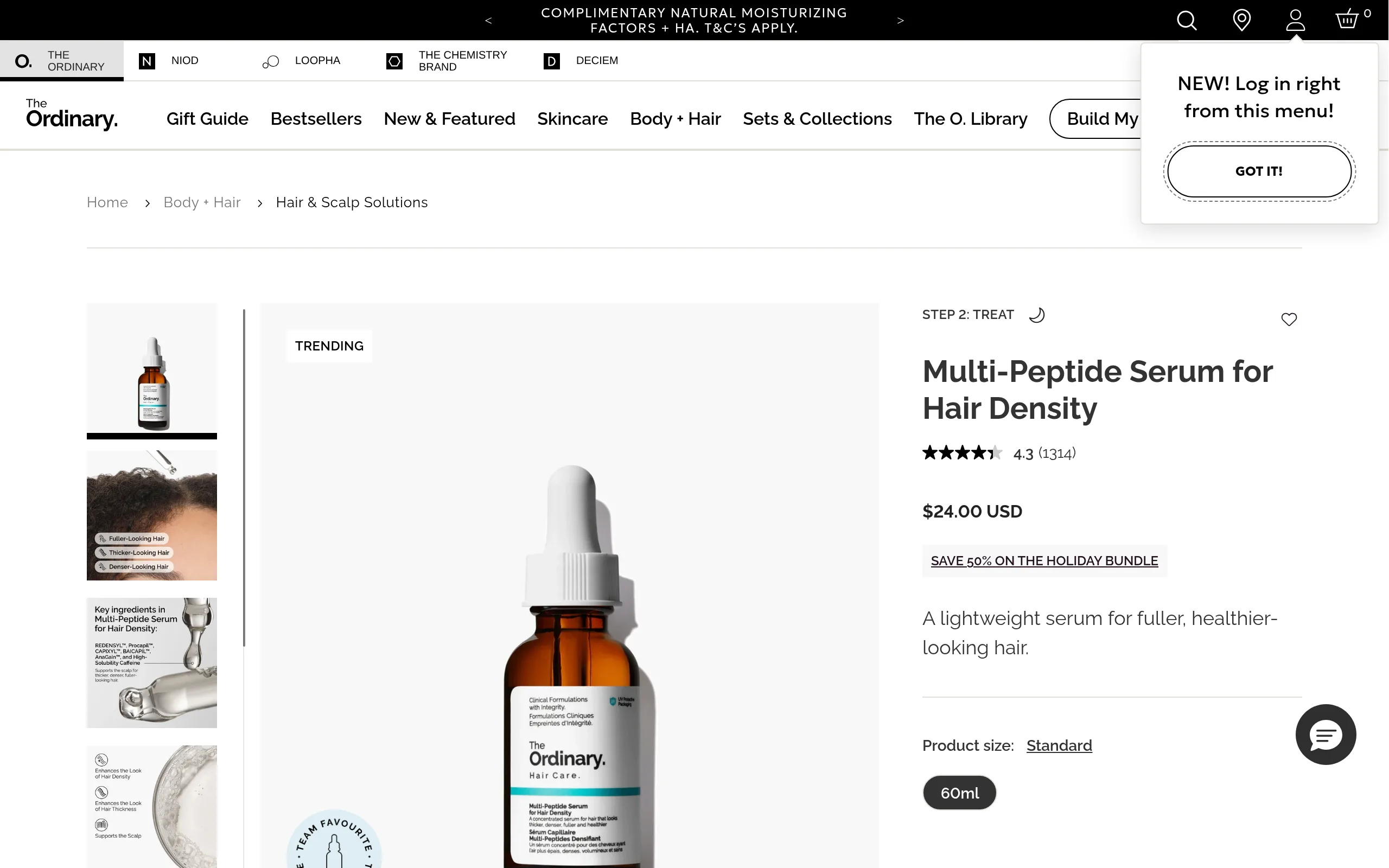
The Ordinary is the volume leader at the accessible end. Its Multi-Peptide Serum for Hair Density sells for $24 and carries a 4.3 rating from 1,314 ratings on the brand's own page, with a TRENDING badge on the product image. The formula stacks five licensed complexes (Redensyl, Procapil, Capixyl, Baicapil, AnaGain) plus high-solubility caffeine, and the actual peptides in the ingredient list are biotinoyl tripeptide-1 and acetyl tetrapeptide-3.
L'Oreal Paris is the volume leader at the cheap end, with a $5.99 peptide shampoo in Walmart and a claim of 2x volume lift. OGX built a four-step line around the same idea, and its ProGrowth + Peptide Scalp Serum promises "visibly thicker, fuller hair from the root" with an asterisk that reads "Instrumental results with full routine vs. untreated hair".
Blueprint, Bryan Johnson's longevity brand, sits at the top. Its Peptide Hair Serum is $119 a bottle for eight peptides including copper tripeptide-1, and the product page itself carries the most honest line in the category: "Blueprint hair care products are not a replacement for Minoxidil."
Salons and clinics are the newest entrant. A Miami studio posted on 30 October 2026 that "with our hair restoration treatments we implement a copper peptide serum to create a healthy & rejuvenated scalp to support more natural hair growth". When an ingredient moves into in-chair services, the search term usually has another year of room.
Pelage Pharmaceuticals is the one building the thing everyone else is gesturing at, and it is worth being precise about. PP405 is not a peptide. The company describes it as a topical small molecule that targets a metabolic switch in follicle stem cells. On 14 October 2026 Pelage dosed the first patient in the Phase 2/3 AWAKEN trial, a randomized, placebo-controlled, 12-month study enrolling roughly 600 men in the US and Canada, after a positive end-of-Phase 2 meeting with the FDA. It is investigational and not approved.
What people now expect, and what the evidence says
The behaviour that has changed is the proof standard. Buyers who used to accept a before-and-after photo now want a named molecule and a mechanism. Peptides supply both, which is exactly why the category grew and exactly where it is vulnerable.
The peer-reviewed position is narrower than the marketing. An April 2026 review in Biomedicines, Overview of Short Peptides for Hair Loss, notes that copper peptide GHK-Cu increases production of VEGF in dermal fibroblasts and that a hair growth effect "was demonstrated in a clinical study of 45 AGA patients". The same review then says the quiet part: "all clinical studies, including those on GPIGS, Ac-KGHK, GHK-Cu, and water-soluble chicken egg yolk peptides, do not provide meaningful comparisons with established drugs such as minoxidil or finasteride, which undermines their credibility."
So the shelf is running ahead of the evidence, and the creator with two empty bottles is closer to the literature than the brand copy is. If you are losing hair in a way that worries you, that is a conversation for a dermatologist, not a serum aisle.
What it means for business
Claim language is the whole game. The FDA's own guidance on whether something is a cosmetic, a drug, or both lists claims "that products will restore hair growth" as an example of wording that makes a product a drug, because the intended use is to affect the structure or function of the body. That single line explains why every product above sells the appearance of density, the look of thickness, visibly fuller hair. Brands can market the molecule freely. They cannot market the outcome. Any challenger that crosses the line buys a warning letter instead of a category.
The $24 tier is the one to watch. At $5.99 the ingredient is a feature on a shampoo. At $119 it is a longevity subscription. The middle, where The Ordinary sits with 1,314 ratings on a single product page, is where the category gets decided, and it is the tier with the least brand protection: the complexes are licensed from Givaudan, Sederma, Lucas Meyer, Provital and Mibelle, so anyone can buy them.
The supplement side is losing a customer, not pausing. Hair growth supplements down 80% in a year is not seasonality. That demand moved to a topical. Any brand still building a hair gummy roadmap is selling into a shrinking query, and the supplement trends we track show the same pattern wherever a pill competes with a serum.
The real risk is a drug approval. If PP405 clears late-stage trials, the cosmetic peptide shelf loses its best argument overnight, because there will finally be a non-hormonal topical that is allowed to say "regrows hair". Peptides would go back to being conditioning ingredients. That is a 2028 question, not a 2026 one, but it is the one that decides whether this is a category or a bridge.
Where this is heading
Three calls, each with a term in our database to watch.
Copper peptide becomes the term, not hair peptides. At 40,500 searches a month and up 174%, copper peptide is already six times the size of the category label and it has a named molecule behind it. Watch whether blue copper peptide, at 720 and up 324%, keeps compounding. A second named variant breaking out is how an ingredient becomes an aisle.
The curve plateaus before it falls. Hair peptides has held 6,600 for five months with zero three-month growth. That is maturity, not decline. The number to watch is peptide hair serum at 1,000 a month: if the product query climbs toward the ingredient query, buyers are converting rather than researching, and the haircare trends we track suggest that is where the money shows up first.
Rosemary oil does not come back. Down 33% over one year and 33% over two, with the bare term rosemary oil down 45% over two years, this is the clearest example we have of a viral ingredient failing to convert attention into a habit. Peptides inherited that shelf space because they arrived with a mechanism attached. The next ingredient to take it will need the same thing.
The signal we trust most is still the pair of lines we opened with. One set of searches going up 313% while the set next to it falls 80% is not two trends. It is one shopper changing their mind.
Want to spot category swaps like this before the shelf catches up? Read our guide on how to identify market trends, or browse what is breaking out right now in our trending topics list.
Never miss a trend again
- One trend broken down with the numbers
- Who's making money, and what to build
- A website on the rise
- A breakout app
Join 5,000+ founders