

For two decades "cognitive offloading" was a phrase you only met in a psychology journal. It described something completely ordinary: writing a shopping list, setting a reminder, tilting your head to read a rotated photo. Then it started showing up in our search data. The term went from 260 monthly searches two years ago to 6,600 in September 2026, its highest month on record, and the people typing it are not cognitive scientists. They are teachers, managers and students trying to name what happens when you let a chatbot do the thinking.
Every explainer ranking for this term gives the textbook definition and stops. None shows the curve, and none shows the thing we find most interesting: the slang version of this complaint is dying while the technical version compounds. "Brain rot" was Oxford's Word of the Year in 2024. It is down 80% in the last year. "Cognitive offloading" is up 175% over the same period. That handover, from insult to mechanism, is the story.
Key takeaways:
- "Cognitive offloading" hit 6,600 US monthly searches in September 2026, up 2,438% in two years and classified EXPONENTIAL in the Rising Trends database (data as of Sep 2026).
- The term comes from a 2016 review by Evan Risko and Sam Gilbert in Trends in Cognitive Sciences. It has been cited 1,236 times and it was never about AI.
- "Brain rot" is down 80% year over year, to 49,500 a month. The mechanism words are going the other way: cognitive atrophy up 213%, cognitive offloading up 175%.
- Three studies did the work. Gerlich surveyed 666 people and found AI use tracked with weaker critical thinking, with offloading in between. Microsoft and Carnegie Mellon surveyed 319 knowledge workers. MIT's EEG study of 54 writers gave the internet the phrase "cognitive debt".
- The 2026 lift is not coming from labs. It is coming from schools. A UTS report in March and the University of Surrey's September redesign both put offloading at the centre of how students get assessed.
- The first causal result landed in September 2026: in a preregistered experiment with 704 participants, metacognitive feedback cut offloading and raised test scores. Paying people to try harder did nothing.
Let's get into it.
The curve
Here is five years of monthly search volume for "cognitive offloading", straight from our database. For the first three years it is flat, sitting between 390 and roughly 500 searches a month. It starts moving in early 2025 and does not stop.
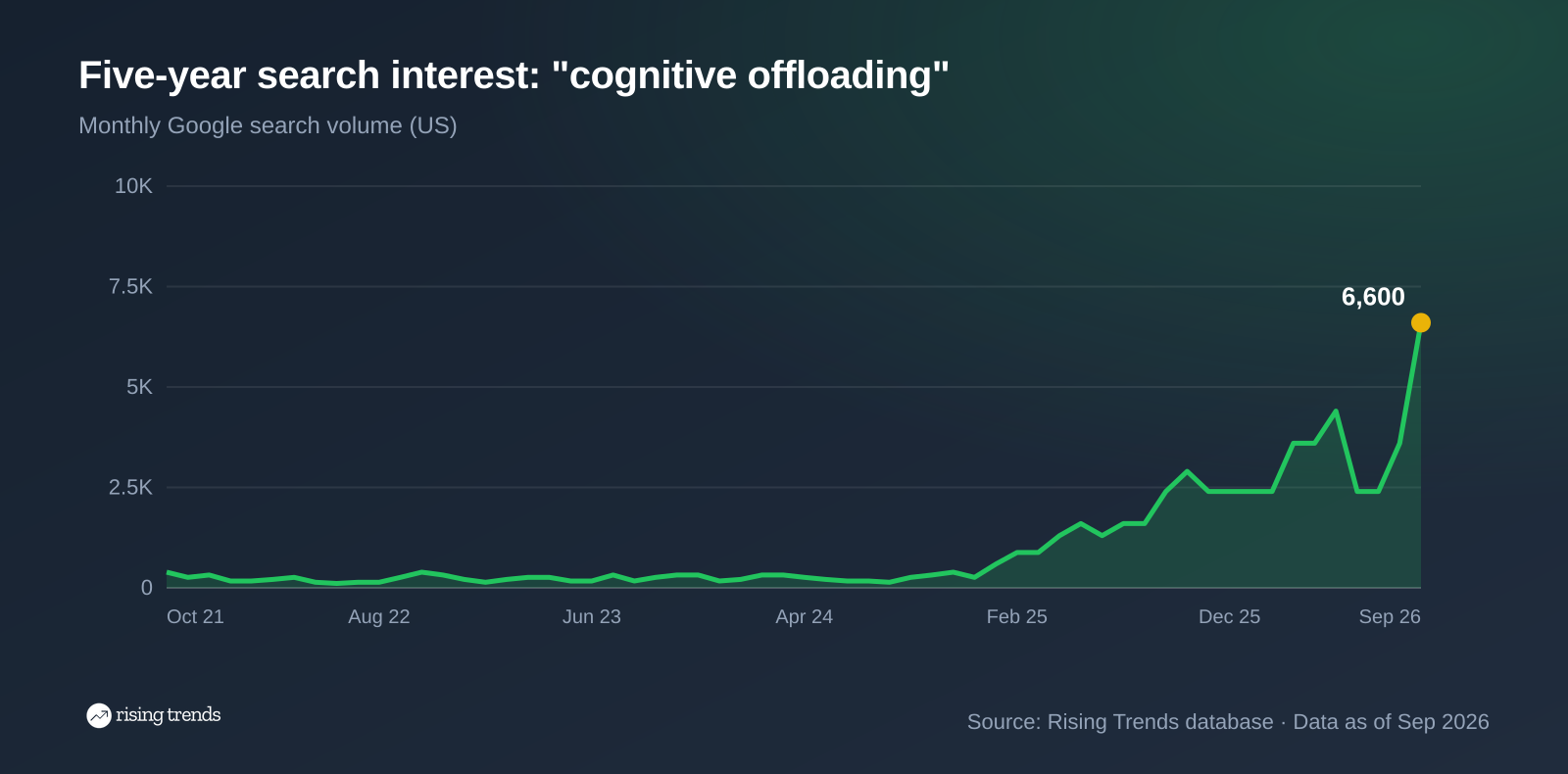
The shape is a staircase, not a spike. Our breakout month is September 2025, when the term first crossed a quarter of its eventual peak. A year ago it was running at 2,400 a month. Two years ago it was 260. The last three months average 4,200, which is 22.1x the level of two years earlier, and September's 6,600 is the highest single month we have on file.
What makes it worth a page is not the line on its own. It is what the neighbouring words are doing. We pulled every related term in our database and ranked them by one-year growth.
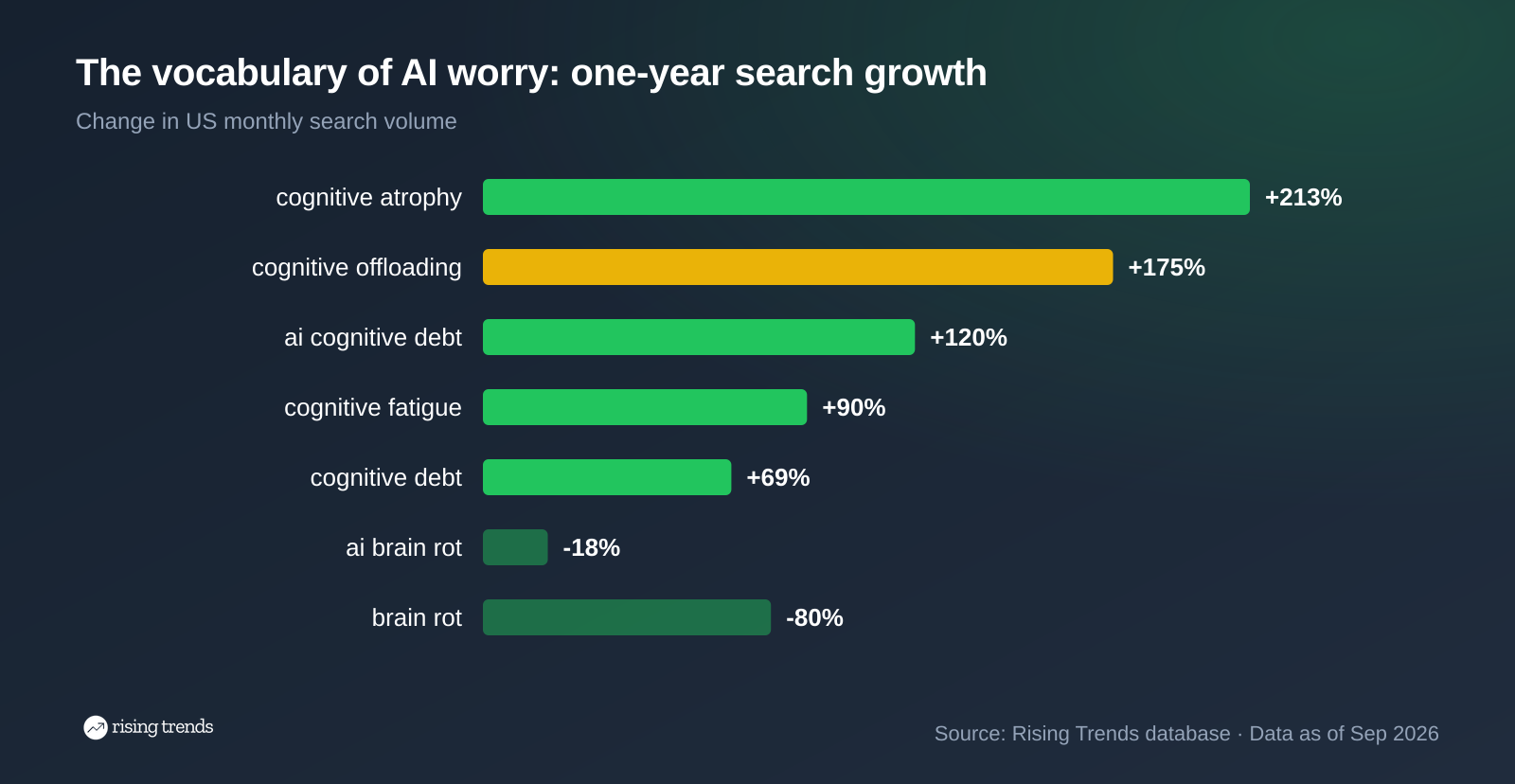
Everything with a clinical or mechanical flavour is rising. "Cognitive atrophy" is up 213%, "cognitive offloading" up 175%, "ai cognitive debt" up 120%, "cognitive fatigue" up 90%. Everything with a meme flavour is falling. "Brain rot" is down 80% and "ai brain rot" is down 18%.
That is a vocabulary changing hands. Now look at the raw sizes, because the ranking by growth hides how lopsided the market still is.
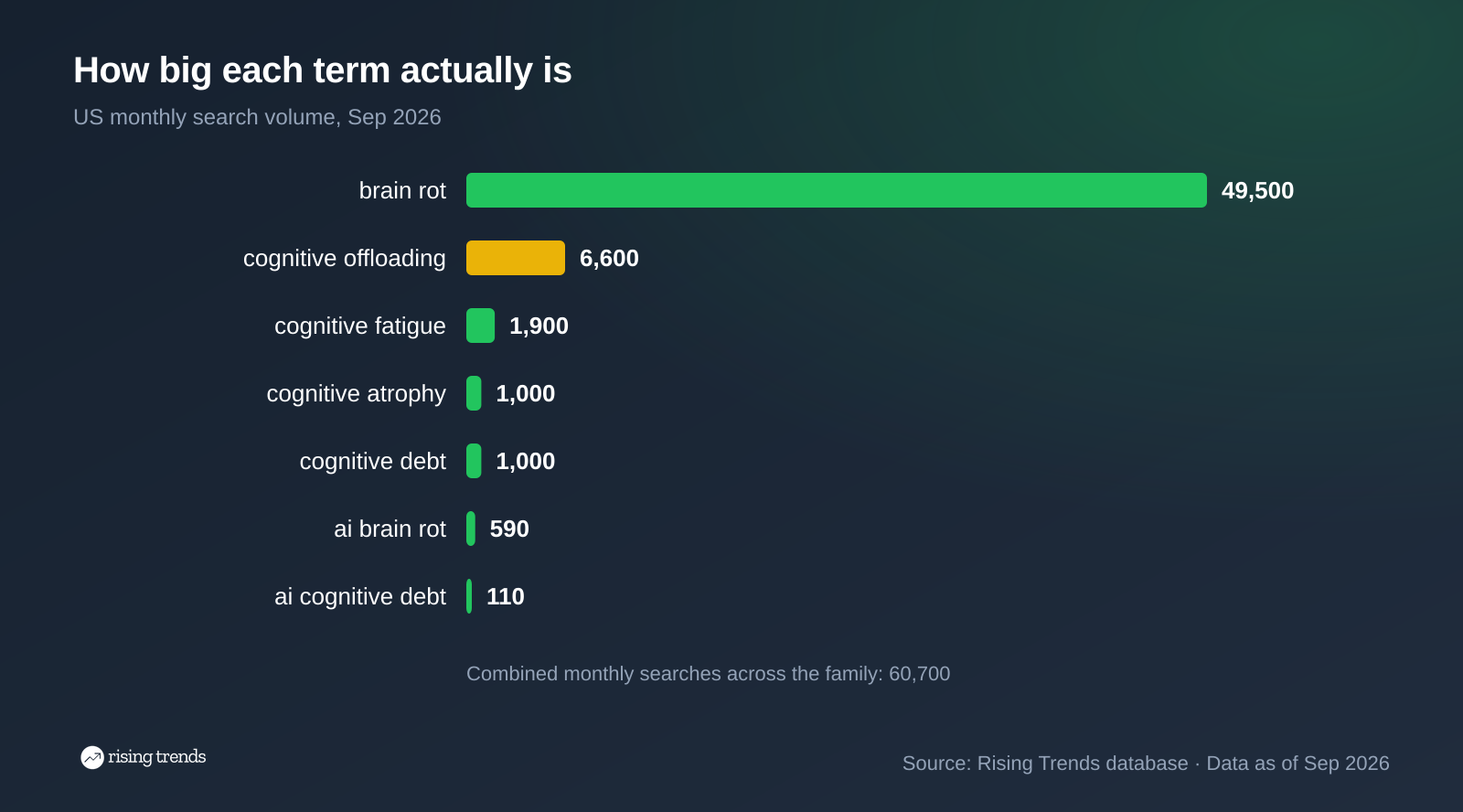
"Brain rot" is still roughly seven times bigger at 49,500 a month. It is just shrinking fast while everything beneath it grows. If you are writing, teaching or selling into this space, that is the trade: the big keyword is a declining asset and the small ones are compounding. We see this pattern constantly in the mental health trends we track, where a joke term peaks, collapses, and leaves behind a smaller, stickier clinical vocabulary.
What cognitive offloading actually means
Cognitive offloading is using the outside world to do part of a mental job. That is the whole idea. You write the number down instead of holding it in your head. You set an alarm instead of remembering. You rotate the map instead of rotating it mentally.
The term was named in September 2016, in a review by Evan Risko of the University of Waterloo and Sam Gilbert of UCL, published in Trends in Cognitive Sciences. Their one-line version: "Physical action is sometimes used to reduce the cognitive demands of a task. This is known as cognitive offloading."
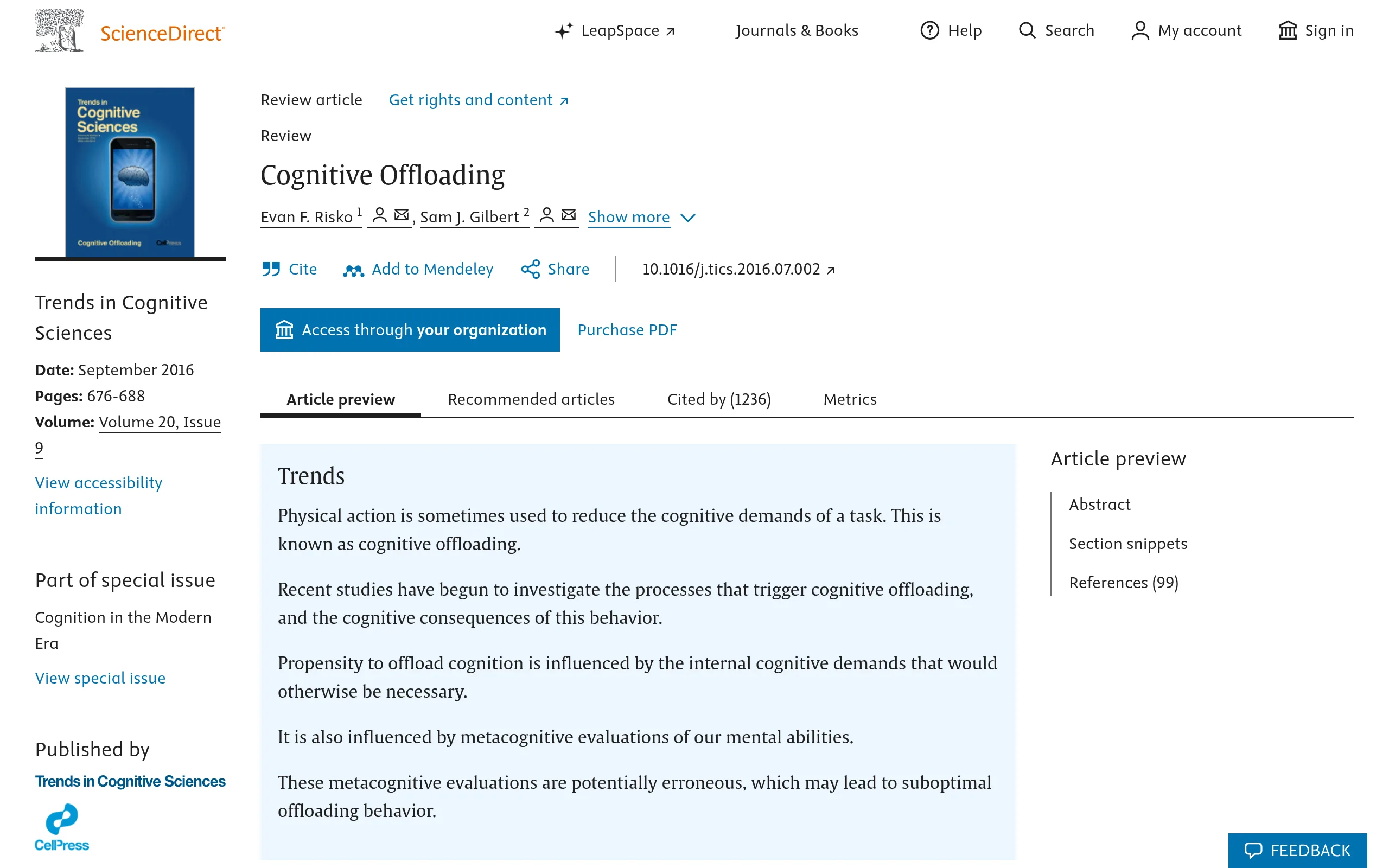
Two things in that 2016 paper matter ten years later. First, the authors treat offloading as a decision, not a reflex: you weigh the effort of thinking against the effort of reaching for a tool. Second, the decision runs on your estimate of your own abilities, and that estimate is often wrong. Their phrasing: these "metacognitive evaluations are potentially erroneous, which may lead to suboptimal offloading behavior."
In plain terms: people offload when they feel unsure, and the feeling is not a reliable guide. That is a 2016 sentence about notepads. It reads differently when the tool on the other side can write the essay.
Why it's breaking out now
Three papers built the ramp, and a fourth thing turned it into a school problem.
In January 2025, Michael Gerlich published a study in Societies that surveyed and interviewed 666 participants about AI tools and critical thinking. He reported "a significant negative correlation between frequent AI tool usage and critical thinking abilities, mediated by increased cognitive offloading", with younger users showing the strongest dependence. One participant put it better than the abstract did: "AI tools help me get things done quickly, but I feel like I rely on them too much to think deeply."
In April 2025, Microsoft Research and Carnegie Mellon presented a survey of 319 knowledge workers at CHI 2025, built on 936 first-hand examples of using AI at work. Their headline finding is a neat inversion: "higher confidence in GenAI is associated with less critical thinking, while higher self-confidence is associated with more critical thinking." They also found the work does not disappear, it changes shape, shifting "toward information verification, response integration, and task stewardship".
Then in June 2025 came the one everybody shared. MIT Media Lab researchers wired up 54 people writing essays and measured brain connectivity. Their preprint reports that "Brain-only participants exhibited the strongest, most distributed networks" while "LLM users displayed the weakest connectivity", and that LLM users later struggled to quote their own work. The title gave the internet a phrase it has been using ever since: cognitive debt.
Our data shows how fast that phrase travelled. "Cognitive debt" is up 99,900% in two years off a base of almost nothing, and "ai cognitive debt" is up 120% in the last year alone. People did not just adopt a theory, they adopted its accounting metaphor.
The fourth thing is the classroom, and it is why 2026 looks different from 2025. Arguments that started as lab findings are now assessment policy, which means millions of students and parents meet the term in a letter from a school rather than in a paper.
Not everyone using the word agrees with the panic, which is the most interesting part of the current conversation. This clip from TikTok creator @thinkwithv, posted on 19 August 2026, takes the opposite side: "'AI makes you dumber' is the story we're hearing online now. But what if cognitive offloading isn't the enemy of thinking?" It had 5,724 views and 523 likes at the time of writing, per the platform page.
That framing, offloading as a skill rather than a failure, is where institutions have landed too.
Who's building on it
The term has stopped being descriptive. It is now something people design against, assess around and sell into.
| Who | What they shipped | The number |
|---|---|---|
| OpenAI | Study mode in ChatGPT: questions and scaffolding instead of answers | Shipped 29 July 2025 |
| Guided Learning in Gemini, a mode built for understanding over answers | Shipped 6 August 2025 | |
| UTS and the Australian Network for Quality Digital Education | National standards proposal for school AI tools | Report released 9 March 2026 |
| University of Surrey | AI in every degree, assessment rebuilt around process | In force from September 2026 |
| Deskilling researchers (arXiv) | Metacognitive feedback that reduces offloading decisions | 704 participants, preregistered |
| PAUSE | Free browser-side self-check on your own AI reliance | 4 domains, no data transmitted |
The product pair is the clearest signal. OpenAI describes study mode as a way "to help students learn something, not just finish something", and Google frames Guided Learning as going "from answers to understanding". Same admission: the default product offloads too well, so they built a mode that offloads less.
The institutional side is where the money moves. In March 2026, the University of Technology Sydney and the Australian Network for Quality Digital Education published a report arguing for national standards on school AI tools. Professor Leslie Loble, who chairs the network, was direct about the risk: "The cognitive offloading from human to AI is especially risky for school students, who are building the foundational knowledge and skills that enable both schooling and lifelong capacity for learning and understanding." Her co-author, Professor Jason Lodge, framed the fix as supporting teachers rather than blocking tools.
And from September 2026, the University of Surrey began running a redesign of every degree it offers, foundation year to postgraduate, with an assessment overhaul attached. The university's own line is that "the focus will move towards process, decision-making and applied problem-solving". That is a direct answer to offloading: if the output can be generated, grade the reasoning instead.
What changes if assessment grades the process
Follow that through and the business consequences are not subtle.
The homework market gets reorganised. An AI tutor that produces correct answers quickly becomes worth less, not more, the moment a university grades process. The premium moves to tools that log reasoning and can prove a student did the thinking. The procurement question changes from "how good are the answers" to "what evidence of learning does it produce".
Assessment becomes a product category. Proctoring vendors sold surveillance. The next wave sells process capture: version history, draft comparison, oral defence scheduling, structured reflection. Surrey is one institution, but it is a signal of where the budget goes next, and the education trends we track are already tilting that way.
Hiring quietly shifts too. The Microsoft and Carnegie Mellon finding, that AI moves the work toward verification and stewardship, describes a job most job descriptions have not caught up with.
There is a widening risk nobody has priced. Lodge's point in the UTS report is the one that should worry anyone selling to schools: students with strong domain knowledge "will be able to leverage AI for beneficial offloading and accelerate their learning", while students without those foundations will be "susceptible to detrimental offloading and bypassing the very learning they need". The same tool helps the top and hurts the bottom. That is an equity story with a procurement bill attached.
The sceptic's view
The evidence is softer than the headlines.
Gerlich's study is correlational and partly self-reported. It can show that AI use, offloading and weaker critical thinking move together. It cannot show which one causes which, and the author does not claim it does. The MIT work is more dramatic and more fragile: it is a preprint, it ran with 54 participants and only 18 completed the crossover session, and it was not peer reviewed when it went viral. Its own authors frame the result as a case for "deeper inquiry", not a verdict. Treating an EEG connectivity difference as proof that AI makes people stupid is exactly the overreach that "brain rot" encouraged and that this new vocabulary was supposed to replace.
There is also a straightforward counterargument: offloading is what humans have always done. Writing offloaded memory. Calculators offloaded arithmetic. Risko and Gilbert treat it as a rational strategy, not damage.
The strongest recent evidence actually sits in the middle. In September 2026, researchers ran a preregistered experiment with 704 people practising fraction arithmetic with an LLM assistant, then tested them unaided. Metacognitive feedback, simply making the consequences of offloading visible, cut answer offloading and improved test performance. An effort-based reward did nothing. That result undercuts both camps at once. Bans are not required, and incentives are not enough. Design is what moves the behaviour.
If you want to check your own habits rather than argue about everyone else's, a research group released PAUSE in July 2026, a free self-check that scores entirely in your browser across four domains and transmits nothing. Its authors are careful to say it is not a validated instrument. As a mirror it is still useful.
What to watch
Three calls, each with a term in our database that would confirm it.
The clinical vocabulary keeps taking share from the slang. "Brain rot" at 49,500 a month is shrinking 80% a year. The signal to watch is whether "cognitive offloading" holds above 4,000 a month through the winter rather than falling back to the 2,400 plateau it sat on for most of 2026. Seasonality here is high and tied to term dates, so January and September are the honest tests.
"Cognitive debt" becomes the business phrase. It is tiny at 1,000 a month, but it has a balance-sheet metaphor built in, and those travel into boardrooms. Watch "ai cognitive debt", currently 110 a month and up 120% in a year. If it clears 500, the term has left academia.
Assessment redesign becomes a procurement cycle. Surrey went first among large universities; the UTS report asks Australian governments to set standards. The thing to watch is not more studies, it is tenders. Our education trends hub is where that shows up first, usually as a spike in searches for a specific tool category rather than for the concept.
One last note on why this term rose at all. People do not search for a mechanism when they are comfortable. They search for one when a feeling needs a name and the joke has stopped being funny. "Brain rot" let you mock the behaviour. "Cognitive offloading" makes you describe it, and once you can describe it you can decide which parts to keep. The same shift runs through AI addiction and AI psychosis, two other terms where the slang arrived first and the mechanism followed. It is also why sensory and self-regulation products keep growing: people are buying tools to manage their own attention, having run out of patience with being told to try harder.
Want to catch shifts like this while they are still small? Read our guide on how to identify market trends, or browse what is breaking out right now in our trending topics list.
Never miss a trend again
- One trend broken down with the numbers
- Who's making money, and what to build
- A website on the rise
- A breakout app
Join 5,000+ founders