
A year ago "bemt sunscreen" was a dead search term in our database. Forty people a month typed it. As of September 2026 it runs at 4,400 monthly US searches, and three sibling terms around it are moving the same way. That part you could guess from the headlines.
Here is the part nobody has written up. Over the same twelve months, the words Americans used to shop for sunscreen are all falling. "Broad spectrum sunscreen" is down 55%. "Mineral sunscreen" is down 45%. "Korean sunscreen", the workaround an entire cohort used for a decade, is down 18%. The new filter is not adding demand to the category. It is draining the old vocabulary into a new one. Below: what the data actually shows, who shipped what between August and October, and the one number on the back of the bottle that tells you how real this is.
Key takeaways:
- "bemt sunscreen" went from 40 monthly US searches a year ago to 4,400 as of September 2026, up 10,900%, classified EXPONENTIAL in the Rising Trends database.
- The three BEMT-named terms we track are up between 1,951% and 10,900% year over year. The three incumbent category terms are all down: broad spectrum 55%, mineral 45%, korean 18%.
- The FDA added bemotrizinol to the sunscreen monograph on June 9, 2026, at concentrations up to 6 percent. The order took effect on August 9, and the first products shipped between August 31 and October.
- Neutrogena doses BEMT at 6 percent. La Roche-Posay doses it at 2 percent. Neither removed a single legacy filter. "Contains BEMT" on a label currently tells a shopper almost nothing.
- Kenvue named the launch in its Q3 2026 results, in a segment whose organic sales fell 0.5% that quarter. This is a rescue product, not a bonus one.
- In July we said the test was October to December: settle between 5,000 and 15,000 and it was a real category shift. "Bemotrizinol" is at 12,100 as of September 2026, near the top of that range.
Let's get into it.
What we're seeing in the Rising Trends data
Start with the curve, because its shape is the whole argument.
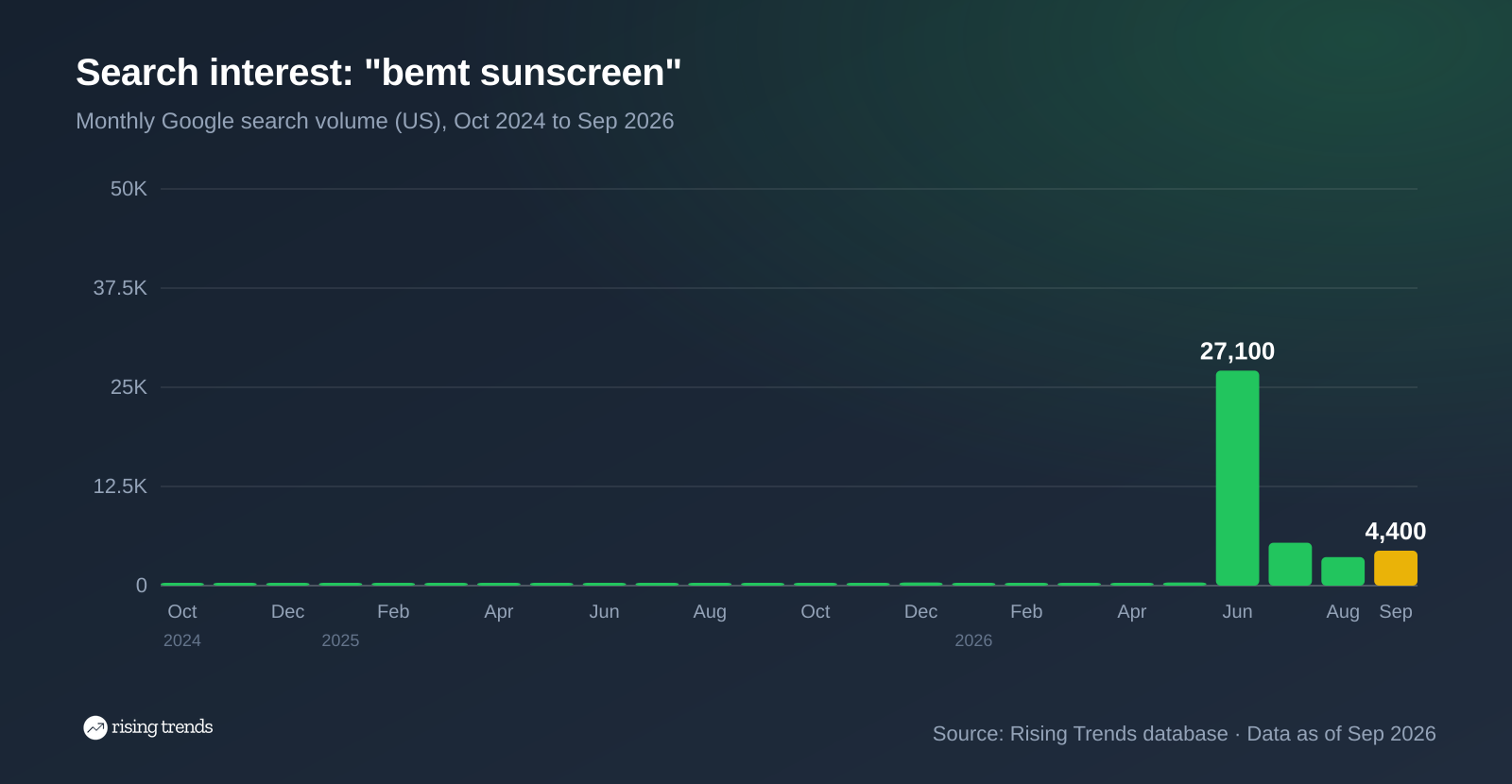
Twenty flat months, then a wall. June 2026 printed 27,100 searches, the month the FDA signed. Then it fell back, which is what news spikes do. The question that matters is where it landed, and it landed at 4,400 in September, with the last three months averaging 4,467. That is roughly 110 times the level of a year earlier and it is holding, not decaying. A spike that resolves into a floor a hundred times higher than its baseline is a category event. A spike that falls back to 40 is a headline. This one did the first thing.
Now the comparison that none of the pages currently ranking for this term will show you.
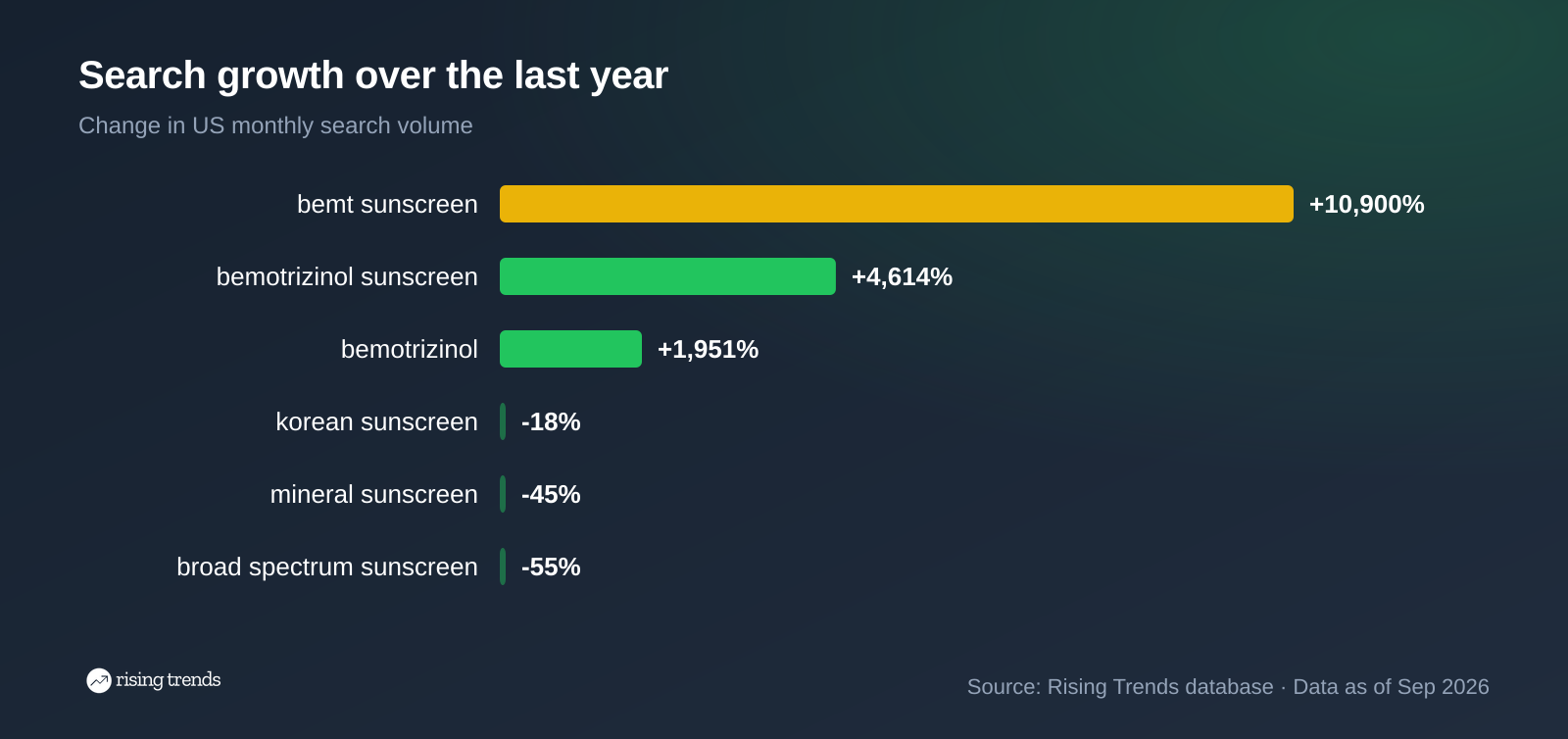
Everything with the chemical in its name is up by four figures. Everything describing the old way of choosing a sunscreen is down by double digits. That is not a category growing. That is a category re-sorting around a new unit of comparison, and the three losing terms are losing to the three winning ones.
The absolute volumes keep it honest, though.
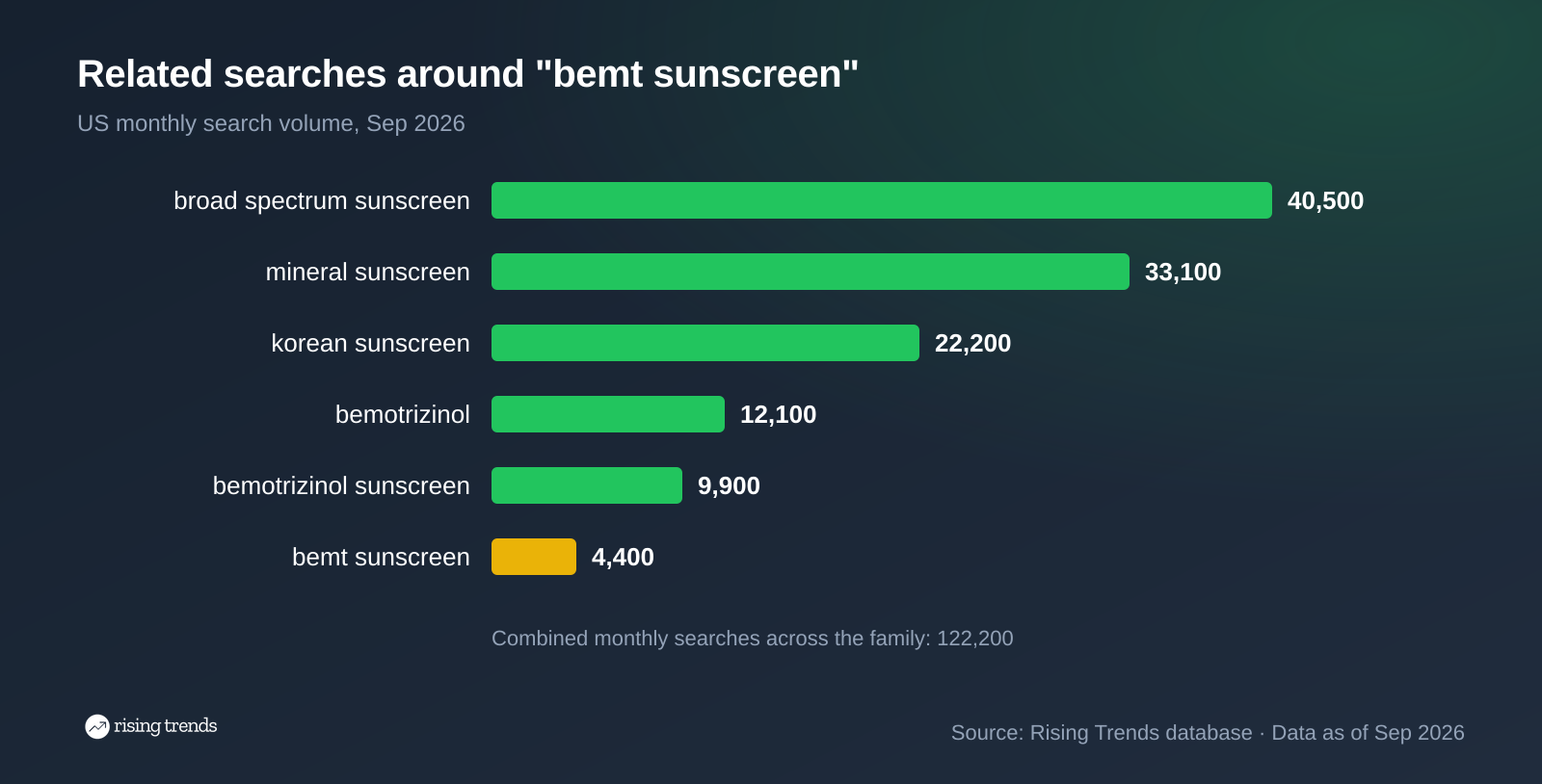
"Broad spectrum sunscreen" still pulls 40,500 searches a month even after a 55% fall. "Mineral sunscreen" still pulls 33,100. The incumbents are bigger than the insurgent by a wide margin, and anyone telling you the aisle has already flipped is selling something. What has happened is that a chemical name almost nobody could pronounce in May 2026 is now a shopping term with real volume, and it got there in one quarter. If you want the method behind reading a split like this, we wrote it up in our guide to using Google Trends for market research.
What actually changed between August and October
For twenty-five years the US sunscreen formulary was frozen at roughly ten active ingredients while Europe worked with more than thirty. That gap is the reason your friend brought back sunscreen from Seoul.
Three dates closed it. On June 9, 2026 the FDA added bemotrizinol to the list of permitted sunscreen actives, the first new one since the late 1990s and the first ever added through the streamlined CARES Act route. The agency finalised it within seven months of the proposed order, which by sunscreen-regulation standards is a sprint. On August 9 the order took effect, which is the day manufacturers could legally put it in a bottle. And between August 31 and the middle of October, bottles appeared.
The final administrative order caps it at 6 percent and grants the requester, DSM Nutritional Products, an 18-month exclusivity window. So one supplier currently controls the input for every US product carrying it. dsm-firmenich, which sells it as PARSOL Shield, put the case plainly through its regulatory director Jochen Klock: "It closes a longstanding innovation gap in the U.S. sunscreen market." The company says the submission rested on clinical work in nearly 500 participants chosen to represent the diversity of the US population.
The underlying safety paper is worth reading with one eye open. The pilot pharmacokinetic trial behind the application, published in Regulatory Toxicology and Pharmacology in 2023, found BEMT plasma concentrations rarely exceeded the FDA's 0.5 ng/mL threshold and showed no accumulation. Every author on it works for DSM or a clinic DSM contracted. That does not make it wrong. It does mean the FDA's own review, not the paper, is the thing doing the work.
Why the old category words are falling
Because "broad spectrum" and "mineral" were never really ingredient searches. They were proxies for a feeling: does this disappear on my face, or does it sit there grey and greasy.
Mineral sunscreen won a decade of that argument on safety optics and lost it on texture. Korean sunscreen won it on texture and lost it on availability. BEMT is the first option that is pitched as winning both, and the brands are saying so out loud rather than hinting.
Watch how one creator covered it. This review of the Neutrogena launch went up on October 13, 2026 on Dana Ripperton's channel, and it is the second of three BEMT videos she posted in eight weeks.
Three reviews of three different brands in two months, each organised around the filter rather than the label, is the tell. When a mid-sized reviewer starts structuring her calendar by ingredient, the ingredient has become the category. We watched the same mechanic turn a single molecule into a 33,100-search behaviour in the persimmon soap trend.
Who is actually shipping it
Four products, three companies, ten weeks.
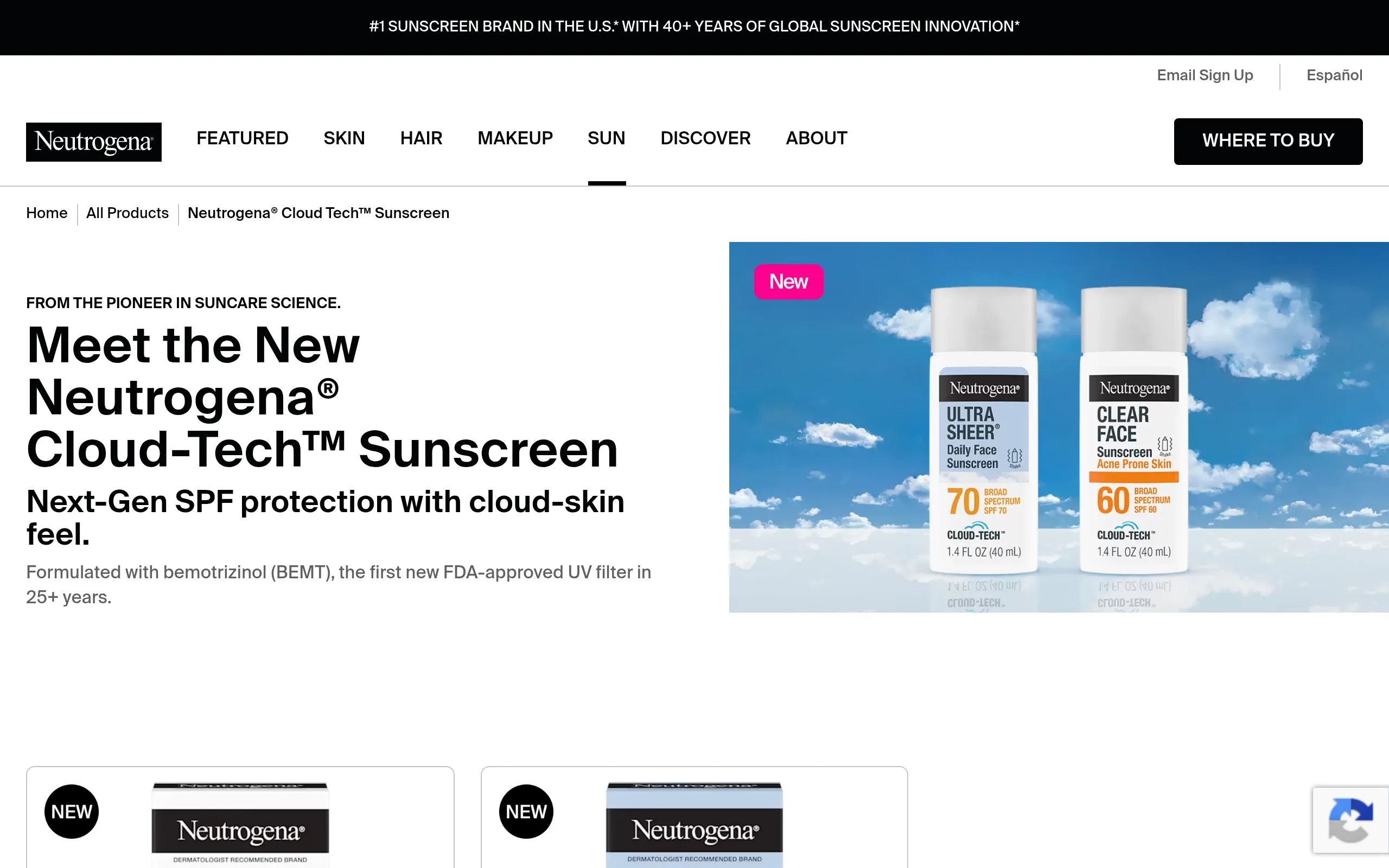
Neutrogena went first among the mass brands, on September 17, with two face sunscreens under a platform it calls Cloud-Tech. Read its own Cloud-Tech page and the positioning is unmistakable: the FAQ contains an entry headed "I've heard about Korean sunscreen. How does Cloud-Tech compare?", and the answer is that the formula was "developed with the same UV filter used in a leading Korean sunscreen". The largest US sunscreen brand is now writing a K-beauty rebuttal into its own product FAQ. That is what a 22,200-search import habit does to an incumbent.
Then the back of the bottle, which is where the story gets less tidy.
| Product | SPF | BEMT | Other active filters |
|---|---|---|---|
| Neutrogena Ultra Sheer Daily Face (Cloud-Tech) | 70 | 6% | Avobenzone 3%, homosalate 15%, octisalate 5% |
| Neutrogena Clear Face (Cloud-Tech) | 60 | 6% | Avobenzone 3%, homosalate 15%, octisalate 5% |
| La Roche-Posay Anthelios UVDefense | 50 | 2% | Avobenzone 3%, homosalate 11%, octisalate 5%, octocrylene 6% |
Neutrogena's Ultra Sheer panel runs BEMT at the legal ceiling of 6 percent. La Roche-Posay's Anthelios UVDefense, which arrived in October at $39.99, runs it at 2 percent alongside five other actives. That is a threefold spread in the headline ingredient between the two biggest launches, and neither brand dropped a single legacy filter to make room. BEMT went on top of the old stack, not in place of it.
So the pitch, which is that one modern photostable filter lets you cut the total active load and get a lighter finish, has not actually shipped yet. What shipped is a sixth filter in a five-filter formula. Ultra Violette, the Australian brand that got to US shelves first on August 31 at $40, is the closest to the clean version, pairing BEMT with zinc oxide and octocrylene and nothing else.
What shoppers now expect
The behaviour change is smaller and more specific than the coverage suggests. People are not switching sunscreens because of UVA physics. They are switching because they have been told, for the first time in twenty-five years, that there is something new to switch to.
Neutrogena's own claims language shows what the fight is over: 93% of testers agreed the formula layers well with makeup, 91% agreed it is invisible on skin. Not one of those claims is about protection. The protection was never the complaint.
What is genuinely new is that a chemical name has become a shopping filter. Shoppers who a year ago searched "mineral sunscreen" and sorted by brand now search a nine-letter compound and sort by percentage. We have watched that exact move in skincare twice already, with PDRN quietly renaming itself into a 74,000-search term, and with the Dr Melaxin peel shot arriving through the same K-beauty pipeline this filter is now competing with.
The flip side is that ingredient shoppers are unforgiving. A 2 percent dose in a $39.99 bottle sitting next to a 6 percent dose in a drugstore tube is a comparison that will be made, loudly, within a season.
What this does to the sunscreen business
Three things, in order of how quickly they bite.
It is a defensive launch, not an offensive one. Kenvue's third-quarter 2026 results name "the expansion of North America Sun Care with the launch of Neutrogena Cloud Tech featuring BEMT" as an innovation driver in a Skin Health and Beauty segment whose organic sales fell 0.5% in the quarter. The filter is there to stop share leaking to imported sunscreens, not to open a new market.
Pricing is about to get decided, fast. Right now the two premium entries sit at $39.99 and $40 while the mass entries sit in drugstore territory with three times the BEMT. Premium positioning on a commodity input only survives while the input is scarce, and the 18-month exclusivity clock on the supplier is the only thing making it scarce.
Distribution favours whoever moves next. One supplier, an 18-month window, and a filter every major sun-care brand now has to answer for. Expect reformulation announcements from CeraVe, Supergoop and the mineral specialists through 2027, and expect at least one of them to go BEMT-only to claim the shorter ingredient list. The launch-curve pattern here looks a lot like Reale Actives, where the product sold out in under ten hours and the search curve told you more than the press release did.
The losers are the brands whose entire pitch was texture. If a US drugstore tube delivers a K-beauty finish at a drugstore price, the premium for importing one disappears, and "korean sunscreen" at 22,200 searches and falling is already showing you the first of that.
Where this is heading
Three calls, each tied to a term you can watch.
"Bemotrizinol" holds above 10,000 through the winter. It is at 12,100 as of September 2026, inside the 5,000 to 15,000 band we set as the test back in July when we first covered the approval. Sunscreen is a low-seasonality category in our data, so a winter hold would confirm this is shopping behaviour rather than summer curiosity. Decay below 5,000 by February and the aisle absorbed it as a feature.
"Bemt sunscreen" overtakes "korean sunscreen" by late 2027, or not at all. The gap is 4,400 against 22,200 as of September 2026. Two more spring launch cycles and a drugstore price will tell you whether the import habit was about the filter or about the brands.
The dose becomes the story. The spread between 6 percent and 2 percent is the kind of detail that produces a comparison-content wave once enough shoppers notice it, and "bemotrizinol sunscreen" at 9,900 searches is exactly where that wave will land. Watch for the first brand to put the percentage on the front of the pack.
What we would not bet on is the aisle flipping. Broad spectrum and mineral lost a lot of ground this year, but they are still the two biggest terms in the family by volume, and a filter that is still being added to old formulas rather than replacing them is not yet the thing that ends them. For the wider picture of how sun care sits against the rest of the category, our skincare trends breakdown tracks the whole shelf.
The honest summary: the twenty-five-year gap closed on paper in June and closed on shelves in October, and the search data says Americans noticed within one quarter. What they bought is still mostly the old formula with a new name on the front.
Want to spot category shifts like this before the products ship? Read our guide on how to identify market trends, or browse what is breaking out right now in our trending topics list.
Never miss a trend again
- One trend broken down with the numbers
- Who's making money, and what to build
- A website on the rise
- A breakout app
Join 5,000+ founders