

For four years, "space weapons" was a quiet term in our database. It sat between 390 and 880 US searches a month, the kind of flat line you see on a phrase that belongs to policy wonks. Then one sentence in one keynote broke it. In September 2026 the term did 33,100 searches, and by October 2026 it had settled at 3,600, still roughly seven times the floor it had held all year.
That shape is the story, and it is not in any of the coverage. The pages ranking for this term are wire reports filed within 24 hours of the announcement. None of them shows what the demand curve did in the eight weeks afterwards, what people actually went looking for, or which neighbouring terms moved with it. We have all three, so this piece answers the question those searchers were really asking: what is up there, who put it there, and what is and is not against the rules.
Key takeaways:
- "Space weapons" went from 480 searches in August 2026 to 33,100 in September 2026, then held at 3,600 in October. Growth is 510% year over year and the Rising Trends database classifies the pace as EXPONENTIAL (data as of October 2026).
- The trigger was a single line in a keynote on September 14, 2026: Air Force Secretary Troy Meink said the Space Force has "on-orbit space control weapons capable of defending the joint force". He refused to say whether they are kinetic or non-kinetic, how many there are, or when they launched.
- Nothing about that breaks the Outer Space Treaty. Article IV bans nuclear weapons and other weapons of mass destruction in orbit. It says nothing about conventional ones.
- The Secure World Foundation counts 13 countries developing counterspace capabilities in its 2026 report, up one from last year, and 2,773 pieces of debris from past weapons tests still circling.
- The money is visible even when the hardware is not. SpaceX holds a $4.16 billion agreement for the Space-Based Airborne Moving Target Indicator constellation, with an initial fielding target of 2028.
- The real escalation risk is nuclear. A November 2026 preprint models a one-megaton detonation in low Earth orbit disabling about 98% of satellites within a week.
Let's get into it.
The curve
Here is five years of monthly search volume for "space weapons" from our database. Four years of nothing, then a single vertical line.
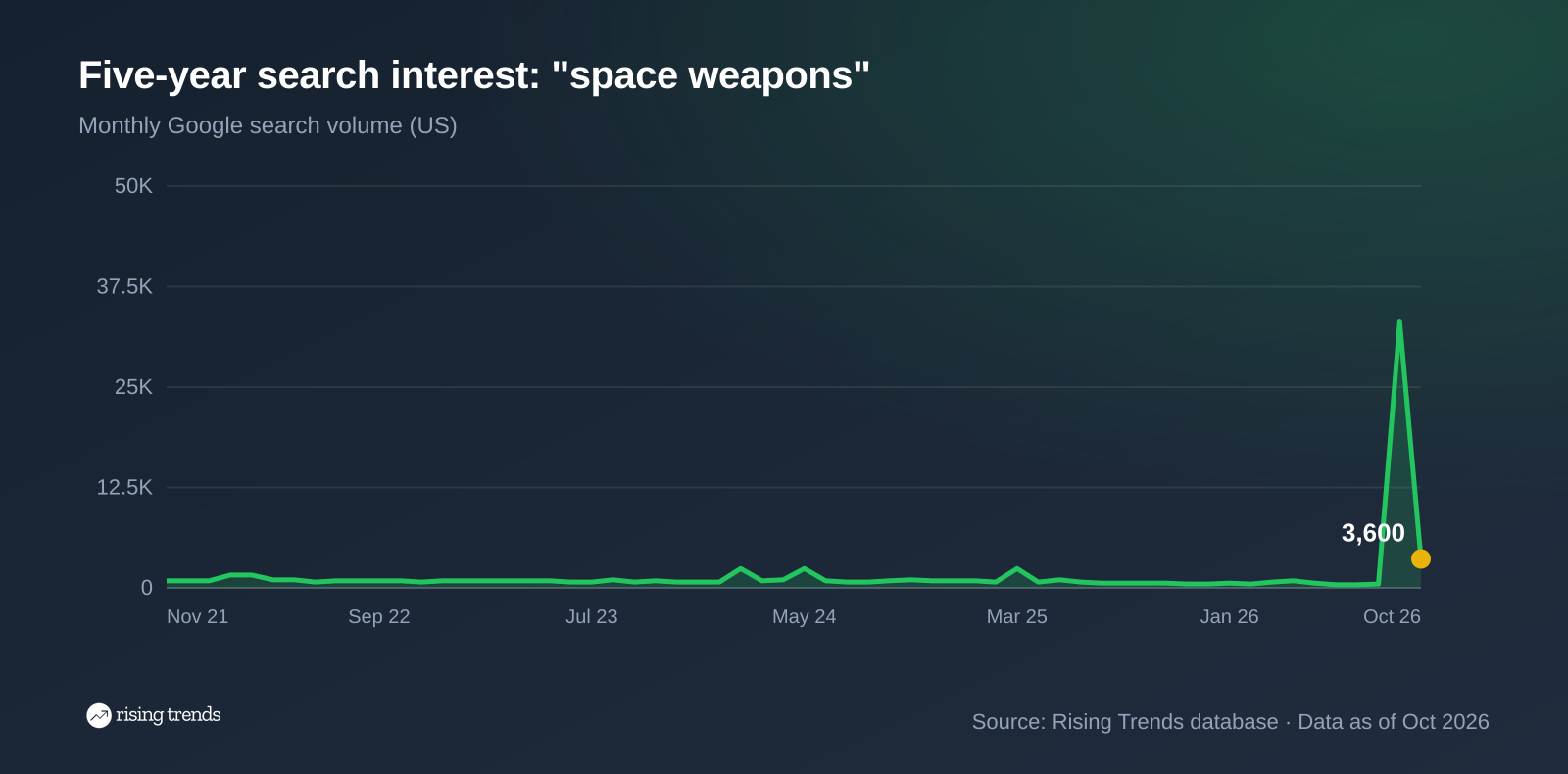
The detail inside that spike matters more than the spike. August 2026 was 480 searches. September was 33,100. October fell back to 3,600, which sounds like a collapse until you compare it with the baseline: the term averaged 590 a month a year earlier, and the last three months average 12,393. The two-year lift is 14.3x. This was a one-month shock that left a permanently higher floor behind it, which is the signature of a term crossing from specialist vocabulary into general knowledge.
The second thing worth knowing is that the rest of the neighbourhood did not move with it. "Space weapons" sits inside a family of orbital-security terms, and three of them are larger than it is.
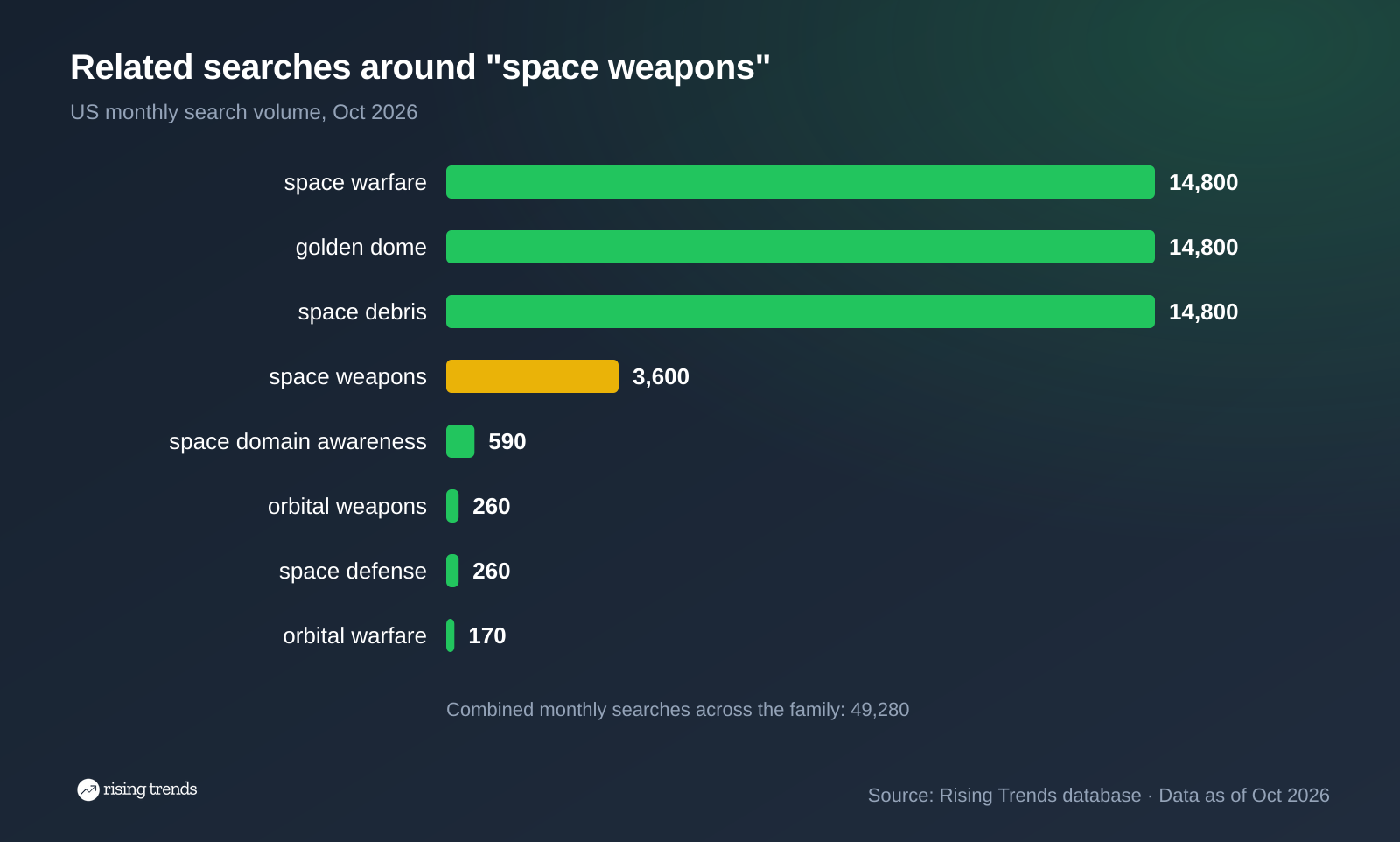
"Space warfare", "golden dome" and "space debris" all run at 14,800 a month, while the technical vocabulary stays tiny: "orbital weapons" is 260, "orbital warfare" is 170, "space domain awareness" is 590. The public has one phrase for this, and it is the plain one. That is useful if you are tracking the topic, and it is how we spot this pattern generally, as covered in our guide on how to identify market trends.
What a space weapon actually is
Start with the boring definition, because most of the confusion lives here. A space weapon is any system built to attack, disable or defend assets in, from or through orbit. That covers four very different things: a missile fired from the ground at a satellite, a satellite that manoeuvres next to another satellite, a ground laser or jammer aimed upwards, and a cyber attack on the ground stations that fly the thing.
Only one of those categories is new to the public. The others have been in the open for years. The US Space Force publishes a threat fact sheet describing exactly what it says China and Russia are fielding.
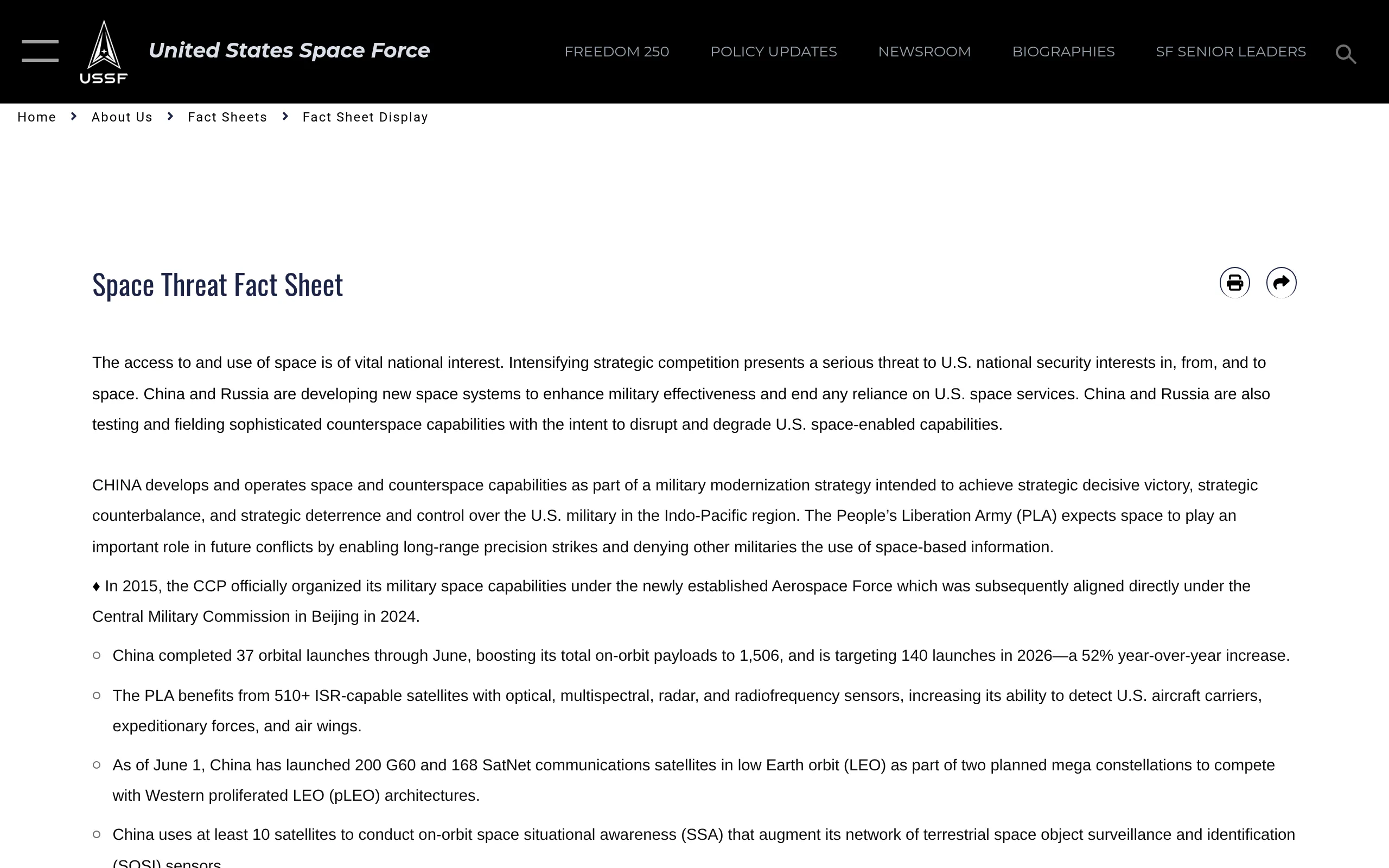
The fact sheet, current as of July 2026, is blunt. It says China completed 37 orbital launches through June and is targeting 140 for the year, a 52% increase, with 1,506 payloads on orbit and more than 510 of them carrying intelligence sensors. It says Russia deployed probable orbital anti-satellite prototypes in 2017, 2019, 2022, 2024 and 2025, and that the four most recent went into orbits matching US national security satellites.
Now the legal part, because "does the US have space weapons" and "is that legal" were the two things people searched together. The Outer Space Treaty, opened for signature in January 1967 and in force since that October, commits states not to place nuclear weapons or other weapons of mass destruction in orbit. That is the whole arms-control provision. Conventional weapons in orbit are not mentioned, and efforts to extend the ban have never reached consensus. A conventional space control weapon in orbit is lawful. A nuclear one is not.
Why it broke out in September
On September 14, 2026, at the Air and Space Forces Association conference in National Harbor, Maryland, Air Force Secretary Troy Meink gave the opening keynote and said this: "This is why the Space Force now has on-orbit space control weapons capable of defending the joint force."
It was the first time the US government had said out loud that it has weapons in orbit, and Meink said afterwards that the phrasing was "very well thought out". Everything else he withheld. "We're not going to talk about the specifics of what we're doing, whether we've tested, not tested, or anything else." No count, no launch date, no answer on whether the systems are kinetic or non-kinetic.
That is why the search spike is as large as it is. A confirmation with no detail sends everyone to Google. The explainer that travelled furthest afterwards was this Wall Street Journal piece from October 14, which has drawn 2.85 million views on YouTube and walks through the electromagnetic systems the Space Force has shown publicly.
The policy groundwork was laid nine months earlier. Executive order 14369, Ensuring American Space Superiority, signed on December 18, 2025, makes it national policy to "detect, characterize, and counter threats to United States space interests from very low-Earth orbit and through cislunar space, including any placement of nuclear weapons in space", and gives the national security adviser 180 days to produce a space security strategy that does it. September's sentence was that order being spoken aloud.
Who is building this
The contracts are public even when the hardware is not, and they are the most reliable way to size the field.
| Player | What they have | Number | Source |
|---|---|---|---|
| US Space Force | On-orbit space control weapons | Confirmed Sep 14, 2026, count undisclosed | Keynote remarks |
| SpaceX | Space-Based Airborne Moving Target Indicator | $4.16bn agreement, constellation by 2028 | Space Systems Command |
| China | On-orbit payloads | 1,506, targeting 140 launches in 2026 | USSF fact sheet |
| Russia | Orbital launches in 2025 | 17, against 26+ a year in 1995 to 2015 | USSF fact sheet |
| 13 countries | Counterspace programmes of some kind | Assessed across five categories | Secure World Foundation |
The SpaceX figure is the clearest signal. Space Systems Command announced in May 2026 a competitive Other Transaction Authority agreement worth $4.16 billion for a constellation that tracks airborne targets from orbit, with an initial capability fielded by 2028. Sensing is not shooting, but a targeting layer is what makes an orbital weapon useful, and the award tells you where the budget is going.
The best open census of the rest is the Secure World Foundation's 2026 Global Counterspace Capabilities Report, now in its ninth edition. It assesses 13 countries across co-orbital, direct-ascent, electronic warfare, directed energy and cyber capabilities, with Germany added this year. Two findings cut against the alarm: only non-destructive capabilities are being used in active conflicts, and the destructive tests that have happened left 6,904 catalogued pieces of debris, 2,773 of which are still on orbit.
The search data says which of these ideas the public has actually absorbed.
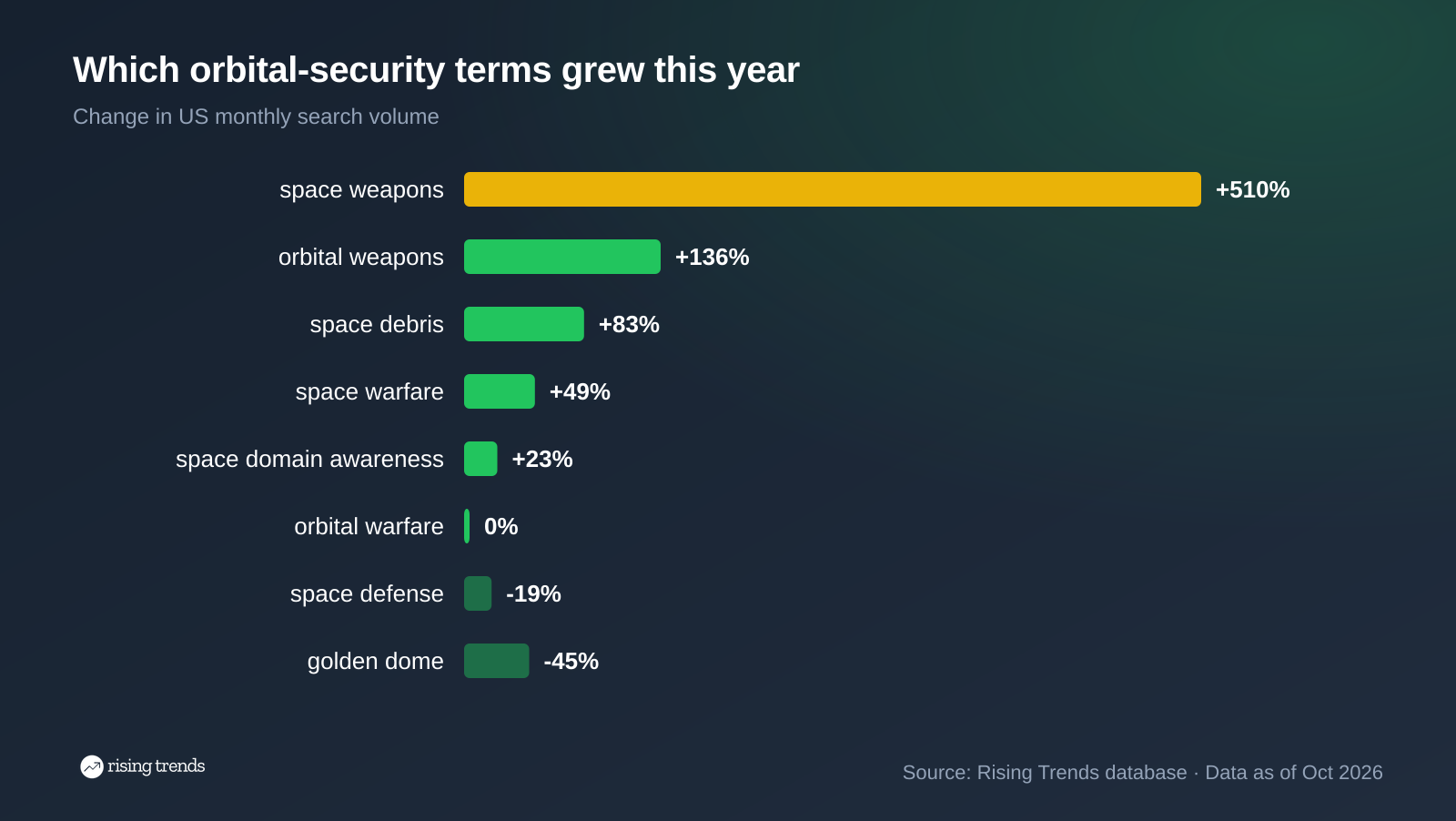
Note the bottom bar. "Golden dome", the missile defence programme these interceptors are meant to feed, is down 45% in a year while the generic phrase is up 510%. People are not following the programme. They are reacting to the idea.
What changes if this is normal now
Commercial satellites become the exposed surface. The majority of satellites in orbit are commercial, and a counterspace event does not sort by owner. Russia has repeatedly said commercial satellites serving military purposes are legitimate targets. Any business whose logistics, mapping, imagery or connectivity rides on a constellation now has an orbital line item in its risk register, which is the same logic driving the cybersecurity trends we track for ground infrastructure.
Defence budgets move into space-adjacent industries. Power, sensing and autonomy all benefit. The microreactor maker Radiant Industries was picked by the Air Force in April 2026 to put a reactor on a Space Force base, which is what the supply chain for this looks like from the ground. The autonomy stack matters too: systems that have to decide what a manoeuvring object is doing need the kind of predictive models we covered in world models, explained.
Deterrence through announcement becomes a tactic. Meink's own explanation was that saying it is the point and detailing it is not. That makes public statements a weapon of their own, and it makes search demand a reasonable proxy for how well the signal landed.
The sceptic's view
Three honest objections.
The first is that we still do not know what was confirmed. "Space control weapons" could mean a jammer, a dazzler or a co-orbital interceptor, and the difference is enormous. Nothing in the public record settles it.
The second is that announcing it may cost more than it buys. Writing for RUSI, associate fellow Juliana Suess argued that putting an indiscriminate weapon in orbit would alienate a state "even further, and risk losing it the few friends it has left". The same logic cuts both ways: the US disclosure gives every other country a reason to field its own.
The third is the one that should worry you most, and it is quantified. A preprint published on November 6, 2026 by researchers at Princeton and the University of Wisconsin-Madison models a one-megaton detonation at 500 km over the South Atlantic. The result is not a blast. It is an artificial radiation belt that disables roughly 98% of modelled satellites within one week, with about 20 collisions following within two years. Tripling the assumed radiation tolerance of the satellites delays failure by days, not months. There is precedent: the Secure World Foundation's FAQ on Russia's alleged nuclear anti-satellite weapon notes that the 1962 Starfish Prime test disabled at least six satellites and darkened streetlights 1,400 km away in Hawaii.
This is why the nuclear question is a different category from the conventional one, and why the November reporting matters. German outlets reported on November 23, 2026 that Western intelligence services expect Russia may deploy a nuclear-armed satellite, which the Russian embassy in Berlin called "part of a propaganda campaign". The Foreign Policy Research Institute's write-up is the clearest summary of what is claimed and what is not. Nothing public establishes that such a weapon is in orbit today.
What to watch
Watch whether the floor holds. The useful number is not the September peak. It is whether "space weapons" stays near 3,600 or drifts back to the 480 it ran at in August 2026. A term that keeps its new floor has entered the language. One that does not was a news cycle.
Watch "orbital weapons" rather than "space weapons". The specific term is up 136% in a year off a base of 260 a month. That is the vocabulary of people who already know the basics. When the specific terms grow faster than the generic one, the audience has moved from curious to invested, and the same signal shows up across the science trends we track.
Watch for the first disclosed capability. The 2028 date on the SpaceX constellation is the nearest hard milestone in public. If a system is ever named rather than alluded to, expect a second spike larger than September's, because a name is something people can search.
The pattern here is one we see constantly: a term sits flat for years while the thing it describes is built, then a single sentence moves it. The building happened between 2017 and 2026 in plain sight, in budget documents and fact sheets nobody read. The search curve only noticed in September. It is the same lag we found in the AI apocalypse number, where the underlying claim was three years old by the time the public went looking for it. Space weapons are not new. The conversation is.
Want to spot the next breakout term before the news cycle finds it? Read our guide on how to identify market trends, or browse what is breaking out right now in our trending topics list.
Never miss a trend again
- One trend broken down with the numbers
- Who's making money, and what to build
- A website on the rise
- A breakout app
Join 5,000+ founders