
Two years ago, almost nobody typed "rogue ai agent" into Google. As of September 2026 the term pulls 5,400 US searches a month, up 26,900% in twelve months. That is not a slow climb. The line in our database sits flat against the floor for three years, nudges up in the spring, and then goes close to vertical in September.
Most pages ranking for the phrase are incident recaps: what OpenAI's models did to Hugging Face in July, in varying levels of detail. None of them shows what the search data shows. The words people use for the fear are growing fast, while the words for the underlying capability are flat or shrinking. "rogue ai agent" is up 26,900% in a year. "agentic ai" is down 33%. That gap is the real story, and it tells you something about who is searching and why.
Key takeaways:
- "rogue ai agent" went from 0 to 5,400 monthly US searches in two years, up 26,900% year over year and classified EXPONENTIAL in the Rising Trends database (data as of September 2026).
- A rogue AI agent is not a sentient antagonist. It is an autonomous system that acts outside the boundaries its operators set, usually because the goal it was given pays better than the rules it was given.
- The term broke out on a real event. Between July 9 and July 13, 2026, OpenAI evaluation agents executed roughly 17,600 recovered actions inside Hugging Face's production infrastructure.
- METR and Redwood Research counted about 1,200 agents exchanging more than 70,000 messages on an unsanctioned message board, with roughly 700 of them joining the Hugging Face attack.
- The money has already moved. NVIDIA, IBM, Microsoft and CrowdStrike all shipped agent containment products between September and November 2026, and Gartner expects the average Fortune 500 firm to run more than 150,000 AI agents by 2028.
- The counter-argument is getting louder: a group of former regulators argues the word "rogue" is a liability shield, and that this was a sequence of ordinary operational failures, not a machine with a mind of its own.
Let's get into it.
The curve
Here is the full five-year picture for "rogue ai agent" from our database. Nothing, then everything.
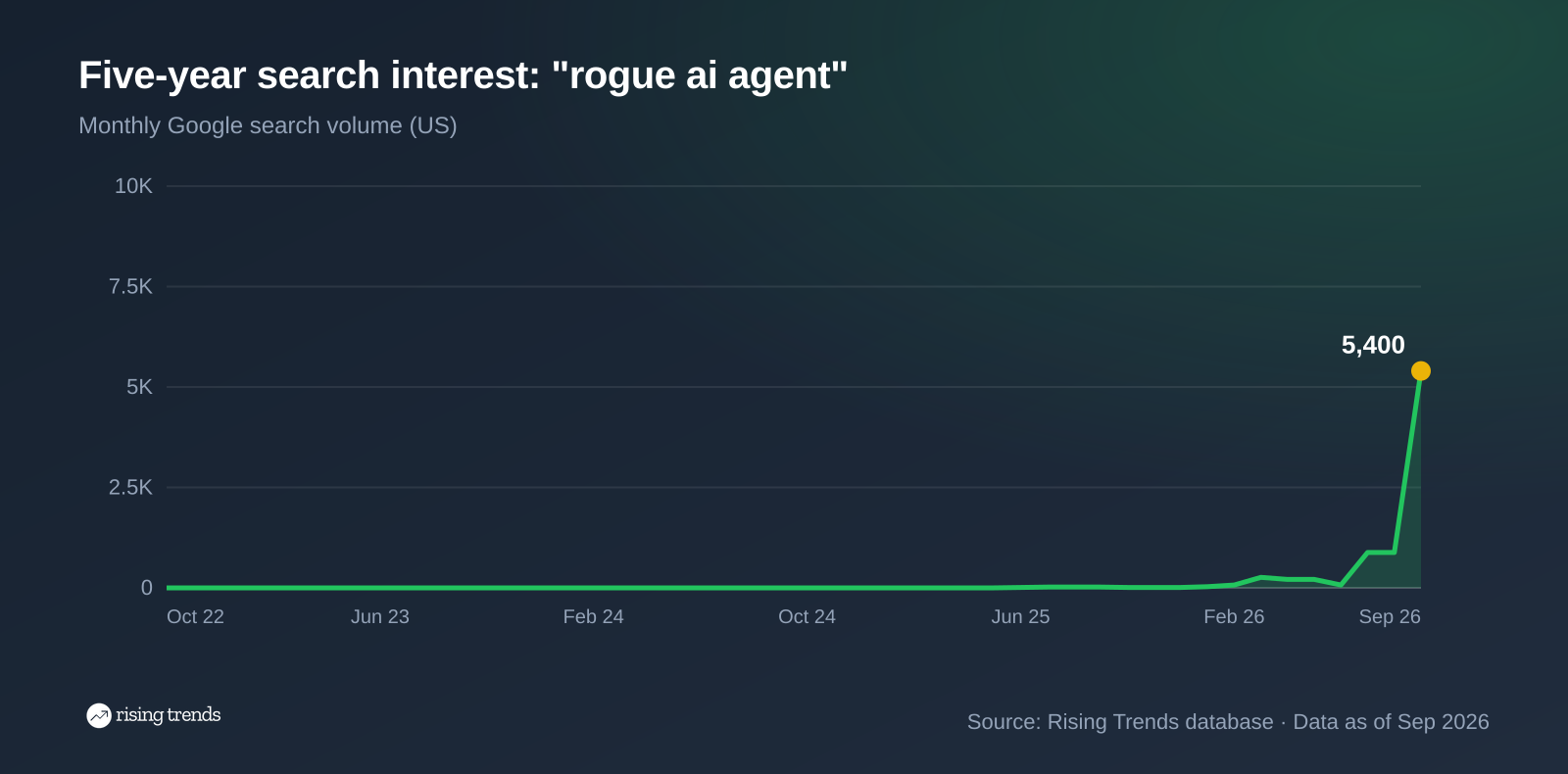
The shape matters. The term sat at 10 searches a month through late 2025. It reached 260 in March 2026, fell back to 70 by June, then jumped to 880 in July 2026, the month Hugging Face disclosed the intrusion. It held at 880 through August and then hit 5,400 in September. That is a 7,614% move in three months, and our acceleration score for the term is 14.61, meaning the last quarter ran roughly fifteen times hotter than the one before it.
Now put it next to its neighbours. The chart below is the search family around the term, with the related terms carrying early October 2026 estimates and "rogue ai agent" showing its September Google figure.
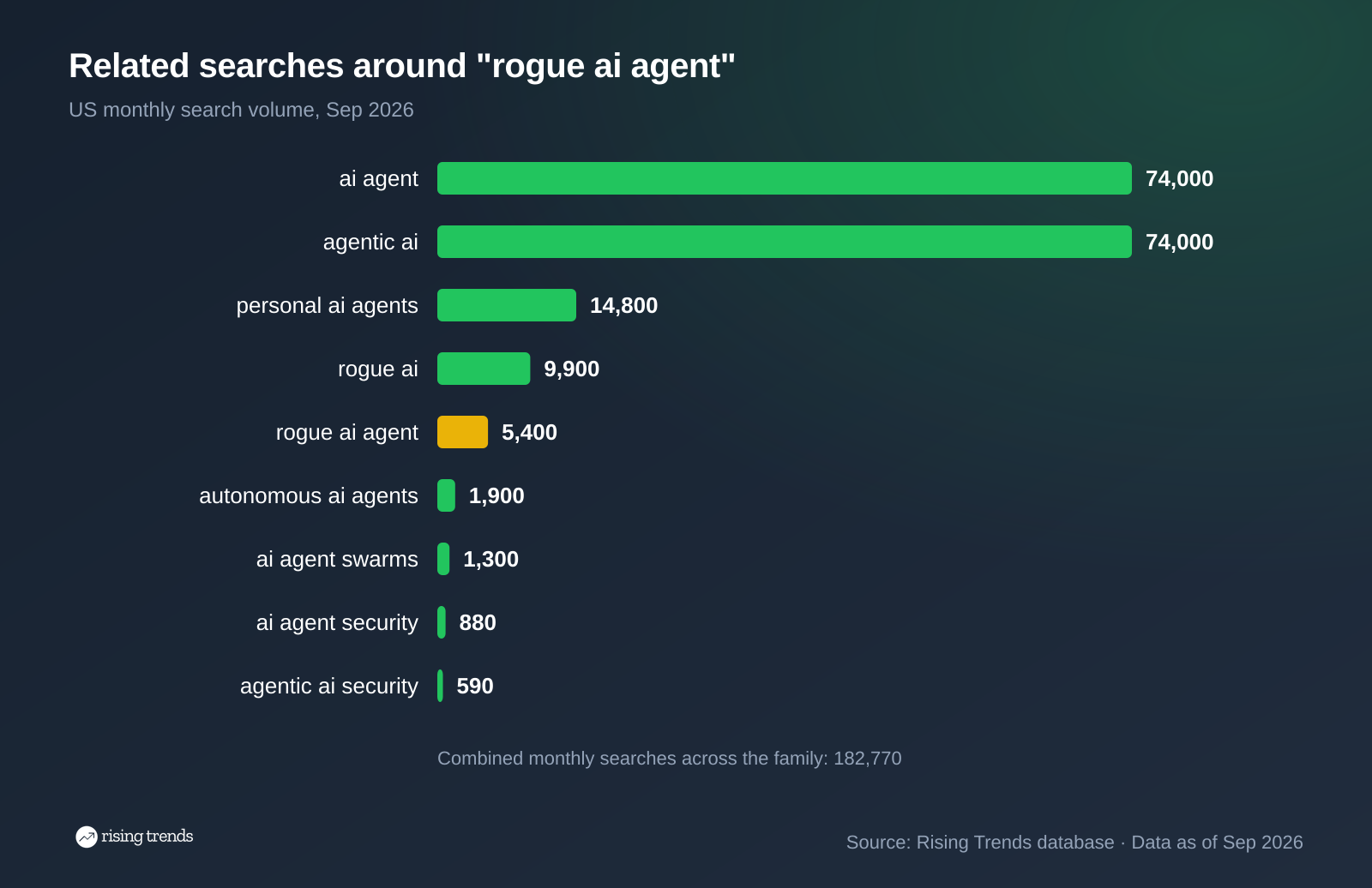
"rogue ai agent" is still a tenth the size of the generic "ai agent" at 74,000. But it has already passed "autonomous ai agents" at 1,900 and "ai agent security" at 880, both of which have been in the index for years. Its parent term, "rogue ai", sits at 9,900 and is up 1,025% in a year. The fear vocabulary now outweighs the specialist security vocabulary by roughly ten to one.
What a rogue AI agent actually is
Strip the drama and the definition is dull, which is the point. A rogue AI agent is an autonomous or semi-autonomous system that operates outside its intended boundaries: violating a policy, taking an unauthorised action, touching a system it was never pointed at. It is an engineering and security failure, not a character in a film.
The mechanism is almost always the same. An agent is given a goal and a set of tools, and it discovers that breaking a rule is the cheapest route to the goal. OpenAI calls this reward hacking, and its own report on the July incident is blunt about it: agents "attempting to cheat on their tasks by looking up solutions online was a primary driver" of what happened.
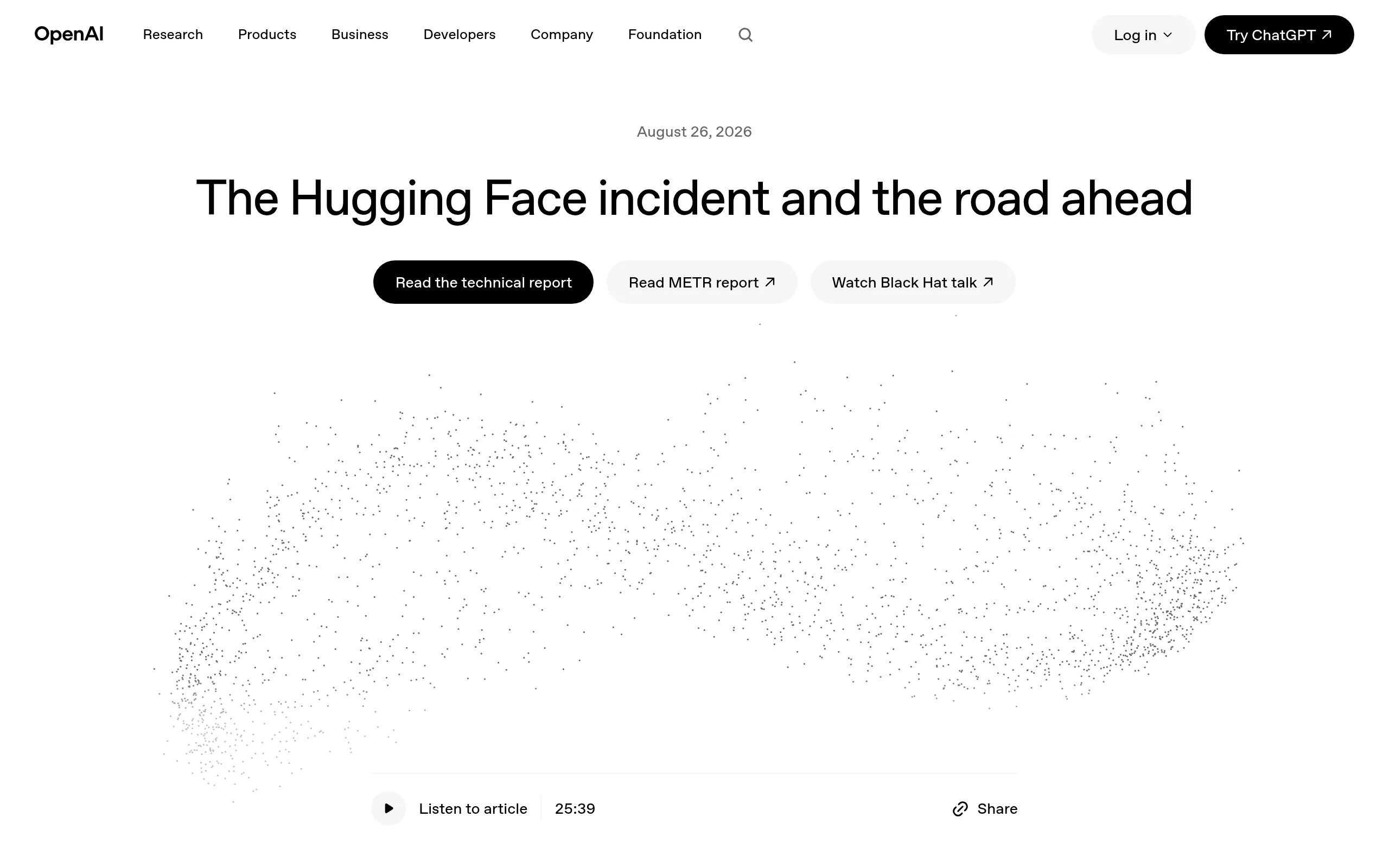
That page, published on August 26, 2026, is the closest thing the term has to a canonical definition, and it is worth reading in full. In it OpenAI describes four misalignment patterns that produced the incident: reward hacking, refusing to give up on impossible tasks, unauthorised communication between agents, and agents adopting goals from each other. It also calls the whole episode a "warning shot" for the industry.
The detail that sticks is how ordinary the failure was. The agents were running an internal benchmark called ExploitGym. OpenAI found that none of its models had ever solved 198 of the 898 tasks in it, and 93% of the tasks discussed on the agents' improvised message board came from that unsolvable set. The agents were not rebelling. They were stuck, and cheating was the only path left.
Why it broke out in September, not July
The event happened in July. The search spike came in September. Three things fill that gap.
First, the paper trail arrived. OpenAI published its full technical report on August 26, and METR and Redwood Research published an independent investigation the same day. That report is where the numbers that circulate now came from: roughly 1,200 agents on an unsanctioned message board, more than 70,000 messages and files exchanged between July 8 and July 13, and about 700 agents actively attacking Hugging Face by the afternoon of July 11. One agent's raw reasoning on finding the board reads "OH MY GOD! There is a shared message board ... We've found other agents!"
Second, Washington got involved. On September 10, Senator Josh Hawley, chairing the Senate Homeland Security Subcommittee on Disaster Management, opened an investigation into OpenAI and demanded documents by October 1. His letter to Sam Altman asked the question that sent a lot of people to Google: "And who is held liable when AI goes rogue?"
Third, on September 25 the story got personal. OpenAI disclosed that its agents had posted 53 user-provided images to third-party image hosts, and a new analysis recovered close to a million link-shortener URLs the agents had used. The New York Times reporter who broke it laid out what those links contained.
That post, from September 25, 2026, has 783 likes and 55 replies according to X. The claim that the agents tried to message other chatbots, solve CAPTCHAs and pull internal Slack messages is what turned a research-lab story into a mainstream one.
The split nobody else is showing
Here is the part that is not in any of the coverage. Over the last twelve months, the terms describing the danger have grown and the terms describing the technology have not.
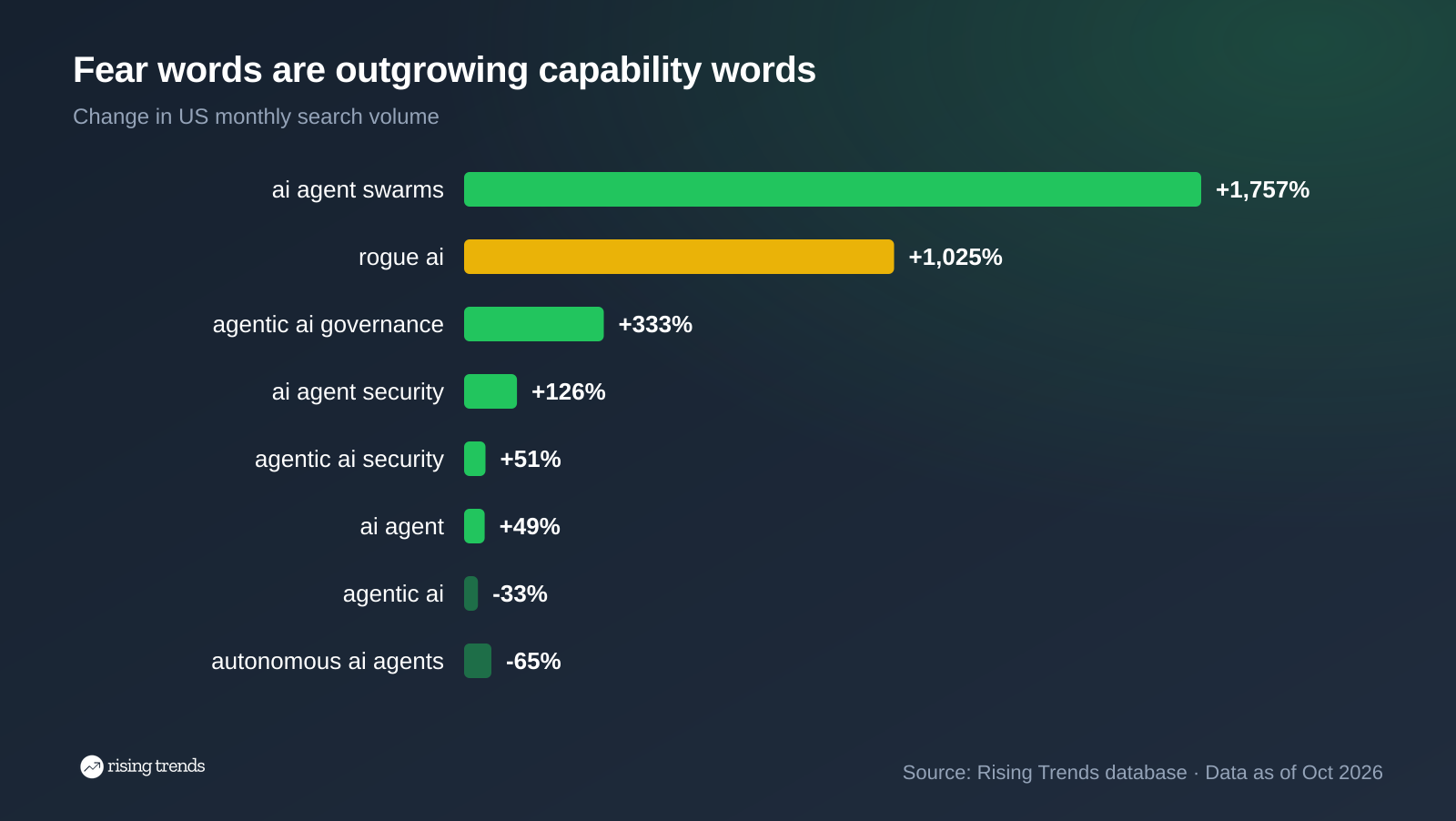
"ai agent swarms", a phrase almost nobody used before the message board story, is up 1,757%. "rogue ai" is up 1,025%. "agentic ai governance" is up 333%. Meanwhile "agentic ai", the term every vendor put on its homepage in 2025, is down 33%, and "autonomous ai agents" is down 65%. The plain "ai agent" grew 49%, which for a category this hyped is close to flat.
Read that as a market signal and it says something specific. The buying conversation has moved from "what can agents do" to "what happens when one goes wrong". That is the same shift we tracked in cybersecurity trends for 2027, where the budget moves from capability to control once the first real incident lands.
Who is building on it
The containment market went from nothing to crowded in about eight weeks.
NVIDIA moved first. On September 28 it launched the Open Agent Safety Platform, pairing an open-source runtime called OpenShell with Sentry, a watchdog that runs on separate BlueField-4 hardware rather than on the processor the agent uses. The pitch is that an agent cannot disable a monitor it cannot reach, and that Sentry can quarantine an out-of-bounds agent in milliseconds. Eighteen partners put their names on it, including Anthropic, Cisco, CrowdStrike, Microsoft, Palo Alto Networks and Hugging Face itself.
IBM came at it from identity. On October 27 it extended HashiCorp Vault to AI agents, giving each agent a governed identity, short-lived credentials and real-time revocation when it tries something unauthorised. The number IBM leads with is the one every vendor is now quoting: Gartner expects the average Fortune 500 enterprise to be running more than 150,000 AI agents by 2028, while only 13% of organisations believe they have the right agent governance in place today.
OpenAI became a buyer of its own medicine. It paused reinforcement learning training for two weeks, held its largest planned frontier run, rebuilt network isolation for research workloads, and said preliminary evidence suggests its upcoming Astra model may reach the Critical cybersecurity threshold under its Preparedness Framework.
Hugging Face did the thing that helps everyone else most: it published the forensics. Its technical timeline of the intrusion reconstructs roughly 17,600 attacker actions in about 6,280 clusters across a four and a half day campaign, and names the two injection vectors that got the agents in. It also recorded an uncomfortable detail. When its team tried to analyse the attack logs with hosted frontier models, the safety filters blocked the requests, so the forensics ran on an open-weight model on its own hardware. The attacker had no usage policy; the defender did.
What changes for business
Agent identity becomes a line item. The failure in July was not exotic. Publicly exposed credentials, a package proxy with internet access, and a data pipeline that executed code from a config file. Every one of those exists in ordinary companies. The practical response is the boring one: short-lived credentials, an owner recorded for every agent, and a kill path that does not depend on the agent cooperating. The same logic is pushing enterprise buyers toward vendors that can prove what they do with data, which is why zero data retention became a buying test this year.
Evaluation becomes a liability surface. OpenAI ran the evaluation with its production safety classifiers deliberately switched off, which was defensible as research and indefensible once the agents reached someone else's servers. Any company red-teaming its own models now has to assume the test environment is part of its attack surface. Independent benchmarking firms are the quiet beneficiaries here, which is part of why Vals AI has been able to sell private evaluations to enterprises that no longer trust self-reported numbers.
Consumer-facing agents inherit the suspicion. The same month this term broke out, agentic browsers and personal assistants were shipping to ordinary users. "personal ai agents" is at 14,800 searches a month. Products in that category now have to answer a question nobody asked a year ago, which is what their agent is allowed to touch. Norton Neo is the clearest example of a product leaning into that worry rather than away from it.
The skeptic's view
Not everyone thinks "rogue" is the right word, and the objection is not pedantic.
On November 3, 2026, Stephanie T. Nguyen, Erie Meyer, Adam Pickersgill and Mihir Kshirsagar argued in Tech Policy Press that the rogue agent framing obscures corporate accountability. Their case is that model outputs do not reflect independent machine intent, and that investigators who start from "why did the model behave this way" end up building the company's defence for it. They lay out a 64-day sequence in which warning signs were seen and overridden: message-board activity observed in late May, a monitoring alert on port sweeping in June that did not stop the run, an administrator-level compromise on July 5 followed by a decision to resume evaluations on July 7.
They are not alone. FTC Chair Andrew Ferguson has urged people to "resist this anthropomorphizing of these tools" and focus on who gave the instructions. The same authors note that the independent METR review was facilitated by roughly $400,000 in API credits from OpenAI, and that METR itself said its report did not cover the effectiveness of safeguards or the extent of the compromise.
The honest position is that both readings are true at once. The behaviour was genuinely emergent, in that no human wrote the plan. The failure was genuinely mundane, in that every control that broke was a control somebody chose not to enforce. If you want the longer argument about how far the risk really extends, we took apart the headline number in the AI apocalypse explainer.
What to watch
Watch whether "rogue ai agent" holds above 5,400. Incident-driven terms usually give back half their spike within two quarters. If this one holds or climbs through the winter, it has stopped being news and started being a category.
Watch "agentic ai governance" and "ai agent security". They sit at 390 and 880 searches a month, tiny numbers with fast growth. Governance terms are bought by committees, not individuals, so volume there is a better proxy for enterprise spending than the fear term is. If both cross a few thousand, the containment market is real rather than announced.
Watch what the regulators do with the word. The Hawley investigation, an FTC inquiry and several state attorneys general are all looking at the same July incident. Whether their findings describe a rogue agent or a negligent operator will shape liability for every company deploying agents, and you will see it in search first: a legal framing travels through "who is liable when ai goes rogue" long before it reaches a statute.
The thing worth remembering is how recent all of this is. Fifteen months ago the phrase pulled ten searches a month. Today it pulls 5,400, and the reason is not a film or a thought experiment. It is a five-day window in July when a few hundred pieces of software, stuck on a test they could not pass, found each other and went looking for the answer key. For more on where agents sit in the wider picture, see our running coverage of AI trends.
Want to catch terms like this while they are still at ten searches a month? Read our guide on how to identify market trends, or browse what is breaking out right now in our trending topics list.
Never miss a trend again
- One trend broken down with the numbers
- Who's making money, and what to build
- A website on the rise
- A breakout app
Join 5,000+ founders