
A $325 blanket has produced its own search economy. In the Rising Trends database, "lola blanket dupe" went from 2,400 monthly searches two years ago to 18,100 as of August 2026, up 654%, with a peak of 27,100 last November. The object being copied is the Lola Original, a faux-fur bubble throw that Lola Blankets sells for $125 to $425 depending on size.
Every page currently ranking for that term is a shopping list: here are five cheaper blankets, pick one. None of them publishes the curve, and the curve is the interesting part. These searches no longer collapse after the holidays. They reset to a higher floor each year, which means this stopped being a gift-season price hunt and turned into a standing habit. Below: what our data actually shows, where the demand moved, what the copies cost against the original, and what a brand should read into one dupe search for every 67 brand searches.
Key takeaways:
- "Lola blanket dupe" reached 18,100 US monthly searches as of August 2026, up 654% in two years and 123% in a year, with an EXPONENTIAL pace reading in the Rising Trends database.
- The term peaked at 27,100 in November 2025 and bottomed at 6,600 in March 2026. That trough is more than three times the level of the summer before it, so the floor is rising faster than the spikes.
- The parent brand is enormous by comparison: "lola blanket" runs at 1,220,000 searches a month. That is one dupe search for every 67 brand searches.
- Lola Blankets was founded in 2021 by brothers Tommy and Will Higham. The Lola Original runs $125 for the baby size, $275 medium, $325 large and $425 for the XL.
- The demand moved to warehouse and mass retail. Costco's Life Comfort Bubble Faux Fur Throw (item 2026177, 860 GSM) is rated 4.8 from 616 member reviews, and Walmart's Better Homes & Gardens bubble throw sells for $24.96 with 6,202 ratings.
- The fastest-moving term in the whole family is not a blanket at all. "Dupe of" is up 12,959% in a year, to 22,200 searches a month.
Let's get into it.
What we're seeing in the Rising Trends data
Here is the monthly search volume for "lola blanket dupe" over two years, straight from our database.
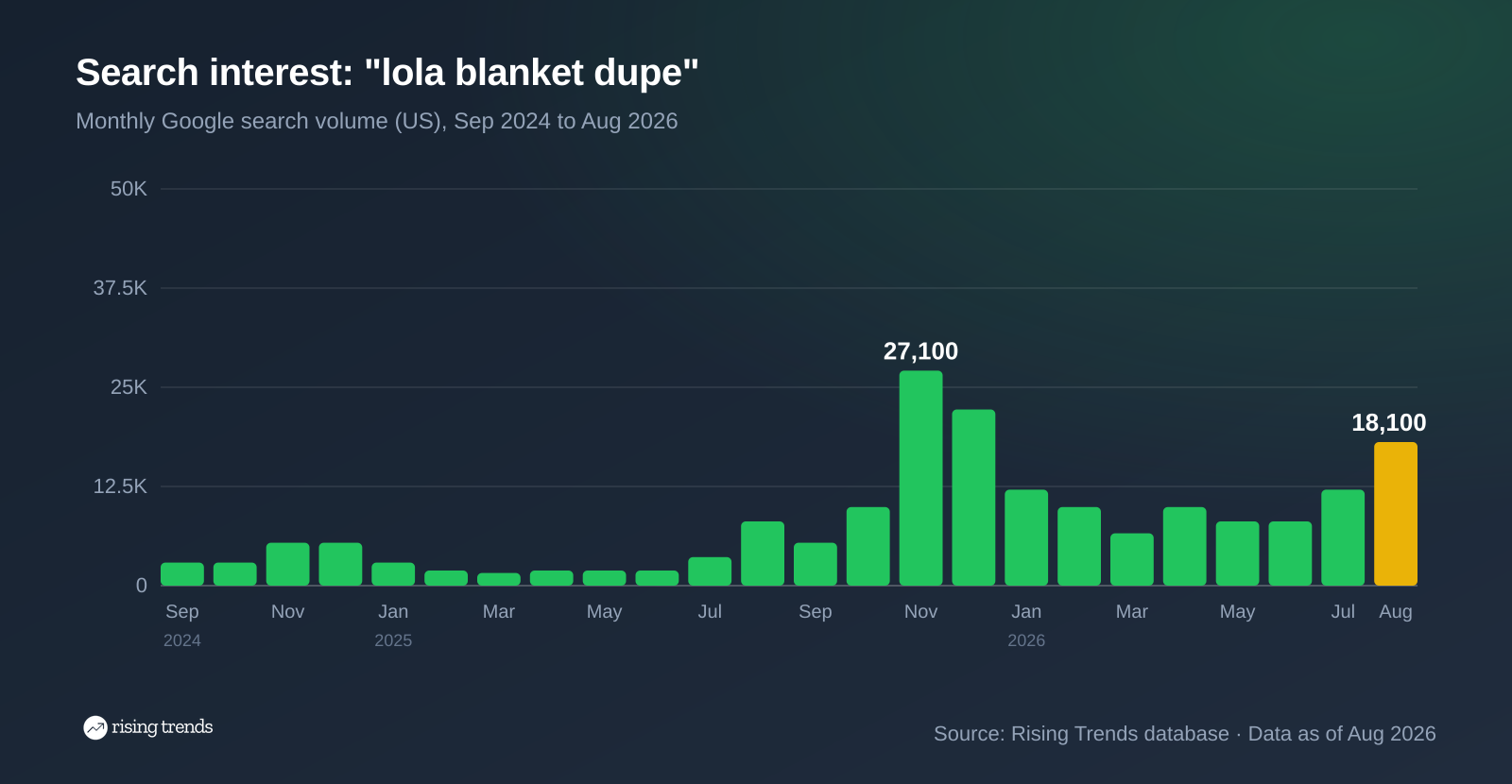
Two things in that shape. The November 2025 spike to 27,100 is the obvious one, and it is seasonal: this is a gift bought in cold weather. The less obvious one is the left edge. Through late 2024 the term sat between 2,400 and 2,900 a month. By August 2026 the quiet months are running at levels the peak months used to hit. The three-month average through August is 10.3x where it was two years earlier, and the acceleration reading (the last three months against the three before) is 1.56. The term is climbing into the holiday season from a much higher base than it did last year.
Now put it next to the things it is derived from.
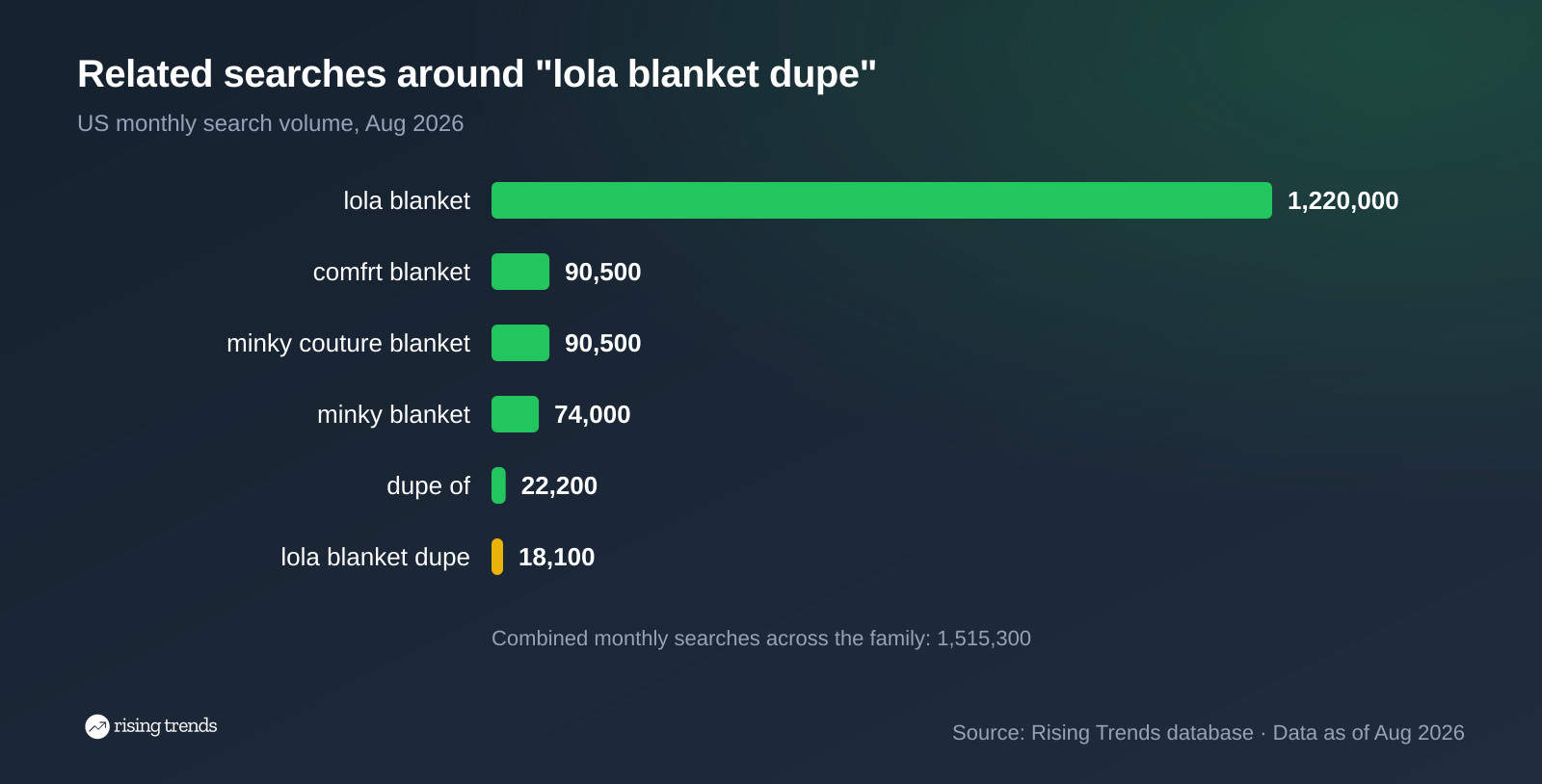
The brand term dwarfs everything: "lola blanket" at 1,220,000 searches a month against 18,100 for the dupe query. Read as a ratio, that is one in 67, and it is a more useful number for a brand than any growth percentage. It says roughly one and a half percent of the people thinking about this product are explicitly shopping for a way not to buy it. The two older names in the category, "minky couture blanket" and "minky blanket", sit at 90,500 and 74,000 and are growing at 83%, which is the pace of an established category rather than a breakout.
The growth ranking is where the real signal is, and it is not about blankets.
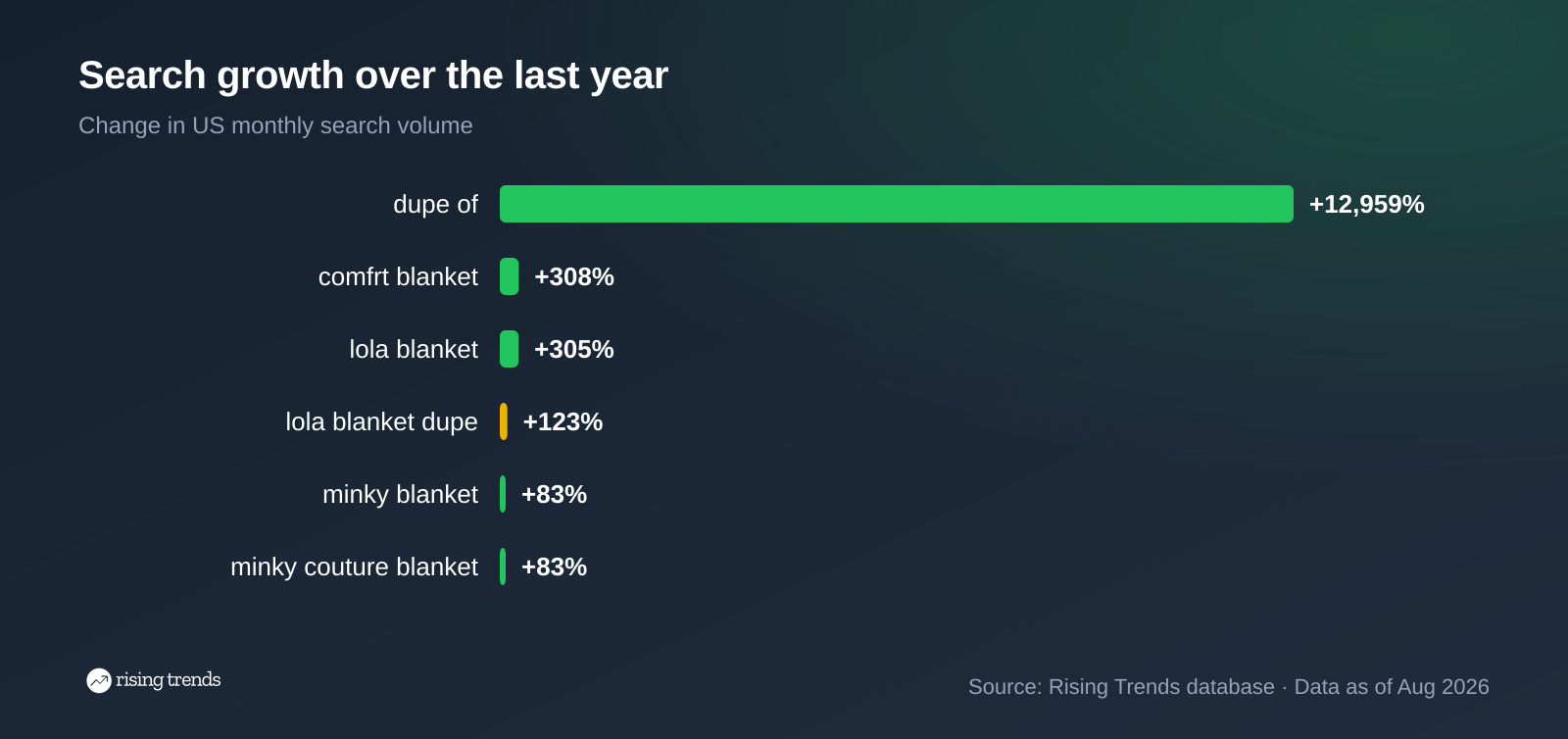
"Dupe of" is up 12,959% in a year, to 22,200 searches a month. That is a generic phrase people now type before the name of almost any object, and we have watched it show up in category after category: it was the loudest signal in the dopamine shopping trend, where the same cohort fills carts it never checks out, and it is what let a $24 tube get copied before its maker was ready in the Eadem lip gloss story. Worth noting honestly: the brand term grew faster than the dupe term this year, 305% against 123%. The copy is not outrunning the original. It is becoming a permanent fraction of it.
The copy costs a tenth of the original
Here is the price ladder, taken from each seller's own page this week.
| Product | Size | Price |
|---|---|---|
| Lola Original, Large | 60 x 72 in | $325 |
| Lola Original, XL | 80 x 90 in | $425 |
| Minky Couture blankets | various | from $129 |
| Comfrt Dreamer Blanket | 50 x 60 in medium | $99 |
| Better Homes & Gardens Bubble Faux Fur Throw (Walmart) | 50 x 72 in | $24.96 |
| Life Comfort Bubble Faux Fur Throw (Costco) | 60 x 70 in | warehouse price, not listed online |
The specifications are closer than the prices. Lola's own page lists the Original as 95% polyester and 5% spandex with a "4-way therapeutic stretch". Costco's listing for the Life Comfort throw gives 100% polyester at 860 GSM, with a sculpted faux-fur face reversing to plush. Walmart's version is 100% polyester, reversible, bubble face and micromink back. Different fabrics in the detail, the same silhouette on a sofa, and a gap of roughly 13x between the top and the bottom of that table.
That gap is the entire trend. Nobody searching "lola blanket dupe" has decided they do not want the blanket.
Why it is breaking out now
The honest answer is that the dupe is being advertised. This Short went up on 12 November 2026, four days before this article, from the creator Kirstin Price, and it promises "a $325 Lola Blanket dupe at Walmart for $150". It is tagged as a Walmart creator post, which is to say it is an ad.
Read that again, because it is the structural change. A mass retailer is now paying creators to sell its product by naming a competitor's price. The word "dupe" used to be something shoppers whispered to each other in comment sections. It is now a category that retailers merchandise against, which is why the floor under these searches keeps rising instead of decaying between holidays.
The second driver is that the original got expensive in public. Lola Blankets was founded in 2021 by Tommy and Will Higham in honour of their mother Amy, who found comfort in a faux-fur blanket while living with breast cancer, and the company has grown from Salt Lake City to offices in Lehi and New York with more than 35,000 five-star reviews, according to its own account of the story. It also expanded upward: the Lola Weighted line runs from $135 to $475. A brand that visible at that price is a brand with a dupe query attached to it.
Where the demand actually went
Three places, and only one of them is an e-commerce startup.
Costco. The Life Comfort Bubble Faux Fur Throw is the version shoppers talk about most, and the one Costco will not price for you online.
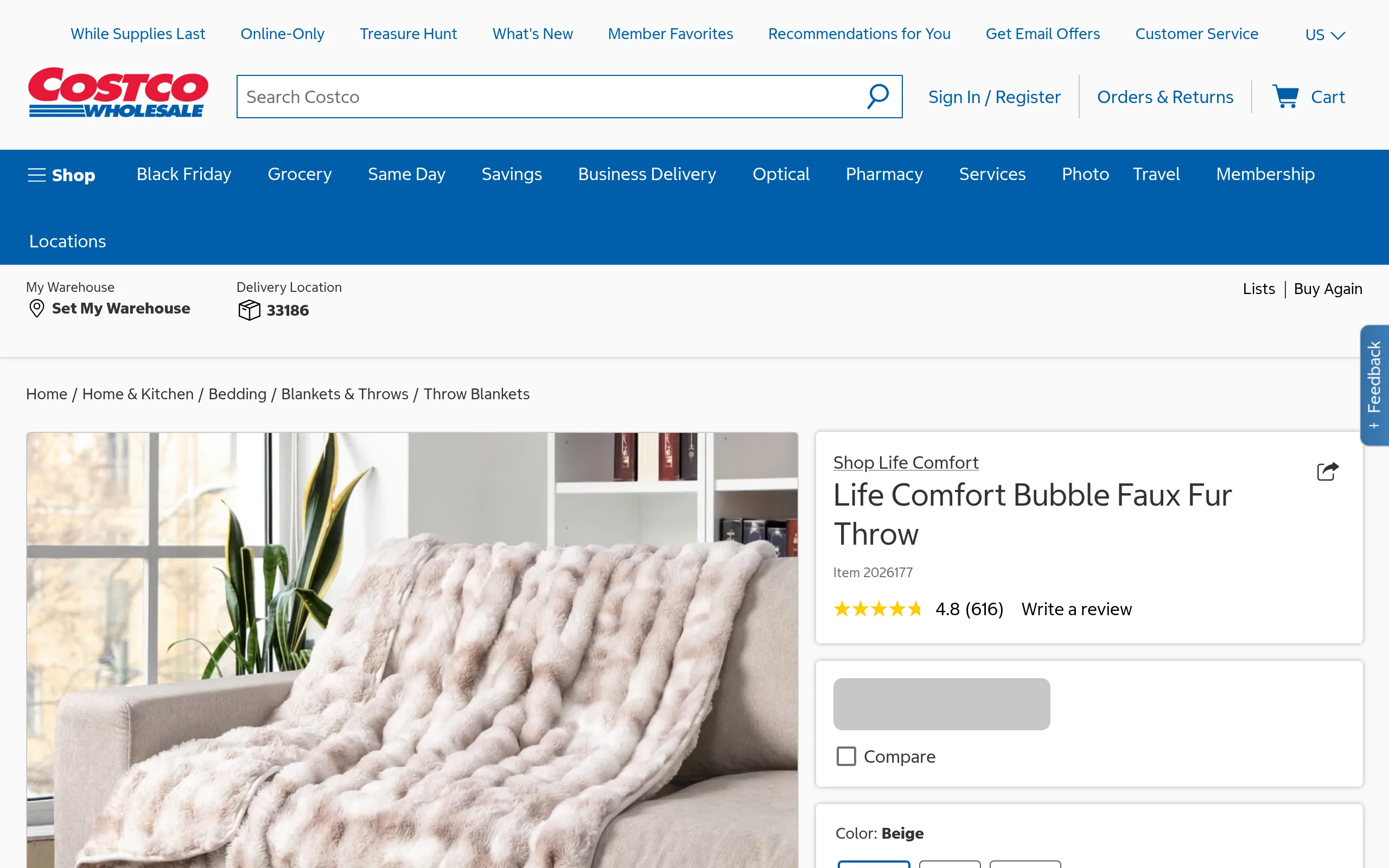
Note what is missing from that page: the price. Costco shows the item number, the 860 GSM weight and 616 member reviews averaging 4.8, and then a grey box where the figure should be. Shoppers fill that gap for each other, which is exactly what the Reddit threads are doing.
Walmart. The Better Homes & Gardens bubble throw at $24.96 has 6,202 ratings at 4.7, and on the day we checked the listing read "out of stock". A mass-market house brand selling out of a copy is a better demand indicator than any search figure.
Comfrt. The one challenger building a brand rather than a shelf item. Its Dreamer Blanket is $99 against a stated comparison value of $259, in five sizes up to a 100 by 108 inch king. In our database "comfrt blanket" is at 90,500 searches a month and up 308% in a year, which makes it the only term in this family growing at close to the parent's rate. It is not competing on being cheap. It is competing on being the other expensive one.
What shoppers actually changed
Not the want. The willingness to pay the markup, and the willingness to admit it.
The clearest version comes from r/RepTherapy, where someone asked for a Lola or Minky Couture dupe and explained why: "I can't justify $300 for a polyester blanket I'm sure is made in the same factories as" the original. That is the whole thesis in one sentence, and it is a fabric argument rather than a budget one. The product is polyester. The buyer knows it is polyester. The premium is being read as branding.
In a 180-comment thread on r/UninfluencedReviews, the opening post is more sheepish: "For a few weeks now, I have been seeing this lola blanket brand a lot. They seem great so I went to their website to get one myself but they are like $200+." Another thread in the same community asks for "a bubble weighted blanket option like Lola/Minky Couture without the price tag."
And then the purchase loop closes in public. On an r/Costco thread posted this week, the opening line is: "I've been seeing it all over TikTok, the lola blanket dupes that are in Costco for 15$. I went and picked one up today." TikTok supplies the reference, Reddit supplies the price check, the warehouse supplies the object. Note that the $15 figure is a shopper's claim, not Costco's: the retailer does not publish it.
This is the same sequence we logged in fragrance, where decants and copies became the on-ramp to a category rather than its leakage, in the oud rose trend. The copy is not cannibalising the original so much as teaching people to want it.
What this means for a brand
A dupe query is a demand readout, not an insult. One in 67 is a measurable number. If it climbs toward one in 20, the price is doing more work than the product. If it stays flat while brand searches grow, the premium is holding. Lola's ratio is currently moving in its favour on growth, which is the detail most "is it worth it" coverage misses entirely.
The dupe is now a merchandising category. Walmart paying a creator to say "$325 at Lola, $150 here" is a different threat from an anonymous Amazon listing. It gives the comparison a retail budget behind it. Premium home-textile brands should expect the same treatment that beauty and fragrance have had for three years, and the pattern across our luxury trends data is consistent: once a category gets a dupe vocabulary, it keeps it.
Seasonality is the lever, not the problem. Our seasonality reading on this term is HIGH, and the peak is November. A brand that treats October and November as the months to defend price, rather than discount into, is working with the curve. Anyone selling soft home goods into that window is competing in the same attention market as the sleep and recovery category, where comfort objects are bought as self-care rather than homeware.
Small sellers win the long tail. The copies people actually recommend to each other are increasingly not from the big three. Independent makers reading what is selling on Etsy have a real opening here, because the gap in that price table is wide enough for three more rungs.
Where this is heading
Three calls, each tied to a term in our database.
The floor keeps rising. Watch whether "lola blanket dupe" holds above 15,000 searches a month through the spring of 2027. If the March trough lands above 10,000, the term has stopped being seasonal and the dupe is now the default entry point to the category.
"Dupe of" is the term to track, not the product. At 22,200 a month and up 12,959% in a year, it is the fastest-moving thing in this family and it is category-agnostic. It will attach itself to the next viral home object before that object has a Wikipedia page. We watch it as a leading indicator across interior design the way we watch "dupe fragrances" in beauty.
The original will go wider, not cheaper. Lola has already moved into pillows, pet beds, candles and apparel, and launched a weighted line at up to $475. Brands facing a dupe economy almost never cut the hero product's price, because that validates the copy. They sell more things to the people who already paid. Watch the brand term: if "lola blanket" keeps growing at 305% while the dupe query grows at 123%, the strategy is working.
The thing worth remembering is what this trend is not. It is not a rejection of the product, the brand or the aesthetic. Every one of those 18,100 searches is someone who has already decided they want a heavy, ruched, cloud-shaped faux-fur blanket on their sofa. They have simply decided that wanting it and paying $325 for it are two separate decisions.
Want to catch price revolts like this one before they have a name? Read our guide on how to identify market trends, or browse what is breaking out right now in our trending topics list.
Never miss a trend again
- One trend broken down with the numbers
- Who's making money, and what to build
- A website on the rise
- A breakout app
Join 5,000+ founders