
For two years "oud rose" sat in the Rising Trends database as a niche term, the kind of phrase a few hundred perfume obsessives type into Google each month. It was at 880 monthly US searches in September 2024. In August 2026 it hit 5,400, and September held exactly there. That is up 238% in a year and 514% in two, with the pace flag in our database reading EXPONENTIAL.
What makes it interesting is not the climb on its own. It is what the climb sits next to. In the same database, over the same twelve months, "vanilla perfume" is down 18%, "miss dior perfume" is down 18%, and "lattafa perfumes", the brand that put cheap Middle Eastern scent in Western bathrooms, is down 33%. The gourmand decade is cooling, and a smoky floral accord that used to live in $400 bottles is what people are moving toward. Nothing currently ranking for this term shows you that curve, so here it is, along with the price ladder and the ratings that go with it.
Key takeaways:
- "Oud rose" reached 5,400 US monthly searches in August 2026 and held there in September, up 238% year over year and 514% over two years (Rising Trends database, data as of Sep 2026).
- The sweet incumbents are going the other way: "vanilla perfume" and "miss dior perfume" are both down 18% in a year, "lattafa perfumes" down 33%, and even the word "niche fragrance" is down 45%.
- Circana's US read for the first half of 2026 explains the money behind it: prestige fragrance dollars up 6%, average prices up 5%, units flat, with eau de parfum and parfum growing double digits. People are buying fewer, stronger bottles.
- The same accord now sells at four price points at once: $4 for a 1.5ml Kayali sample, $49 for a Dossier bottle, $140 for Kayali's 50ml, and $415 to $695 for Fragrance Du Bois at Nordstrom.
- The cheap one wins on taste. Al Rehab's Oud Rose oil scores 4.23 out of 5 on Fragrantica; the $415 Fragrance Du Bois version scores 3.83.
Let's get into it.
What we're seeing in the Rising Trends data
Here is the monthly curve for "oud rose" over the last two years, straight from our database. The first fifteen months barely move, apart from one December 2024 spike. Then 2026 happens.
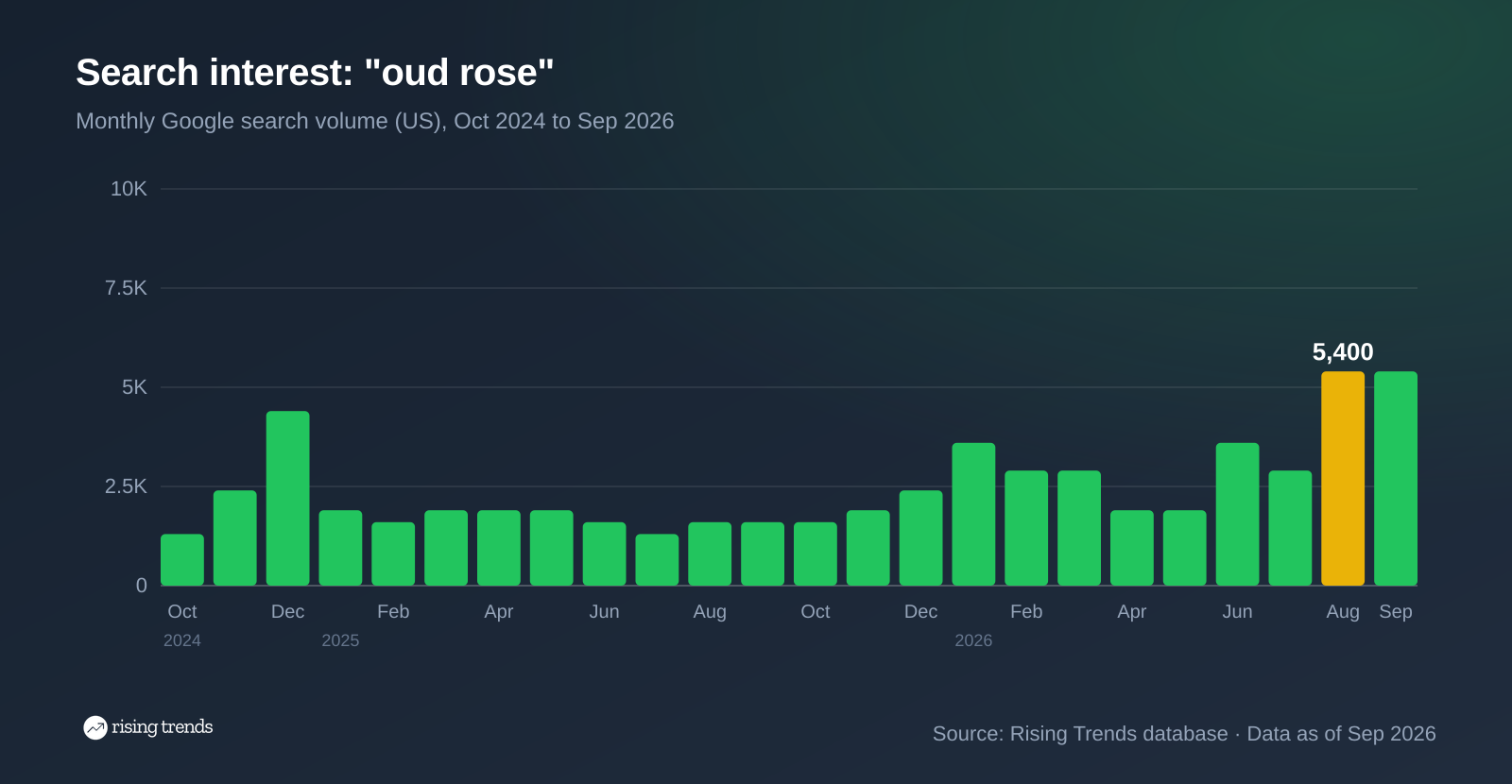
Three things in that shape are worth naming. The breakout month, the first time the term crossed a quarter of its eventual peak, was November 2024. The term then spent eighteen months building rather than spiking, which is the signature of a preference rather than a news cycle. And the acceleration is still going: the last three months average 1.85 times the three before them, which is why the trajectory flag reads RISING rather than peaking.
The comparison that matters is what else moved. We pulled the fragrance terms our database tracks alongside it and ranked them by one-year change.
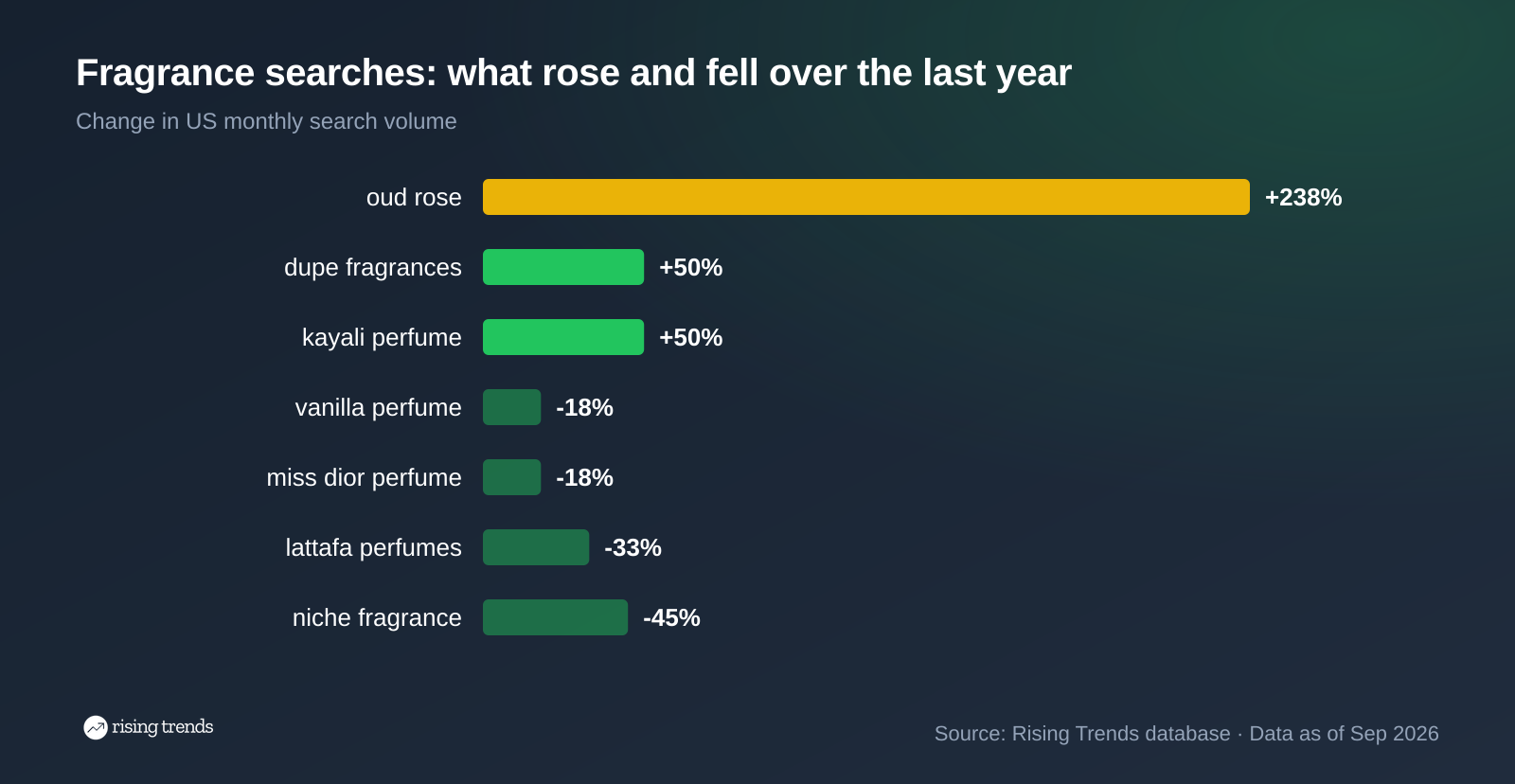
Only three of the seven are growing, and "oud rose" is growing roughly five times faster than either of the other two. The decliners tell the better story. "Vanilla perfume" at 33,100 searches a month is still far bigger than oud rose in absolute terms, but it is shrinking, and over two years it is down 33%. "Miss dior perfume" is down 80% over two years. The sweet, pretty, designer-counter category is losing the search conversation it owned.
What oud rose actually is
Oud is resin from agarwood, produced when a specific mould infects an Aquilaria tree. It smells like smoke, leather, animal and damp wood, and real oud oil is one of the most expensive raw materials in perfumery. Rose, in Middle Eastern perfumery, is its traditional partner: the bright, slightly sour, jammy top note that makes the resin wearable.
The pairing is centuries old in the Gulf and barely a decade old in Western mass retail. What is new in 2026 is that Western shoppers are searching for the accord by name rather than for a brand. That is the tell. "Lattafa perfumes" is a brand search and it is falling. "Oud rose" is an ingredient search, and ingredient searches are what people type when they know what they want and are shopping for the best version of it.
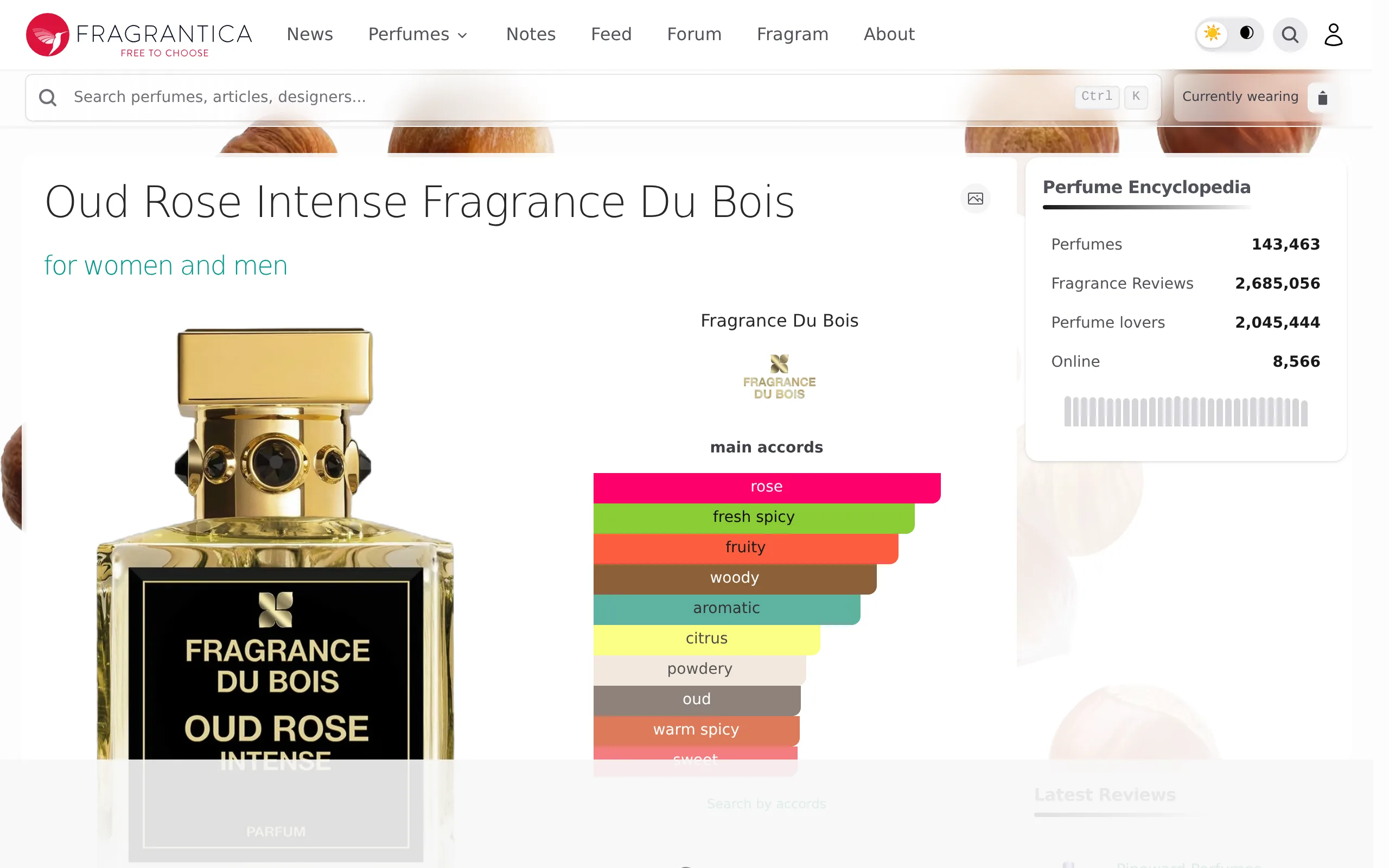
That page is a useful illustration of how the accord is read now. On Fragrantica's entry for Oud Rose Intense, the community-voted accord bars put rose first and oud eighth, below woody and powdery. The oud in most of what sells as oud rose is a suggestion, not a slap. That is precisely why it travelled.
Why it's trending now
There is no single viral moment behind this one, and anyone telling you otherwise is reverse-engineering a story. There is a money shift with a date on it.
On 11 August 2026, Circana published its read on the first half of the US beauty year. Prestige beauty sales rose 7% to $17.1 billion. Inside that, prestige fragrance dollars grew 6% while unit sales stayed flat and average prices rose 5%. Circana's own wording is the important part: the growth was "driven primarily by premiumization rather than an increase in purchases", and shoppers "continued to trade up into higher-concentration formats, with eau de parfum (EDP) and perfume posting double-digit growth".
Larissa Jensen, Circana's global beauty industry advisor, framed it as selectivity rather than splurging. "Beauty continues to benefit from consumers' willingness to shop across price tiers, selectively investing in products that deliver the strongest emotional and functional value," she said. "Fragrance remains a key avenue for affordable luxury and self-expression."
Fewer bottles, stronger juice, higher price per bottle. That is a description of the buyer who is about to discover oud. Our own curve jumped in the same month the report landed: 2,900 searches in July, 5,400 in August.
The second engine is social, and it is doing the translation work. The clip below, posted on 3 October 2026 by @myartdeals, is a one-bottle rose oud pitch rather than a perfume-nerd deep dive, which is the point: the accord is now sold in the same language as a lip oil.
"This Rose Oud smells EXPENSIVE," the caption runs. "Sweet, warm, feminine and impossible to ignore." Smelling expensive, not being expensive, is the whole proposition.
The new behaviour: what people are doing differently
Strip the romance away and three concrete changes show up.
People are buying the accord, not the bottle. The old path was brand first: you wanted Miss Dior, you bought Miss Dior. The new path is note first. You decide you want rose and oud, then you shop the ladder for the version that fits your budget. That is why brand terms are sliding while the ingredient term climbs.
The ladder has four rungs now, and they all sell at once. Here is the same accord at four prices, all live this week.
| Product | Format | Price |
|---|---|---|
| Kayali Oudgasm Rose Oud | 16 | 1.5ml sample | $4 |
| Dossier Oud de Rose | 50ml eau de parfum | $49 |
| Kayali Oudgasm Rose Oud | 16 | 50ml eau de parfum intense | $140 |
| Fragrance Du Bois Oud Rose Intense | Parfum, at Nordstrom | $415 to $695 |
Price has stopped predicting satisfaction. This is the part the luxury houses should find uncomfortable. On Fragrantica, Al Rehab's Oud Rose, a Saudi perfume oil that costs less than a sandwich, holds 4.23 out of 5 from 35 votes. The Fragrance Du Bois bottle that Nordstrom lists from $415 holds 3.83 from 210 votes. One reviewer on the expensive page put it plainly: "the price on this is outright horrendous, it's not a good deal even if you get 20% off", before conceding it lasts nine to ten hours.
The enthusiasts are not shy about the money either. The Fragrantica thread Best Oud Rose Perfume ever opens with a request that would have read as absurd for any other accord: "I am looking to splurge on one perfume that is the holy grail of oud-rose for a man in his 40's. Price is not a consideration here." Across the 31 posts in that thread, the recommendations span cheap clones and $500 niche bottles in the same breath.
It is the same two-speed behaviour we saw when a $400 Swatch outsearched the luxury watches it was copying: people will pay up for the idea, then find the cheapest honest route to it.
Who's building on it
The clearest signal that this has left the enthusiast layer is who is now making it.
Dossier is the loudest example. The affordable-perfume brand, best known for selling impressions of luxury scents, launched its own Oud Collection on 21 October 2026: three originals, Tropical Oud, Oud de Rose and Golden Amber Oud, at $49 each. Its Oud de Rose page lists rose, saffron and clove in the heart over a base of oud, leather and cistus. Founder and chief executive Sergio Tache told WWD exactly what the launch is for: "Oud is typically in perfumes that are sold for very high prices. We want to make oud accessible for everybody."
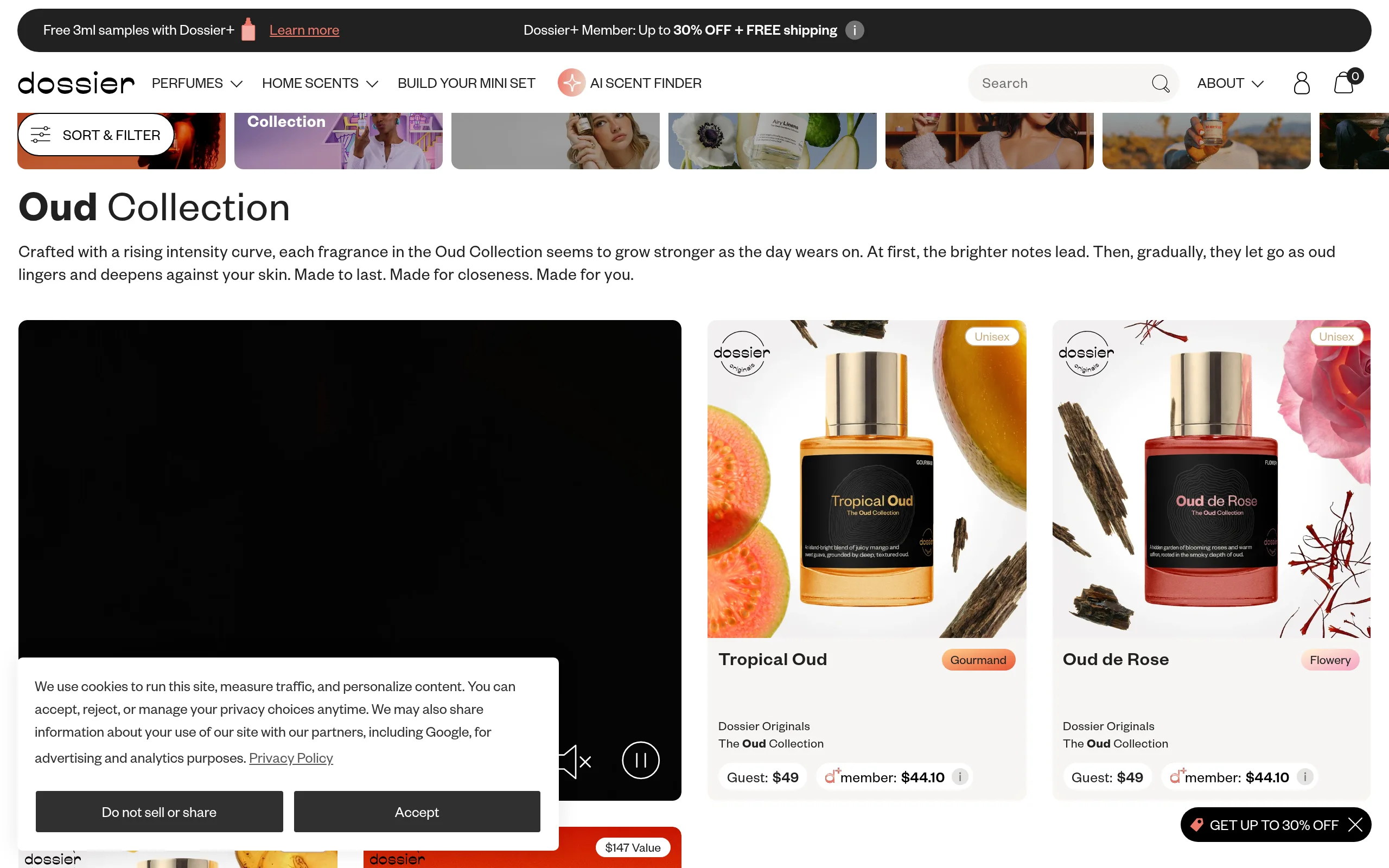
Note what is not on that page. The Oud Collection is not sold as an alternative to anything. For a brand built on dupes, launching originals in this accord is a bet that the accord itself is the draw.
Kayali, the fragrance house from Huda and Mona Kattan, got there first and is still the volume story. "Kayali perfume" runs at 165,000 monthly searches in our database as of September 2026, up 50% in a year, and its Oudgasm line is the reason. The Oudgasm Rose Oud | 16 bottle is $140 for 50ml, $38 for a 10ml miniature and $4 for a 1.5ml size, and as of this week the 50ml is listed as pre-order only.
The niche houses hold the top rung and are the ones with something to lose. Nordstrom lists the Fragrance Du Bois Oud Rose Intense Parfum from $415 to $695, a price that made sense when the accord was unfamiliar and the alternative was a trip to Dubai.
Decanters and sample sellers are the quiet winners. "Fragrance decants" is at 8,100 searches a month, up 23% in a year, and "dupe fragrances" is at 5,400 and up 50%. A $4 sample is how a 24-year-old tries a $140 bottle, and the ladder only works because that rung exists.
What it means for business
The uncomfortable read for prestige is that an ingredient search is a commoditisation signal. When shoppers search for brands, brand equity does the pricing. When they search for notes, the market prices the note, and someone will always sell the note cheaper.
Designer gourmands are the exposed category. Vanilla, caramel and sugar dominated the last five years, and the search data says that run is over, not slowing. If your hero product is a sweet floral launched before 2024, the renewal case is weaker than your sales deck suggests.
The $40 to $60 tier is where this gets fought. Dossier at $49 and Kayali's miniatures at $38 bracket the price a curious buyer will risk on an unfamiliar accord. Circana's flat units with rising prices means the win is not more customers; it is the same customers paying more per bottle. The retail trends we track show the same pattern across categories: fewer, better, pricier.
Sampling is the distribution channel, not an afterthought. The decant and sample numbers are not a side market. They are the top of the funnel for an accord that most Western shoppers have never smelled. Any brand launching into this without a cheap trial size is asking a stranger to spend $140 on smoke.
The risk is saturation, and it is close. Three new ouds from one affordable brand in a single October launch is what the late stage of a trend looks like, not the early stage. The accord that defines a moment usually gets flattened by the volume of launches chasing it, exactly as vanilla did.
Where this is heading
Three calls, each with a term in our database to watch.
The accord goes mainstream and the word stops meaning much. Expect oud rose on supermarket shelves within a year, at which point the enthusiasts move on. The signal is "oud rose" itself: if it holds above 5,000 a month through the winter it is a category, and if it slips back under 3,000 the August spike was a launch cycle.
Ingredient search beats brand search, permanently. "Niche fragrance" being down 45% while a specific accord is up 238% is the clearest version of this we have. Watch whether "fragrance decants" keeps climbing from 8,100; a rising decant market is a market where nobody trusts a brand name enough to buy blind.
The cheap end takes the accord. Al Rehab out-rating Fragrance Du Bois by four tenths of a point is a small fact with a large implication, and "dupe fragrances" at 5,400 and up 50% says the audience has already worked it out. The same force that moved shoppers from buying to browsing is at work here: the want is intact, the willingness to pay full price is not.
One last thing worth sitting with. Scent trends used to move at the speed of department store counters. This one moved at the speed of a search box, and we could see the shape of it eighteen months before Dossier shipped a bottle. The persimmon soap trend followed the same route a year earlier, and so will the next accord. If you sell anything people smell, the luxury trends we track are worth a monthly look, because the ingredient your customers will ask for next year is already in somebody's search history.
Want to catch shifts like this before the launches start? Read our guide on how to identify market trends, or browse what is breaking out right now in our trending topics list.
Never miss a trend again
- One trend broken down with the numbers
- Who's making money, and what to build
- A website on the rise
- A breakout app
Join 5,000+ founders