
The biggest bill payment trends for 2027 are household bills rising faster than prices in general, more customers asking for time to pay, and billers moving billing, payments and customer messages onto one system. Here are all eight, with the number behind each:
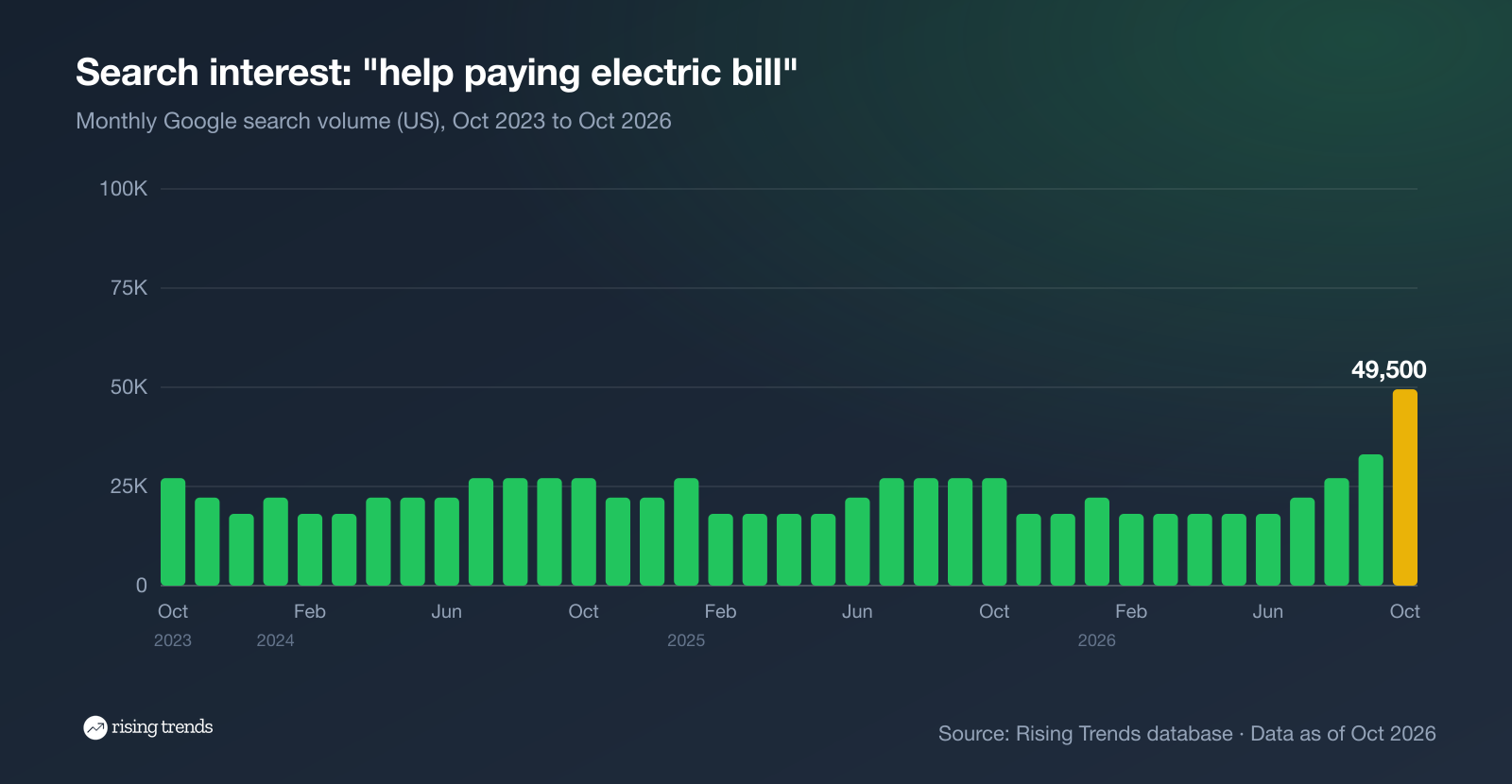
- Bills get bigger and more customers fall behind. About one in six US households is behind on utility bills, owing about $23 billion, and searches for "help paying electric bill" are up 83% in a year.
- Billing, payments and messages move onto one platform. Paymentus processed 219 million bill payments in Q3 2026, up 20.1%, and 36% of Gen Z customers say a bad billing experience has made them pay late.
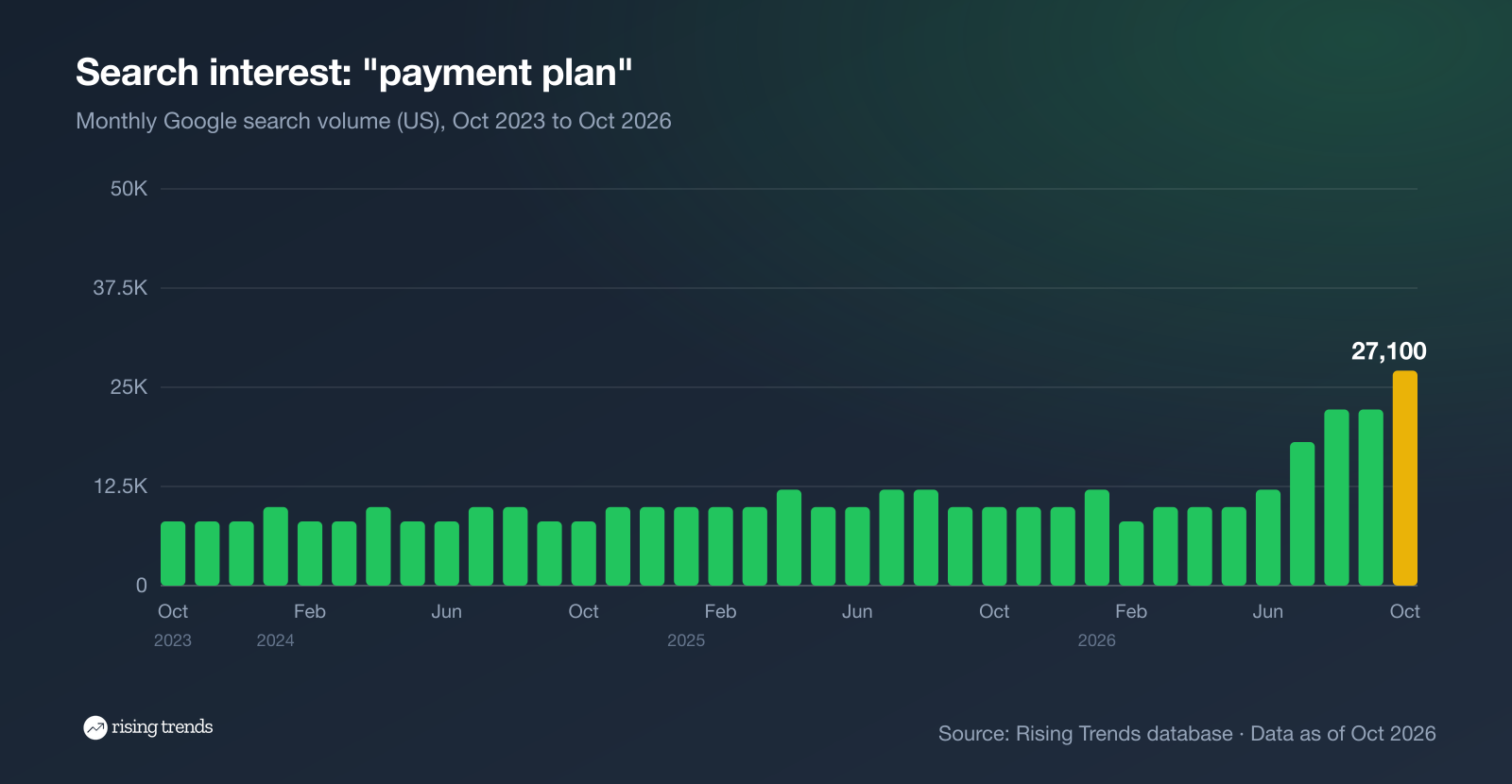
- Payment plans become a standard option. US searches for "payment plan" went from 9,900 to 27,100 a month in a year.
- Other apps step in between biller and customer. Flex now handles more than $2 billion of bill payments a month, and Bilt expects to process more than $100 billion of housing payments this year.
- Paper leaves the bill cycle. Checks sent to the Federal Reserve fell 8.7% through August, and check processing fees for banks go up on January 1, 2027.
- Bank payments get faster. Same Day ACH payments grew 36.7% in Q3 2026, and FedNow volume is about 2.5 times what it was a year ago.
- Card fees get passed to the payer. Two city utilities started charging customers a percentage fee for card payments on October 1, 2026.
- Scammers copy the payment page. PG&E has logged more than 10,000 scam reports in 2026, with an average loss of $929.
Every figure comes from the organization that measured it (the EIA, the Bureau of Labor Statistics, NEADA, the Federal Reserve, Nacha, company earnings releases and named surveys), plus our own search data from the Rising Trends database. This article is written for businesses that send bills: utilities, insurers, lenders, landlords, healthcare providers and local governments. For the checkout side of payments (tap to pay, card fees for stores, digital wallets), see our payment trends article.
Let's get into it.
1. Bills Get Bigger and More Customers Fall Behind
The bills people can't skip are rising faster than everything else they buy.
The Bureau of Labor Statistics' September CPI release shows electricity up 4.4% in a year, piped gas up 5.0% and water, sewer and trash service up 4.8%, against 3.7% for prices overall. The EIA's November Short-Term Energy Outlook puts the average US residential electricity price at 18.2 cents per kilowatt-hour in 2026, up from 17.2 cents in 2025, and forecasts 18.7 cents for 2027. More increases are in the queue: investor-owned utilities asked regulators for a record $4.5 billion in rate increases in the third quarter, and $23.1 billion so far this year, according to PowerLines.
Customers are feeling it. In a Consumer Reports survey of 2,003 US adults published October 21, 81% of people who have lived in the same home for three years said their electricity bill went up, and about three in four of those said it strained their finances. The National Energy Assistance Directors Association said in its November 10 winter update that about one in six households is behind on utility payments, owing about $23 billion, and that heating a home will cost $1,002 on average this winter, up 7.1%. Across all debts, the New York Fed's Q3 2026 report shows 5.0% of household debt in some stage of delinquency, up 0.3 points in a quarter.
Search shows the same pressure. US searches for "help paying electric bill" reached 49,500 a month in October 2026, up 83% from October 2025. Searches for "disconnect notice" went from 210 to 1,300 a month, and "medical bill" from 14,800 to 33,100.
What to do about it
Plan for more late payers in 2027, not fewer. Size your collections staff, payment plan capacity and bad-debt reserve on this winter's numbers rather than last year's.
Put help where the bill is. Only about one in five people in the Consumer Reports survey had looked up whether their utility has a program that lowers their costs, so link assistance and payment options on the bill itself and on the payment page.
2. Billing, Payments and Messages Move Onto One Platform
Billers are replacing separate billing, payment and notification systems with one platform, and the companies selling those platforms are growing fast.
Paymentus, one of the largest US bill payment platforms, reported Q3 2026 results on November 2: 219.0 million transactions, up 20.1% in a year, and revenue of $372.2 million, up 19.8%. On the earnings call, management said almost one in three US households and businesses now pay a bill through its platform. ACI Worldwide's biller business (Speedpay) brought in $210 million, up 6%. Both are growing faster than the number of bills in the country, which means billers are moving payments off in-house systems and onto shared platforms.
The reason is cost. Separate systems for billing, communications and payment processing mean duplicate data entry, manual reconciliation and repeated customer outreach, and a single correction can pass through finance, customer service and operations before the account is right. For service providers evaluating a customer payment experience, consolidating billing, payments and communications can reduce handoffs and give teams a clearer view of each transaction.
A bad billing experience also delays the money. In a PYMNTS Intelligence study done with Paymentus and published October 13, 36% of Gen Z customers said dissatisfaction with billing sometimes or very often caused them to delay a payment, against 8% of baby boomers and seniors. A second study in the series found that 18% of insurance policyholders delay payments because they are unhappy with their insurer, and one in four are ready to switch over billing. In the Consumer Reports survey above, 38% of people who read their electricity bill find it hard to understand.
What to do about it
Work out what one bill costs you from delivery to confirmed payment. Include staff time, paper handling, failed-payment follow-up and reconciliation, not just the processing fee.
Measure where customers drop out: bill opened, login, payment started, payment confirmed. A customer who starts online and then calls is telling you the online flow is missing something.
3. Payment Plans Become a Standard Option
More customers are asking for time to pay, and billers that used to offer it case by case are building it into the bill.
US searches for "payment plan" reached 27,100 a month in October 2026, up from 9,900 a year earlier. "Payment arrangement" rose 50% to 5,400, "late fee" more than doubled to 6,600, and "change due date" went from 140 to 480.
Utilities show what this looks like at scale. Nashville Electric Service has about 20,000 customers on long-term payment arrangements, Axios reported on November 16, after it enrolled people automatically in a six-month plan when its shutoff pause ended. About 14,000 of them are behind on the plan and 8,000 qualify for disconnection. Winter rules add to the backlog: Wisconsin's shutoff moratorium runs from November 1 to April 15, which pauses the debt without cancelling it, and customers need a payment arrangement in place by April 15, 2027.
Medical bills are heading the same way. An Urban Institute survey of more than 10,000 adults, reported October 13, found that 27% had medical debt and 15% had family medical bills that were past due or that they couldn't pay at all. Flywire said in its Q3 2026 results that it sold its patient financing product, which builds a payment plan into the hospital bill, to more health systems, including Endeavor Health.
What to do about it
Let customers set up a plan themselves, online, without calling. Every plan agreed in the portal is a call your staff doesn't take.
Track whether plans work. The Nashville numbers show that enrolling people is the easy part, so watch the share of plans that are current after three months and adjust the instalment size if most are not.
4. Other Apps Step In Between Biller and Customer
A growing number of customers pay through an app that isn't yours, and that app decides when and how you get paid.
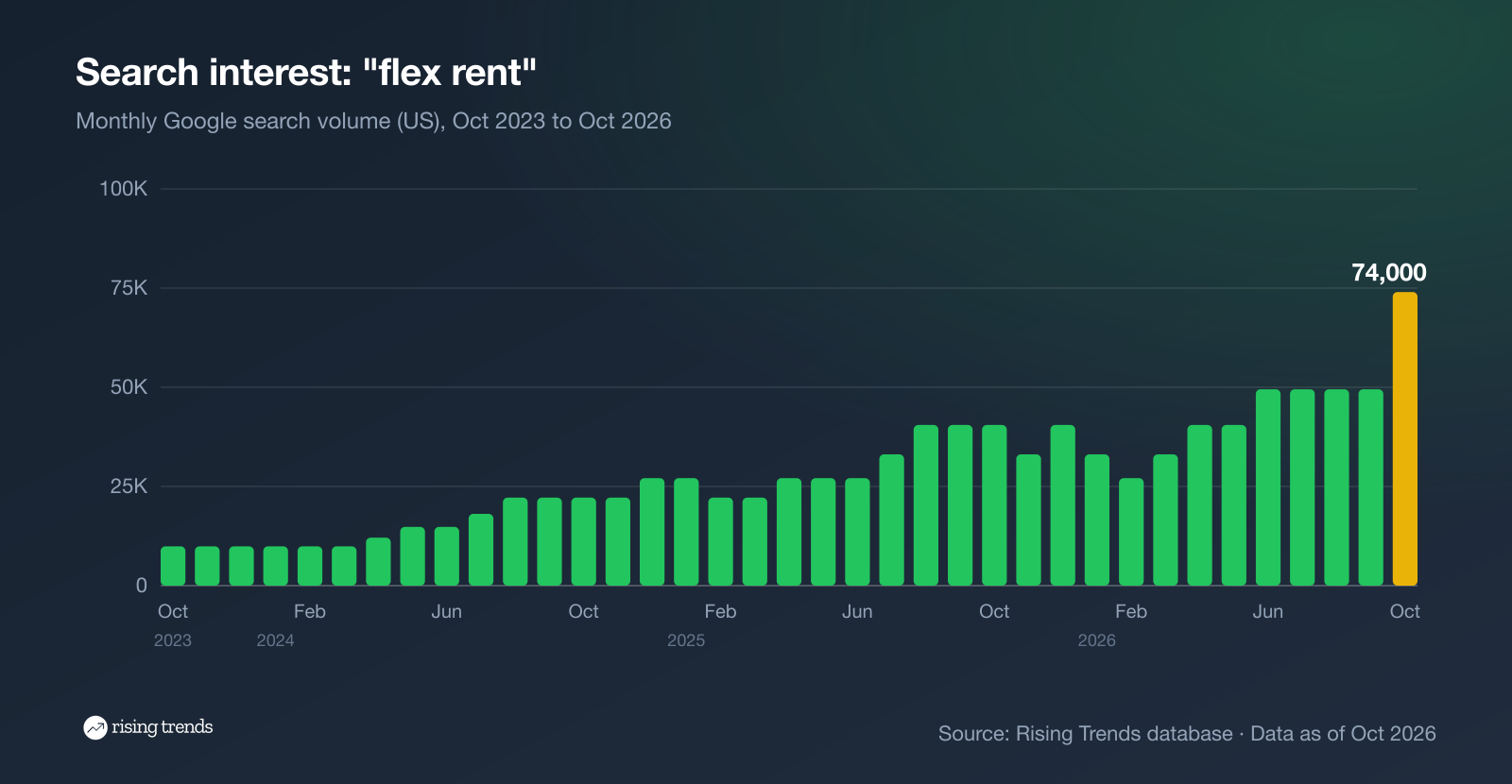
Flex started as a way to split rent into smaller payments. On October 20 it expanded to broadband, car, insurance, mortgage and utility bills, and said it handles more than $2 billion in payments a month and has served more than 3.5 million customers. The customer pays for the flexibility: $5.99 a month, 0.5% of every bill paid through Flex, and up to 3% of the amount Flex advances. US searches for "flex rent" reached 74,000 a month in October 2026, up 83% in a year and up from 9,900 three years ago.
Bilt, the rent rewards program, said on November 10 that it has signed one in four US apartment buildings and is on track to process more than $100 billion in housing payments this year. Searches for "bilt" are up 49% to 201,000 a month. Rent is also turning into credit data: Maryland's rent reporting law took effect October 1, 2026, requiring landlords with six or more units to offer tenants the option of having on-time rent reported to a credit bureau, with the first offer on existing leases due by January 1, 2027.
AI assistants are next in line, though not yet for household bills. Visa, BILL and Billtrust launched a pilot on October 20 in which AI agents pay approved business invoices from start to finish. Paymentus said its bill wallet doubled to 200,000 users and can be reached from personal AI agents. We found no consumer AI agent that pays household bills this fall, and in a Wildfire survey of 1,007 US consumers, only 5% said they would trust an AI platform to process a payment for them.
What to do about it
Find out how much of your money already arrives through third-party apps, and what those payments look like in your system. A payment that shows up without an account number is a reconciliation problem.
If customers are paying another company for flexible dates, consider offering them yourself. A free due-date change costs you less than a customer relationship that now runs through someone else's app.
5. Paper Leaves the Bill Cycle
Paper checks and paper statements are being pushed out by cost and by government policy.
The Federal Reserve said on November 12 that the volume of checks it processes is declining, and that it will raise check processing fees for banks from January 1, 2027. PYMNTS, reporting on the notice, says commercial checks sent to the Reserve Banks fell 8.7% through August and check service prices will rise 5.4% on average. The federal government stopped issuing most paper checks on September 30, 2025, and the Social Security Administration plans to finish moving beneficiaries to electronic payments by the end of 2026.
Paper statements are going faster than vendors planned. Waystar, which sends patient bills for hospitals and medical practices, told investors on its Q3 2026 call that the move from printed patient statements to digital delivery was larger than it expected and will continue for several years.
Older customers are not the obstacle many billers assume. In InvoiceCloud's survey of 1,000 US adults aged 65 and over, updated October 12, 76% prefer digital payment channels, 66% pay most of their bills on a mobile device, and 55% already get utility bills electronically.
In search, "how to write a check" fell 18% in a year, though it still gets 165,000 searches a month. "Paperless billing" rose 84% to 590, and "paper check" rose 83% to 12,100 as people looked up what the changes mean for them.
What to do about it
Count what a paper payment costs you, including opening mail, lockbox fees, returned checks and the days it takes to clear. That number is your budget for moving customers to digital.
Keep one simple route for people who can't or won't switch, and make the digital route easy enough that most people don't need it.
6. Bank Payments Get Faster
Paying straight from a bank account no longer means waiting days for the money to arrive.
Nacha's Q3 2026 figures show the ACH network handled 9.3 billion payments, up 5.9%. Same Day ACH grew much faster: 470.4 million payments, up 36.7%, worth $1.3 trillion. On the instant payment systems, the Federal Reserve's FedNow statistics show 6.38 million payments in Q3 2026, about 2.5 times the 2.51 million of a year earlier, and The Clearing House's RTP network handled 150 million payments worth $621 billion in the same quarter.
For billers, a bank payment costs far less than a card payment and can now confirm the same day or in seconds. What hasn't happened yet is customers choosing it. We found no named biller that went live with "request for payment" (a bill sent as a payment request the customer approves in their banking app) this fall, and searches for "fednow" and "pay by bank" are flat on a year ago. A PYMNTS and Trustly survey of 2,071 US bank customers, published October 12, found that pay by bank could take 32% of bill payments among digital banking users, but only when it comes with a discount and buyer protection.
What to do about it
Offer a bank payment option next to cards and tell customers when the payment will count. "Paid today" matters most to someone paying on the due date.
If you want customers to switch from cards, give them a reason. A small discount or a waived fee for bank payments can cost less than the card fees you save.
7. Card Fees Get Passed to the Payer
More billers are deciding they will no longer absorb the cost of card payments.
The City of Independence, Missouri changed its utility payment fees on October 1, 2026: a card payment now costs the customer 2.75% of the bill with a $2.95 minimum, instead of a flat $3.50. On the same day the City of Lodi, California stopped absorbing payment fees and began charging 2.49% for residential card payments and $0.10 for bank payments. In both cities, paying by mail, by bank transfer or in person stays free.
The earnings numbers show how much of bill pay revenue is card fees. Of the $210 million ACI's biller business brought in last quarter, only $66 million was left after interchange (the fee that goes to the customer's card issuer). Paymentus told investors its average price per transaction was $1.70, flat on a year ago.
Customers notice. US searches for "convenience fee" rose 50% in a year to 5,400 a month. Rules differ by state and by bill type, so check what applies to you before you add a fee.
What to do about it
If you charge a fee for cards, keep at least one free digital way to pay and show it first. A fee with no free alternative online produces complaints and late payments.
Show the fee before the customer enters payment details, as an amount in dollars, not only as a percentage.
8. Scammers Copy the Payment Page
Bill scams have moved from threatening phone calls to fake websites that look like your payment page.
November 18, 2026 is Utility Scam Awareness Day, run by a group of more than 150 US and Canadian utilities. Duke Energy said on November 16 that it has had hundreds of fake websites, social media accounts and online ads taken down since November 2025, all sending customers to fake payment pages and phone numbers. PG&E reported more than 10,000 scam reports so far in 2026, with customer losses above $300,000 and an average loss of $929.
The wider numbers are large. The FTC said in a September 24 release that it received more than 1 million reports of imposter scams in 2025, with nearly $3.5 billion lost, and that nearly 30% of people who lost money to a scam were first contacted on social media. It is now asking whether its rule against impersonating businesses should also cover the platforms where the fake ads run.
What to do about it
Search for your own company name plus "pay bill" every month, and report the fake ads and lookalike sites you find. Customers who search for your payment page instead of typing the address are the ones who land on a copy.
Tell customers exactly how you will and won't ask for money, on every bill. PG&E's message is specific: it never asks for payment at a store kiosk or by prepaid card.
What We're Seeing in Search
Our database tracks US search demand for tens of thousands of trends. Here is what it shows for bill payment as of October 2026, compared with October 2025.
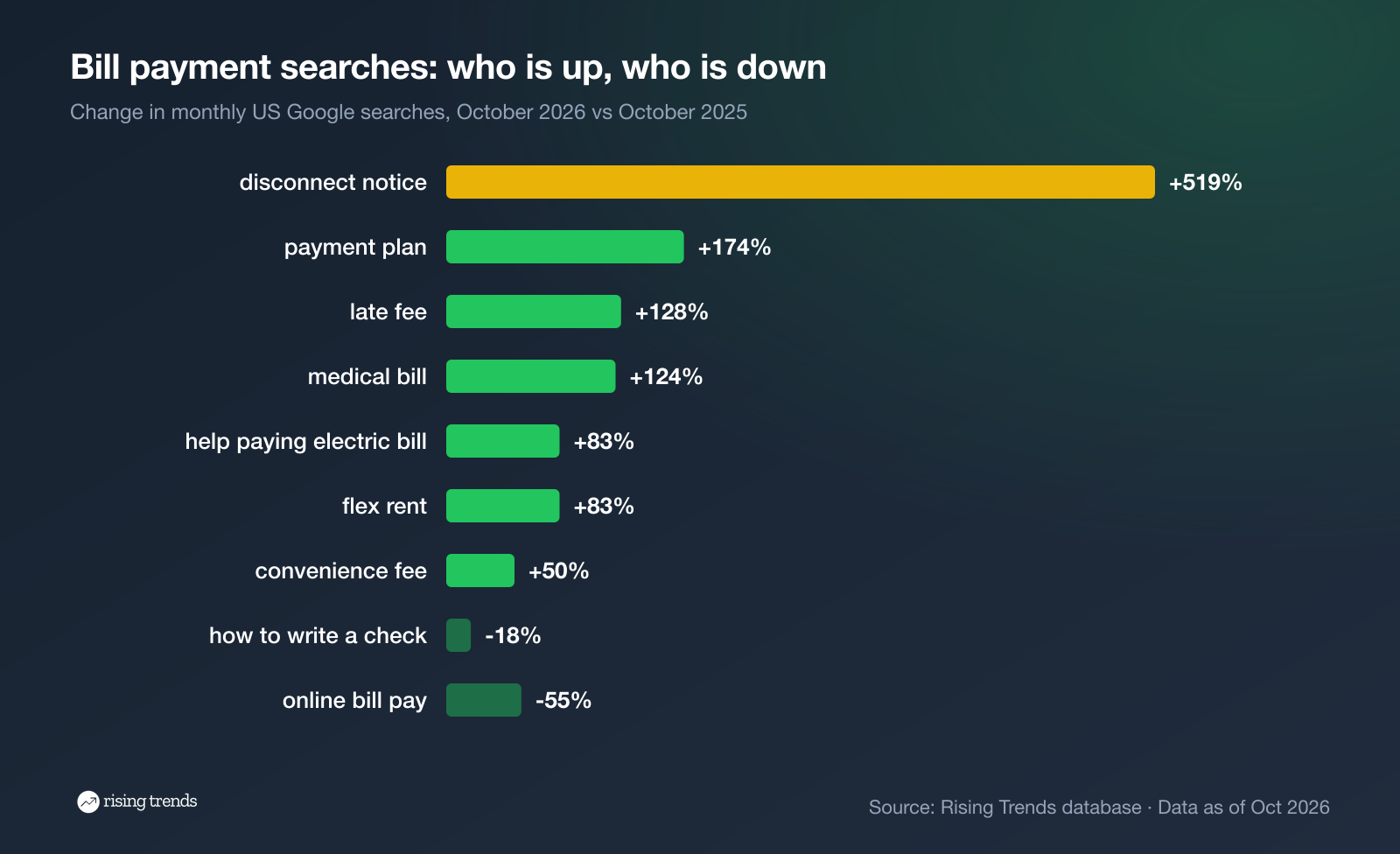
- People are looking for help. "help paying electric bill" (+83%) and "disconnect notice" (+519%, from a small base) back the arrears numbers in trend 1.
- Time to pay is the top request. "payment plan" (+174%) and "late fee" (+128%) rose together, in line with trend 3.
- Medical bills are on people's minds. "medical bill" (+124%) reached 33,100 searches a month.
- Bill-splitting apps are mainstream. "flex rent" (+83%) is now at 74,000 a month, as covered in trend 4.
- Fees are getting noticed. "convenience fee" (+50%) rose as more billers passed card costs on, in trend 7.
- Generic bill pay searches are falling. "online bill pay" (-55%) dropped as people go straight to a biller's app or their bank.
If you want to use search data like this to test a market before you invest in it, our guide on validating market demand walks through the method.
The Common Thread
Put the eight shifts side by side and one pattern runs through them: bills are getting harder for customers to pay at the same moment the tools for paying them are getting better. Rates are rising, more households are behind, and people are searching for payment plans and help. At the same time, a bill can now be delivered, paid from a bank account and confirmed in seconds, on a phone, without paper.
The billers who do well in 2027 will use the second fact to deal with the first. That means one clear place to see and pay the bill, a payment plan the customer can set up alone, a free way to pay, and enough data to see where people get stuck.
If you only fix three things before 2027: let customers set up a payment plan online, offer a free bank payment option that confirms the same day, and check what a search for your payment page shows.
This connects to a wider change in how companies treat service, which we cover in our customer experience trends article.
Frequently Asked Questions
What are the biggest bill payment trends for 2027?
Rising utility and household bills with more customers falling behind, billers moving billing, payments and messages onto one platform, payment plans as a standard option, third-party apps such as Flex and Bilt paying bills for customers, the decline of paper checks and statements, faster bank payments through Same Day ACH and instant payment networks, card fees passed on to payers, and scams that copy biller payment pages.
How many Americans are behind on their utility bills?
The National Energy Assistance Directors Association said on November 10, 2026 that about one in six US households is behind on utility payments, owing about $23 billion to electric and natural gas utilities.
How much are electricity prices rising?
The EIA's November 2026 outlook puts the average US residential electricity price at 18.2 cents per kilowatt-hour in 2026, up from 17.2 cents in 2025, and forecasts 18.7 cents in 2027. The Bureau of Labor Statistics measured electricity prices up 4.4% in the year to September 2026.
Can a utility or landlord charge a fee for paying by card?
Often yes, but the rules depend on the state and the type of bill. Many city utilities charge a convenience fee for card payments and keep bank, mail or in-person payment free. Some states limit these fees, so check the rules for your state and bill type.
Are paper checks going away?
They are declining, not gone. The Federal Reserve says the number of checks it processes is falling and will raise check processing fees for banks on January 1, 2027. The federal government stopped issuing most paper checks on September 30, 2025. Businesses and many households still write checks, so most billers keep accepting them while moving customers to digital payment.
Want to spot the next market shift before your competitors do? Read our guide on how to identify market trends or see what's changing in money and banking in our fintech trends article.
Never miss a trend again
- One trend broken down with the numbers
- Who's making money, and what to build
- A website on the rise
- A breakout app
Join 5,000+ founders