Trends


Two years ago, about 70 people a month typed "va ai" into Google. As of August 2026 it is 1,900, up 2,614% over those two years and classified EXPONENTIAL in our database. That is a tiny number next to the AI brands everyone writes about. It is a very large number for a search about a federal agency's internal software, and it is the fastest-growing government AI term we track.
The term means two different things to the people searching it, and that is the story. One group wants to know what the Department of Veterans Affairs has automated inside its hospitals and its claims shop. The other is worried an algorithm is about to read their disability file. Nobody ranking for the term has the curve, the breakout month, or the comparison with the rest of government AI search. We do, and the curve says the second group arrived more recently.
Key takeaways:
Let's get into it.
Here is the five-year shape of "va ai" in our database. For four of those five years it is a flat line at single and double digits. The whole move happens after October 2024.
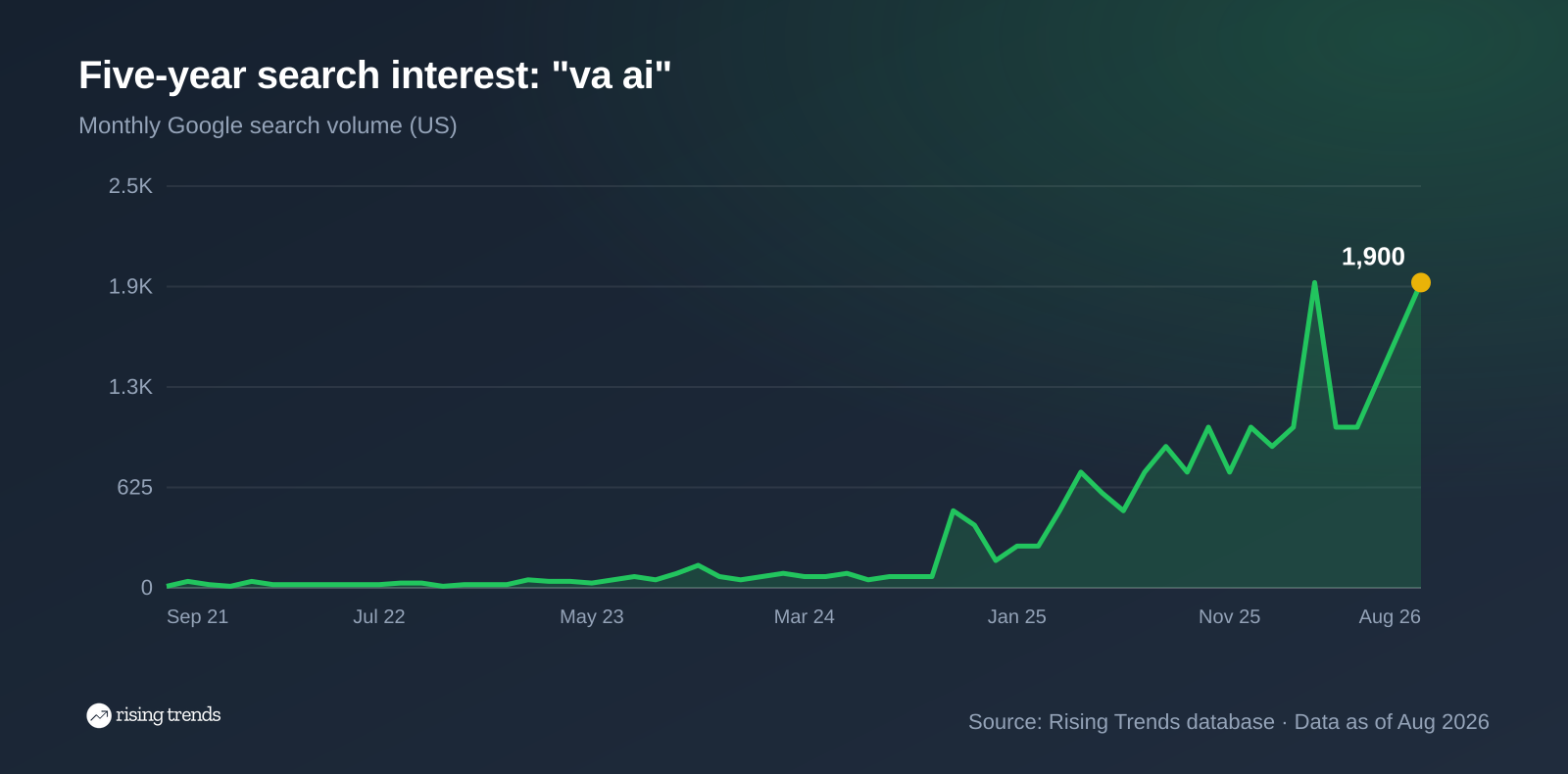
October 2024 is the breakout month, the first month the term crossed a quarter of its eventual peak. From there it climbs in steps rather than a single spike: 70 searches a month two years ago, 880 twelve months ago, and 1,900 as of August 2026. The one visible spike is March 2026, which doubled the term from 1,000 to 1,900 in a month and gave most of it back in April. Hold that month, because it has a date attached to it.
The term does not sit alone. Two neighbours in our database frame it.
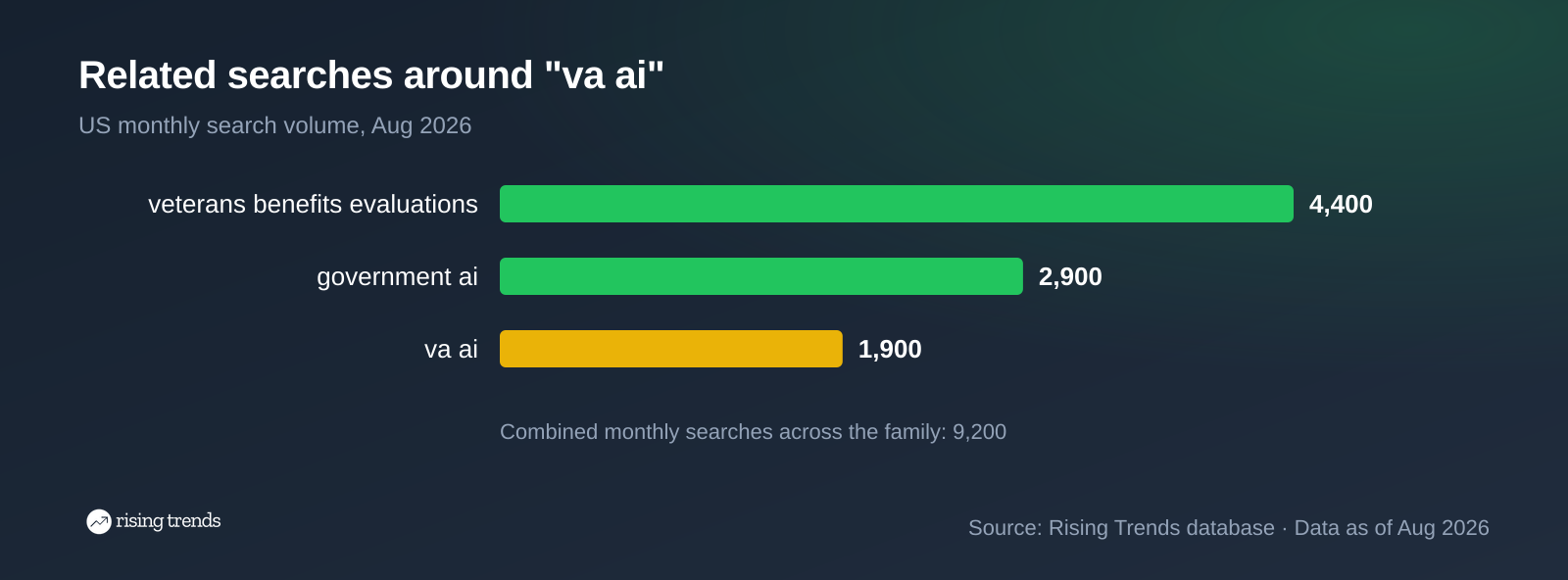
"Veterans benefits evaluations" is the bigger term at 4,400 a month, and it is flat: 0% over the last year. Government ai is 2,900 a month and climbing. Put the growth rates side by side and the picture inverts.
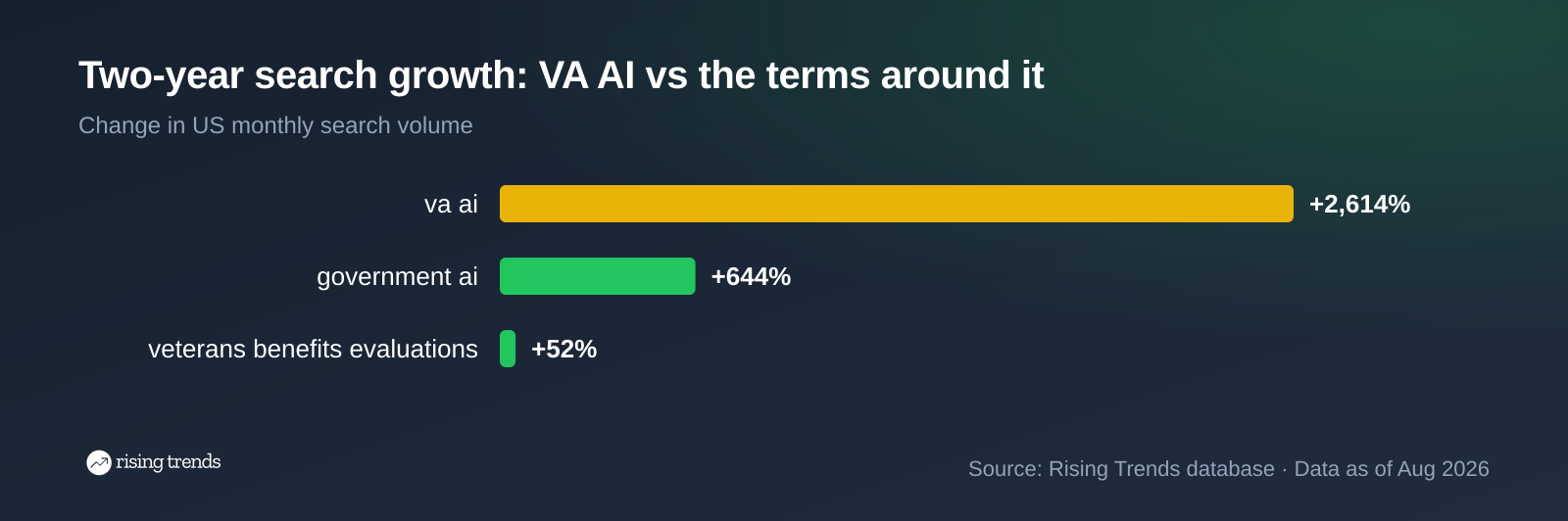
That is the comparison worth keeping. The generic benefits term is static. The whole-of-government AI term is up 644% in two years. The single-agency term is up 2,614%, four times faster than the category it belongs to. People are not searching for federal AI policy in the abstract. They are searching for one agency, and they want to know what it is doing with the technology. You can follow both curves on the live va ai trend page and the veterans benefits evaluations page.
VA AI is not a product. It is the umbrella term for the Department of Veterans Affairs' use of artificial intelligence and automation across three very different jobs: delivering health care, processing disability and pension claims, and running the back office.
The useful thing about the VA, compared with almost any private company, is that it has to publish the list. Federal reporting rules mean the department maintains a public AI Use Case Inventory, and the 2025 edition is the best answer to "what has the VA automated".
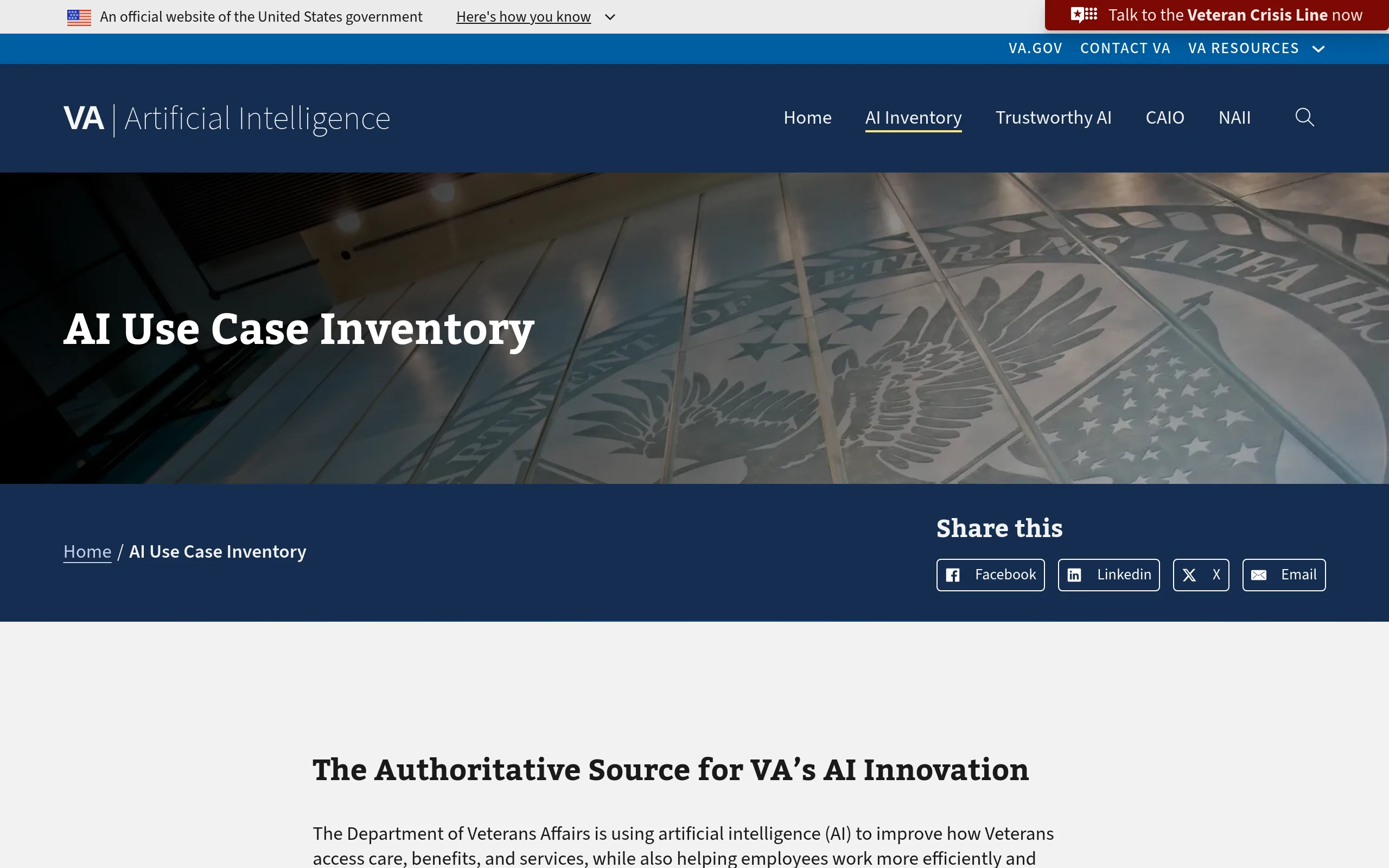
That page carries 367 individual AI use cases and 13 consolidated ones, with the purpose, deployment stage and risk handling for each. It also states that the VA has granted no waivers from the minimum risk management practices required for high-impact use cases. That is more detail than most Fortune 500 companies publish about their own models.
The department's AI strategy sets out five priority areas and one memorable promise for the claims side: that AI will automate document intake, classification and preliminary adjudication, making it "more feasible than ever for VA to deliver benefits in 'minutes not months.'" The same document is honest about the starting point. The VA has a small number of AI experts across a workforce of more than 400,000, and the Chief AI Officer team is trying to build an AI Corps of at least ten.
There is also a rulebook. VA's generative AI guidance sorts tools into tiers: Microsoft Copilot Chat and VA GPT are approved for VA sensitive data including protected health information, GitHub Copilot is not, and Claude for Gov and ChatGPT FedRAMP sit behind a gate. The first rule puts accuracy on the human: staff are responsible for the interpretation and use of AI-generated content and must review output before using it. That sentence is the whole legal position the VA takes in every argument that follows.
Three dated events sit under the curve, and they pull in opposite directions.
November 2025: the scribe shows up in the exam room. VA's Digital Health Office rolled out ambient AI scribe technology that listens to the appointment and drafts the progress note. Providers review and edit before anything enters the record, and veterans can opt out. Donna Hill, who directs operations for AI and emerging technologies there, said veterans "felt more connected to their provider because they were having a real conversation, not talking to someone typing on a computer." This is where the program became something a veteran experiences in person.
March 2026: the claims story. The VA said it would analyse around a million old Disability Benefits Questionnaires going back to 2010 to build a fraud-detection tool. On March 11, DAV published a statement from National Commander Coleman Nee saying the organisation had concerns and that "it is critical that adequate legal and procedural safeguards will be in place to guarantee veterans' due process and appeal rights." Within days the VA narrowed the scope in public. Press Secretary Peter Kasperowicz told Stars and Stripes that "this tool is forward-looking only. VA will not use the tool to revisit previously finalized and processed DBQs," and that no veteran's claim or benefit would be reduced because of the effort. Our search curve for the month doubled.
September 2026: the throughput number. VA announced it had processed more than three million disability claims in fiscal 2026 as of September 18, with the average decision taking 75.6 days against 141.5 days in January 2025, and accuracy at 94%. The release credits the administration rather than the software, but automation is the mechanism underneath a number that size.
The veteran-facing internet has settled on the second story. This clip from the law firm VA Disability Group, posted on September 28, 2026, is the kind of explainer now filling the results page. The question it asks is not what the VA built, it is whether the machine is reading your file.
Two groups are building on VA AI, and they are easy to confuse because they rank on the same page. The first is the department itself. These are its use cases with published numbers attached:
| Tool | What it does | Reported result |
|---|---|---|
| VA GPT | On-network generative AI chat for staff | 95,000+ users onboarded, 2 to 3 hours saved per week |
| AI-assisted coding | Development assistants for VA engineers | 2,000+ developers, 8+ hours saved per week |
| STORM | Opioid and suicide risk stratification | 22% decrease in mortality |
| AI colonoscopy | FDA-approved computer vision in the scope | 21% increase in the odds of adenoma detection |
| AIEFF | Sorting and routing community care faxes | Handling time per document 4.5 to 3.1 minutes |
| Payment Redirect Fraud model | Flags suspicious direct deposit changes | Targets the 1 to 2 of every 1,000 changes that are fraudulent |
The eFax one is the clearest picture of what agency AI looks like day to day. VHA receives more than 13 million faxes a year from community providers, and staff used to open each one by hand. At the Bay Pines medical centre in Florida, the AI-driven eFax fix cut average handling time by 31% and saved close to 4,000 minutes a week. Evan Carey, acting director of VA's National AI Institute, described the impact as "faster processing time, decreased manual work and a reduction in backlogs." No model is deciding anything. It is reading a fax and putting it in the right folder, which is most of what AI bookkeeping looks like in the private sector too.
The second group is the private claims-help market that grew up next to the search term. VeteranAI sells six tools that read a veteran's claims file and draft nexus letters, personal statements and buddy letters, and says it has served more than 75,000 veterans. VetClaims.ai offers flat-fee claim preparation and reports 43,000 veterans guided at a 4.87 rating across 207 reviews. Neither is part of the VA, and the department's own fraud work is aimed at the unaccredited end of that industry. If you search "va ai" and land on one of these, you have found a vendor, not the agency.
The claims shop becomes a throughput business. An average decision now takes 75.6 days. The strategy's stated target is minutes, not months. If even the intake and classification half of that gets automated reliably, the binding constraint on veterans' benefits stops being staff hours and starts being policy. That is the same shift that turned generative AI from a demo into an operating line in every other large organisation.
Clinical AI gets its proof set in public. A 22% mortality reduction attributed to a risk model, and a 21% lift in adenoma detection, are the kind of outcomes private health systems rarely publish. Vendors selling into hospitals will cite the VA inventory for years. The knock-on reaches the whole of senior care, where the staffing maths looks the same.
Agentic workflows arrive at an agency before they arrive at most companies. The strategy names no-code agent builders, Model Context Protocol tooling and AI-driven robotic process automation as things the VA is already testing. Agencies are usually last. On this one the VA is ahead of a lot of the private deployments we covered in our AI agents report.
The strongest criticism is not that the tools do not work. It is that nobody outside the building can tell when they are being used.
The VA's Office of Inspector General made the sharpest version of that point first. Its January 15, 2026 preliminary review of VHA's use of generative AI found that VHA authorised VA GPT and Microsoft 365 Copilot Chat for clinical use without coordinating with the National Center for Patient Safety, and that the administration "lacks a formal process to report, track, and respond to safety issues associated with generative AI use." The memorandum carries no formal recommendations because it is preliminary. The finding stands.
Benjamin Krause, a veterans law attorney who founded Krause Law, put the practitioner's version to Federal News Network in August 2026. His objection is to the framing that a human signs the final decision, so the question is closed. "As a practitioner who's seen a lot of decisions that appear to be coming from a computer where the language doesn't make sense, it seems clear that whoever's doing the checking is not doing a great job in a lot of these instances," he said. His ask is concrete: a disclosure line on every decision where AI had a meaningful impact, including the sub-decisions that lead to the final one.
Veterans themselves are split rather than hostile. On a February 2026 r/VeteransBenefits thread about AI in appointments, the original poster was asked for permission and was fine with it. A reply was not: "I was just at the Primarys office visit and spoke to doc, later that afternoon, I looked at the notes and it said transcribed by AI. I wasnt notified of this prior." Another asked a question nobody in the thread could answer: "Do you have any information on how to opt out?" One veteran came down firmly the other way: "I appreciate AI scribe because every single time that it's been down to the doc to get what I say charted accurately, it's been bogus and impossible to get fixed."
Consent exists on paper, the inventory exists in public, and the gap between the two is where every complaint lives.
Whether the March spike repeats. Our curve doubled the month DAV went public and fell back the month after. The next policy announcement touching claims files will show up the same way. If va ai holds above 1,900 for a full quarter with no news trigger, the term has become a standing question rather than a reaction.
The OIG's final report. The January memorandum was explicitly preliminary and promised further analysis. A final report that names specific safety incidents, or that formally recommends a disclosure requirement, is the event most likely to change how the VA documents AI use. Watch it against "government ai", up 190% in a year across the whole federal estate.
Whether the vendor layer gets regulated. The department is building a fraud tool pointed at unaccredited claims companies while those same companies rank for the agency's own search term. Accreditation rules, a VA referral list or an enforcement action would reshape that market quickly. The legal trends we track already show the demand for representation these firms are filling.
Three years ago the VA published a strategy document and almost nobody searched for it. Today 1,900 people a month want to know what the department is running, and the honest answer is: 367 catalogued things, most of them clerical, a handful of them clinical and genuinely good, and one claims-side tool that got walked back within five days of a veterans organisation asking how it worked. The technology is not the interesting part any more. The disclosure is.
Want to spot the next breakout term before the policy fight starts? Read our guide on how to identify market trends, follow the live va ai dashboard, or browse what is breaking out right now on the Rising Trends dashboard.
Thousands of Emerging Trends
Thousands of Breakout Apps
Mega Trends
Trend Analysis Tool