
Two years ago "dirty soda syrup" was a rounding error in our database. Seventy searches a month in October 2024, the kind of number you ignore. As of October 2026 it runs at 2,400 a month, about 44x the level of two years ago, and the shape of the curve is the interesting part. It did not climb when dirty soda went viral. It climbed when the biggest drinks companies in America started selling dirty soda ready-made.
Every page ranking for this term is a retail listing, a vendor flavour page or a Facebook thread arguing about brands. None has the curve, and none has noticed what it shows: the two product launches designed to make syrup unnecessary are the two months syrup searches doubled. So we pulled the series, read the launch releases and priced out the gap between a shop drink and a home one.
Key takeaways:
- "Dirty soda syrup" is at 2,400 US monthly searches as of October 2026, up 307% in a year and classified EXPONENTIAL in the Rising Trends database. It broke out in November 2025 and peaked at 2,900 in May 2026.
- The peak month is the month McDonald's put Dirty Dr Pepper on the permanent menu at nearly 14,000 US restaurants. The month before it, PepsiCo shipped a canned dirty soda whose pitch line was "no syrup, no custom recipe required."
- Growth has moved to the make-it-yourself half of the family. Over the last year dirty soda syrup is up 307% and dirty dr pepper is up 309%, while dirty soda creamer is down 45% and coffee mate dirty soda is down 64%.
- Torani's own research says 62% of dirty soda drinkers now make their own at home, and 64% keep two to three syrups on hand.
- A 750 ml Torani bottle is 25.4 fl oz. At one ounce a drink that is about 25 drinks from a $10.99 bottle, roughly 44 cents of syrup per glass, against the roughly $4 a soda shop charges.
- The umbrella term "dirty soda" grew only 22% in the past year. The money question is no longer whether people want the drink. It is where they make it.
Let's get into it.
What we're seeing in the Rising Trends data
Here is the monthly search volume for "dirty soda syrup" over the last two years, straight from our database.
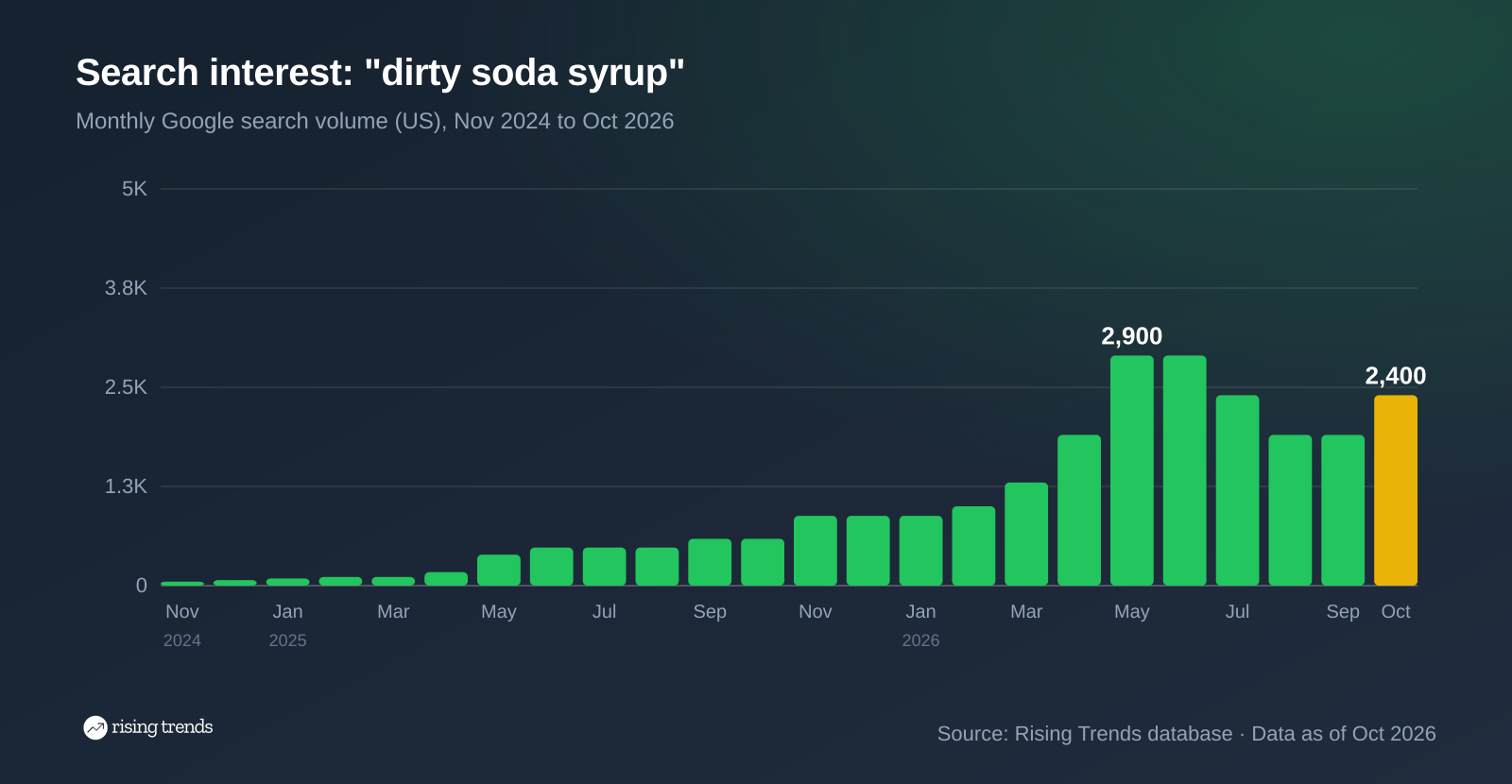
The line sits under 200 searches a month through late 2024 and early 2025, lifts to 590 by that autumn, then crosses into breakout territory in November 2025 at 880. From there it is a straight climb: 1,300 in March 2026, 1,900 in April, 2,900 in May and again in June. It cooled over the summer and settled back at 2,400 in October 2026. Not a news spike with a comedown to zero, but a step change that held.
Hold those dates. Now look at what is growing around it.
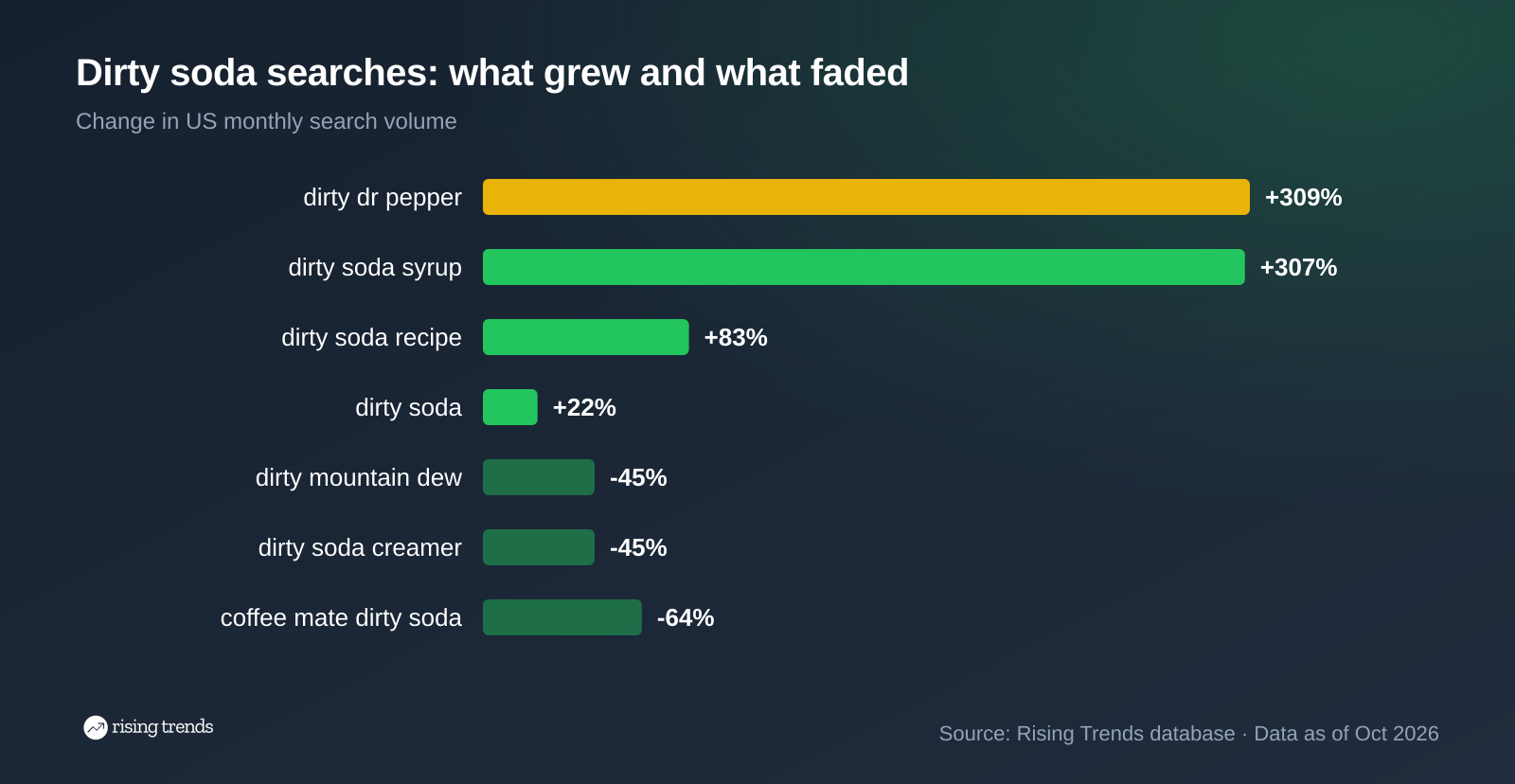
The terms that describe a drink you build are up sharply: dirty dr pepper 309%, dirty soda syrup 307%, dirty soda recipe 83%. The terms that describe a shortcut someone else built are falling: dirty soda creamer is down 45% and coffee mate dirty soda is down 64%. The branded ready-to-drink term, dirty mountain dew, is down 45% over the year even though the product only reached shelves in April.
In raw volume the syrup term is still the small one, which is exactly why it is worth watching.
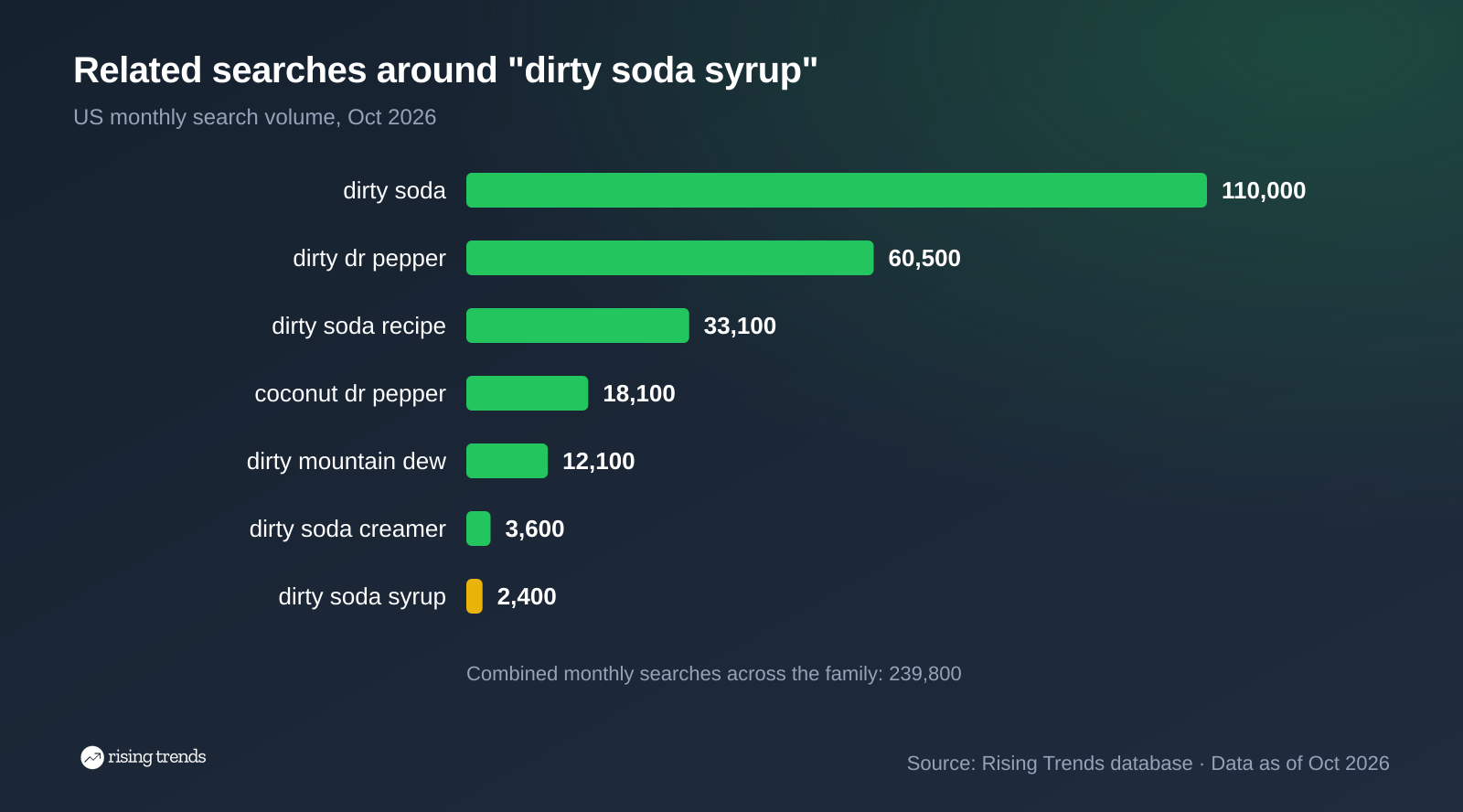
"Dirty soda" alone holds 110,000 searches a month as of October 2026, and syrup is less than 1% of the family. But a category term growing 22% with a supply term under it growing 307% is changing shape, not size. The same split runs through the drinks on our beverage trends page: the headline term plateaus while the ingredient terms take off.
What dirty soda syrup actually is
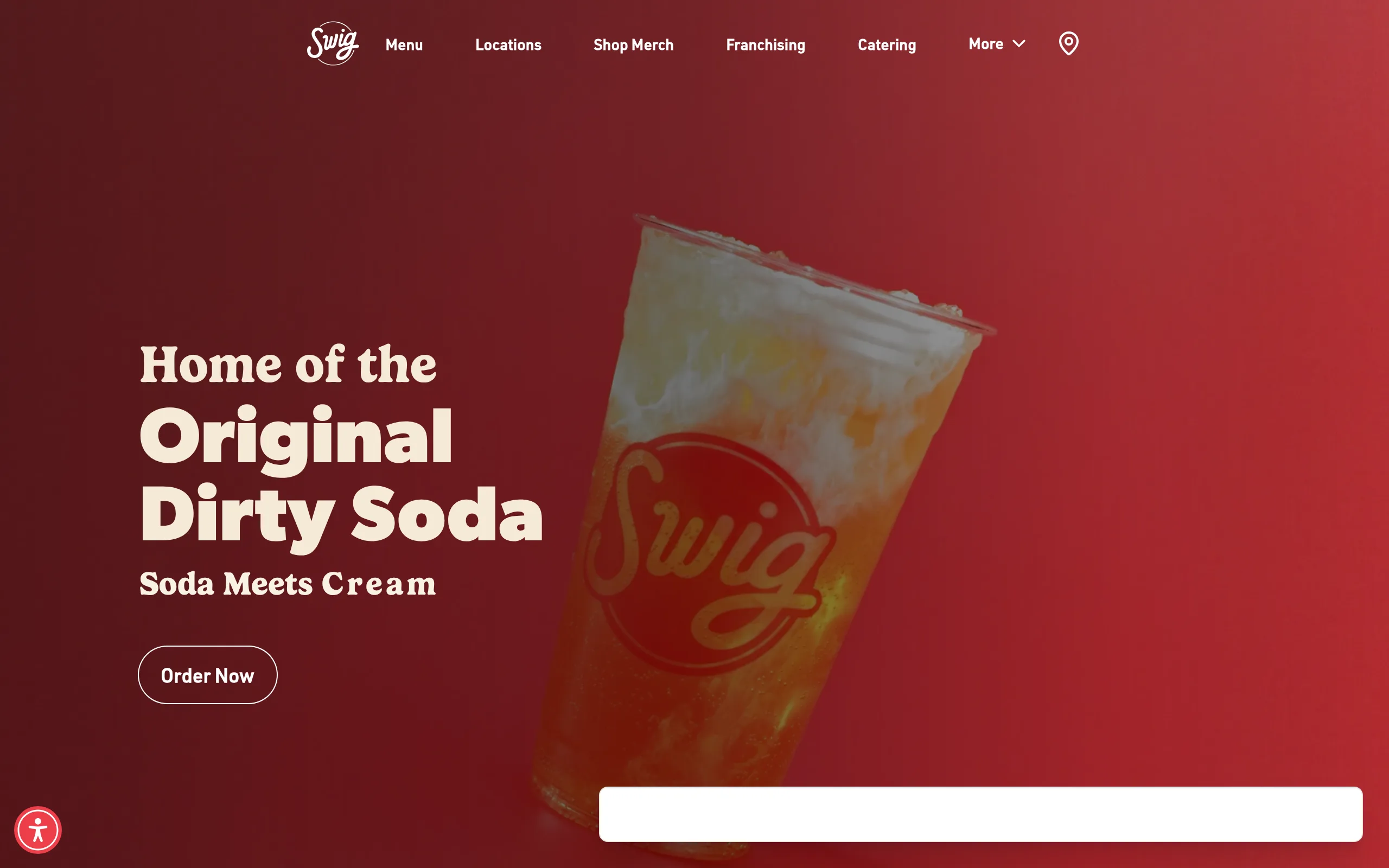
A dirty soda is a soft drink with things added: flavoured syrup, a splash of cream or half and half, sometimes fruit puree, usually over crushed ice. The format came out of Utah soda shops in the early 2010s, where selling a Dr Pepper with coconut syrup and cream to people who do not drink coffee or alcohol turned out to be a real business. Swig, the chain that started it, still brands itself "Home of the Original Dirty Soda."
"Dirty soda syrup" is the search people make once they decide to skip the drive-through. It is the pump syrup itself: the 750 ml glass bottles behind soda shop counters, sold by Torani, Monin, DaVinci, Jordan's Skinny Mixes and a long tail of smaller labels. Our database files it under both Beverages and Cooking and Recipes, which is the clearest sign of what is happening to it. It stopped being a foodservice input and became a grocery item.
The vocabulary moved with it. Shops publish drinks as formulas rather than names: one of Swig's holiday sips is listed as Coke Zero plus pomegranate plus raspberry puree plus vanilla cream. Once the recipe is on the menu board, the only thing between a customer and the same glass at home is a bottle of syrup.
Why it's trending now
The trigger is the opposite of what you would expect. Syrup searches took off because the drink stopped being niche, and the two companies that made it mainstream both sold it as something you no longer have to make.
On 7 April 2026, PepsiCo shipped Dirty Mountain Dew nationwide, in 20 oz bottles and 12-packs, alongside a zero sugar version. The release is blunt about the pitch: "No syrup, no custom recipe required, just Mountain Dew, done dirty." It also cites Yelp data showing searches for dirty soda on that platform up more than 600% year over year. That month, syrup searches in our data went from 1,300 to 1,900.
Three weeks later, on 28 April 2026, McDonald's announced its first lineup of Refreshers and crafted sodas, on sale from 6 May. One of the three sodas is Dirty Dr Pepper, described as classic Dr Pepper layered with vanilla flavour and a cloud of cold foam. These were not a limited run. "These drinks are here to stay," the release says, across what Chief Marketing and Customer Experience Officer Alyssa Buetikofer called "nearly 14,000 restaurants, every single day."
May 2026 is the peak of our syrup curve at 2,900. The month the largest restaurant chain in the country started selling the drink ready-made is the month the most Americans ever looked up how to make it themselves. Demonstration beat substitution.
That pattern is not unique to soda. We saw the same thing with the Starbucks Aerocano, where a chain drink sent people looking for the technique rather than the counter.
By June, Torani had the survey to prove it. The company published research showing US awareness of dirty soda had gone from 56% in 2025 to 75% in 2026, trial from 21% to 42%, and the share naming it their favourite drink from 4% to 9%. June syrup searches held at 2,900.
Here is what the behaviour looks like from the inside. This clip from the TikTok account @sailorkinsley, posted on 3 November 2026, has drawn more than 760,000 views, and it is a child building a blue dirty soda on a kitchen counter.
No shop, no drive-through, no brand. A bottle, a can and a glass.
The new behaviour: what people are doing differently
Three changes show up consistently once you read the threads.
The drink became a pantry category. Torani's figures are the clearest evidence: 62% of dirty soda drinkers report making their own at home, 64% keep two to three syrups or sauces on hand, and 34% keep four or more. Four bottles is not an impulse purchase. It is a shelf, the same logic that turned flavoured coffee syrup into a permanent supermarket aisle twenty years ago.
People are shopping for brands, not recipes. A typical post in the r/dirty_soda community asks for "recommendations for syrup flavours and brands for dirty sodas" and adds "the most easily accessible to me is torani. Are their syrups good?" That is a buyer, not a browser. The question has moved past what goes in the glass and on to which bottle goes in the cupboard.
Price is doing the arguing. A thread in r/Soda titled "Are y'all paying $4 for one can of soda with 3 pumps of syrup?" ran past 200 comments, and even the defenders are lukewarm. "Comes from syrup though, so it's usually a better soda experience," one reply says. "Still overpriced but not the same as a simple can of soda."
The arithmetic is not close, using the vendor's own listed prices.
| Route | What you pay | Syrup cost per drink |
|---|---|---|
| Soda shop or drive-through | About $4 a drink, per the r/Soda thread above | Included, not itemised |
| Torani 750 ml bottle at $10.99 | 25.4 fl oz, about 25 drinks at 1 oz each | About 44 cents |
| Torani Dirty Soda Sampler, $11.99 | 5 x 50 ml, about 8 drinks | About $1.50 |
That is before soda and cream, and it ignores the part of the $4 that pays for someone else making it. But a 44 cent ingredient against a $4 drink is the kind of gap that creates a search curve.
Who's building on it
Torani is the company this trend runs through. The 100-year-old San Francisco syrup maker says its products flavour more than a billion beverages a year and sit in more than 9 million US households. Its newest release, a Cookie Butter syrup in the standard 750 ml bottle, launched at $10.99, and it now sells a Dirty Soda Sampler five pack at $11.99 in Blue Raspberry, Cherry, Peach, Coconut and Strawberry, pitched in its own words as "your shortcut to soda shop magic at home." Andrea Ramirez, the company's senior consumer and customer market insight manager, told Beverage Industry in August that "with national awareness now reaching 75% and trial climbing to 42%, dirty soda has clearly moved beyond an emerging trend".
PepsiCo took the opposite bet. Dirty Mountain Dew and its zero sugar version are the first ready-to-drink take from a major brand, backed with free DashMart delivery in twelve markets from 29 April. In our data "dirty mountain dew" is at 12,100 searches a month as of October 2026, up 5,662% over two years but down 45% in the last twelve months.
McDonald's made the format a default. Dirty Dr Pepper is permanent, and "dirty dr pepper" now takes 60,500 searches a month as of October 2026, up 309% in a year, the fastest growing large term in the family.
Crumbl added drinks to a cookie business, with a dirty soda menu advertising more than 40 signature combinations plus build-your-own. It also shows the execution risk. A complaint in r/CrumblCookies, "What is up with the Dirty Soda heavy syrup use?", reports "each syrup pump listed on that sticker had 4-6 pumps." When the recipe is public, so is the overpour.
Nestle Coffee mate is the cautionary one. Its dirty soda creamers were an early and clever read on the trend, and the search data has turned against them: "dirty soda creamer" is at 3,600 a month as of October 2026, down 45% in a year, and "coffee mate dirty soda" is at 1,600, down 64%. The shortcut sold well when nobody knew the recipe. Now they do.
What it means for business
Ready-to-drink is advertising for ingredients. PepsiCo and McDonald's spent real money teaching America what a dirty soda is, and the measurable result in search is that more people went looking for syrup. A can makes the category legible. It does not make it convenient enough to beat a bottle that costs 44 cents a glass. Anyone planning an RTD entry in an assemble-it category should price in that effect rather than assume they are capturing the occasion.
The shortcut layer is the squeezed middle. Syrup is up, the finished drink is up, and the halfway products (flavoured creamers, branded mixers) are the ones falling. That is the familiar shape of a category maturing: buyers either pay for the full service or buy the raw input, and the convenience premium in between gets thin. The same split is visible across the categories in our food industry trends breakdown.
Grocery shelf space is the live fight. Torani is in 9 million households and now ships sampler packs and portable enhancers to lower the barrier to a first bottle. Mitch Madoff of retail platform Keychain put it plainly in that same Beverage Industry piece: the packaged market for dirty sodas is still early, with real runway for brands that crack retail-friendly formats. Whoever owns the dirty soda bay in a supermarket owns the repeat purchase, and syrup repeats roughly every 25 drinks.
The health conversation is coming. Soda plus syrup plus cream will not escape scrutiny, and the better-for-you flank is already moving: Torani expects the next wave of builds to use prebiotic and fibre-enhanced bases. That is the demand that built the functional soda category, and the instinct behind buyers reaching for things like the Feel Free tonic instead of a conventional drink.
Where this is heading
Three calls, each with a term in our database to watch.
The syrup curve outlives the drink's news cycle. "Dirty soda" grew 22% in a year while the ingredient terms tripled, so the category's search story is now a supply story. Watch whether dirty soda syrup holds above 2,000 a month through the winter. It sat at 2,400 in October 2026 with no new launch behind it, which is the best evidence that the behaviour, not the headlines, is carrying the term.
The generic shelf term is the bigger prize. "Drink syrup" is at 12,100 searches a month as of October 2026, up 124% in a year and also classified EXPONENTIAL. Branded shelf terms are moving too, with "skinny mixes syrup" at 5,400, up 50%. If those keep climbing while dirty soda plateaus, the trend has stopped being about one Utah drink and become a general permission to flavour anything in the fridge.
Expect the shops to sell you the bottle. The chains have already published the recipes. The next step is retail: branded syrup on a shelf beside the drive-through window, or in a supermarket, from the same companies selling the finished glass. The signal will be a soda shop brand turning up in grocery search terms rather than restaurant ones, the kind of crossover we flag in our guide to spotting market trends early.
The number we keep coming back to is the smallest one. Seventy searches a month in October 2024, 2,400 as of October 2026, with the sharpest climb in the exact months the industry was telling people they would never need a bottle again. People heard the pitch, liked the drink and bought the syrup.
Want to catch ingredient shifts like this before the brands do? Read our guide on how to identify market trends, or browse what is breaking out right now in our trending topics list.
Never miss a trend again
- One trend broken down with the numbers
- Who's making money, and what to build
- A website on the rise
- A breakout app
Join 5,000+ founders